Curious Patents
Old patents, brought to life.
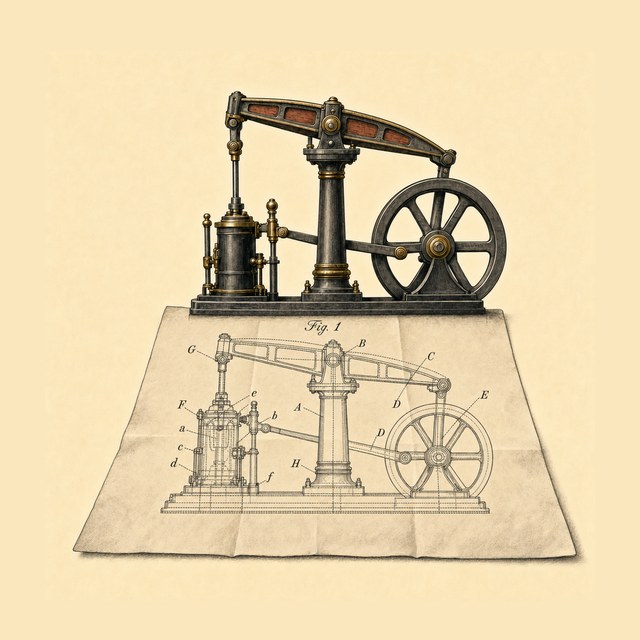
Every patent comes with a drawing and a description of how the invention is supposed to work. Curious Patents starts from those original pages and brings the machine to life as an animated model, part by part, using the inventor's own figures and reference letters, until you can watch it work the way the inventor intended.
Then we look at what the patent leaves out: where the idea came from, whether it would actually have worked, and what became of it.
Episodes
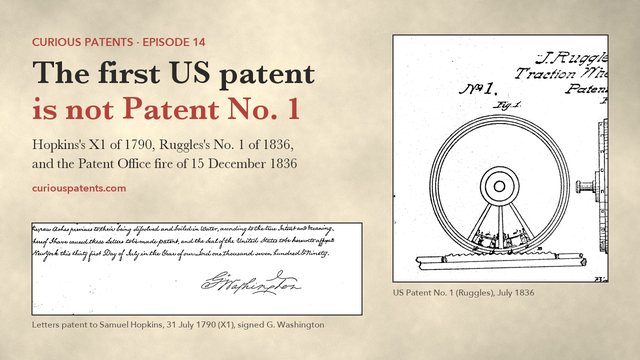 The first US patent is not Patent No. 1: the 1836 fireThe first United States patent, signed by George Washington in 1790, is Samuel Hopkins's way of burning ashes, with no drawing. Patent No. 1 came forty-six years later: John Ruggles's locomotive wheel, whose cogs slip into a toothed rail when the wheel starts to slide. Five months after that, the Patent Office burned. What happened to the nearly ten thousand patents in between?Run Patent No. 1's wheel and its two-speed gear, read the first patent and the 1836 papers, and see the sources →
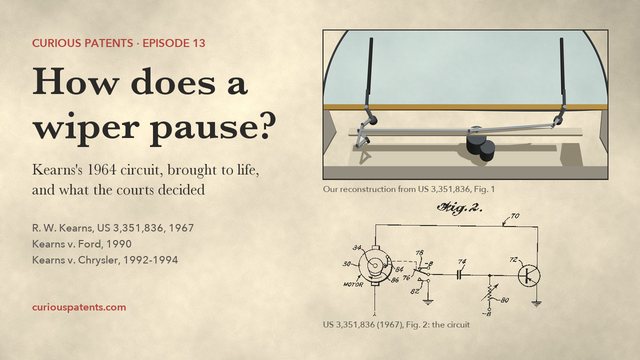 How does a wiper pause? Kearns's 1964 circuit, and the Ford and Chrysler casesA pause between two sweeps of a windshield wiper ended in a court judgment against Chrysler, affirmed on appeal "in all respects", and Ford had already settled. The patent behind it, Robert Kearns's US 3,351,836, switches the wiper motor with one transistor, a capacitor and a switch the wiper trips itself. What did the courts say he owned? Not the pause itself, and not the first one: patented pauses go back to 1923.Run the circuit, set the pause, change the glass from wet to damp, and read what the courts decided →
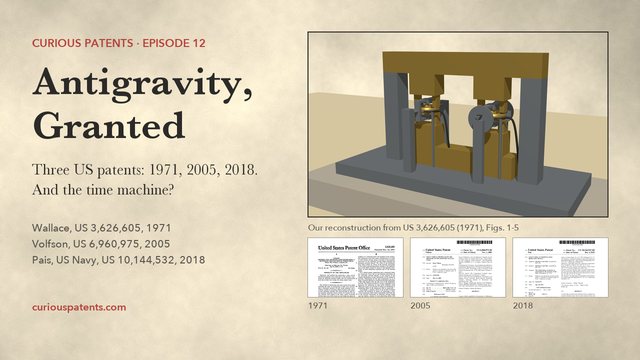 Antigravity, granted: three US patents, and the time machineIn 1971 the US Patent Office granted a patent for a spinning brass wheel, with the claim that things inside its field would lose their weight. In 2005 it granted a second, for a spaceship driven by bending spacetime, and in 2018 a third went to the United States Navy. The Navy's own tests of the idea behind it concluded that the effect "was not observed or disproved in the tested configuration". What did each one measure? And has the Office ever granted a time machine?Spin Wallace's wheel and watch the light spot, open up Volfson's ship and the Navy's craft, and read the Navy's test reports →
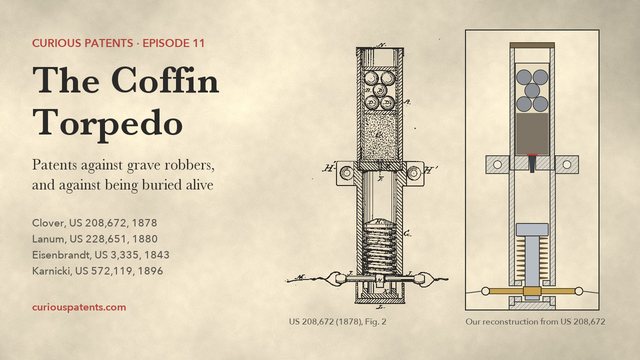 The coffin torpedo: patents against grave robbers, and against being buried aliveIn 1878, a month after a former congressman's body was found hanging in a Cincinnati medical college, Philip Clover of Columbus patented a gun to sit inside a coffin, wired to the arms of the dead. Eighteen years later Michael Karnicki of Warsaw patented the opposite: a box on the grave that throws up a flag and rings a bell if the person below moves. Did any of them go off?Pull the torpedo's wire, arm Lanum's grave torpedo, open Eisenbrandt's coffin and Karnicki's box, and see the sources →
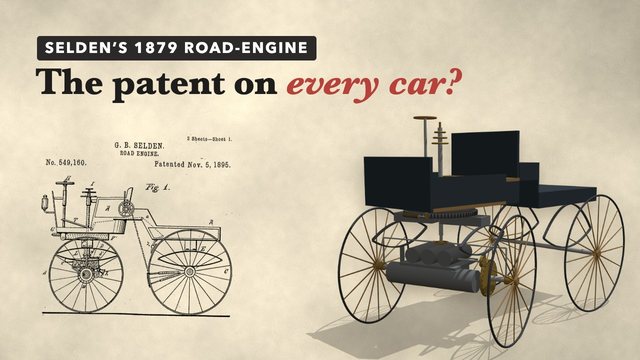 The patent on every car: Selden's road-engine, and Henry FordIn 1879 a Rochester lawyer who had never built a car applied for a patent on a gasoline carriage, and kept the application open for sixteen years. By 1903 the leading carmakers held it and licensed every gasoline car in America. Henry Ford refused to pay, and in 1911 the case turned on how the fuel burns inside the engine.Steer the carriage from the patent's drawings, run Brayton's and Otto's engines side by side and see the sources →
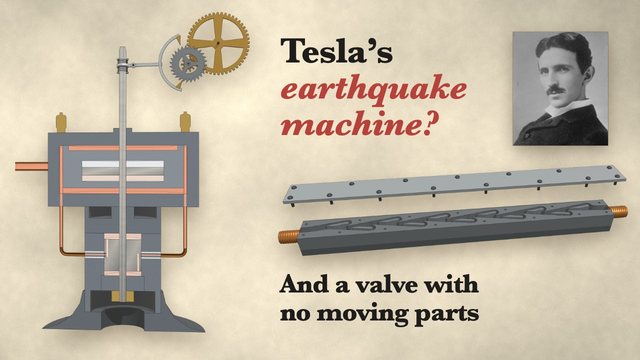 Tesla's earthquake machine, and the valve with no moving partsIn 1893 Nikola Tesla showed Chicago an engine with no flywheel that kept time like a pendulum. In 1935 he said a small one had once shaken his neighbourhood like an earthquake; we found no report of it at the time. In 1916 he drew it driving a valve with nothing inside that moves, and a century later a laboratory tested the valve.Run the engine cut in half, lift the lid off the valve, watch our flow simulation both ways and see the sources →
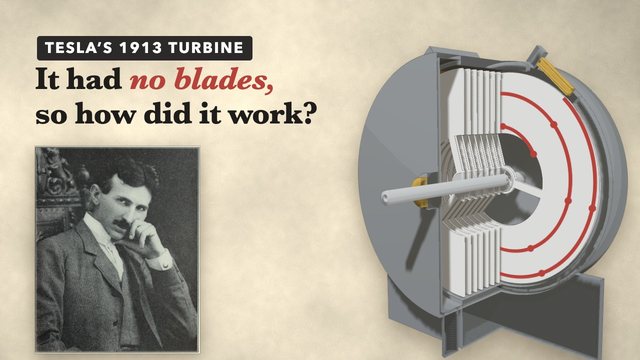 Tesla's turbine with no bladesIn 1911 Nikola Tesla showed off an engine made of smooth, flat disks, turned by the way steam clings to metal. It never went on sale. The same drag, held still in a cup of air, became Waltham's speedometer on the dashboards of Packards and Rolls-Royces, and paid Tesla a royalty on every one.Run the turbine, watch the steam spiral through it, spin the speed indicator and see the sources →
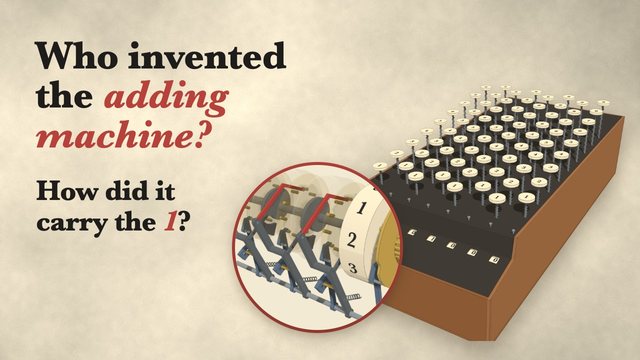 The adding machinesIn 1884 a Chicago machinist started an adding machine in a macaroni box, with meat skewers for keys. His 1887 Comptometer carries the one with a spring that the wheel winds up as it turns. In St. Louis, William Burroughs set the keys first, pulled a handle, and let a cylinder of oil set the pace.Press the keys of Felt's machine, watch 999 + 1 carry three times and see the sources →
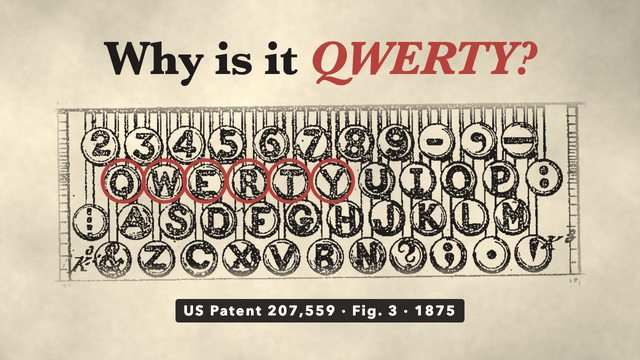 The typewriter and QWERTYIn 1868 three Milwaukee men patented a typewriter played like a piano, its keys in alphabetical order. QWERTY came later, drawn in a patent but never claimed, and nobody at the time said it was meant to slow typists down.Type on the 1868 machine, slide its keys into QWERTY and see the sources →
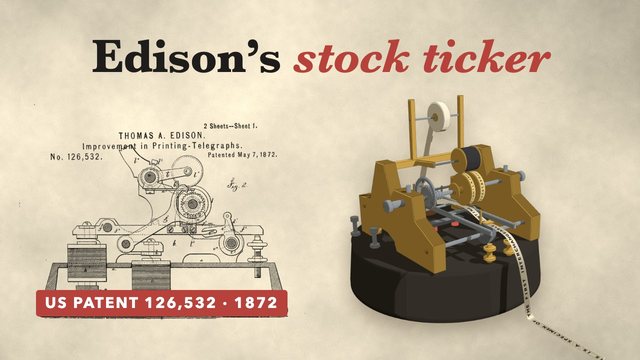 The stock tickerIn 1872 Thomas Edison patented a stock printer that set prices in type from pulses on a telegraph wire. He remembered being paid with a check for $40,000; the contract he signed says otherwise.Print your own ticker tape, step Laws's gold dial and see the sources →
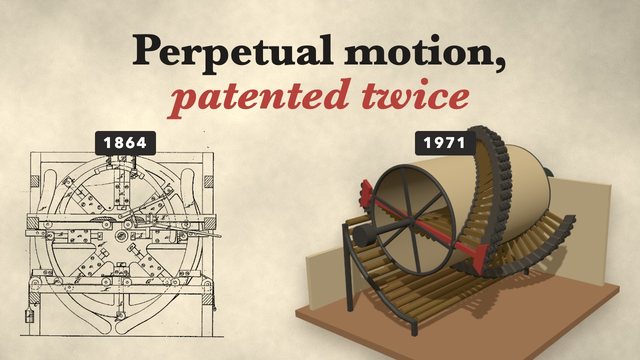 Perpetual motion, patented twiceThe Patent Office granted the same impossible wheel twice, a hundred and seven years apart.Push the machines and watch where the energy goes →
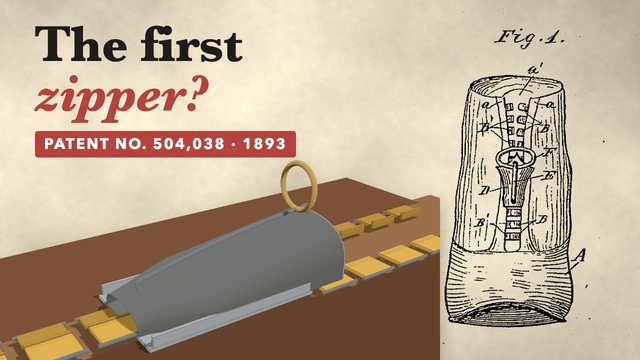 The clasp locker: the zipper before the nameIn 1893 Whitcomb Judson of Chicago patented a sliding guide that locked a whole row of shoe clasps in one pull, thirty years before anyone called it a zipper.Operate the guide, read both patents and see the sources →
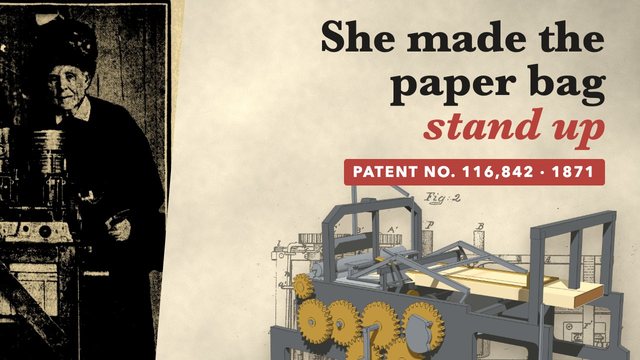 Margaret Knight's paper bag machineIn 1871 Margaret E. Knight patented a machine that folded a flat, square bottom onto a paper tube, after proving to the Patent Office that the idea was hers.Run her machine, read the case papers and see the sources →
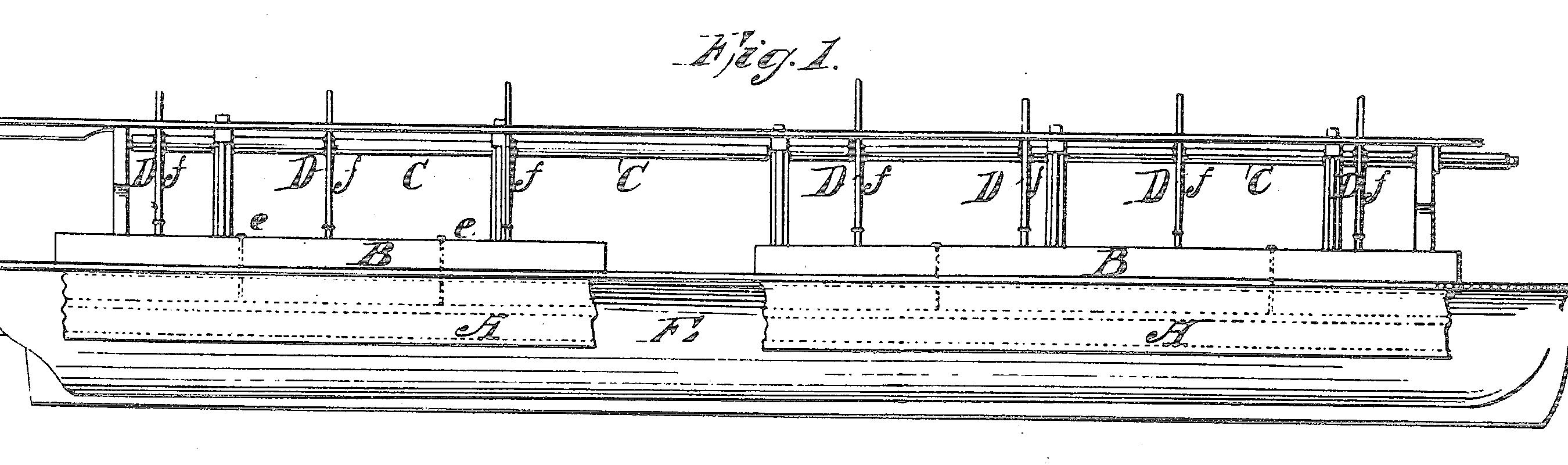
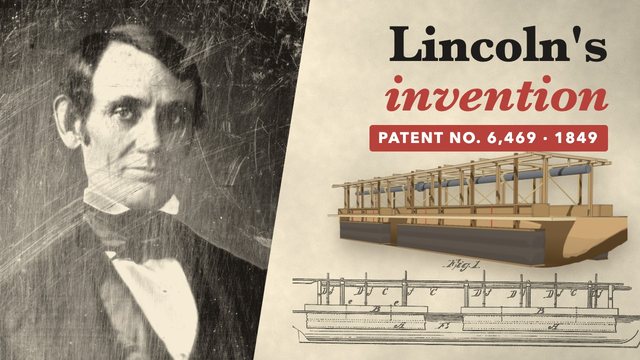 Lincoln's patent: buoying vessels over shoalsThe only US president to hold a patent. In 1849 Abraham Lincoln patented a way to lift steamboats over sandbars with inflatable air chambers.Operate his invention, read the original patent and see the sources →
Reconstructions follow the patents' own figures and are labelled as reconstructions. Each episode's page lists its sources.