 Curious Patents
The First US Patent Is Not Patent No. 1
The first United States patent was signed by George Washington in 1790. Patent No. 1 came forty-six years later, in July 1836, and five months after that the Patent Office burned. Read the first patent, run Patent No. 1's wheel and its two-speed gear from the patent's own drawings, and see every source.
Watch the episode
The first patent, and Patent No. 1
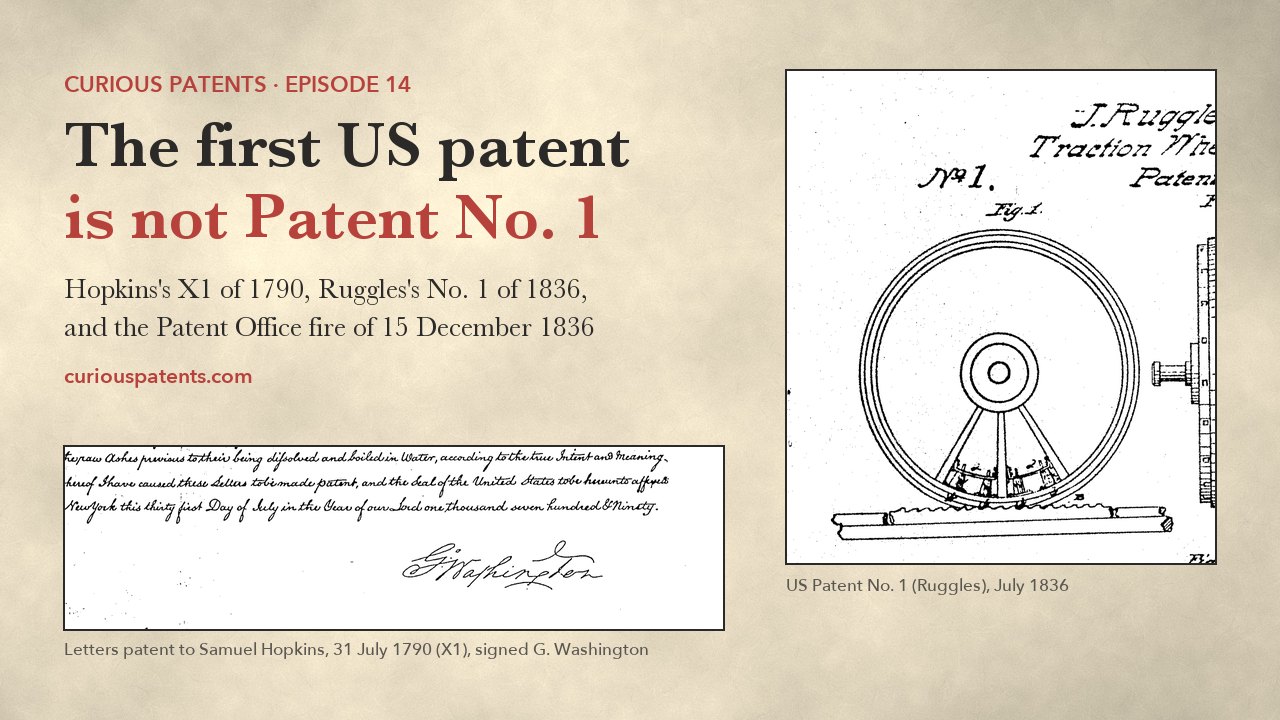
The first patent in the United States was granted on 31 July 1790, to Samuel Hopkins, and signed by George Washington. It is not Patent No. 1. Patent No. 1 was granted forty-six years later, in July 1836, to John Ruggles, a senator from Maine whose own Senate committee had reported the new patent law.
Between the two there were nearly ten thousand patents. Ruggles's committee counted 9,731 issued up to 31 March 1836; the USPTO counts 9,957 granted before the new numbering. In December 1836 the Patent Office burned. This page follows the episode: the first patent, which has no drawing; Patent No. 1, a wheel that slips into gear, which you can run below; and the night the records burned.
Jefferson's doubt
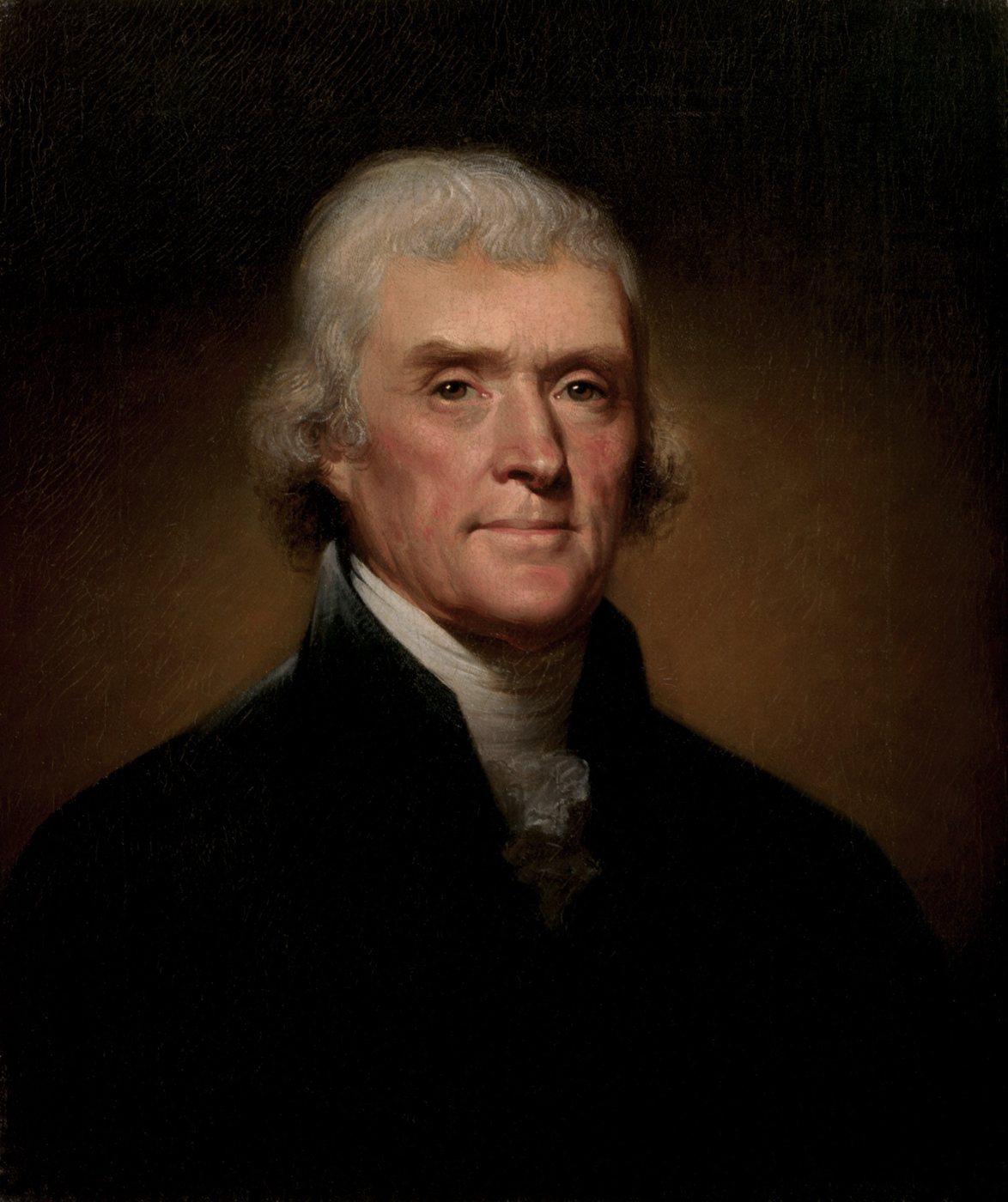
In 1788 Thomas Jefferson was in Paris, and he had doubts about patents. He wrote to James Madison that "the benefit even of limited monopolies is too doubtful to be opposed to that of their general suppression" (31 July 1788).
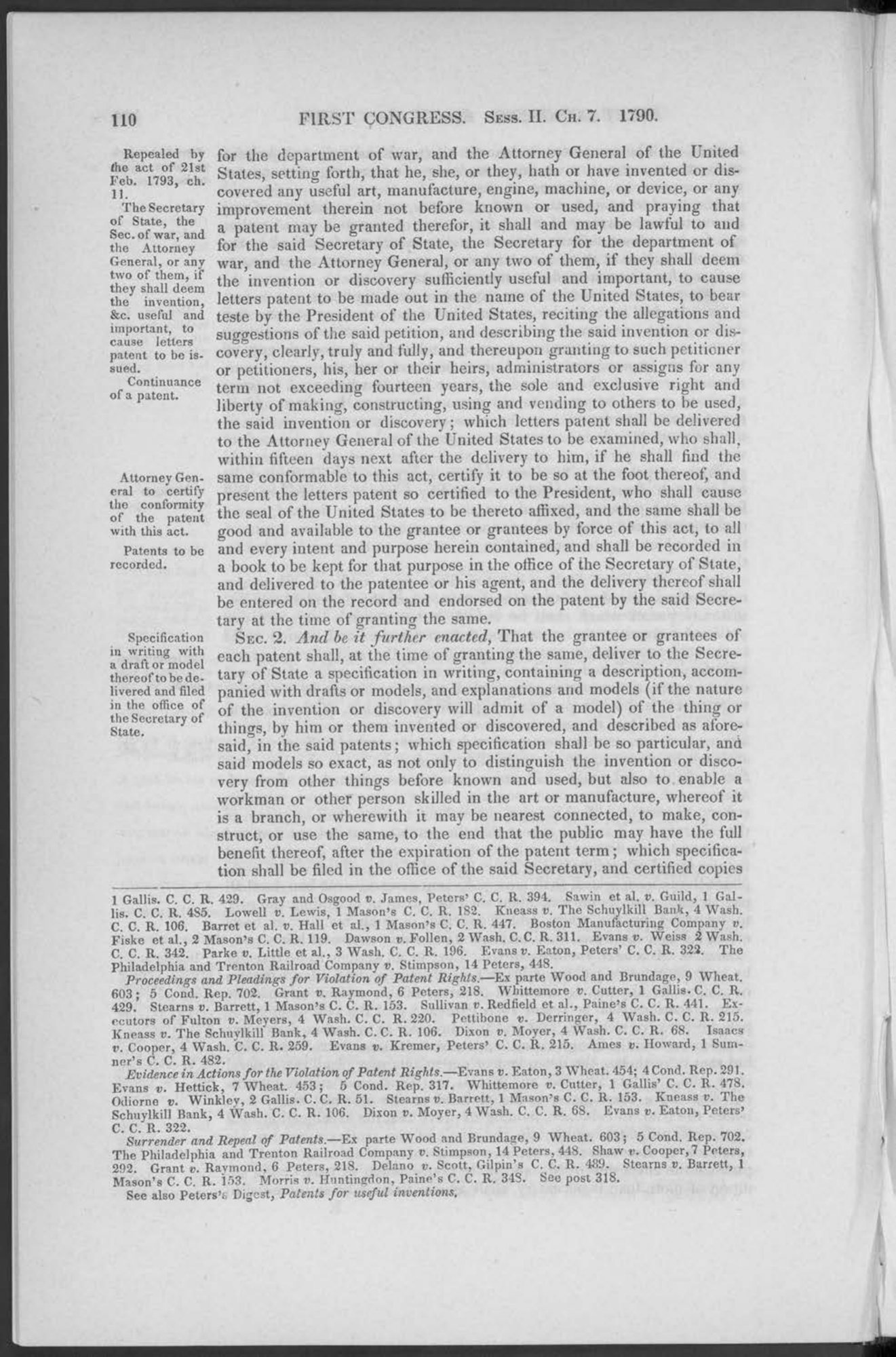
Two years later he was Secretary of State. The first patent law, of 10 April 1790, made his office one of three that could grant a patent, with the Secretary of War and the Attorney General. Any two of them could grant one, "if they shall deem the invention or discovery sufficiently useful and important" (1 Stat. 110, sec. 1). The Act names the offices; the USPTO names the men: Jefferson, Henry Knox and Edmund Randolph.
That June, Jefferson wrote that the new law "has given a spring to invention beyond my conception" (to Benjamin Vaughan, 27 June 1790). According to the historian David Maxey, the board approved fifty-seven patents under that law, and turned down at least as many.
The first patent, 31 July 1790
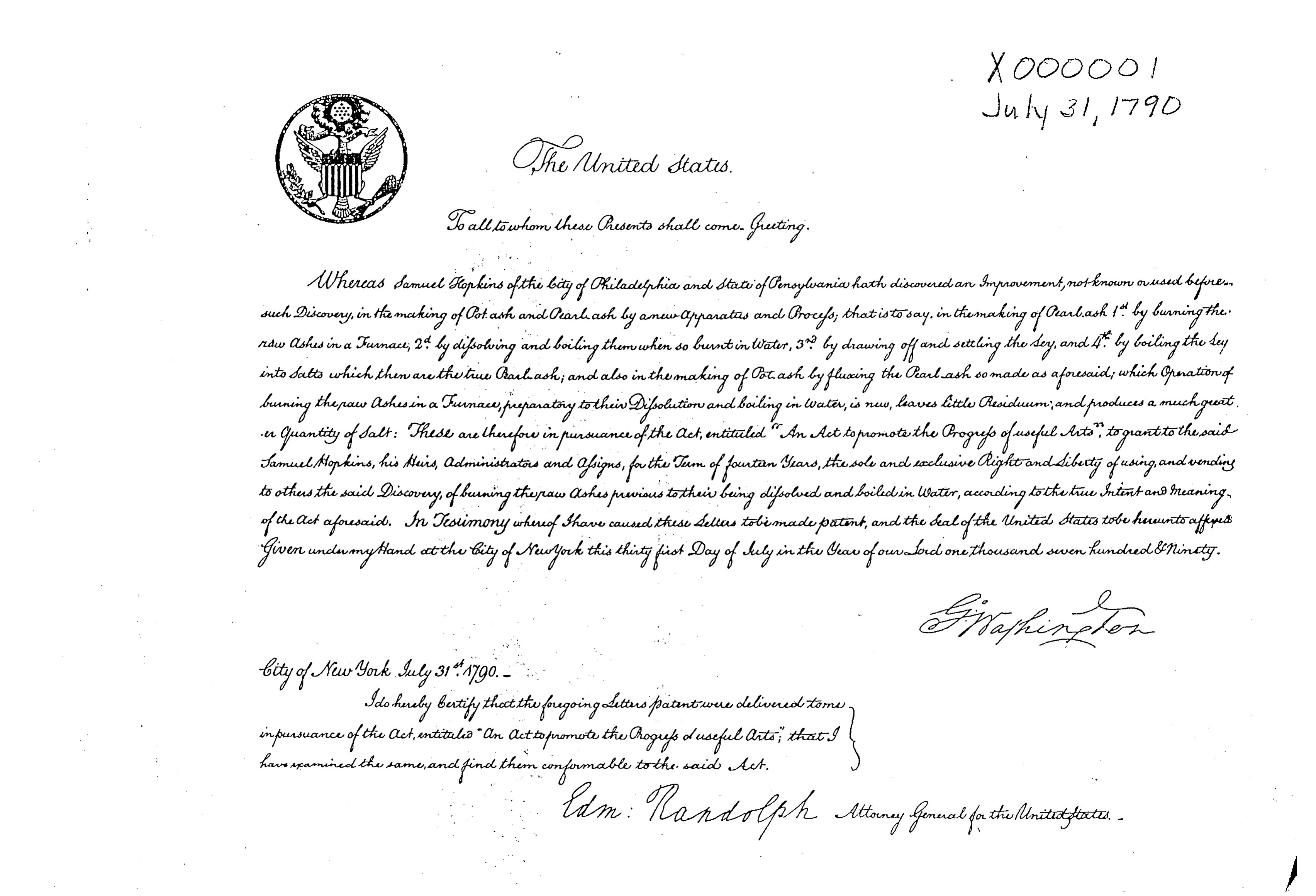
It was granted at New York to Samuel Hopkins, "of the City of Philadelphia", for an improvement "in the making of Pot ash and Pearl ash". Potash and pearl ash were salts made from wood ashes, two grades of the same alkali. The sheet is signed by the President, George Washington, and certified by the Attorney General, Edmund Randolph, as "conformable" to the Act.
There is no drawing. It speaks of "a new Apparatus and Process", but the only apparatus it names is "a Furnace". It lists four steps: burn the raw ashes in a furnace; dissolve and boil them in water; draw off and settle the lye; and boil the lye into salts, "which then are the true Pearl ash". Only the first step was new. The grant is for "burning the raw Ashes previous to their being dissolved and boiled in Water".
Above, the ordinary way, from Hopkins's own glossary of 1793; below, the four steps of his patent, the new one in red. Ours: the boxes, the flame and the glass. No drawing of his furnace survives, so none is drawn.
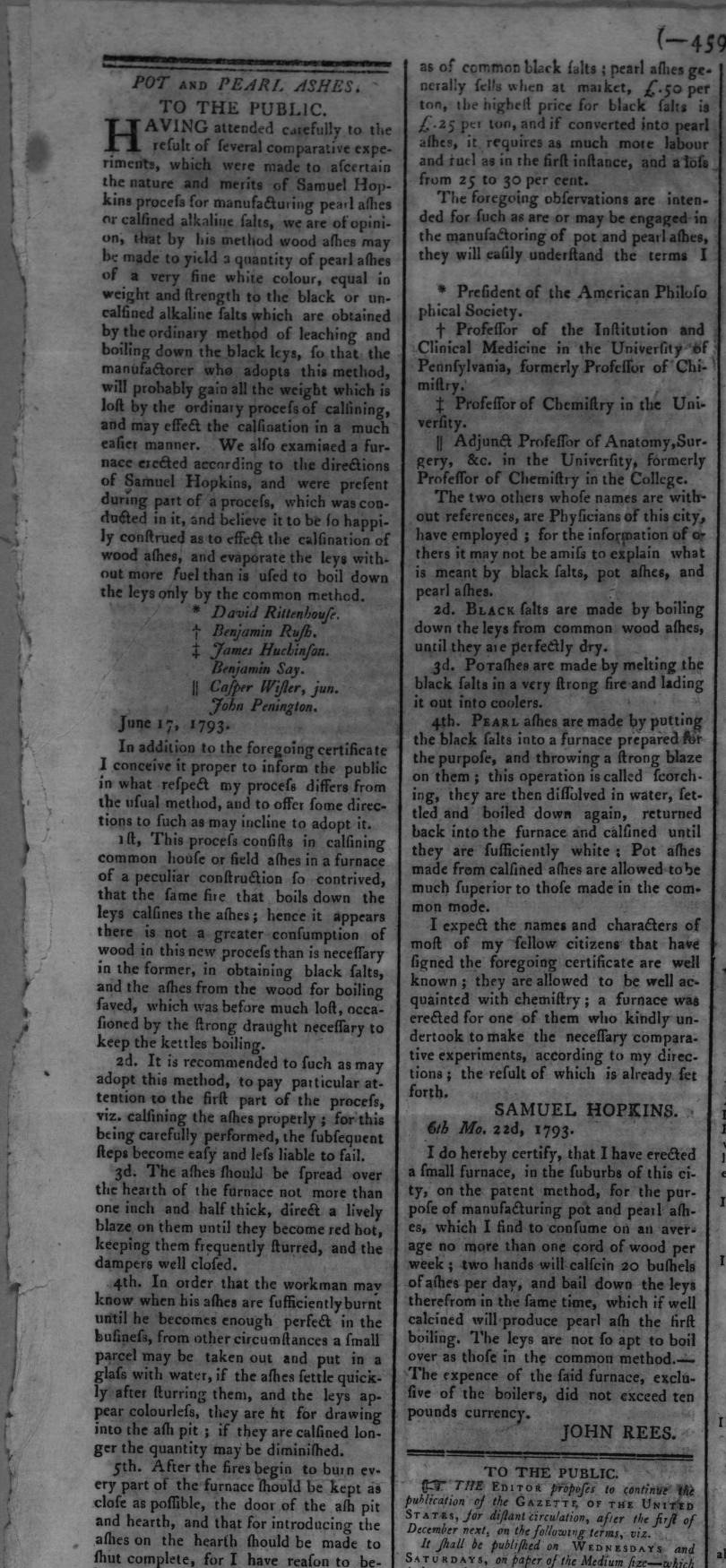
The ordinary way, as Hopkins himself described it, was to boil the lye from raw ashes down to black salts, then melt them for potash, or scorch them in a furnace for pearl ash. Hopkins burned the ashes first, in a furnace where "the same fire that boils down the leys calcines the ashes".
In 1793 he printed his directions. Spread the ashes on the hearth "not more than one inch and half thick", and "direct a lively blaze on them until they become red hot". To test them, put a little in a glass of water: "if the ashes settle quickly after stirring them, and the leys appear colourless", they are done. One furnace built his way, its maker John Rees reported, used "no more than one cord of wood per week; two hands will calcine 20 bushels of ashes per day".
Six Philadelphians, among them David Rittenhouse and Benjamin Rush, certified that his method gave pearl ash "equal in weight and strength" to the black salts of the old one (their certificate of 17 June 1793, in the same notice). Jefferson sat on the board that approved the patent. His name is not on the sheet.
Which Samuel Hopkins?
For decades the first patentee was taken to be a different man: Samuel Hopkins of Pittsford, Vermont. According to Maxey, markers were put up in Pittsford, Vermont, in 1956, and in Pittsford, New York, in 1989. But the patent says Philadelphia.
In 1998 Maxey set out the records of a Philadelphia man: a Quaker, born in 1743, listed in the census of 1790 as a "Pott Ash Maker". When Hopkins went to Quebec in 1791 to ask for a Canadian privilege, Maxey found, his petition was from "Samuel Hopkins of the City of Philadelphia". And Hopkins's own notice of 1793 is dated the Quaker way, "6th Mo. 22d, 1793": the sixth month, the twenty-second day.
In 2002 a marker went up at Second and Arch Streets in Philadelphia, where he lived: "The holder of the first U.S. patent, signed by George Washington, lived here." The Vermont man was real, and is buried in Pittsford. The case for Philadelphia rests on one historian's work, from the records he cites; we found no published reply to it. No portrait of the Philadelphia Samuel Hopkins is known, so there is none here.
What the patent earned him
Hopkins sold licences. According to Maxey, every licensed works was to put up a board reading "Pot and Pearl Ash Works, licensed by Samuel Hopkins". But asheries were everywhere already, and the old method was simple and cheap. In 1802 his Quaker meeting dealt with him for "Engagements beyond his Ability to manage", and for debts he had not paid. His will, signed in 1818, left everything "to my two daughters, Ann and Elizabeth". We do not know whether any licensee ever paid him.
Forty-six years of registration
The board lasted three years. In 1793 a new law took its place, and a patent was granted to anyone who filed the papers and paid the fee. In 1836 a Senate committee described what had followed. The Secretary of State had no power "to refuse a patent for want of either novelty or usefulness". "The granting of patents therefore is but a ministerial duty."
Many patents, it said, were "worthless and void, as conflicting with, and infringing upon one another". Lawsuits were "daily increasing in an alarming degree". And there was fraud. People would "copy patented machines in the model-room; and having made some slight immaterial alterations, they apply in the next room for patents." The Patent Office kept the models, and some five hundred of them, the committee said, had been "stowed away in a dark garret".
The committee's own figures: an average of 26 patents a year from 1790 to 1800, 91 in the next ten years, 200 in the ten after, 535 a year in the last ten years, and 776 in 1835.
The committee also answered Jefferson's old doubt: "the evil of the temporary monopoly is greatly overbalanced by the good the community ultimately derives from its toleration." And it warned about the building: "the present building is too much exposed to destruction by fire", and the loss of the records and models "would be, in a great degree, irreparable". That was April 1836. (All from the committee's report with Senate bill No. 239, 28 April 1836, read in a modern transcription.)
The 1836 Act and Patent No. 1
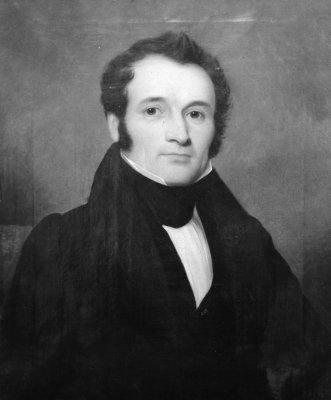
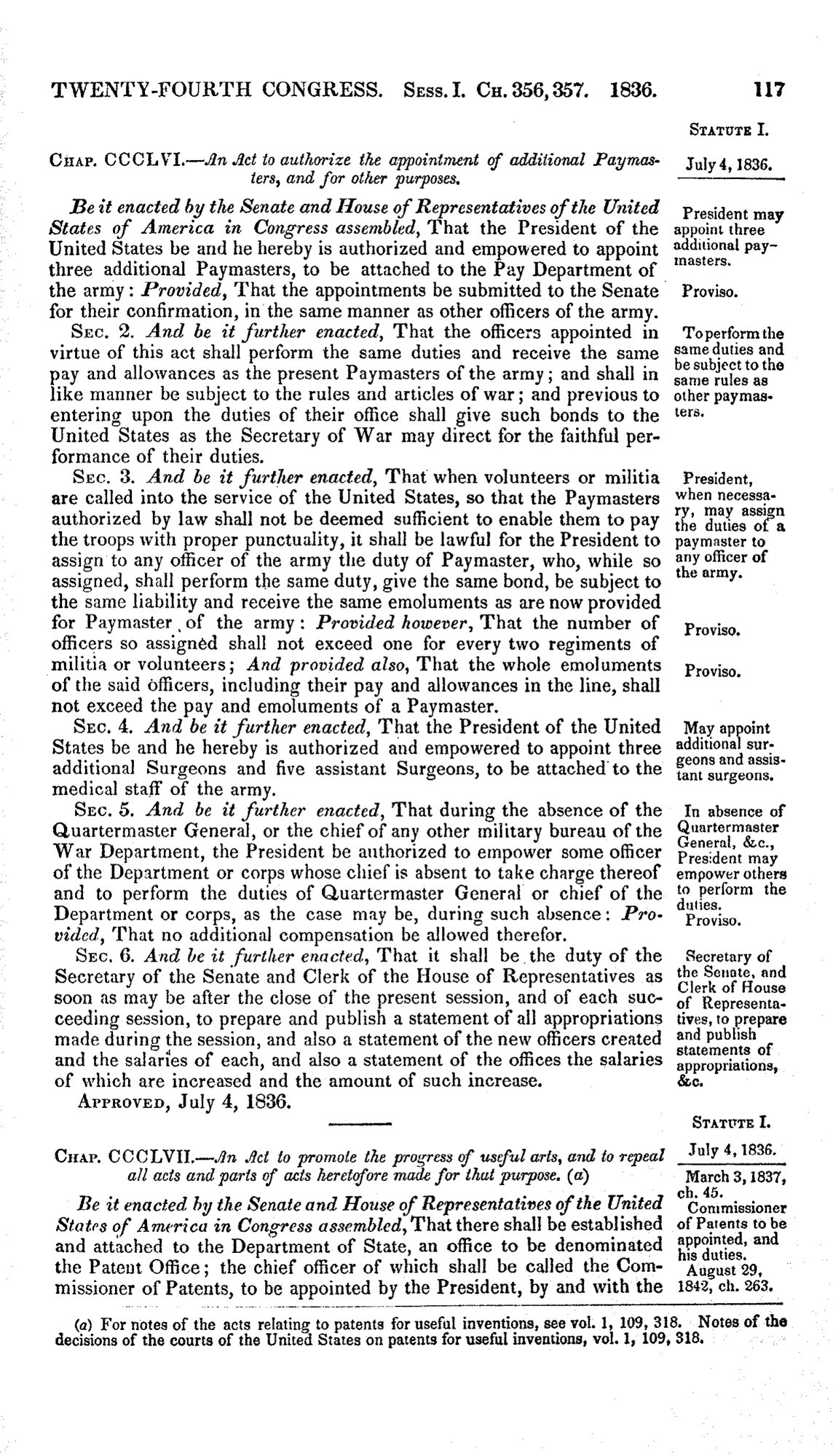
The committee's chairman was John Ruggles, a senator from Thomaston, Maine. The bill it reported became law on 4 July 1836. It created "an office to be denominated the Patent Office", under a Commissioner of Patents (5 Stat. 117, sec. 1).
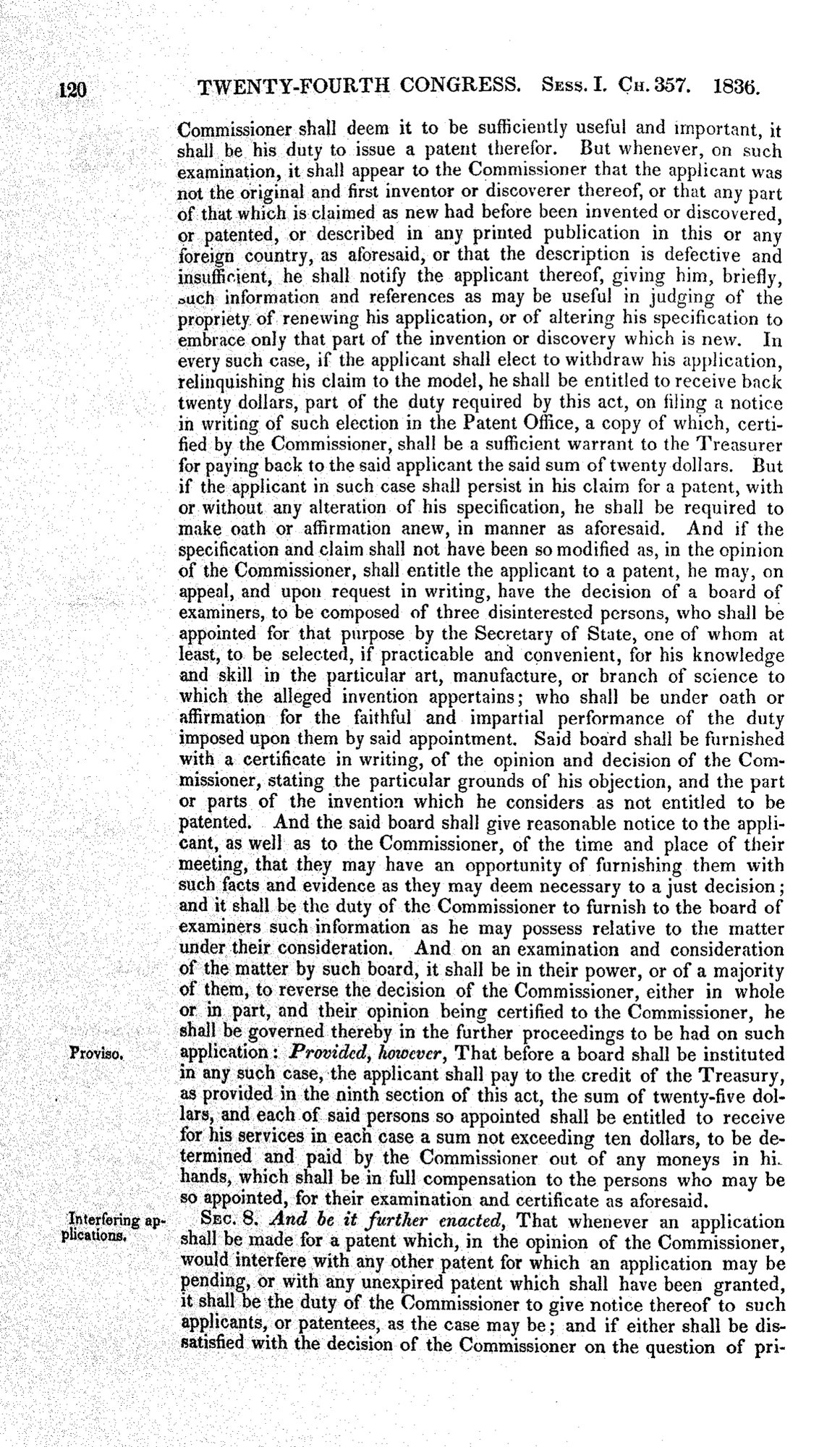
And it brought back an examination. If the invention was new, and the Commissioner deemed it "sufficiently useful and important", it would be "his duty to issue a patent" (sec. 7). The words of 1790, again. The committee had put the aim plainly: to "put an end to litigation before it begins."
A citizen paid $30 ≈ $880 to apply, and a British subject $500 ≈ $15,000, in today's money (sec. 9).
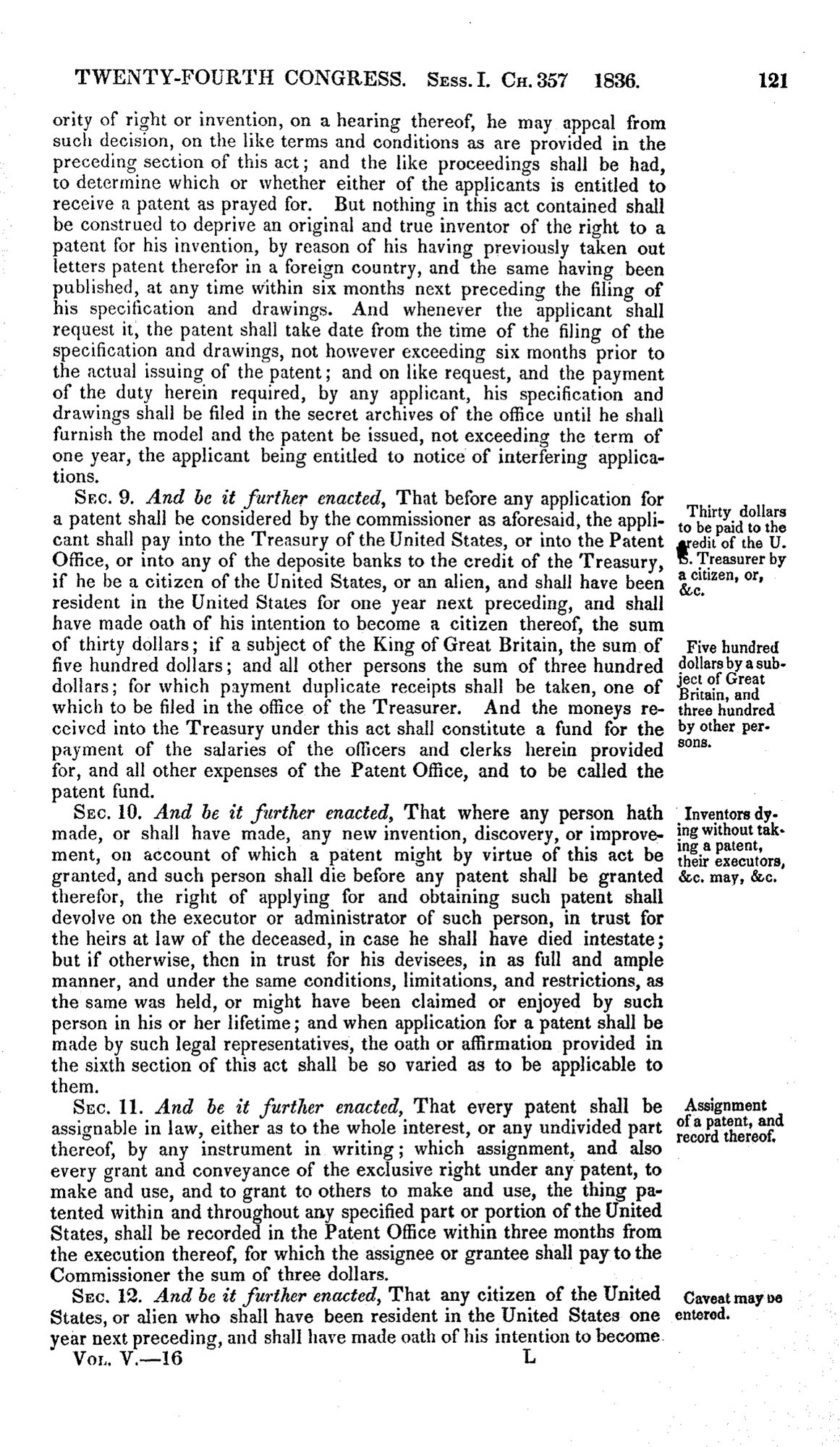
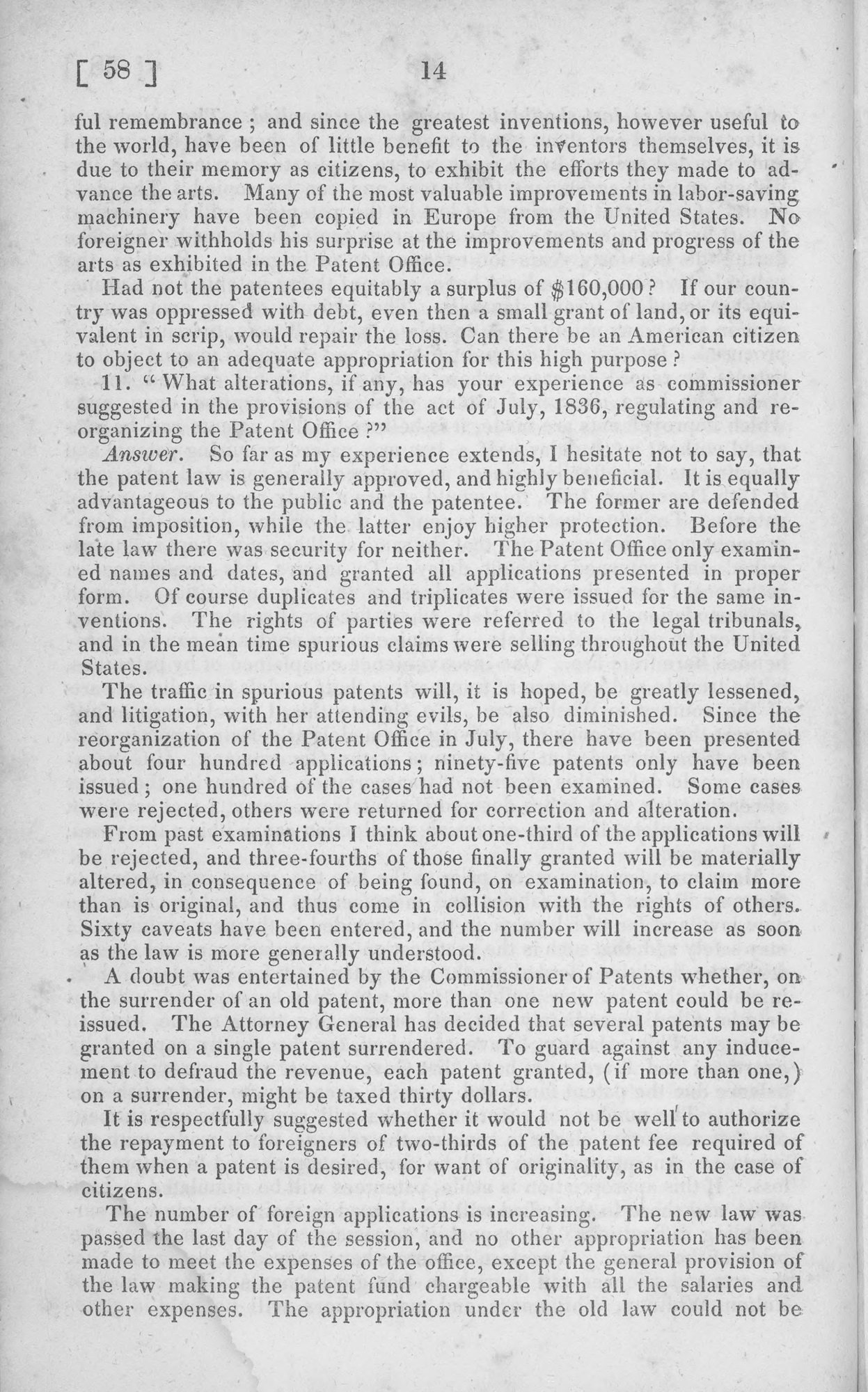
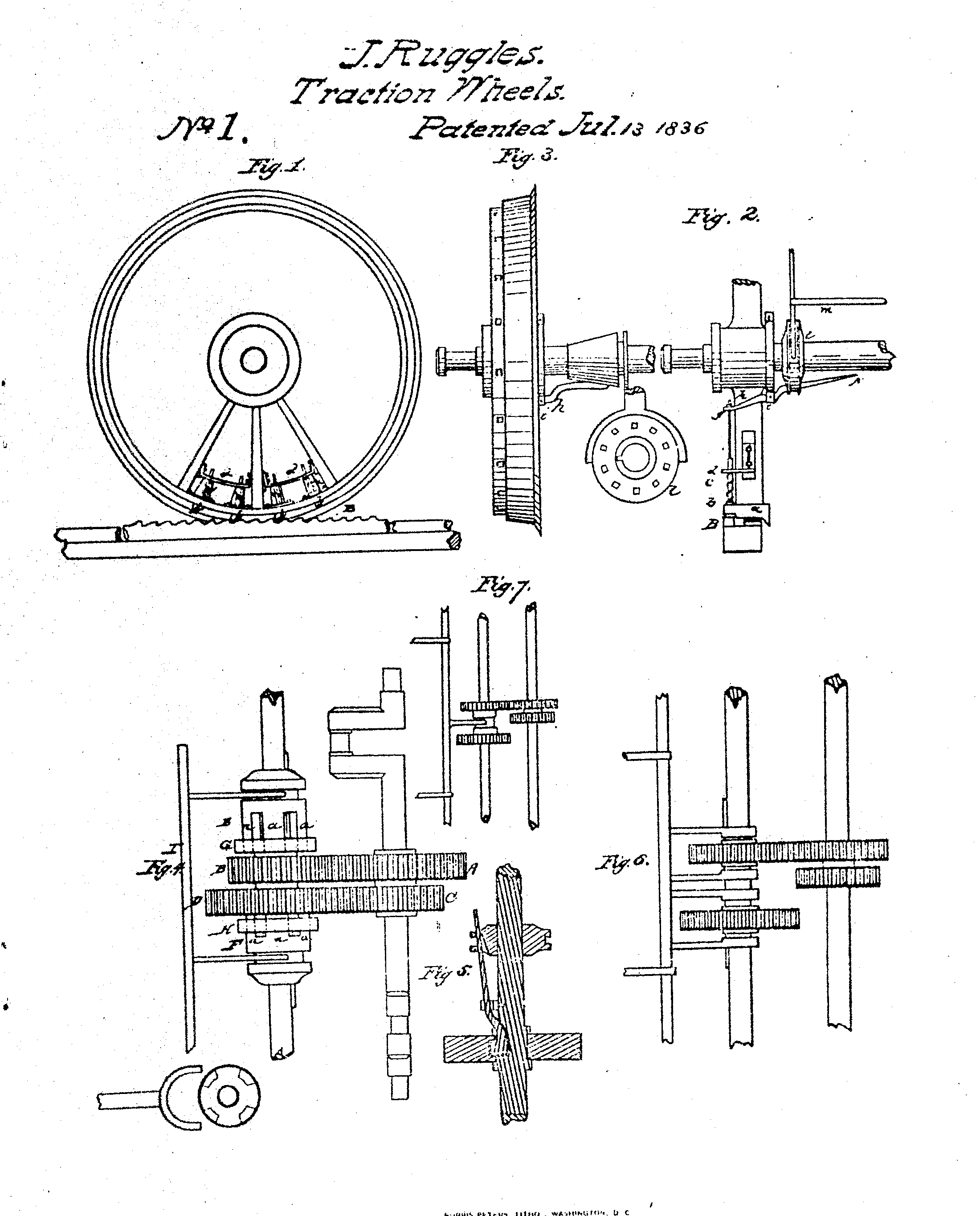
The Patent Office's numbering starts again with that law. Patent No. 1 was granted in July 1836, to John Ruggles, for traction wheels for a locomotive. The record disagrees on the day: the printed patent and the USPTO give 13 July 1836; the National Archives' manuscript copy gives 28 July. By the end of the year the Commissioner, Henry Ellsworth, had about four hundred applications, and expected "about one-third" of them to be rejected (S. Doc. 58, p. 14).
Patent No. 1: the wheel
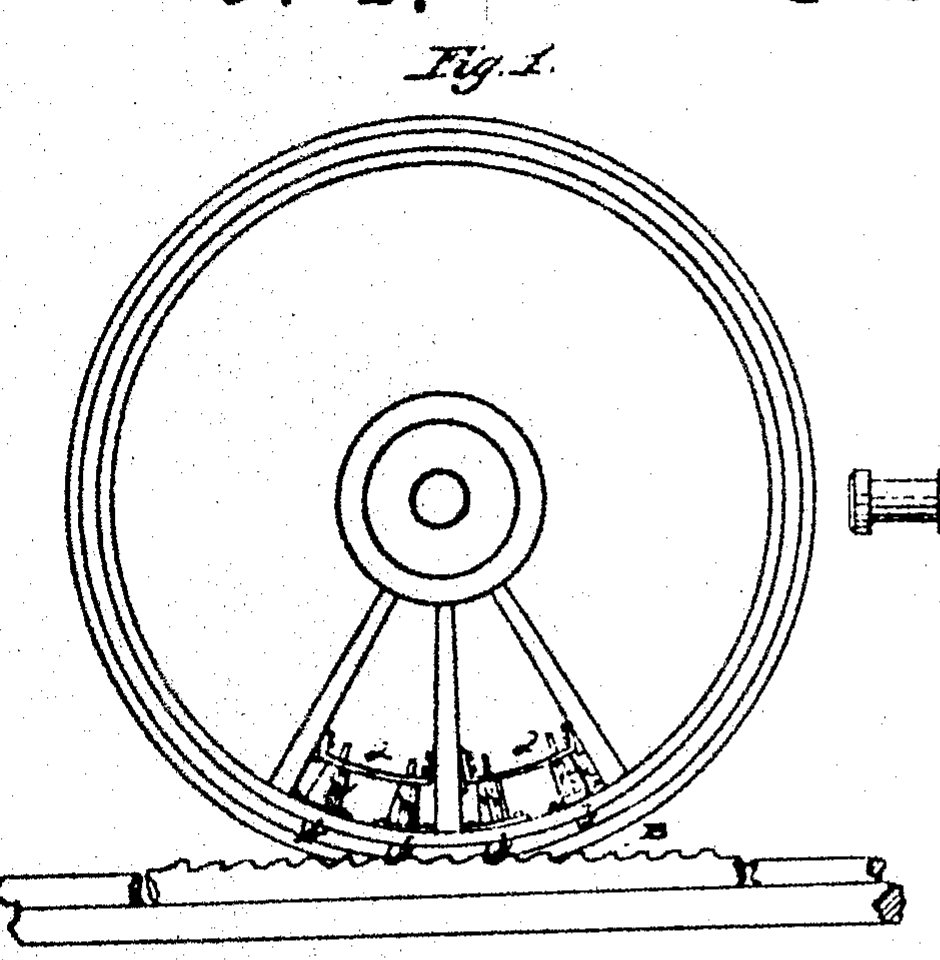
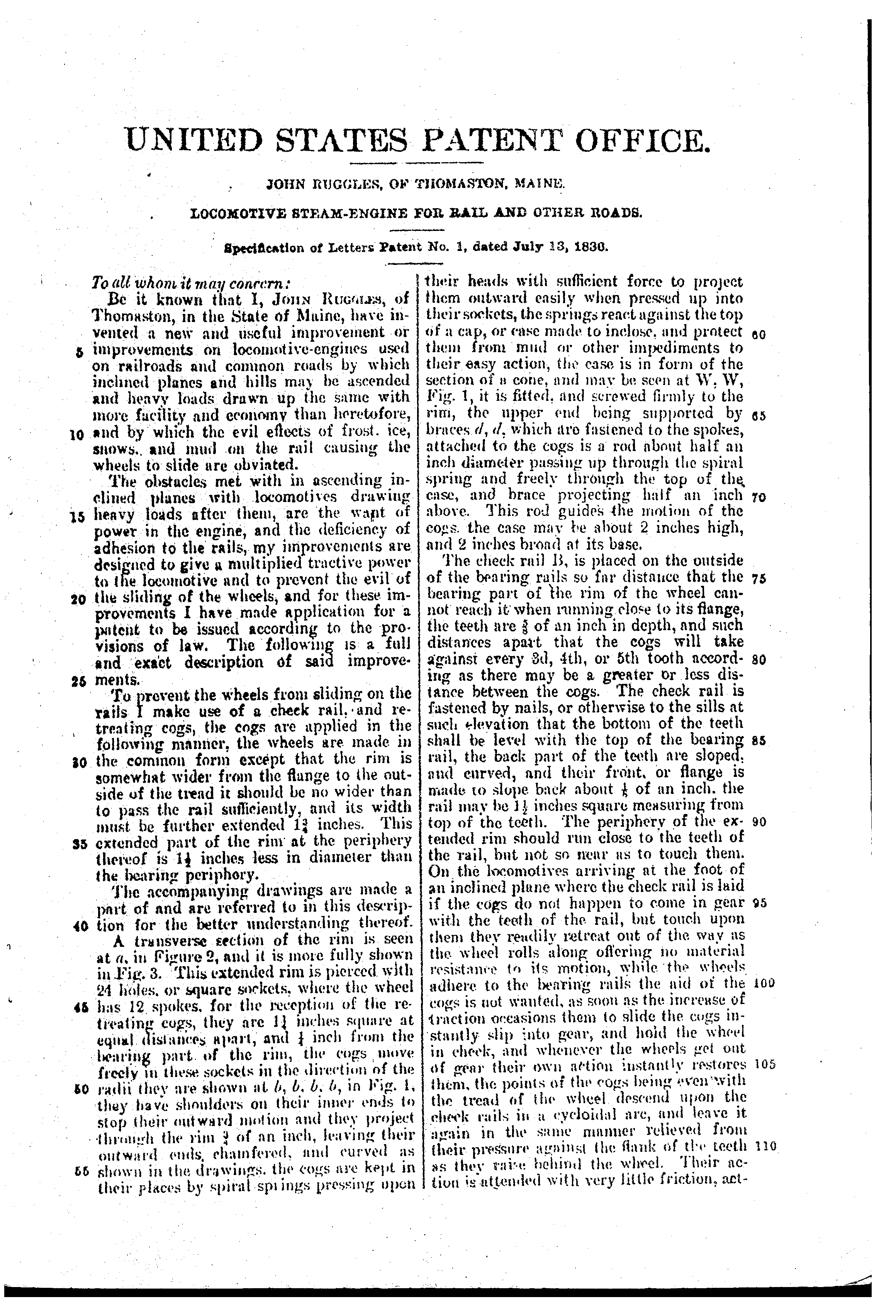
Ruggles's problem was hills. A locomotive climbing an incline met "the want of power in the engine, and the deficiency of adhesion to the rails". On "frost, ice, snows, and mud", the wheels would slide. His answer to the sliding was "a check rail, and retreating cogs" (US Patent No. 1, col. 1).
The wheel has an extra band outside its rim, pierced with twenty-four square holes. In each hole sits a cog, pushed outward by a spiral spring in a cone-shaped case. At the foot of an incline, a toothed check rail is laid beside the track. While the wheel grips the rail, the cogs touch the tops of the teeth, and "readily retreat out of the way". But as soon as the wheel starts to slide, "the cogs instantly slip into gear, and hold the wheel in check" (col. 2).
They carry only what the grip of the wheel cannot: their pressure on the teeth, Ruggles wrote, is "only the balance of leverage which is not sustained by the adhesion at the tread" (cols. 2-3). Each cog comes down onto the rail "in a cycloidal arc", and leaves it the same way, as the wheel rolls on.
The wheel rolls on the level and runs onto check rail B out of gear: watch the tooth tops push the cogs in. Once it is over the rail, press "Let the wheel slide": the wheel turns without moving on, as a driving wheel does when it slips, and no moment is set for the catch. The model steps the wheel forward and stops it where a cog, pushed out by its spring into a gap, meets a tooth's steep front face; then it climbs on, held, and the dashed line traces the path of the next cog's point. "Draw the cogs in" works the hand lever (the withdrawal gear, below): drawn in, the cogs pass over the rail untouched; the slide is then left out, as the patent draws the cogs in for the way down.
From the patent (Figs. 1-3, cols. 1-2): "24 holes, or square sockets, where the wheel has 12 spokes", the sockets "1 1/4 inches square", the case "about 2 inches high, and 2 inches broad at its base", the teeth "3/8 of an inch in depth", their bottoms level with the bearing rail, and the cogs taking "against every 3d, 4th, or 5th tooth" (we use every third). Checked by the episode's test, run again on this page's copy (34 checks, all pass): no point of any cog ever enters the rail; out of gear the tooth tops push the cogs in; a slide always ends in a catch within one tooth pitch; held, every later cog drops fully into its gap; drawn in, the cogs pass the check rail untouched; and a projection of 3/8 in, the other reading of the blurred fraction, never catches.
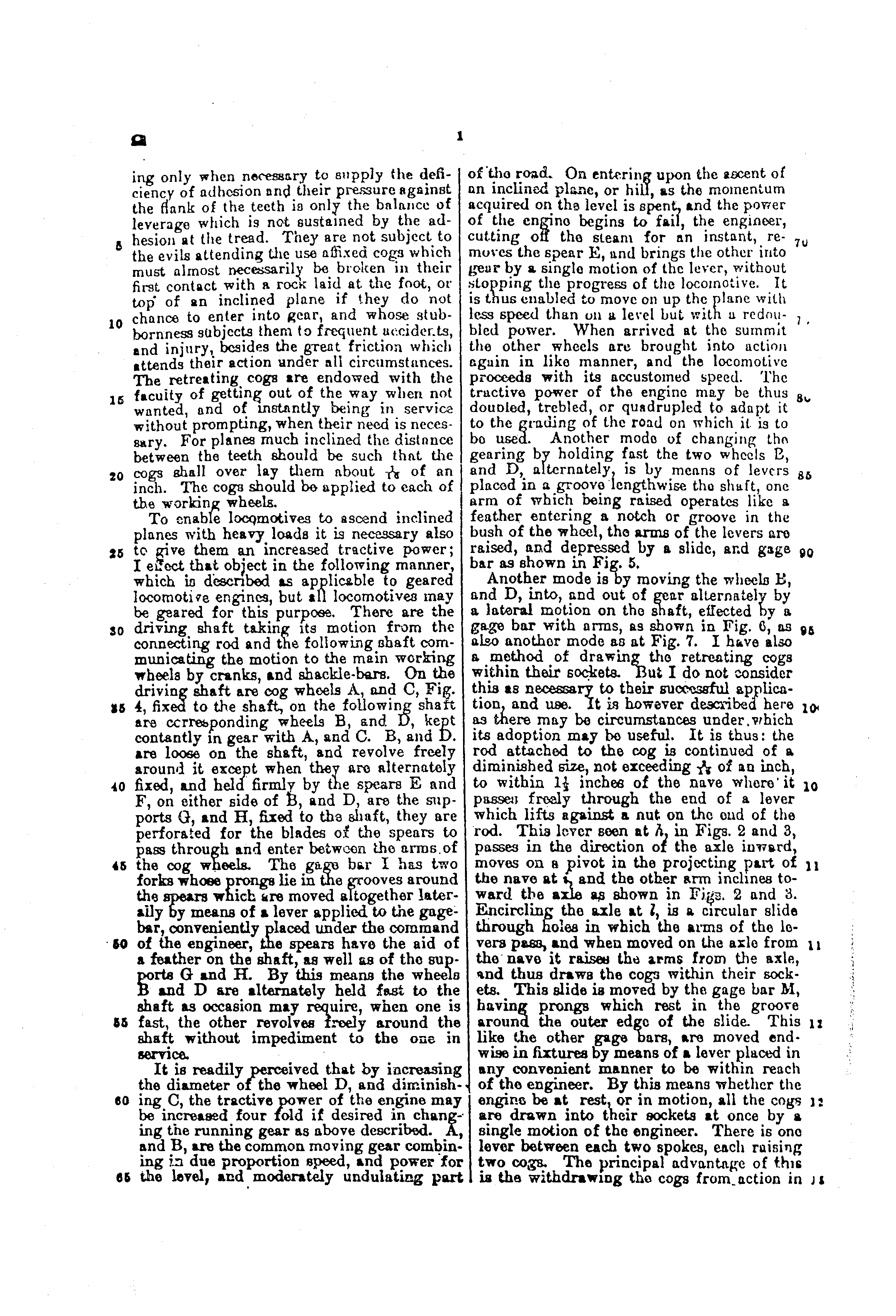
For the way down, a hand lever draws all twenty-four cogs into their sockets at once: "all the cogs are drawn into their sockets at once by a single motion of the engineer" (col. 4).
From the patent (Figs. 2 and 3): the cog's rod "passes freely through the end of a lever", which "lifts against a nut on the end of the rod"; the lever "moves on a pivot in the projecting part of the nave at i and the other arm inclines toward the axle"; "a circular slide through holes in which the arms of the levers pass, and when moved on the axle from the nave it raises the arms from the axle", moved by gage bar M. One lever between each two spokes: 12 levers, 24 cogs. Checked by the same test: at rest the lever leaves the nut free; the slide raises one arm and lowers the other steadily; a full stroke draws every point just flush with the band, and no further.
The two-speed gear
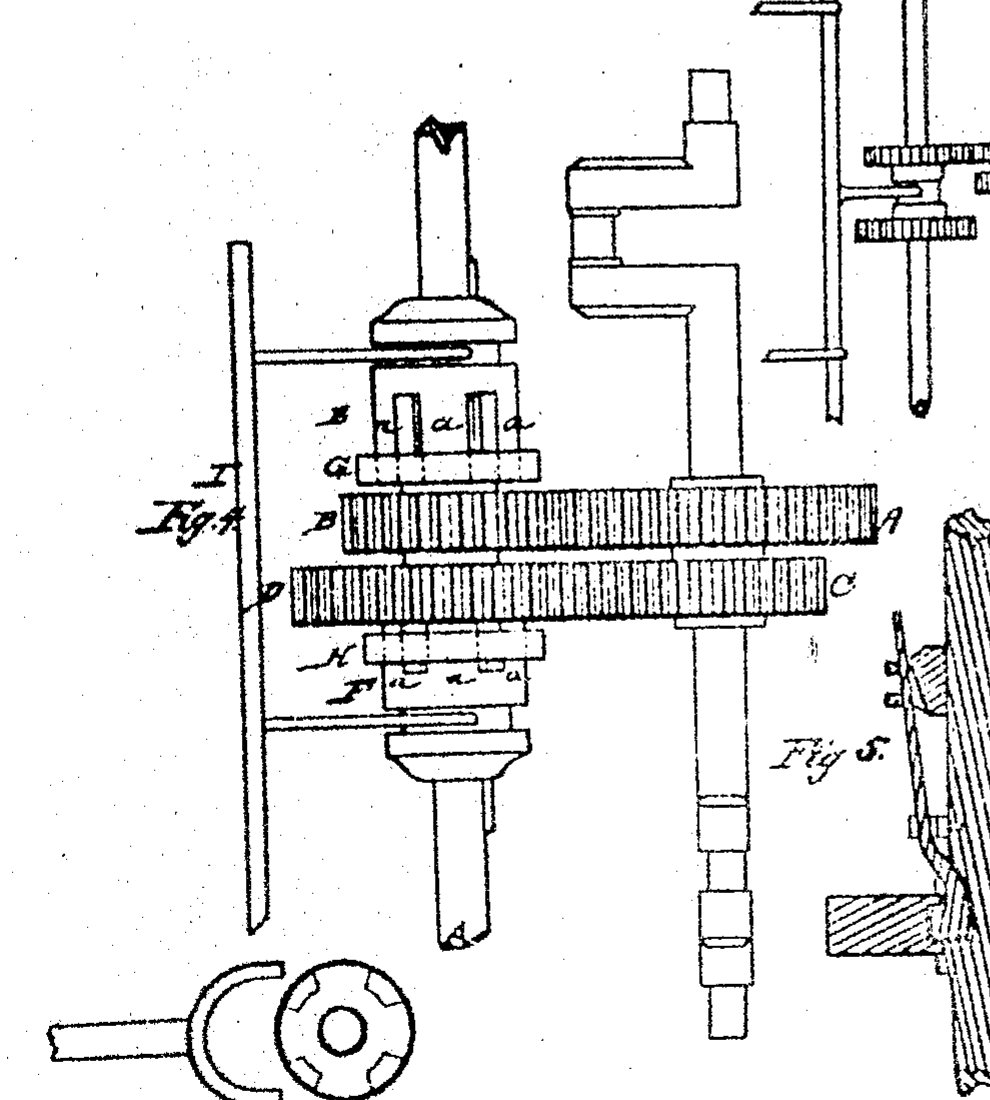
The second idea is a two-speed gear. Two gear wheels, A and C, are fixed on the engine's shaft. Two more, B and D, turn loose on the shaft that drives the wheels, each always in mesh with its partner. A sliding blade, which Ruggles calls a spear, goes in between the arms of one loose wheel, and locks it to its shaft.
At the foot of a hill the engineer cuts off the steam "for an instant", and with one lever swaps one spear for the other, "without stopping the progress of the locomotive". It climbs "with less speed than on a level but with a redoubled power" (cols. 3-4).
From the patent (Fig. 4, col. 3): A and C fixed on the driving shaft; B and D loose on the following shaft, always in gear with them; spears E and F sliding through supports G and H, fixed to the following shaft, to "enter between the arms" of B or D; one gage bar I moving both. Shift at any moment: one stroke draws E out of B, and whether F goes straight in or presses on an arm and waits depends on where D's arms happen to be. That wait is our reading; the patent does not say how the spear finds a gap. While neither spear holds, the steam is off and the shaft runs on with the locomotive. Checked by the same test: E is out of B before F reaches D; F passes between the arms only through a gap, never through an arm; the following shaft turns one for one on the level and at half the speed on the hill.
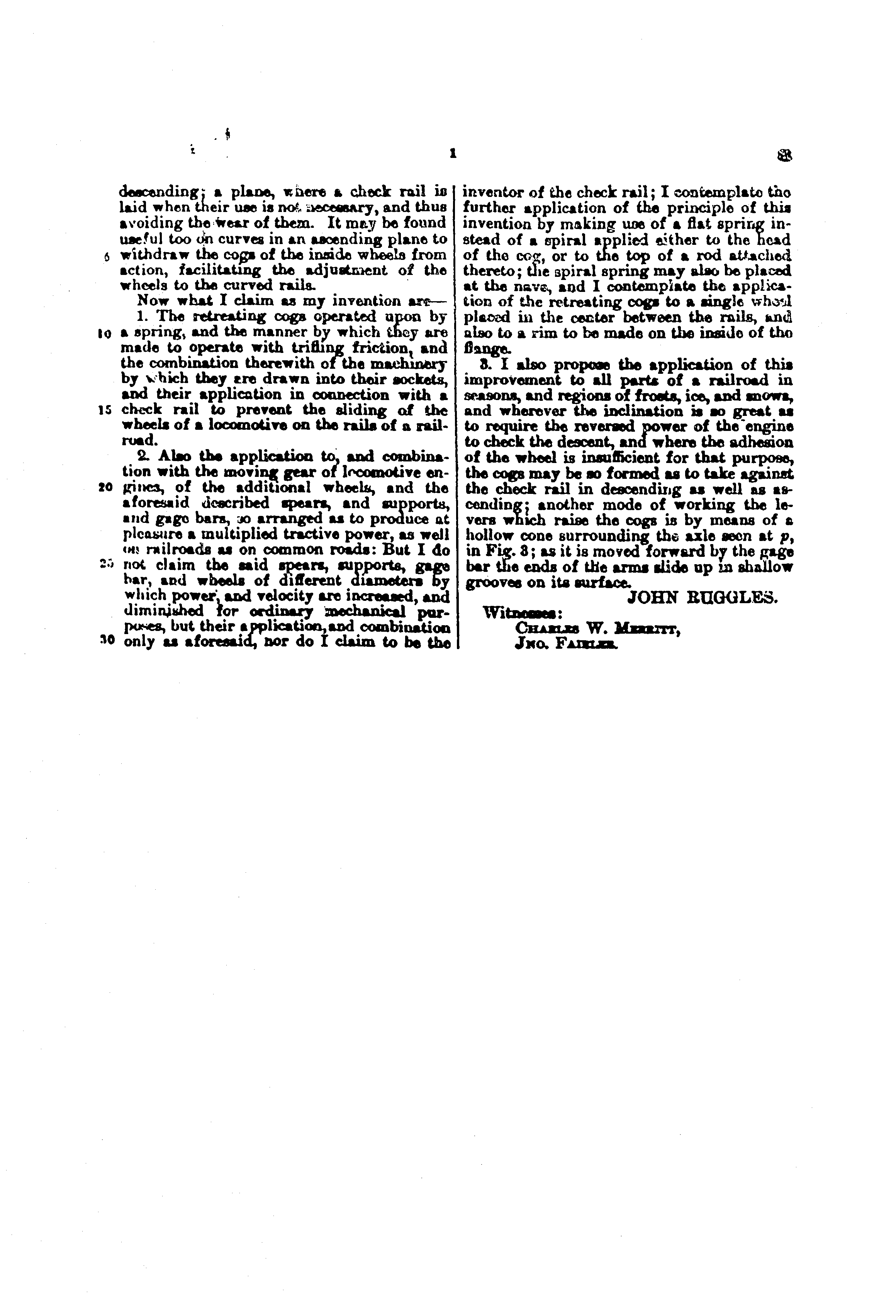
One thing Ruggles did not claim: "nor do I claim to be the inventor of the check rail" (the claims).
Was it built?
We looked for a trial, a railroad that used it, a licence or a reissue, and found none. And the drawing we have is not the one filed in 1836: it is a later lithograph, with the imprint of Norris Peters of Washington, of the drawing restored after the fire.
The night of the fire
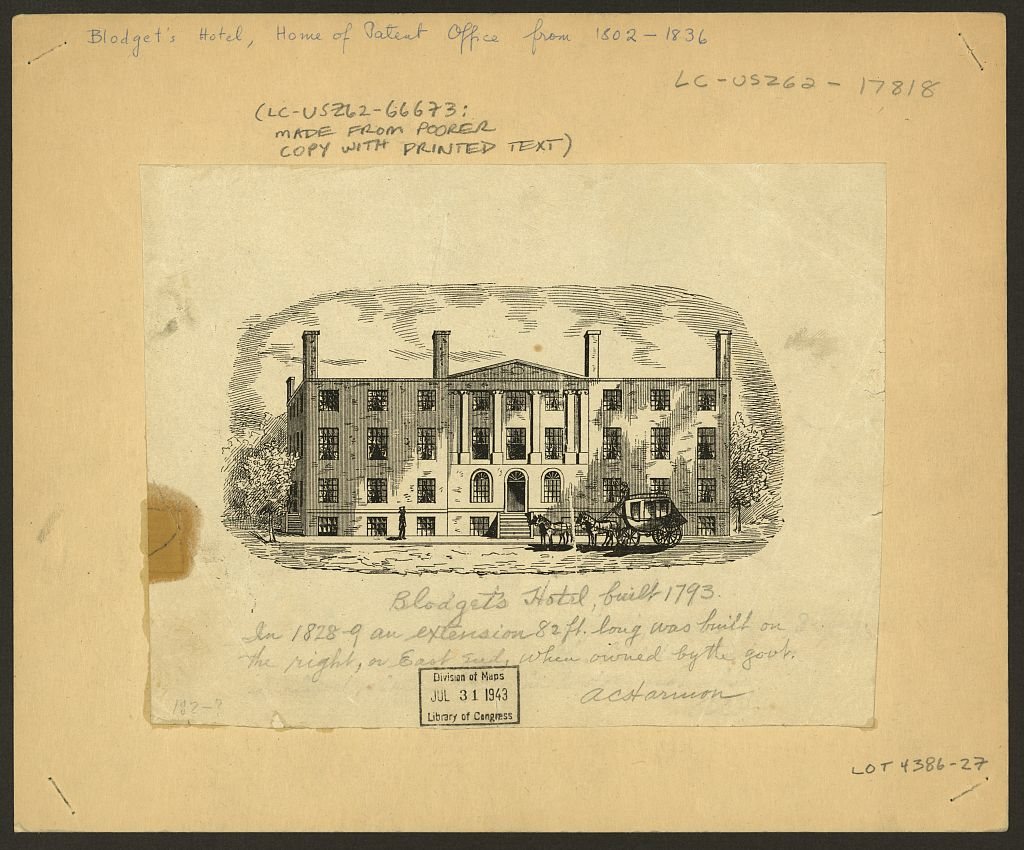
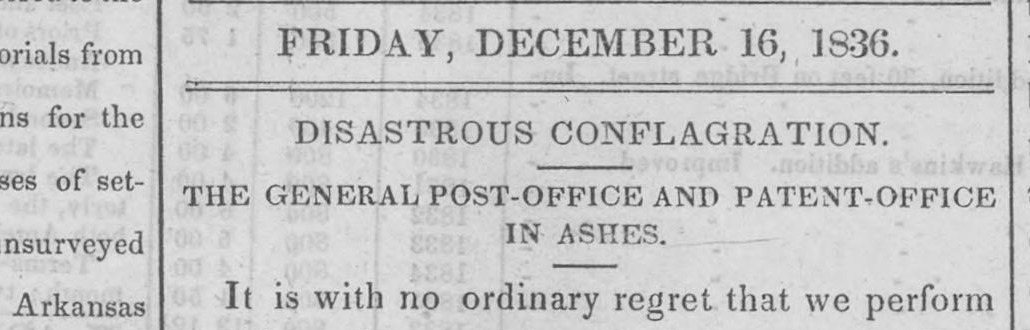
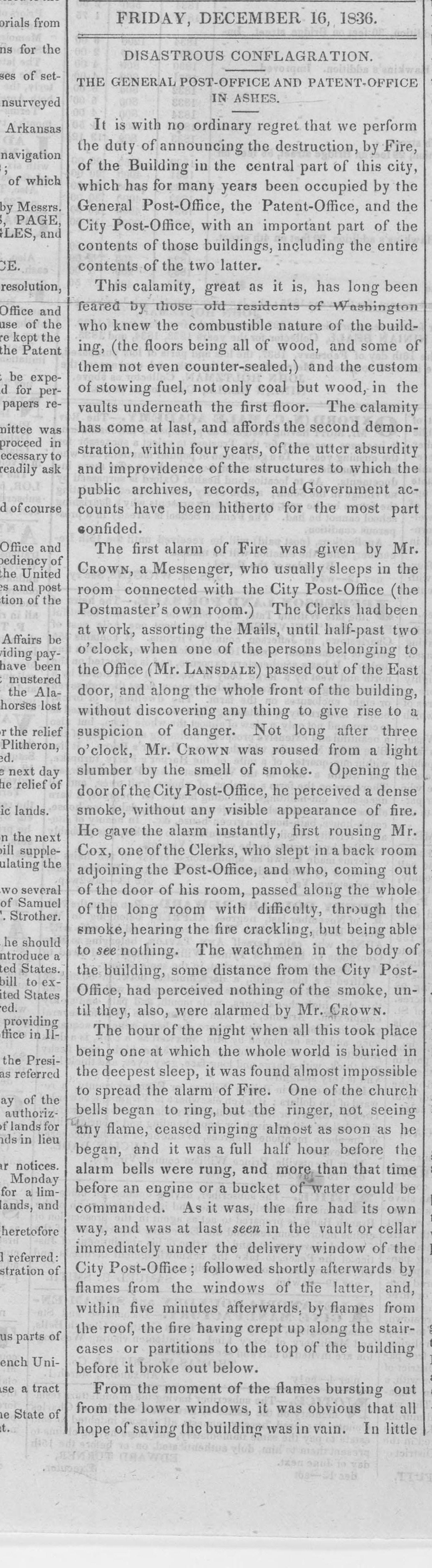
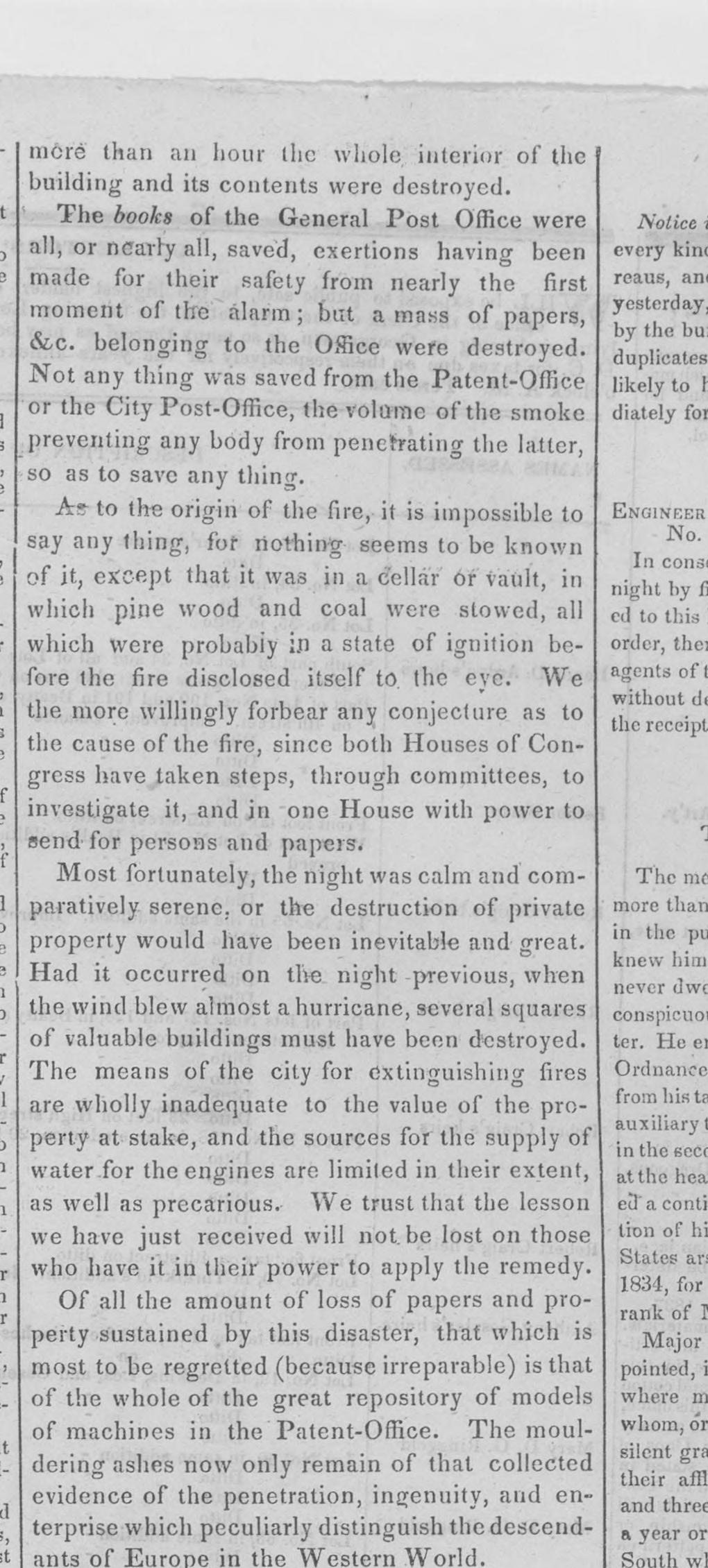
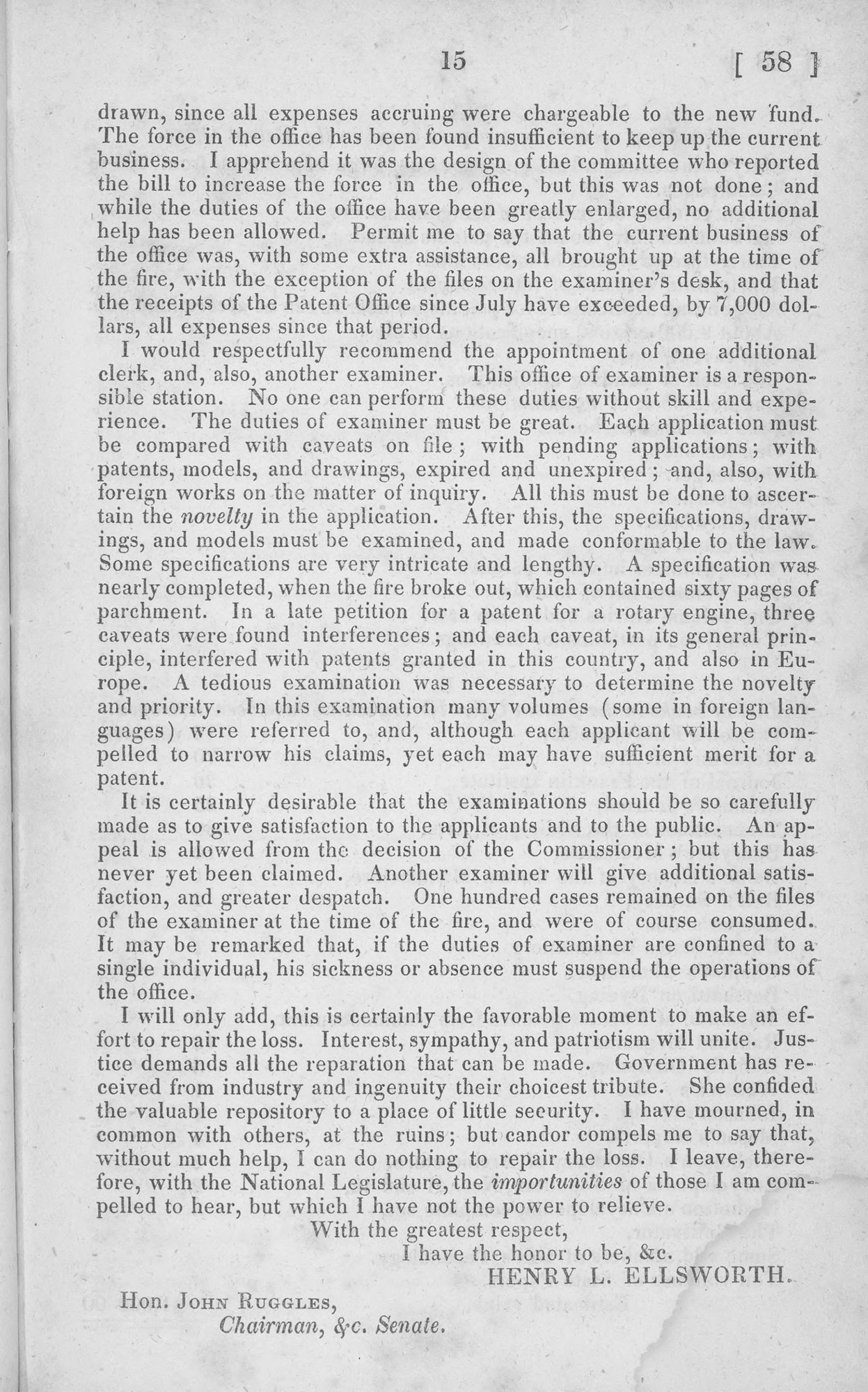
Not long after three o'clock on the morning of 15 December 1836, fire broke out in the building in Washington that held "the General Post Office, the Patent-Office, and the City Post Office". A messenger who slept in the building, Mr. Crown, was roused "by the smell of smoke". Its floors were "all of wood", and fuel, "not only coal but wood", was stored in the vaults underneath.
A church bell began to ring, and stopped. The Daily National Intelligencer wrote that "it was a full half hour before the alarm bells were rung, and more than that time before an engine or a bucket of water could be commanded." In little more than an hour, the paper said, "the whole interior of the building and its contents were destroyed." "Not any thing was saved from the Patent-Office."
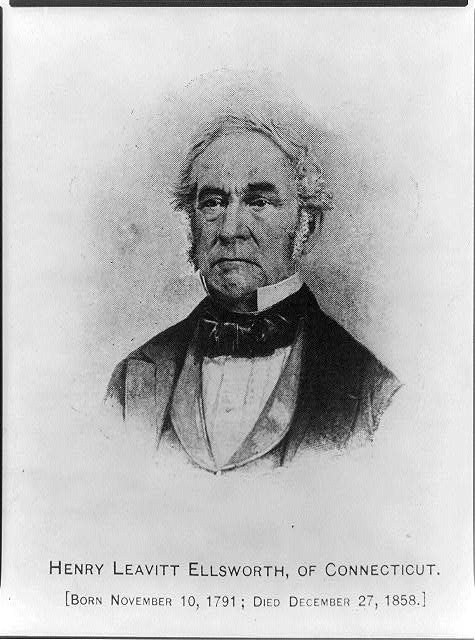
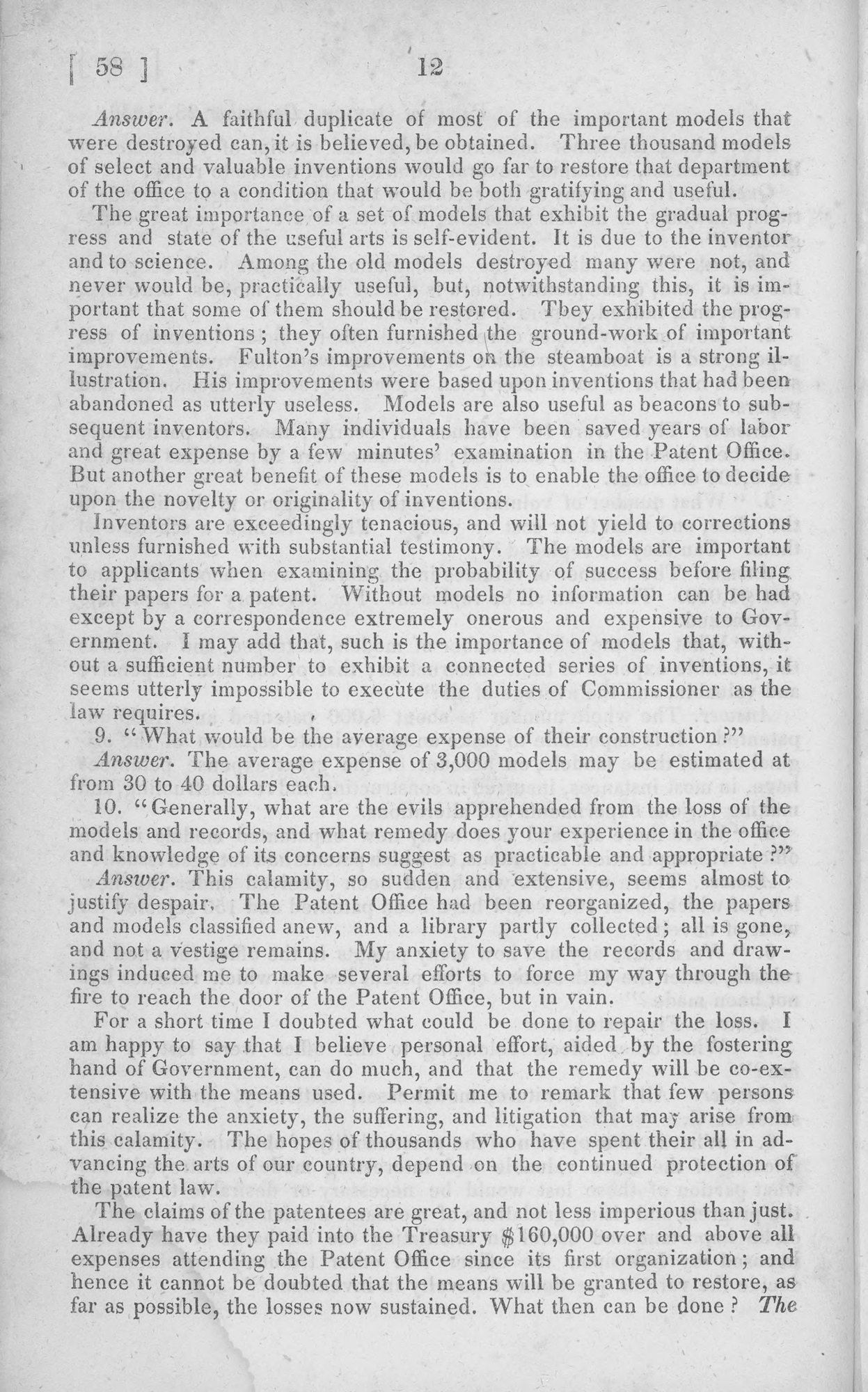
The Commissioner, Henry Ellsworth, wrote that he made "several efforts to force my way through the fire to reach the door of the Patent Office, but in vain" (S. Doc. 58, p. 12).
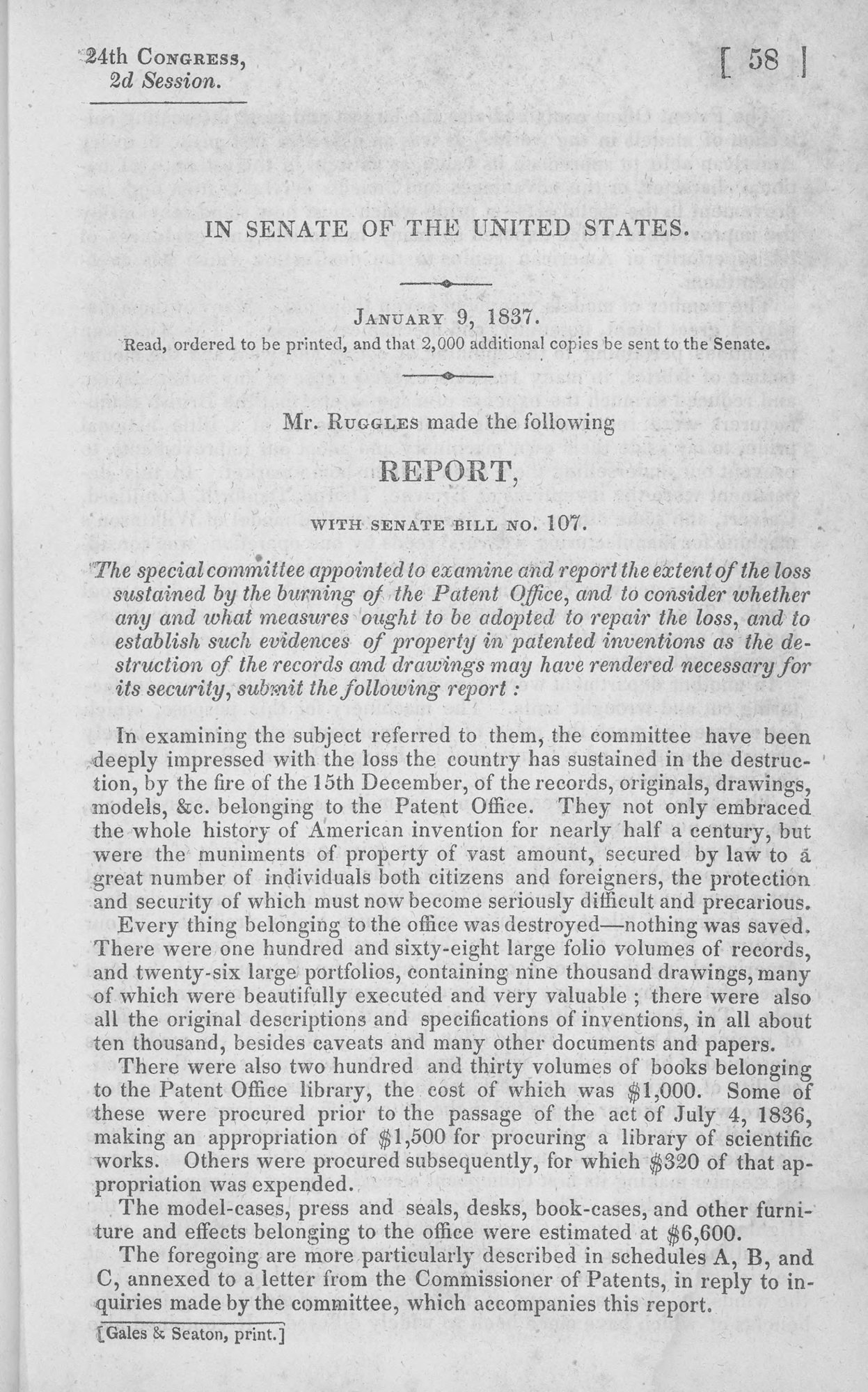
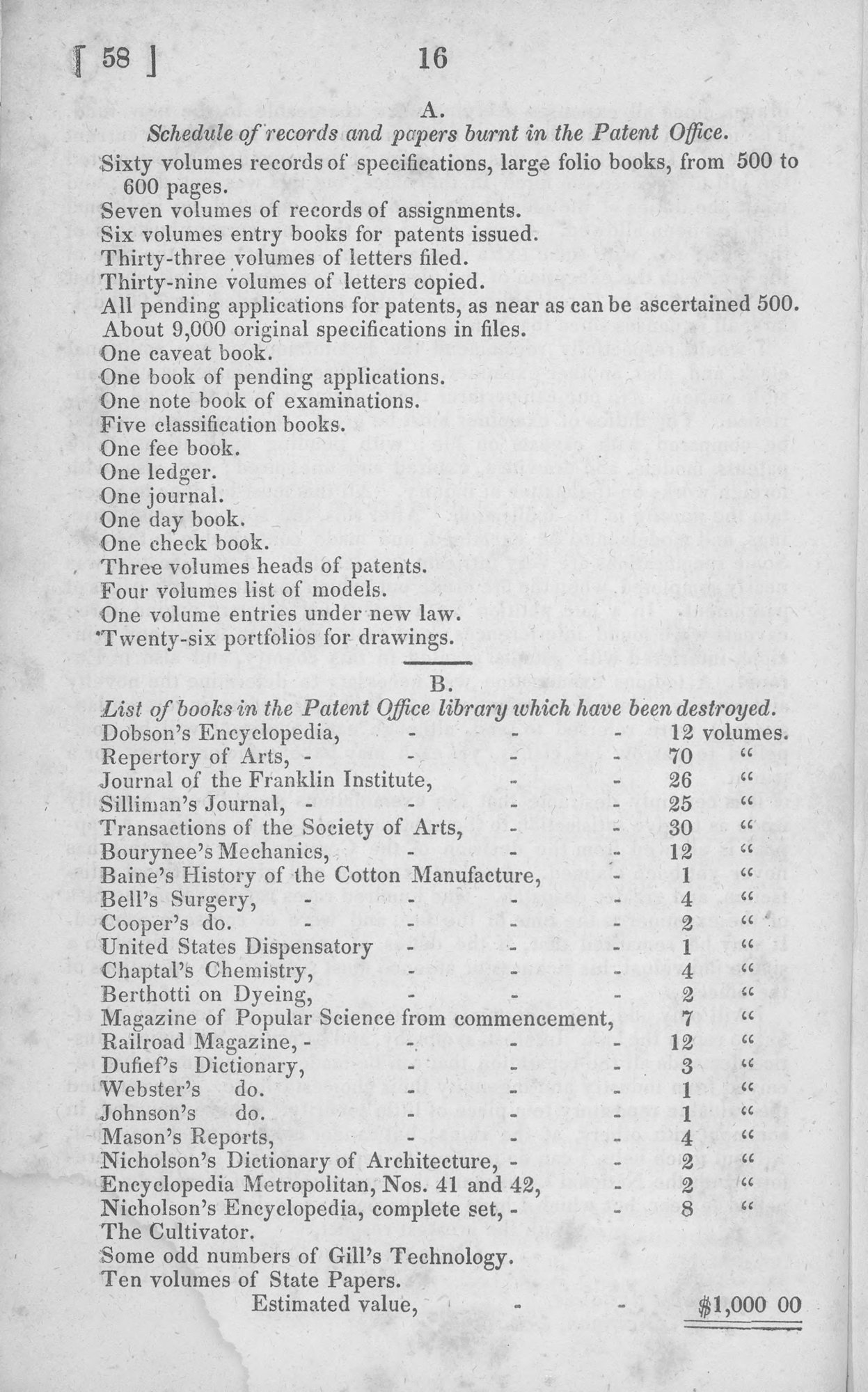
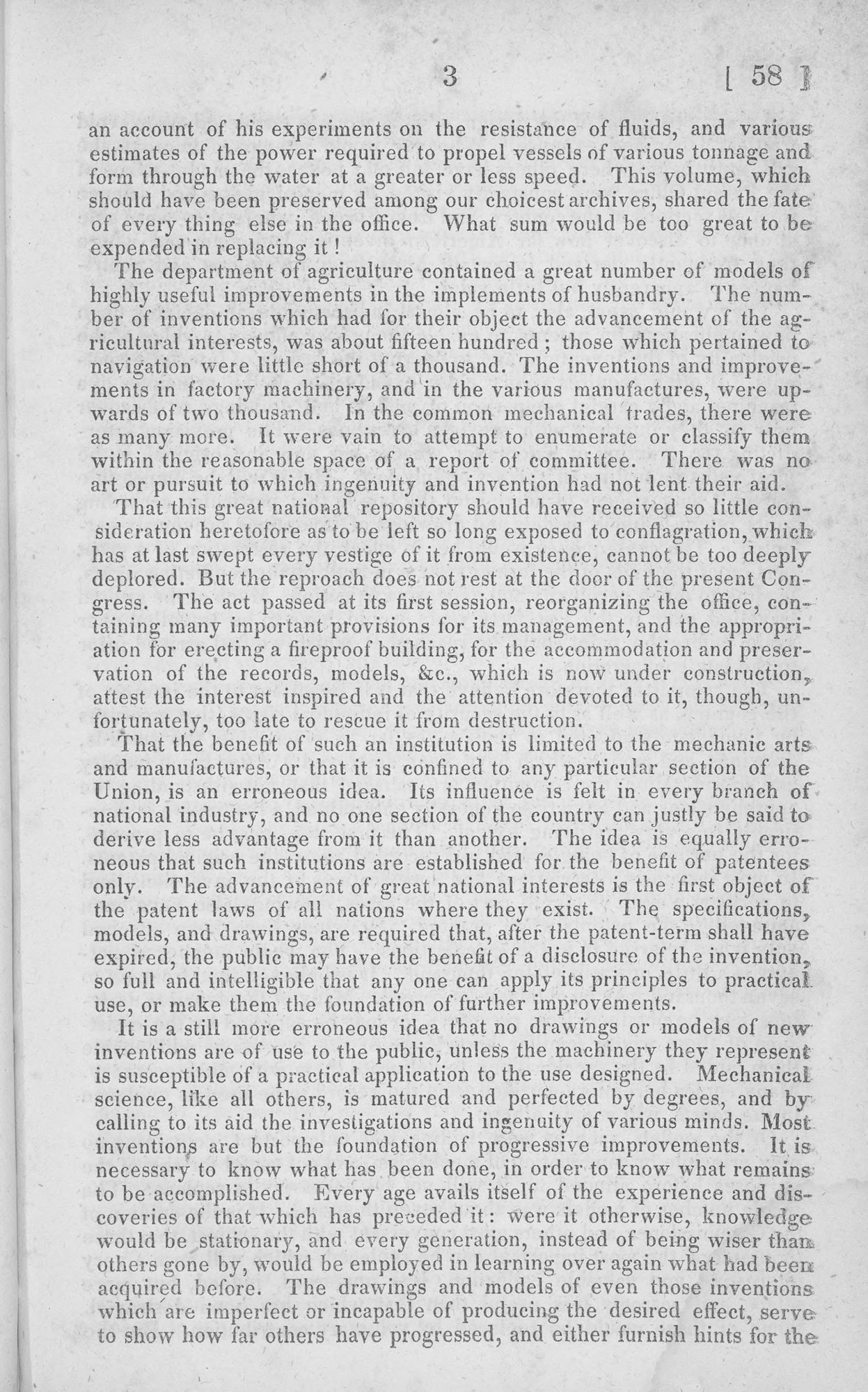
One specification, sixty pages of parchment, was nearly finished when the fire broke out. A hundred cases waiting for the examiner, Ellsworth wrote, "were of course consumed" (pp. 14-15). Among the losses was a volume of Robert Fulton's own drawings. Ruggles's committee wrote: "What sum would be too great to be expended in replacing it!" (p. 3).
| 168 | volumes of records |
|---|---|
| 26 | portfolios, holding 9,000 drawings |
| about 9,000 | original specifications |
| about 7,000 | models: "about 6,000 patented and 1,000 unpatented" |
| about 230 | volumes of the library |
As to the cause, the paper said "it is impossible to say any thing": it began in a cellar where pine wood and coal were stowed. Some at the time blamed an arsonist: a letter from Washington reprinted in the Herald of the Times (Newport, 22 December 1836) called it "the act of an incendiary". A later account says hot ashes (the National Archives, 2018). No one was ever found to have caused it.
What came back: the X-patents
In January 1837 Ruggles reported for a new committee. It hoped that "from six to seven thousand" of the lost patents could be recorded again (S. Doc. 58, p. 4). "It is necessary to know what has been done," the report said, "in order to know what remains to be accomplished" (pp. 3-4).
A law of 3 March 1837 let any holder of an older patent have it "recorded anew", without charge. Where a drawing was lost, one could be "made in the office", from the specification (5 Stat. 191, sec. 1).
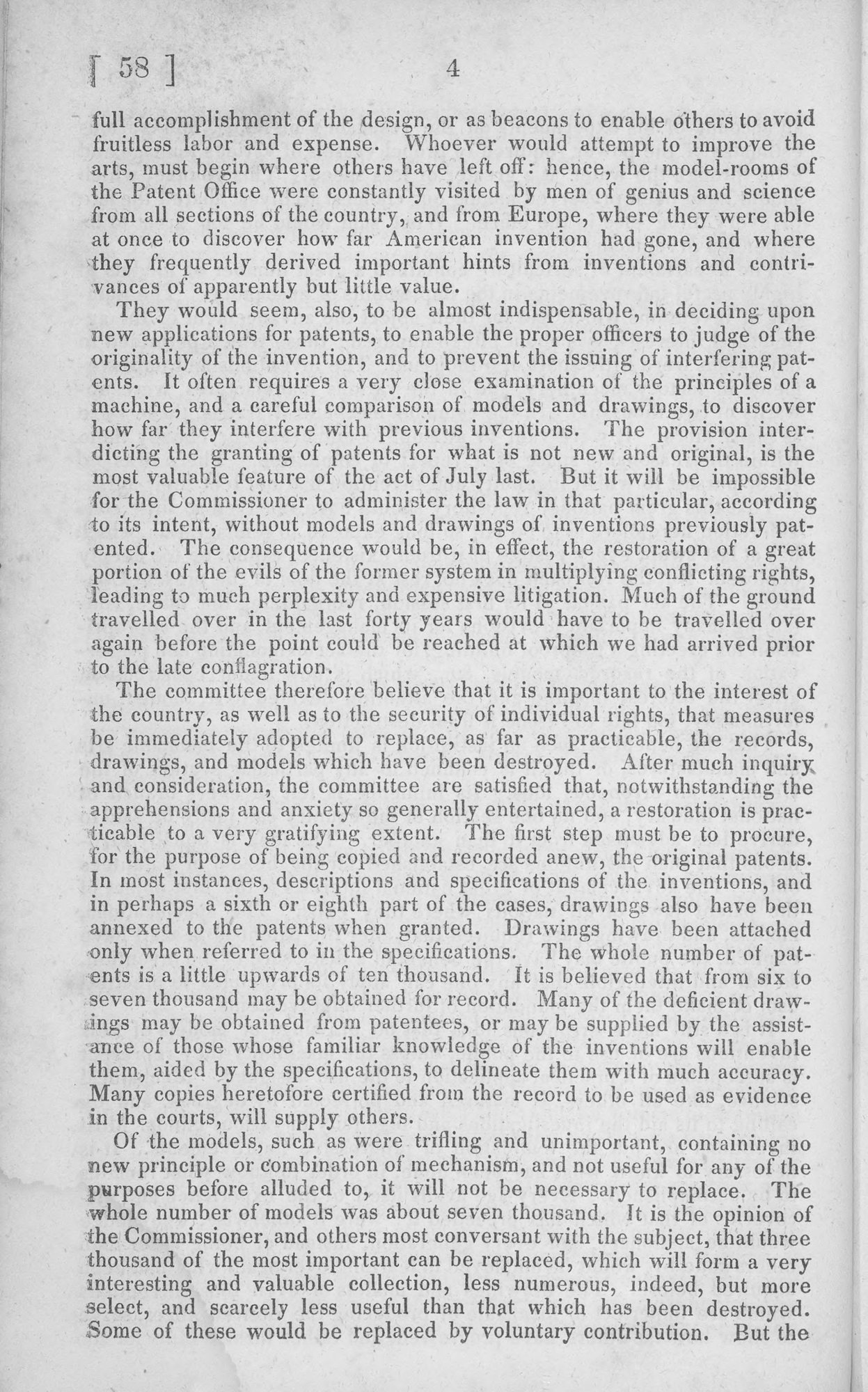
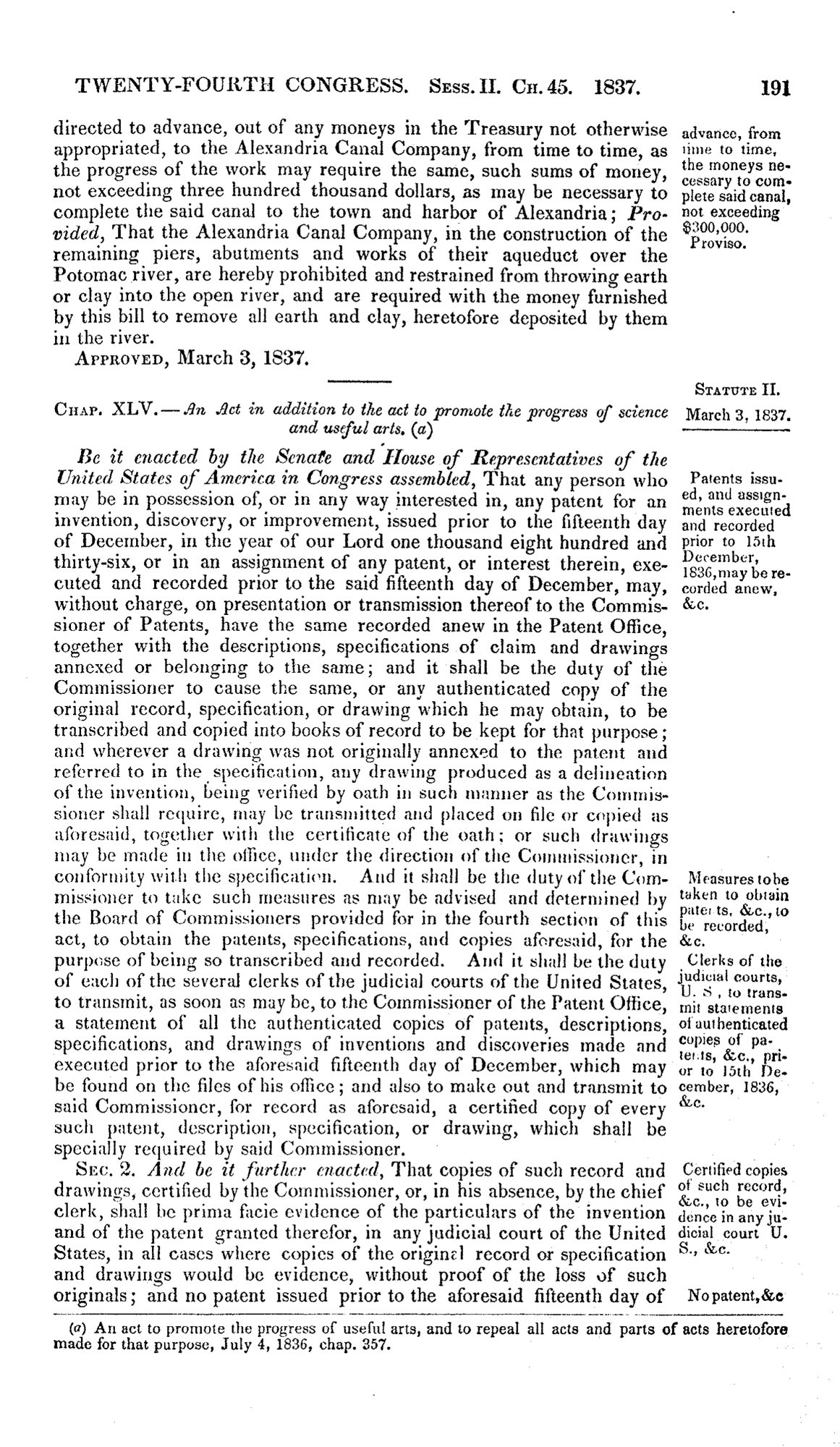
According to the Patent Office's historian, about 2,800 were rebuilt from what inventors sent in. More than 7,000 never were. Patent No. 1 was granted five months before the fire, so its records burned too. The drawing we have is a later reproduction of what was restored; how and when it was redrawn is not known.
The patents from before 1836 were later numbered with an X. Hopkins's is X1: its stamp reads "X000001". Eli Whitney's cotton gin is 72X, while No. 72 of the new series went in October 1836 to Silas Lamson, for scythes. People still look for the lost ones. Archivists, librarians, examiners and members of the public have found hundreds. In 2022, according to Smithsonian magazine, two original patents of Robert Fulton's, 995X and 1434X, turned up and were authenticated. They are patents, not the lost book of drawings.
Then and now
In 1835 the office issued 776 patents. In the 2024 fiscal year the US Patent and Trademark Office granted about 327,000 utility, plant and reissue patents. The law of 1836 provided one examining clerk. In 2024 there were 8,944 examiners.
The first United States patent is a way of burning ashes, with no drawing. Patent No. 1 is a locomotive wheel that nobody is known to have built. Most of the records between them were lost in one night.
Next episode: the electric self-starter. Charles Kettering's starter patent was granted in 1915 (US 1,150,523), but a patent of 1903 (US 745,157, Coleman) already started an engine with an electric motor. So what did Kettering patent?
Read the original patents
Both are in the public domain. Click a page for full resolution.
Patent X1, Samuel Hopkins, potash and pearl ash, granted 31 July 1790
US Patent No. 1, John Ruggles, Locomotive Steam-Engine for Rail and Other Roads, July 1836
Sources
Every fact on this page comes from these, as in the episode. Where we have read a source only in a transcription, or only second-hand, the text says so.
Patents (public domain; USPTO images)
- Letters patent to Samuel Hopkins, 31 July 1790, later X1: "of the City of Philadelphia", the four steps, "a new Apparatus and Process", "a Furnace", the grant, Washington's signature and Randolph's certificate. A USPTO reproduction, not a photograph of the original.
- J. Ruggles, Locomotive Steam-Engine for Rail and Other Roads, US Patent No. 1 (July 1836): the problem (col. 1), the cogs, cases and check rail (cols. 1-2), the gear (col. 3), the withdrawal (col. 4), the claims. The drawing is a later Norris Peters lithograph of the drawing restored after the fire.
Laws and Congress (public domain)
- Act of 10 April 1790, 1 Stat. 109, sec. 1. Act of 4 July 1836, 5 Stat. 117 (secs. 1, 2, 7, 9), and Act of 3 March 1837, 5 Stat. 191 (sec. 1): Library of Congress.
- Senate select committee on the Patent Office, report with Senate bill No. 239, 28 April 1836 (J. Ruggles, chairman): the ministerial duty, "worthless and void", the model-room, the dark garret, the counts, "greatly overbalanced", the warning about fire, "put an end to litigation". Read in the IPMall transcription.
- Report on the burning of the Patent Office, with Commissioner Ellsworth's answers of 28 December 1836, S. Doc. 58, 24th Cong., 2d Sess., 9 January 1837: pp. 1, 3-4, 11-16.
Newspapers (Library of Congress, Chronicling America)
- Samuel Hopkins, "Pot and Pearl Ashes", Gazette of the United-States (Philadelphia), 3 July 1793, p. 4: his glossary, his directions, Rees's furnace, the certificate of 17 June 1793 and its six names, "6th Mo. 22d, 1793"; read on the page image.
- "Disastrous Conflagration", Daily National Intelligencer (Washington), 16 December 1836, p. 3; every quote read on the page image.
- The reprinted letter, "the act of an incendiary", Herald of the Times (Newport), 22 December 1836, p. 3 (read in the machine reading of the page).
Other sources
- Jefferson to Madison, 31 July 1788 (the clause quoted is the same in the Founders Online text, as copied by teachingamericanhistory.org, and in Maxey, p. 4; we have not seen the printed Papers page), and to Benjamin Vaughan, 27 June 1790 (Papers of Thomas Jefferson 16:342, as given by Encyclopedia Virginia).
- David W. Maxey, "Samuel Hopkins, The Holder of the First U.S. Patent: A Study of Failure", Pennsylvania Magazine of History and Biography 122 (1998): the board's fifty-seven (p. 5), the Pittsford markers (pp. 6-7), the Philadelphia Hopkins and his census entry (pp. 8-10), the Quebec petition (p. 17), the licences (p. 19), the meeting's minute (pp. 33-34) and the will (p. 36).
- The Philadelphia historical marker, Second and Arch Streets, dedicated 2002: its text from ExplorePAHistory.com.
- USPTO, "Patent milestones" (the 9,957 X-patents, No. 1's date) and "The history of presidentially signed patents" (the board's members). Adam Bisno, USPTO Historian, "The search for lost X-patents" (13 July 2022): about 2,800 restored, more than 7,000 never, the X numbers, 72X and No. 72, the search.
- National Archives, The Unwritten Record, "Recalling the Devastating Patent Office Fire of 1836" (13 December 2018): the later account of hot ashes.
- The day of Patent No. 1: 13 July 1836 in the printed patent and on the USPTO's milestones page; 28 July 1836 in the National Archives' manuscript copy (NAID 7560372, read in our first screening of the record; the catalogue did not answer when we checked again).
- Danny Freedman, "The Remarkable Effort to Locate America's Lost Patents", Smithsonian, October 2022: Fulton's 995X and 1434X.
- USPTO, PPAC 2024 Annual Report, p. 19: grants and examiners in the 2024 fiscal year.
- Today's money: dollars by the ratio of annual-average consumer prices (Federal Reserve Bank of Minneapolis, "Consumer Price Index, 1800-"), 2025 as today, rounded to two figures, marked ≈ because the early index is an estimate.
- The reconstructions and diagrams are our own work, as described under each one. The models are checked by the episode's test, run again on this page's copy (34 checks, all pass).
Images
- The patents, the Statutes at Large and S. Doc. 58: US government documents, public domain (USPTO, govinfo.gov, Library of Congress).
- The Gazette of the United-States (1793) and the Daily National Intelligencer (1836): Library of Congress, Chronicling America; public domain.
- Thomas Jefferson by Rembrandt Peale, 1800, White House collection: public domain. Henry L. Ellsworth (a later halftone, cph.3a14001) and Blodget's Hotel (a later wood engraving by A. C. Harmon, LCCN 2008677115): Library of Congress, via Wikimedia Commons, public domain.
- John Ruggles: Wikimedia Commons, "John Ruggles.jpg", tagged public domain by age; who made it, and when, is not established.
- No AI illustration is used, on this page or in the episode.