 Curious Patents
The Typewriter and QWERTY
Look at the top row of almost any keyboard: Q, W, E, R, T, Y. The usual story is that early typewriters jammed, so the letters were scrambled to slow typists down. We looked for that story in the records of the men who built the first typewriter and did not find it. What we found was a machine played like a piano, with its keys in alphabetical order, type-bars that crashed into each other, and a layout that nobody ever patented.
Watch the episode
Milwaukee, 1868
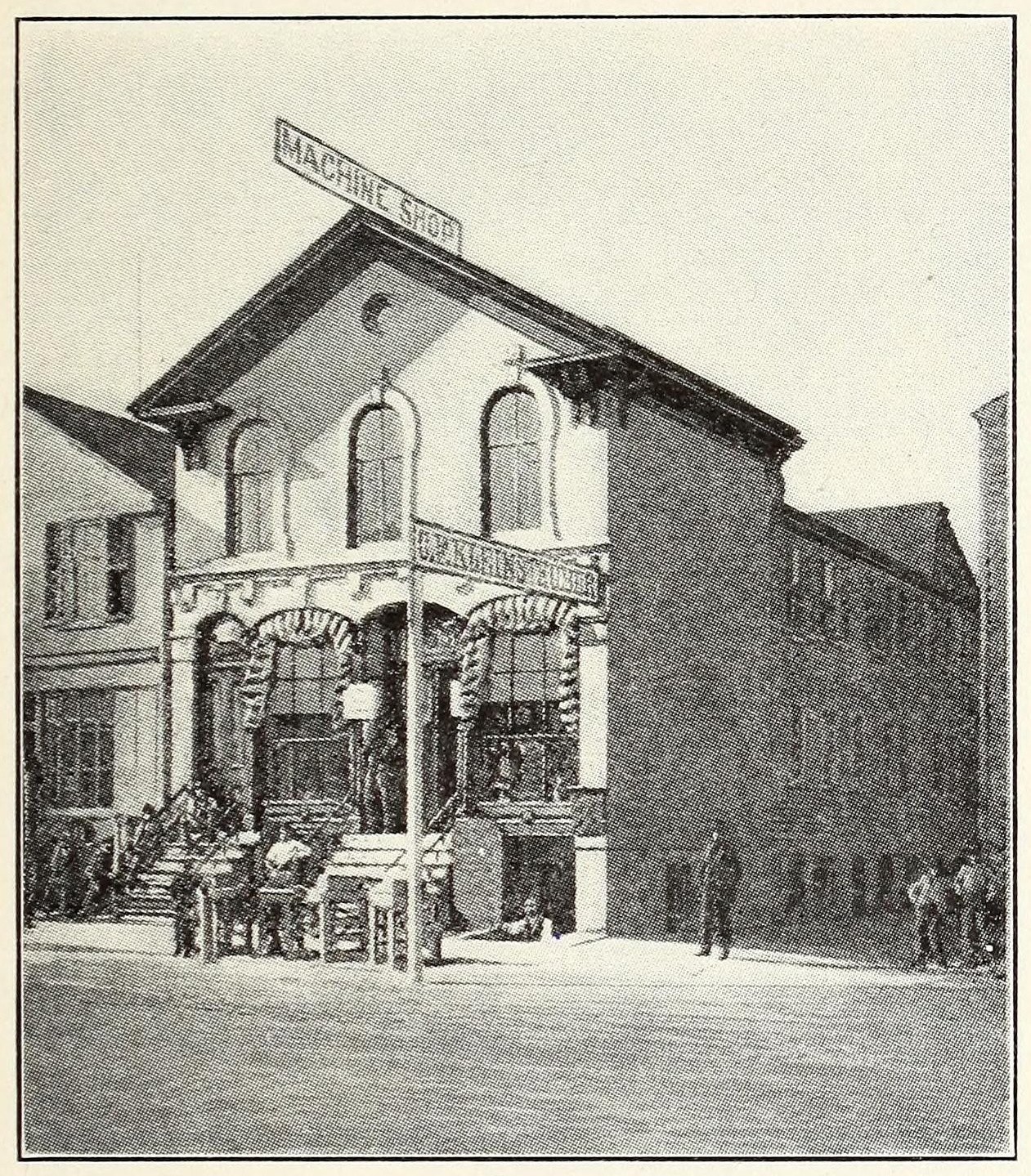
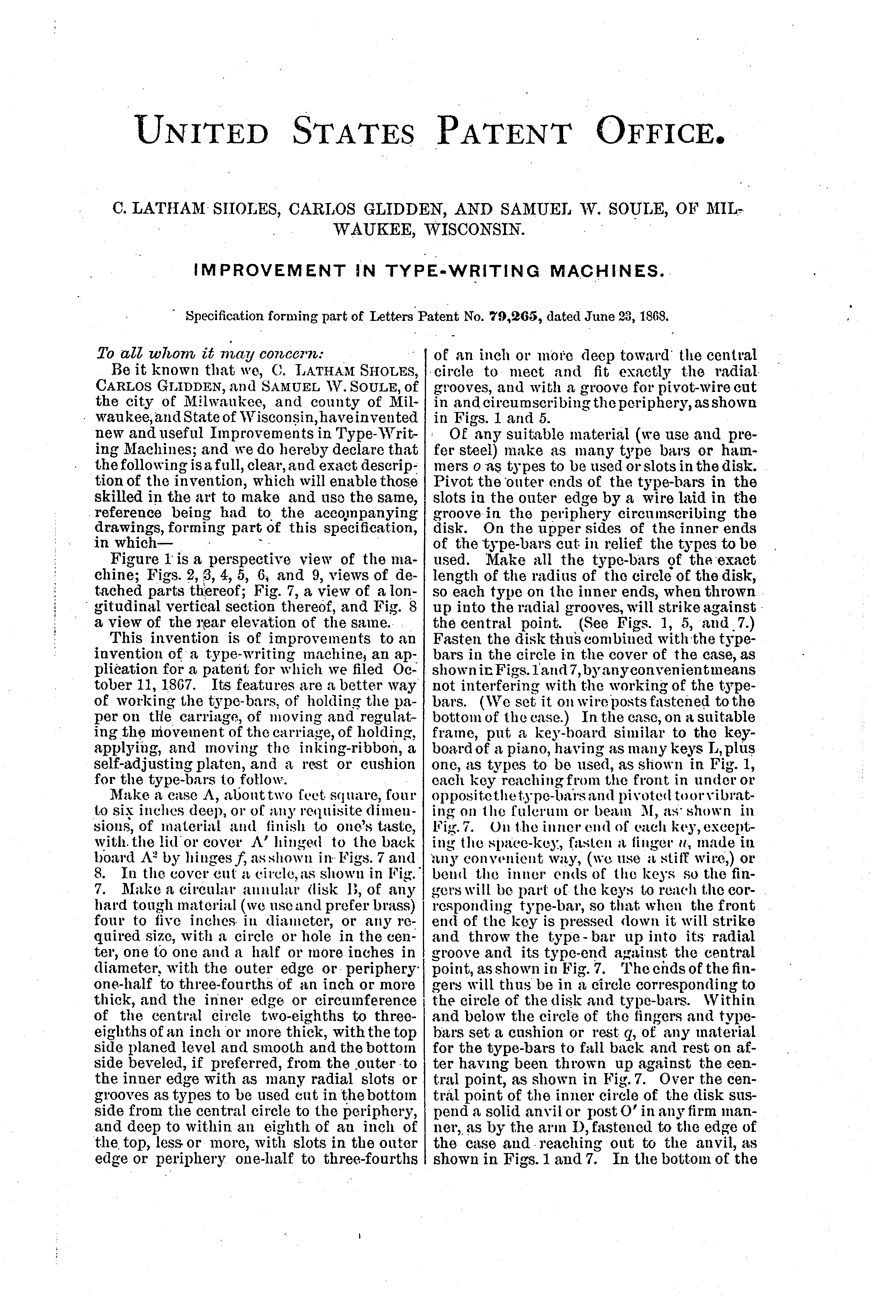
The machine came out of a machine shop in Milwaukee, Wisconsin. Christopher Latham Sholes was a printer and newspaper editor who had sat in the state legislature; Carlos Glidden and Samuel W. Soule worked on the machine with him. In 1872 Sholes told Scientific American that "his inspiration was derived from the idea advanced in these columns": a writing machine the magazine had described in July 1867.
On 23 June 1868 the three of them were granted US Patent 79,265, for an "Improvement in Type-Writing Machines". Three weeks later, on 14 July, came a second, US 79,868. The June patent describes the better machine. It says so itself: it improves on "an invention of a type-writing machine, an application for a patent for which we filed October 11, 1867". The July patent shows the earlier design, with its keys pulling the type-bars by wires.
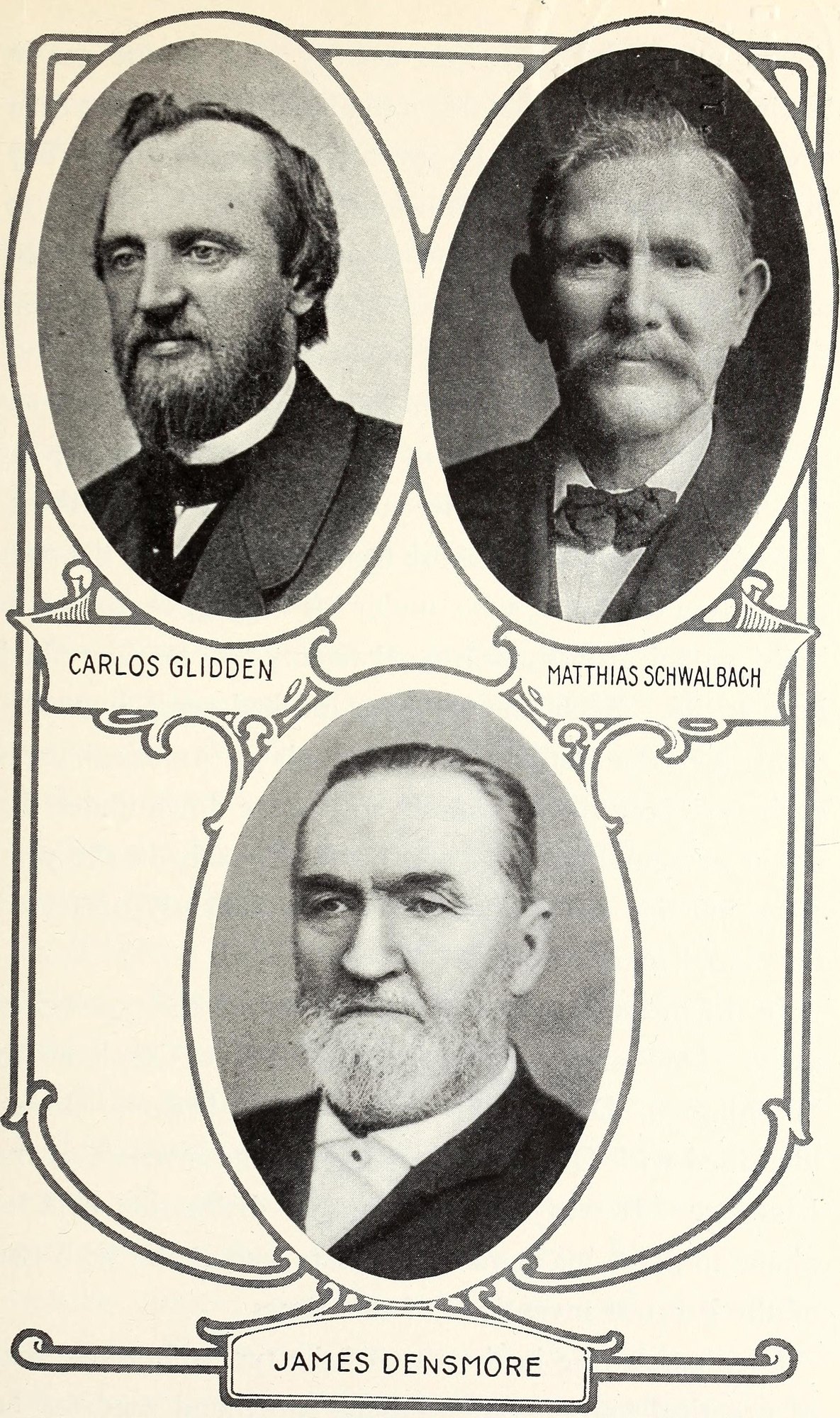
Their backer was James Densmore, whose name is on the June drawings as a witness. Soule soon "dropped out of the enterprise". When Densmore first saw the machine, in March 1868, according to the history published for the typewriter's fiftieth anniversary, he "pronounced it good for nothing save to show that the idea was feasible".
How it works
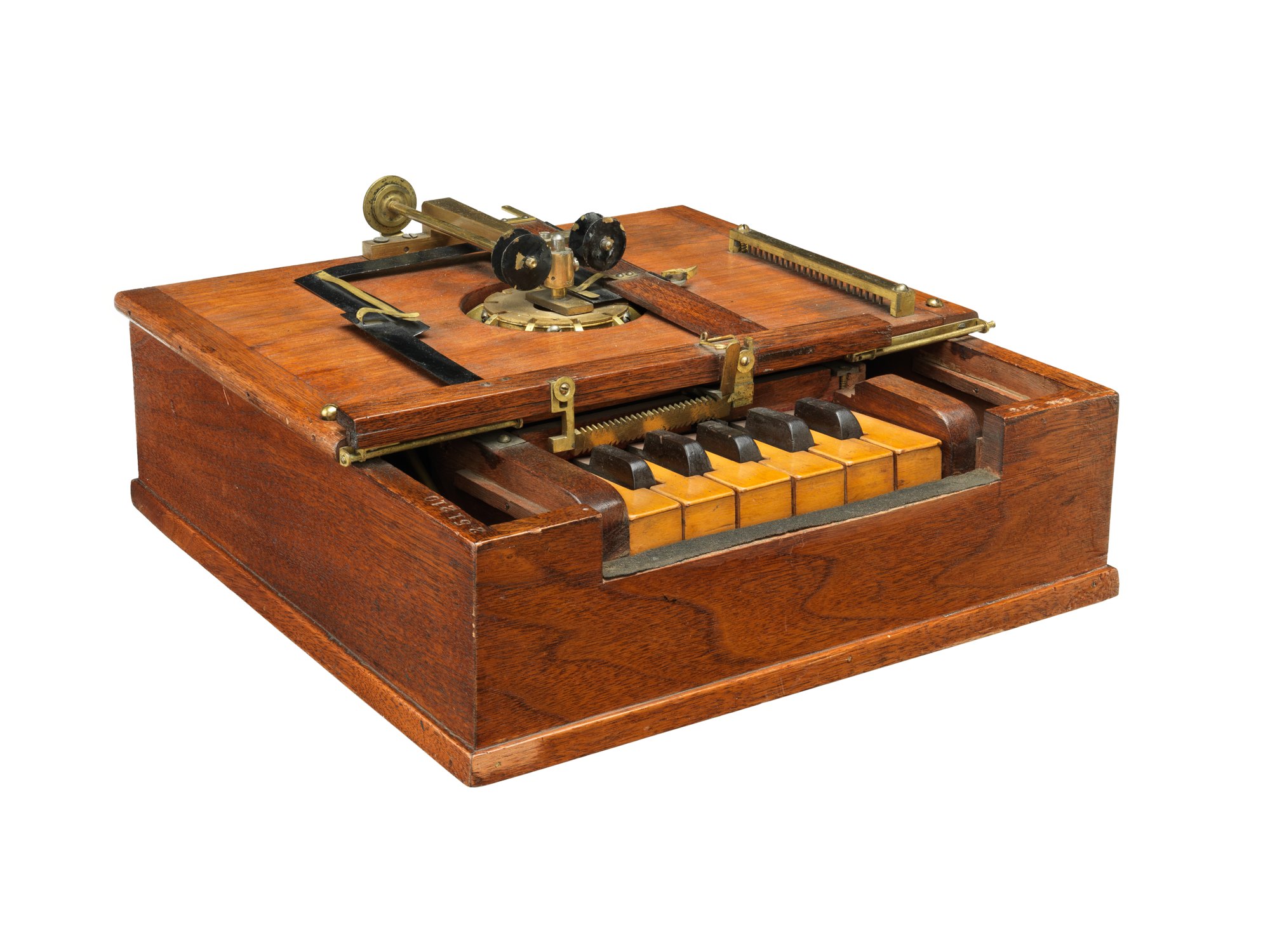
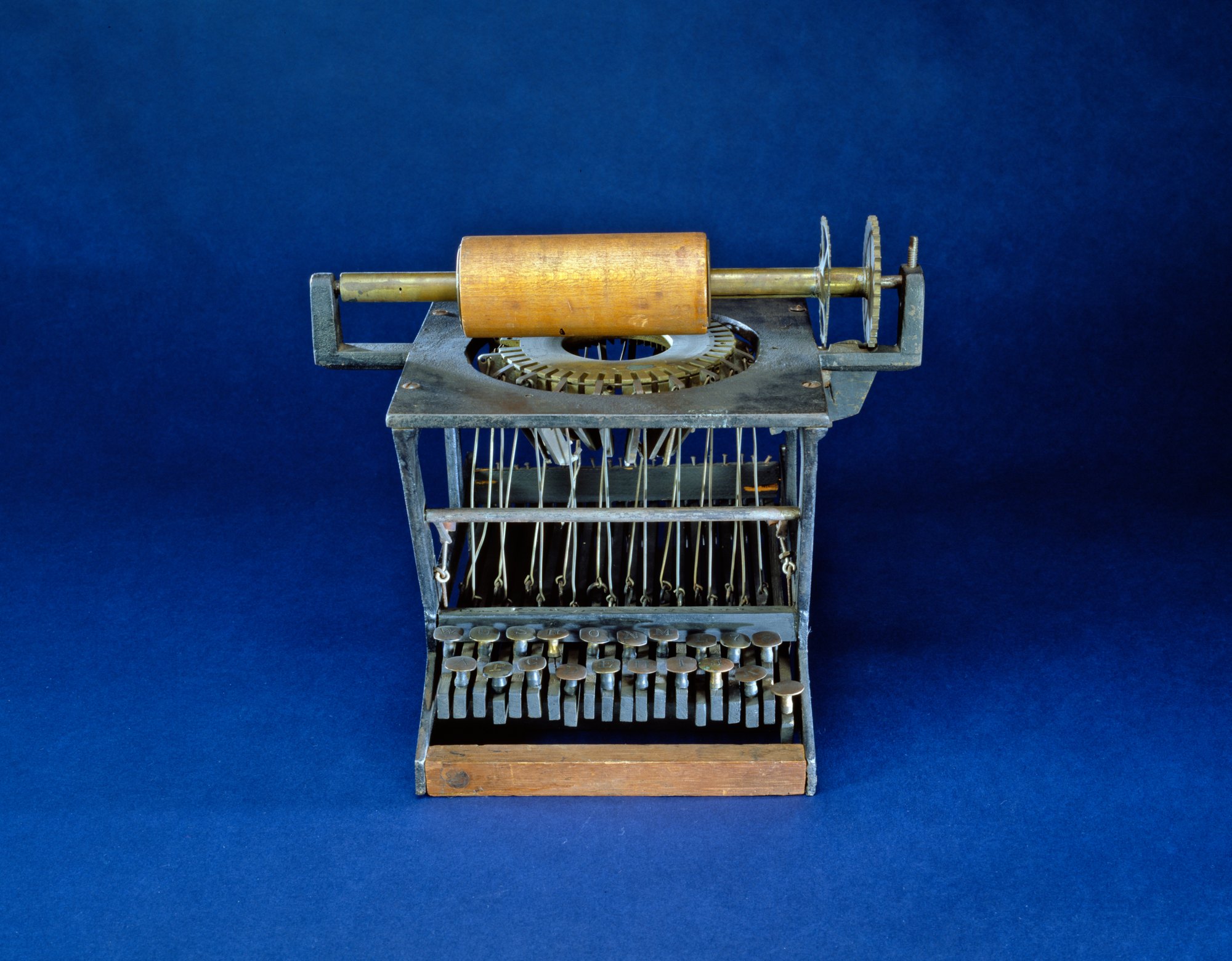
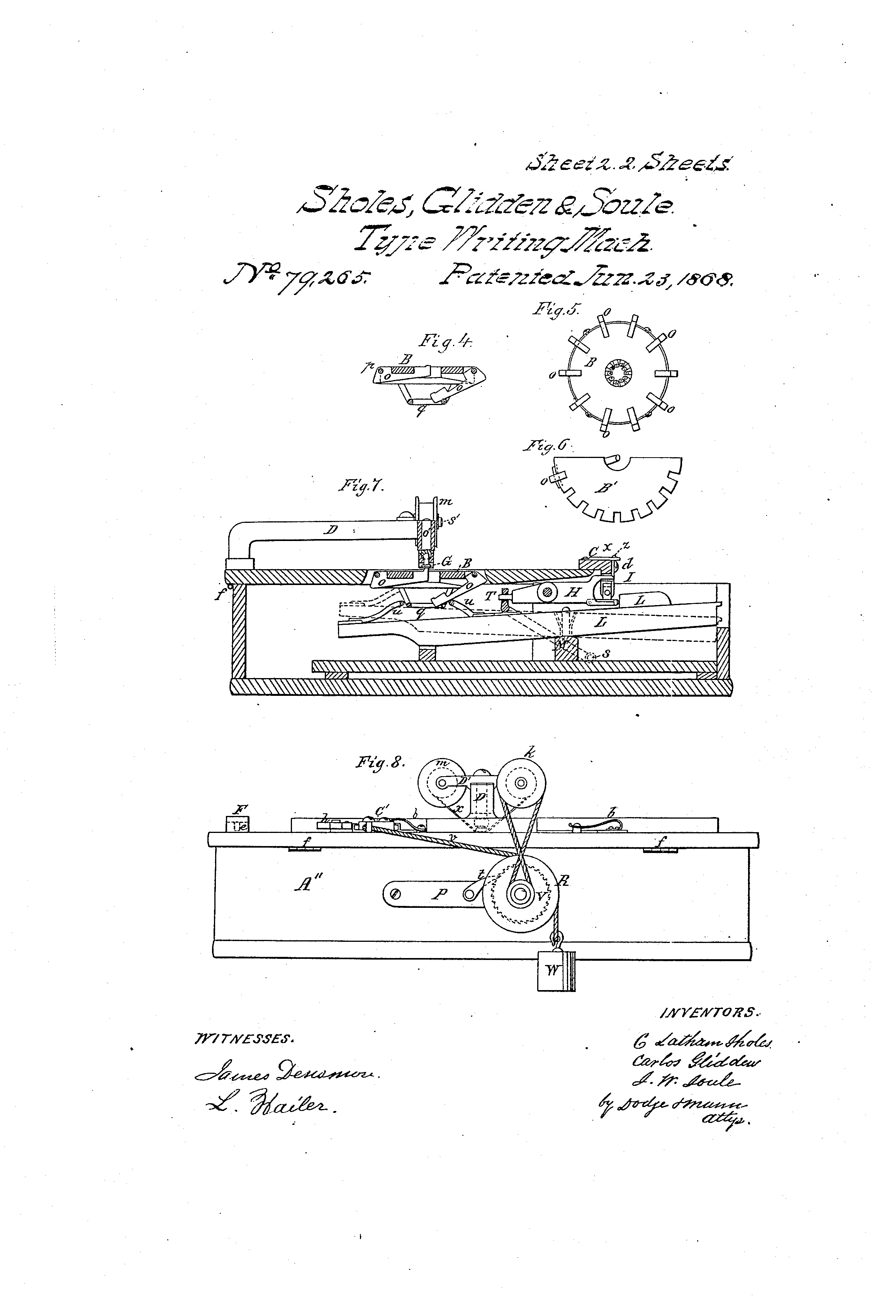
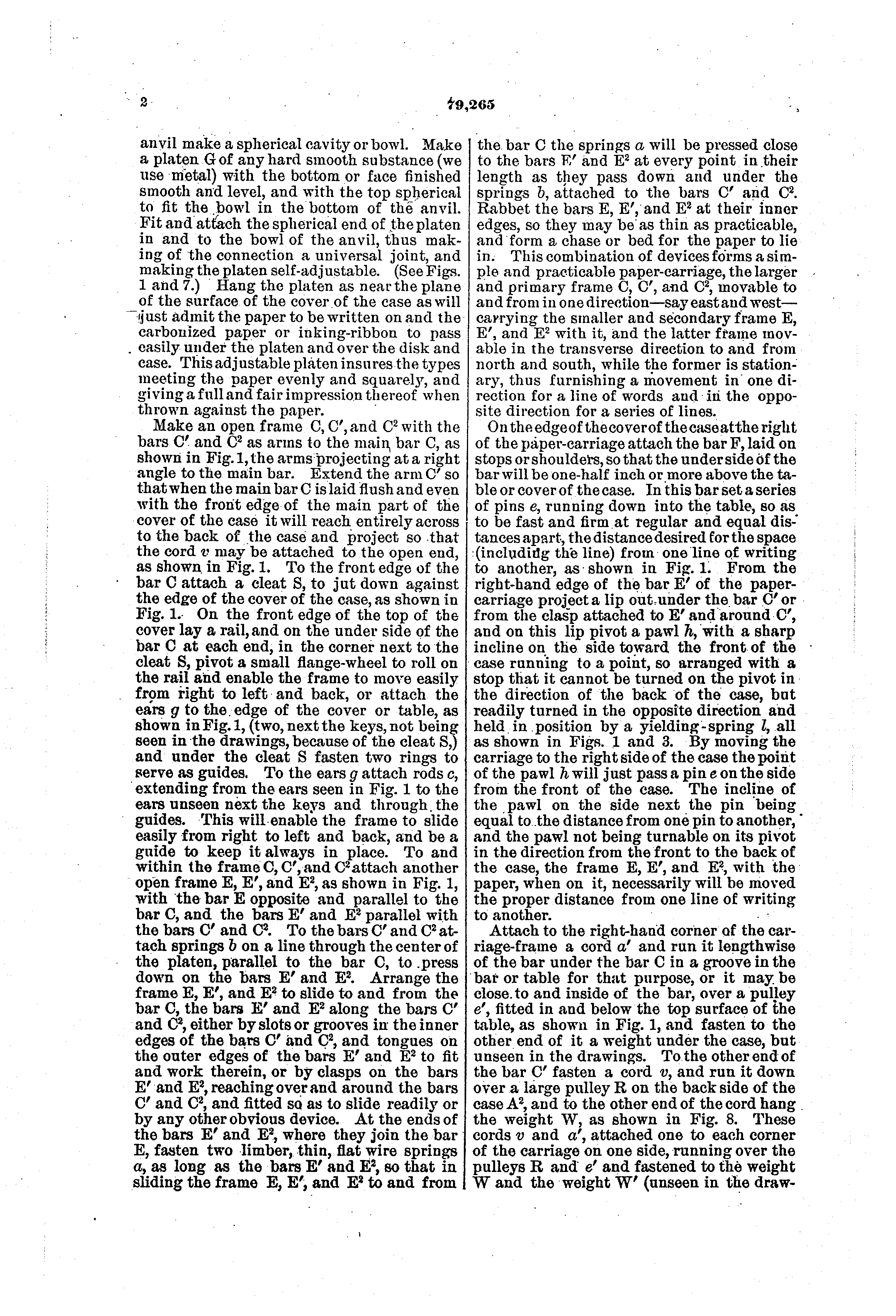
Here is the machine as the June patent describes it. It sits in a wooden case, "about two feet square, four to six inches deep". Everything happens around a brass disk, "four to five inches in diameter", with a slot cut in it for every letter. In each slot hangs a steel type-bar, pivoted at the outside of the ring, with its letter cut in relief on the inner end. Every bar is "of the exact length of the radius", so that each one, thrown up, "will strike against the central point".
The keys are, in the patent's words, "similar to the key-board of a piano", one for each type and one more for the space. Each key is a lever on a beam, M. Press the front end down, and a finger on the back end ("we use a stiff wire") throws up its own type-bar. The letter strikes the paper from underneath, against a small flat platen hung on a ball joint, "a universal joint", so that it meets the type squarely. The inked ribbon runs between the paper and the platen, so the letter is printed on the top face of the paper, where the typist can see it; the July patent says the letter "will be printed on the top side of the white paper". Then the bar falls back onto a cushion.
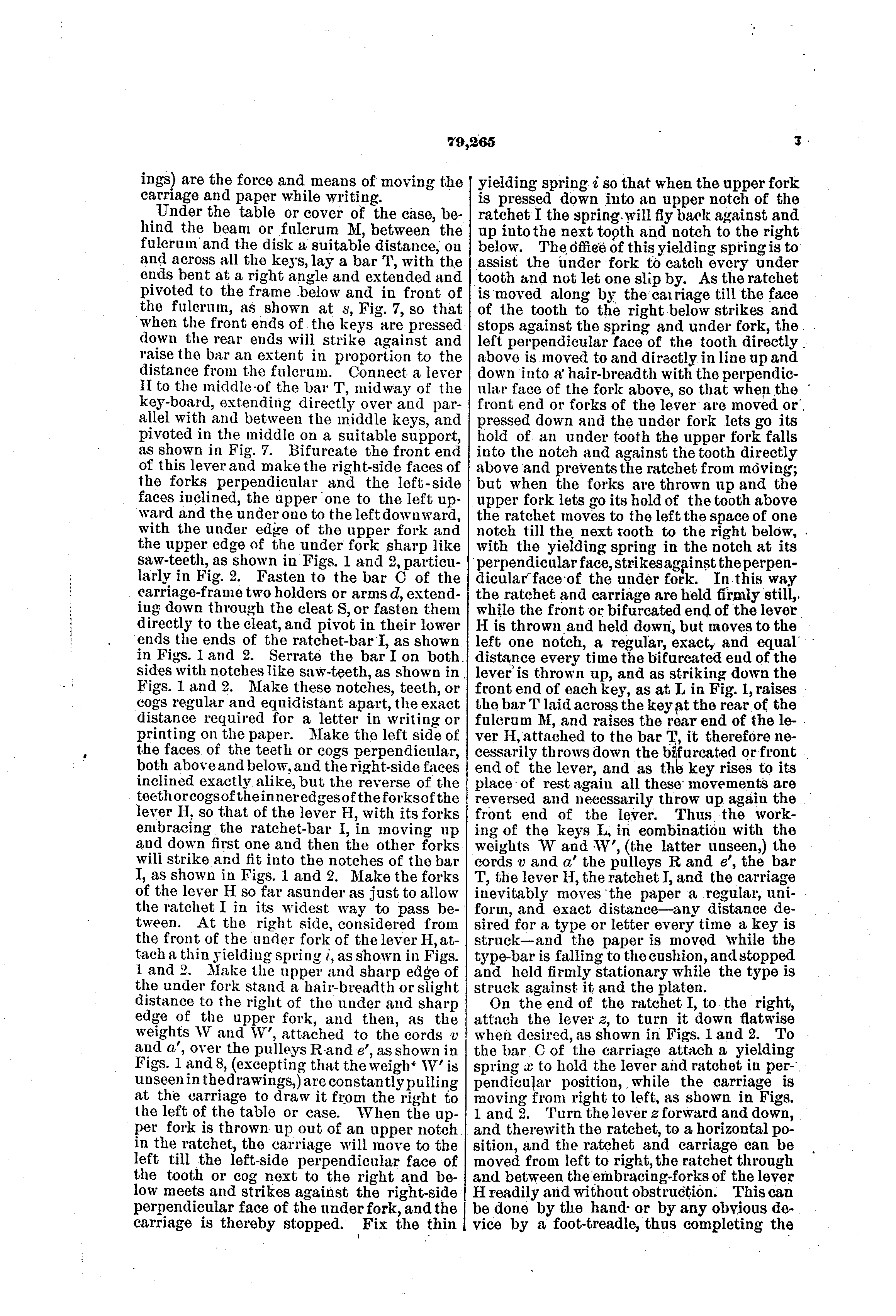
The paper lies on a carriage made of two frames: one slides along for each letter, the other moves the paper on for each line, "a movement in one direction for a line of words and in the opposite direction for a series of lines". A weight on a cord is always pulling the carriage to the left. What holds it back is a rack, "serrate… on both sides", gripped by a lever H with a forked end. Every key also lifts a bar T laid across the backs of all the keys; that tips the lever, its fork drops into the rack, and the carriage is held still while the letter strikes. When the key comes back up the fork lets go, and the carriage runs one tooth to the left. In the patent's words, "the paper is moved while the type-bar is falling to the cushion, and stopped and held firmly stationary while the type is struck against it". It is a clock's escapement, laid out flat; the comparison is ours. The same pull turns the ribbon spools a notch, to give "a fresh place of the inking-ribbon every time for every type".
At the end of a line the typist turns a lever to lay the rack flat and slides the carriage back, and a pawl catching on a row of pins moves the paper up one line.
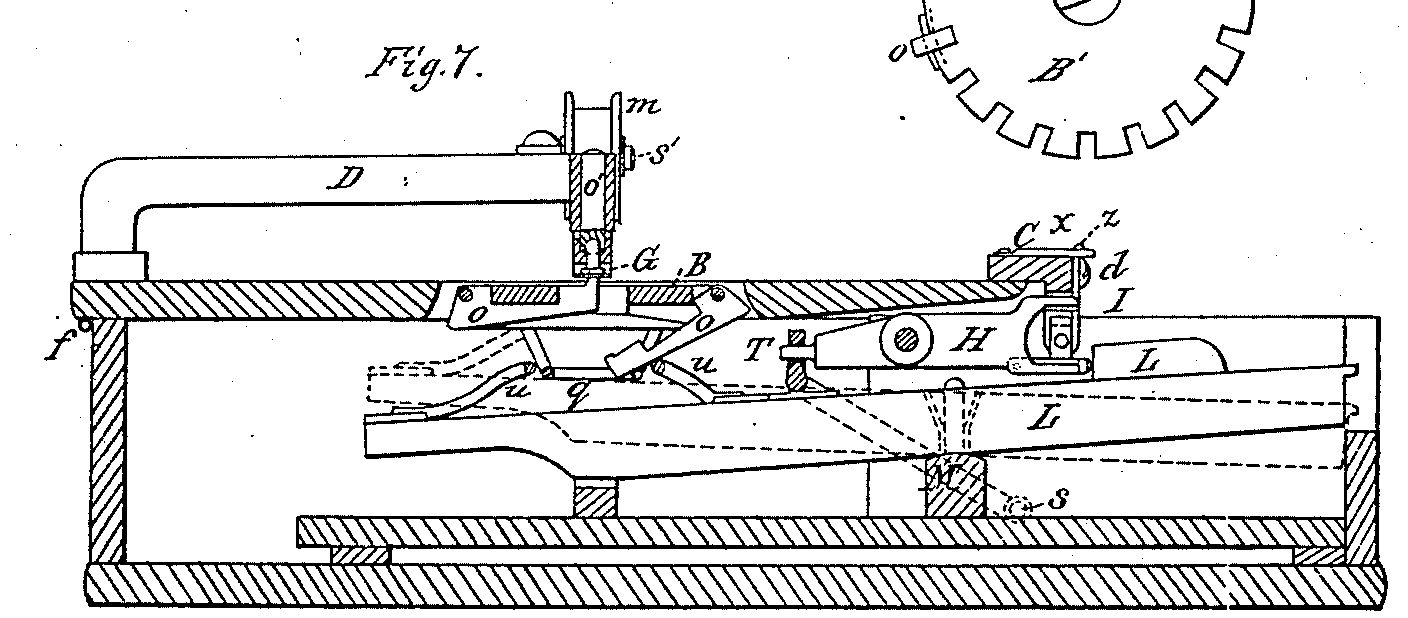
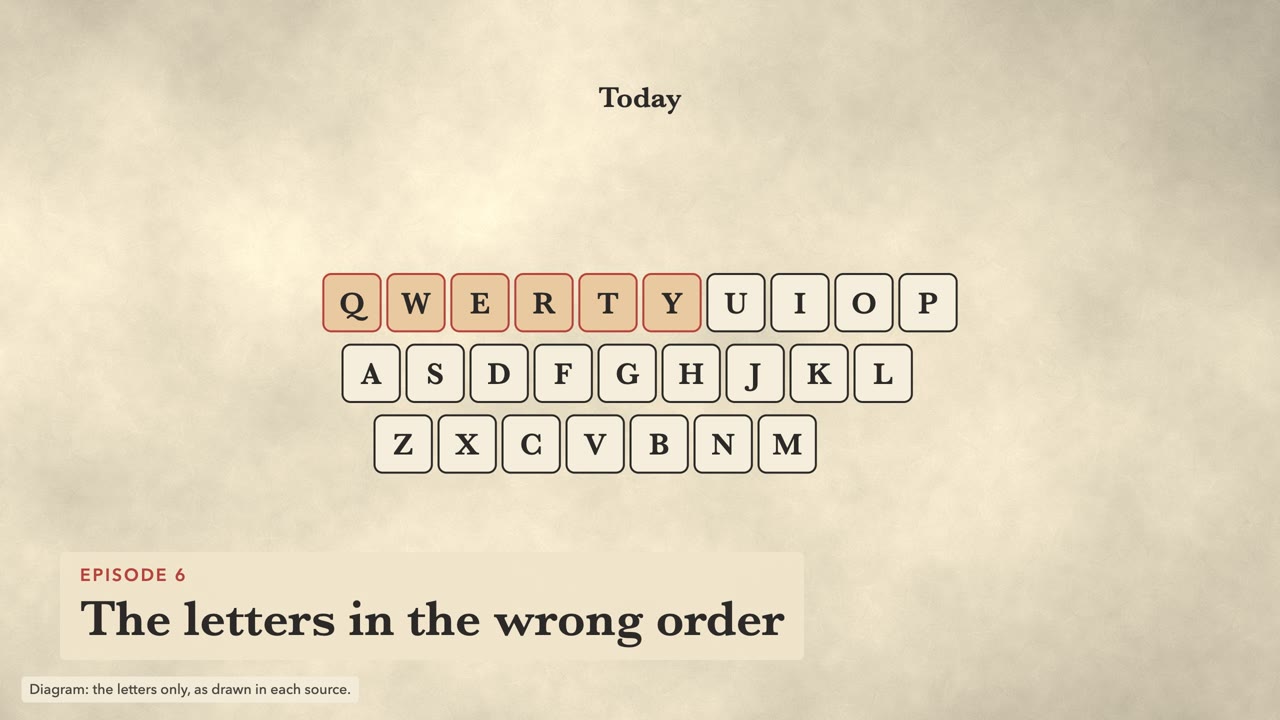
Diagram: the letters only, as drawn in each source. Solid keys strike a type-bar on this reconstruction; dashed ones have none.
From the patent: the disk, the type-bars one radius long, the piano keys on the beam M with a wire finger under each bar, the cushion q, the platen G on its ball joint in the anvil O′, the arm D, the ribbon spools m, the two-frame carriage, the weight on its cord, and the bar T tipping the forked lever H into the double-toothed rack I, with the carriage stepping as the key rises. Ours, as in the episode: twelve type-bars (the patent says one for every type to be used; its model has six keys), the letters on them (T Y P E W R I A S N O H), the lever ratios, the bars' resting angle, the tooth pitch, the weight's travel and every size the text does not give. The paper shows only the line being typed; the line feed is not drawn. The two failures are the episode's: R thrown up before E has fallen, and the T bar stuck at the centre with the next bars hammering against it.
- B
- The brass disk, "with as many radial slots or grooves as types to be used".
- o
- The type-bars, pivoted on a wire round the outside of the disk, the type cut on the upper side of the inner end.
- L, M, u
- The keys, the beam they rock on, and the finger on each key that reaches under its own bar.
- q
- The cushion the bars fall back on.
- O′, G
- The anvil over the centre and the platen hung from it on a ball joint, "making the platen self-adjustable".
- T, H, I
- The bar across the keys, the forked lever it tips, and the rack on the carriage, toothed on both edges "the exact distance required for a letter".
- W
- The weight on its cord, over a large pulley at the back, that pulls the carriage along.
A long row of T's

Now look at the keyboard in the July patent. Two rows, like a piano. On the long keys, A to M; on the short keys, N to Z. Alphabetical order. Switch the keyboard under the model to "1868" to see it.
Machines went out to be tried. One of the first testers was Charles Weller, a shorthand reporter in St. Louis, from "about the middle of January, 1868". Fifty years later he remembered "more or less sticking of the type bar in the slot", and that "it was not an uncommon thing to find a few type bars bunched up in the center, which of course stopped all operations until they could be pried apart". The weight was trouble too: they would add to it "a jack knife or a paper weight or a pair of shears or whatever might be at hand", and sometimes the cord broke, "letting the weight down with a crash".
"When one started out on a sentence commencing with the letter 'T' in place of the sentence we would have a long row of T's, indicating that the T had stuck in the slot, and the other letters were hammering up against it."
Weller blamed the slots: the bars caught in the grooves of the disk instead of dropping back. Try "Stick the T bar" on the model above. On 28 September 1870 Sholes wrote to him that he had "dispensed with the slotted disk altogether", and that now "the hammers can never stick". That was a fix in the machine. The letters were about to move for other reasons.
Moving the letters
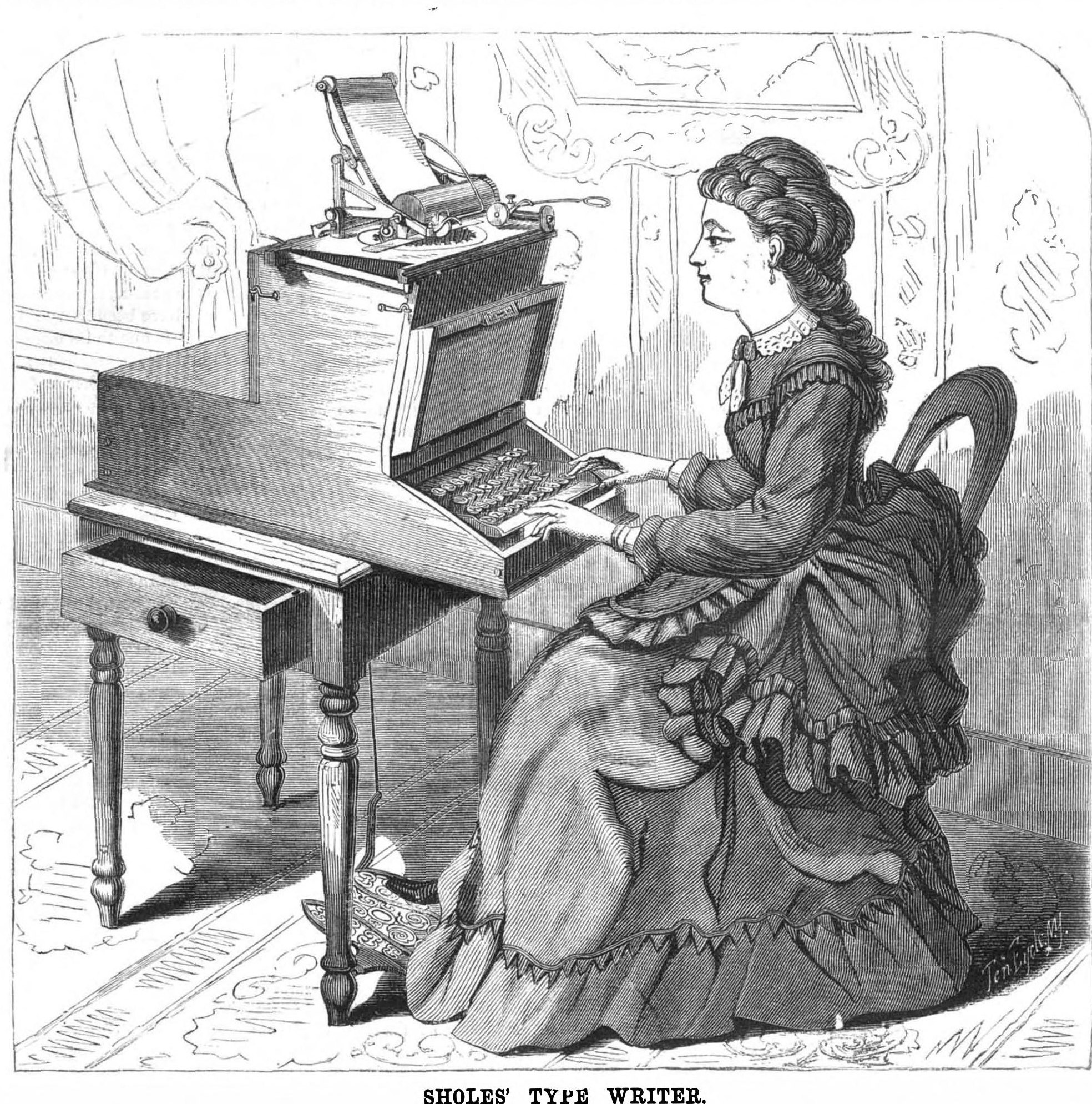
Between 1870 and 1873 Sholes and Densmore rebuilt the machine again and again, and the keyboard changed with it. On 14 March 1871 Sholes wrote to Weller: "The key board is not the same; the disk is not the same." By August 1872 the machine was on the front page of Scientific American. Its keys, the magazine said, took "from four to five ounces" to press, "the same as that of the keys of a piano".
How they chose the new order, nobody wrote down at the time. The 1923 anniversary history was sure that "Densmore and Sholes, laboring together, worked out the universal arrangement of the letter keys", but admitted that "just how they happened to arrive at this arrangement, however, is a point on which there has always been much speculation". What we have are later recollections. Henry Roby, a Milwaukee court reporter, remembered in 1925: "At first the keys were set in alphabetic order and we found certain keys colliding and jostling with one another." The historian Richard Current, who read Sholes's and Densmore's letters, wrote in 1954 that some often-used letters "were so close together that the type bars, hung as they were in a circular 'basket,' collided more frequently than need be". So keeping those letters apart was part of the reason.
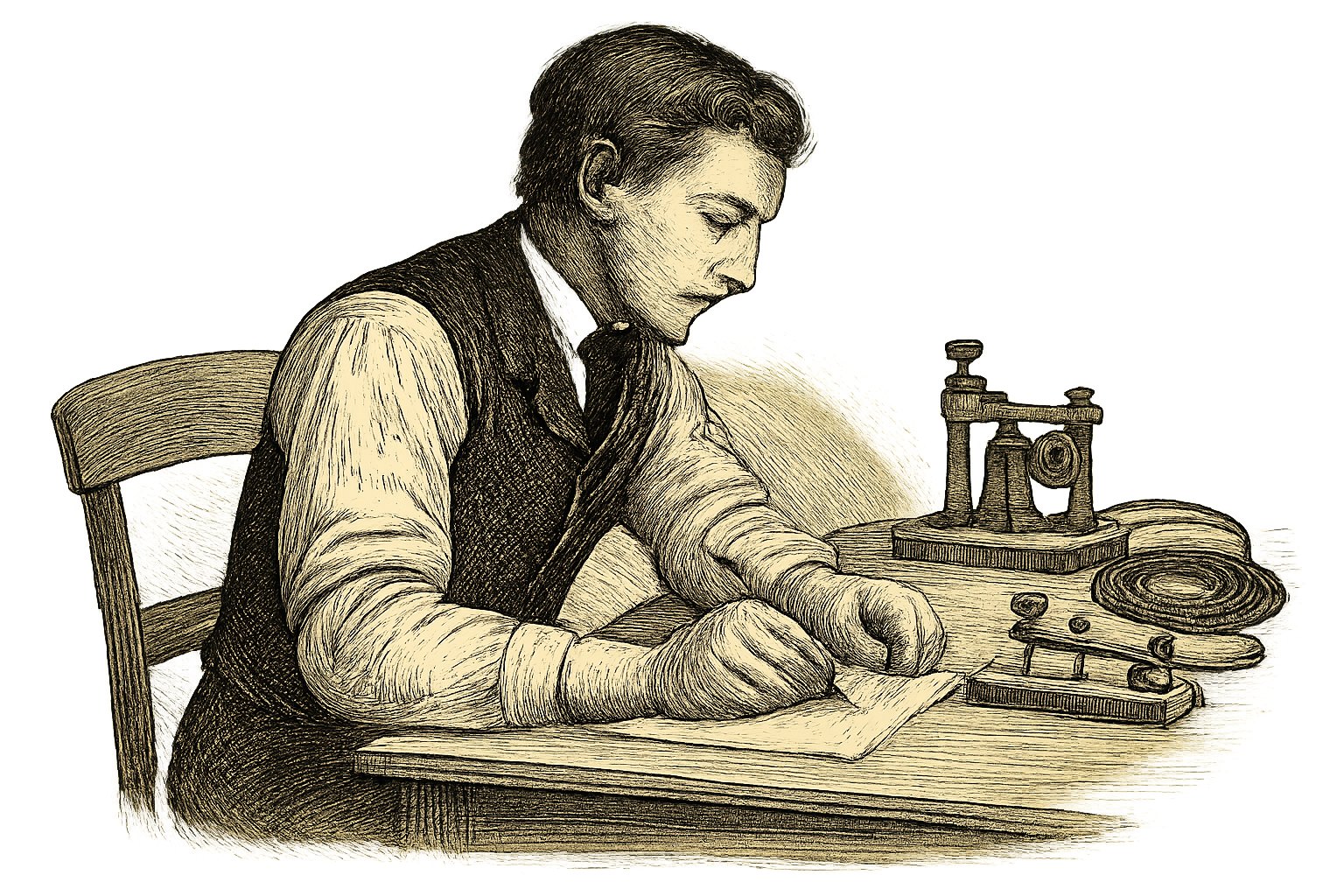
But some of the earliest testers were telegraph operators: Current names E. Payson Porter, who ran a school for telegraphers in Chicago, and Koichi and Motoko Yasuoka date the first machine sent there to November 1868. The Yasuokas, two Kyoto researchers, argue that those operators shaped the keyboard: that it grew out of the piano keyboard of the Hughes printing telegraph (George Phelps's US 26,003 of 1859 has one), and that some letters sit side by side because they are easy to confuse in Morse code. In American Morse, they point out, Z can be mistaken for S followed by E. Other typewriter historians aren't convinced. Richard Polt has written that he is "not convinced by their argument about Morse code", and nobody has settled it.
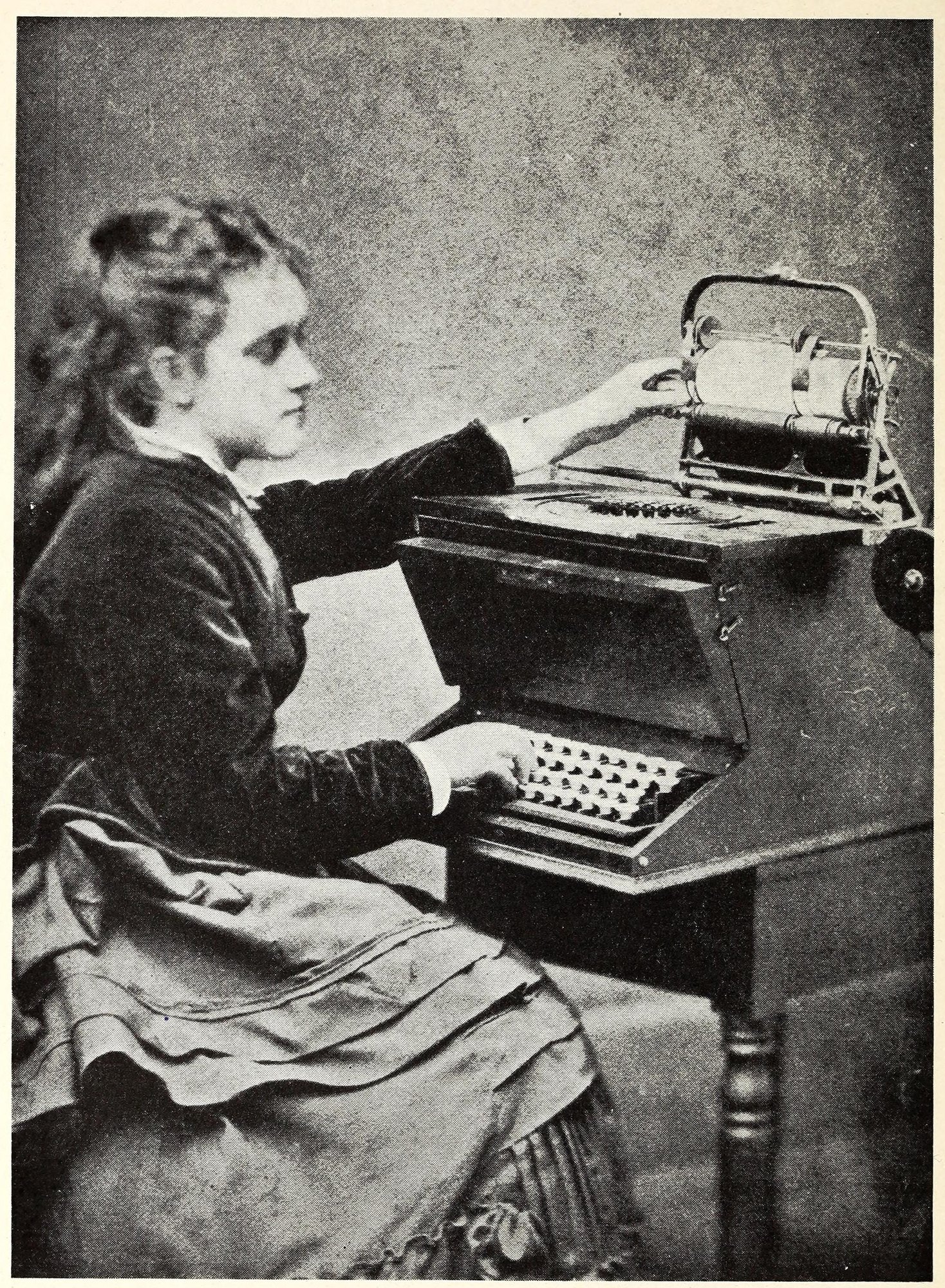
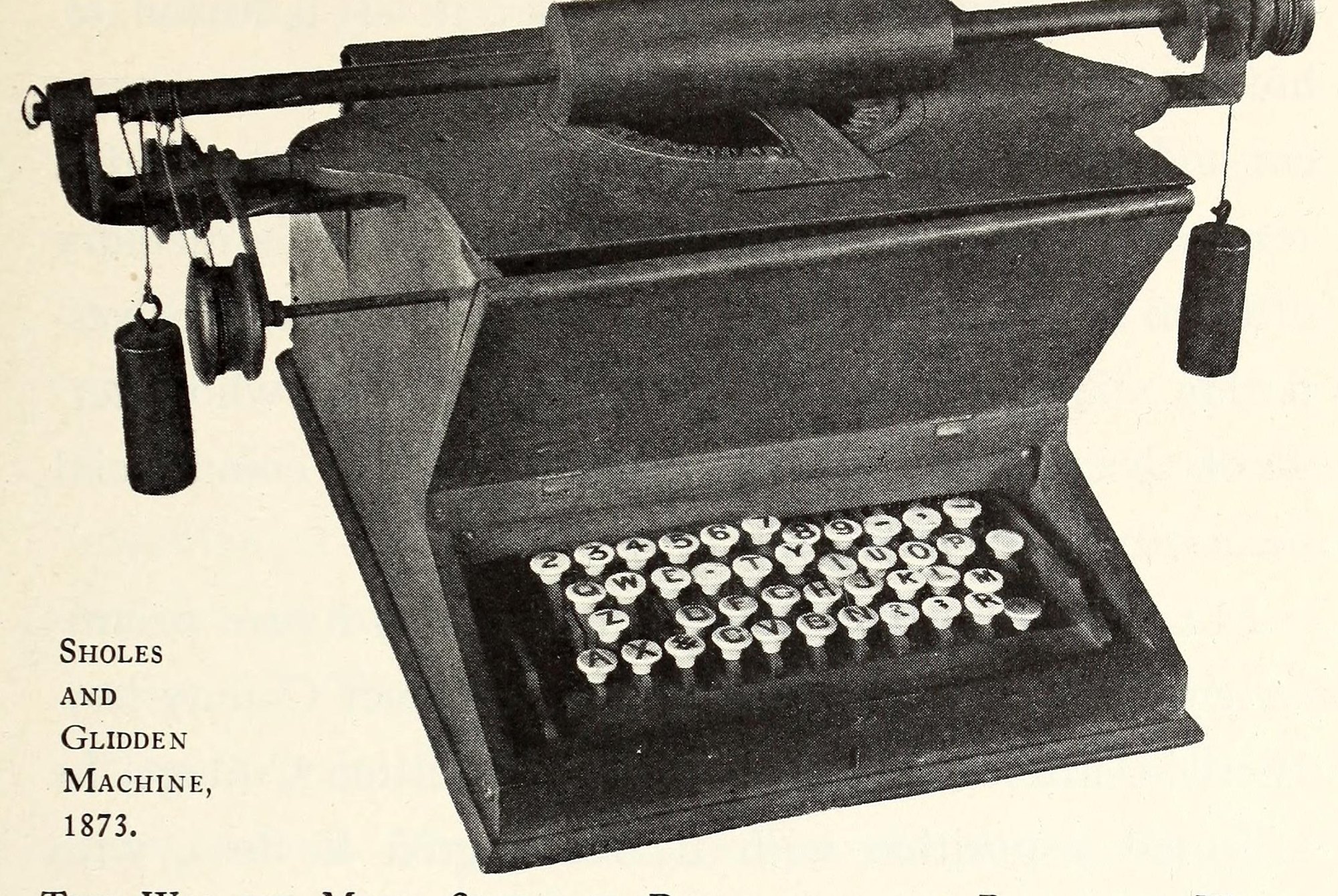
This is the machine Densmore took to the Remington company in 1873. In the 1923 photograph you can read, along its second row, Q, W, E, a full stop, T, Y. The R was still down at the end of the bottom row. Paul David and the Yasuokas both say Remington's mechanics later put the R where the full stop had been. (The keytops are read from a halftone of 1923; several are uncertain.)
Remington
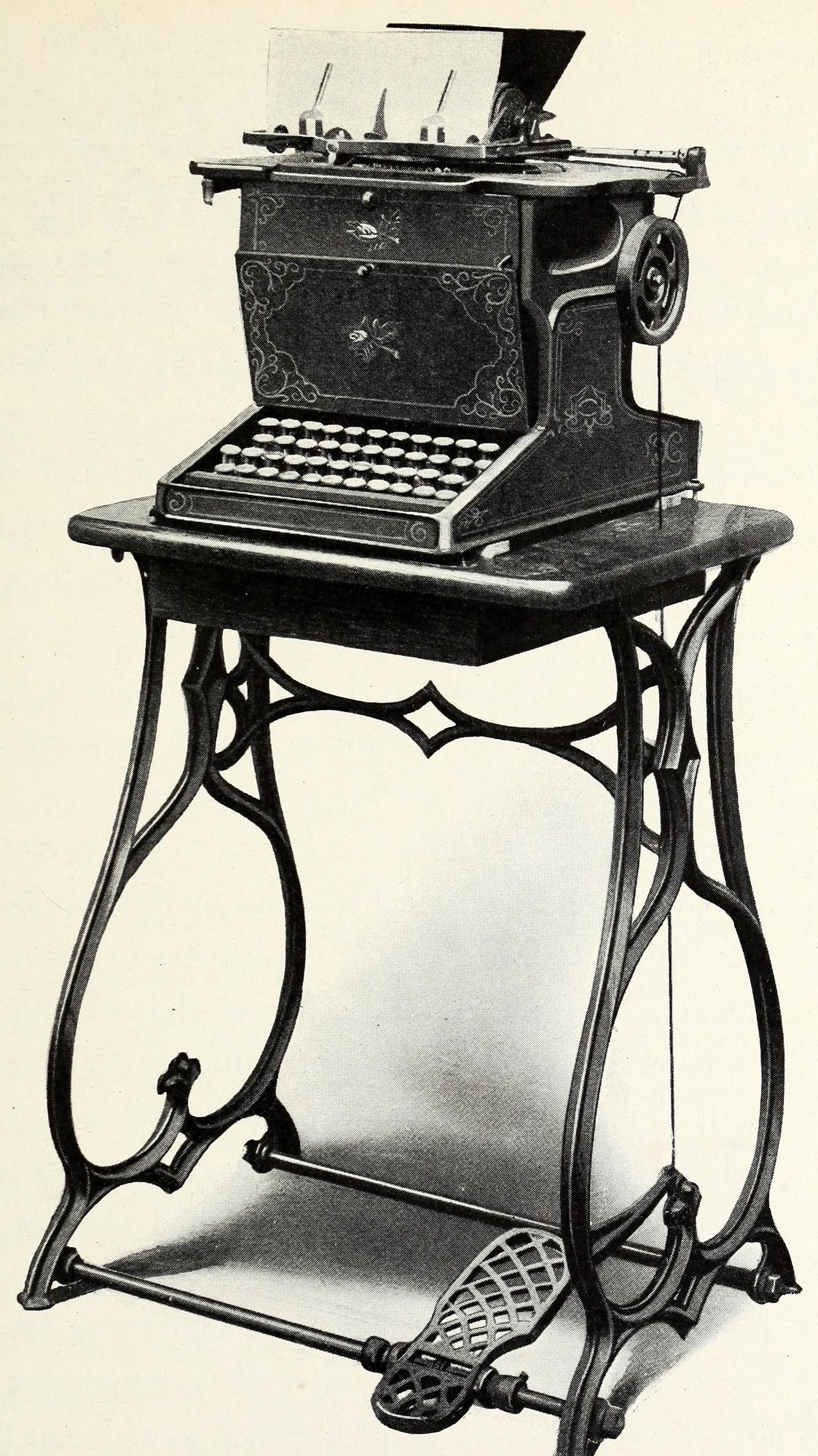
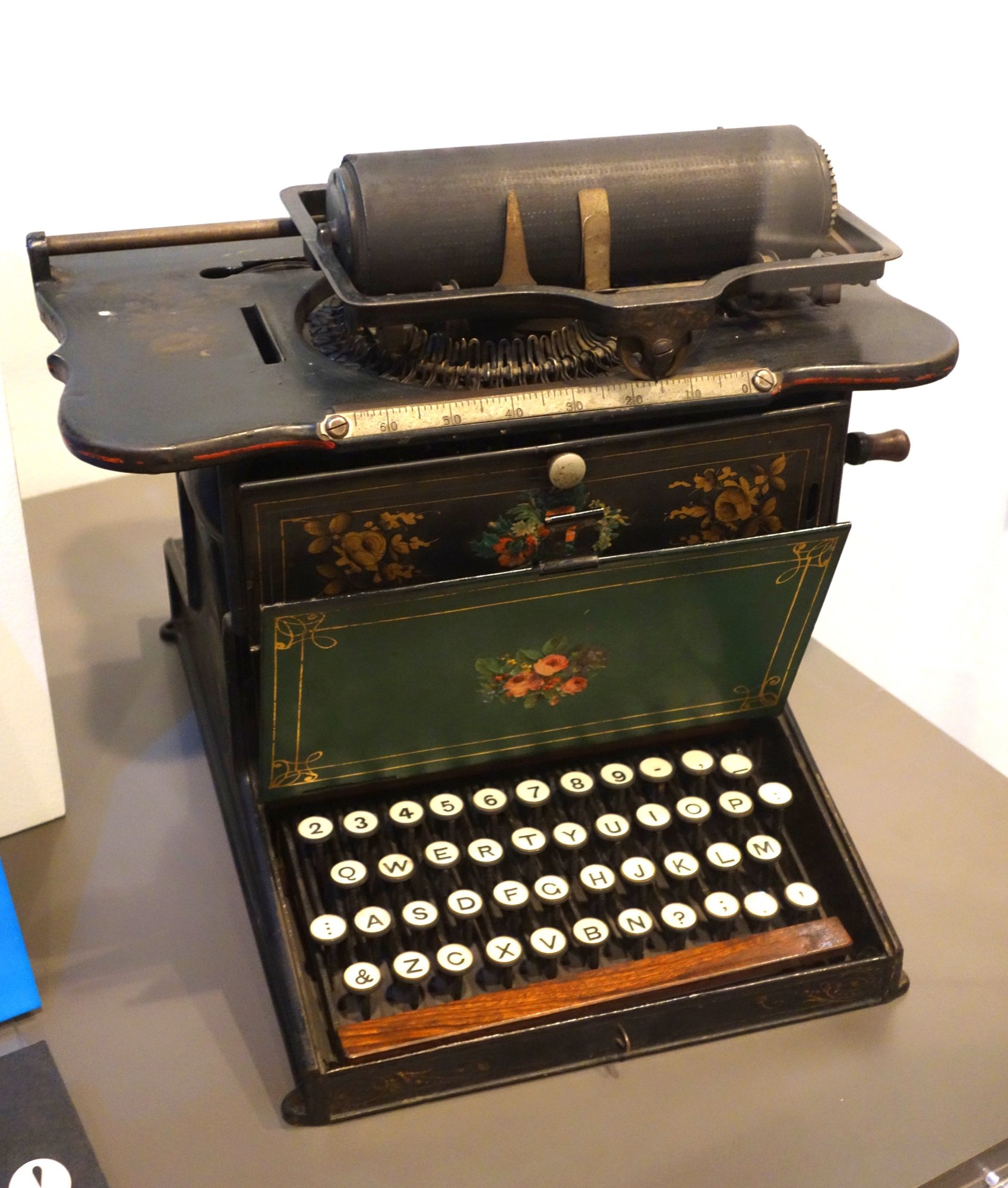
On 1 March 1873 Densmore signed a contract with E. Remington and Sons, of Ilion, New York, makers of guns and sewing machines. "The original contract was for manufacture only", not a sale of the patents. Remington's mechanics, William Jenne and Jefferson Clough, reworked the machine, and manufacture began that September. It came on a sewing-machine stand, with a treadle to bring the carriage back.
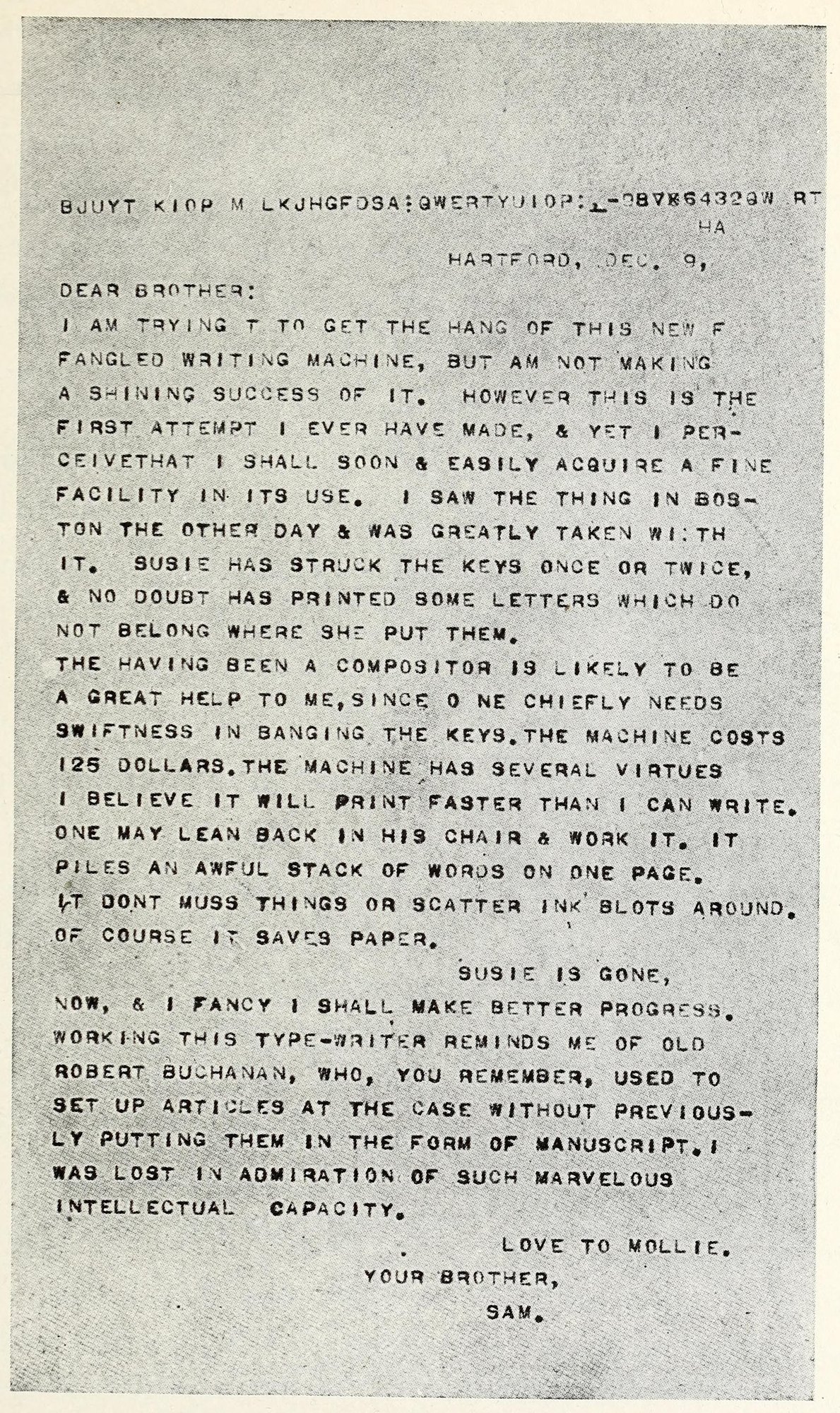
In 1874 it went on sale as the Sholes and Glidden Type-Writer, for $125 ≈ $3,600. It typed only capital letters. One of the first buyers was Mark Twain. His typed letter of 9 December 1874 starts by running along a row of keys, "QWERTYUIOP", and says "the machine costs 125 dollars". The name Remington Model 1 came later.
Sholes himself "is said to have sold out his royalty rights to Densmore for $12,000" ≈ $320,000, which the anniversary history calls "the only reward, so far as we know, that he ever received for his priceless invention".
Drawn, not patented
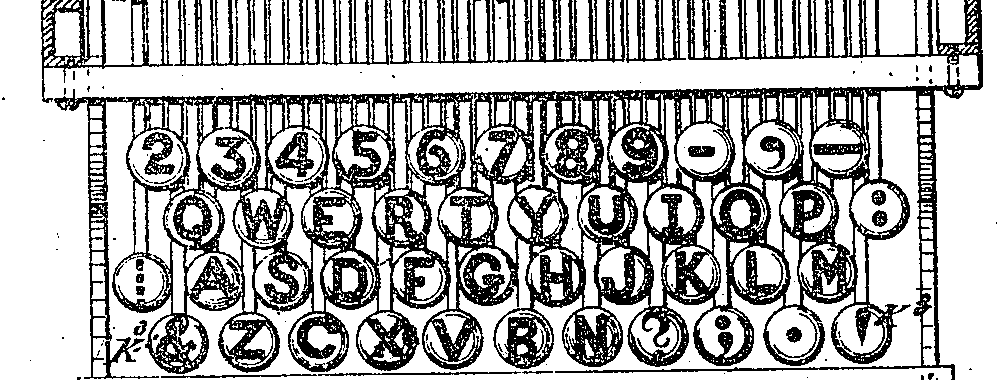
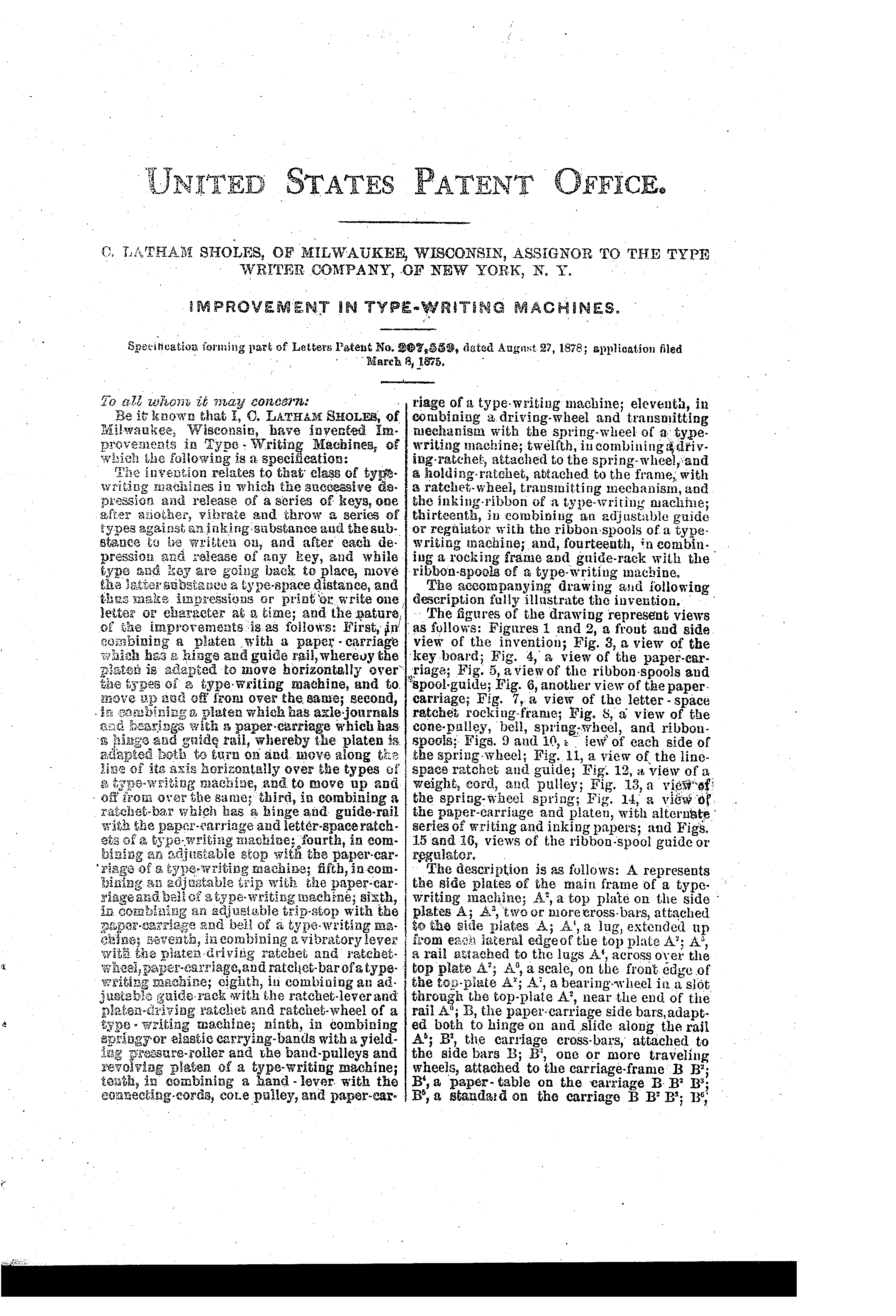
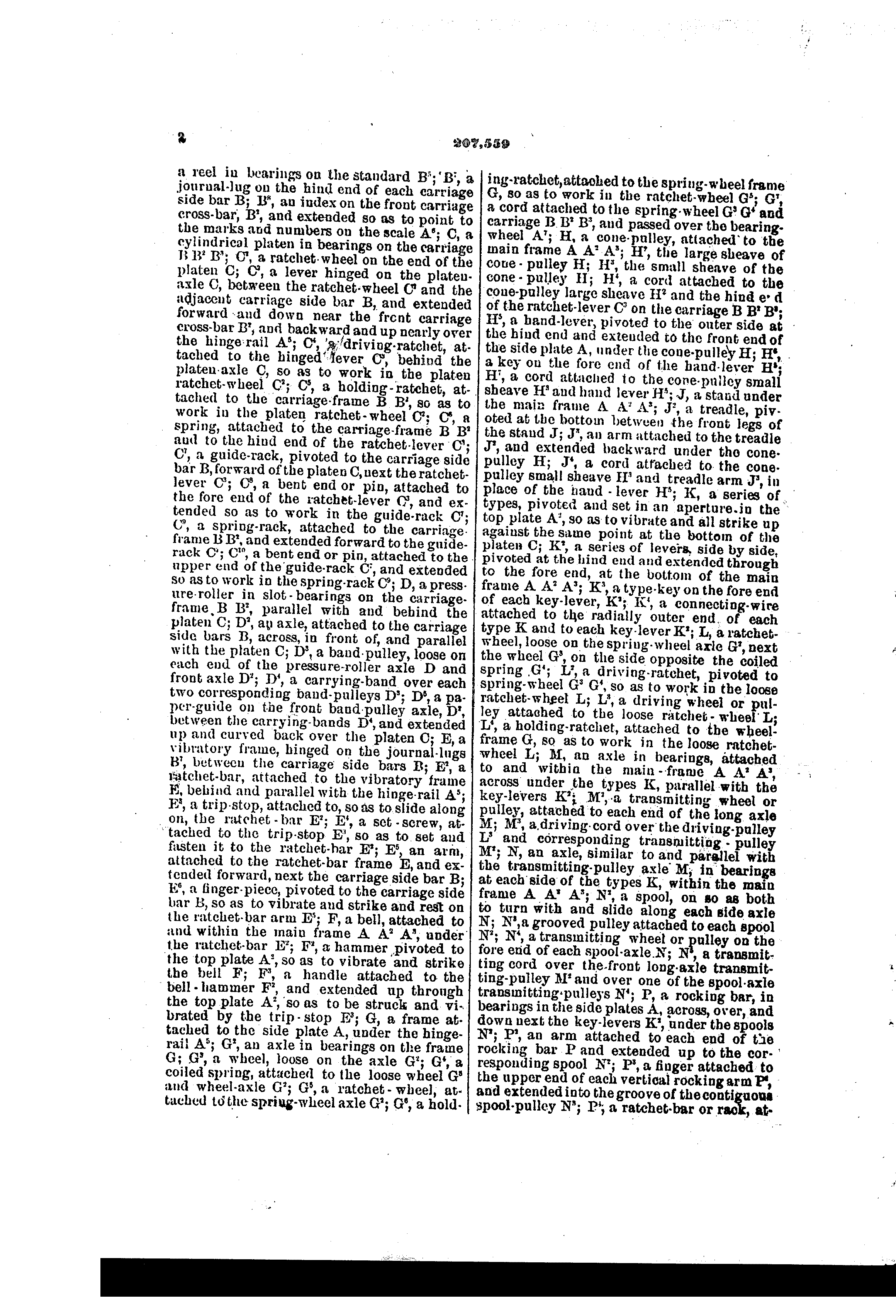
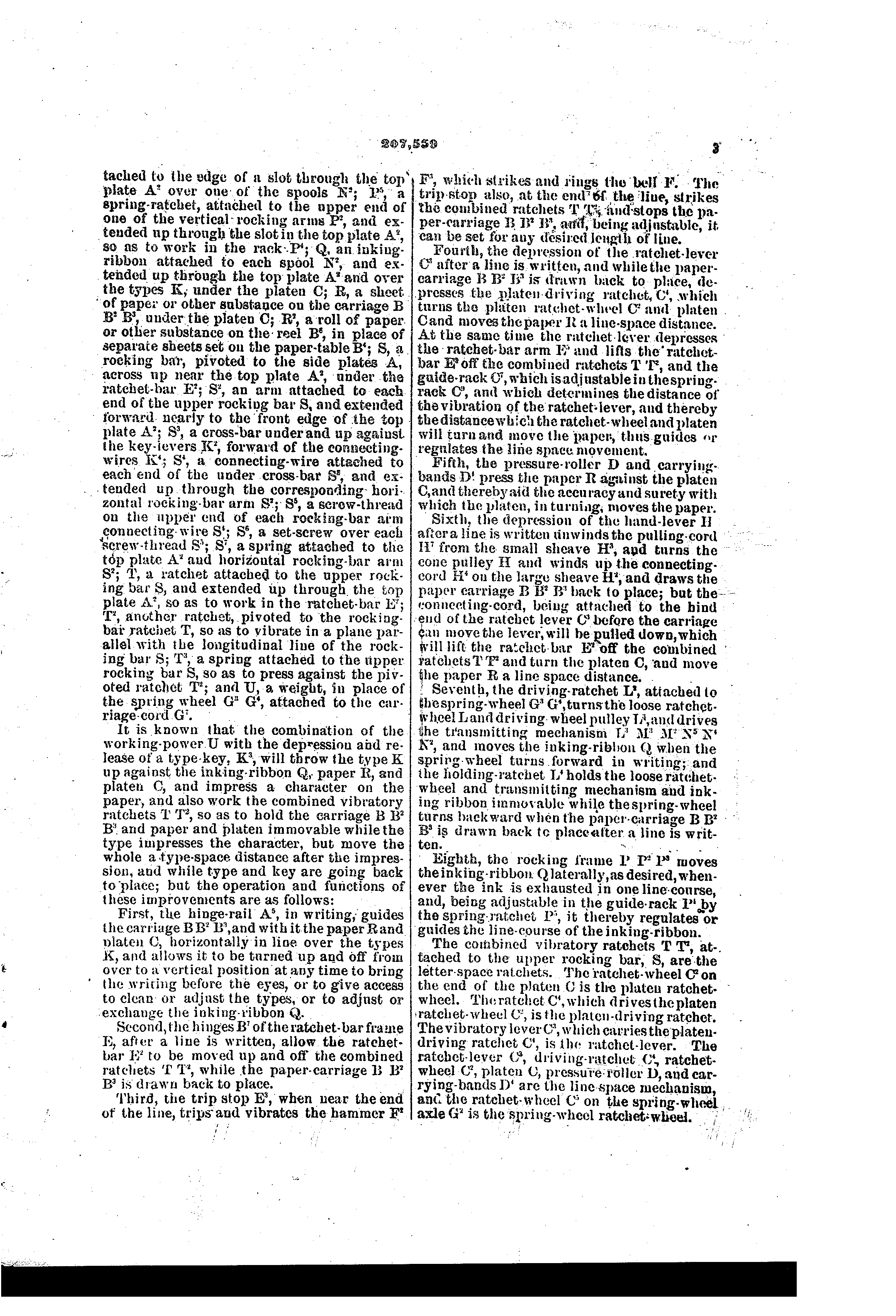
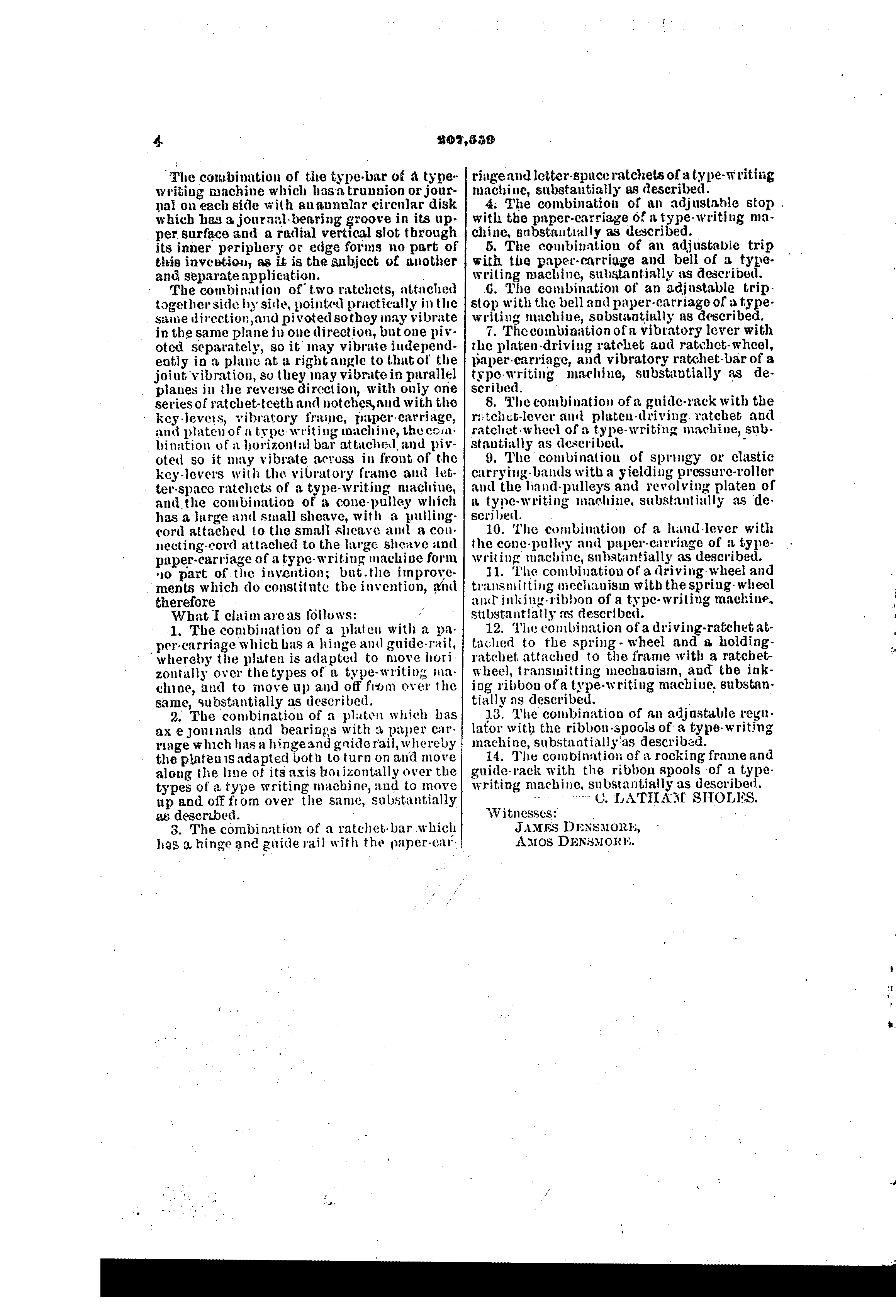
On 8 March 1875 Sholes filed another patent, granted on 27 August 1878 as US 207,559. Its drawings include the keyboard, and there it is: Q, W, E, R, T, Y, U, I, O, P. There are two small differences from yours: M sits at the end of the middle row, and C comes before X. But the patent never describes the letters, or claims them. The keyboard is just a figure, listed as "a view of the key-board". The layout was drawn, not patented.
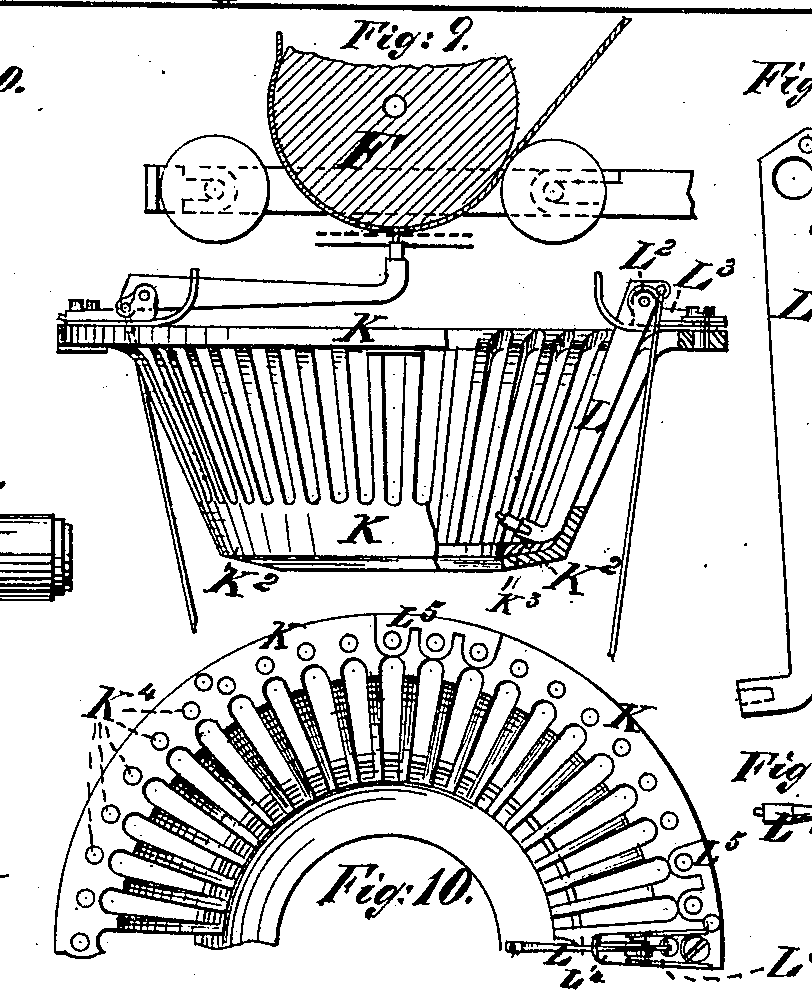
What the letters had to fit was the ring of type-bars. In this machine they "all strike up against the same point at the bottom of the platen". Bars that sit side by side in the ring travel closest together, so if one rises before its neighbour has fallen, they meet; that reading of the drawings is ours. A Remington patent filed the same year, Clough and Jenne's US 199,263, made its type-bars of tempered steel, thin at the pivot end, so that each one "will spring to one side without harm when colliding with another". The collisions were real enough to design around.
But when the Yasuokas measured where the letters sat in the ring of surviving machines, E and R, one of the commonest pairs in English, were only 16 degrees apart: with 44 bars round the ring, about two bars. If the plan was to keep common pairs apart, it didn't manage it everywhere; the Yasuokas call the arrangement "somewhat ad hoc". Try "Strike R before E has fallen" on the model.
And slowing typists down? We found no one from the time who said that. The machine was sold on speed: "any one, after short practice, can easily become able to write from sixty to eighty words per minute", Scientific American promised in 1872.
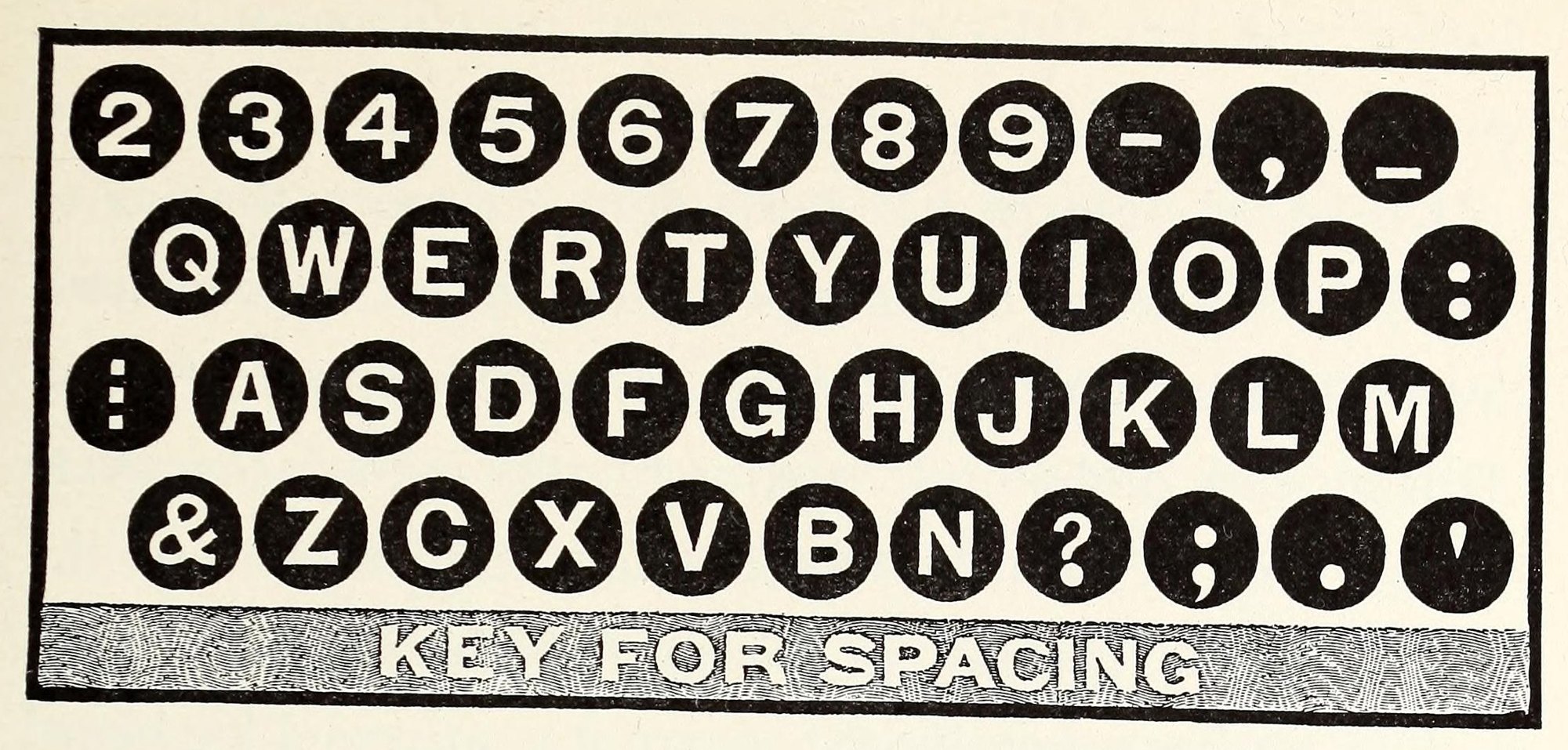
Almost QWERTY
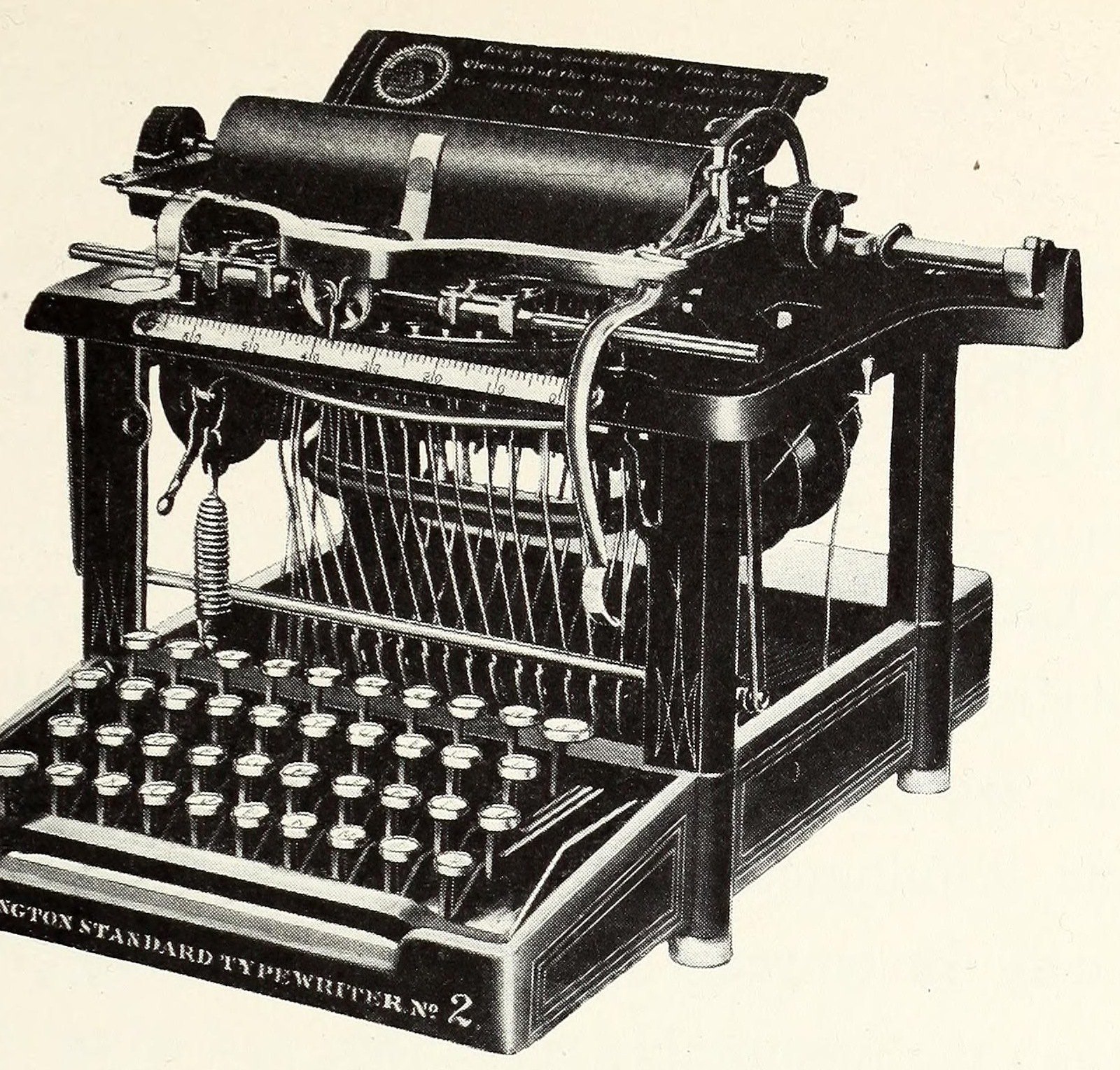
In 1878 the Remington Number Two added a shift key, and with it small letters. Pressing shift moved the platen (B. A. Brooks's US 202,923, granted that April), so the same type-bar could print a capital or a small letter. About four years later, according to the Yasuokas in 1882 on the Remington Standard No. 2 sold by Wyckoff, Seamans and Benedict, M moved down beside N, and C and X swapped places. That is the keyboard we use now; switch the diagram between "1875" and "Today" to watch the two changes. (We have not checked their date against a Remington catalogue.)
Typists learned to type without looking, on Remington's keys, from the late 1880s. By the 1890s the big typewriter makers had settled on the same arrangement; the Yasuokas name the five makers of the Union Typewriter Company, formed in 1893. It wasn't for want of rivals: Hammond and Blickensderfer machines were sold with other keyboards, and QWERTY still won out. Teleprinters took it up in the 1910s, and later computers inherited it.
Once people had learned it, changing it had a cost. Densmore had felt that cost himself. Learning one of the new keyboards, he wrote that it "was as new to me as if I had never learned any one. And there was this against it — I had to unlearn as well as learn."
Dvorak
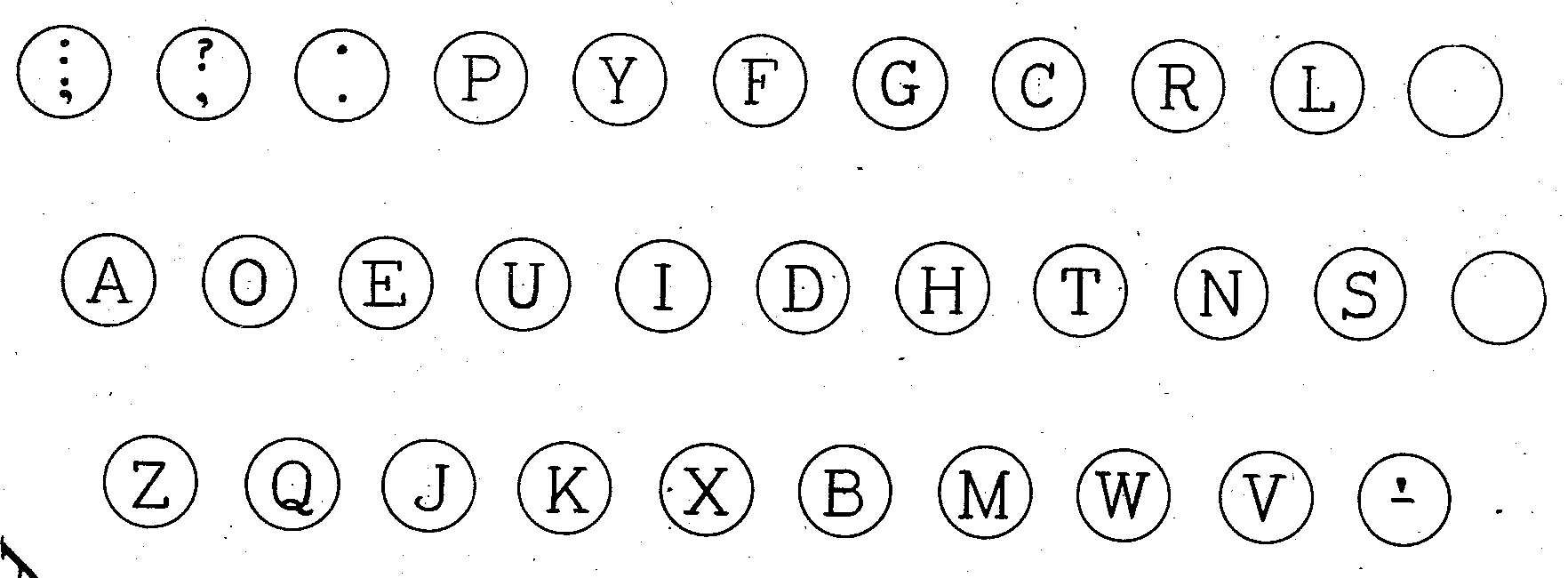
On 12 May 1936, August Dvorak and William L. Dealey, of Seattle, were granted US 2,040,248 for a typewriter keyboard (they had filed in May 1932). It put the vowels under the left hand and the commonest consonants under the right: "we have been able to locate letters accounting for 70% of the total letter frequency in the home row". The patent calls the "so-called 'universal' keyboard" slow and full of errors, citing "more than 11,000 errors by student typists". Its bottom row is not quite today's Dvorak, which ends in Z; the diagram under the model follows the patent.
In 1944 a US Navy report said typists retrained on Dvorak had become far faster. In 1985 the economist Paul David made QWERTY the classic example of a worse technology we are locked into, and pointed to those Navy tests; advertising of the time claimed Dvorak "lets you type 20-40% faster". Then two other economists, Stan Liebowitz and Stephen Margolis, went looking for the Navy study. It "does not state who conducted the study". Earle Strong, a Pennsylvania State University professor, reported that Dvorak himself had run it, and another writer, Foulke, called him "the Navy's top expert in the analysis of time and motion studies". Hisao Yamada, a Dvorak advocate, said Dvorak had only provided the typewriters. Liebowitz and Margolis: "We do not know whom to believe". Its two groups weren't measured in the same way. A study Strong ran for the US General Services Administration in 1956 retrained typists more carefully and found no gain in switching. Later studies put Dvorak's advantage at somewhere between nothing and about six percent.
So the claim that QWERTY is badly slower isn't supported. Neither is the claim that it's the best there could be. (The Navy report and Strong's study are known to us through Liebowitz and Margolis; we did not read them.)
Why we're stuck with it
So why are we still typing on QWERTY? Not because it was made to slow anyone down: nothing from the time says that. Partly because the first machines jammed, and the letters were moved with that in mind. Partly for reasons nobody wrote down. And mostly because it came first, on the machine that sold, and everyone learned it. In 1923 the typewriter's anniversary history already said it:
"To induce typists generally to unlearn the universal keyboard and learn another would be a well nigh impossible task… The universal keyboard has a hold similar to that of language itself."
It's why the phone in your pocket still puts Q, W and E in the top corner.
Read the original patents
All three patents are in the public domain. Click a page for full resolution.
US 79,265, Sholes, Glidden and Soule, granted 23 June 1868
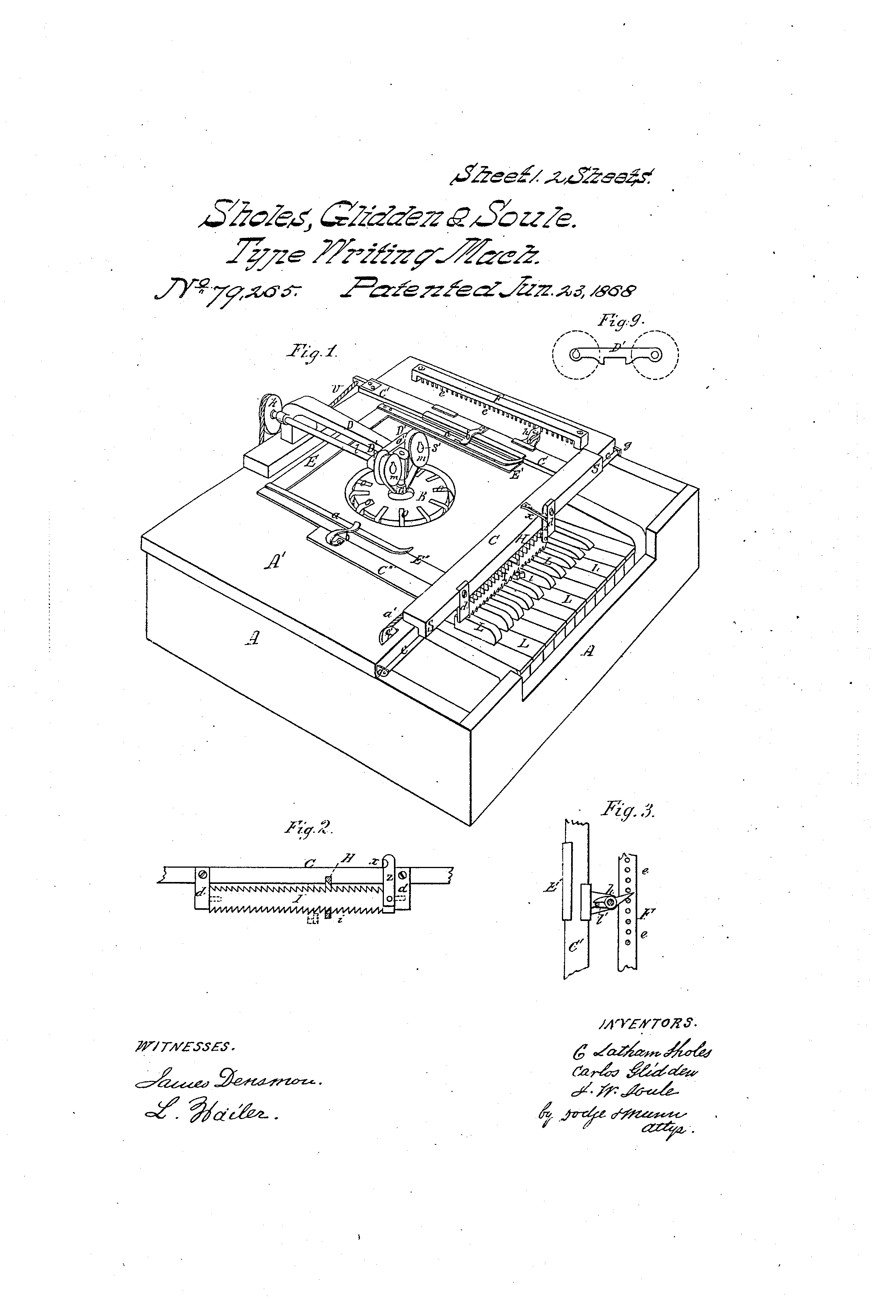
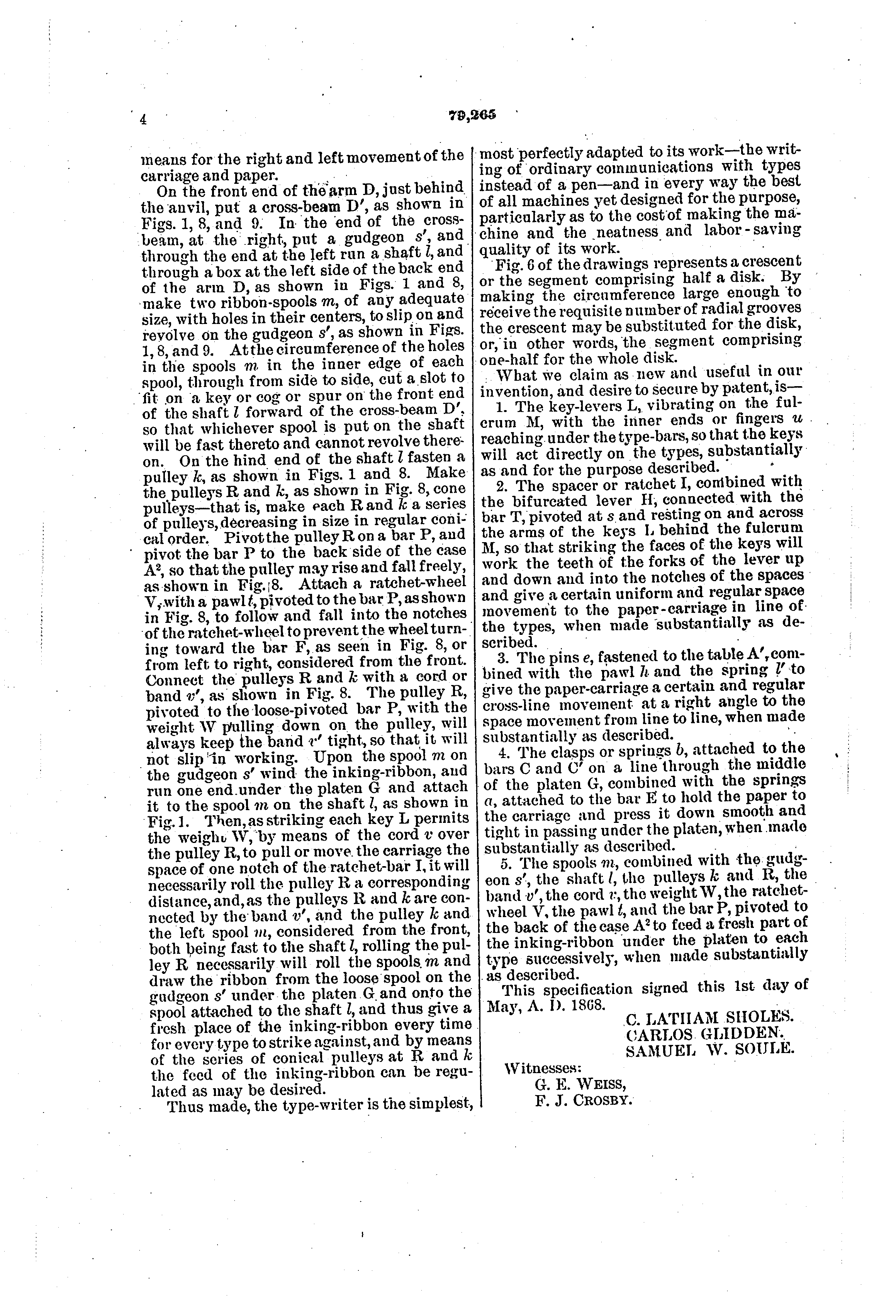
PDF · Google Patents · Signed 1 May 1868; the drawings are witnessed by James Densmore.
US 79,868, Sholes, Glidden and Soule, granted 14 July 1868
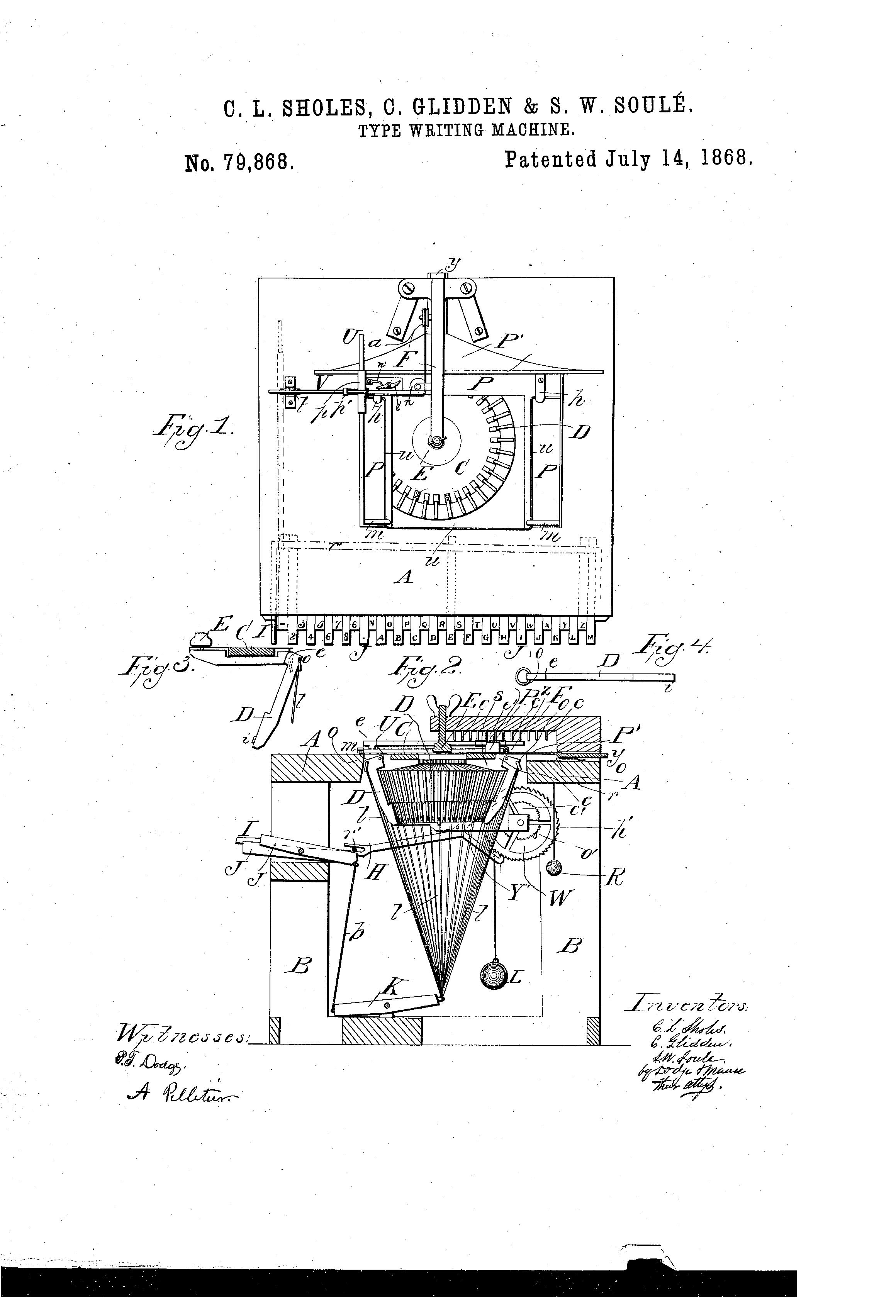
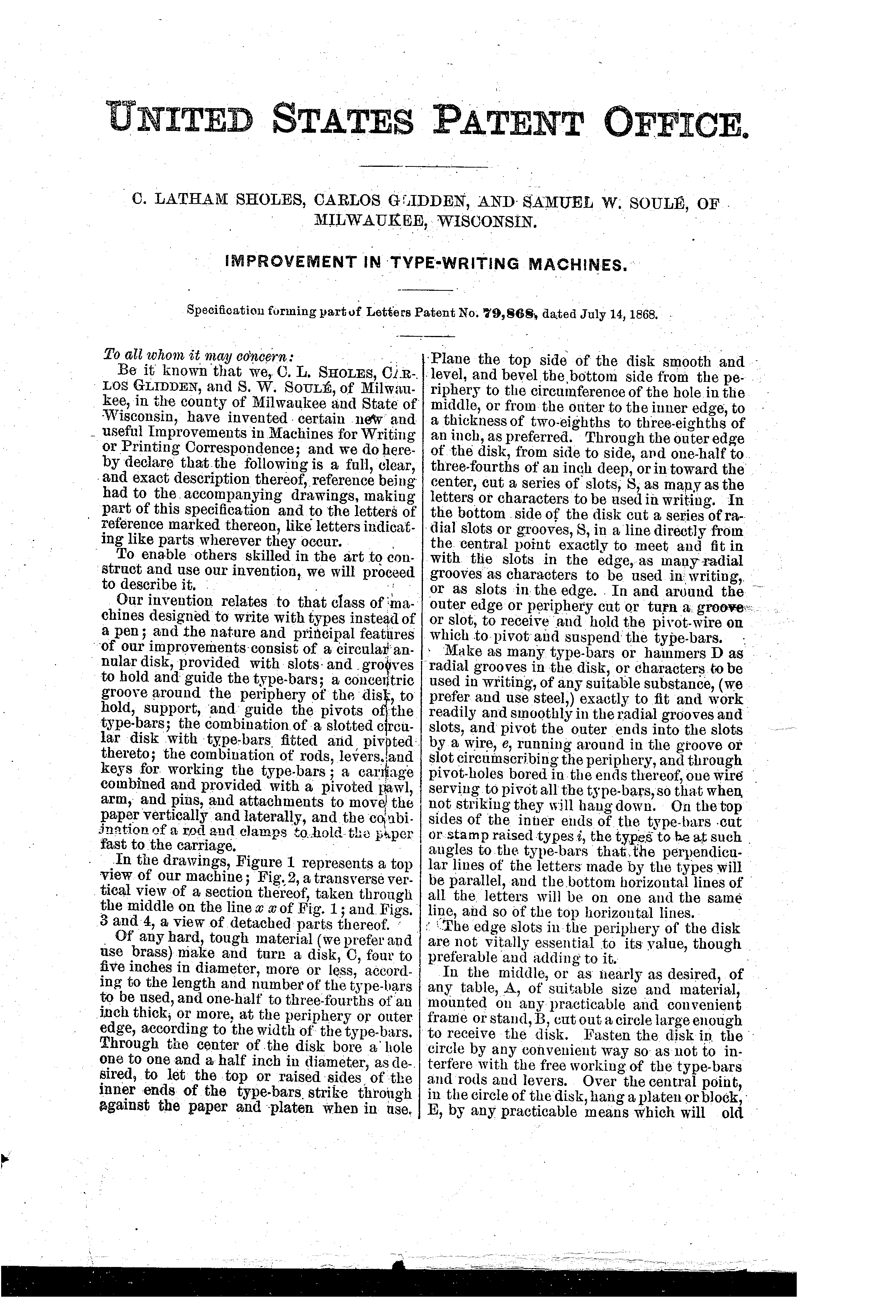
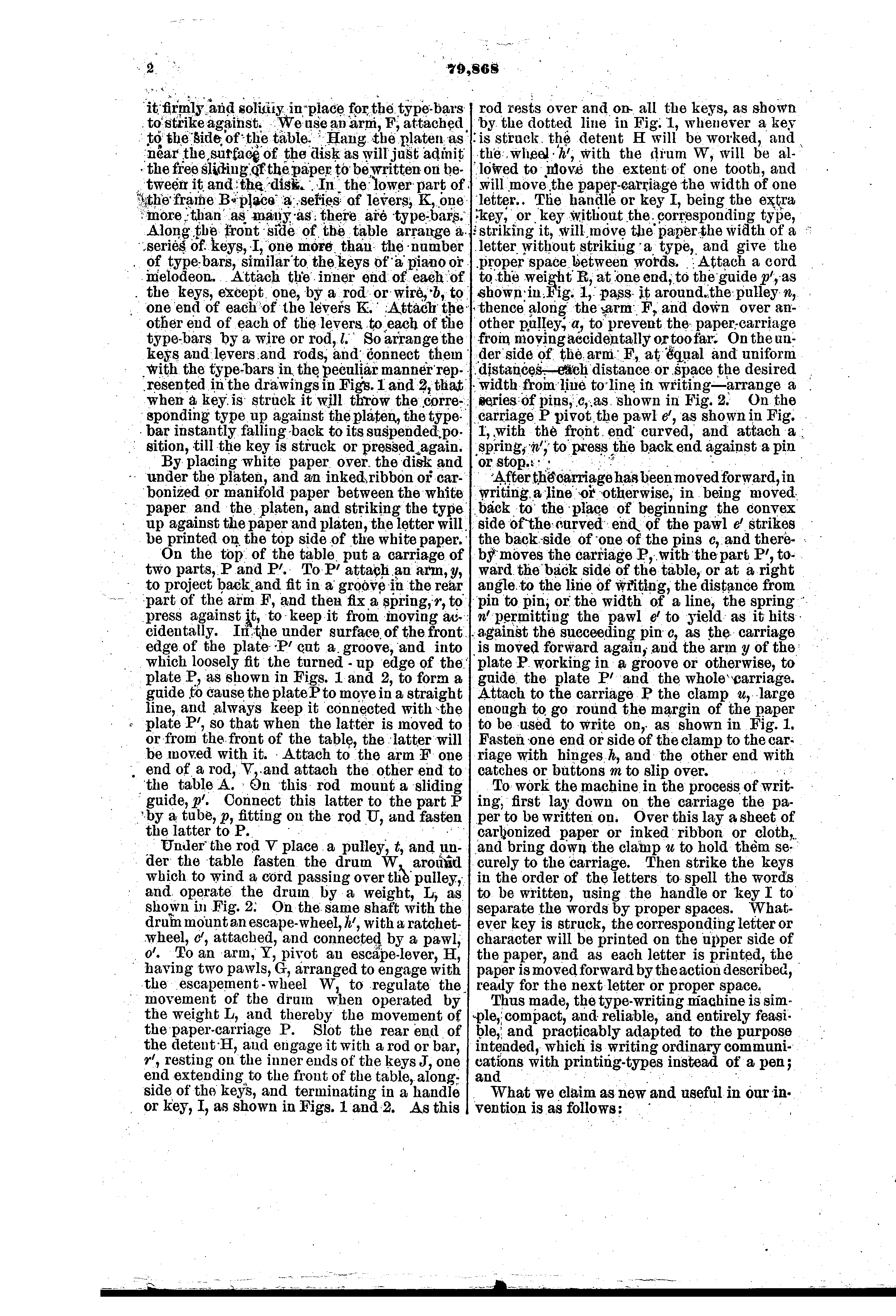
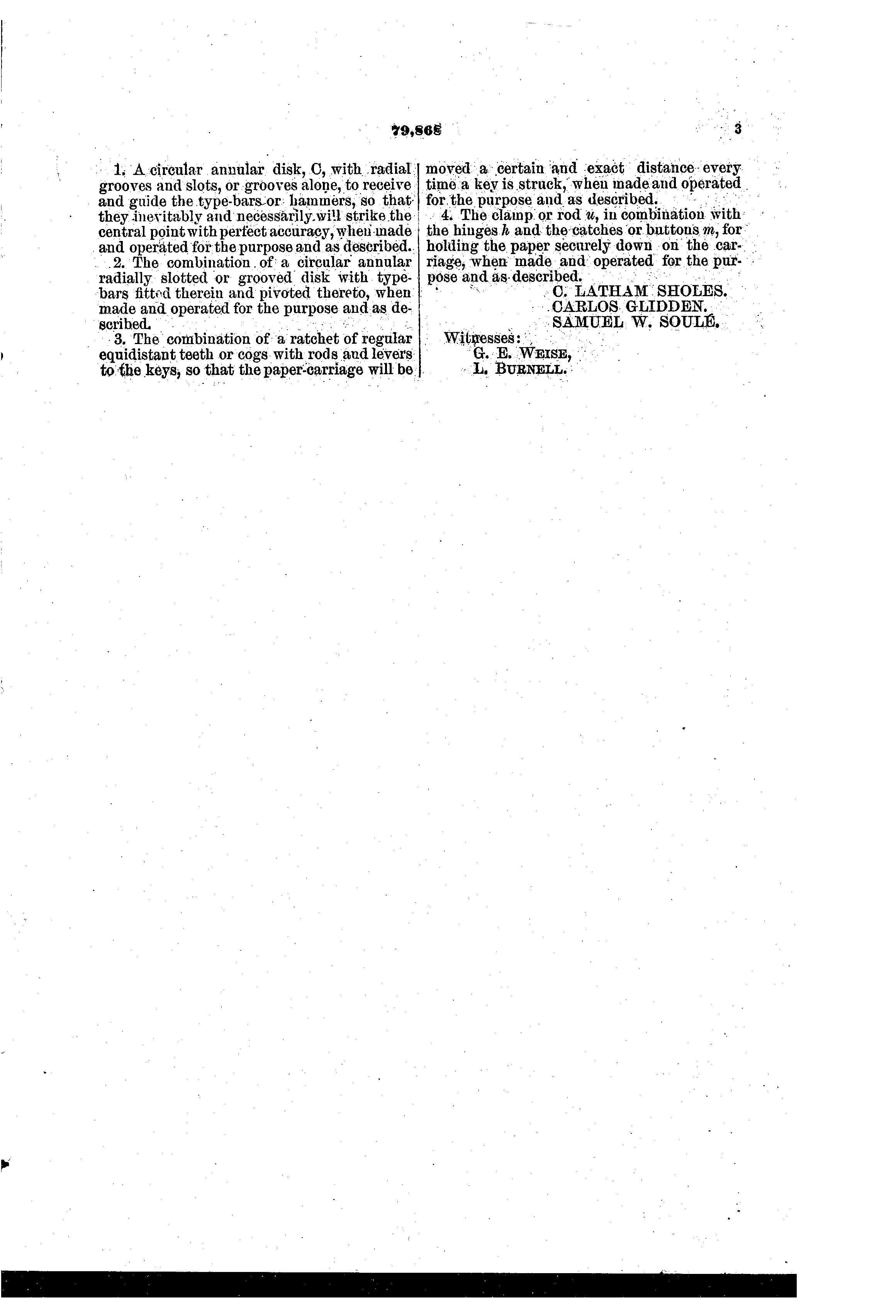
PDF · Google Patents · The earlier, wire-linked design, with the alphabetical keyboard of Fig. 1.
US 207,559, Sholes, filed 8 March 1875, granted 27 August 1878
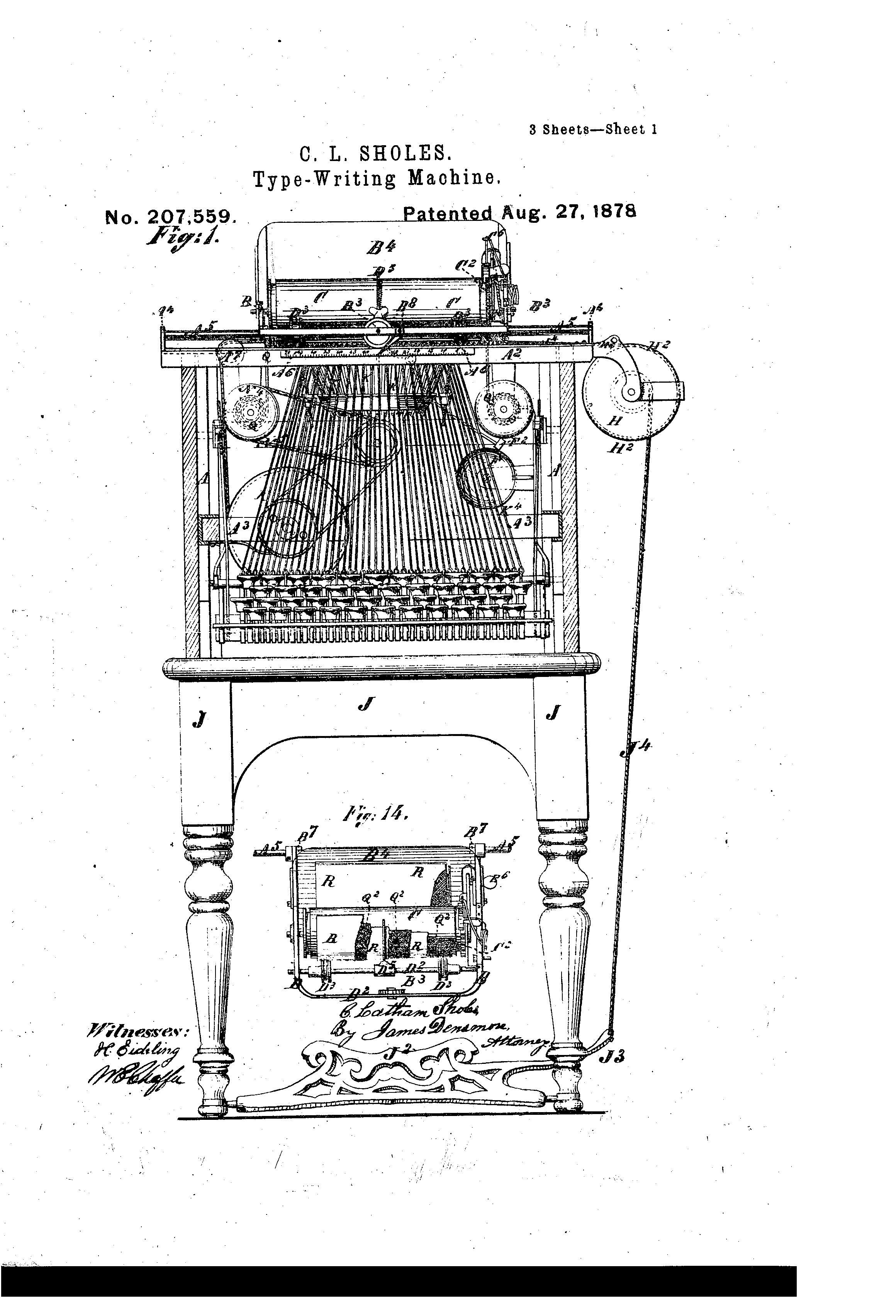
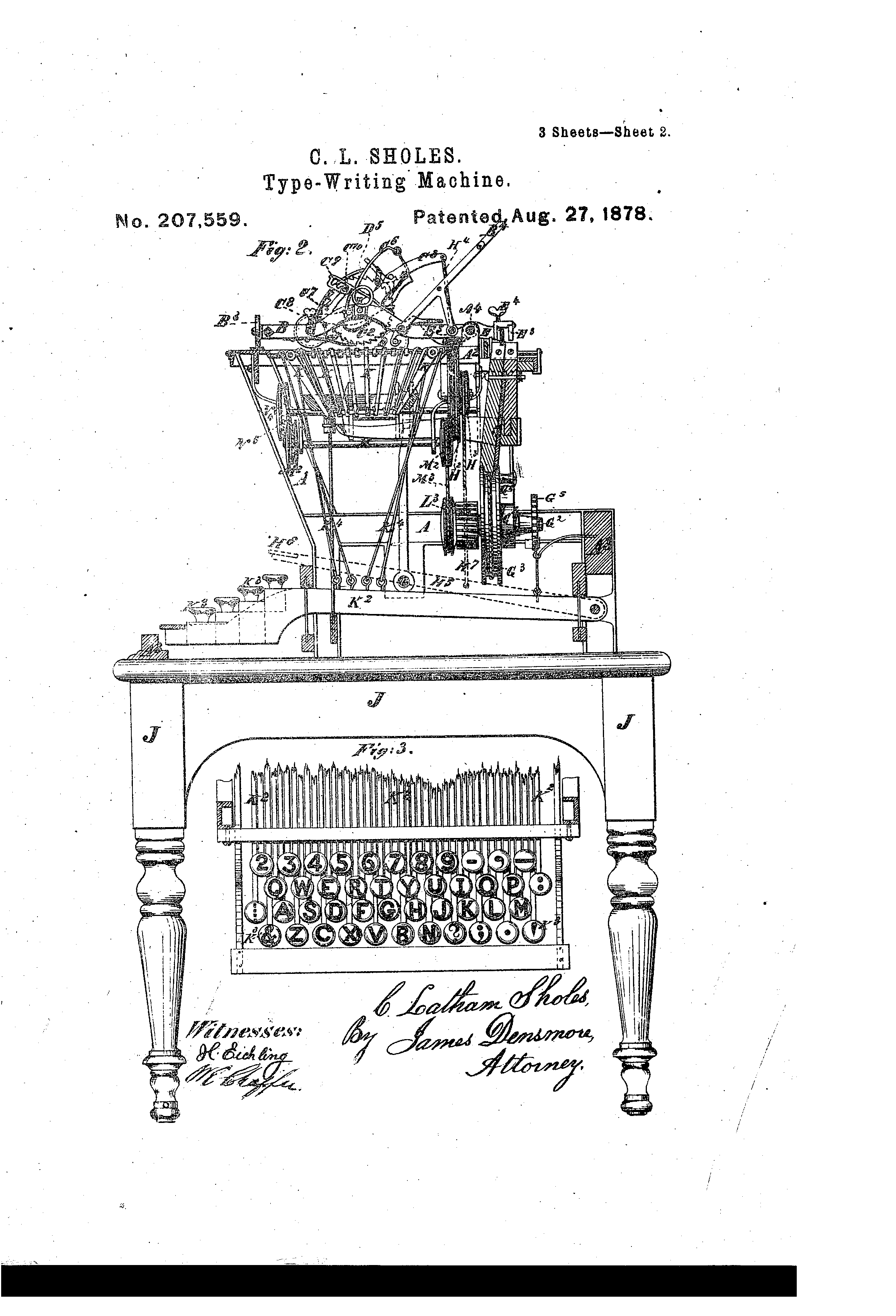
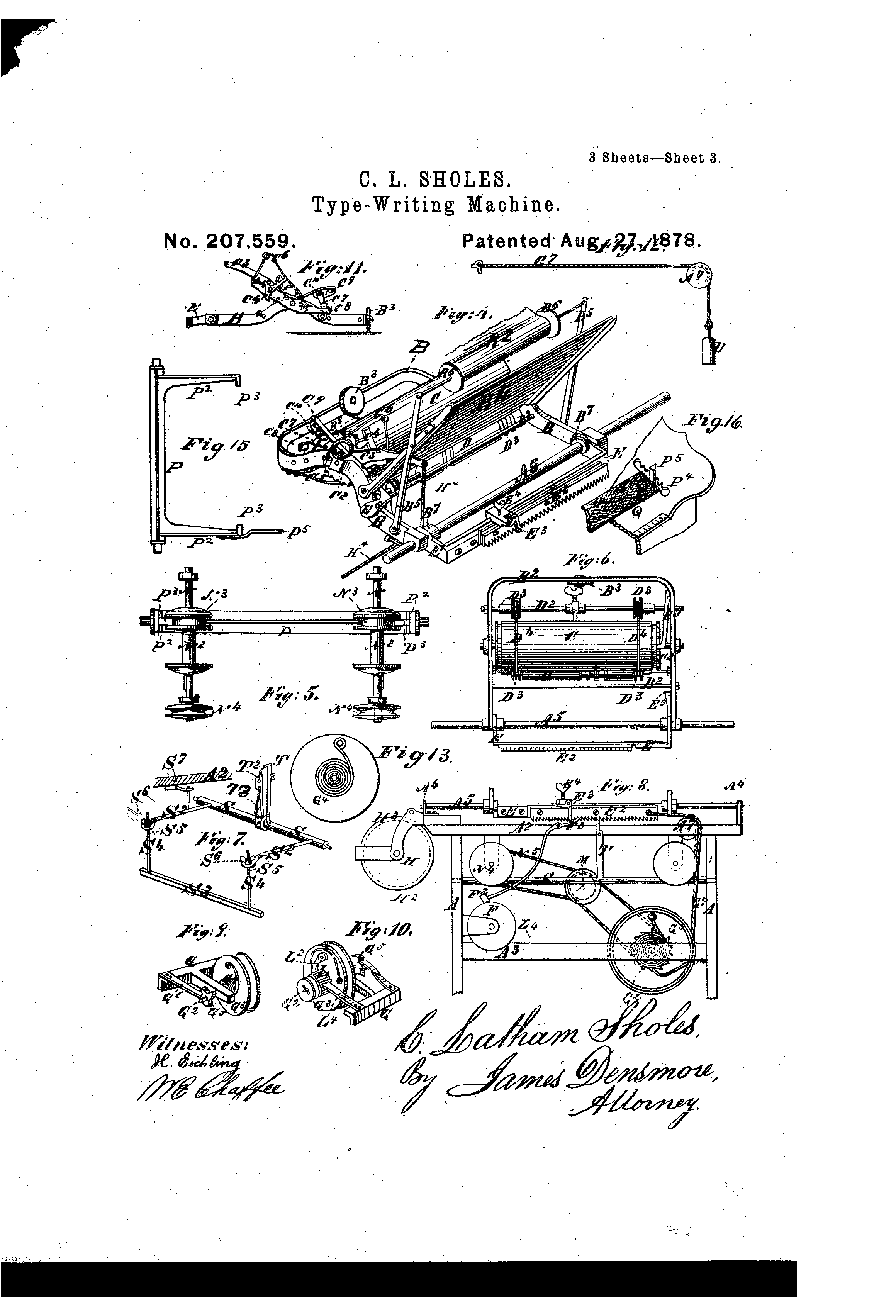
PDF · Google Patents · Assigned to the Type Writer Company, New York; attorney James Densmore. None of its claims is about the layout.
Sources
Every fact on this page comes from these, as in the episode. Where the sources disagree, the page says so or leaves the point out.
Patents
- C. L. Sholes, C. Glidden and S. W. Soule, Improvement in Type-Writing Machines, US Patent 79,265, 23 June 1868: the machine, its parts and the patent's words quoted above; the October 1867 application; Densmore as witness.
- The same, US Patent 79,868, 14 July 1868: the wire-linked design, the keyboard of Fig. 1 (read at 300 dpi), and "printed on the top side of the white paper".
- C. L. Sholes, US Patent 207,559, filed 8 March 1875, granted 27 August 1878: Fig. 3, "a view of the key-board"; "all strike up against the same point at the bottom of the platen"; the claims.
- J. M. Clough and W. K. Jenne, US Patent 199,263, filed 19 November 1875, granted 15 January 1878: the stand and treadle, and the springy type-bars ("will spring to one side without harm when colliding with another", pp. 4–5).
- B. A. Brooks, US Patent 202,923, 30 April 1878 (the platen shift); C. L. Sholes and M. Schwalbach, US Patent 182,511, filed 30 March 1872, granted 19 September 1876 (the four-row keyboard); G. M. Phelps, US Patent 26,003, 1 November 1859 (the Hughes printing telegraph and its piano keyboard).
- A. Dvorak and W. L. Dealey, Typewriter Keyboard, US Patent 2,040,248, filed 21 May 1932, granted 12 May 1936, cols. 1–3.
History
- "The Type Writer", Scientific American, 10 August 1872, p. 81 (Sholes's inspiration, the key pressure, "sixty to eighty words per minute").
- C. E. Weller, The Early History of the Typewriter (La Porte, Ind., 1918), pp. 26–30 (testing from January 1868, the bunched bars, the weight, the row of T's) and pp. 42–46 (Sholes's letters of 28 September 1870 and 14 March 1871).
- Henry W. Roby's Story of the Invention of the Typewriter (1925), pp. 43–44.
- Herkimer County Historical Society, The Story of the Typewriter 1873–1923 (Herkimer, N.Y., 1923): p. 37 (the machine shop), p. 38 (Densmore's verdict, Soule), p. 58 (the contract of 1 March 1873, "for manufacture only"; Sholes's $12,000), p. 61 (manufacture from September 1873), pp. 66–68 (the keyboard, "much speculation", "a hold similar to that of language itself"), p. 73 (Twain's letter), p. 83 (the 1878 shift machine).
- Mark Twain, "The First Writing-Machines", in The $30,000 Bequest and Other Stories (1906), Project Gutenberg no. 142 (capitals only).
- R. N. Current, The Typewriter and the Men Who Made It (University of Illinois Press, 1954): Porter's telegraph school, the colliding bars, Densmore's "unlearn as well as learn". Read only as full-text-search passages on the Internet Archive, without page numbers; the date of Densmore's letter was not seen.
- K. Yasuoka and M. Yasuoka, "On the Prehistory of QWERTY", ZINBUN 42 (2011), pp. 161–174: the first shipment to Porter (p. 162), the telegraph argument and Z and SE in Morse (pp. 164–165), the name Sholes and Glidden Type-Writer (p. 165), the shift (p. 167), the 1882 changes (p. 168), the Union Typewriter Company and Teletype (p. 169), "somewhat ad hoc" (p. 169), R and the period (pp. 170, 172), and the bar positions, E and R 16° apart (p. 171, Table 1).
- P. A. David, "Clio and the Economics of QWERTY", American Economic Review 75:2 (May 1985), pp. 332–337: the $125 price and the R (p. 333), the Navy claim and the advertising copy (p. 332), touch typing and lock-in (pp. 334–335).
- S. J. Liebowitz and S. E. Margolis, "The Fable of the Keys", Journal of Law & Economics 33:1 (April 1990), pp. 1–25: the 1944 Navy report, Strong and Foulke, Strong's 1956 study, the later studies, and the Hammond and Blickensderfer keyboards.
- ASME, Sholes & Glidden 'Type Writer', Historic Mechanical Engineering Landmark brochure no. 249 (Milwaukee, 2011): Sholes's life.
- Smithsonian Open Access records: the 79,265 patent model, ME.251210 ("only six keys"), record; the 182,511 patent model, 1981.0359.02, record; and the production machine's record nmah_850542 (Remington's sewing machines, the stand, $125).
- R. Messenger, "Getting SHIRTY about QWERTY (Part I)", oz.Typewriter, May 2016 (Richard Polt's comment on the Morse argument; a collector's blog).
- Dollar amounts in today's money: the ratio of annual-average consumer prices, from the Federal Reserve Bank of Minneapolis, "Consumer Price Index, 1800-", with 2025 as today, rounded to two figures. Prices before 1913 are estimates, which is why every figure is marked ≈.
Images
- Patent drawings and specifications: USPTO, public domain.
- The Story of the Typewriter 1873–1923 (1923) and Scientific American (1872): published in the United States before 1931, public domain; scans via the Internet Archive.
- The patent models of US 79,265 and 182,511: National Museum of American History, Smithsonian Institution, Open Access, CC0.
- The Sholes and Glidden at the Wisconsin Historical Museum: photo by Daderot, Wikimedia Commons, CC0.
- The telegraph operator is an AI illustration made for the episode, not a period picture.
