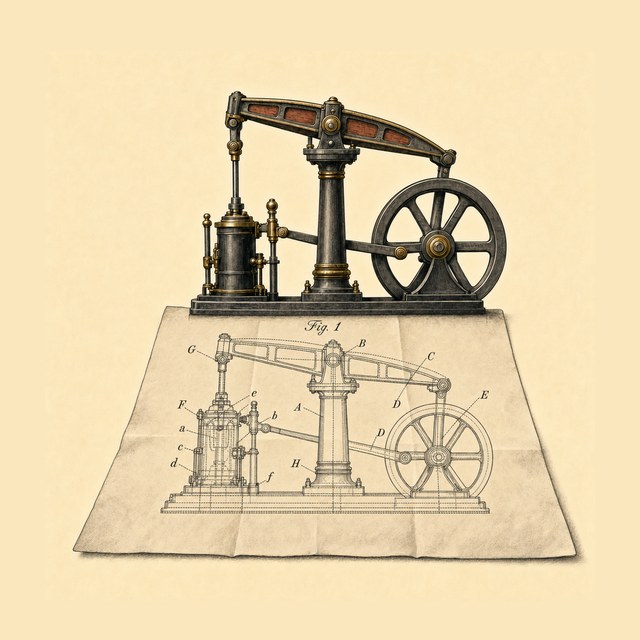
 Curious Patents
The Paper-Bag Machine
In 1871 Margaret E. Knight of Boston patented a machine that folded a flat, square bottom onto a paper tube. Before she could have the patent, she had to prove the idea was hers.
Watch the episode
Run the machine
This is the model from the episode, built from Knight's drawings. One turn of the winch makes one bag: the tube feeds forward, the blade and the guide-finger open its end into a square, the side-folders hold it, the knife cuts it off, and two more folds and a dab of paste finish the bottom. Drag to look around, and pinch or scroll to zoom.
The patent gives no sizes, gear ratios or cam shapes. Here every gear turns at the same speed, as the drawing's equal gears suggest, so one turn of the winch makes one bag. The paper roll, the seam paster and the stop-motion are described in the patent as well known and are not drawn; they are shown pale. Where the letters in the text and the drawings disagree, the model follows the drawings.
The parts, in Knight's letters
- H′
- The former, "an oblong piece of wood". The paper is wrapped around it and pasted into a tube.
- C, J′
- Feed rollers, one under the tube and one set into the former, that nip the paper and push it forward in steps.
- I′
- The follower, a light frame riding on the former. It is her first claim; the patent never says what it does to the paper.
- N′
- The guide-finger, with a roller i′ at its tip. It holds back the middle of the tube's upper side while the blade carries the rest forward: the fold the patent turns on.
- F, c
- The plate-knife-folder: arms a and b carrying the blade c, whose ends run in curved guide-ways e′.
- Q′, R′
- Side-folders that come down and hold the paper while it is cut and folded.
- Z, O′
- The severing knife and the steel edge it cuts against: "a species of shears".
- p, b′
- The pasting-knife and the roller that feeds it paste.
- D′, r s t
- The vertical knife that pushes the bag down between rollers s and t, making the last fold.
The case she won
Knight's application reached the Patent Office in February 1870 and was rejected: some of what she claimed had been patented the year before by Charles Annan, whom she knew from the machine shop where her model was perfected. She asked for an interference, a hearing to decide who invented first. Her evidence included a drawing from February 1867, wooden parts from early prototypes, photographs of her model and bags the machine had made. The Patent Office decided for her on 25 June 1870, and Annan's appeal failed that September.
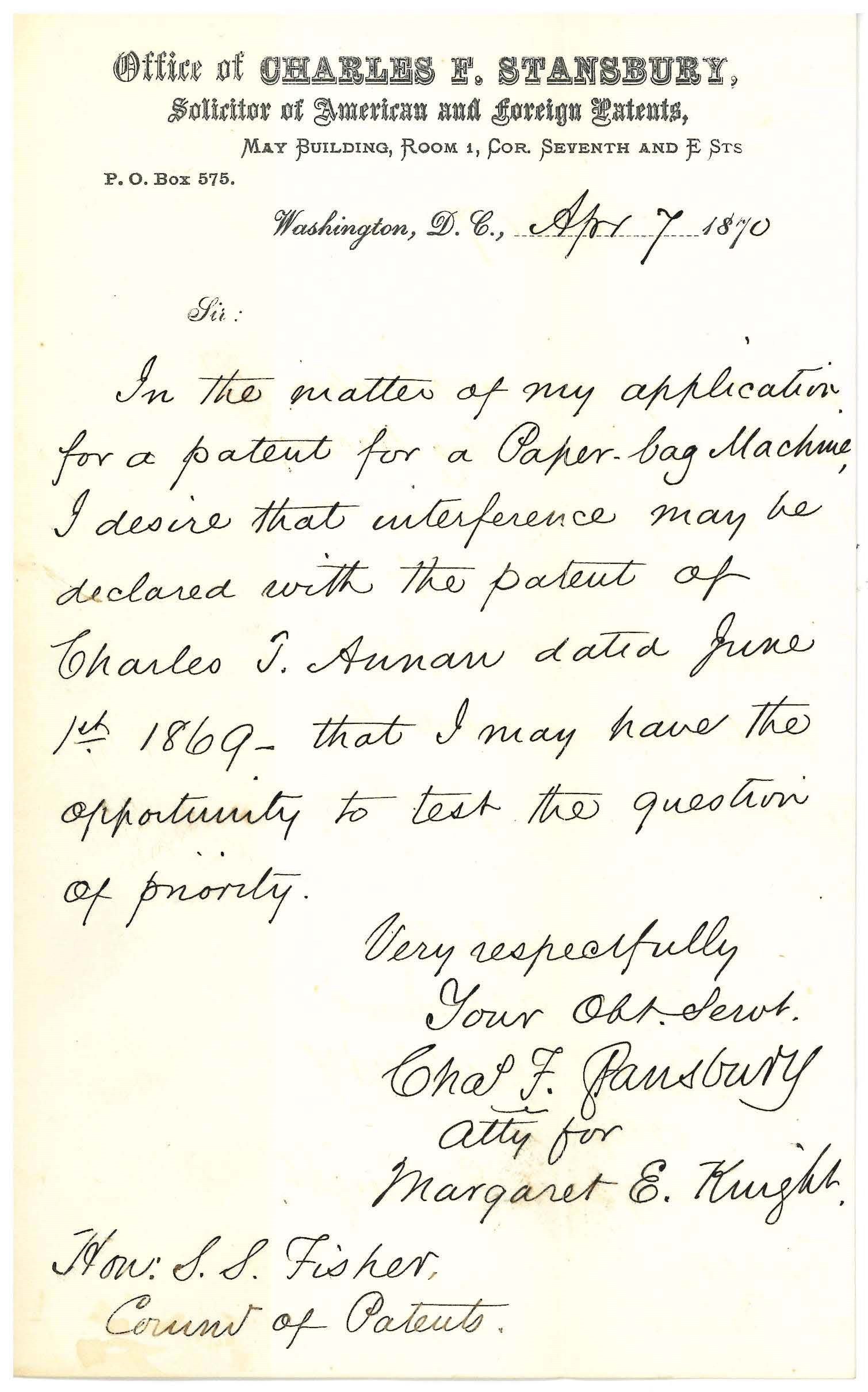
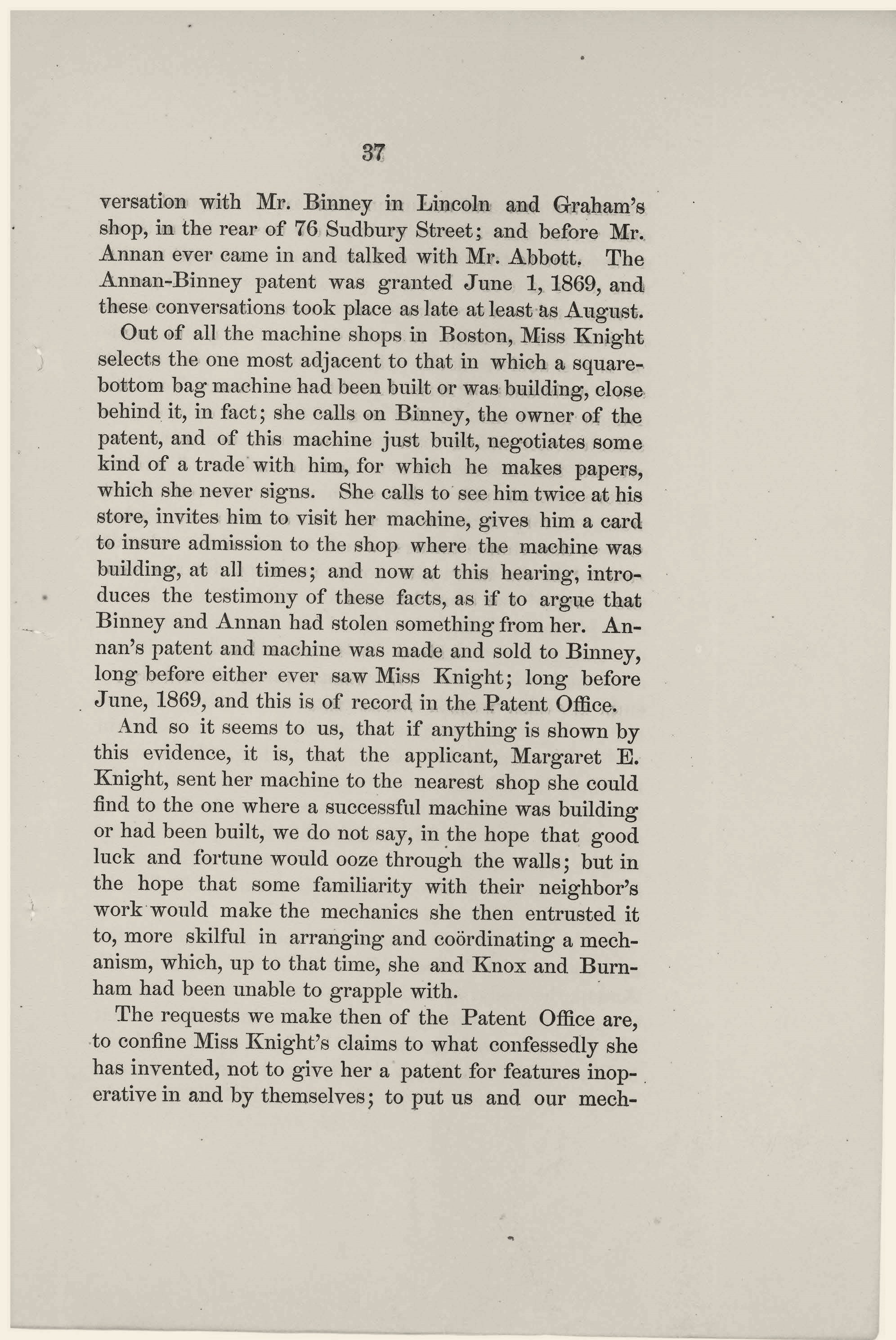
Read the original patent
The patent is three sheets of drawings and three pages of text. It is in the public domain. Click a page for full resolution.
Download the patent (PDF) · Google Patents record · Signed 9 November 1869, granted 11 July 1871.
Sources
Every fact in the episode comes from these. Where the sources disagree, the episode says so.
Patents
- M. E. Knight, Improvement in Paper-Bag Machines, US Patent 116,842, 11 July 1871 (PDF); reissued as RE 9,202, 18 May 1880, to the Eastern Paper Bag Co.
- Her patent count: 25 US patents and one reissue name her as inventor, 1870 to 1915. We read each specification and checked the Commissioner of Patents' annual lists of patentees for 1870 to 1918 (1874 not online). Her obituaries' "eighty-seven" is not supported by any patent record we found.
- M. E. Knight, US Patent 220,925 (1879), an improvement on 116,842; US Patent 109,224 (1870), a paper-feeding machine.
- C. F. Annan, US Patent 90,624, 1 June 1869, assignor to B. S. Binney.
- C. B. Stilwell, US Patents 165,381 (1875) and 279,505 (1883).
- J. Kristola, H. G. Weber & Co., Quasi-Heat Seal SOS Bag, US Patent 5,472,282 (1995): self-opening square bags, "typically used for grocery sacks", "sometimes referred to as a diamond fold bag".
- N. M. Johnson, Artificial Freezer, US Patent 3,254 (1843); S. P. Mather, Submarine Telescope and Lamp, US Patent 3,995 (1845).
The interference
- National Archives at Kansas City, "Paper Bag Wars", newsletter, June 2021, from RG 241 patent case file (NAID 302050) and interference case file 272 (NAID 563063).
- University of Maine library guide citing M. Quezon, Mattie and the Machine (2022), on the witnesses.
Newspapers
- Cairo Daily Bulletin, 14 July 1872, p. 2; The Sun (New York), 15 October 1914, p. 9; Springfield Weekly Republican, 22 October 1914, p. 11 (Chronicling America, Library of Congress).
- Boston Sunday Post, 31 March 1912, p. 45 (photograph; via Wikimedia Commons).
Her life and legacy
- Knight's 1912 interview (87 patents, engine patents pending), Boston Sunday Post, 31 March 1912, as transcribed by J. Brown (below); the original page was not seen.
- 35 U.S.C. §122 and the American Inventors Protection Act of 1999: patent applications were confidential, and unsuccessful ones unpublished, until applications filed from 29 November 2000.
- J. Brown, "Woman Edison", Cow Hampshire (2020), citing census and vital records.
- National Inventors Hall of Fame, Margaret E. Knight (inducted 2006).
- Smithsonian Lemelson Center, "Counting Women Inventors" (Mary Kies, 1809).
- Smithsonian National Museum of American History: patent models for US 220,925 and US 109,224 (CC0).