 Curious Patents
The Clasp Locker
In 1893 Whitcomb Judson of Chicago patented a row of clasps for a shoe and a small sliding guide that locked them all in one pull. Neither patent says "zipper": that name came thirty years later, from a rubber boot.
Watch the episode
Operate the guide
This is the model from the episode, built from Judson's drawings. Slide the guide along the row. Closing, each clasp enters its own channel, rides up the ridge until its two halves stand at about ninety degrees, and is pressed flat and locked. Turn the guide round to open them again. Drag to look around, and pinch or scroll to zoom.
The patent gives no sizes. Proportions come from its figures (the guide is about four clasps long in Fig. 1); the shapes of the channels and the ridge along their length are our reading of Figs. 6–10.
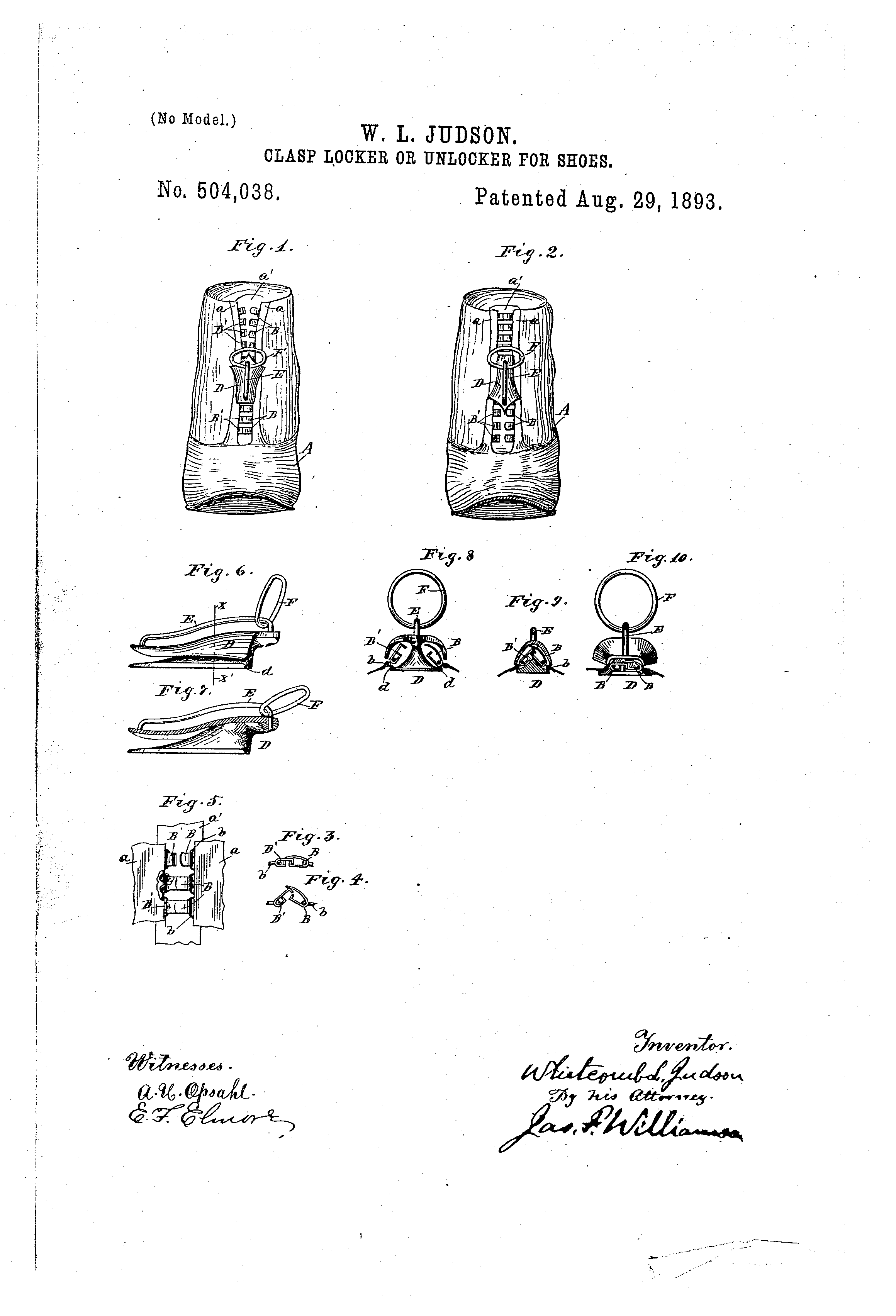
The parts, in Judson's letters
US 504,038, "Clasp Locker or Unlocker for Shoes"
- a, a′
- The flaps of the shoe, and the tongue under them, which the guide rides on "as a base or trackway".
- B, B′
- The two halves of each clasp, with hooks and overlapping lips. They hook or unhook only when "thrown upward" to about ninety degrees to each other.
- b
- The wires that fix each half to its flap.
- D
- The guide: a base flat underneath with upturned lips d, a bell-shaped top plate, and a wedge-shaped centre piece that makes two channels ("cam-ways") at the front, which climb over a ridge, the "instep", and merge into one.
- E, F
- The bail, a wire staple along the top, and the ring that slides on it, so the guide can be pulled from either end.
US 504,037, "Shoe-Fastening"
- B
- Each link, bent from one piece of steel wire: a rod b, an eye b′ joining the next link, a cord loop b², and a hook b³ with a small stop at its tip.
- C, a²
- Lacing cords through the loops and the shoe's eyelets, so the fit can be adjusted.
- D, d
- The guide, with the angle reversed so the hooks pass under the rods opposite; the foot's upward pressure holds them in.
Read the original patents
Both patents are in the public domain. Each has one sheet of drawings and three pages of text. Click a page for full resolution.
US 504,038, granted 29 August 1893
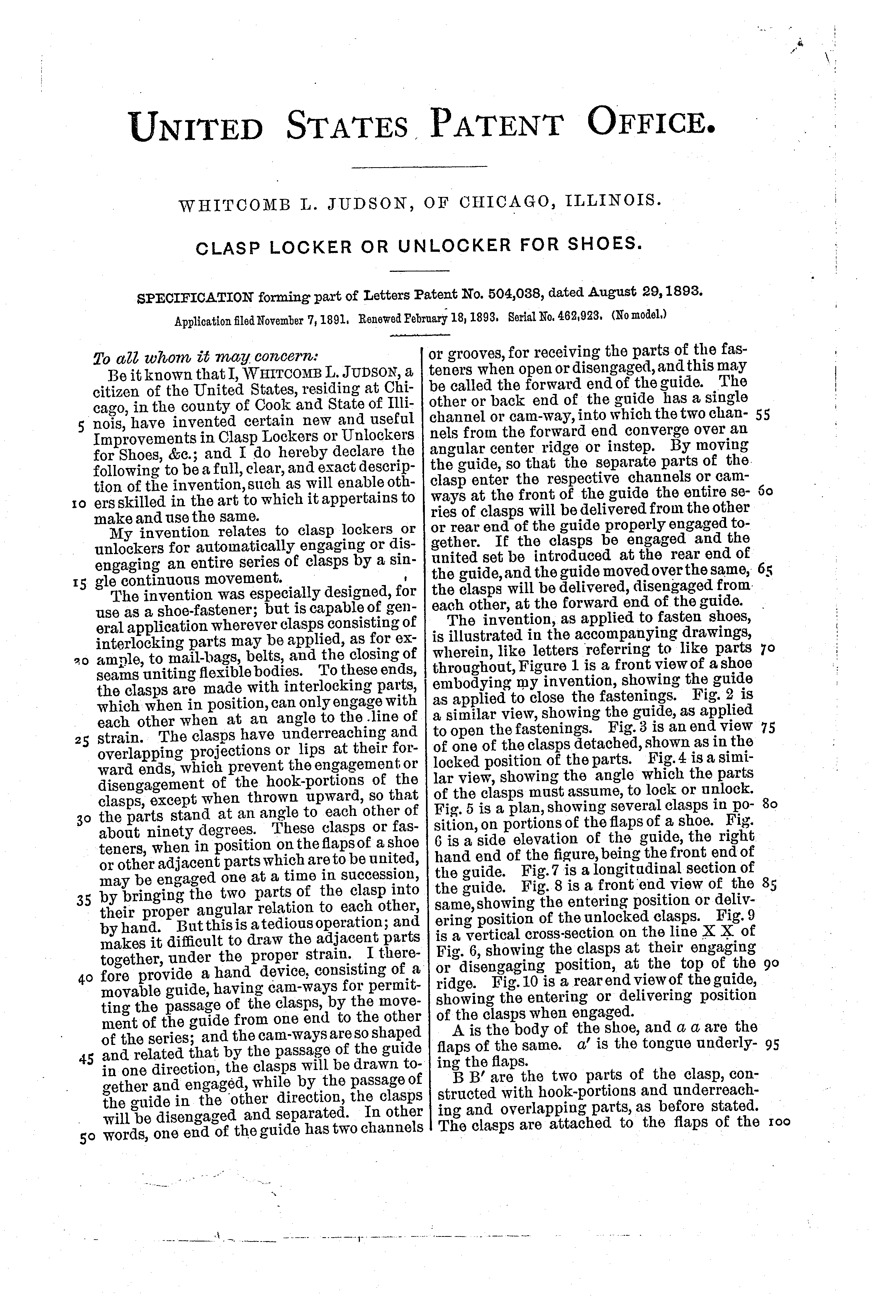
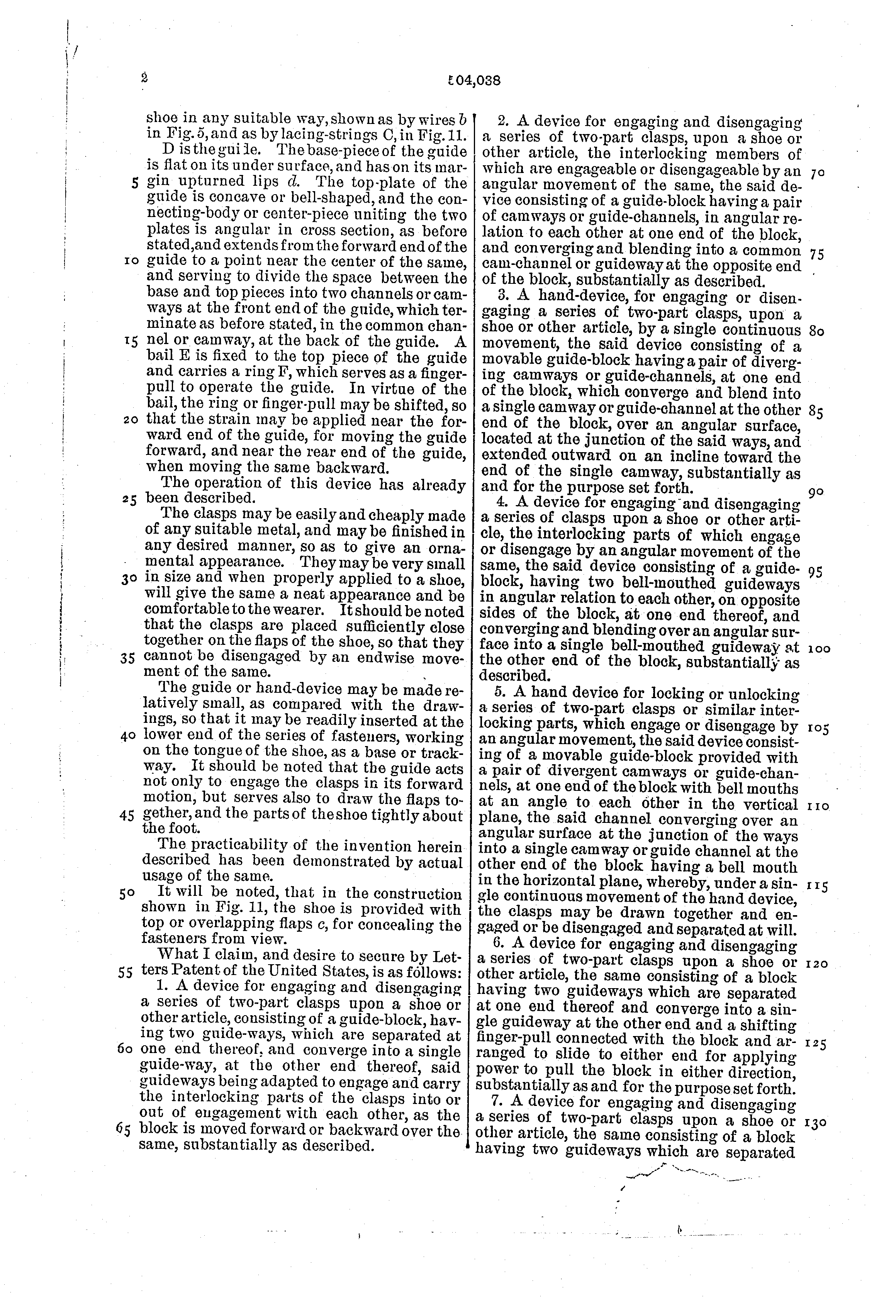
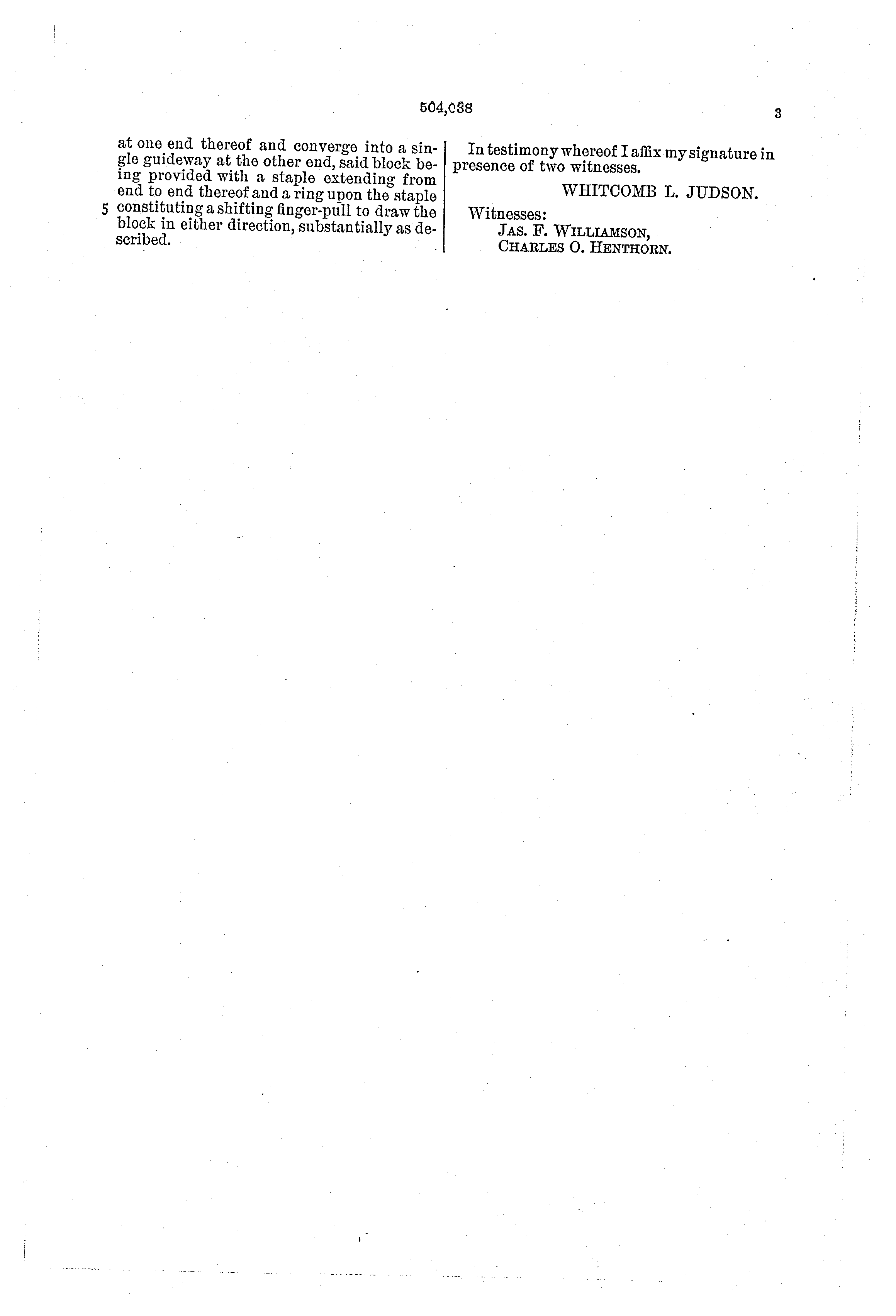
PDF · Google Patents · Filed 7 November 1891, renewed 18 February 1893.
US 504,037, granted 29 August 1893
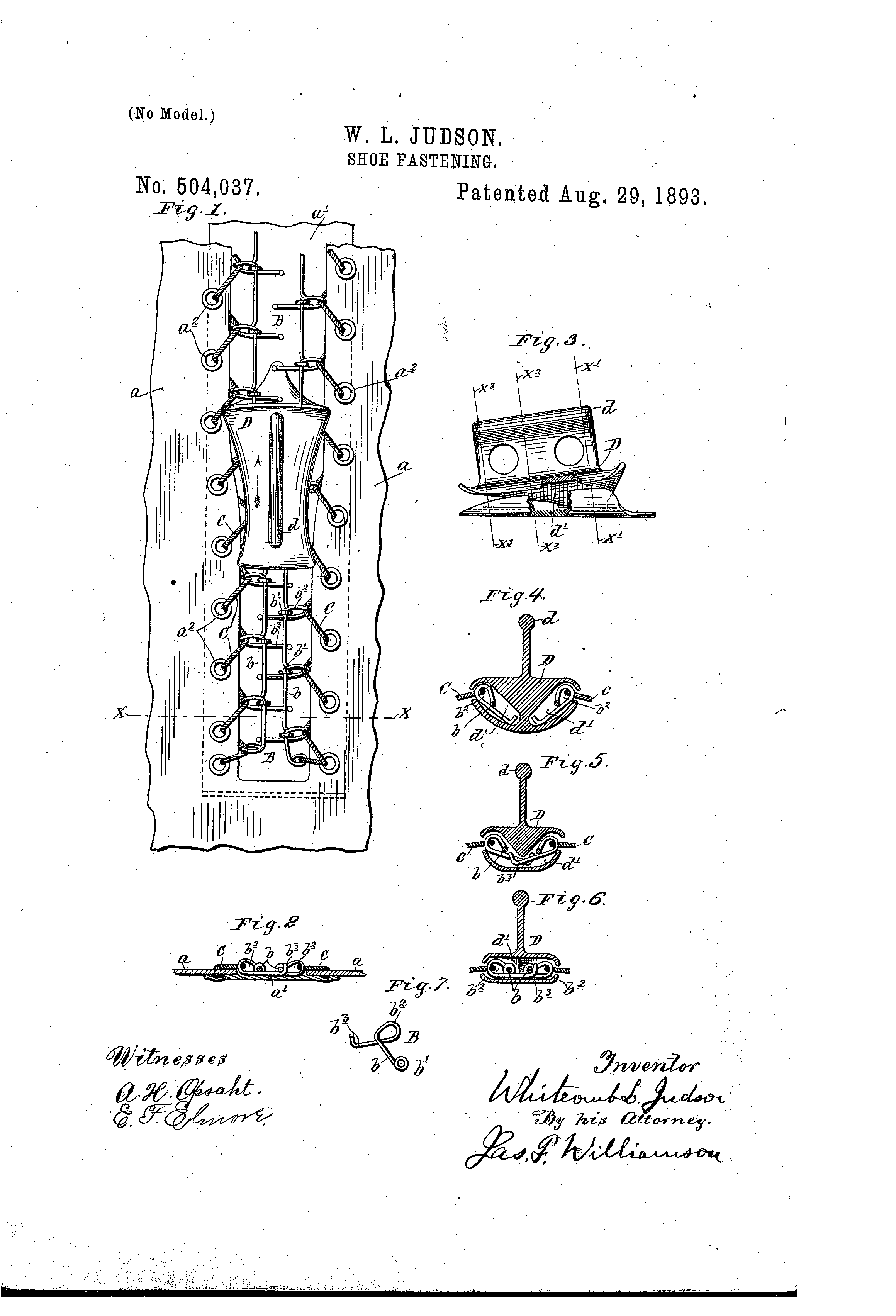
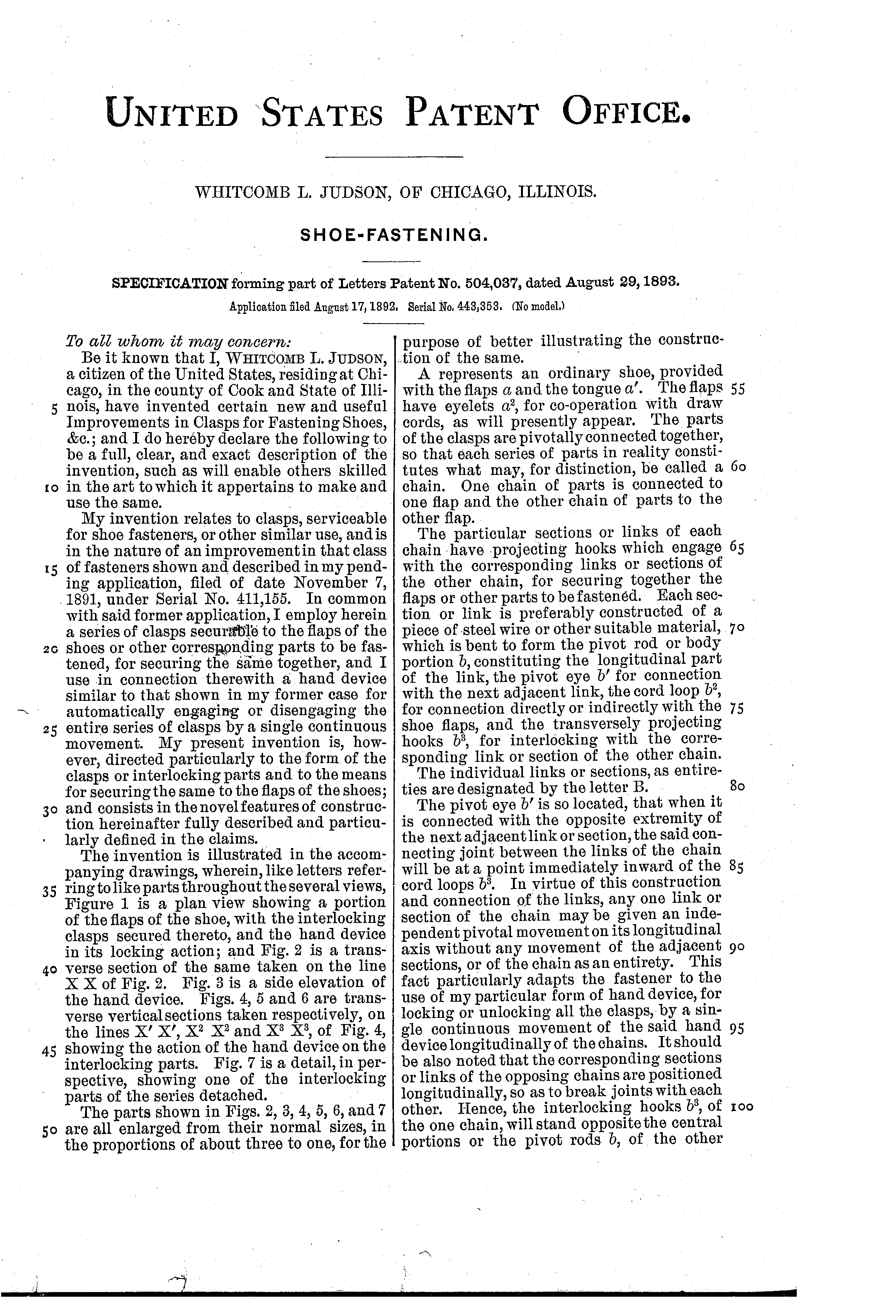
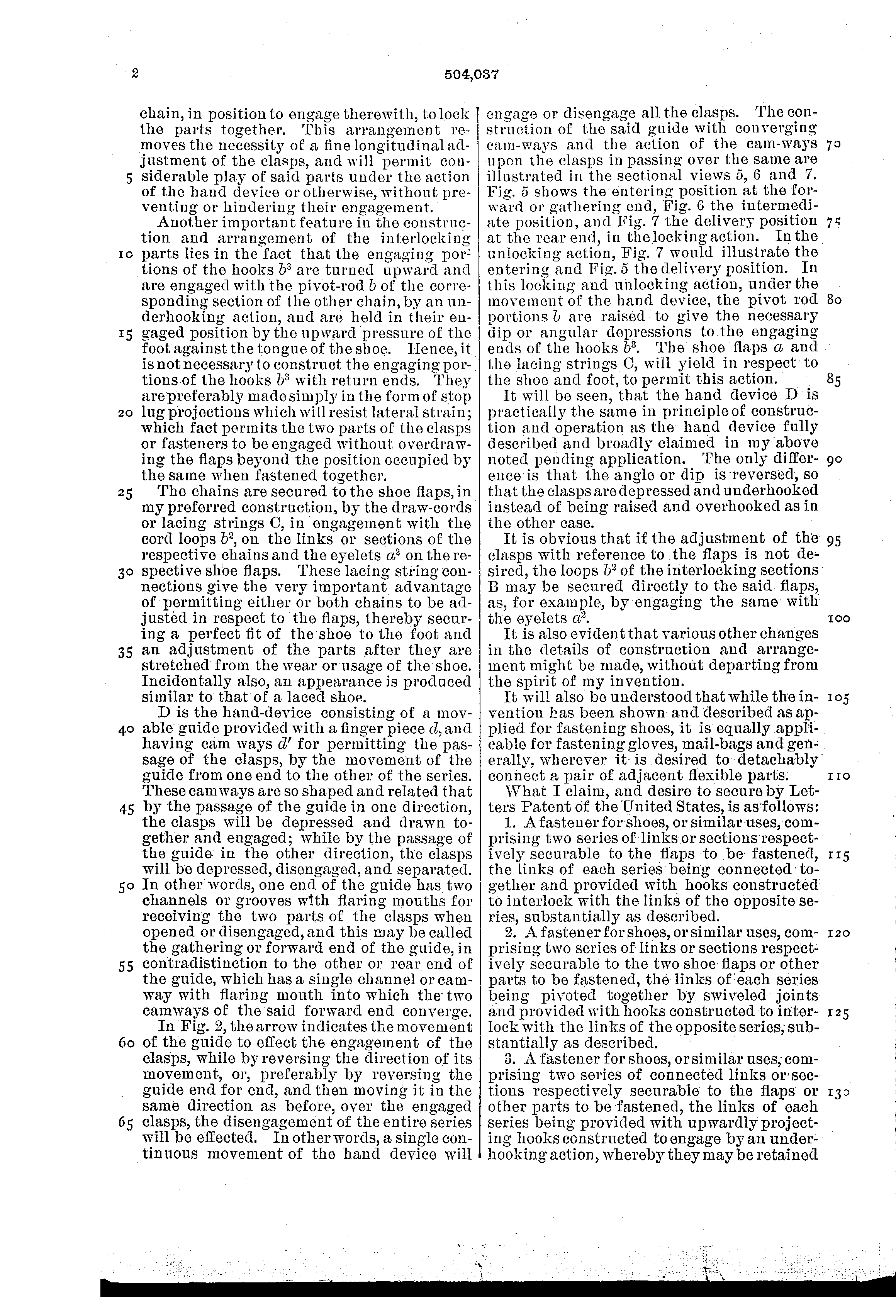
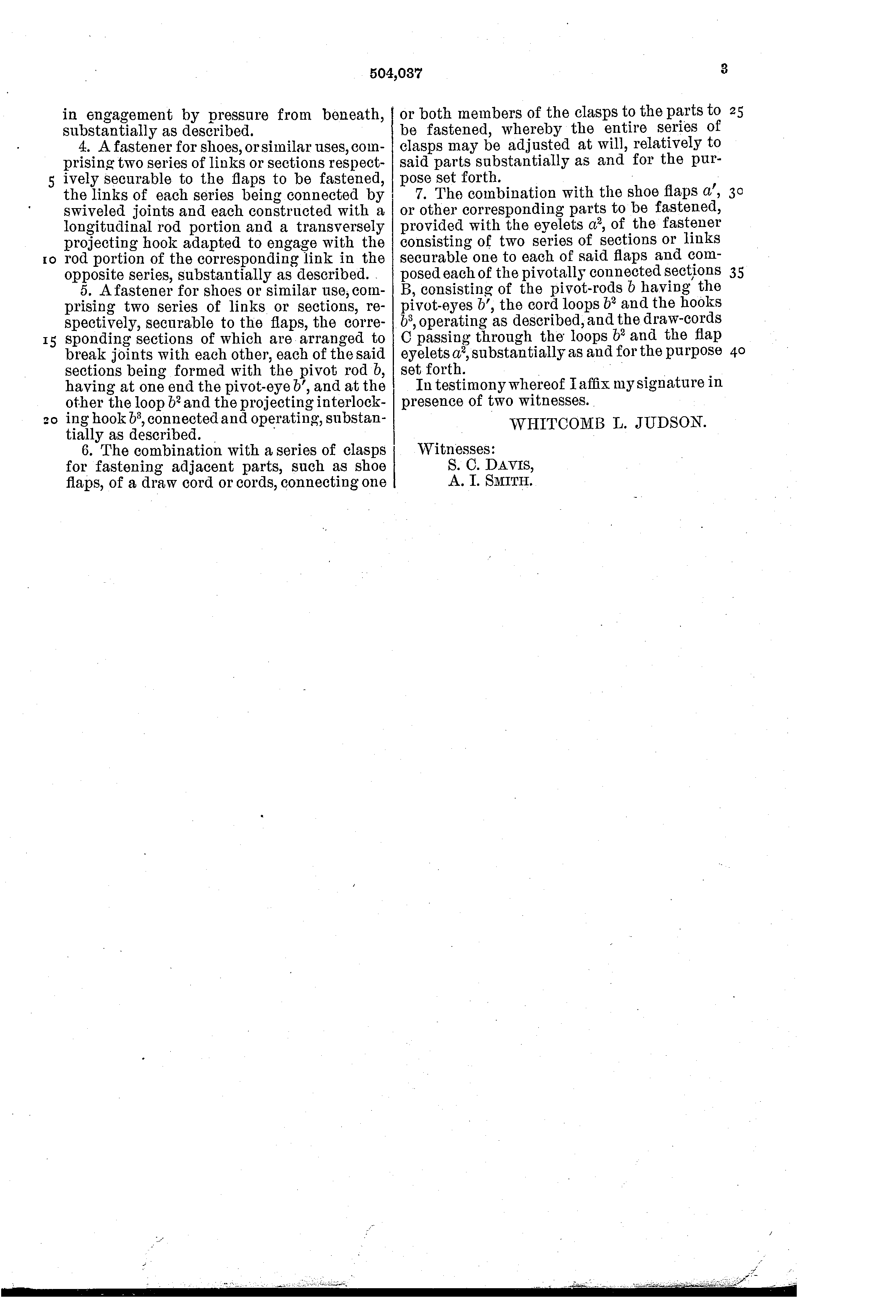
PDF · Google Patents · Filed 17 August 1892. The later application got the earlier number.
Sources
Every fact in the episode comes from these. Where the sources disagree, the episode says so or leaves the point out.
Patents
- W. L. Judson, US Patents 504,038 and 504,037 (1893); 402,934, "Street Railway" (1889); 557,207 and 557,208 (1896).
- G. Sundback, US Patent 1,219,881, "Separable Fastener" (filed 1914, granted 1917), with the Hookless Fastener Company's disclaimer (Official Gazette, 26 April 1932); and 1,060,378 (filed 1908, granted 1913).
- G. Sundback, US Patent 1,236,784, "Separable Fastener" (filed 1912, granted 14 August 1917): its heading names him "of Meadville, Pennsylvania" and assigns it to the "Hookless Fastener Company, of Meadville, Pennsylvania, a corporation of Pennsylvania".
- National Inventors Hall of Fame, Gideon Sundback (inducted 2006): his dates.
History
- R. Friedel, Zipper: An Exploration in Novelty (W. W. Norton, 1994). Read through the Internet Archive's full-text search; page numbers from its index.
- H. Petroski, The Evolution of Useful Things (Knopf, 1992), "Stick Before Zip".
- Scientific American, 9 September 1893, front page and weekly patent list.
- World's Columbian Exposition, Official Catalogue of Exhibits, Parts 8, 11 and 12 (1893).
- M. P. Handy (ed.), The Official Directory of the World's Columbian Exposition (Chicago: W. B. Conkey, 1893), 1,244 pages, searched in full: no entry for Whitcomb Judson, the clasp locker or the Universal Fastener Company.
- Report of the Adjutant General of the State of Illinois, vol. III, Forty-Second Infantry (Judson's war service); History of Knox County, Illinois (1878), p. 322.
- Commissioner of Patents, annual indexes of patentees, 1886–1917 (Judson's fourteen earlier patents; none after 1905).
- Engineering News, 13 July 1889, pp. 28–30 (the Judson pneumatic railway) and 23 November 1889, p. 501 (the Brightwood Avenue trial); Electrical Review, 23 November 1889.
- Trow's Copartnership and Corporation Directory of New York City, March 1890, p. 152 (the Judson Pneumatic Street Railway Co.: Earle, secretary; Walker and Williamson, directors).
- The New York Times, 11 May 1905 (the Automatic Hook and Eye Company); Chicago Daily Tribune, 4 November 1905 (the C-curity); US Patent 788,317 (1905).
- The full research notes, with every primary and secondary source, are kept with the episode.
- B. F. Goodrich Co. v. Hockmeyer, 40 F.2d 99 (C.C.P.A., 1930): the "Zipper" trademark for boots.
Images in the episode
- Patent drawings and specifications (US government works, public domain).
- Scientific American (1893) and the fair's official catalogue and directory (1893), public domain, scans via the Internet Archive.
- Gideon Sundback, c. 1915. Tekniska museet, Stockholm. Photographer unknown.
- Advertisements, trade journals and newspapers published in the United States before 1931 (public domain): McCall's, Vick's Magazine, The Saturday Evening Post, Boot and Shoe Recorder, Ladies' Home Journal, The Scholastic, The Tech, the Comanche Chief and the Chicago Daily Tribune, via the Internet Archive.
- Maps drawn from Natural Earth (public domain).