 Curious Patents
The Coffin Torpedo
In 1878 an American patent was granted for a gun that sits inside a coffin, wired to the arms of the dead. Eighteen years later another patent did the opposite: a box on the grave that throws up a flag and rings a bell if the person in the coffin moves. Work both machines, and two more from the same years, from the patents' own drawings; read the patents, and see every source.
Watch the episode
Two coffins
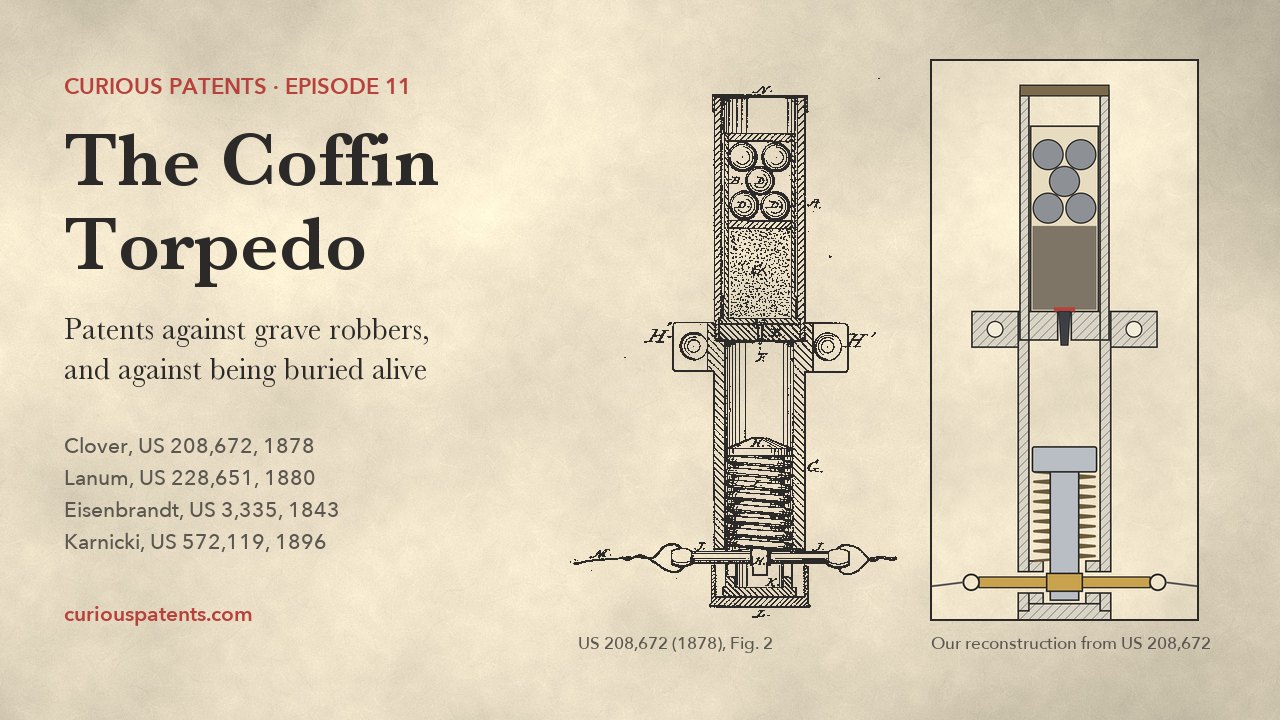
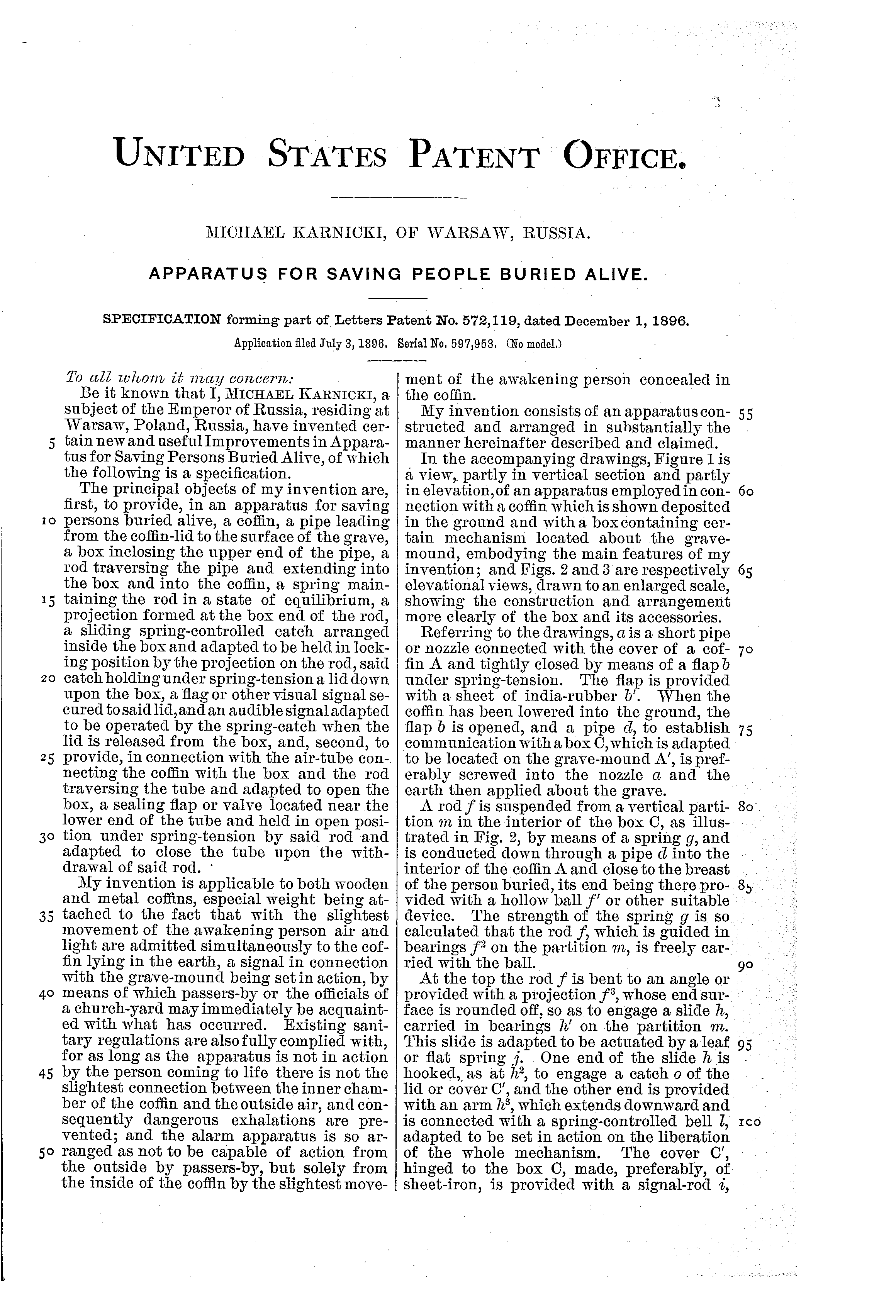
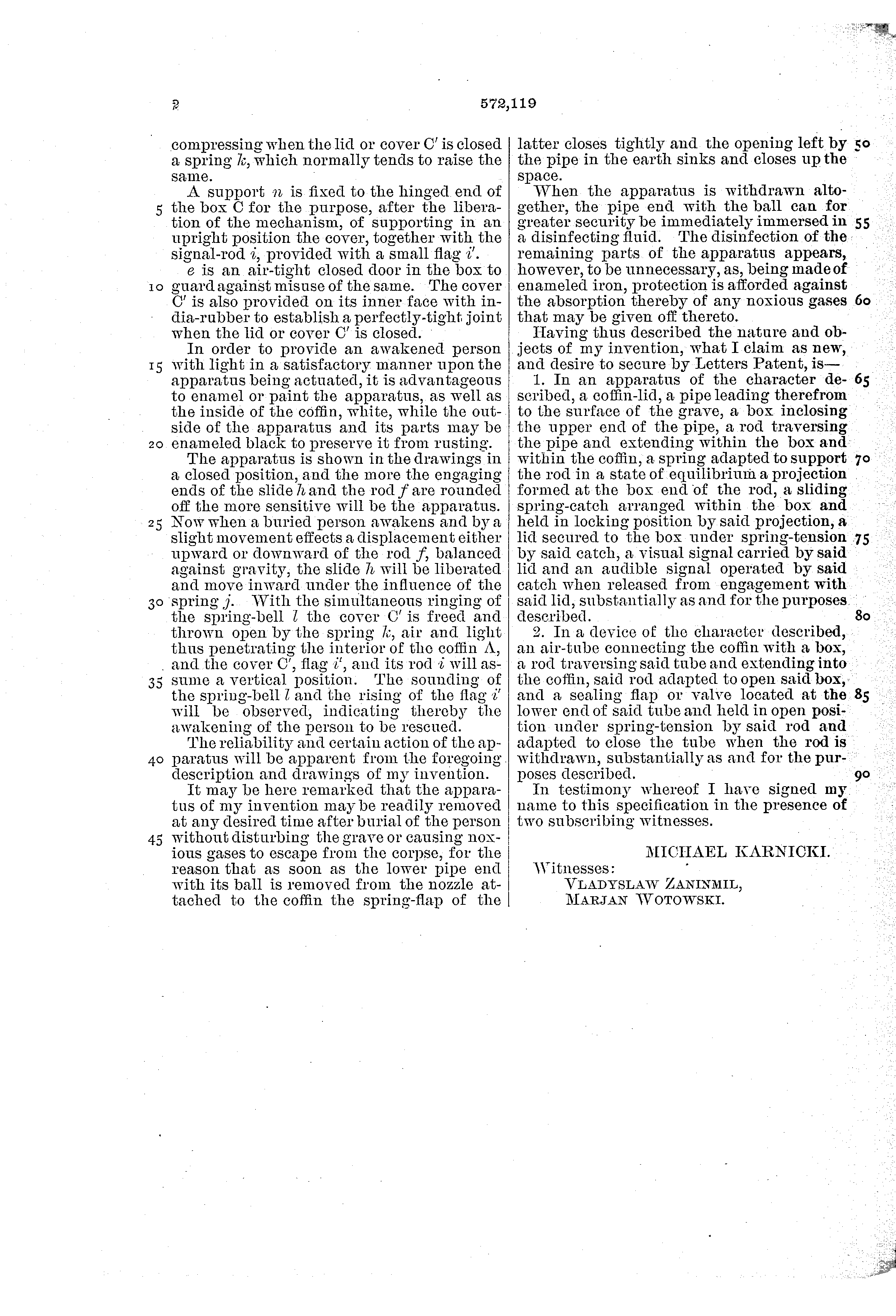
Philip K. Clover's patent, granted on 8 October 1878, is for a small gun screwed inside the head of a coffin. Its "trigger-wires M M are secured to the arms, legs, or other portion of the body": move the body, and it fires (US 208,672, p. 2). Michael Karnicki's, granted on 1 December 1896, puts a box on the grave, joined to the coffin by a pipe; the slightest movement below sets free a lid that springs open with a flag and a bell (US 572,119, pp. 1-2).
One was made for the fear of grave robbers, the other for the fear of being buried alive. And in 1881 a newspaper dispatch said that a grave torpedo had killed a man. This page follows the episode through what the record shows, with the four machines we rebuilt from their patents. Our drawings show coffins and mechanisms only, never a body.
Edinburgh, fifty years earlier
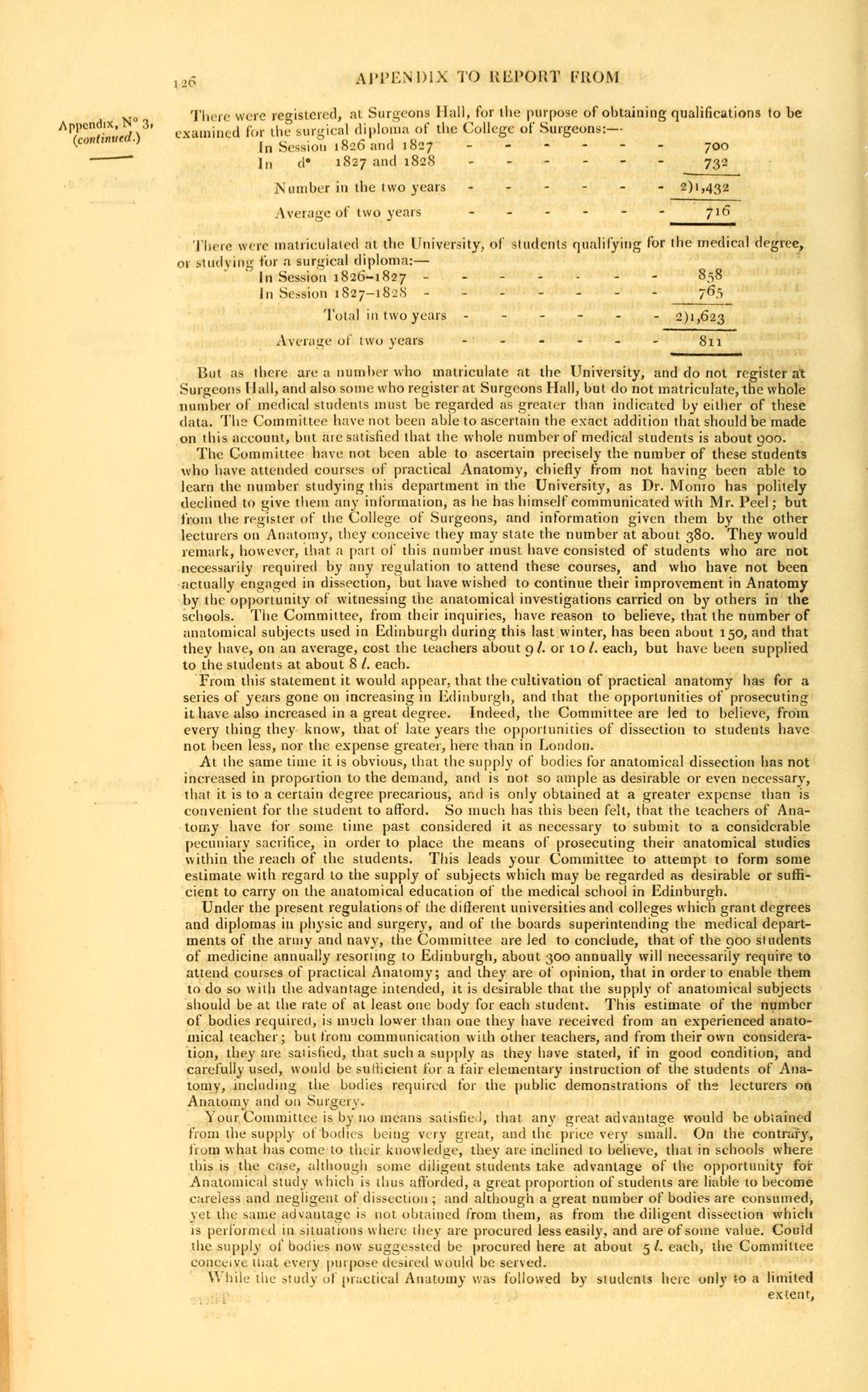
The trade in bodies was old by 1878. In Edinburgh in the 1820s the law gave anatomists the bodies of hanged murderers (the Murder Act of 1752), and far too few of them (Report from the Select Committee on Anatomy, 1828, p. 11). In the winter of 1827 to 1828 the city's anatomy teachers used "about 150" bodies, at "about 9l. or 10l. each": £9 ≈ £1,400 or £10 ≈ £1,500 in today's money. They came "chiefly from a distance, and a considerable part of it from Ireland" (the same report, Appendix 3, pp. 126-127).
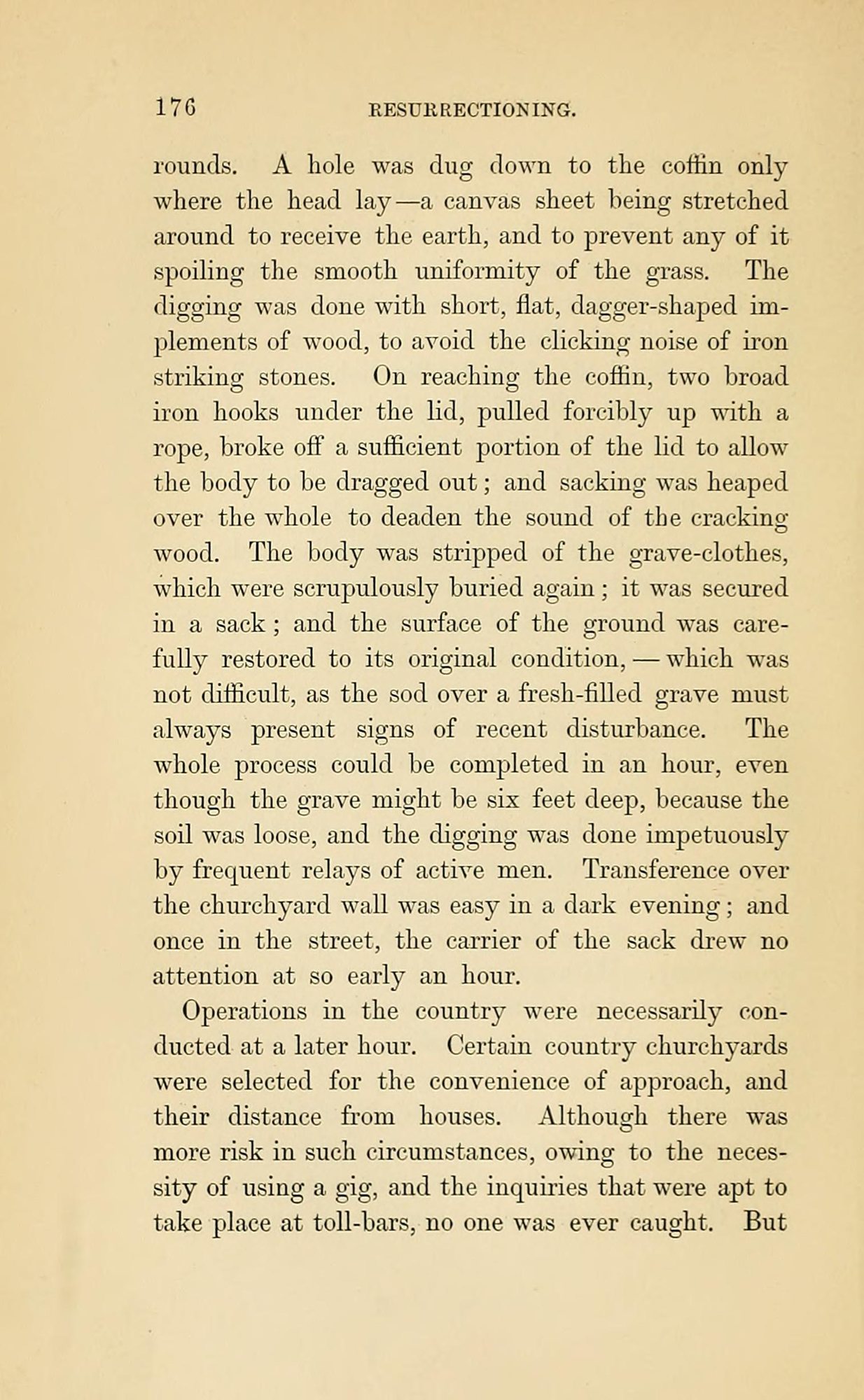
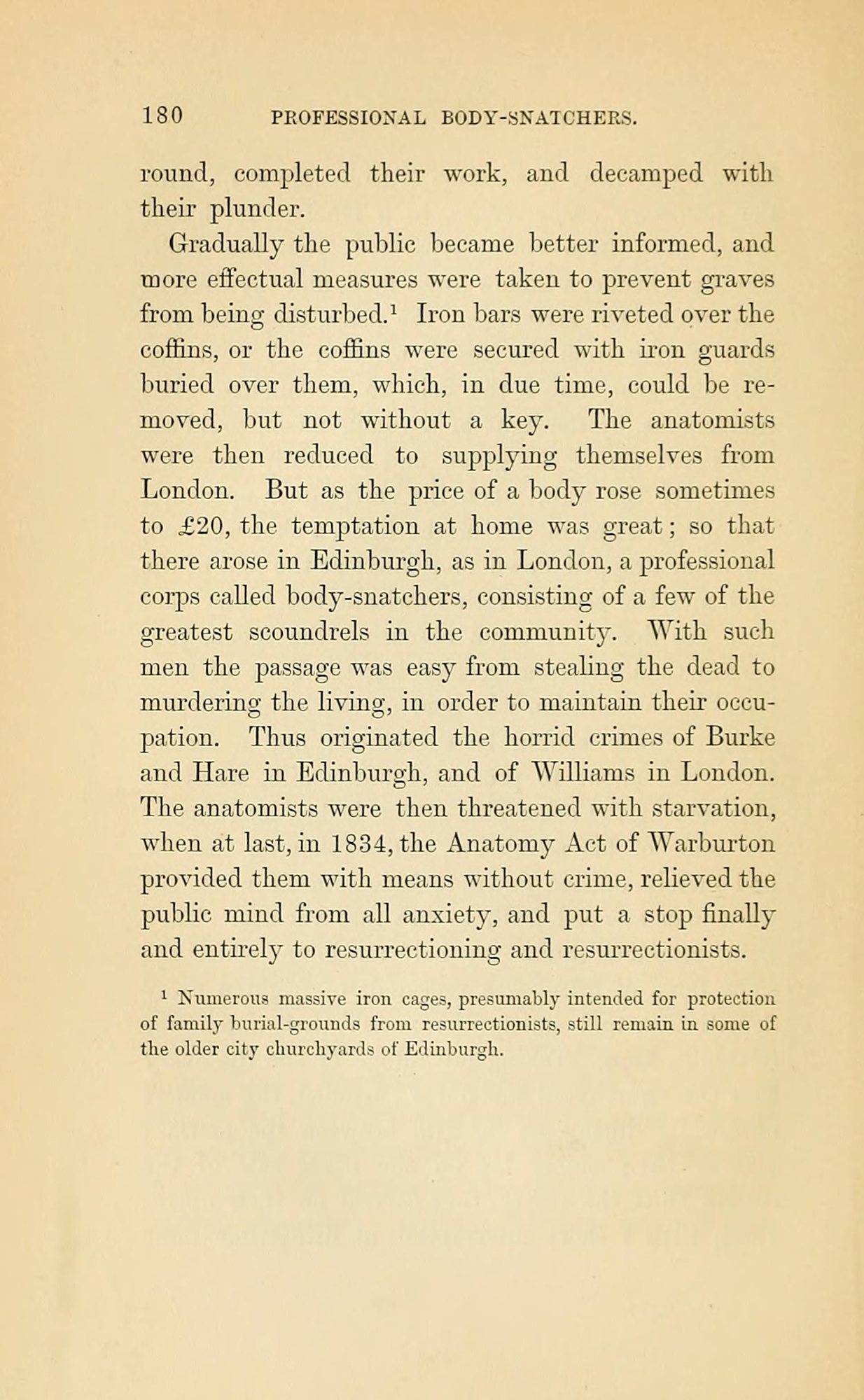
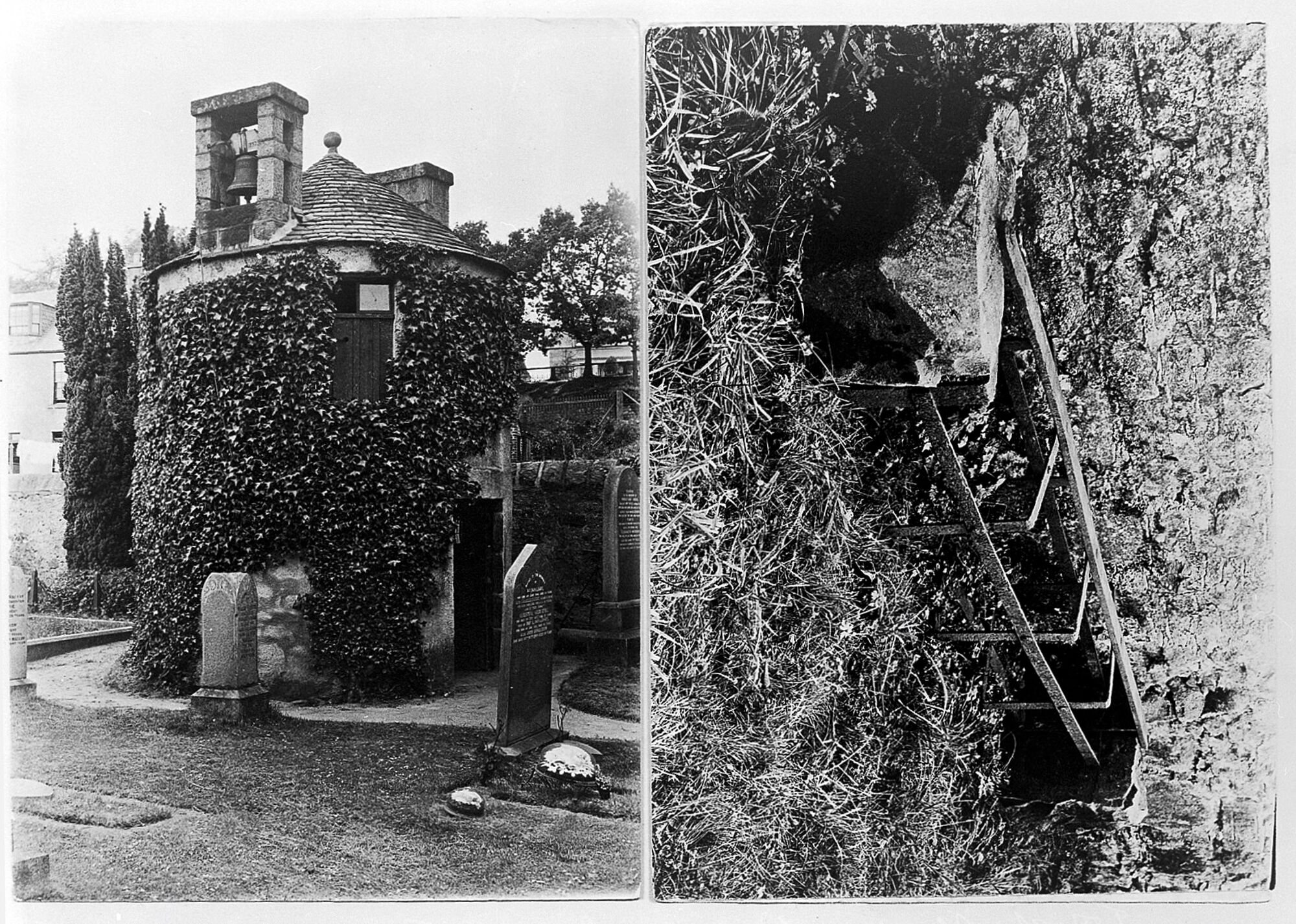
A doctor who knew the diggers, Robert Christison, later wrote down how it was done: a hole dug only where the head lay, "two broad iron hooks under the lid", and a rope. "The whole process could be completed in an hour" (Life, vol. 1, p. 176). Families answered with iron: "iron guards buried over" the coffin that only a key would release, iron cages over graves, and watch towers for men with guns (pp. 178-180). The tower in St Cuthbert's churchyard, Edinburgh, is dated 1827 (Historic Environment Scotland, listing LB27346).
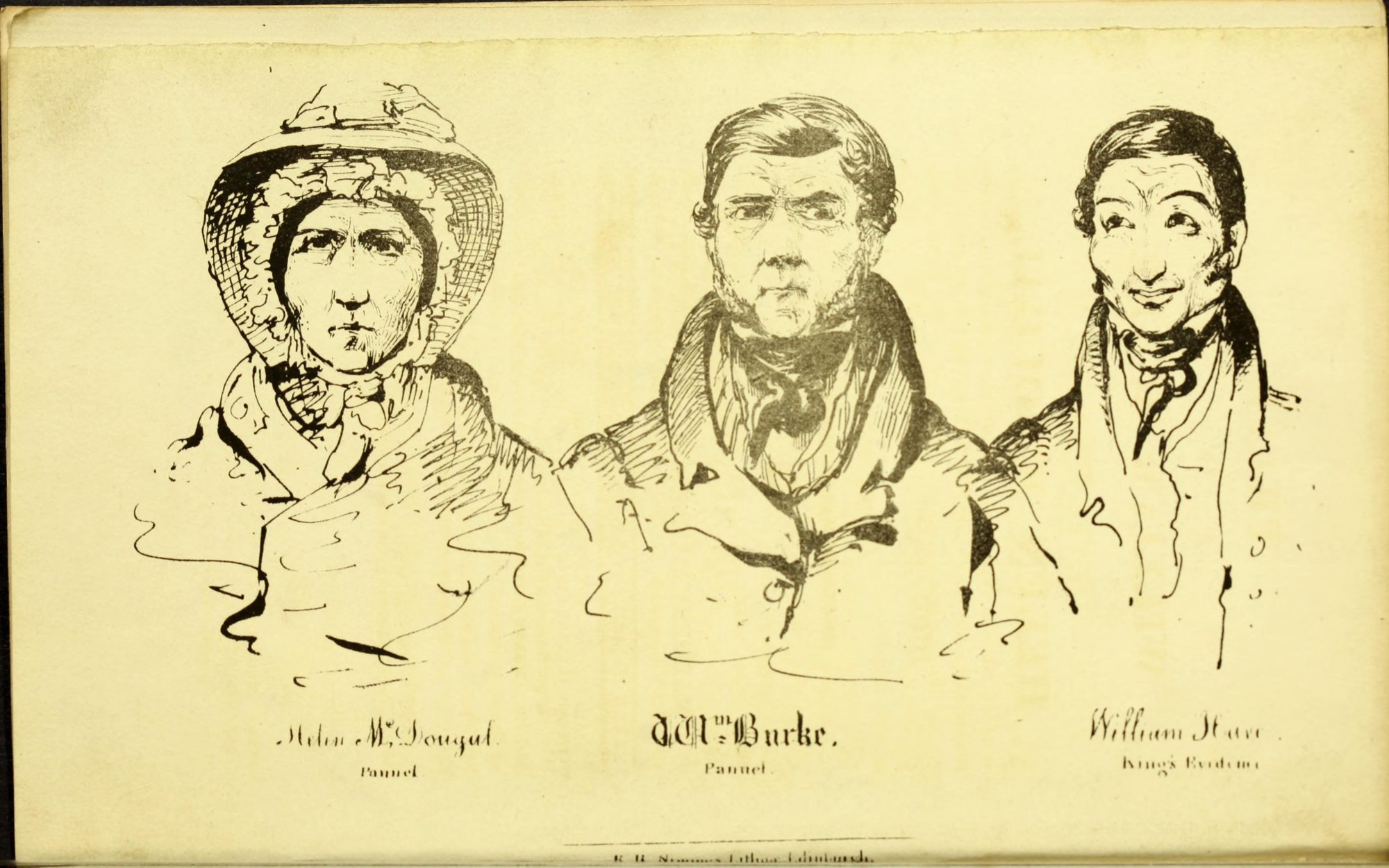
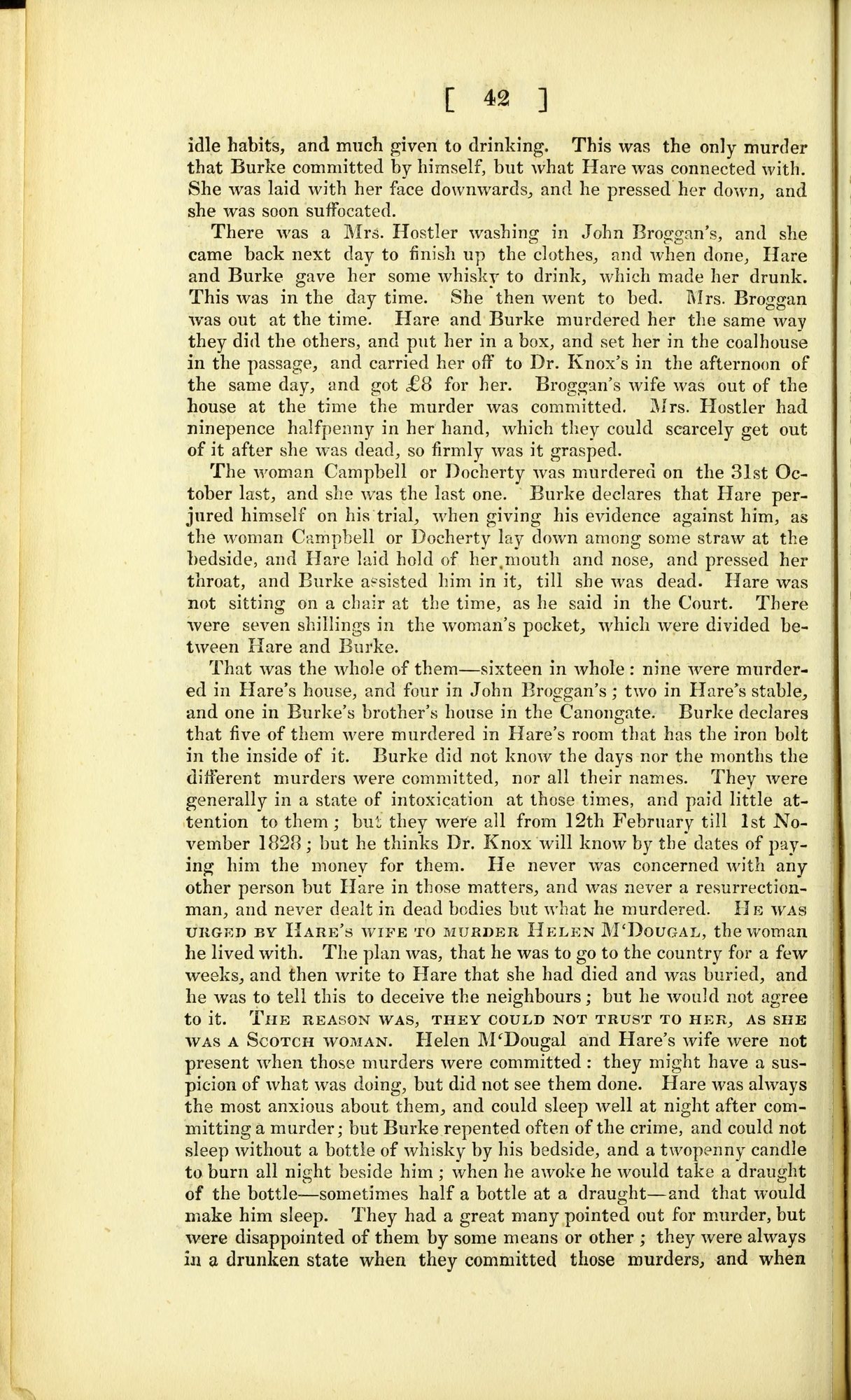
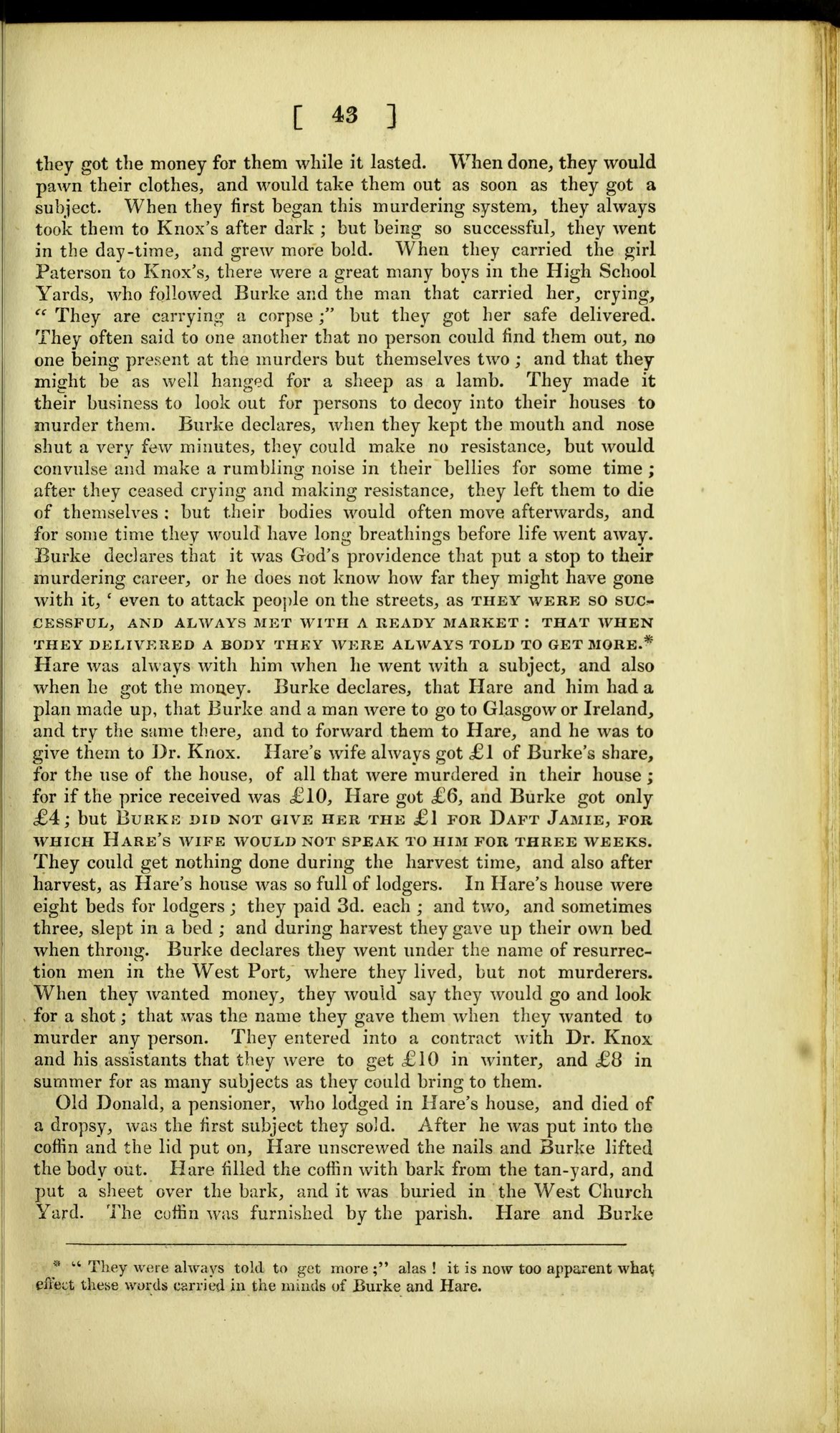
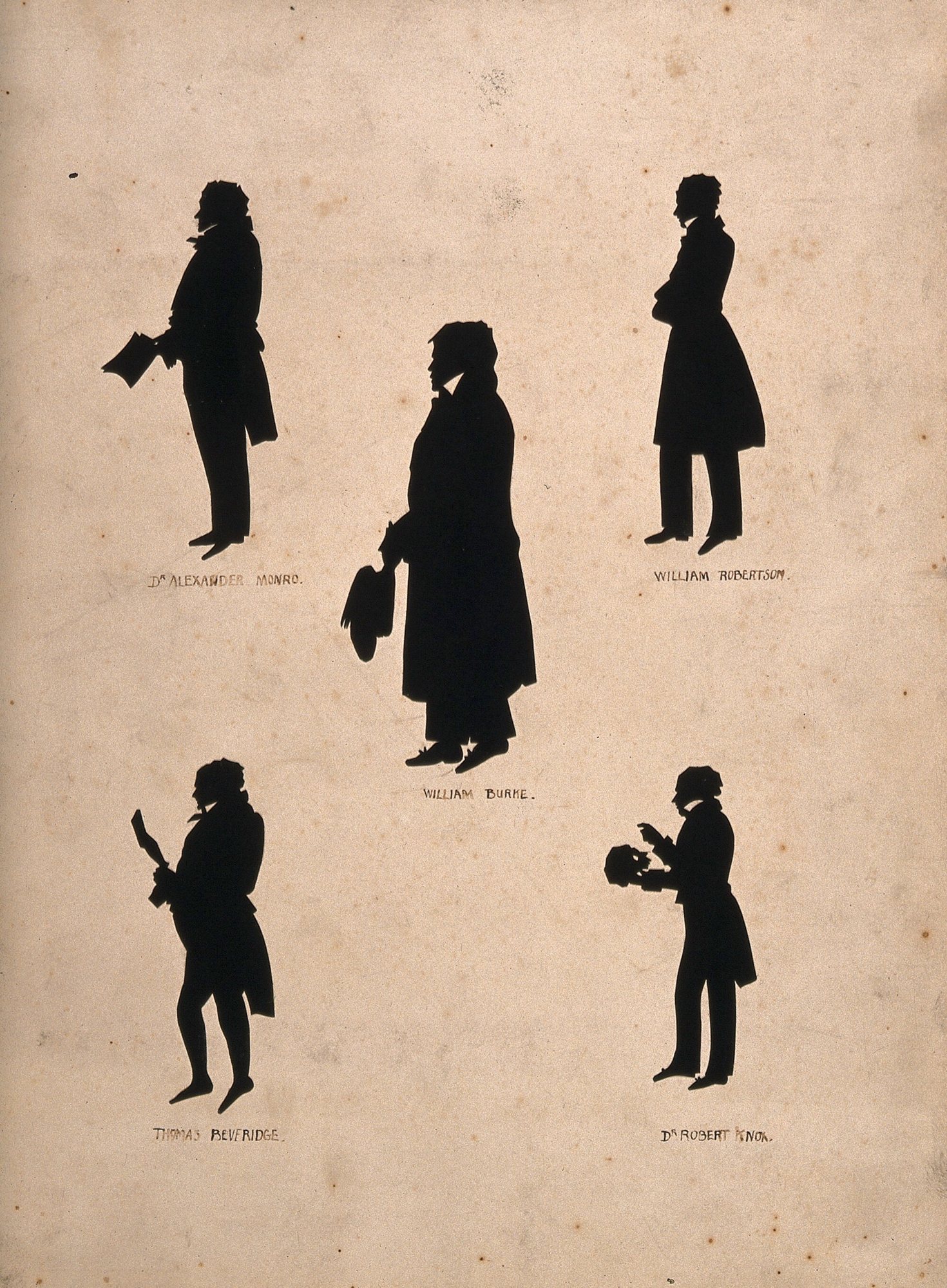
Then two men in a lodging house in the West Port found an easier supply. When an old lodger died, about Christmas 1827, William Burke and William Hare took his body out of its coffin and sold it at the rooms of the anatomist Robert Knox for £7 10s ≈ £1,100 (Burke's declaration to the Sheriff, January 1829). After that, they killed. Burke confessed to sixteen murders in 1828, "sixteen in whole", at "£10 ≈ £1,500 in winter, and £8 ≈ £1,200 in summer". He was never a resurrection man, he said, and "never dealt in dead bodies but what he murdered" (the Courant confession, pp. [42]-[43]).
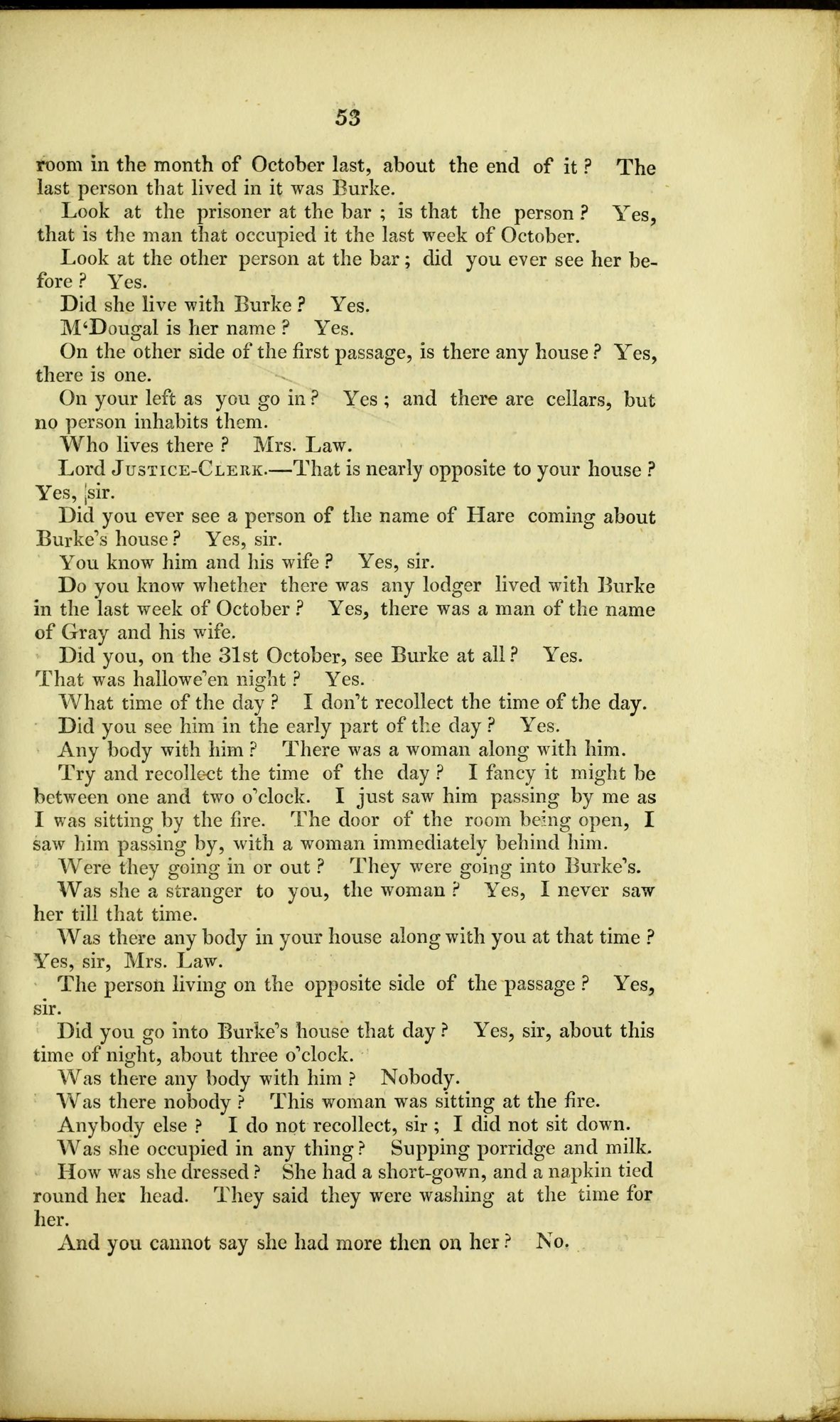
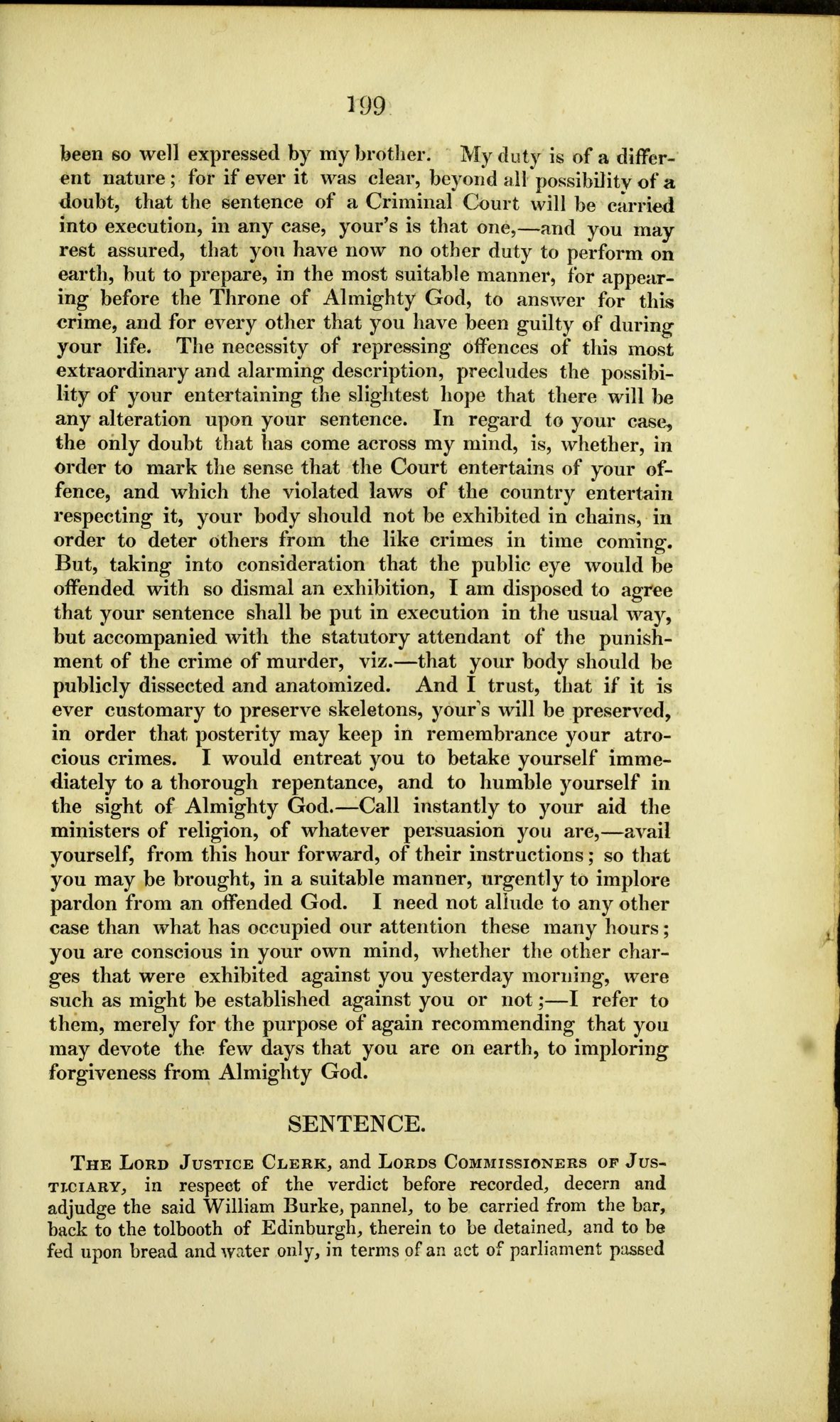
The last was a beggar woman, Mary Docherty, on Hallowe'en night, 1828: asked in court "That was hallowe'en night?", a witness answered "Yes" (Trial, p. 53). Hare turned King's evidence and went free. Burke was hanged in January 1829, and his body was publicly dissected. The judge hoped his skeleton would be kept: "your's will be preserved" (Trial, p. 199). It is still in the University of Edinburgh's Anatomical Museum, which lists it. Knox, who bought every body, was never charged.
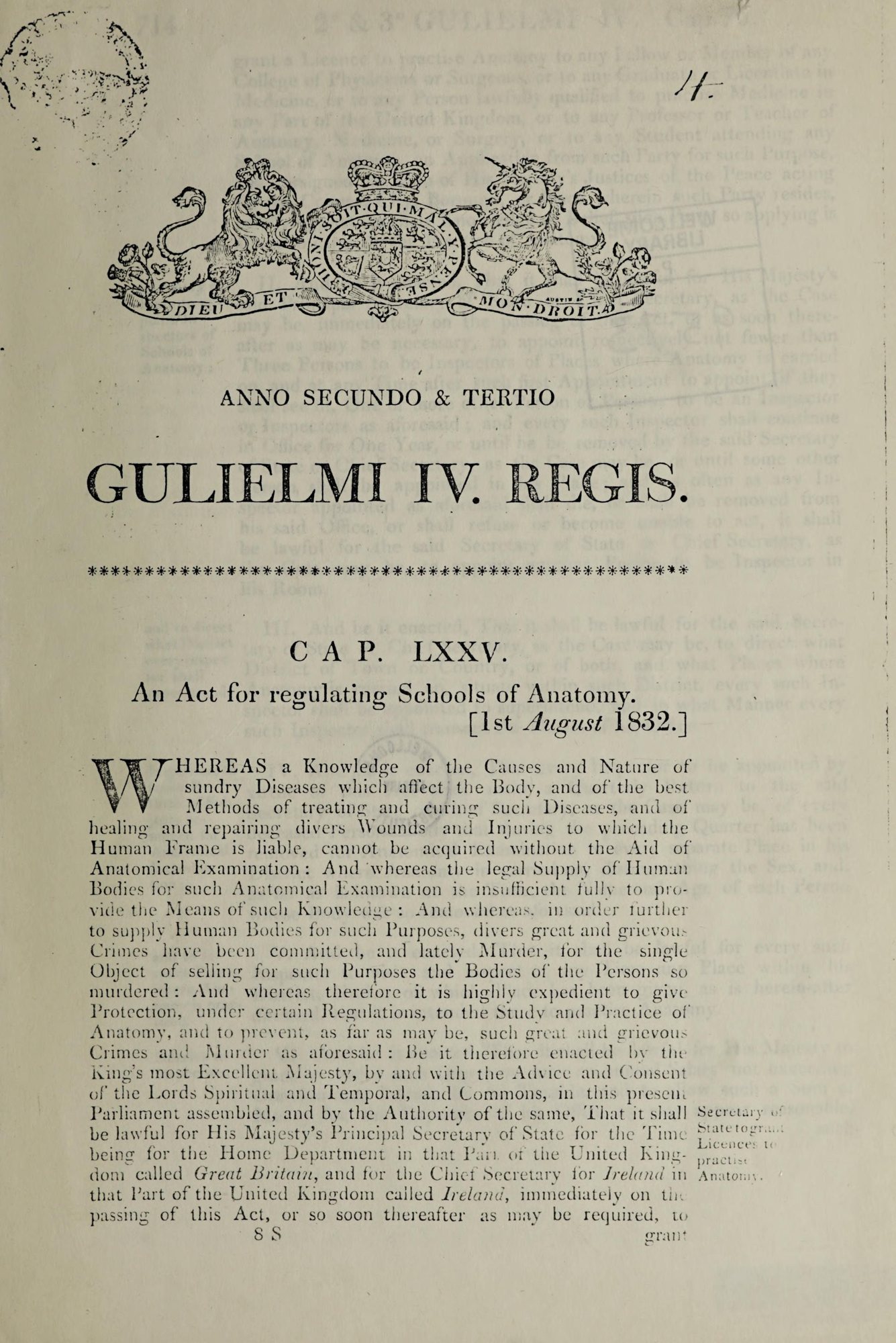
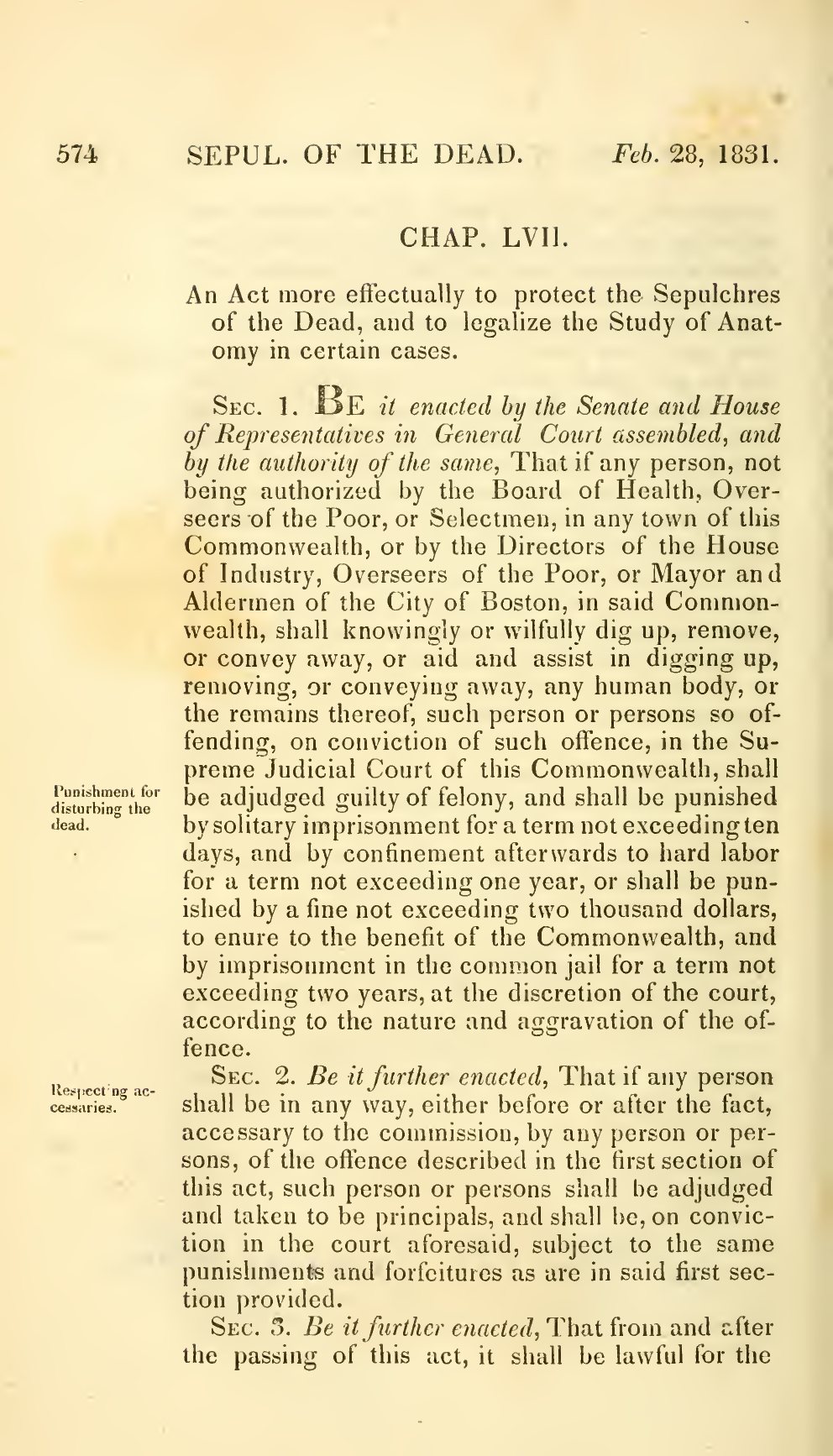
After two London men were hanged in 1831 for the same crime, Britain gave anatomists the bodies that no one claimed (the Anatomy Act, 1832, whose preamble speaks of crimes committed to supply bodies, "and lately Murder"). In practice they came mostly from workhouses and hospitals (so the general histories; the Act does not say it). Massachusetts had passed a law of its own the year before (Acts 1830, chap. LVII, approved 28 February 1831). Ohio, in 1878, had no such law (according to a history of the Harrison case: Ohio State Law Journal, 1958, citing L. F. Edwards).
Cincinnati, May 1878
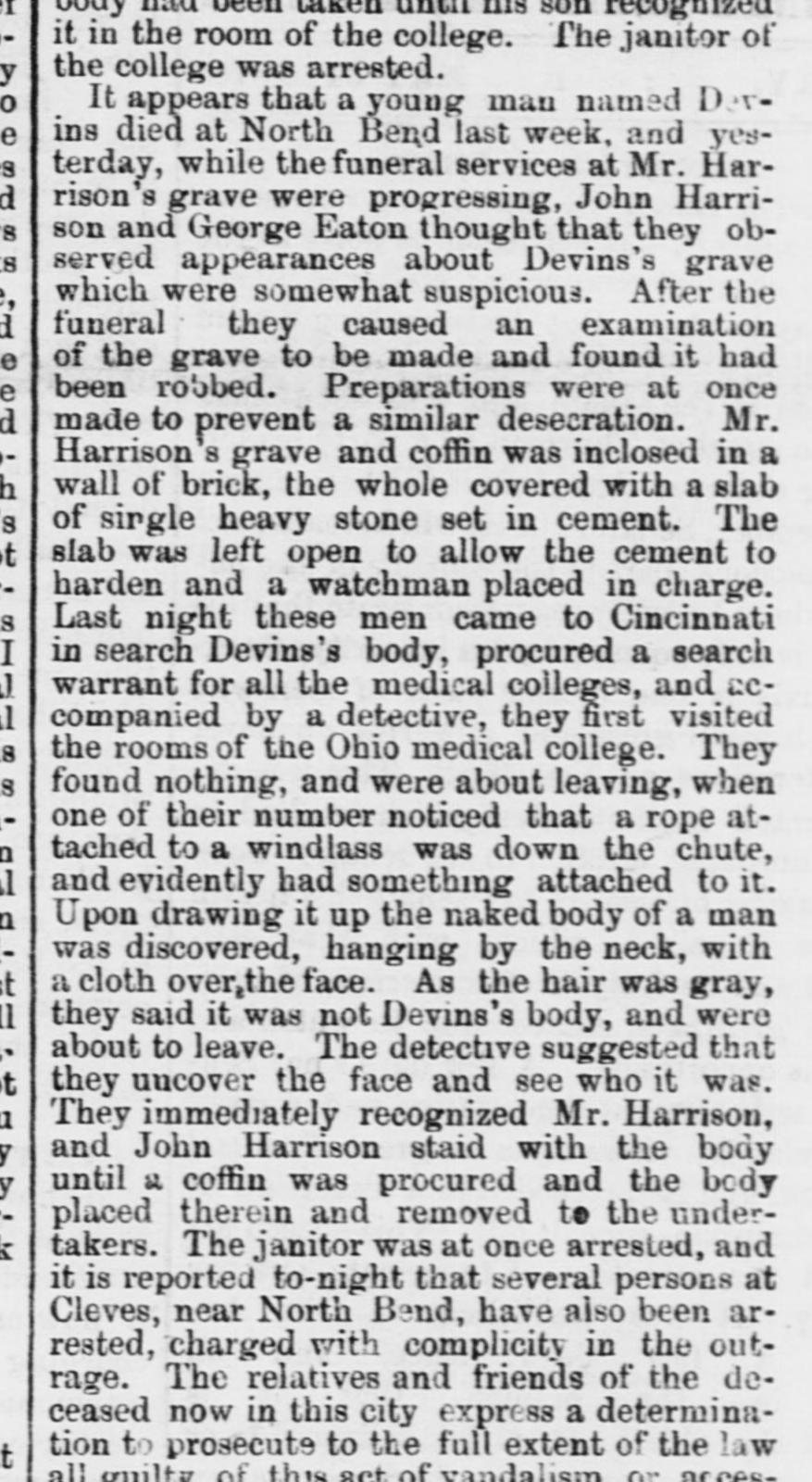
In May 1878 John Scott Harrison died: a former congressman, and the son of President William Henry Harrison. He was buried at North Bend, west of Cincinnati. A family friend's grave nearby had just been robbed, so his grave and coffin were "inclosed in a wall of brick, the whole covered with a slab of single heavy stone set in cement", and "a watchman placed in charge".
The next day his son went to the Ohio Medical College with a search warrant, looking for the friend's body. They found nothing, until someone noticed that "a rope attached to a windlass was down the chute". They hauled it up. On it hung his father. "The janitor of the college was arrested." (The wire report, in the Memphis Daily Appeal, 31 May 1878, and the Daily Cairo Bulletin, 1 June 1878.)
In our search of the Library of Congress's newspaper collection the story ran in at least fifteen papers between 31 May and 26 June 1878. And in November, thieves in New York took the body of the merchant A. T. Stewart from its vault, it was thought for a ransom: "an expectation of a reward for the return of the remains" (New-York Tribune, 8 November 1878).
A month later: a gun inside the coffin
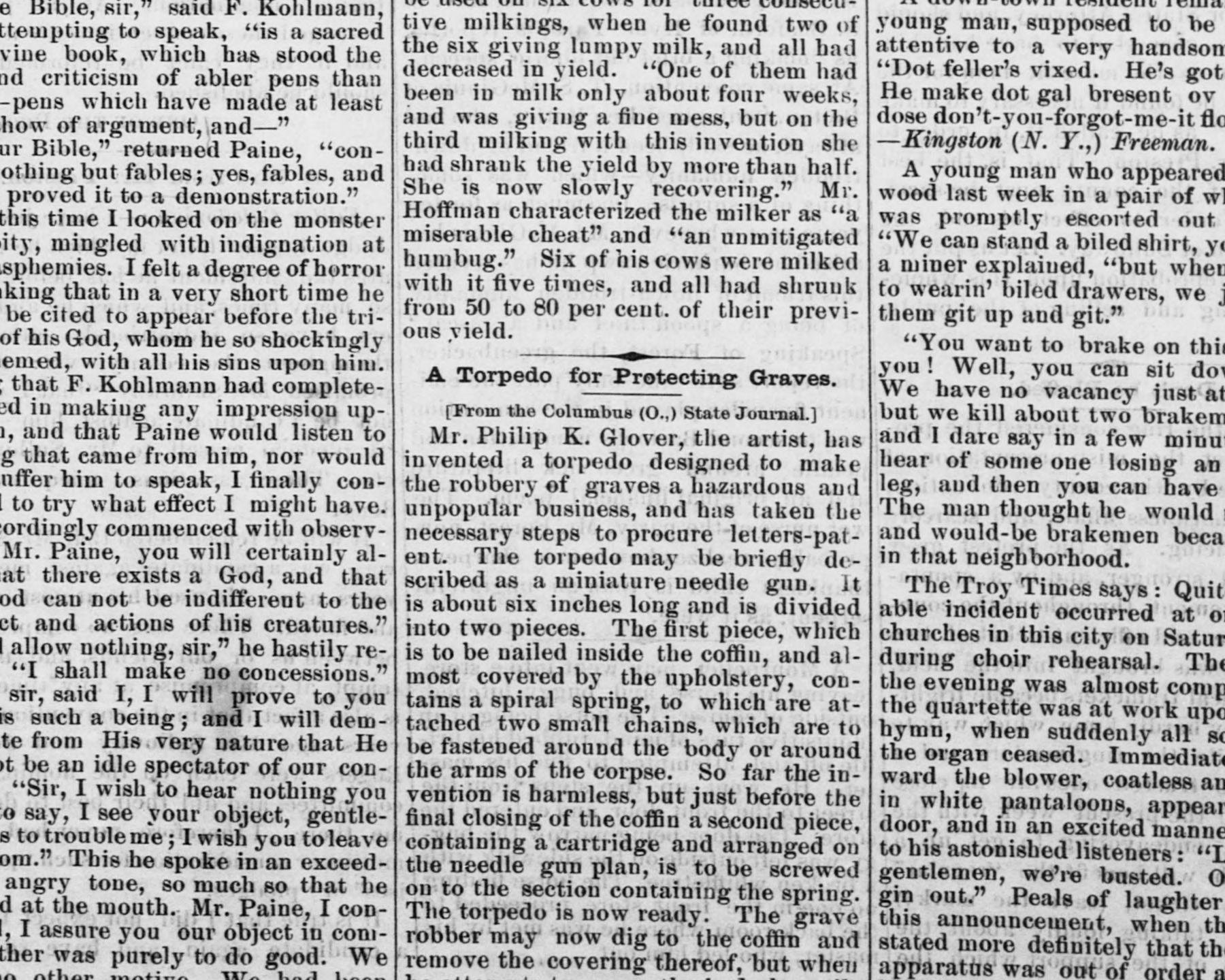
On 29 June 1878, a month after the Harrison discovery, Philip K. Clover of Columbus, Ohio, filed a patent for a coffin torpedo (US 208,672, granted 8 October 1878). His home paper called him "the artist", and described the torpedo as "a miniature needle gun", "about six inches long" (the Columbus State Journal, reprinted in Vermont).
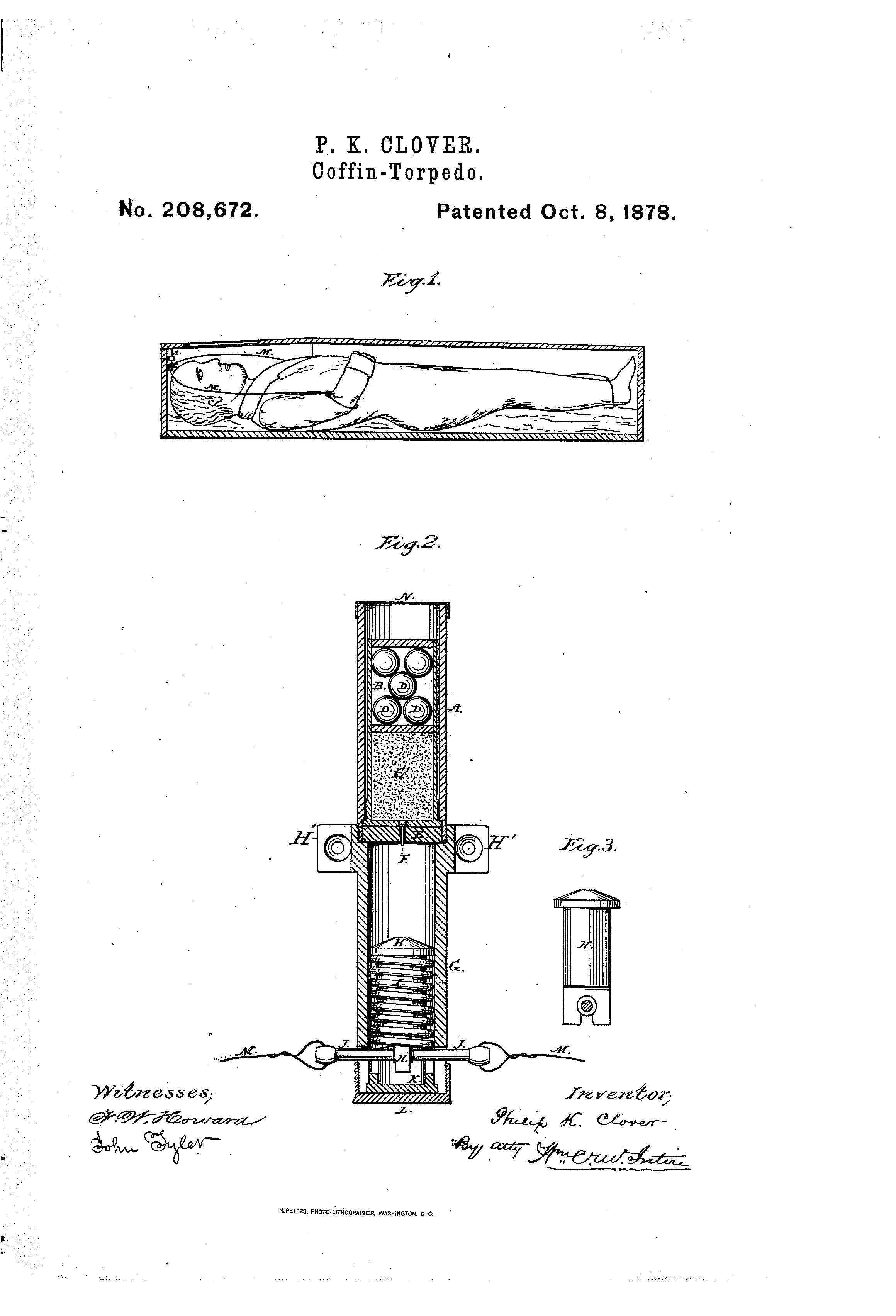
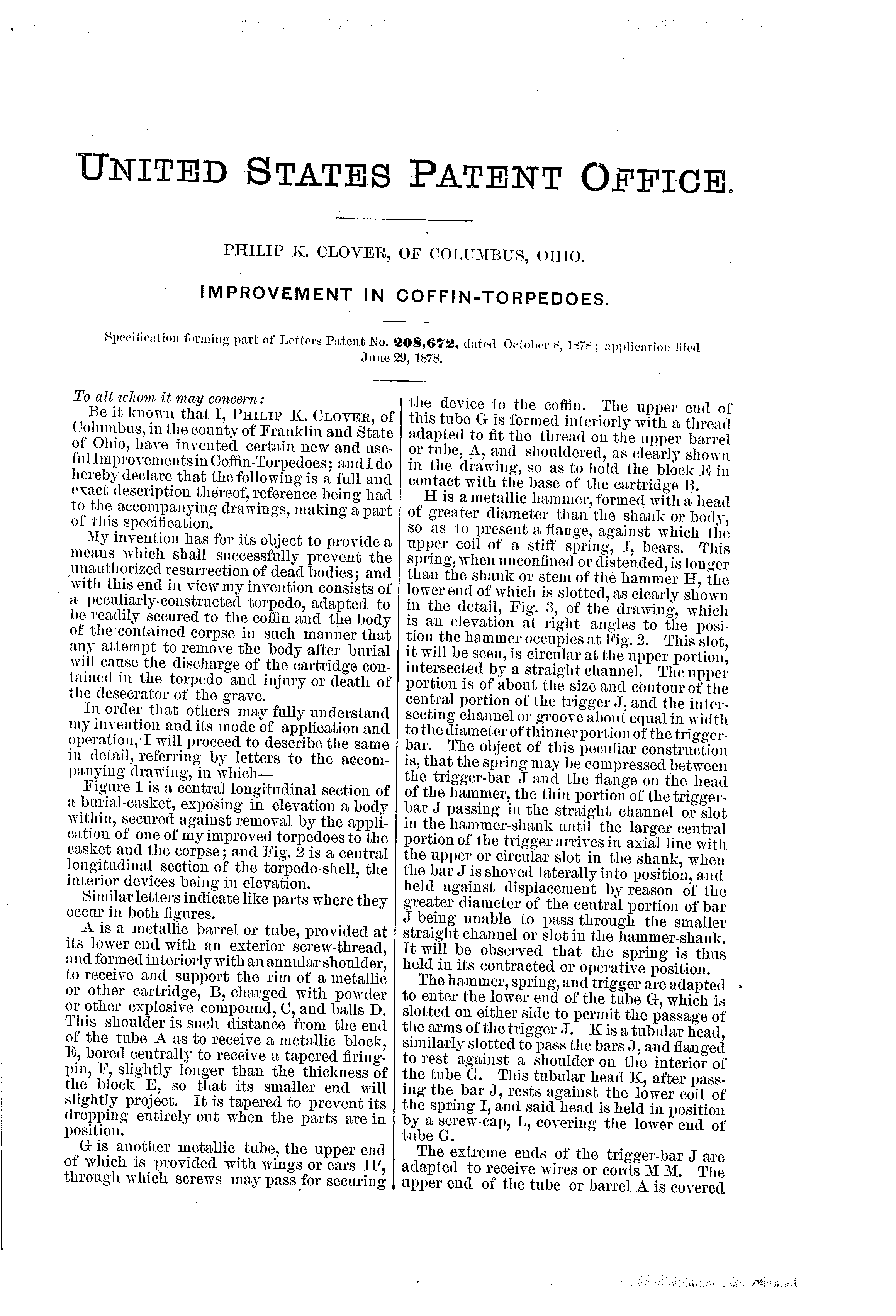
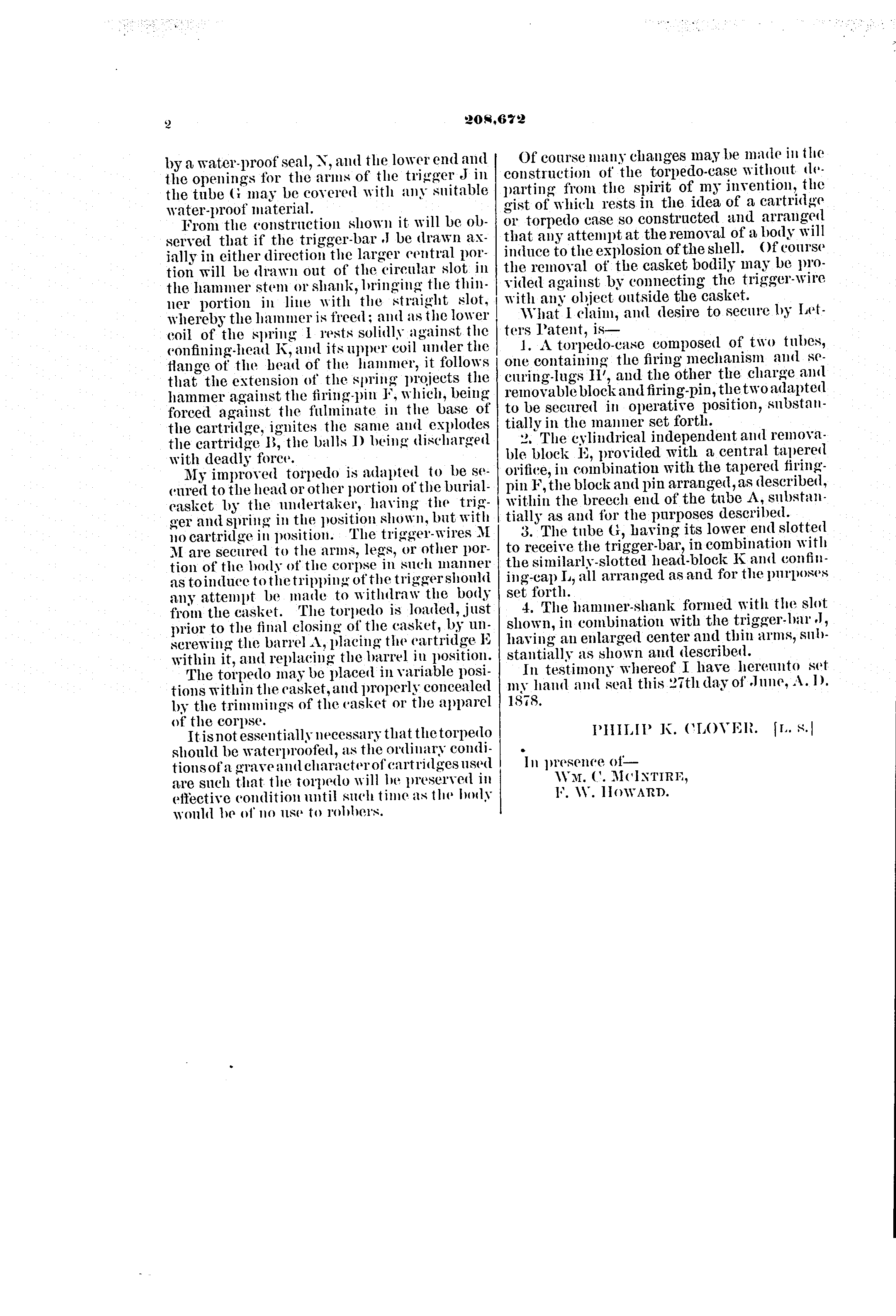
Its purpose, in the patent's words, was to prevent "the unauthorized resurrection of dead bodies", by the "injury or death of the desecrator of the grave" (p. 1). Two tubes, one above the other. The upper one, the barrel A, holds a cartridge B of powder C and balls D, with a firing pin F in the block E under it. The lower one, tube G, holds the hammer H on a stiff spring I. The spring is held squeezed by the trigger bar J, which passes through a slot in the hammer's shank.
The bar is thick in the middle and thin at the ends. The slot is a round hole with a narrow channel below it (Fig. 3). The thick middle fills the hole, and cannot pass the channel, so the hammer is held back. Pull the bar "axially in either direction" (p. 2) and its thin part lines up with the channel: the spring drives the hammer up onto the pin, and the pin strikes the cap.
From the patent (Figs. 2 and 3): barrel A, cartridge B, powder C, balls D, block E and firing pin F ("slightly longer than the thickness of the block"), tube G with its wings H′ for the screws, hammer H, the stiff spring I ("longer than the shank"), trigger bar J through the slot in the shank, head K, screw-cap L, wires M, seal N; the bar thick in the middle, the slot a round hole with a channel below it, the bar freed when "drawn axially in either direction". Ours: every size (the 1878 paper gives "about six inches" overall, which we used for the two tubes together), the stroke slowed down (the real one takes a few thousandths of a second), and the flash at the cap. No discharge is shown. The inset on the right is the shank's face, as Fig. 3, with the bar seen end on. Checked by a test of our own, the episode's: the parts nest; the thick middle fits the hole and cannot pass the channel, the thin arm can; pulled either way, the hammer is held until the thick part is clear of the shank, the bar never cuts into the shank as it rises, and the hammer stops on the pin; planted faults are caught.
The patent says how it was to be fitted. Wires from the two ends of the bar were to be tied to the arms or the legs of the body. The undertaker screws the torpedo to "the head or other portion of the burial-casket", where it is "concealed by the trimmings", and loads it "just prior to the final closing" of the lid. In case robbers carried off the whole coffin, a wire could be tied to "any object outside the casket". It need not be waterproof: the cartridge will keep "until such time as the body would be of no use to robbers" (all p. 2).
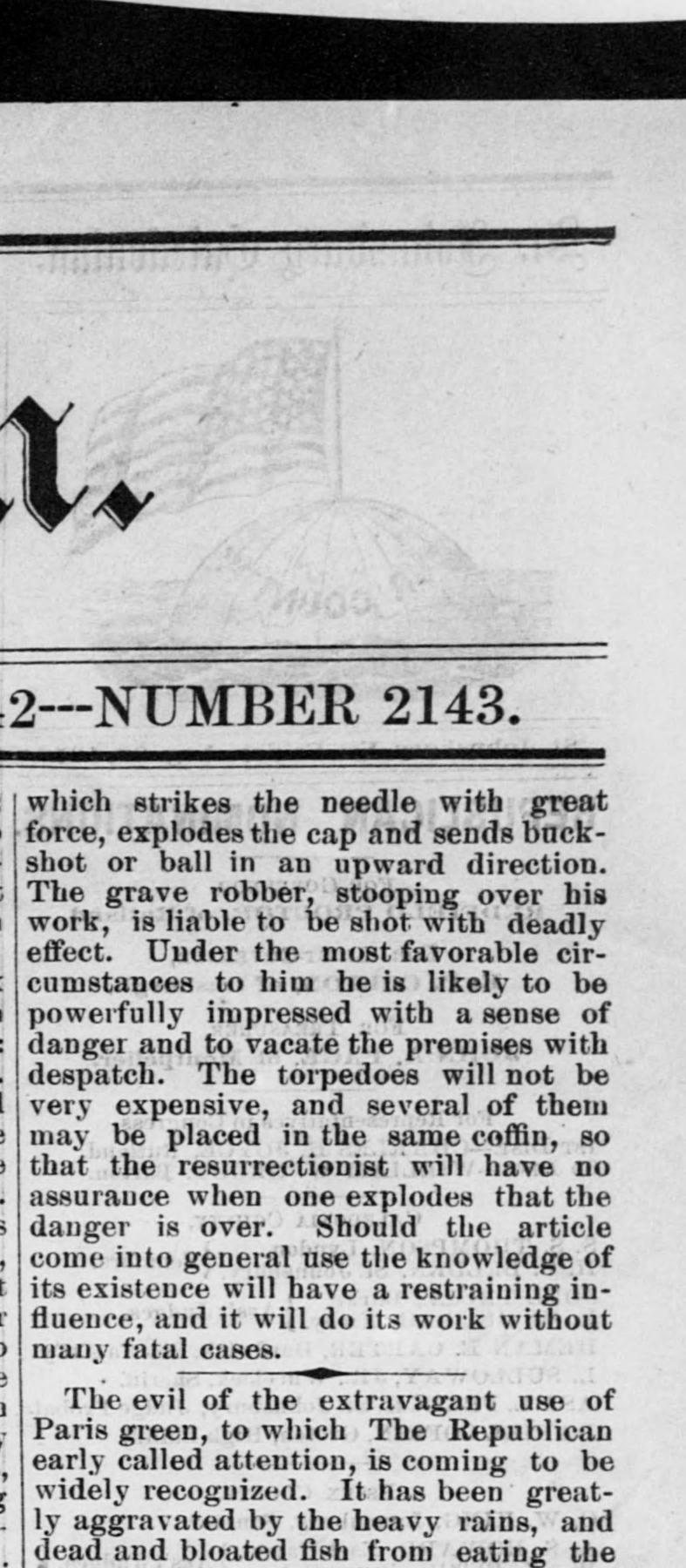
The idea, the Columbus paper said, was that once people knew about it, "it will do its work without many fatal cases".
"A noise like thunder"
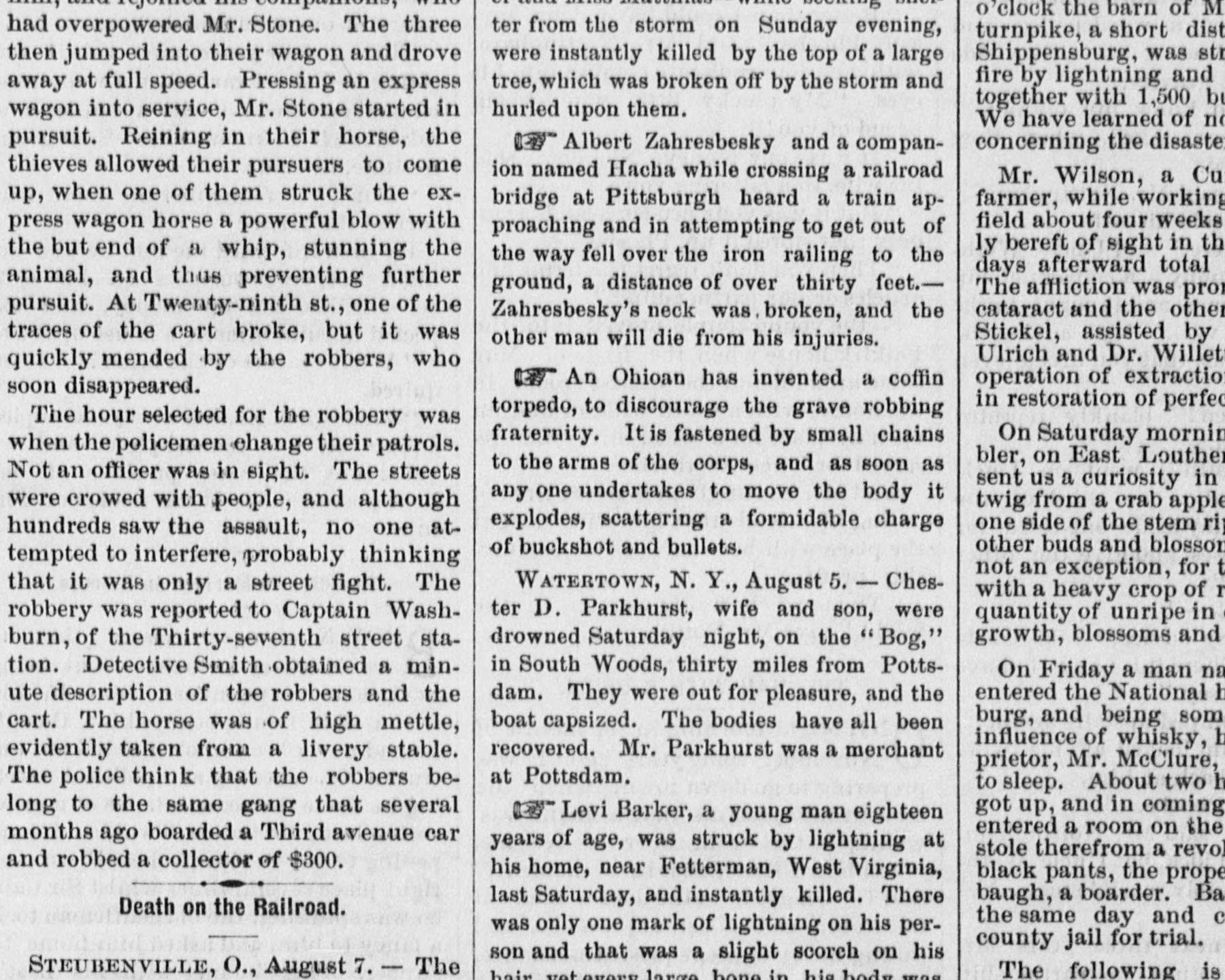
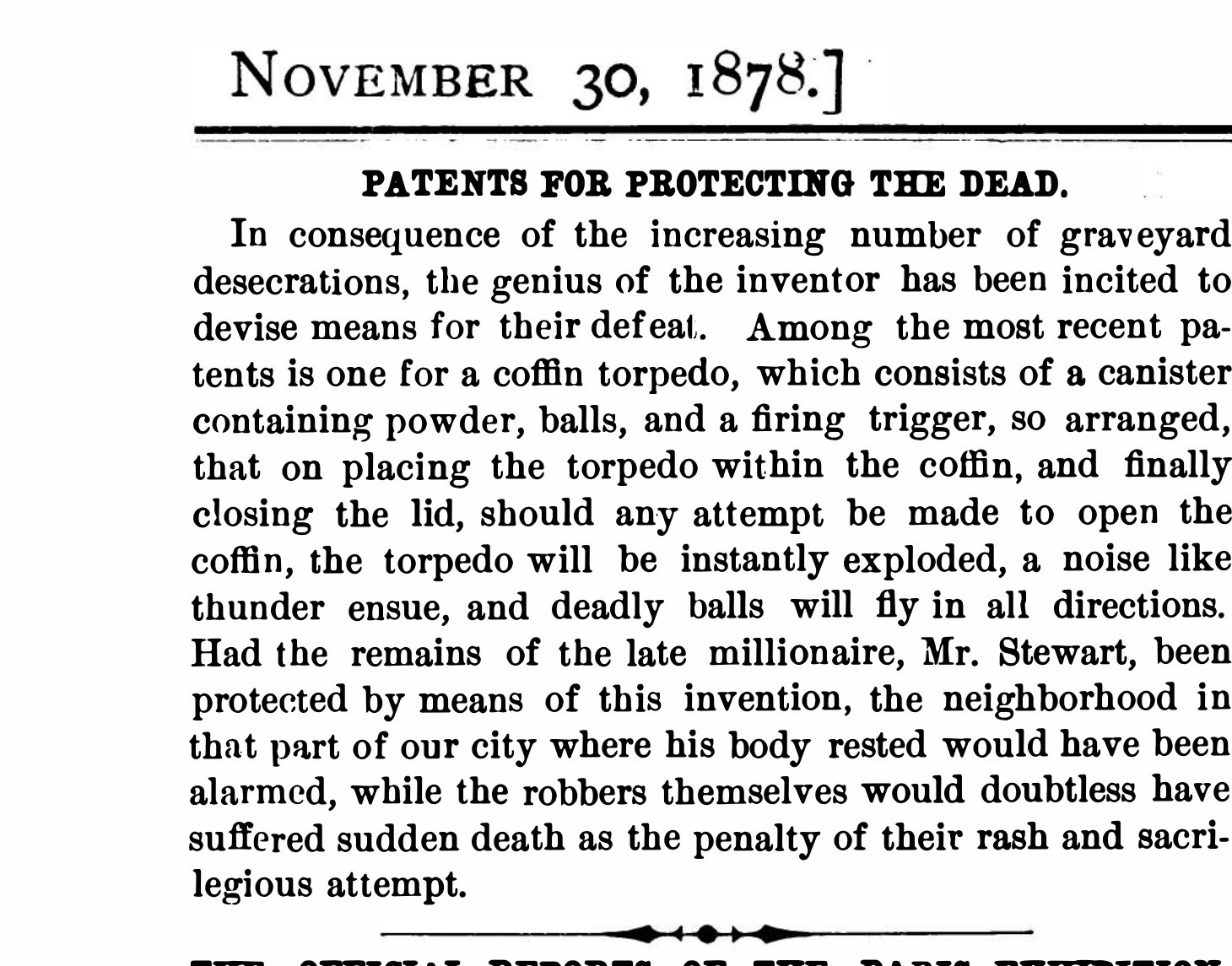
By August a two-line item was going round the country's papers: "An Ohioan has invented a coffin torpedo" (New Bloomfield Times, 13 August 1878). In November, after the Stewart theft, Scientific American described "a canister containing powder, balls, and a firing trigger". Open the coffin, it said, and "a noise like thunder" would follow, and "deadly balls will fly in all directions" (30 November 1878, p. 337).
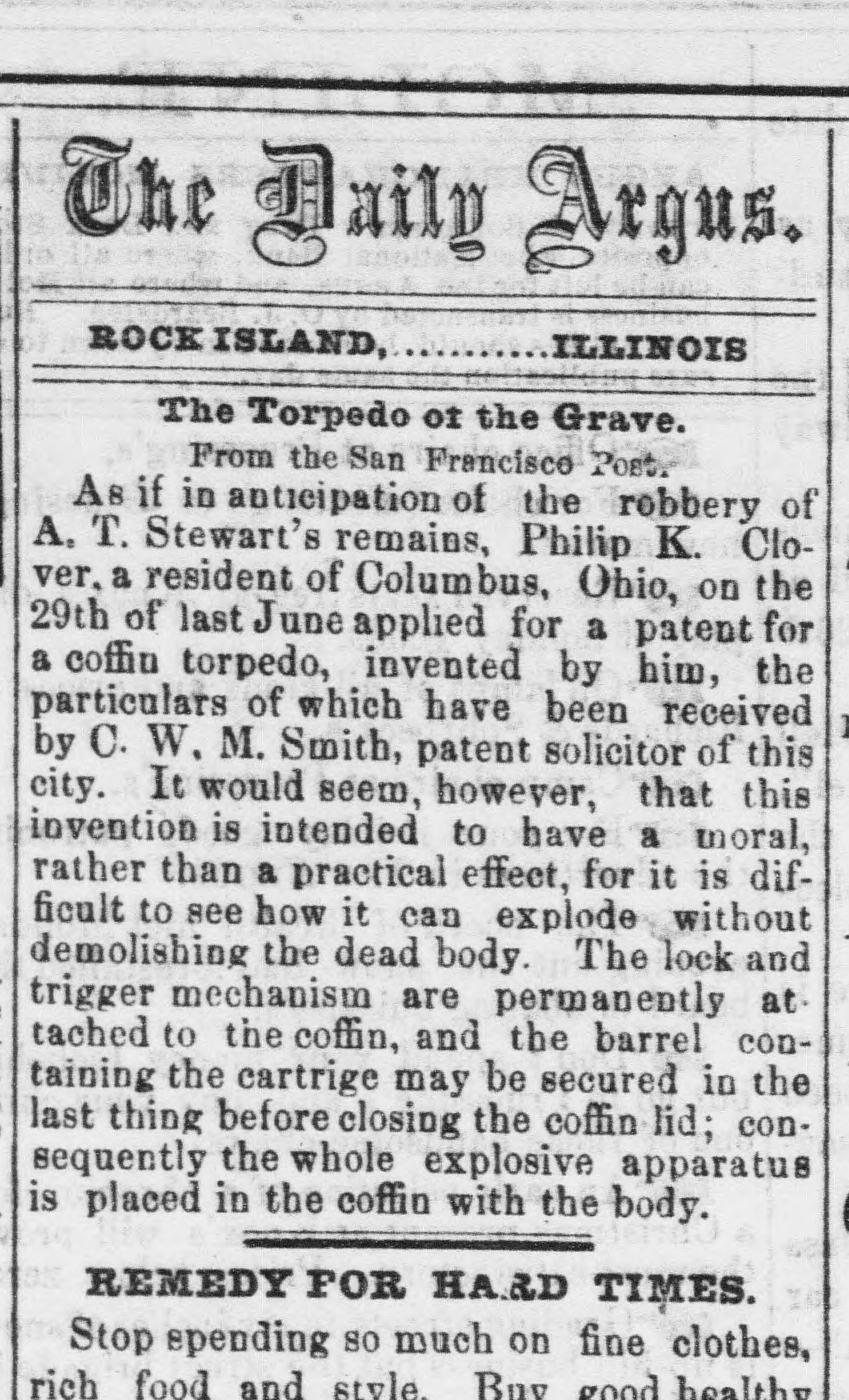
In San Francisco a paper asked the obvious question: how could it go off "without demolishing the dead body"? (the San Francisco Post, reprinted in the Rock Island Argus, 11 December 1878). And in Richmond, Virginia, when a reader suggested torpedoes for the city's cemetery, another wrote in with his own question: "Who is going to do the filling up?" (Daily Dispatch, 17 February 1880, p. 4; we read this letter in the machine reading of the page).
Circleville: the torpedo moves into the earth
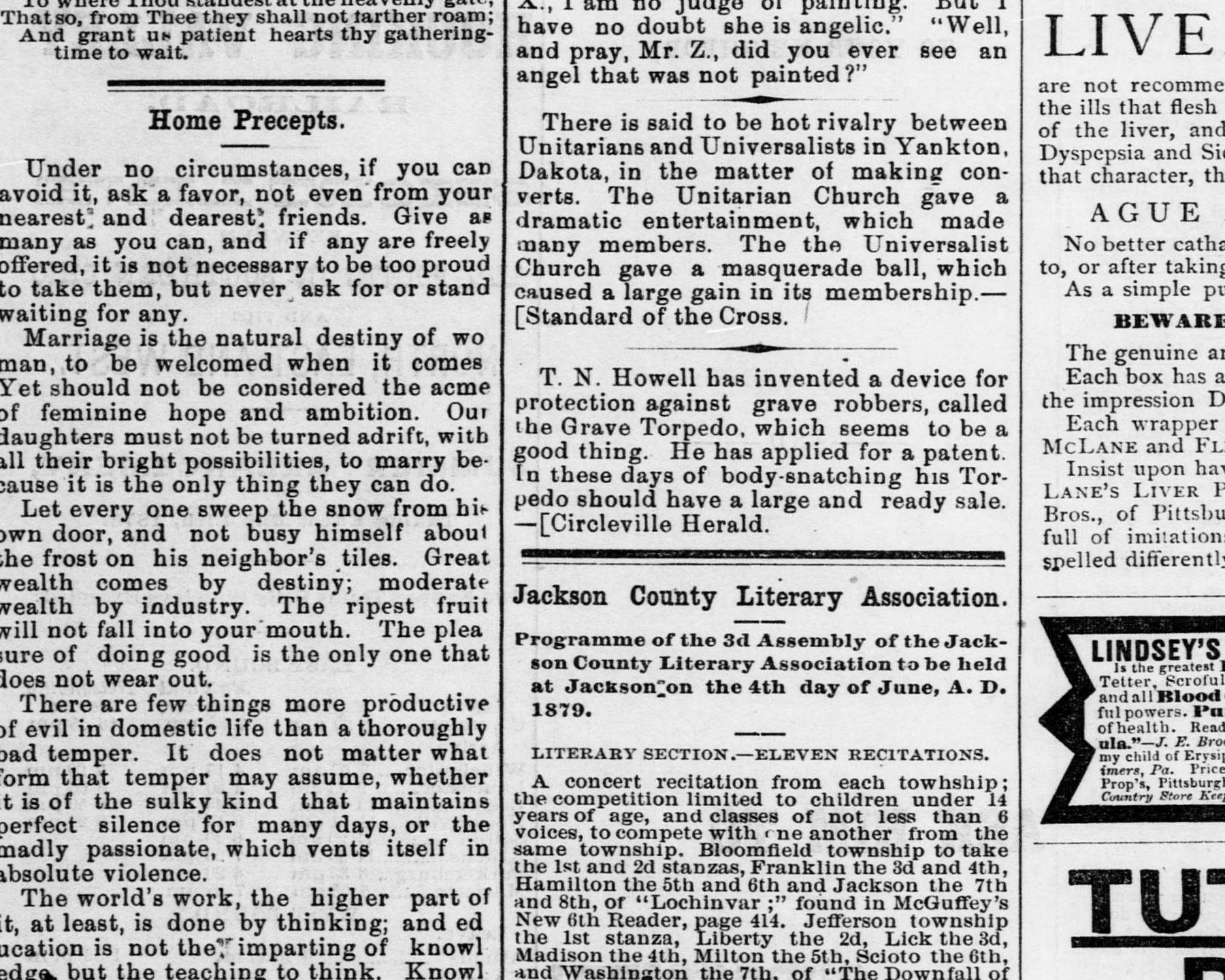
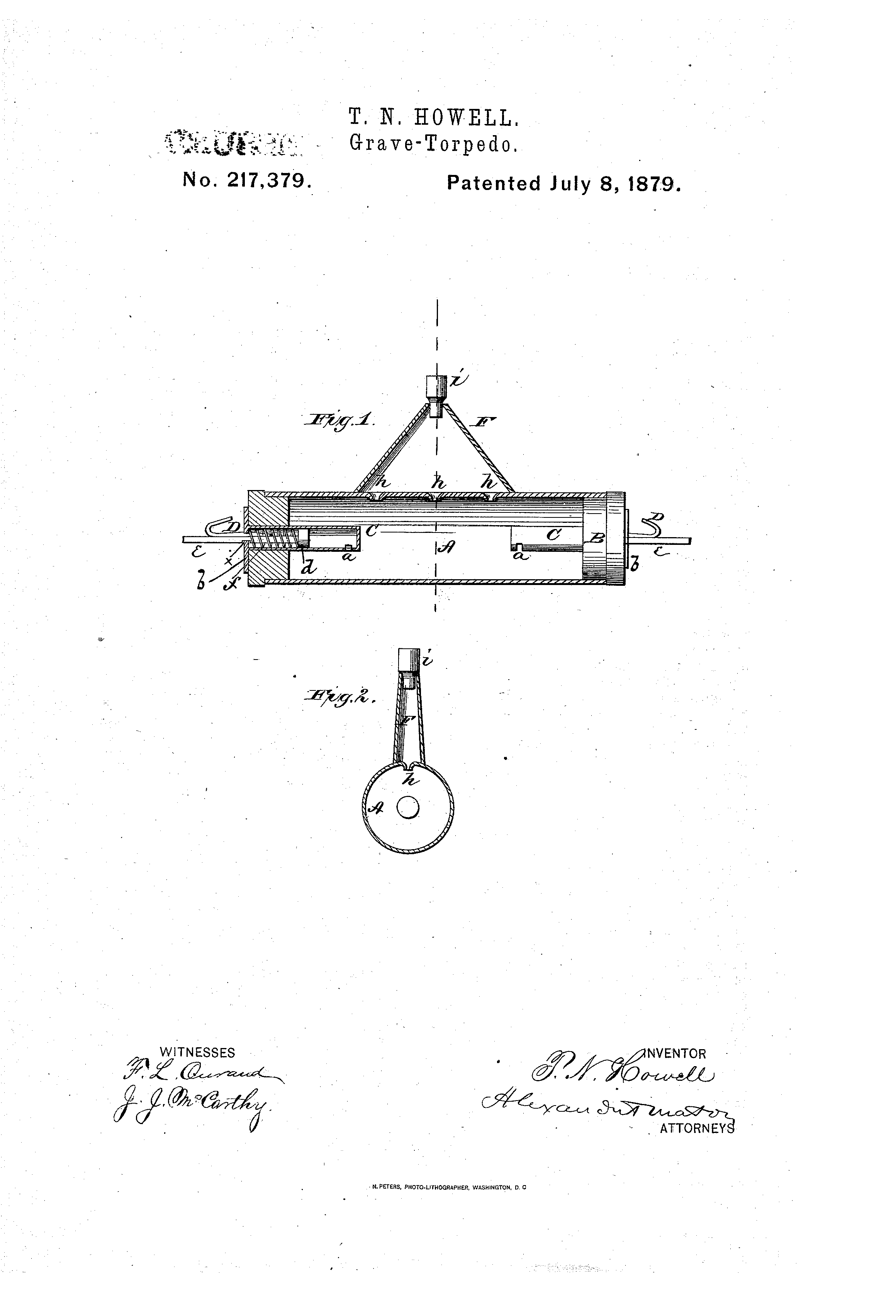
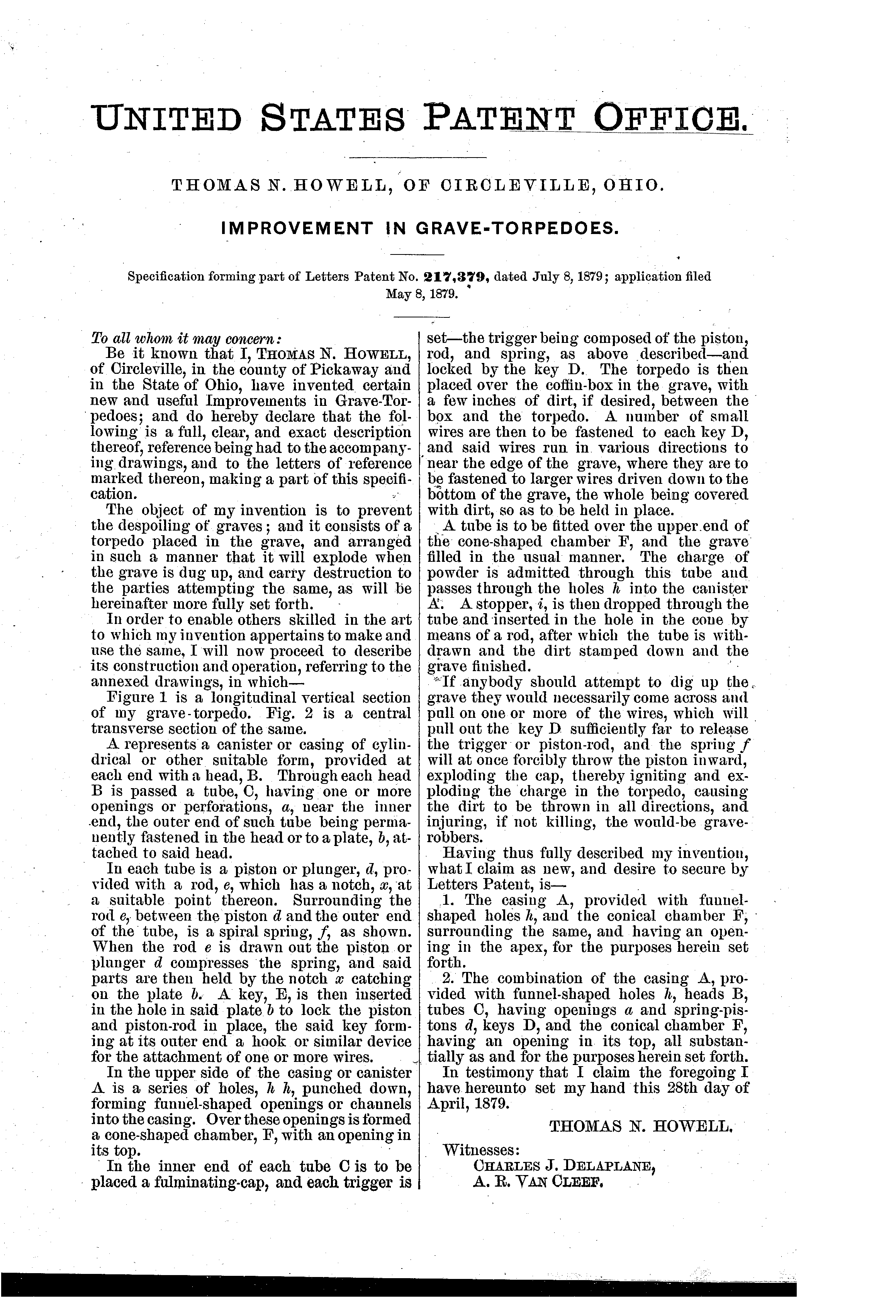
About twenty-five miles south of Columbus, in Circleville, Thomas N. Howell applied for a patent on a grave torpedo in May 1879 (US 217,379, filed 8 May, granted 8 July 1879). The local paper thought "his Torpedo should have a large and ready sale".
Howell's torpedo is not in the coffin. It is a canister buried "over the coffin-box in the grave, with a few inches of dirt", with wires that "run in various directions to near the edge of the grave". The powder goes in last: "the grave filled in the usual manner. The charge of powder is admitted through this tube" (p. 1).
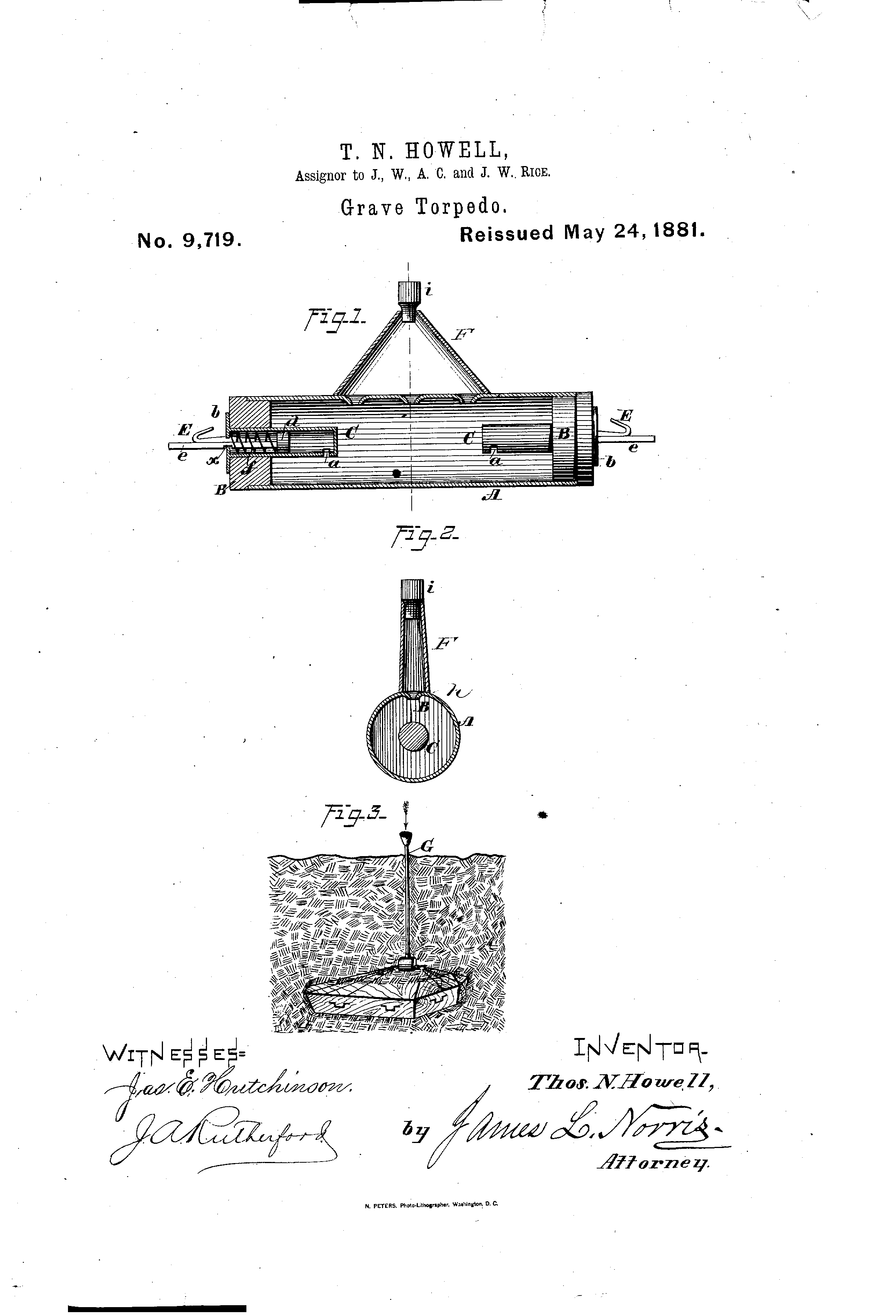
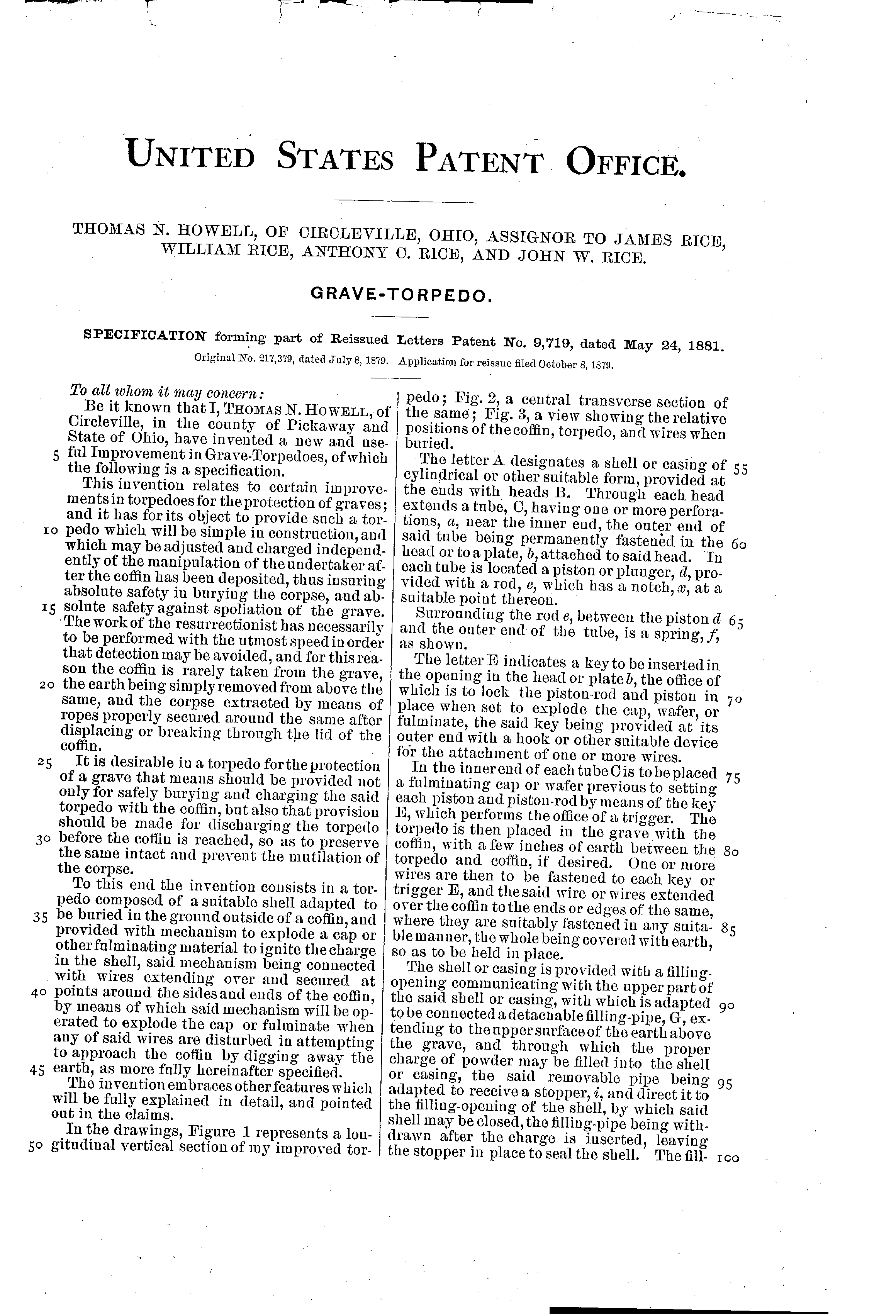
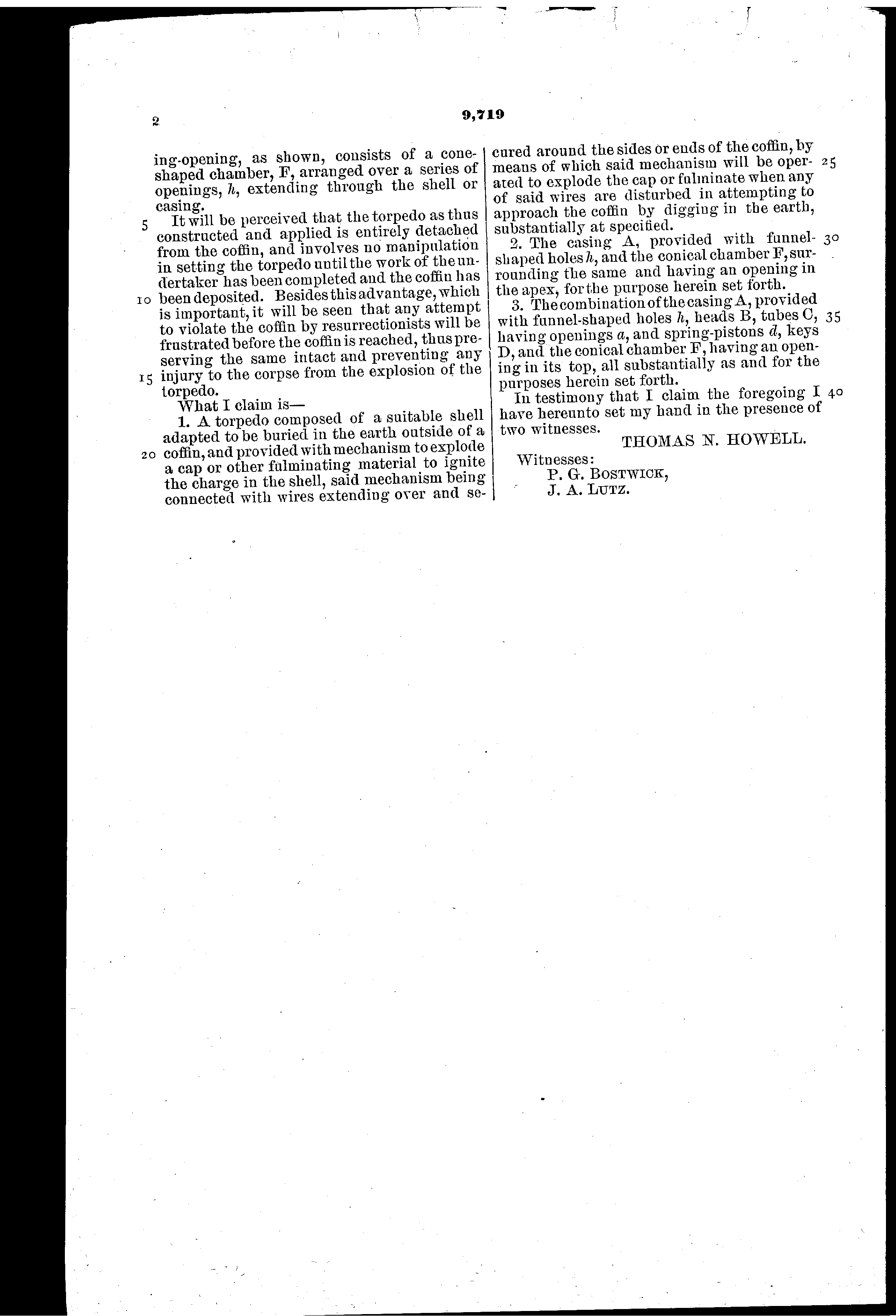
Why on top? His reissue (RE 9,719, 1881) explains how robbers worked: fast, digging only over the coffin, breaking the lid, and pulling the body out with ropes. It is the method Christison had written down in Edinburgh (the comparison is ours). So a spade would meet the wires before the coffin was reached, to "preserve the same intact and prevent the mutilation of the corpse" (RE 9,719, p. 1).
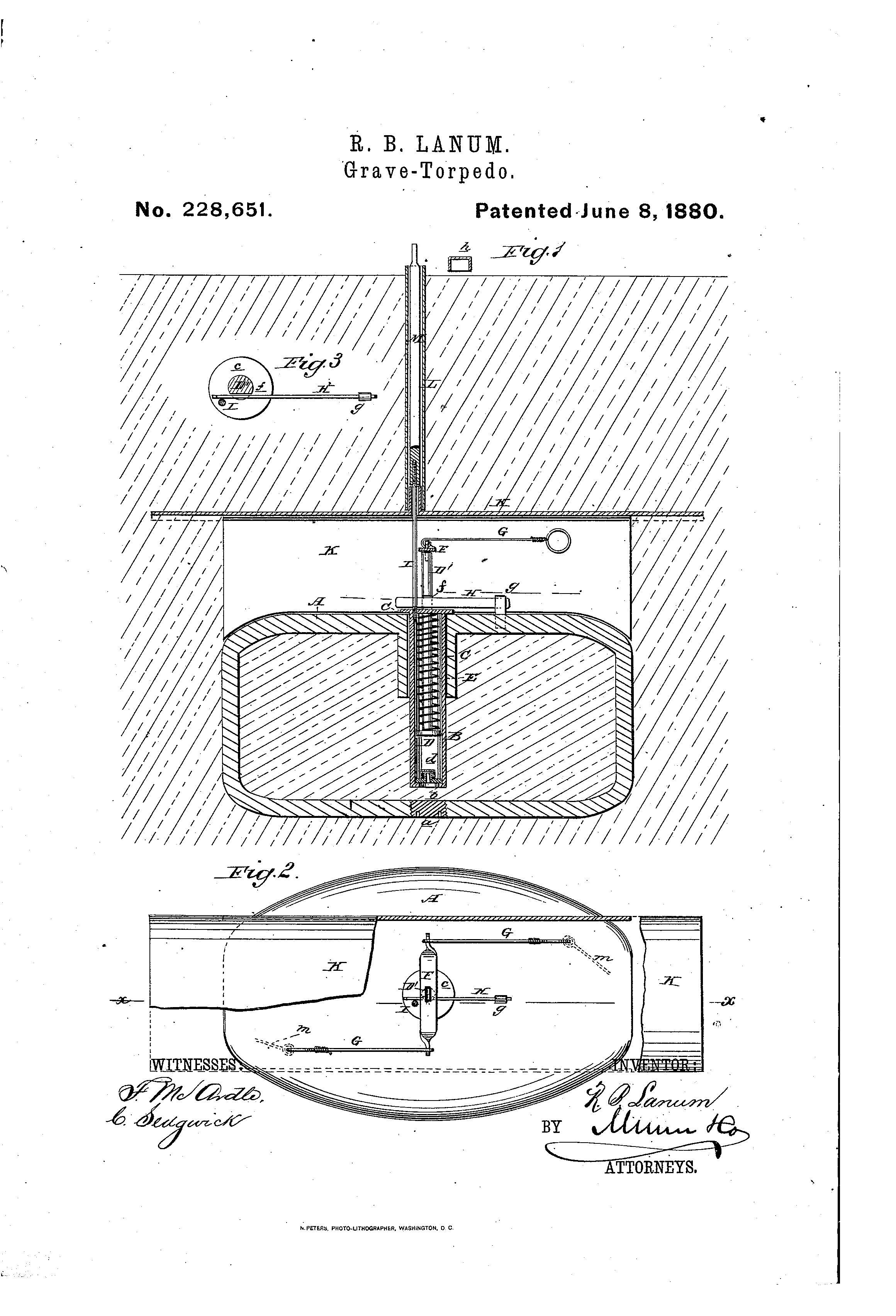
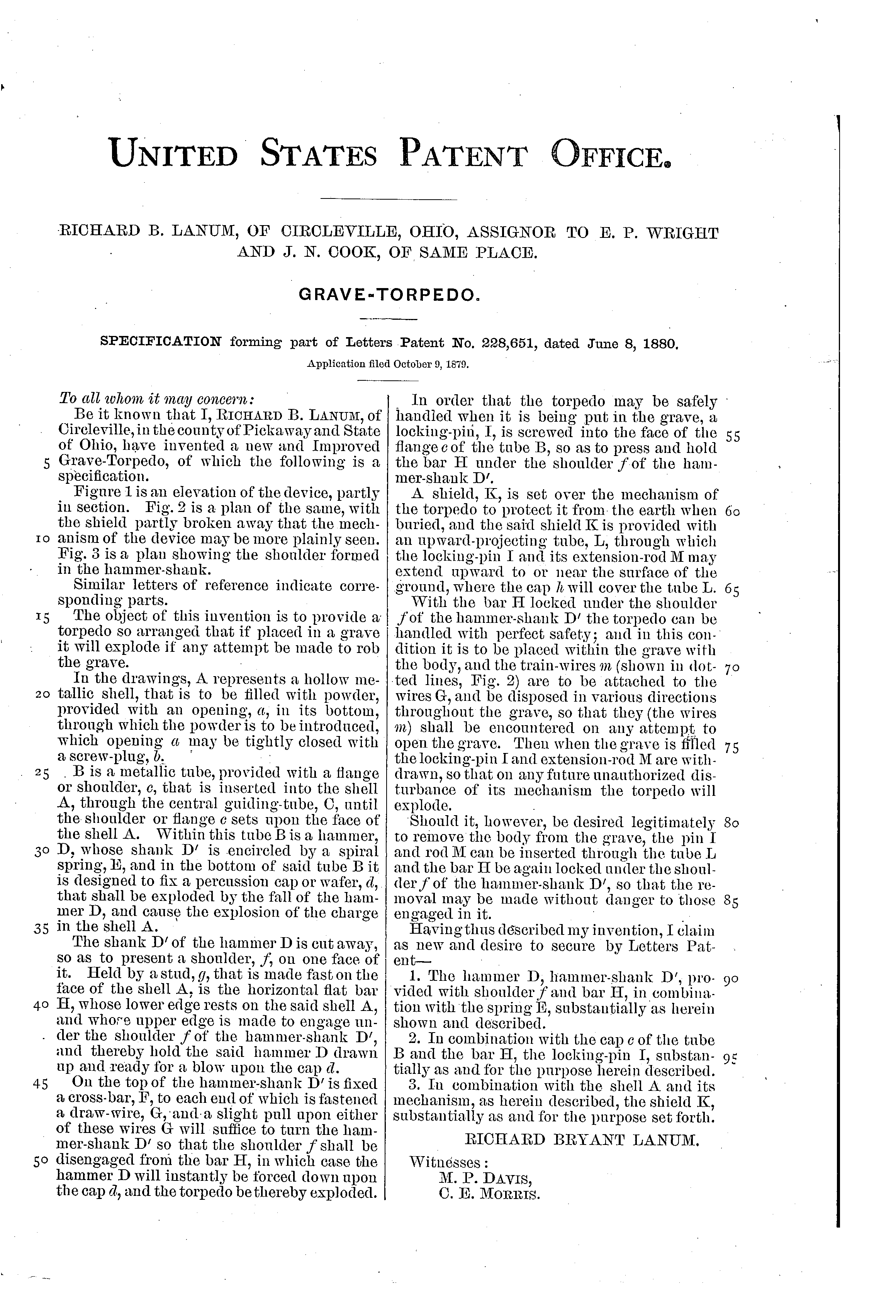
In 1880 a second Circleville man, Richard B. Lanum, patented a grave torpedo with a safety catch that could be reached from the surface (US 228,651, granted 8 June 1880, assigned to two other Circleville men). Its hammer D is held up by a flat bar H under a shoulder f on its shank. Pull any wire, and the shank turns, the shoulder slips off the bar, and the hammer falls on the cap. A locking pin I on a long rod M reaches down a tube L from the top of the grave: pushed down, it locks the bar ("press and hold the bar H under the shoulder f", p. 1); pulled out, the torpedo is armed. If the body ever had to be moved, the rod could go back down, so that the work could be done "without danger to those engaged in it" (p. 2).
From the patent (Figs. 1 and 3): hammer D on shank D′ in tube B, spring E, cap d, flange c, bar H under shoulder f, the cross-bar on the shank with wires G, locking pin I on rod M; a pull on a wire turns the shank and disengages the shoulder; with the pin down, the bar is held under the shoulder. Ours: how the turn frees the hammer (the patent says only that it does): we cut the shank to a flat below shoulder f, as Fig. 3 seems to draw it, and let the turning shank push bar H aside on a stud g; all sizes; the fall slowed down. Checked by a test of our own, the episode's: held at rest; lets go after a 53° turn; the bar is pushed aside, never cut through; either wire works; with pin I in, nothing can turn; the hammer falls onto cap d and the cross-bar still clears the flange.
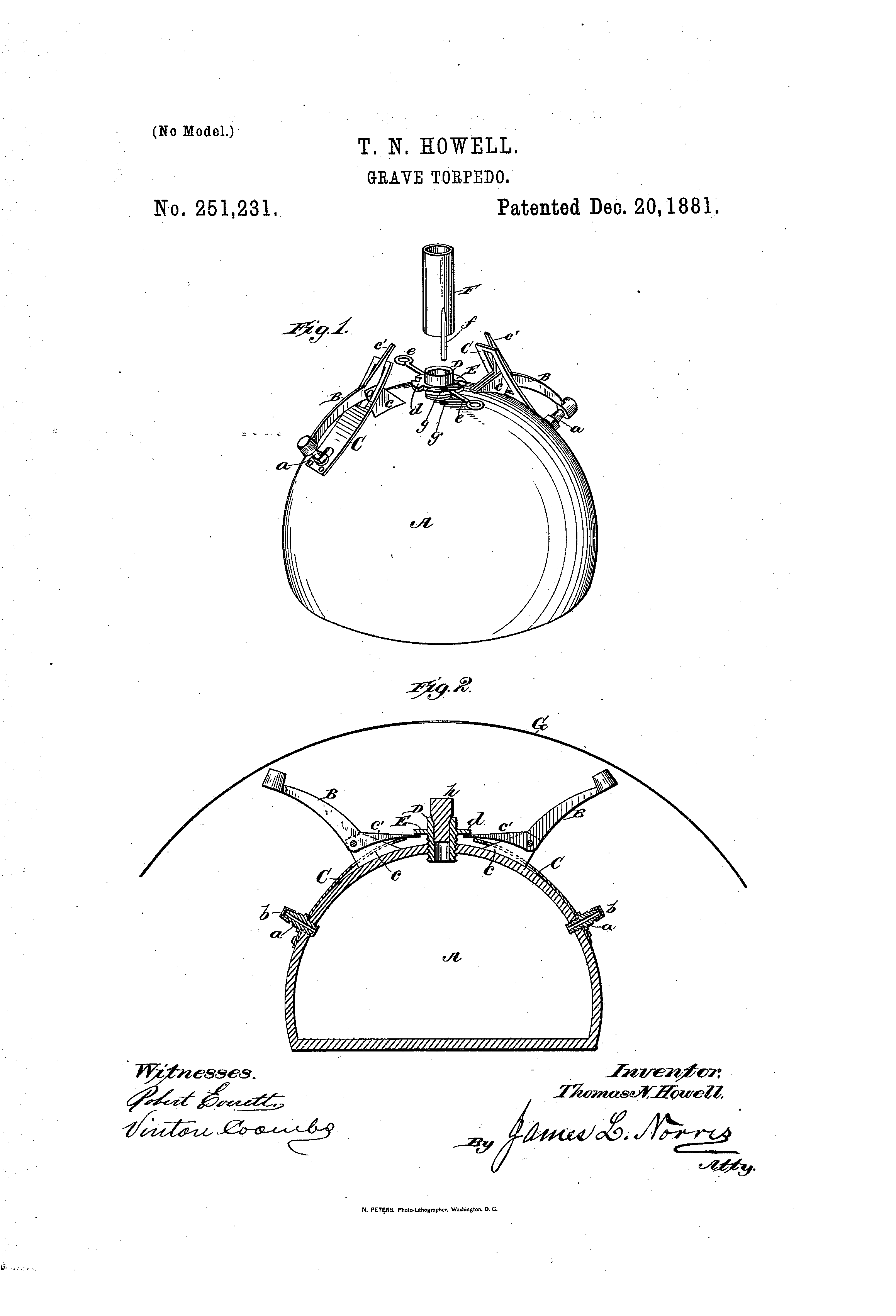
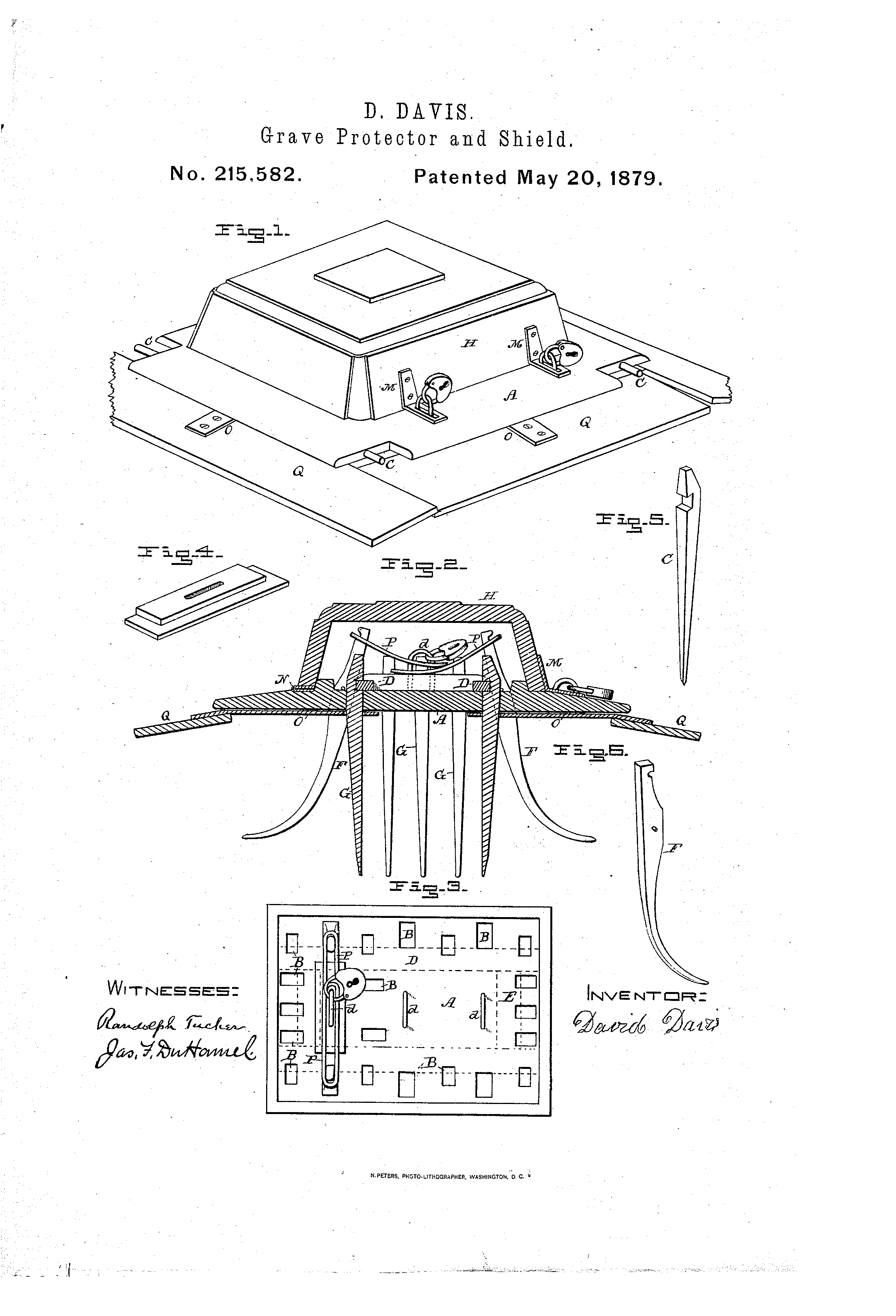
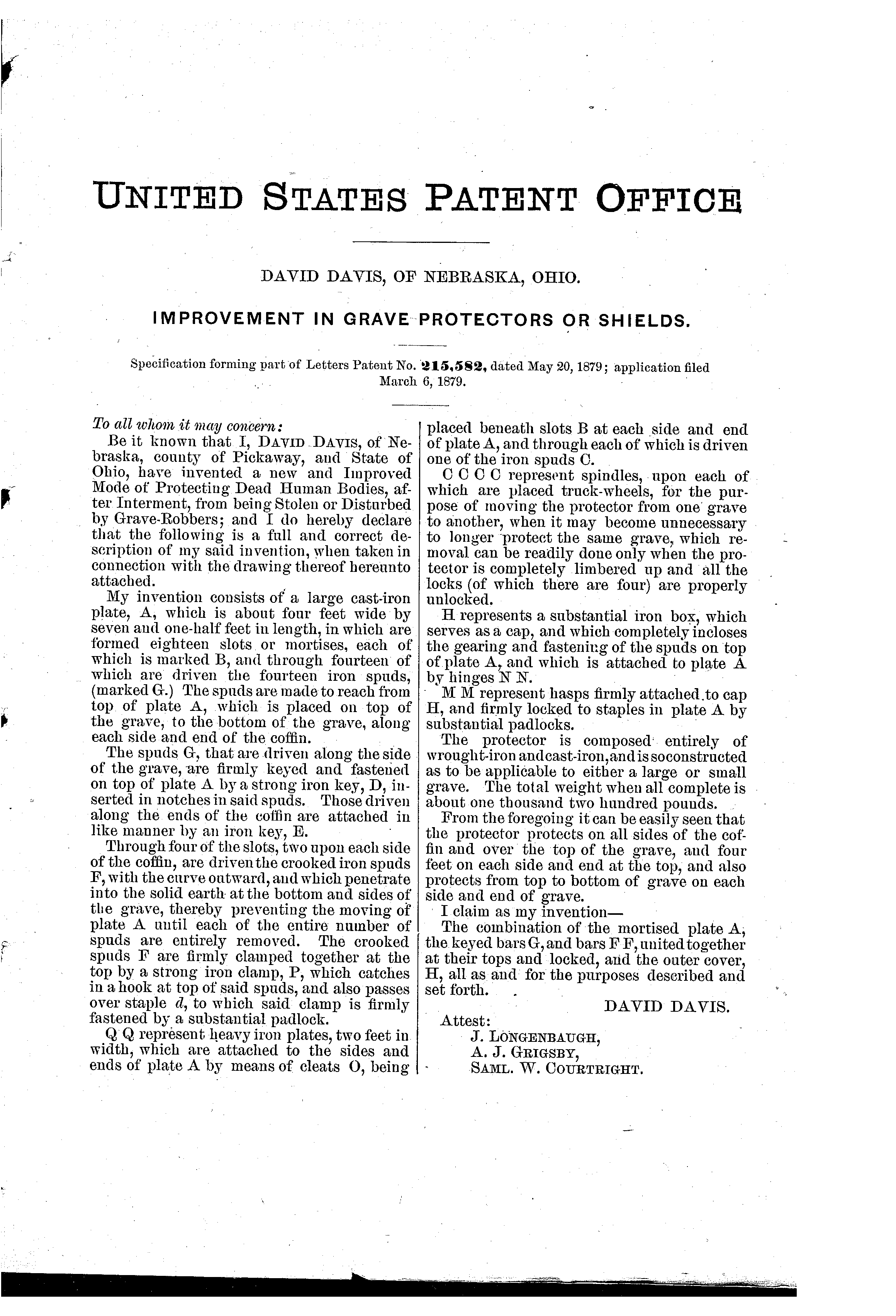
By 1881 Howell himself could write that "various forms of grave-torpedoes" had already been invented (US 251,231, p. 2). A third man in the same county, David Davis, patented an iron grave protector (US 215,582, 1879). Between 1878 and 1882 we found ten Ohio patents meant to keep the dead in the ground. That is the patents we read, not a full count: no classification search was possible.
| US 201,936 | Alton H. Mooers, North Ridgeville: a coffin shield, granted 2 April 1878 (filed in February, before the Harrison case) |
|---|---|
| US 208,672 | Philip K. Clover, Columbus: the coffin torpedo, 8 October 1878 |
| US 215,582 | David Davis, Pickaway County: a grave protector and shield, 20 May 1879 |
| US 217,379 | Thomas N. Howell, Circleville: a grave torpedo, 8 July 1879 |
| US 218,185 | James A. Marsh, Cincinnati: a burial vault, 5 August 1879 |
| US 220,119 | George W. Boyd, Springfield: a burial case, 30 September 1879 |
| US 220,402 | Samuel P. McClean, Range: a metallic burial safe, 7 October 1879 |
| US 228,651 | Richard B. Lanum, Circleville: a grave torpedo, 8 June 1880 |
| US 251,231 | Thomas N. Howell, Circleville: a second grave torpedo, 20 December 1881 |
| US 267,348 | A. Ogden Huffman and Frederick A. Brooks, Dayton: a burglar-proof grave vault, 14 November 1882 |
Did any of them go off?
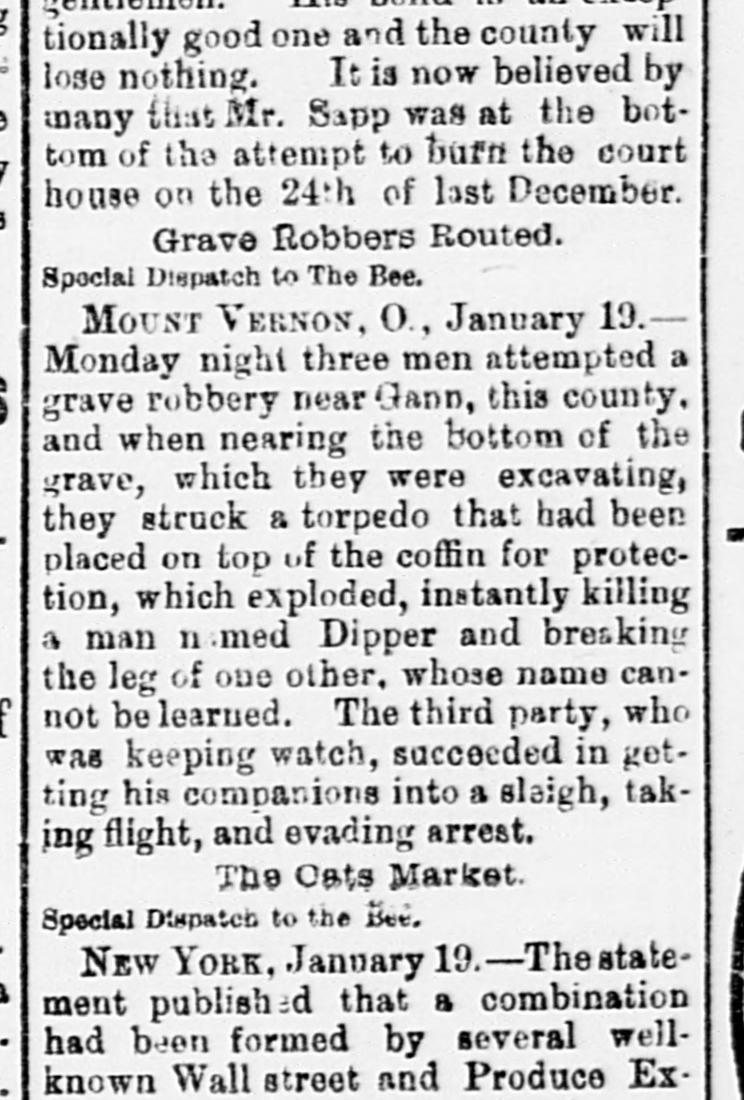
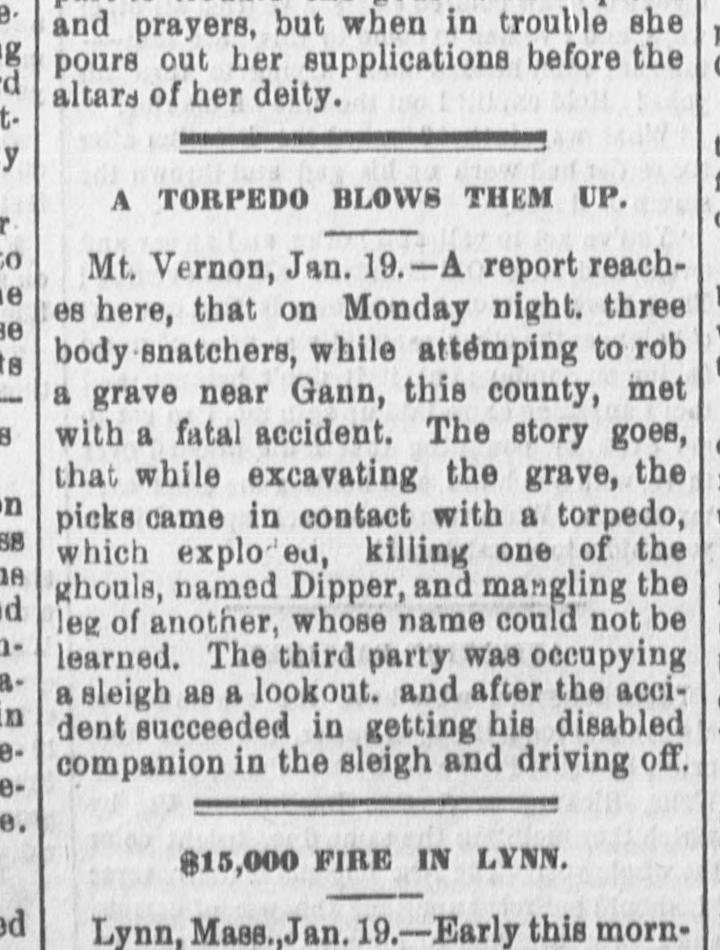
In January 1881 a dispatch from Mount Vernon, Ohio, said that three men digging up a grave near the village of Gann had "struck a torpedo that had been placed on top of the coffin". It reported one man, named Dipper, killed, another with a broken leg, and the third getting them away in a sleigh (Omaha Daily Bee, 20 January 1881, and other papers). One Ohio paper printed it with care: "A report reaches here", and "The story goes" (Stark County Democrat, 20 January 1881).
We found no follow-up: no full name, no inquest, no arrest. The town's own papers are not in the collection we searched.
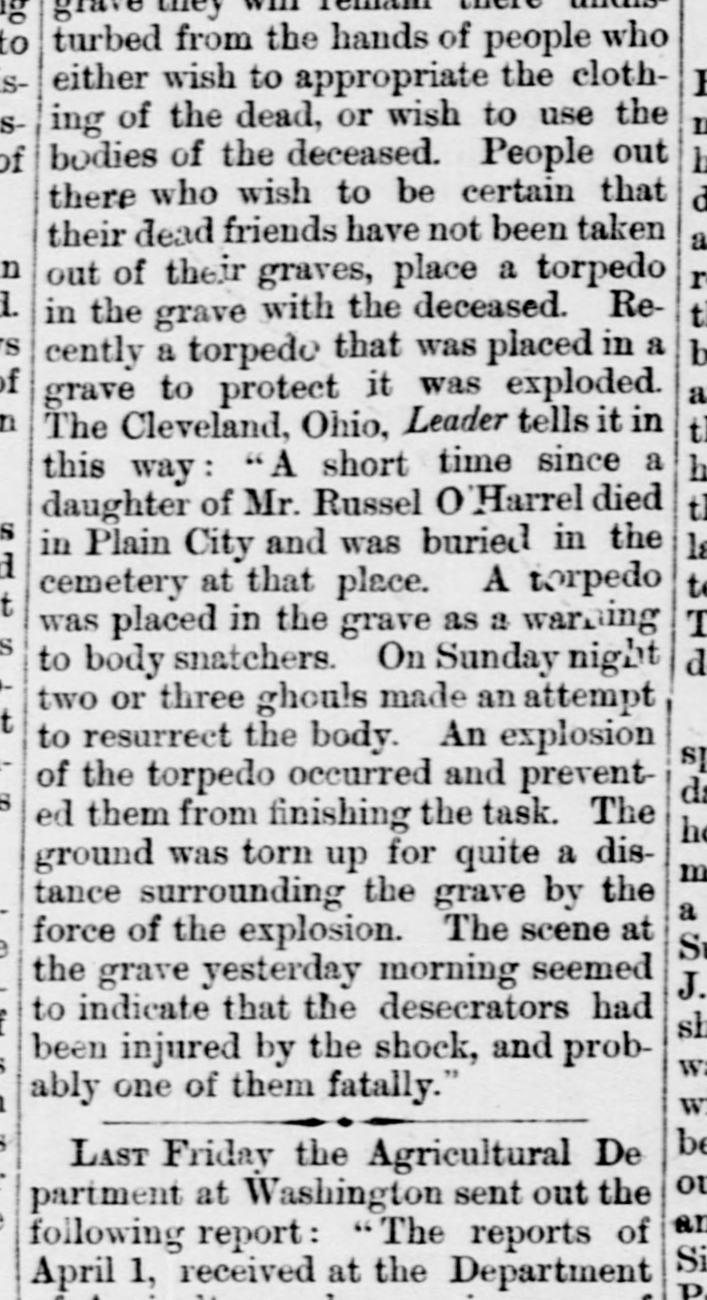
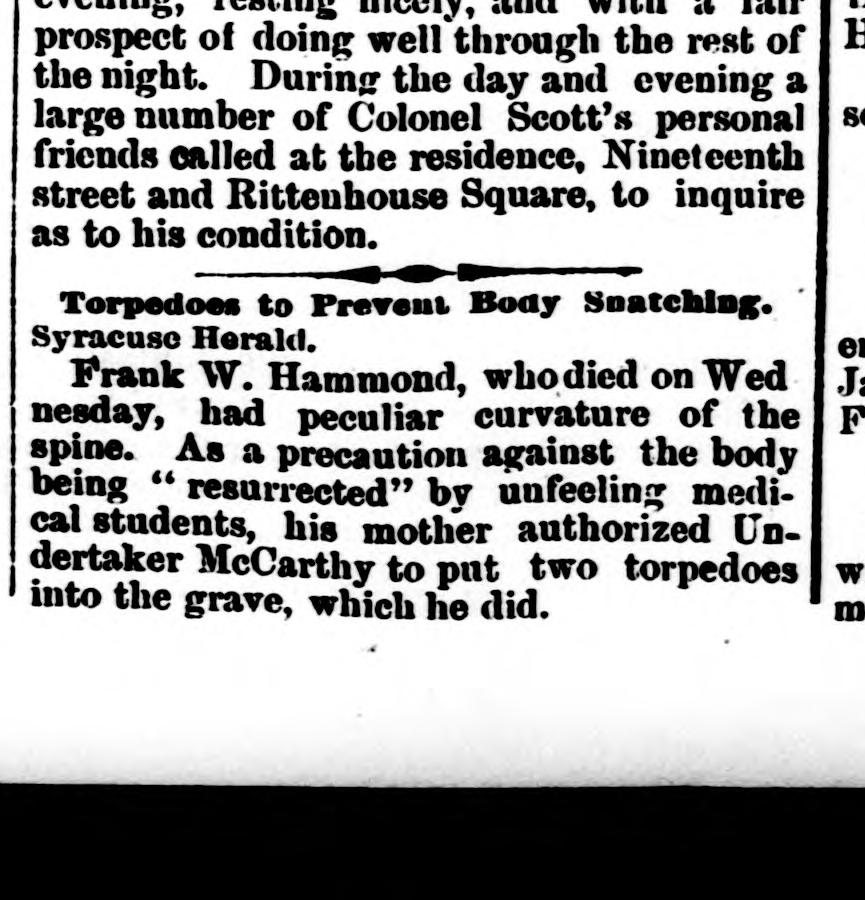
In April 1881, at Plain City, Ohio, a torpedo placed in a girl's grave went off. "The ground was torn up for quite a distance", and the paper guessed from the scene that the robbers had been hurt (the Cleveland Leader, in the Juniata Sentinel, 20 April 1881). That spring in Syracuse, New York, Frank W. Hammond had died with "a peculiar curvature of the spine". As a precaution against "unfeeling medical students", his mother had the undertaker put "two torpedoes into the grave" (the Syracuse Herald, in the Lancaster Daily Intelligencer, 10 May 1881).
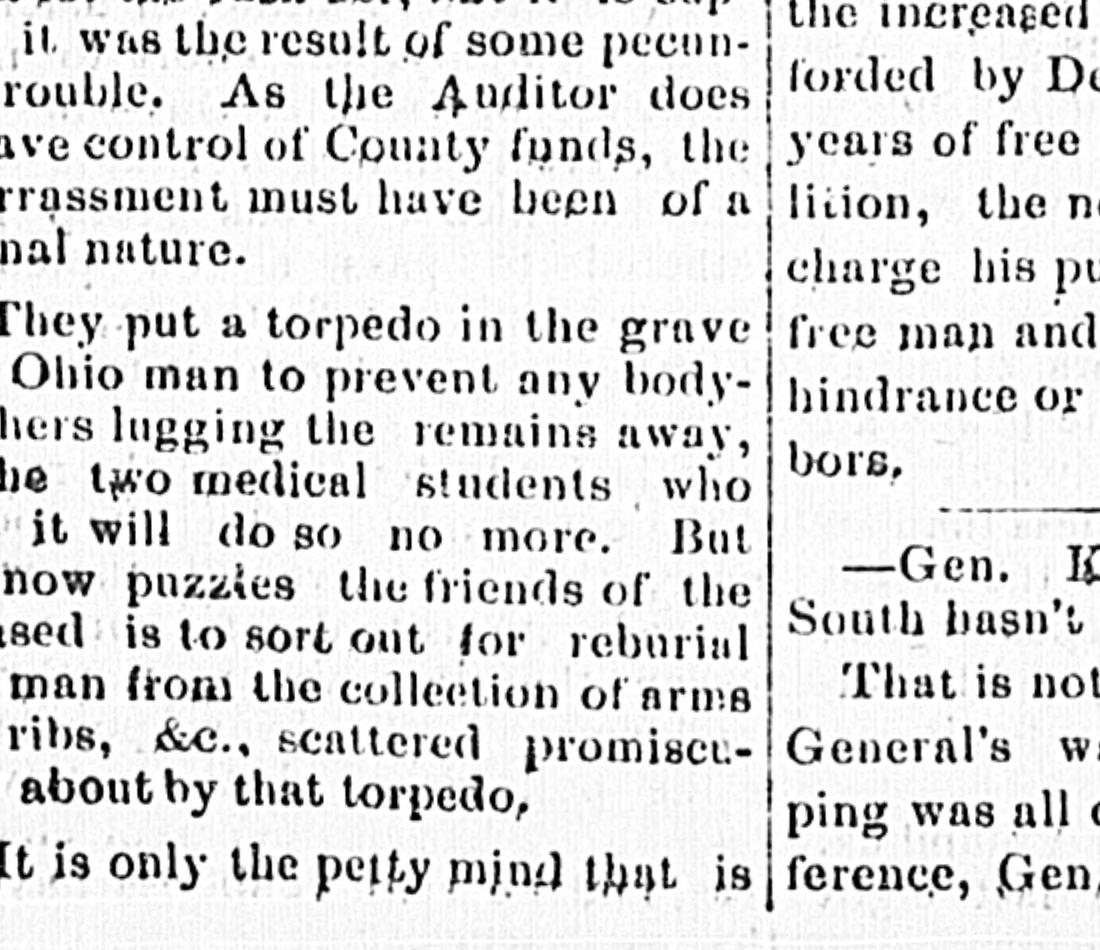
And the most reprinted story, that "two medical students" were blown apart in an Ohio grave, gave no names and no town. It came from the joke columns (for example the Orangeburg Democrat, 4 June 1880). So torpedoes were bought and buried, and at least one was reported to have killed a man. Nothing we found proves it.
The other fear
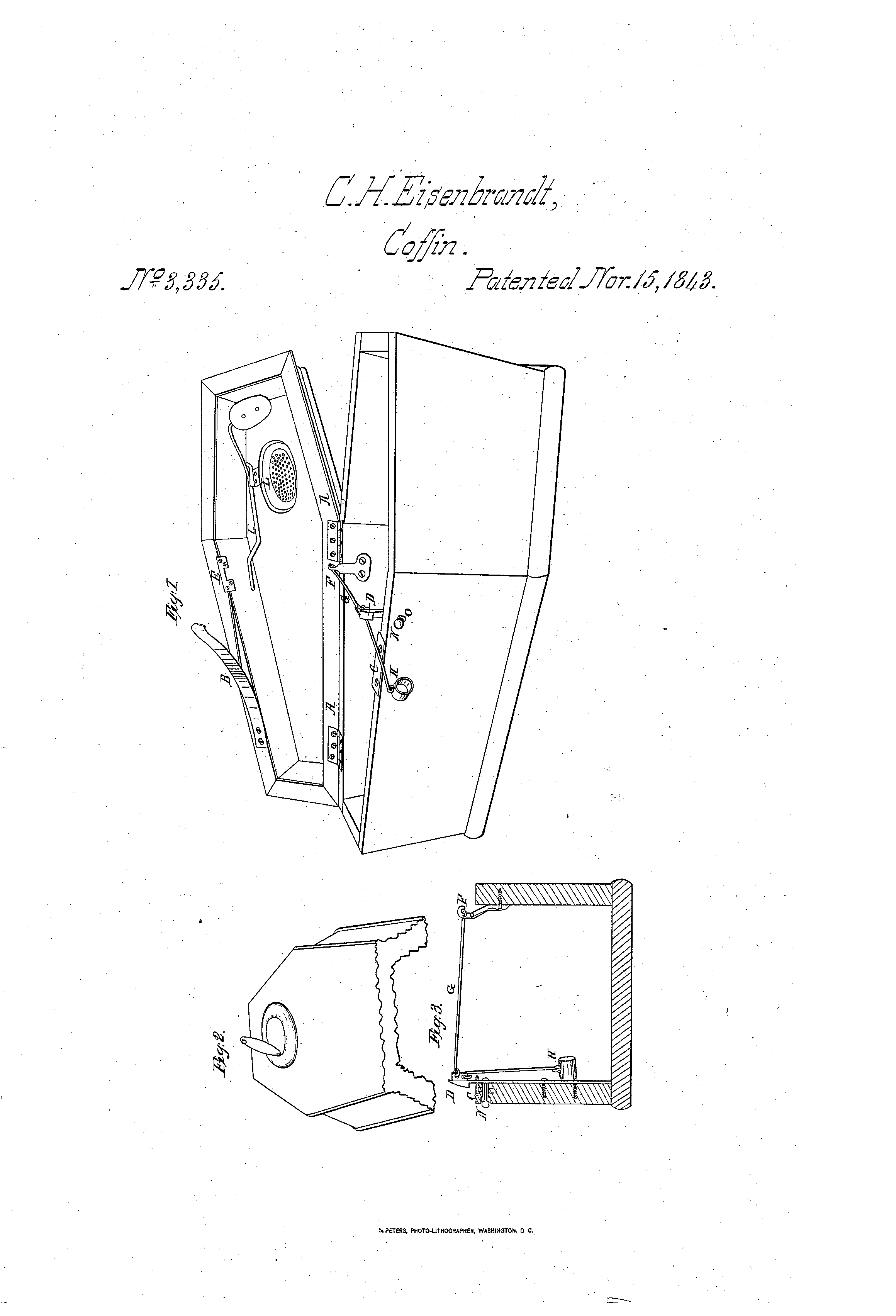
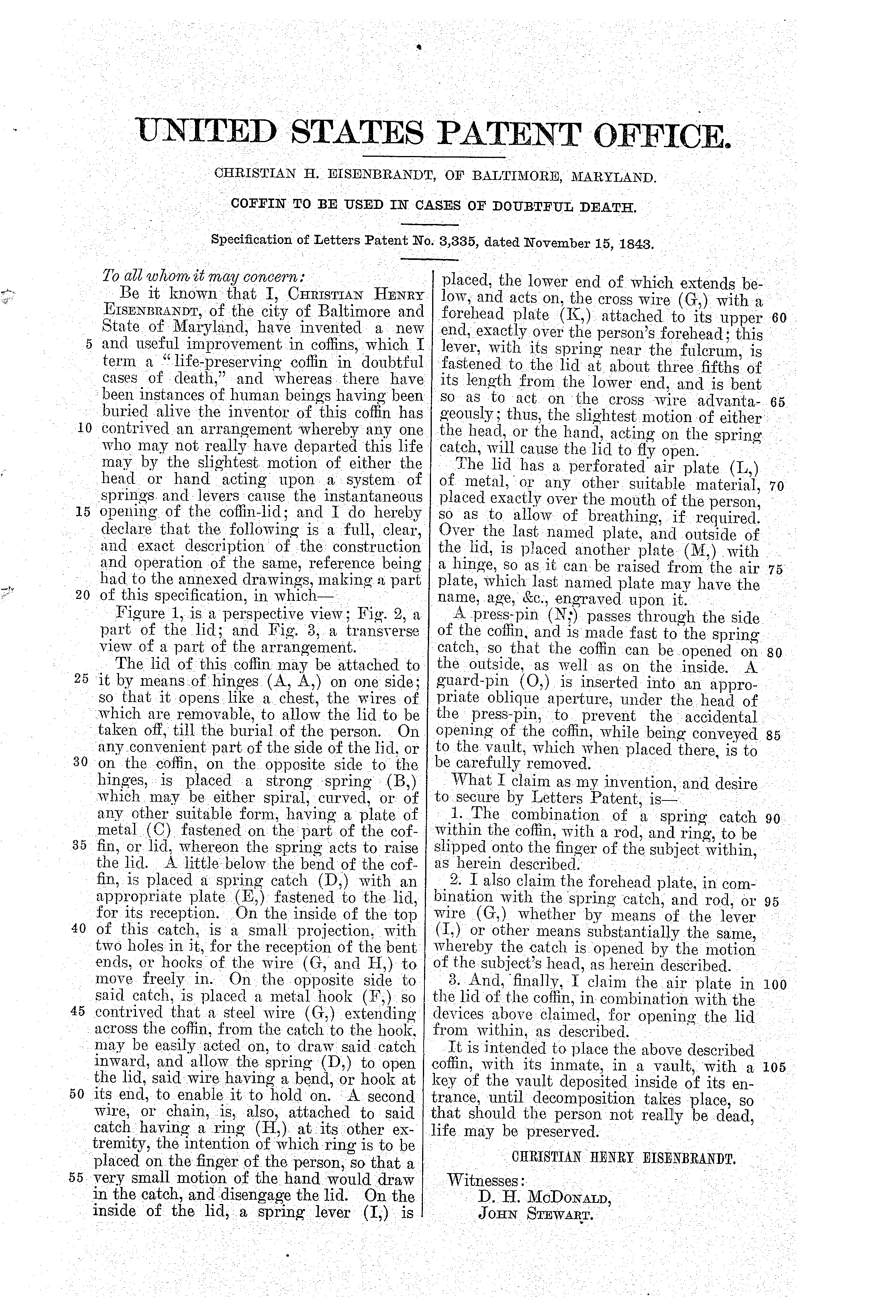
The same decades had the opposite fear: that the person in the coffin was not dead. The earliest American patent we found for it is from Baltimore, in 1843: Christian H. Eisenbrandt's "coffin to be used in cases of doubtful death" (US 3,335, granted 15 November 1843). A ring H goes on the finger, and a plate K hangs over the forehead. The slightest movement of either trips a catch D, and a spring B throws the lid open. There is a plate L with air holes over the mouth. A press-pin N through the side lets the lid be opened from outside as well, and a guard-pin O keeps it shut on the way to the vault. For it was meant for a vault, not for six feet of earth: "place the above described coffin, with its inmate, in a vault" (p. 1).
From the patent (Figs. 1 and 3): the lid hinged at A on one side and thrown open by spring B on the other; spring catch D holding it; wire G across the coffin from the catch to hook F; ring H on its own wire to the catch; lever I in the lid with the forehead plate K, its lower end on wire G; air plate L, name plate M, press-pin N, guard-pin O. Ours: all sizes, the bend in wire G, and the lever drawn end on (it runs along the coffin). No figure is drawn. Checked by a test of our own, the episode's: held at rest; a 4 mm pull on the ring frees it; a rise of the forehead plate of 5.7 mm frees it through lever I and the bent wire; the lid opens past upright; the catch stays in its slot.
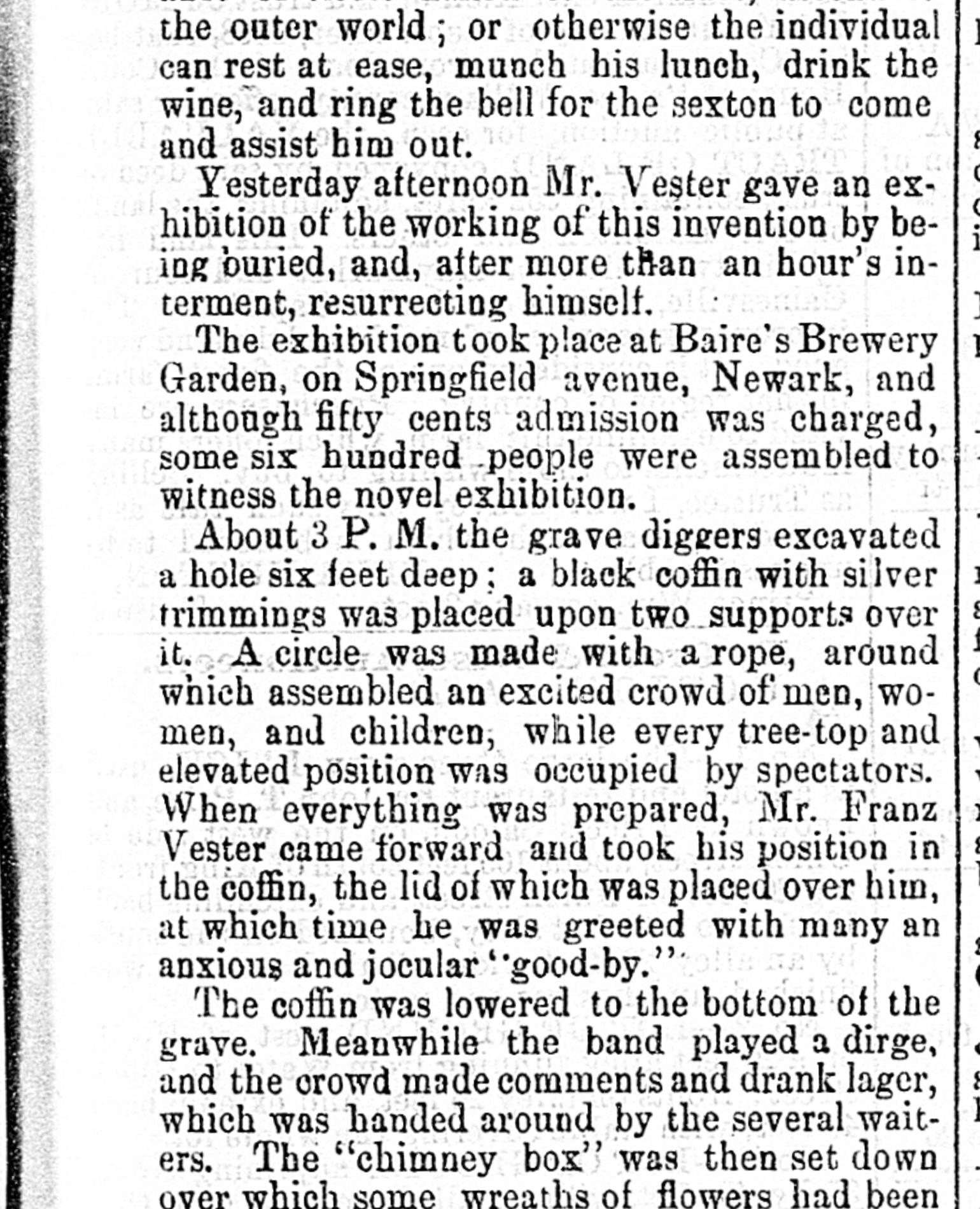
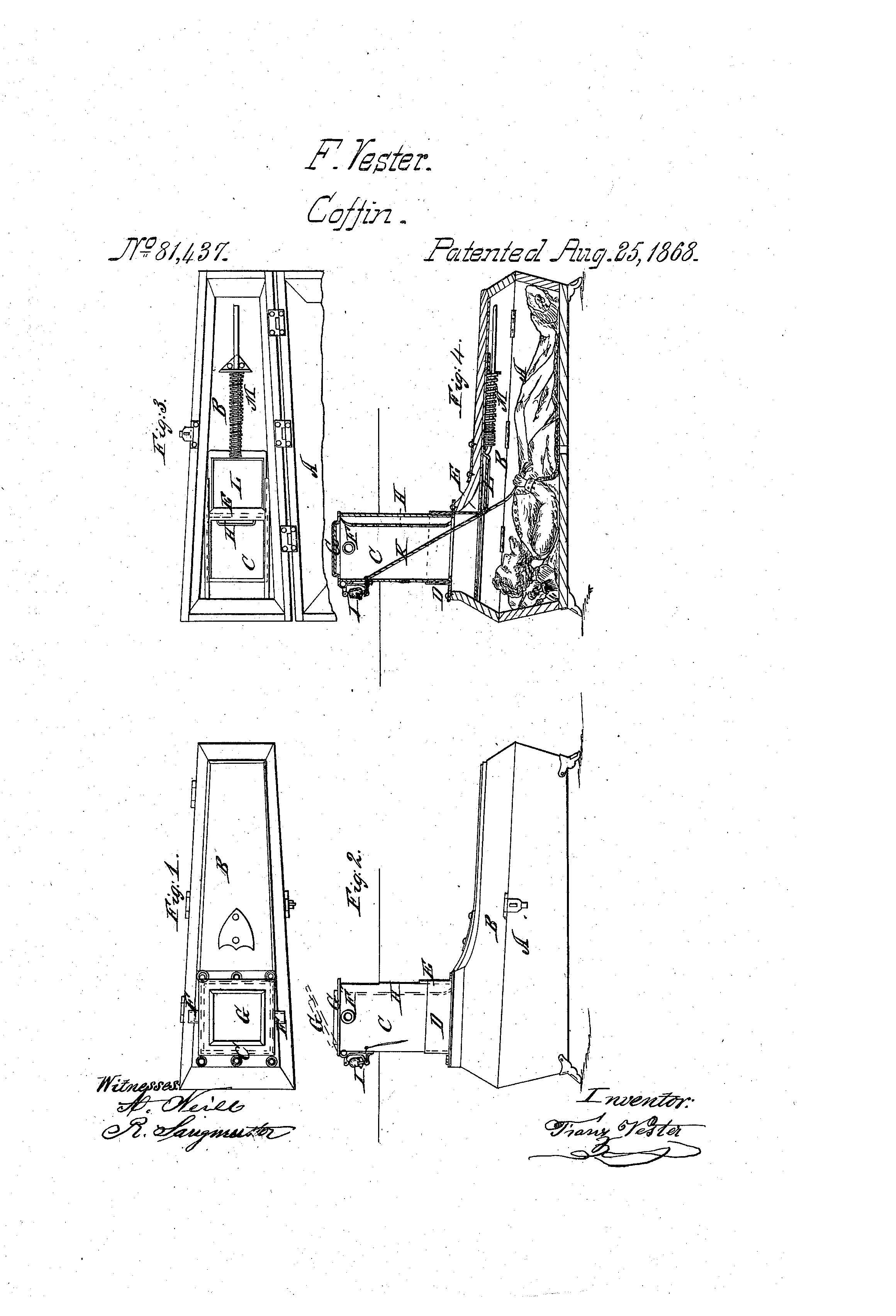
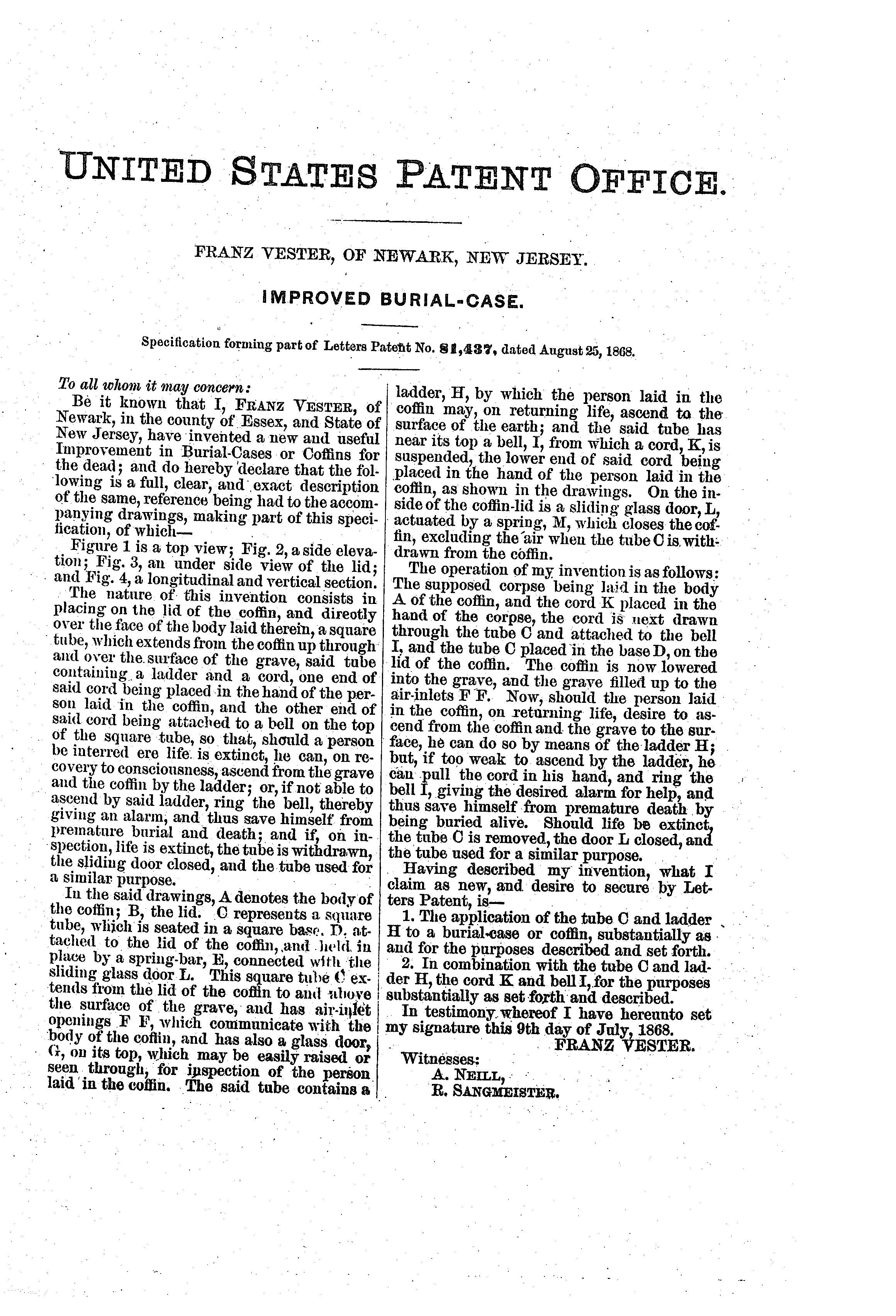
In 1868, in Newark, New Jersey, Franz Vester patented a square tube from the face to the surface, with a ladder inside it, and a cord from the hand to a bell (US 81,437, granted 25 August 1868). A week later he tried it on himself. At Baird's Brewery Garden, "some six hundred people" paid "fifty cents admission" (50 cents ≈ $12 in today's money) to watch him buried under "at least four feet of earth", while "the band played a dirge". After "an hour and a quarter" a signal was given, and "Mr. Vester, unaided, stepped out of his living grave", to applause (the New York Star, in the Alexandria Gazette, 4 September 1868). It was a demonstration by the inventor; it is not evidence that anyone was ever buried in one.
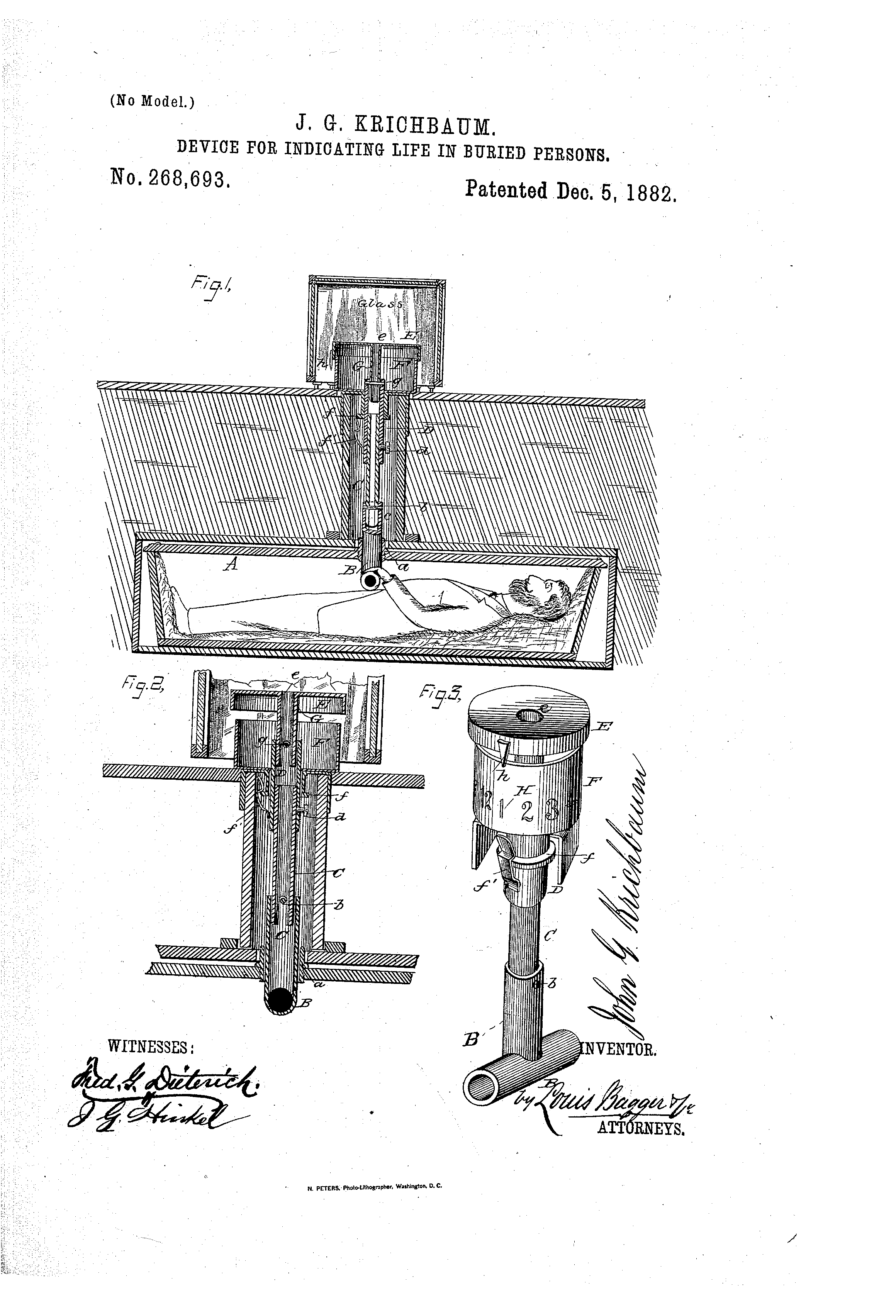
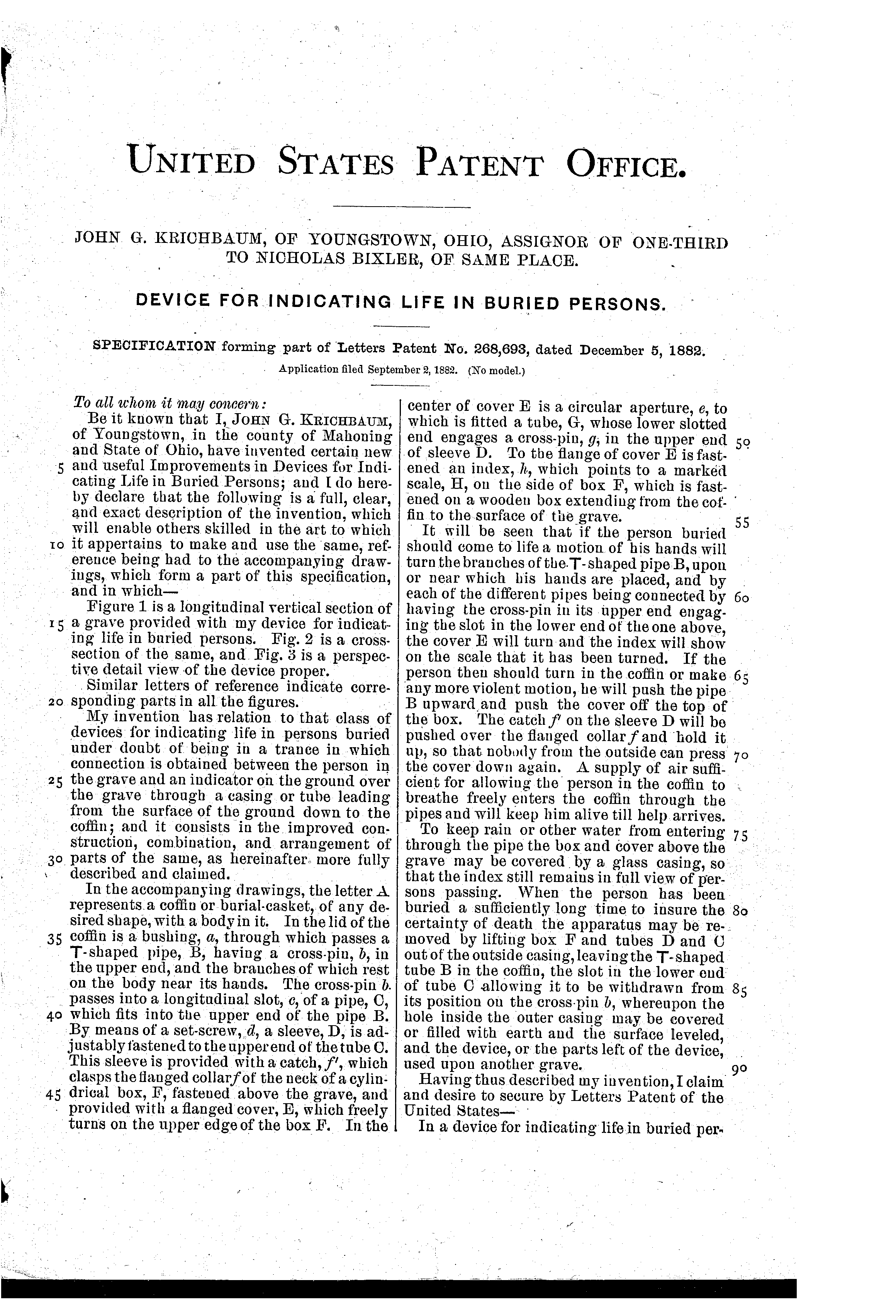
In 1882 a Youngstown man, John G. Krichbaum, patented a "Device for Indicating Life in Buried Persons": a dial above the grave, turned by the hands below (US 268,693). In the same years Ohio was patenting coffins to keep people out, and coffins to let people out.
Count Karnicki's box
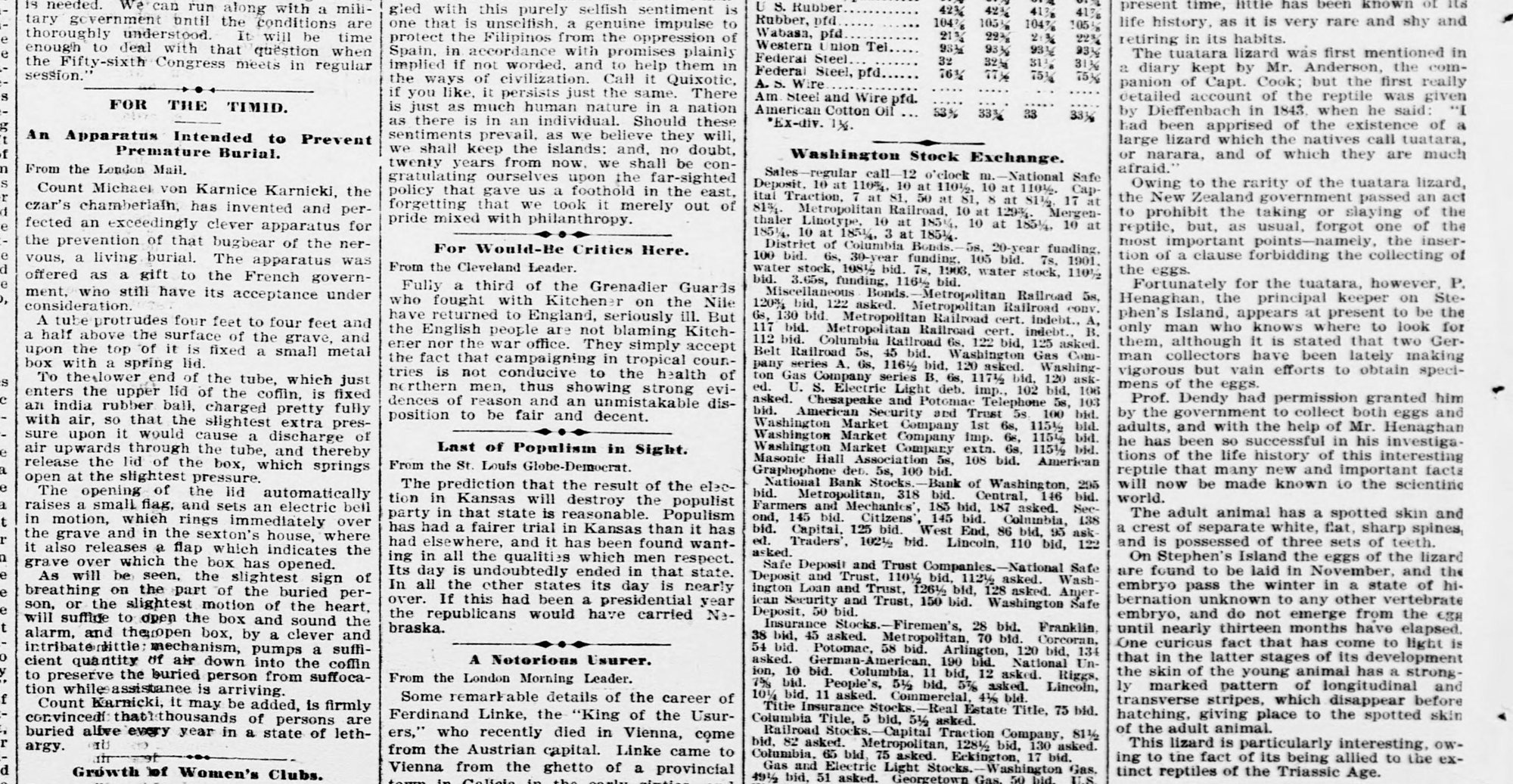
The most elaborate came from Warsaw. Michael Karnicki took out three American patents, in 1896 and 1897 (US 572,118 and 572,119, 1 December 1896; US 584,876, 22 June 1897). The papers called him a count, and "the czar's chamberlain" (the London Mail, in the Evening Star, 18 November 1898).
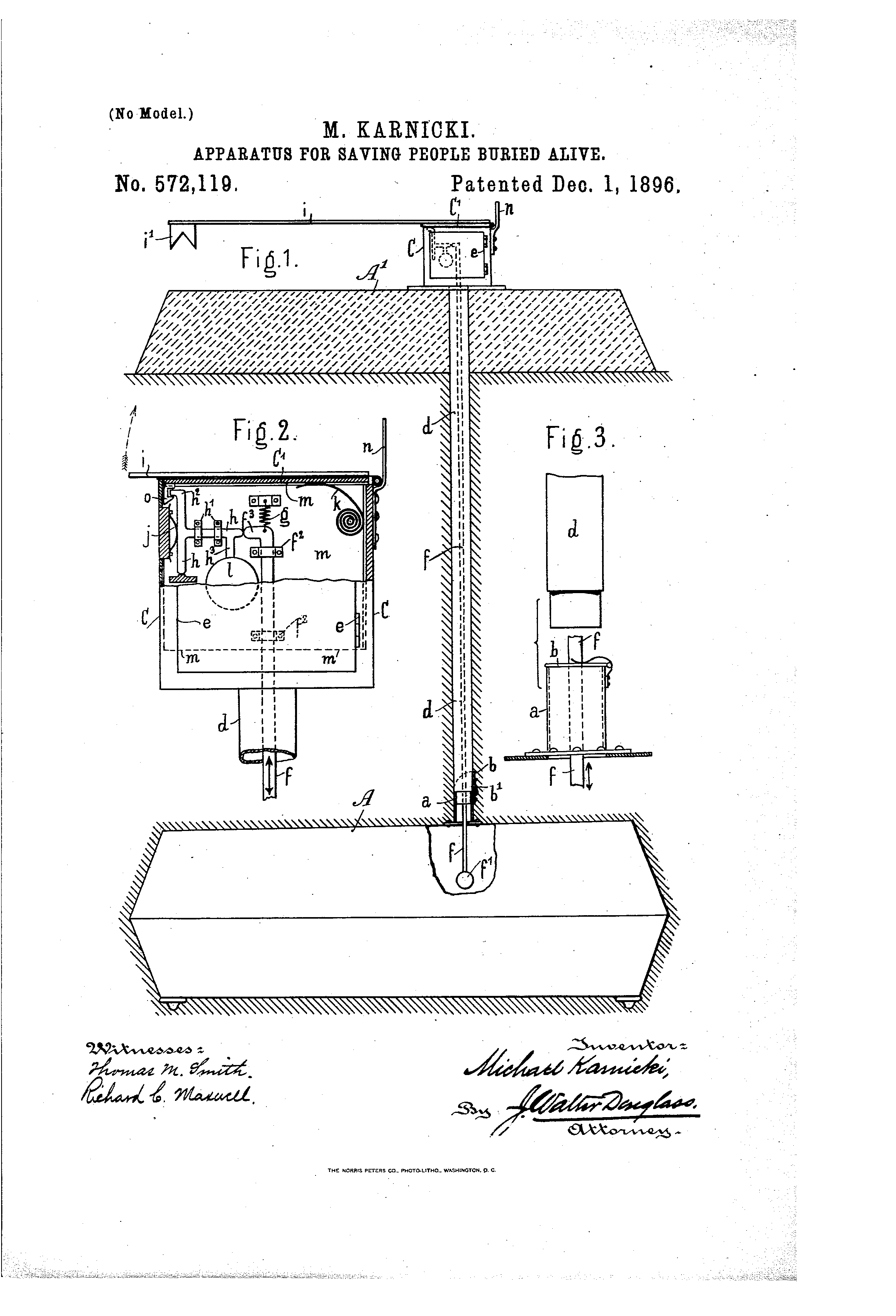
In US 572,119 a pipe d runs from the coffin lid up to an iron box C on the grave. Down the pipe hangs a rod f, balanced on a spring g, with a hollow ball f′ at its end, "close to the breast". At the top, the rod's bent end f³ holds back a sliding catch h, and the slide's hook holds down the lid C′ against a spring k. "With the slightest movement of the awakening person" the rod moves, up or down, and frees the slide. The lid springs open, a flag stands up on its rod i, a bell l rings, and air and light go down the pipe. Until then the coffin stays sealed, and nobody outside can set it off: there is "not the slightest connection" with the outside, and it is "not to be capable of action from the outside by passers-by" (pp. 1-2).
Where it sits, as Fig. 1: the box C on the mound, pipe d down to a nozzle a on the lid, rod f with its ball f′ where the breast would be. No figure is drawn.
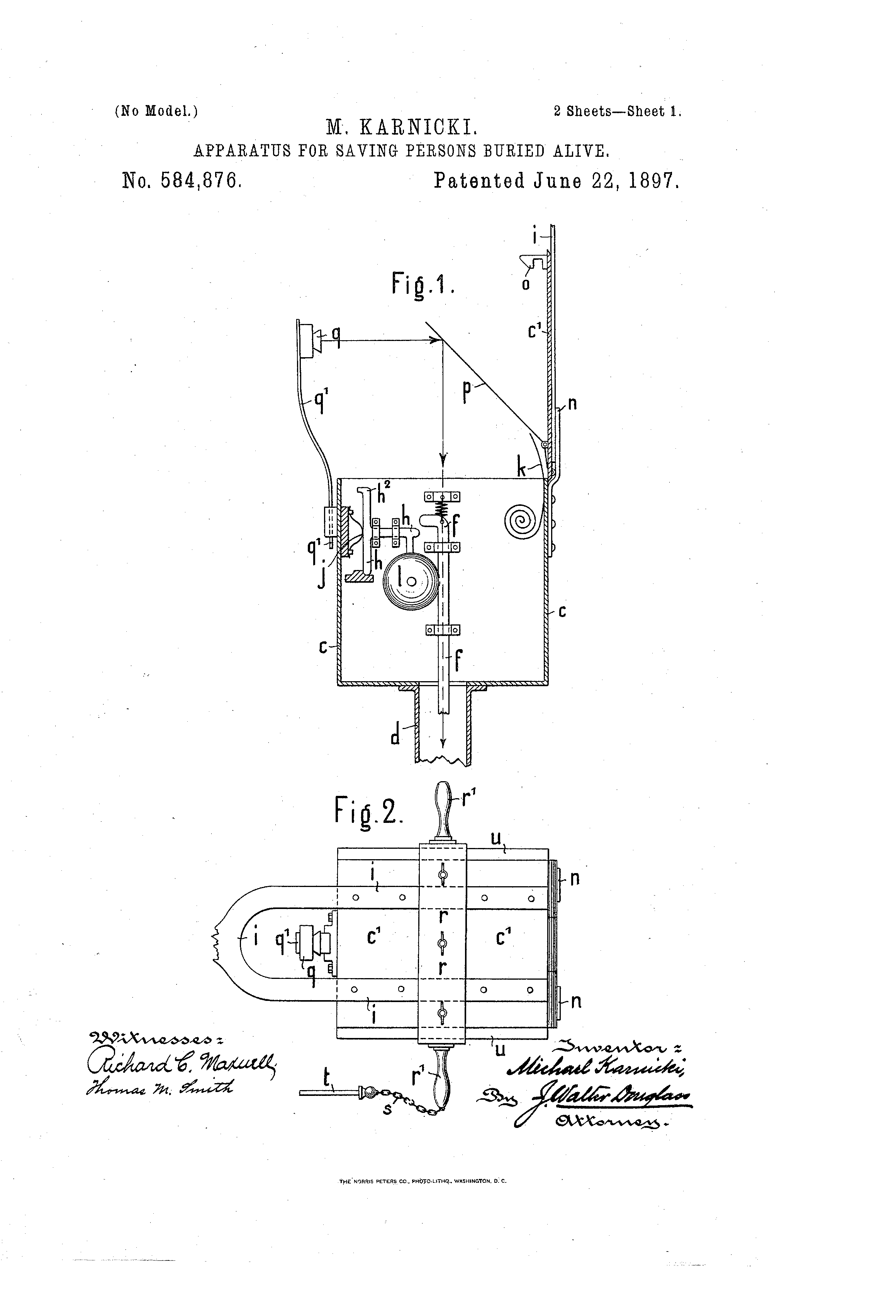
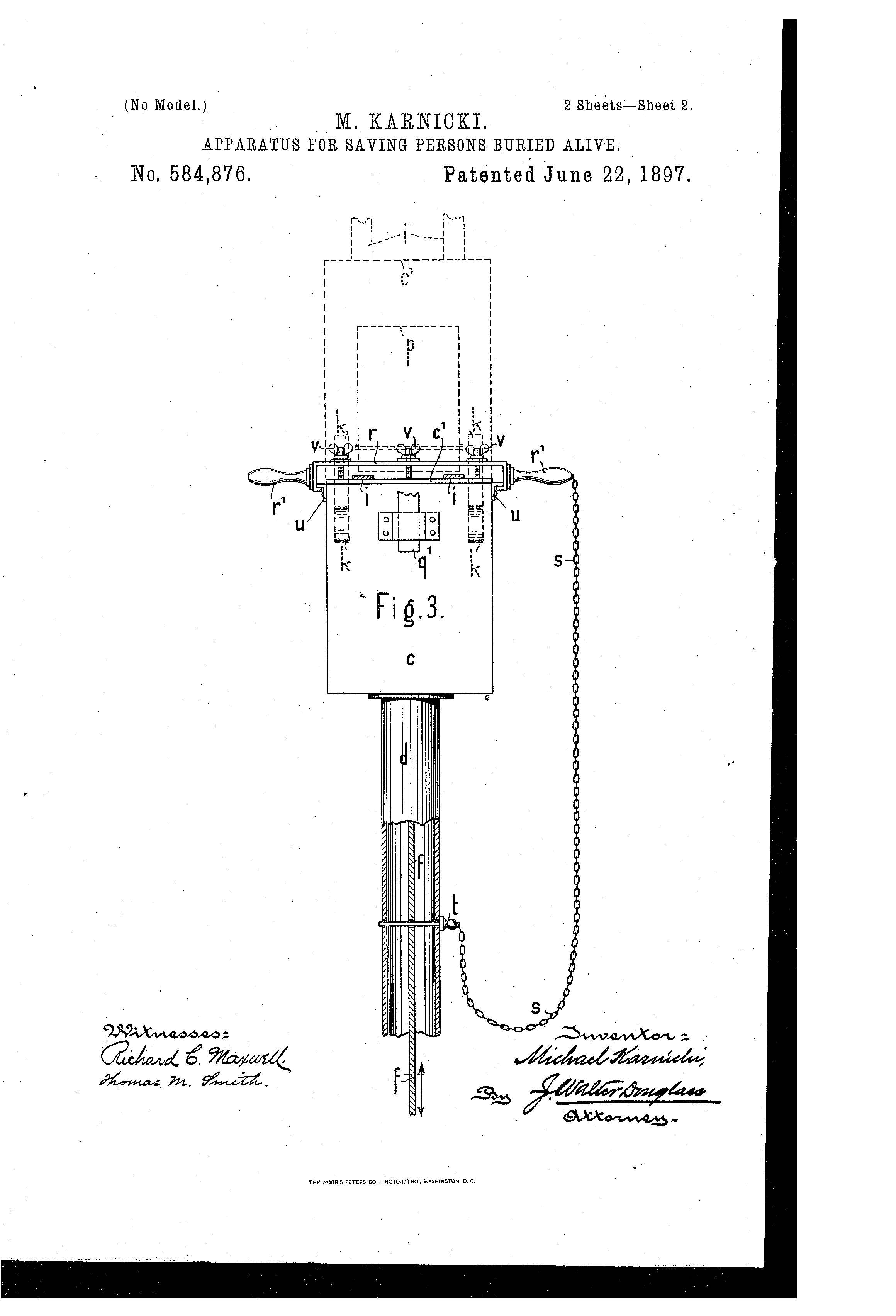
From the patents (US 572,119, Figs. 1-3; US 584,876, Fig. 1): box C and lid C′ with its spring k, pipe d, rod f on spring g with its rounded bent end f³, slide h pushed inward by leaf spring j, its hook h² over catch o on the lid, arm h¹ that sets bell l going, signal rod i with its flag; in 1897, reflector p swinging to about 45 degrees as the lid opens, and lamp q, so the light goes down the pipe. Ours: all sizes, the shape of the hook and the catch, the slide's travel, the movement at which the rod lets go (2.5 mm), and the timing, which runs a little slower than the springs would. The drawing starts close on the catch and pulls back as the lid opens, so the flag is seen. Checked by a test of our own, the episode's: latched at rest; a movement under 2.5 mm leaves it set; 3 mm up or down frees the slide, the hook clears and then the lid opens, in that order, no part passing through another; the lid stops upright with the flag above; the 1897 reflector at 45 degrees sends a level ray from the lamp straight down the pipe.
A year later he added a mirror on the lid that swings to forty-five degrees, and a lamp, to send light down into the coffin, against "the anxious feelings caused by the darkness" (US 584,876, pp. 1-2). He offered the apparatus as a gift to the French government, which, a London paper reported, "still has its acceptance under consideration". He was "firmly convinced that thousands of persons are buried alive every year" (the London Mail, 1898).
The papers described it with a rubber ball, and an electric bell in the sexton's house. The patent has neither: its ball is a hollow ball on a rod, and its bell is in the box on the grave.
The sceptics
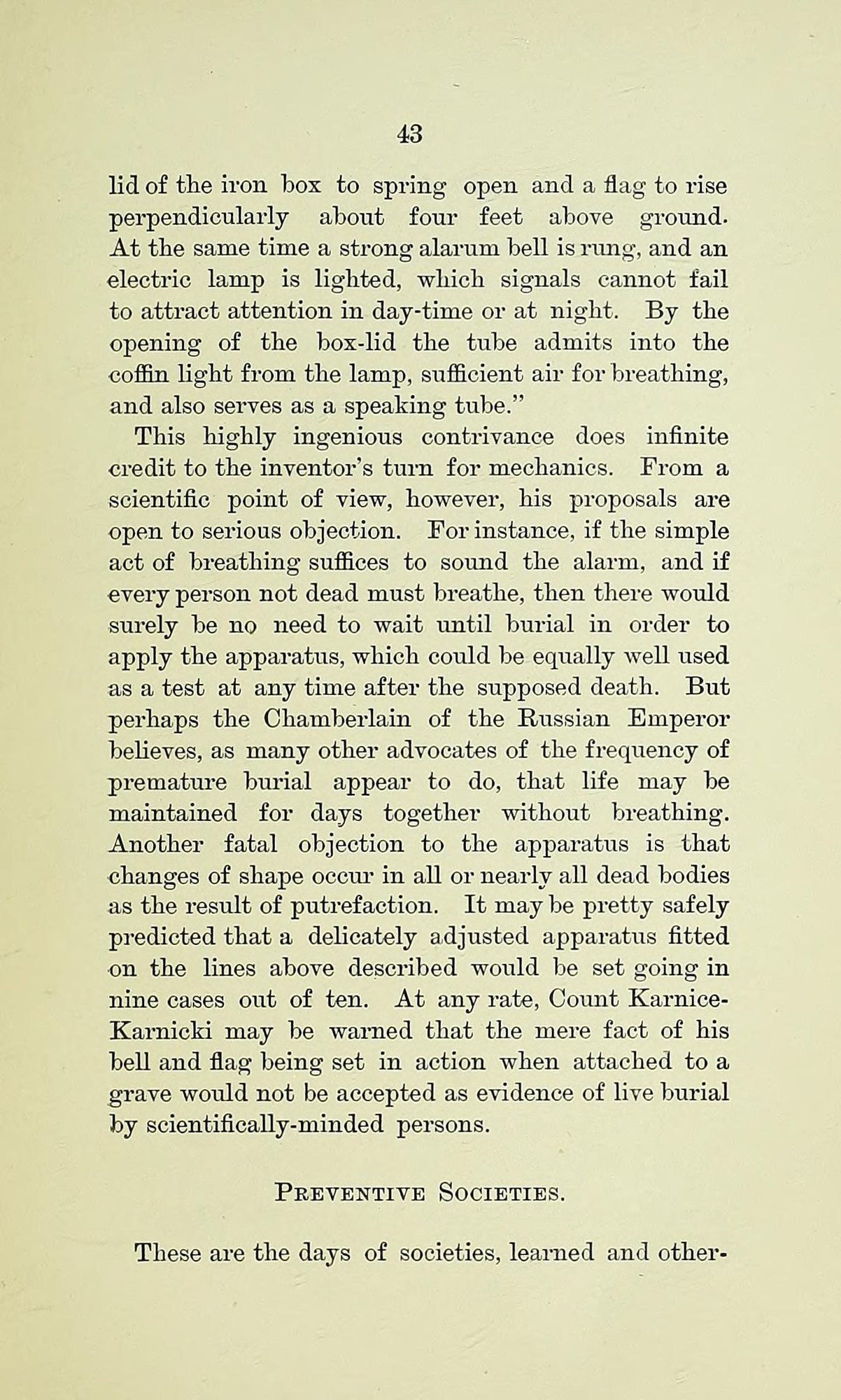
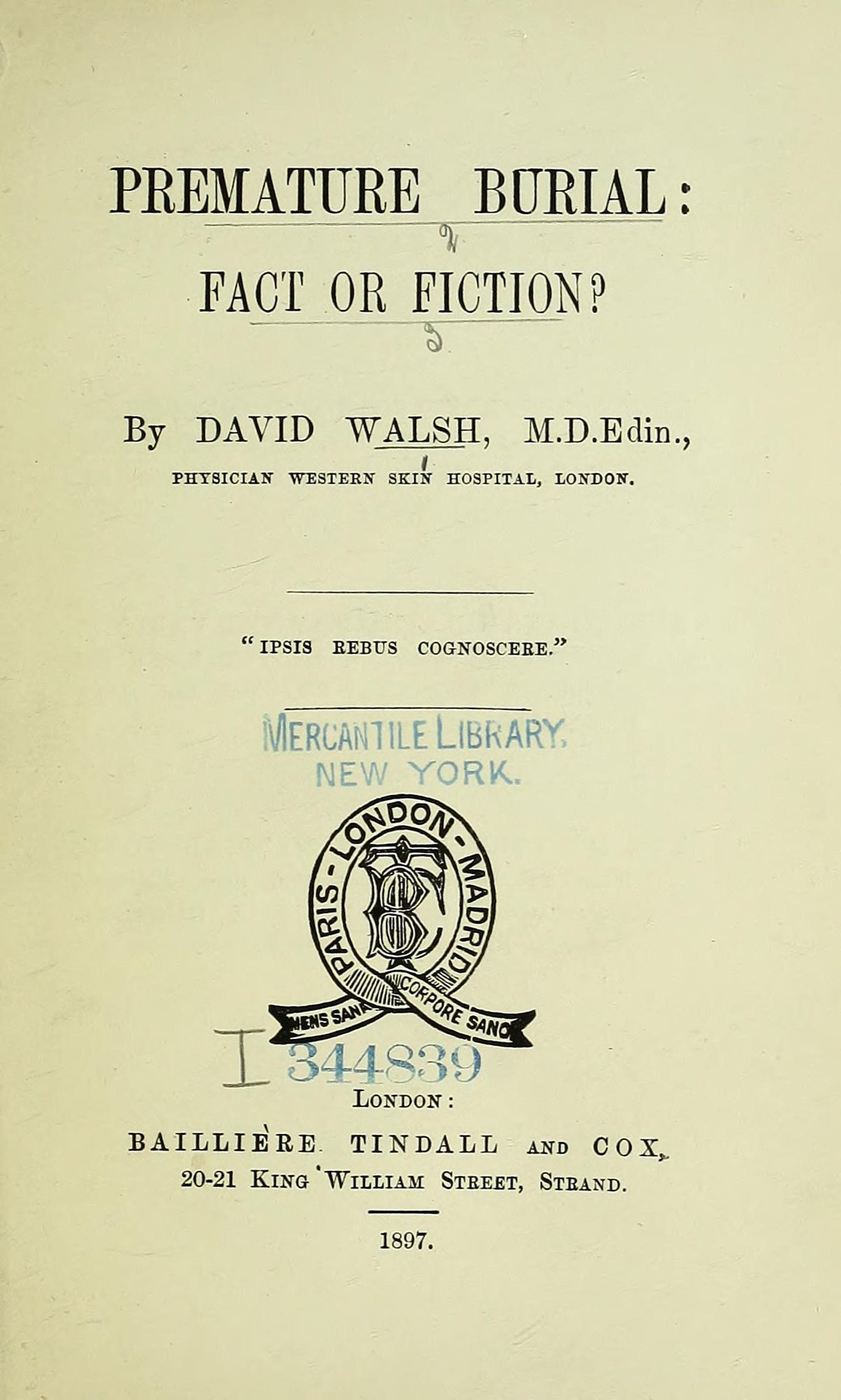
A London physician, David Walsh, read a description of it in 1897, and admired "the inventor's turn for mechanics". Then he made two objections. If breathing is enough to set it off, why wait until after the funeral? Test the person before burial. And dead bodies change shape as they decay: a device that delicate, he predicted, "would be set going in nine cases out of ten" (Premature Burial: Fact or Fiction?, p. 43).
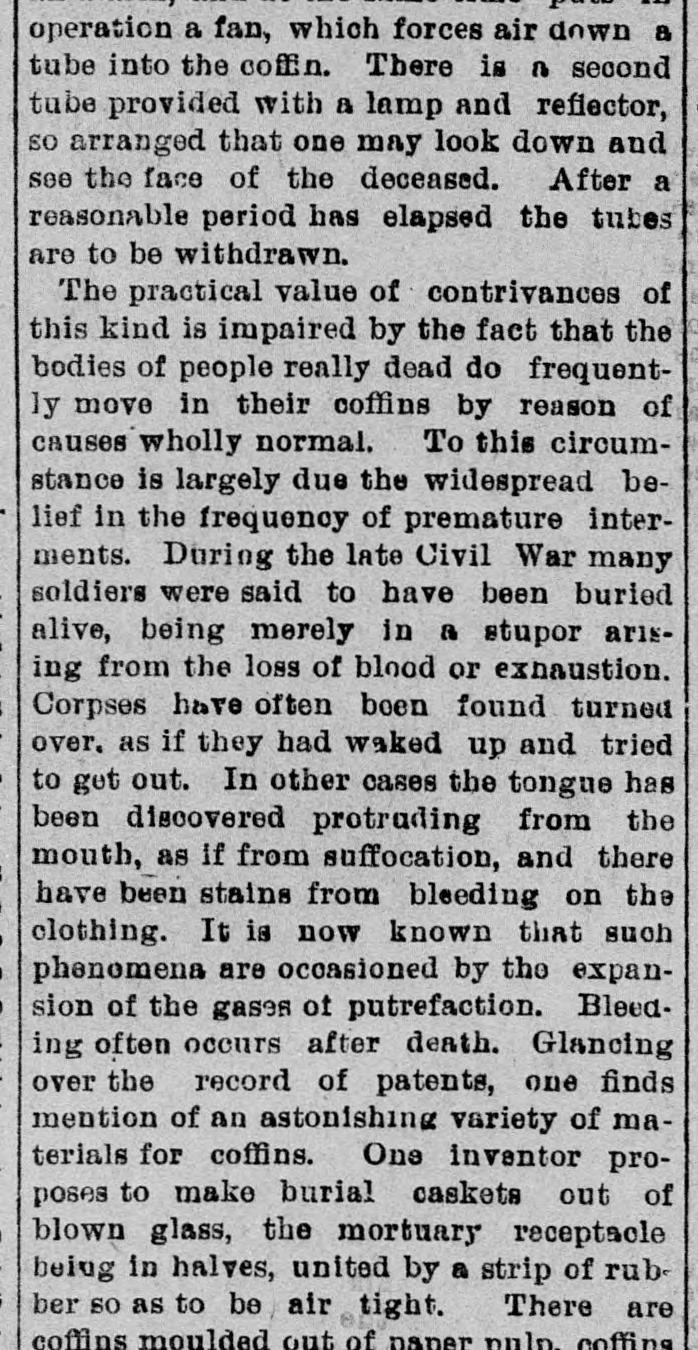
An American survey of burial patents, the year before, said the same: bodies "really dead do frequently move in their coffins", from "the expansion of the gases of putrefaction". That, it said, explained most stories of people buried alive ("Patents for Death", a Washington letter, in the Portland Daily Press, 27 June 1896).
What ended it
According to a history of the Harrison case, Ohio passed its own anatomy law in 1881, giving medical schools the bodies that no one claimed (Ohio State Law Journal, 1958, citing L. F. Edwards; we have not read the statute). With a lawful supply, grave robbing for the dissecting room faded.
| January 1829 | Burke hanged, Edinburgh |
|---|---|
| 28 February 1831 | Massachusetts: anatomy law approved |
| 1 August 1832 | Britain: the Anatomy Act |
| 30 May 1878 | Harrison found at the Ohio Medical College, Cincinnati |
| 1881 | Ohio: anatomy law, nearly fifty years after Britain's |
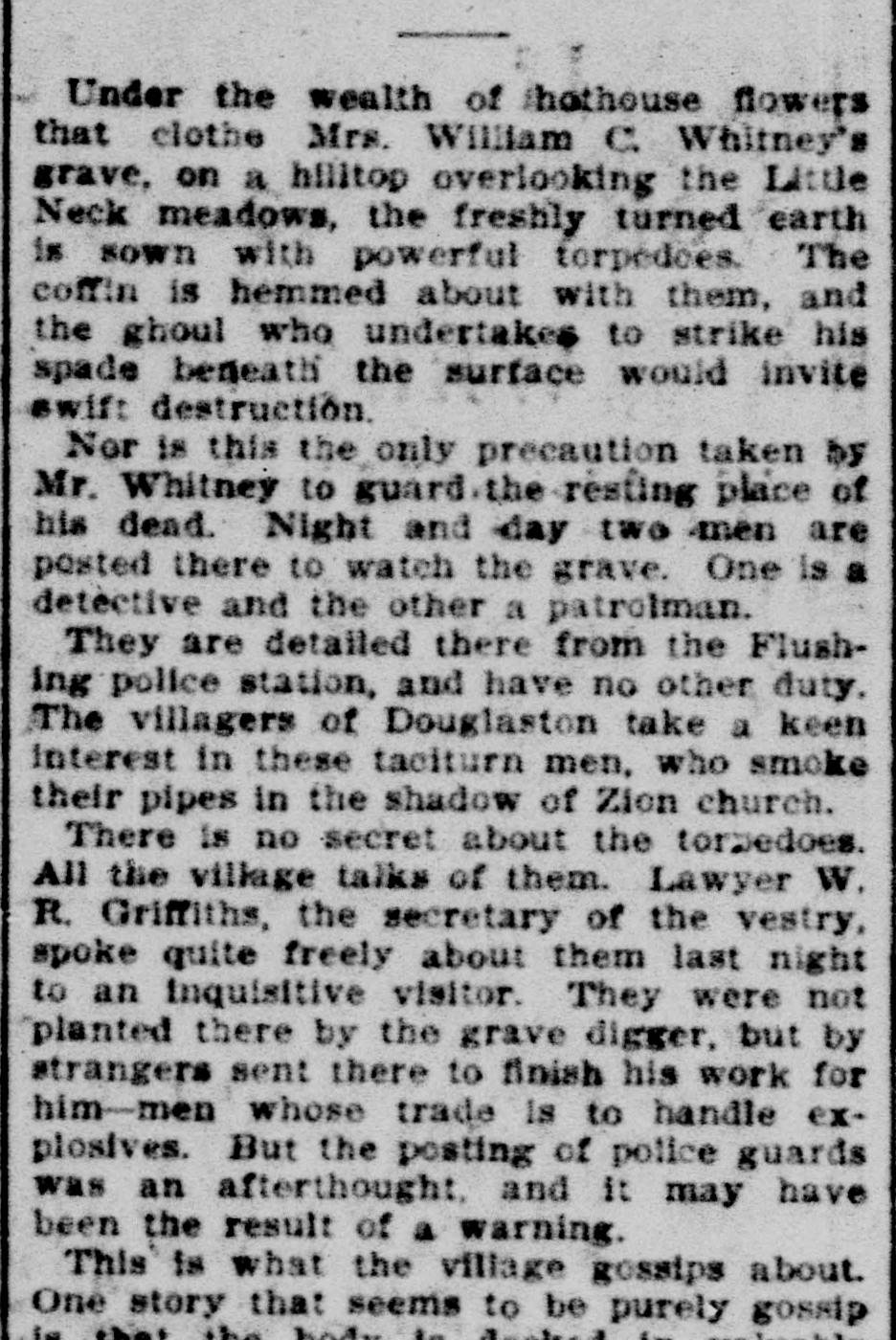
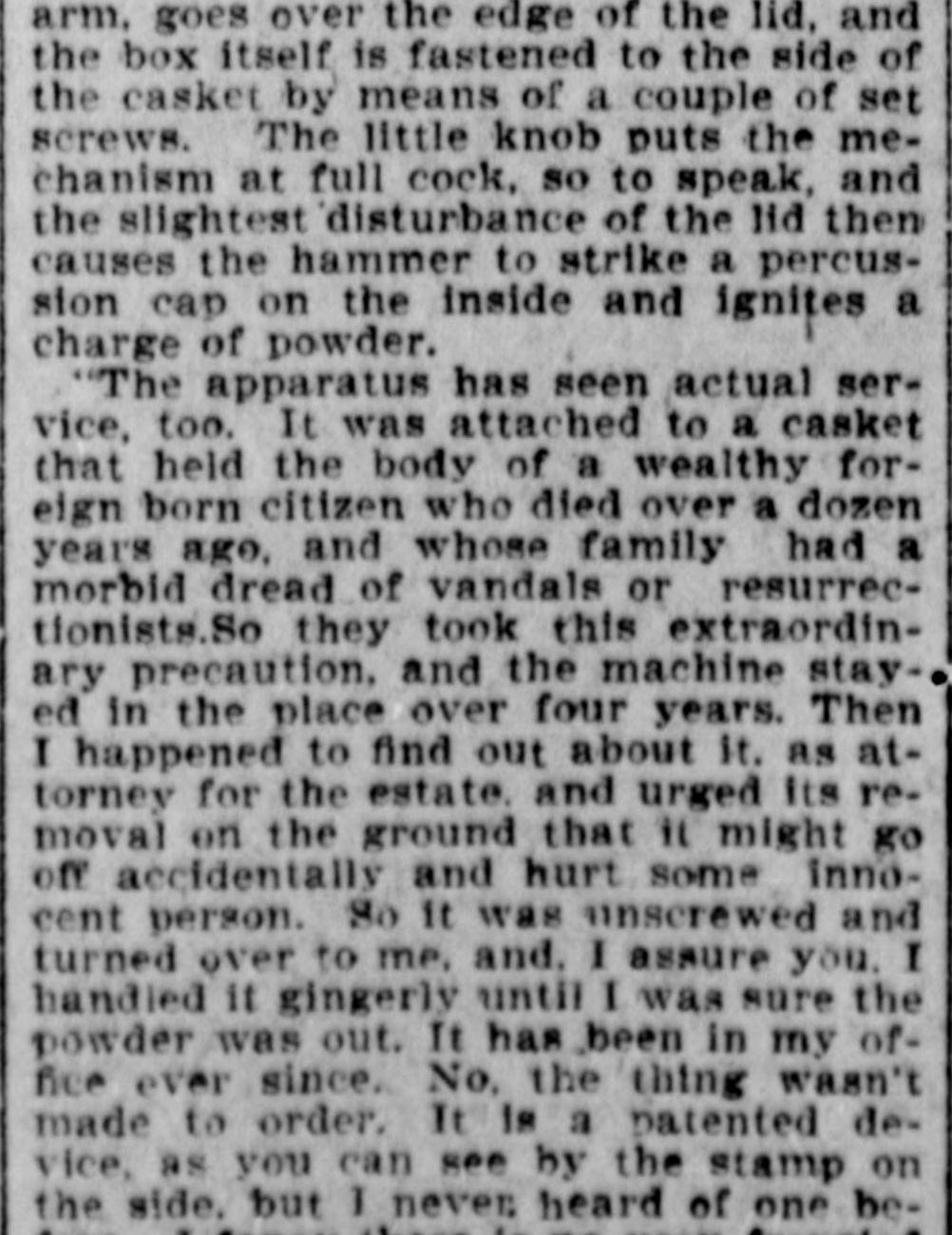
By 1896 the New-York Tribune thought bombshells in graveyards would "expend most of its effect upon posterity, who always sooner or later want the premises for other use" (editorial, 14 August 1896, p. 6; read in the machine reading of the page). The torpedoes lingered with the rich. In 1899, at Douglaston on Long Island, torpedoes were sown round the coffin in Mrs. William C. Whitney's grave, with "a detective and a patrolman" on watch (Seattle Post-Intelligencer, 4 June 1899). And in 1900 a lawyer in New Orleans showed a reporter a coffin torpedo he had had taken off a client's casket, "on the ground that it might go off accidentally and hurt some innocent person" (a Times-Democrat reporter's story, in the Providence News, 28 May 1900).
One coffin was built to keep people out. The other was built to let someone out. For the first, there is one reported death, which we could not confirm. For the second, we found no record of anyone saved. Both fears were answered in the end by a law, and by a better knowledge of death, not by a machine.
Next episode: three patents for antigravity, granted in 1971 (US 3,626,605), 2005 (US 6,960,975) and 2018 (US 10,144,532, to the United States Navy).
Read the original patents
All twelve are US patents of 1843 to 1897, in the public domain. Click a page for full resolution; drawing sheets come first, then the specification. Three of the sheets draw a body in the coffin: Clover's Fig. 1, Vester's Fig. 4 and Krichbaum's Fig. 1.
US 208,672, Philip K. Clover, Coffin-Torpedo, filed 29 June 1878, granted 8 October 1878
US 217,379, Thomas N. Howell, Grave-Torpedo, filed 8 May 1879, granted 8 July 1879
Reissue 9,719, Thomas N. Howell, Grave-Torpedo, reissued 24 May 1881
US 228,651, Richard B. Lanum, Grave-Torpedo, filed 9 October 1879, granted 8 June 1880
US 251,231, Thomas N. Howell, Grave-Torpedo, filed 24 October 1881, granted 20 December 1881
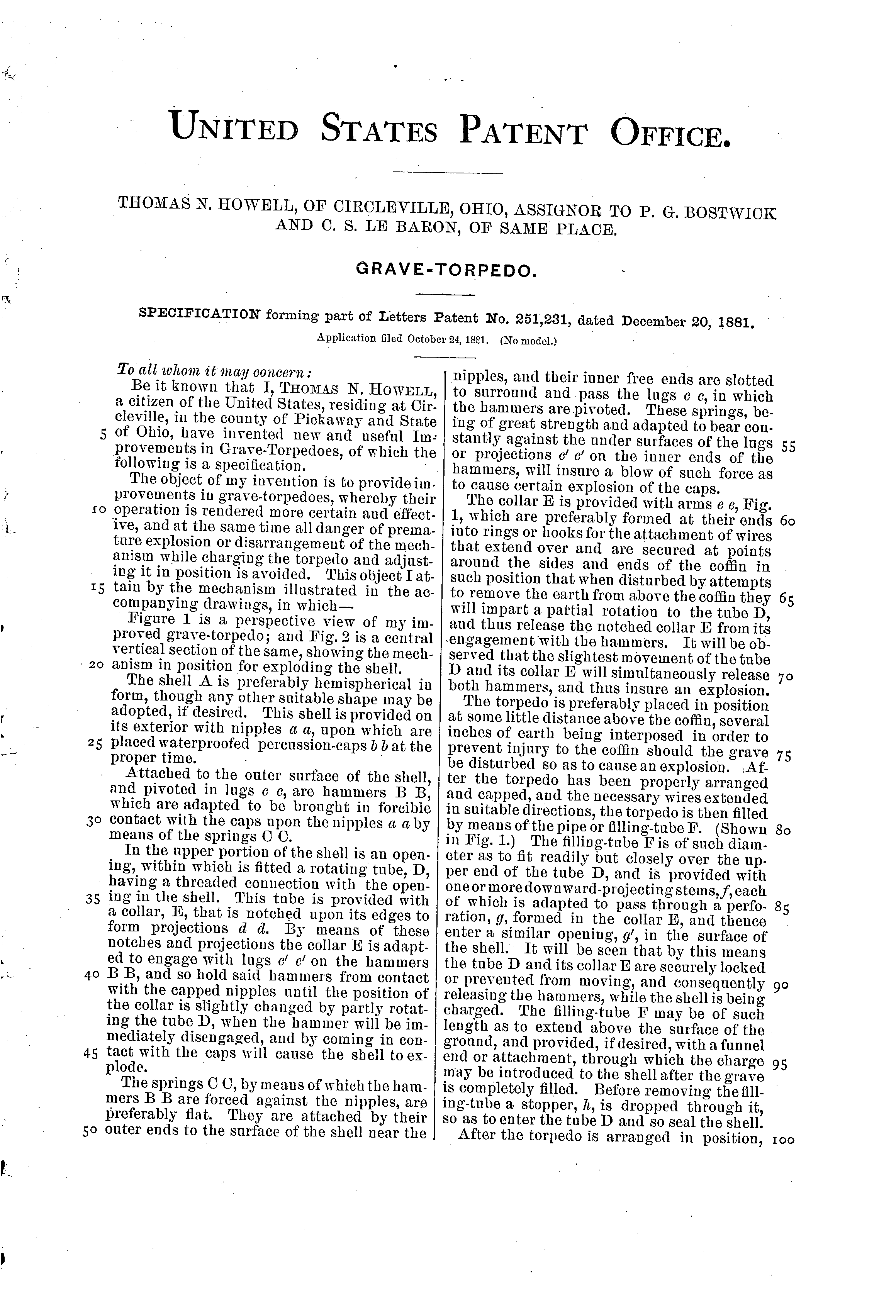
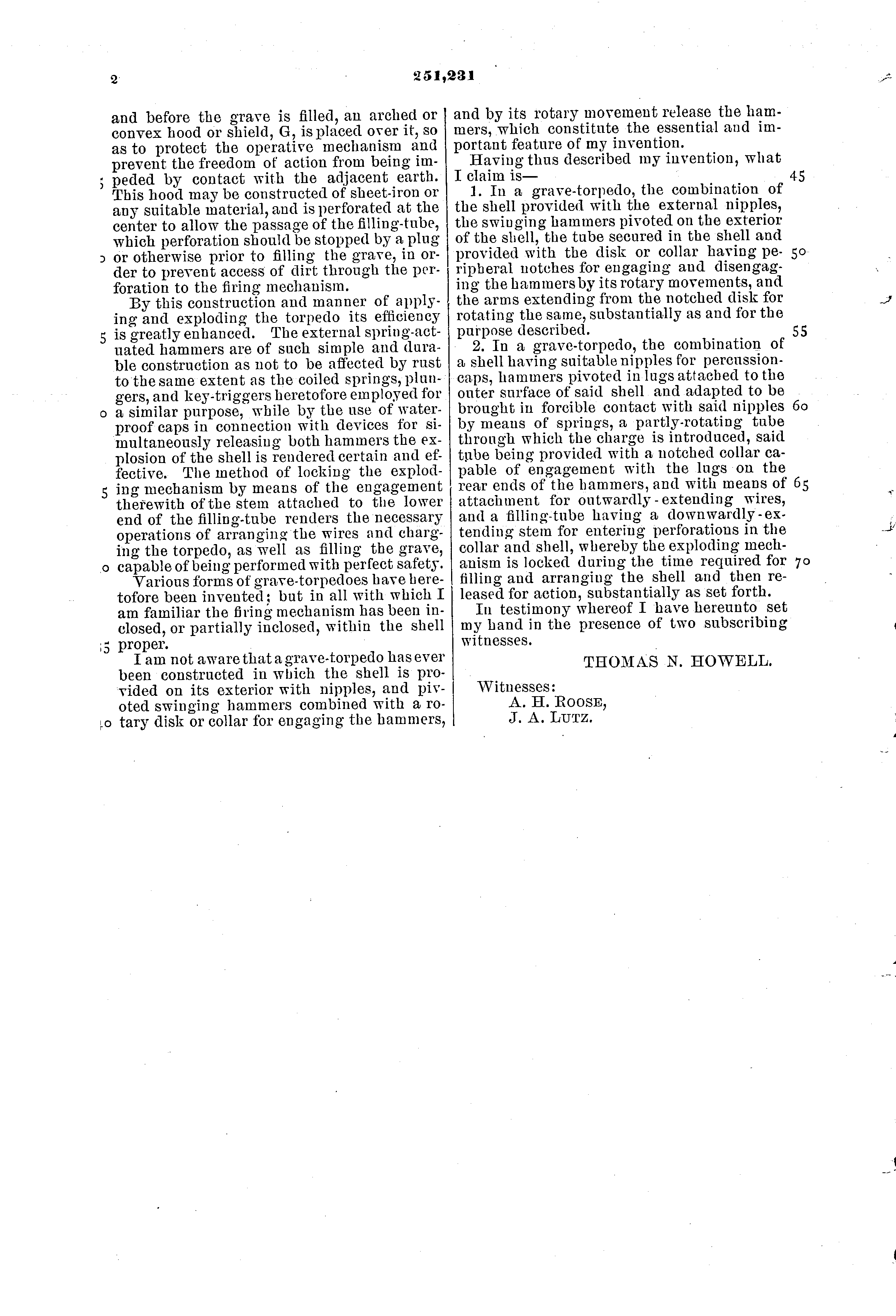
US 215,582, David Davis, Grave Protector and Shield, granted 20 May 1879
US 3,335, Christian H. Eisenbrandt, Coffin, granted 15 November 1843
US 81,437, Franz Vester, Improved Burial-Case, granted 25 August 1868
US 268,693, John G. Krichbaum, Device for Indicating Life in Buried Persons, granted 5 December 1882
US 572,119, Michael Karnicki, Apparatus for Saving People Buried Alive, filed 3 July 1896, granted 1 December 1896
US 584,876, Michael Karnicki, Apparatus for Saving Persons Buried Alive, filed 17 March 1897, granted 22 June 1897
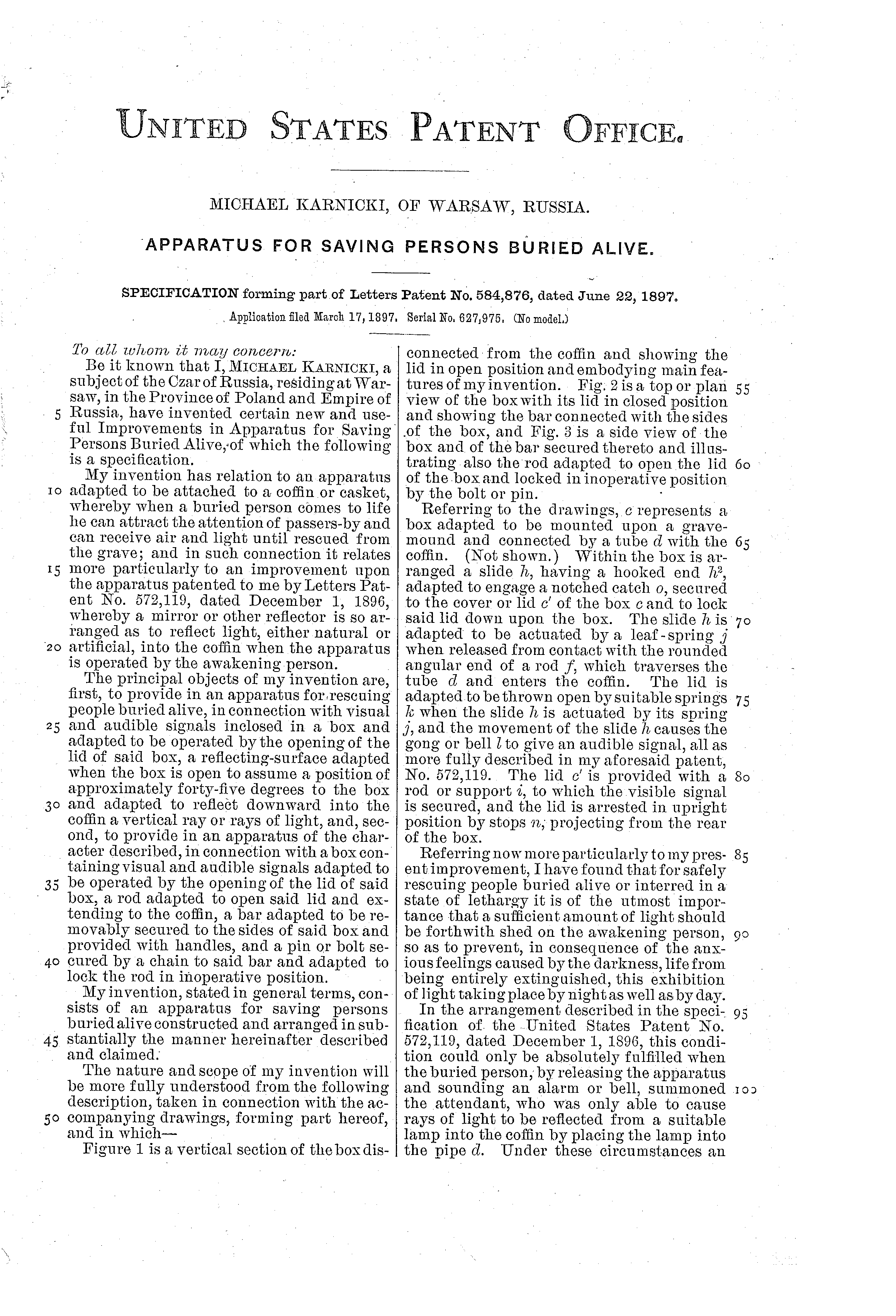
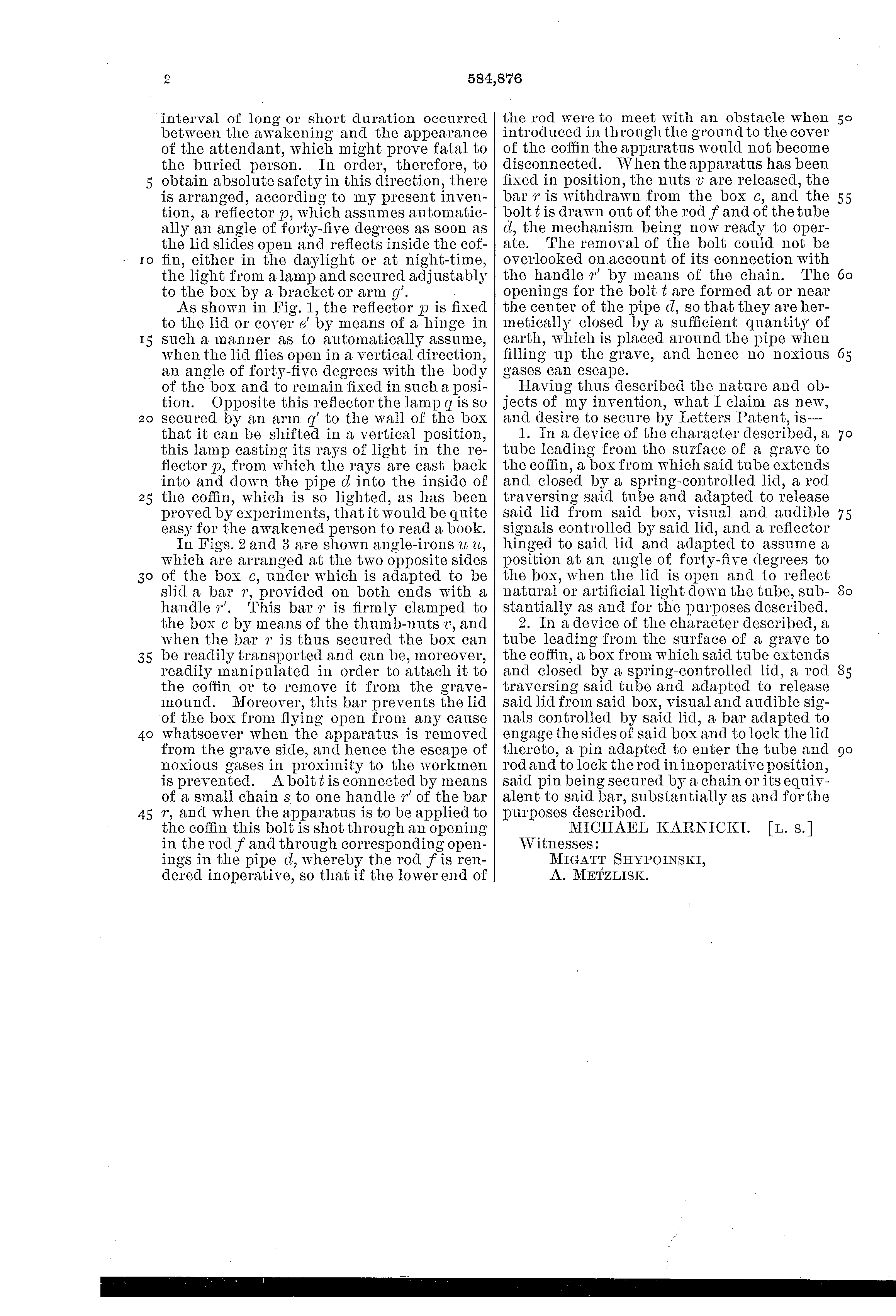
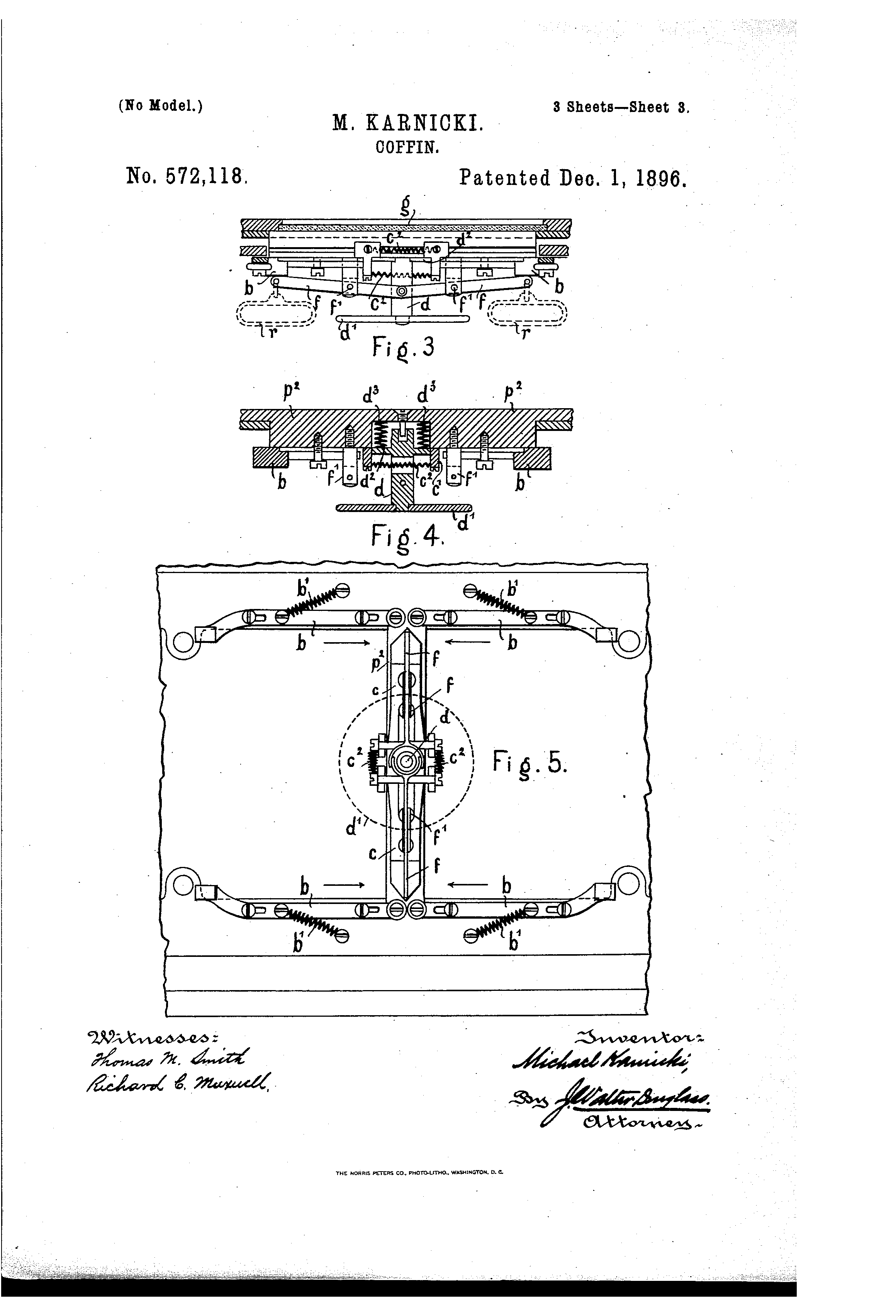
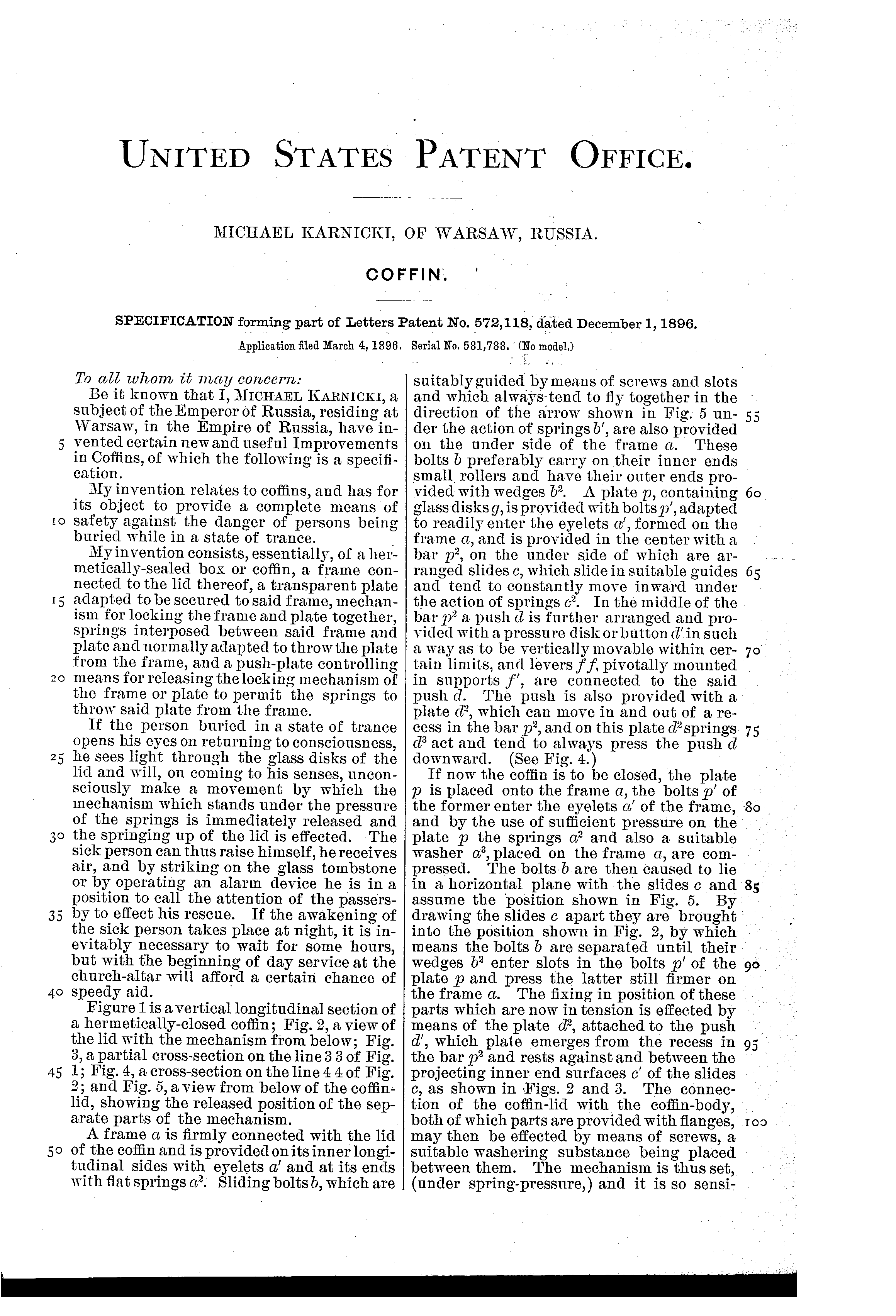
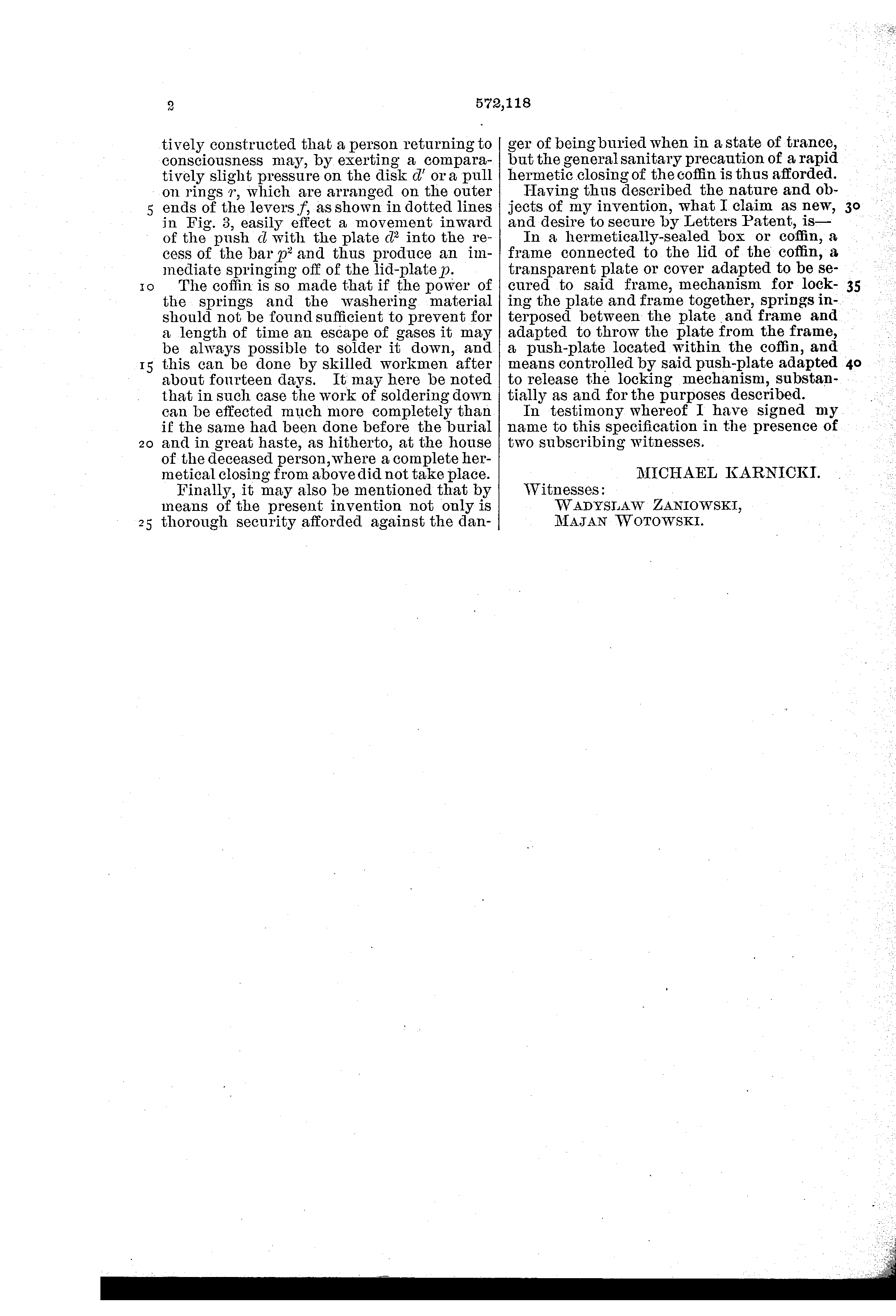
US 572,118, Michael Karnicki, Coffin, filed 4 March 1896, granted 1 December 1896
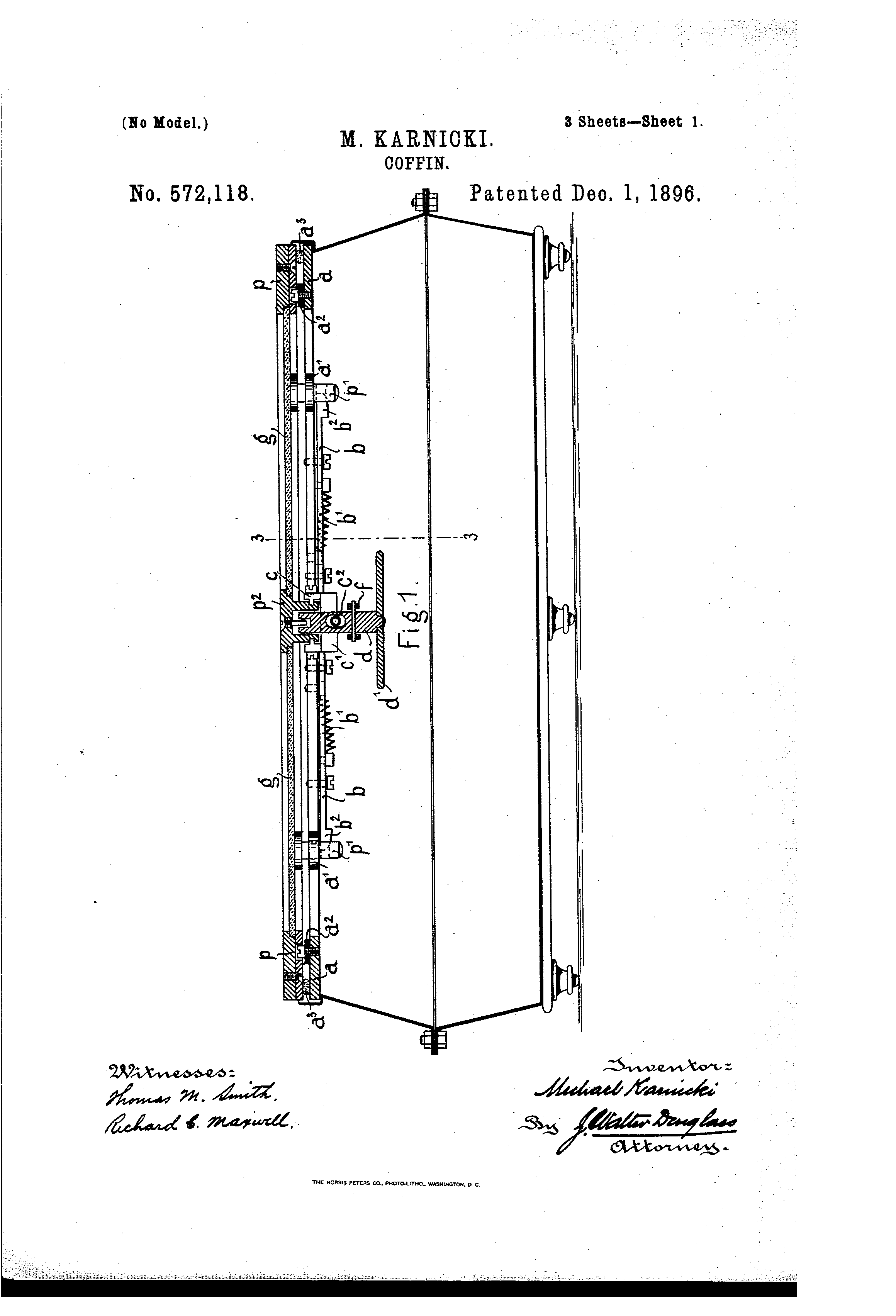
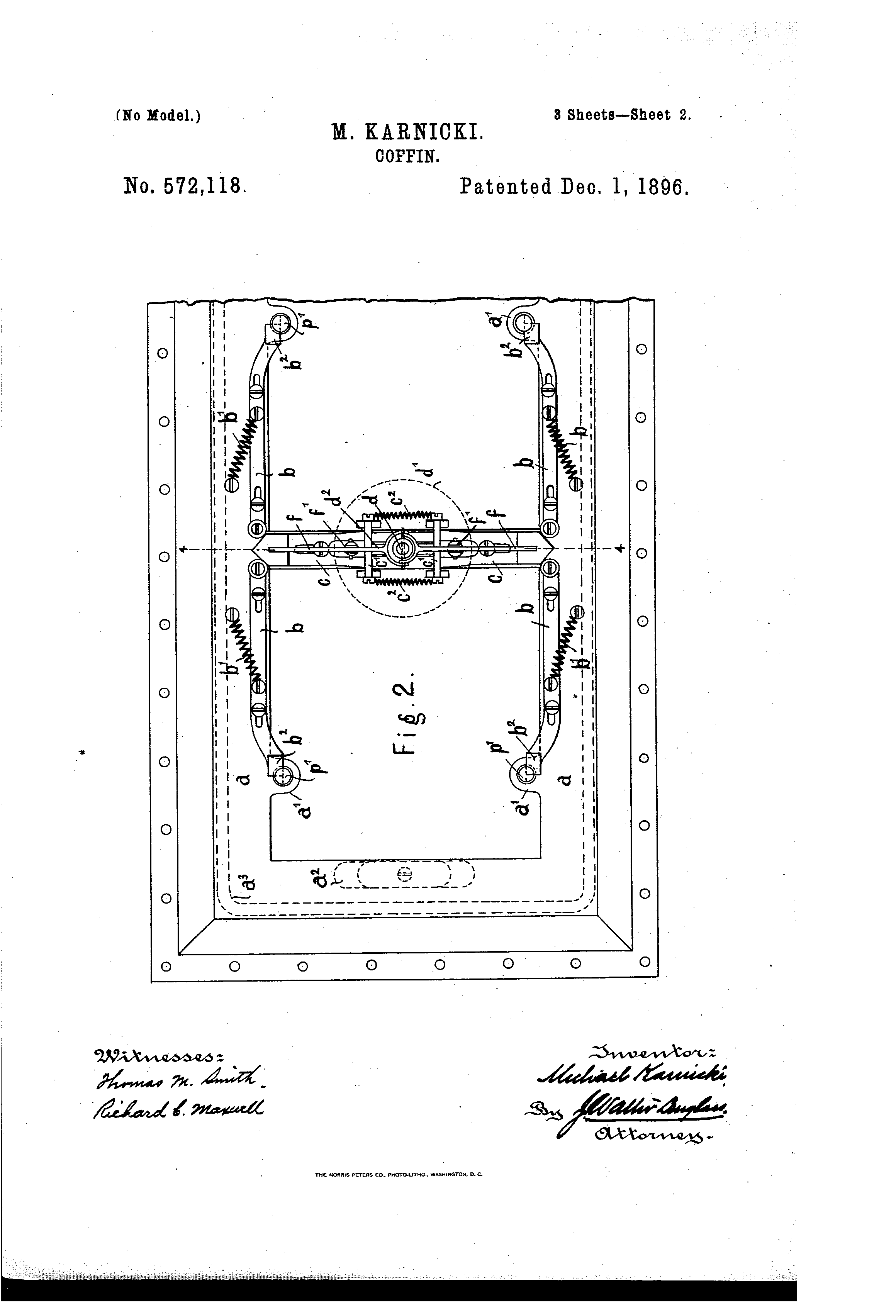
Sources
Every fact on this page comes from these, as in the episode. Where we have read a source only in the machine reading of its page, or only second-hand, the text says so.
Patents (US, public domain; full-page scans from the USPTO)
- P. K. Clover, Coffin-Torpedo, US 208,672 (filed 29 June 1878, granted 8 October 1878): the purpose (p. 1), the parts and Figs. 2-3, "drawn axially in either direction", the wires, the undertaker, "any object outside the casket", "of no use to robbers" (p. 2).
- T. N. Howell, Grave-Torpedo, US 217,379 (8 July 1879), its Reissue 9,719 (24 May 1881: the robbers' method, "preserve the same intact"), and US 251,231 (20 December 1881: "various forms of grave-torpedoes").
- R. B. Lanum, Grave-Torpedo, US 228,651 (8 June 1880): the catch, pin I and rod M, "without danger to those engaged in it".
- D. Davis, US 215,582 (20 May 1879); and the other Ohio patents in the table: 201,936, 218,185, 220,119, 220,402, 267,348.
- C. H. Eisenbrandt, Coffin, US 3,335 (15 November 1843): "doubtful death", the ring, the forehead plate, the catch and spring, the press-pin and guard-pin, "in a vault".
- F. Vester, Improved Burial-Case, US 81,437 (25 August 1868). J. G. Krichbaum, US 268,693 (5 December 1882).
- M. Karnicki, US 572,118 and US 572,119 (1 December 1896: the box, rod and ball, "close to the breast", "the slightest movement", "not the slightest connection", "by passers-by") and US 584,876 (22 June 1897: the reflector and lamp, "the anxious feelings caused by the darkness").
Newspapers (Library of Congress, Chronicling America)
- The Harrison case: wire report "Cincinnati, May 30", Memphis Daily Appeal, 31 May 1878, p. 1, and The Daily Cairo Bulletin, 1 June 1878, p. 2 (the second read in the machine reading). How far it ran: our phrase searches of the collection, 17 October 2026.
- A. T. Stewart: New-York Tribune, 8 November 1878, p. 1, and New Orleans Daily Democrat, 8 November 1878, p. 1 (both read in the machine reading).
- "A Torpedo for Protecting Graves", from the Columbus State Journal, St. Johnsbury Caledonian, 23 August 1878, p. 1. New Bloomfield Times, 13 August 1878, p. 4. "The Torpedo of the Grave", from the San Francisco Post, Rock Island Argus, 11 December 1878, p. 3.
- The Richmond letter, Daily Dispatch (Richmond), 17 February 1880, p. 4 (read in the machine reading).
- Howell's torpedo, from the Circleville Herald, The Jackson Standard, 20 February 1879, p. 4.
- Gann: Omaha Daily Bee, 20 January 1881, p. 1; Stark County Democrat, 20 January 1881, p. 8; the same dispatch in the Wheeling Daily Intelligencer and other papers.
- Plain City, from the Cleveland Leader, Juniata Sentinel and Republican, 20 April 1881, p. 2. Syracuse, from the Syracuse Herald, Lancaster Daily Intelligencer, 10 May 1881, p. 2. The joke item, The Orangeburg Democrat, 4 June 1880, p. 2.
- Vester's burial, from the New York Star, Alexandria Gazette, 4 September 1868, p. 1.
- "Patents for Death", Portland Daily Press, 27 June 1896, p. 9. "Burial Devices", New-York Tribune, 14 August 1896, p. 6 (read in the machine reading).
- "For the Timid", from the London Mail, Evening Star (Washington), 18 November 1898, p. 2.
- "Bombs and Grave Torpedoes to Protect Mrs. Whitney's Body", Seattle Post-Intelligencer, 4 June 1899, p. 11. "Coffin Torpedoes", Providence News, 28 May 1900, p. 4.
Books and documents
- "Patents for Protecting the Dead", Scientific American 39:22, 30 November 1878, p. 337.
- Report from the Select Committee on Anatomy (House of Commons, 1828): the supply (p. 11), Edinburgh's teachers (Appendix 3, pp. 126-127).
- The Life of Sir Robert Christison (Edinburgh, 1885), vol. 1, pp. 175-180: the method, the iron guards.
- Trial of William Burke and Helen M'Dougal (Edinburgh, 1829), Wellcome copy: pp. 53, 199-200, the frontispiece; and its Supplement (1829): Burke's declarations (pp. [31]-[37]), the Courant confession (pp. [37]-[44]), the execution and dissection (pp. [45]-[48]).
- Knox not charged: Burke's declaration, Supplement p. [37], and the report of the committee of inquiry of March 1829, reprinted in H. Lonsdale, A Sketch of the Life and Writings of Robert Knox (1870), pp. 85-88.
- The Trial, Sentence, and Confessions of Bishop, Williams, and May (London, 1831).
- An Act for regulating Schools of Anatomy, 2 & 3 Will. IV c. 75, 1 August 1832 (s. VII: unclaimed bodies). "In practice mostly from workhouses and hospitals" is from general histories, not the Act's text.
- Massachusetts, Acts 1830, chap. LVII, approved 28 February 1831, Massachusetts State Archives.
- D. Walsh, Premature Burial: Fact or Fiction? (London, 1897), pp. 42-43.
- Burke's skeleton: the University of Edinburgh's Anatomical Museum page (read 18 October 2026). St Cuthbert's watch tower: Historic Environment Scotland, LB27346.
Secondary
- "The Law of Dead Bodies: Impeding Medical Progress", Ohio State Law Journal 19 (1958), citing L. F. Edwards, "The Famous Harrison Case and its Repercussions" (1957) and "The Ohio Anatomy Law of 1881" (1950): Ohio's law of 1881. We have not read the statute.
- John Scott Harrison as a former congressman: WOSU (Gabe Rosenberg, 17 May 2017) and Hagley Museum and Library (Chris Cascio, 26 October 2023). The 1878 reports call him "Hon. J. S. Harrison" and the president's son.
- Today's money: dollars by the ratio of annual-average consumer prices (Federal Reserve Bank of Minneapolis, "Consumer Price Index, 1800-"); pounds by the Office for National Statistics' Retail Prices Index: Long run series (CDKO); 2025 as today, rounded to two figures, marked ≈ because the early indexes are estimates.
- The reconstructions are our own work, as described under each model. Each model is checked by the episode's test, run again on this page's copy (46 checks, all pass).
Images
- Patent drawings and specifications: USPTO, public domain.
- US newspapers of 1868 to 1900: Library of Congress, Chronicling America; published in the US before 1931, public domain.
- The 1828 report, Christison's Life (1885), the 1829 Trial and Supplement (Wellcome copies), the 1832 Act, Walsh (1897) and Scientific American (1878): scans via the Internet Archive; public domain.
- James Ritchie's photographs of the watch-house at Banchory-Ternan and the mortsafe at Tough (Aberdeenshire): Wellcome Collection, CC BY 4.0, resized for this page. The silhouettes of c. 1830: Wellcome Collection, Public Domain Mark.
- The video also uses AI illustrations, each labelled on screen with what it is based on. None is used on this page.