 Curious Patents
How Does a Wiper Pause?
In 1992 a jury set Chrysler's bill at 90 cents a car for a wiper that pauses between sweeps. With interest, the judgment came to $18,740,465.43 ≈ $43 million in today's money, and an appeals court affirmed it "in all respects". Ford had already settled. Run the patent behind it, Robert Kearns's 1964 circuit, from its own drawings: set the pause, change the glass, and read what the courts decided, and what they did not.
Watch the episode
A pause in court
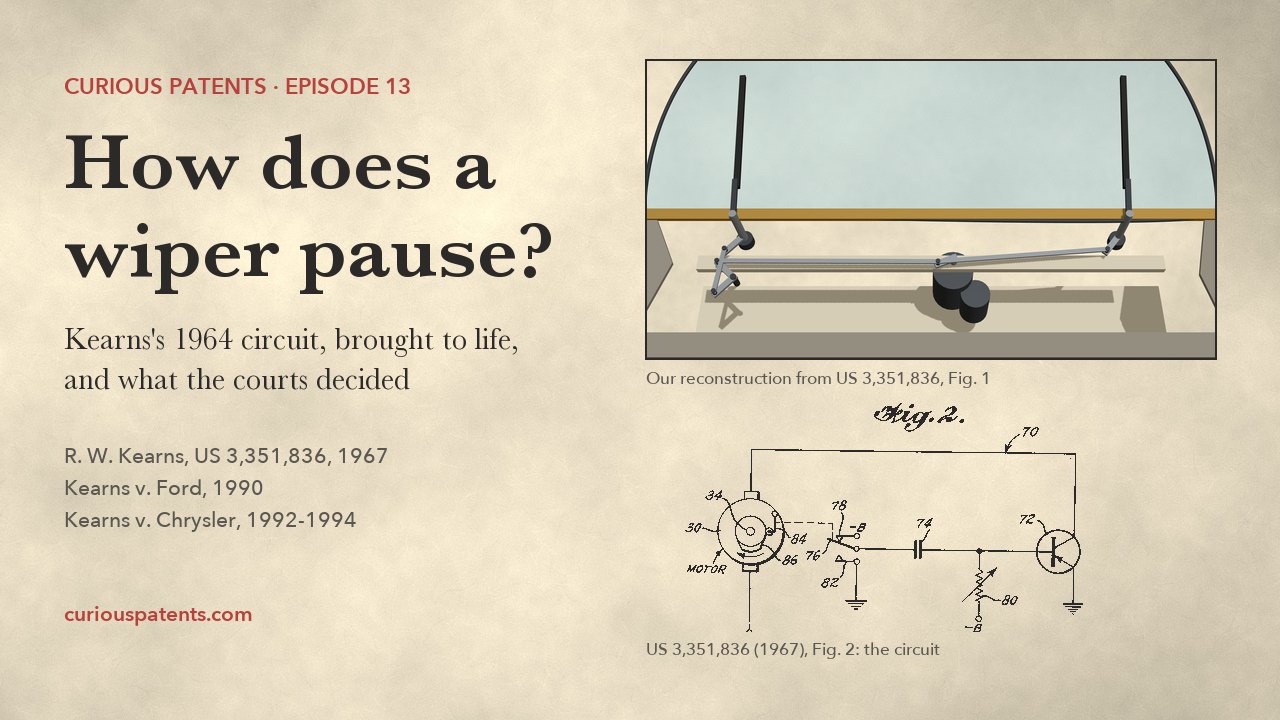
A pause between two sweeps of a windshield wiper ended in a court judgment against Chrysler for $18,740,465.43 ≈ $43 million. In 1994 the Court of Appeals for the Federal Circuit affirmed it "in all respects". Ford had already settled with the same man (Kearns v. Chrysler Corp., 32 F.3d 1541).
This is his patent, US 3,351,836, filed on 1 December 1964 by Robert W. Kearns of Detroit and granted on 7 November 1967. It describes a wiper motor switched by a transistor, a capacitor, and a dial that sets the length of the pause. Yet, as the appeals court put it, he felt he "never enjoyed an exclusive status under his patents". How do you patent a pause? And what did the courts say he owned? Below, the circuit rebuilt from the drawings, and what the courts decided, and what they did not.
Wipers that never rest, and the pauses before Kearns
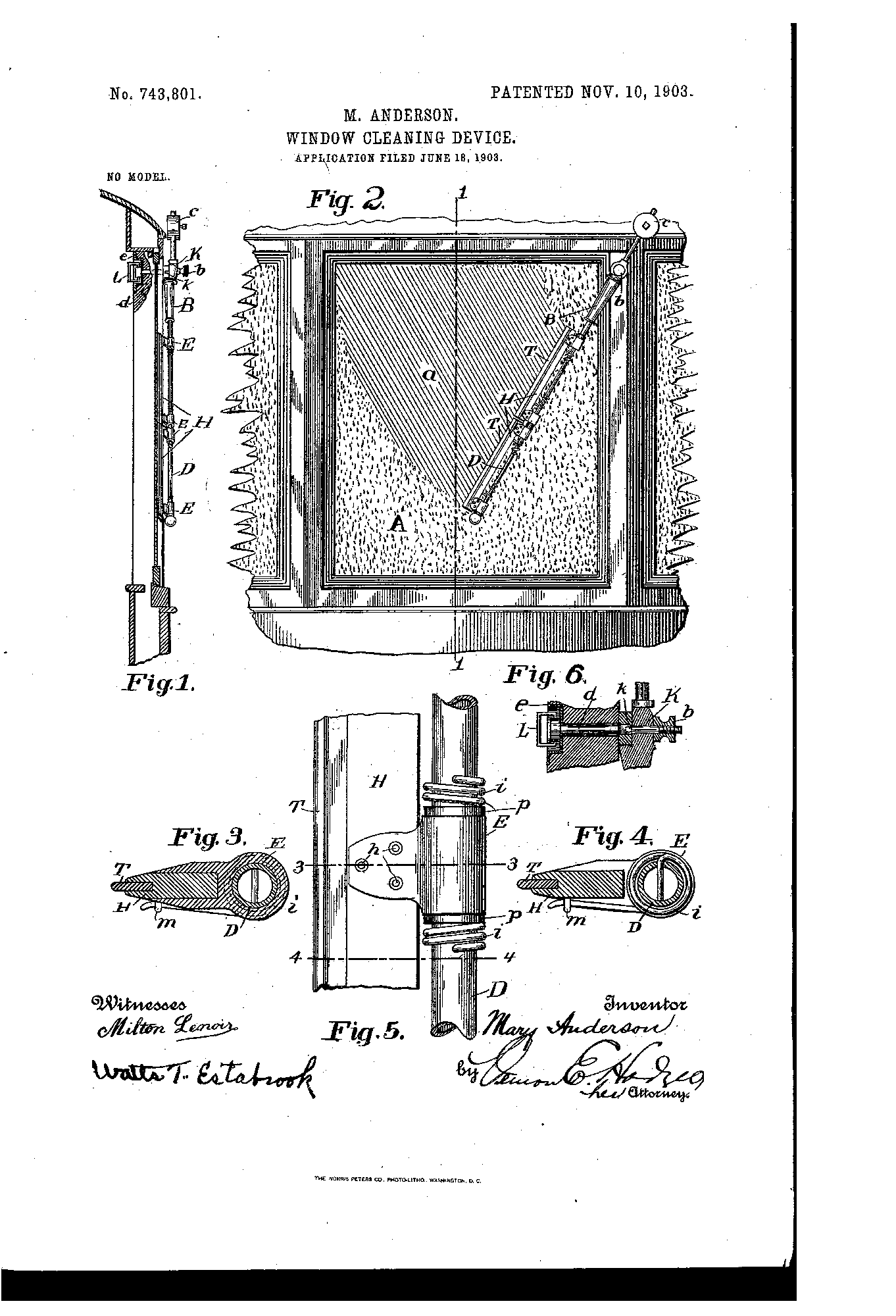
The first windshield wipers were worked by hand, like the window cleaning device patented by Mary Anderson in 1903. Later wipers ran on engine vacuum, then on electric motors, and they swept without stopping (Invention & Technology, 2007).
Kearns's patent names the trouble with that. "Under certain conditions, such as light rain or splash-back produced by other vehicles on wet roads, the condition of the windshield is often in what may be termed a wet-dry condition. Continuous windshield wiper operation with such a windshield condition may cause smearing to obscure the vision of the driver" (col. 1).
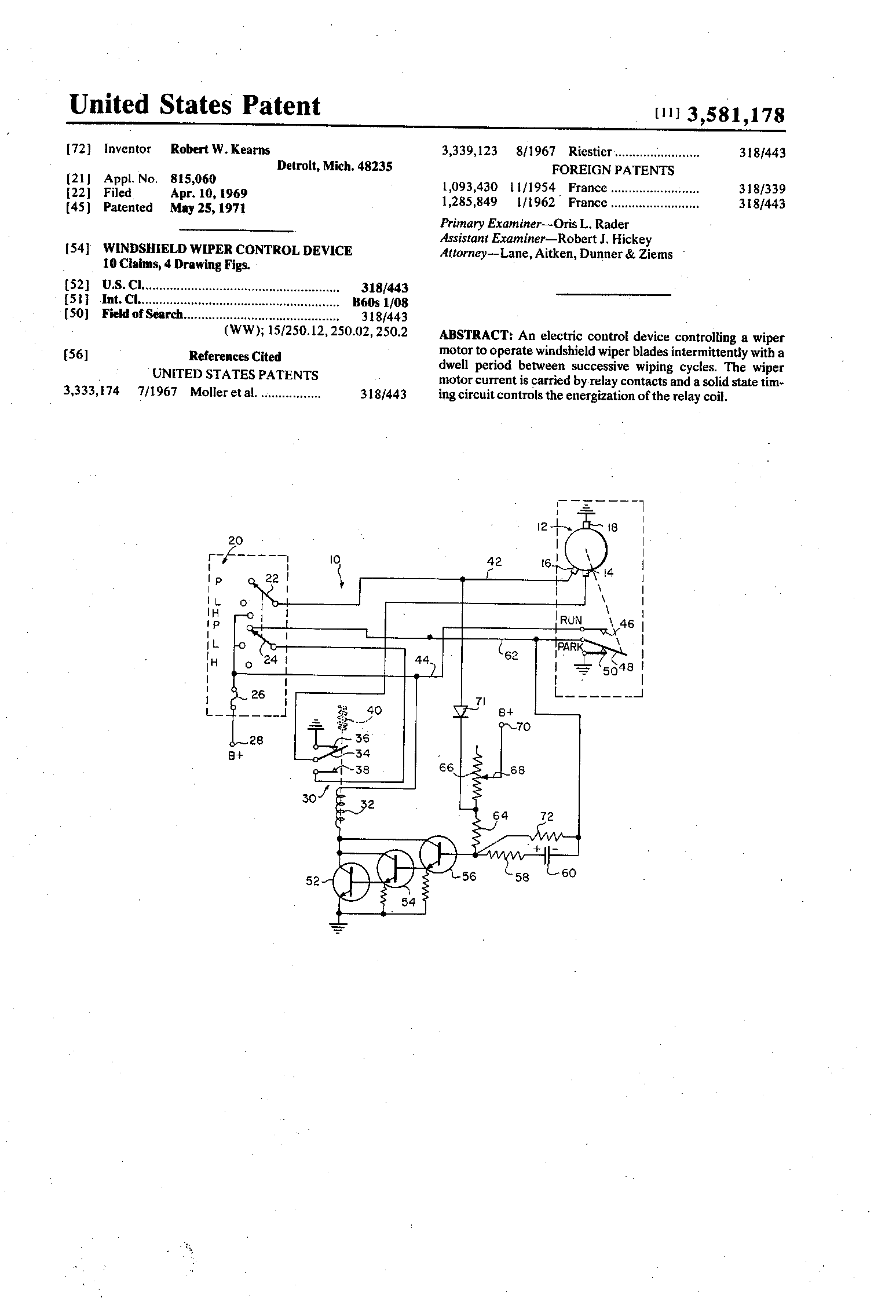
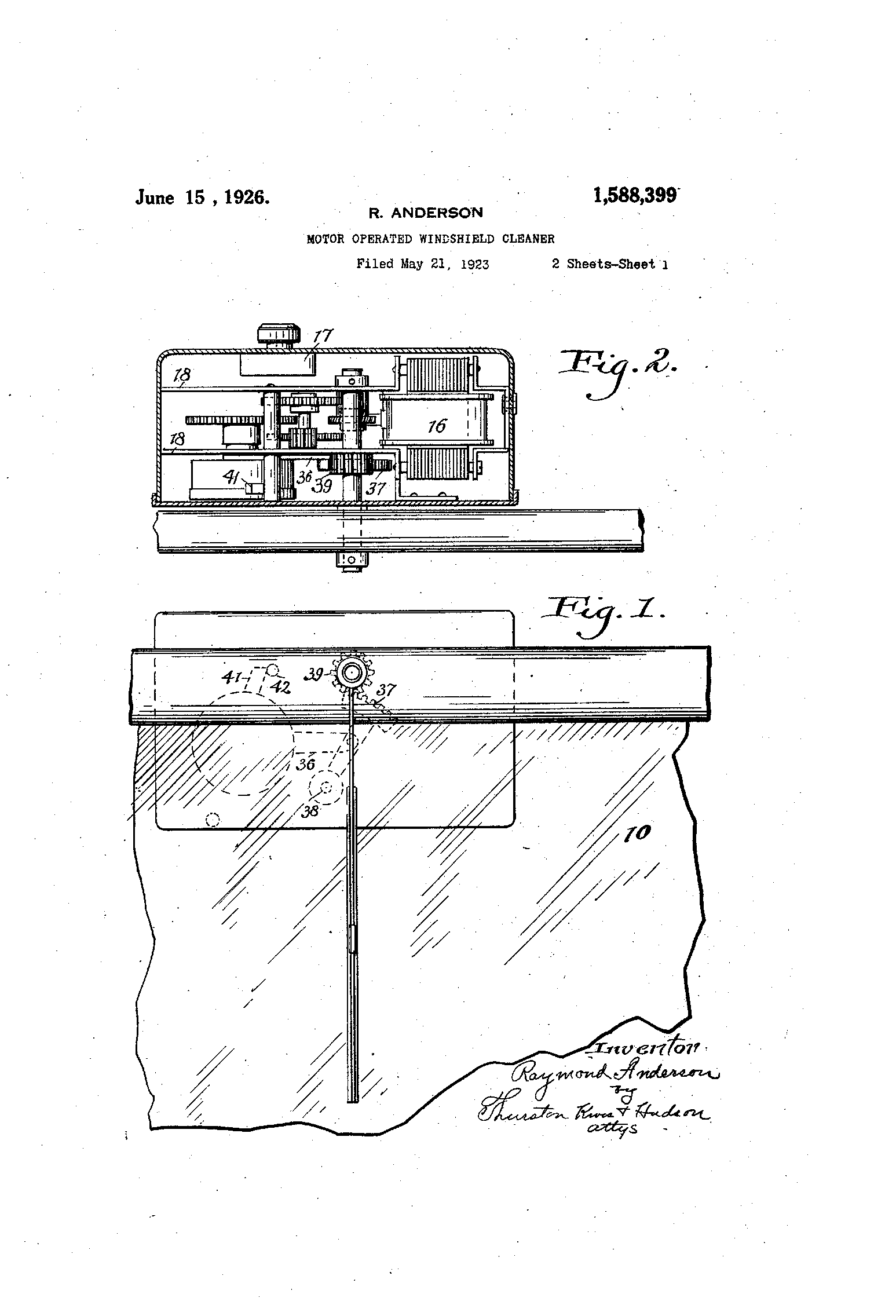
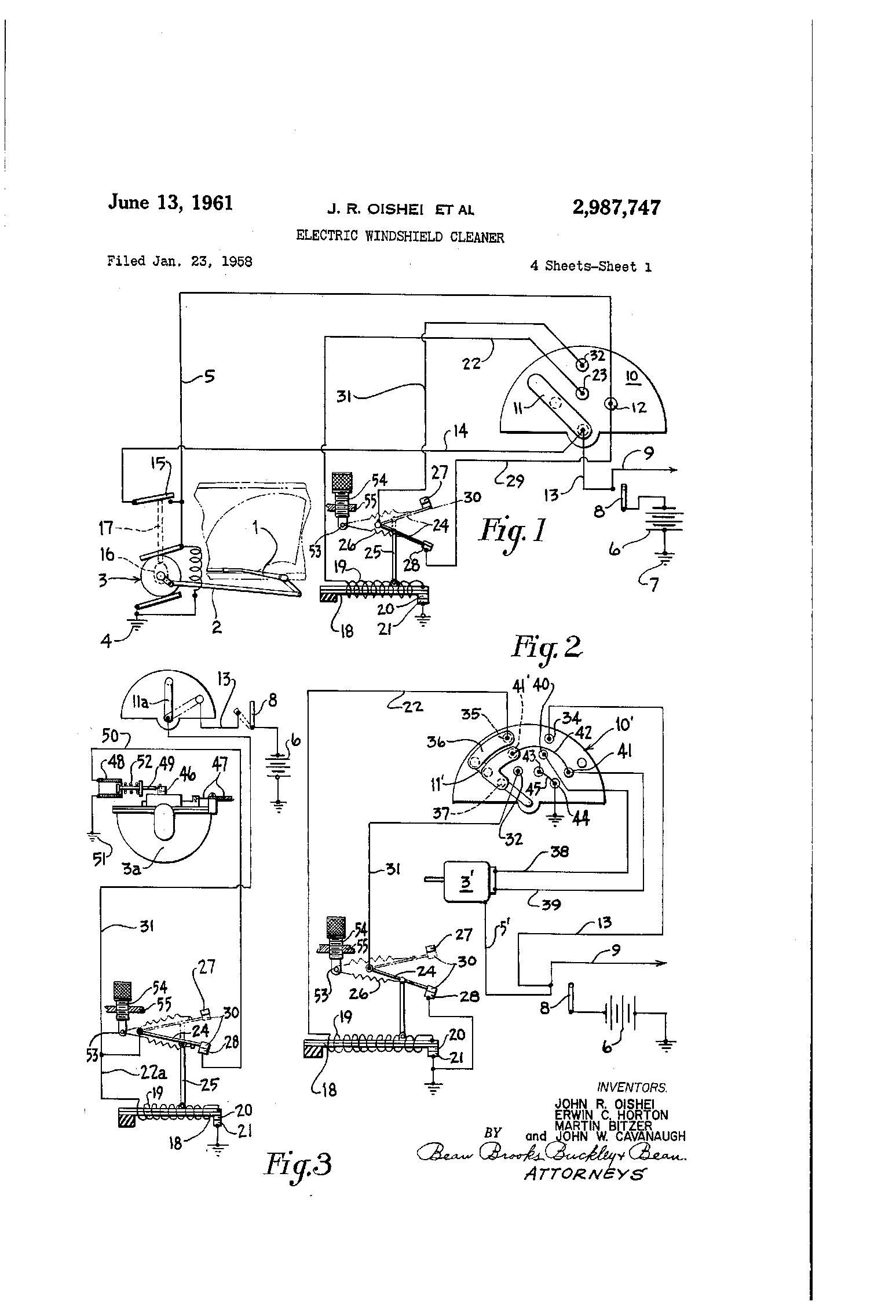
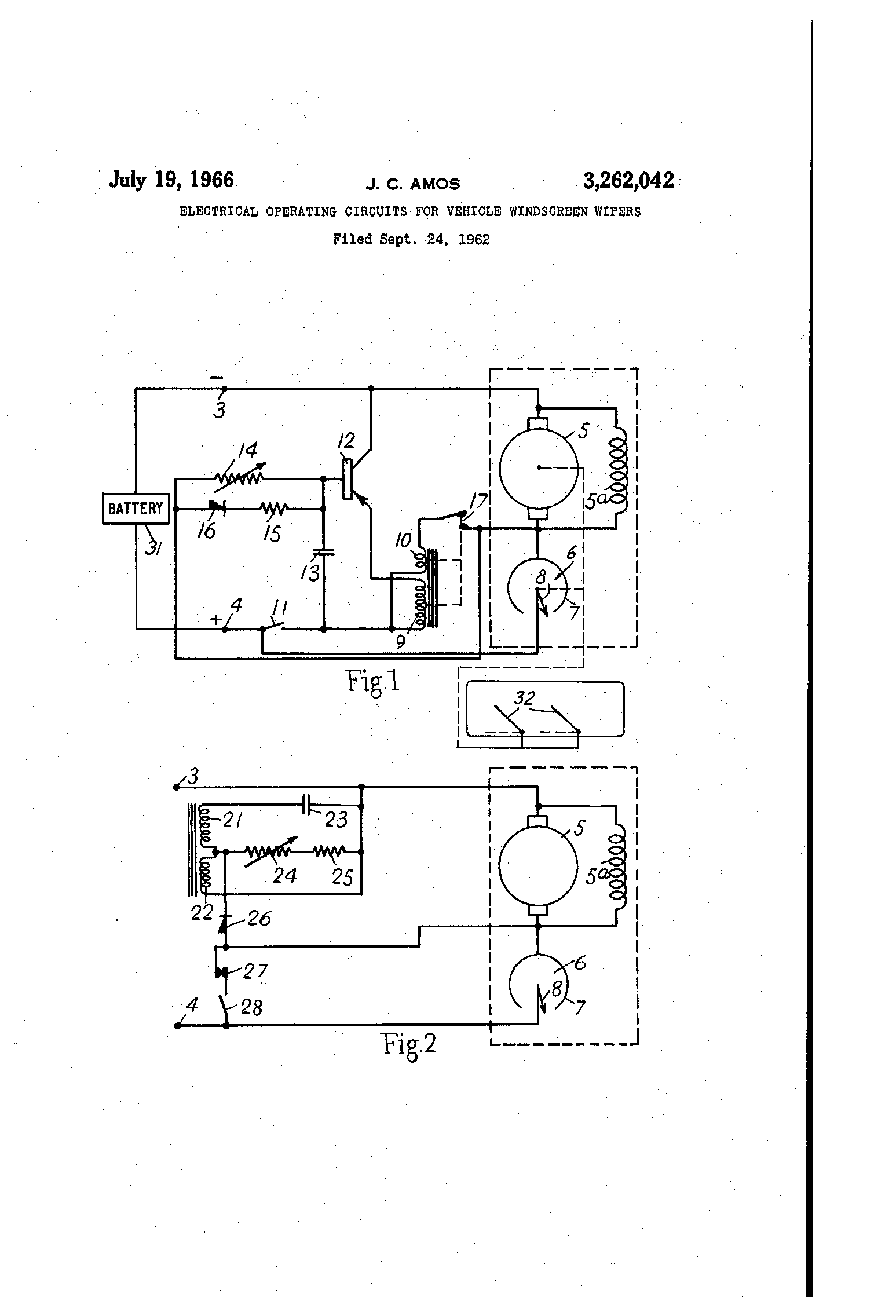
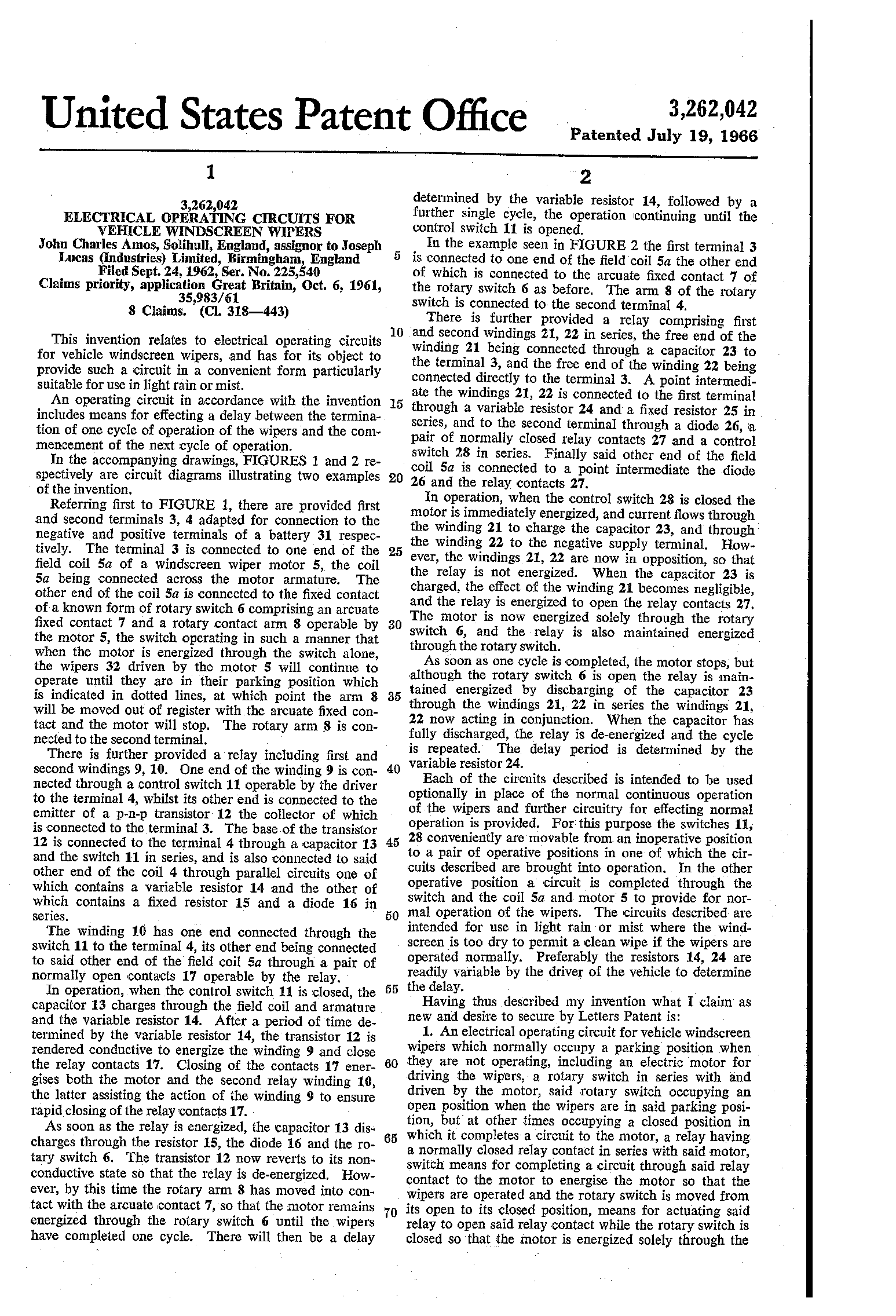
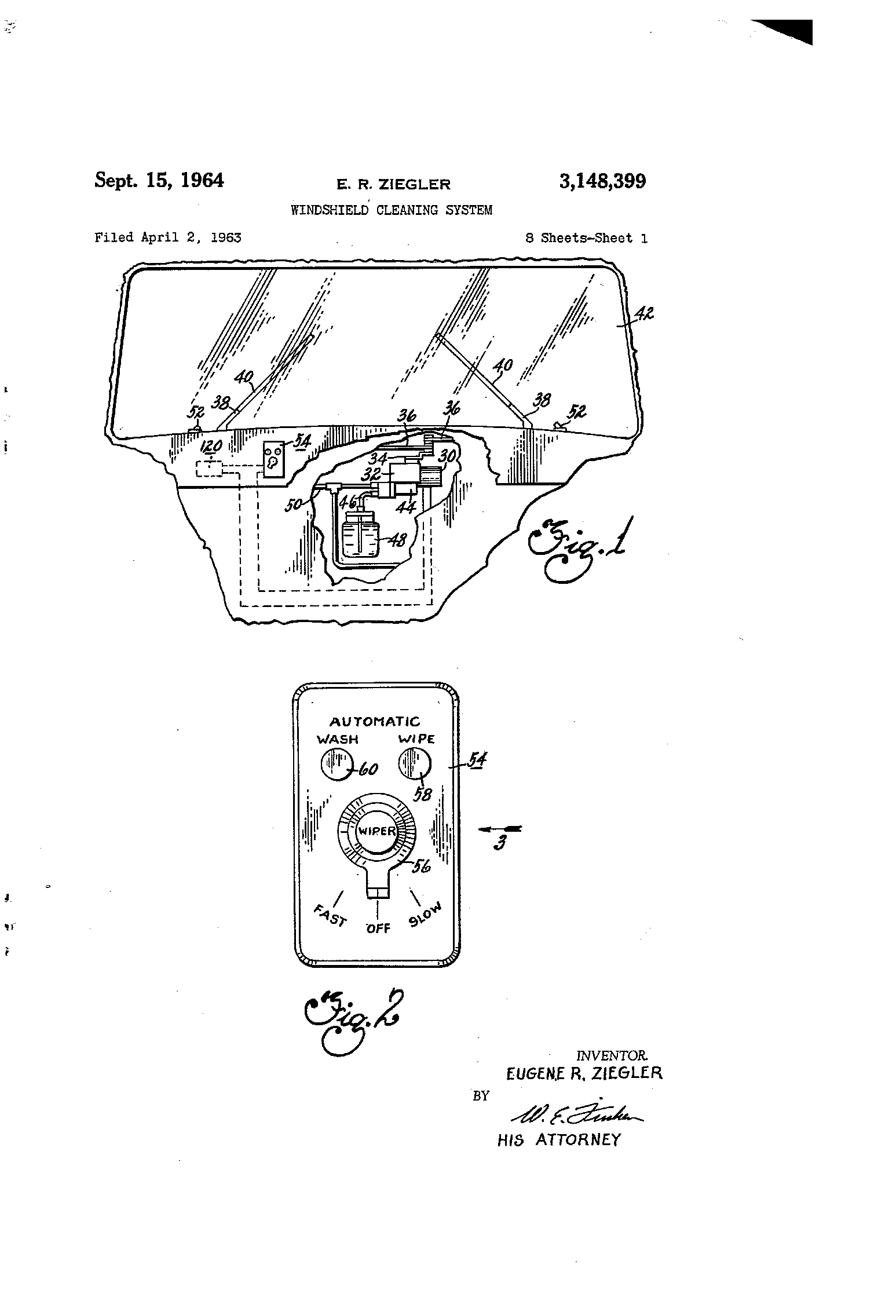
The answer was a wiper that waits between sweeps. That idea was older than Kearns's patent. These are the patented pauses the episode shows, by filing date:
| Filed | Patent | How it paused |
|---|---|---|
| 21 May 1923 | R. Anderson, US 1,588,399 (granted 1926) | A small motor winds a spring, and releases it to swing the wiper "after a predetermined interval of time". |
| 23 Jan. 1958 | Oishei, Horton and others, Trico Products, US 2,987,747 (granted 1961) | "Intermittent cycling" on a strip of metal that bends as it warms (a bimetal time delay). |
| 6 Oct. 1961 | J. C. Amos, Joseph Lucas Ltd., British filing; US 3,262,042 (granted 1966) | A pausing circuit, "particularly suitable for use in light rain or mist". |
| 2 Apr. 1963 | E. R. Ziegler, General Motors, US 3,148,399 (granted 1964) | A switch that responds to heat. Kearns's patent calls that system "erratic and unreliable" (col. 1). |
| 1 Dec. 1964 | R. W. Kearns, US 3,351,836 (granted 1967) | A transistor, a capacitor, and a switch the wiper trips itself. |
So Kearns did not patent the pause. He patented one way of making it: a transistor, a capacitor, and a switch the wiper trips itself (claims 1 and 12).
The patent on the page
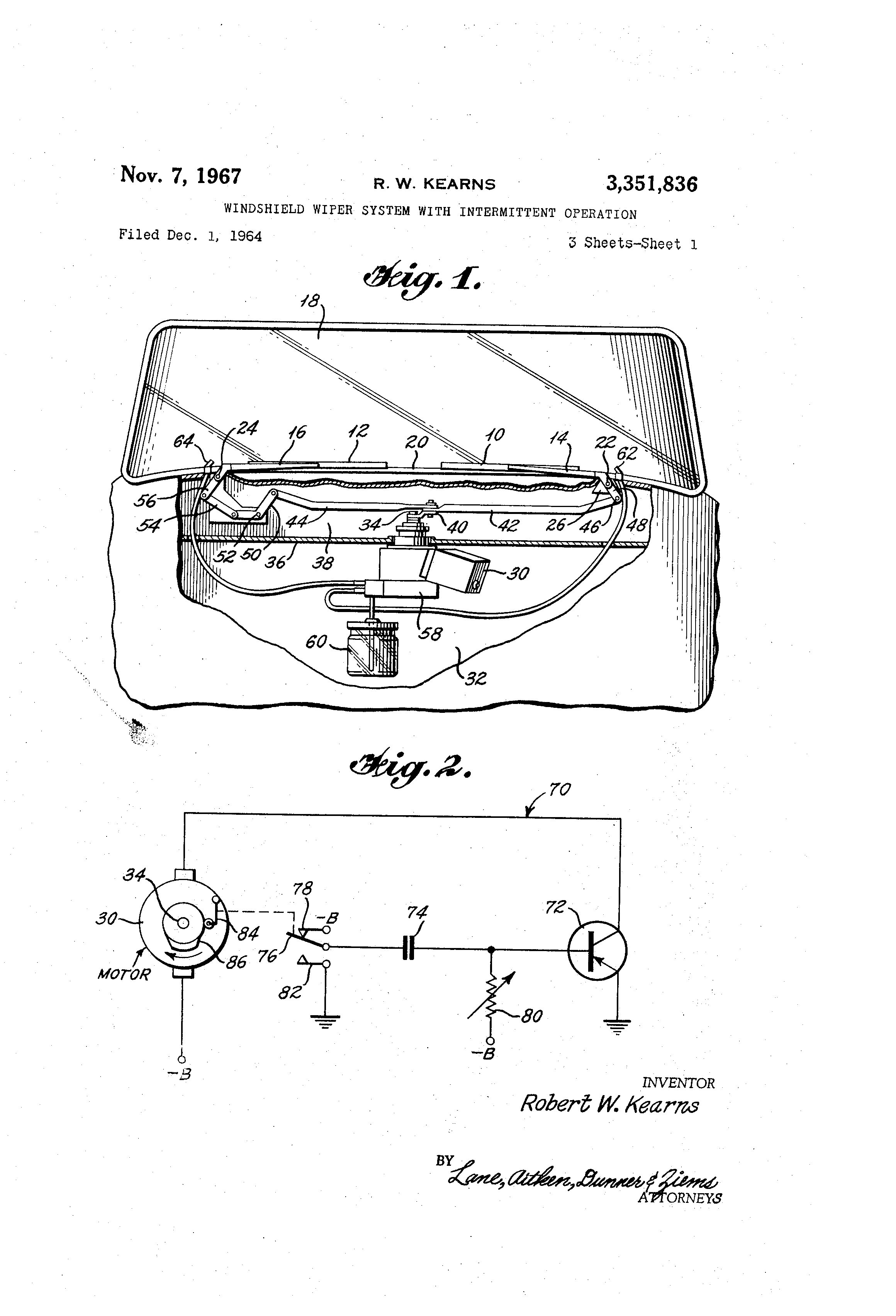
Kearns filed on 1 December 1964. The patent was granted on 7 November 1967, with nineteen claims and three sheets of drawings. By then its rights belonged to the Tann Company of Detroit: Kearns, "assignor, by mesne assignments, to Tann Company, Detroit, Mich., a partnership of Michigan" (front page).
The first figure is the wiper, seen from the front, with the panel below the windshield cut away. The second is the circuit. The text promises more than a timer: a wiper "truly responsive to the condition of the windshield", by "utilizing the drag encountered by the wiper blades" (cols. 1-2). Keep that idea in mind. The patent claims it separately, in claim 4, and no court ruled on it.
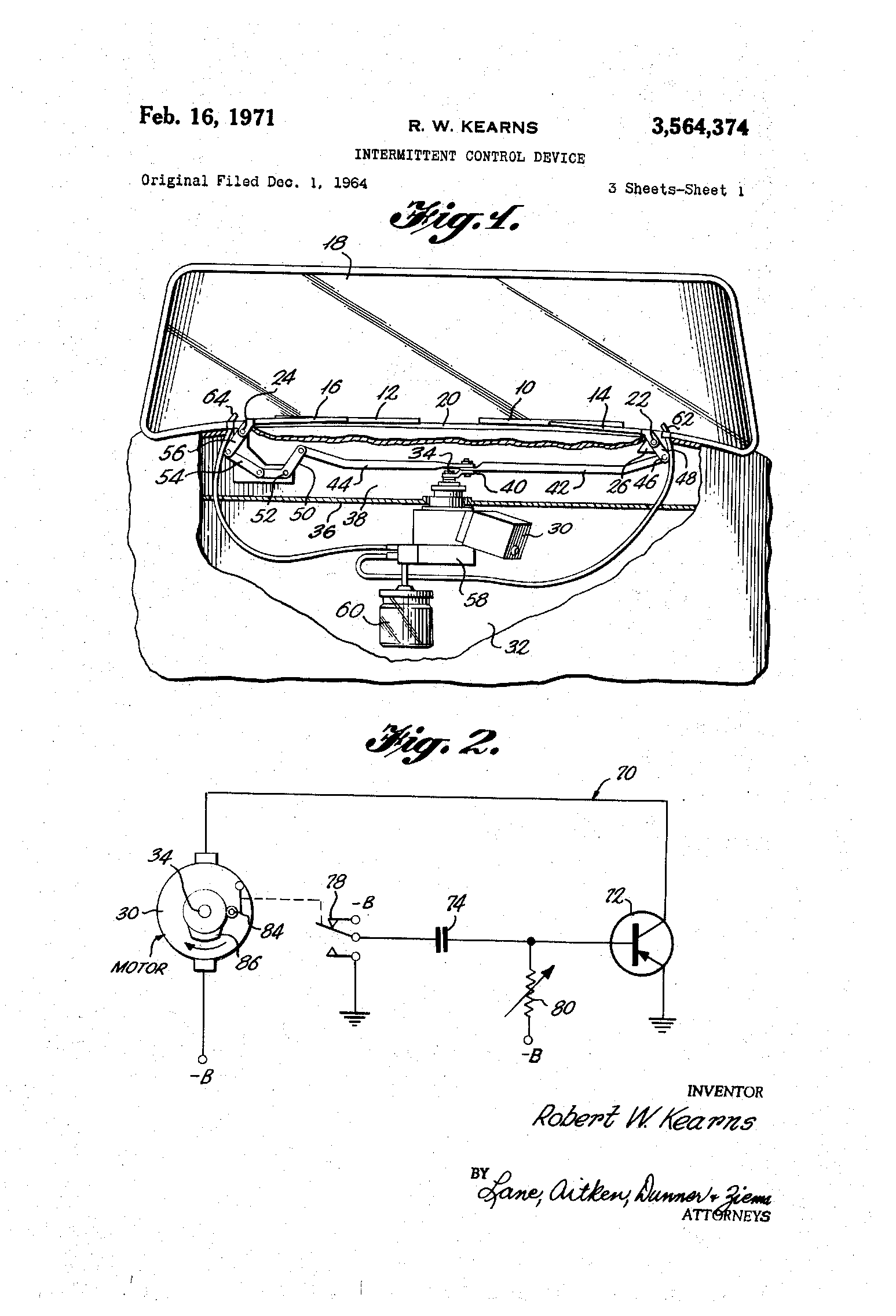
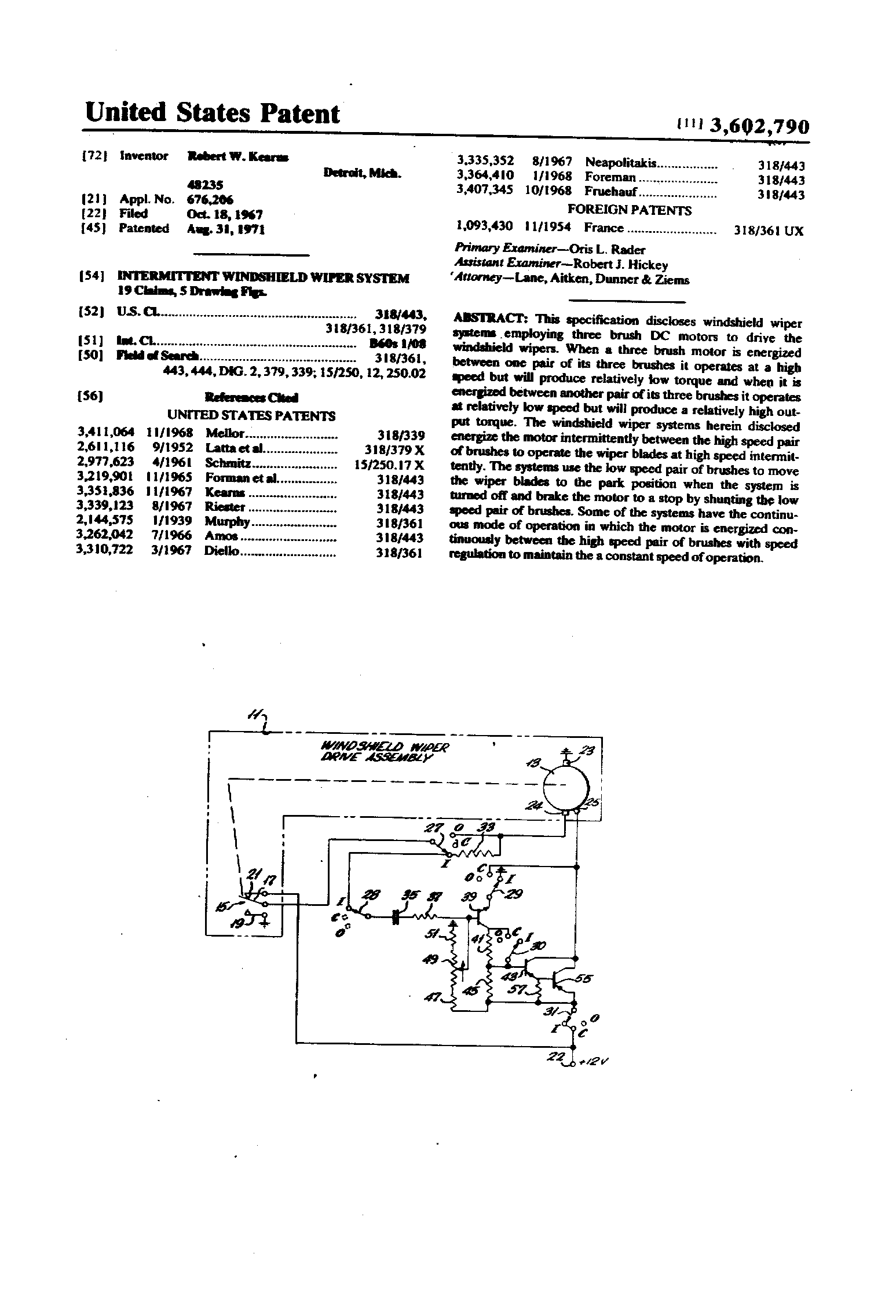
Three more patents came from the same work, all granted in 1971: US 3,564,374 (a division of the 1964 application), 3,602,790 and 3,581,178. These four were the patents Kearns took to court against Ford and Chrysler (Kearns v. Chrysler, which lists all four).
Run the wiper
The wipe (Fig. 1). Under the cowl, motor 30 is fixed to the fire wall 32. Its shaft 34 comes up through the floor 36 of the plenum chamber and turns crank 40. Two links hang from the crank. Link 42 pulls crank 48, on pivot shaft 22. Link 44 goes the other way, to bell crank 50, which passes the motion through link 54 to the other pivot shaft, 24 (col. 4). So one motor drives both arms, and the blades sweep together. One turn of the shaft is one whole wipe, up the glass and back; at full speed, the patent says, that takes "about one second" (cols. 4, 7). Left alone, a wiper like this keeps going, about sixty sweeps a minute, whether the glass needs it or not.
The pause (Fig. 2). The motor is wired to the battery's negative side, −B, and through transistor 72 to ground. The transistor is the switch: it "is ON when its base is negative" (col. 5). The base is pulled negative through variable resistor 80 and joined to capacitor 74, whose other side goes to contact 76, which normally rests on contact 78, at −B. Near the end of the return stroke, cam 86 on the motor's shaft lifts follower 84, which throws contact 76 over to 82, ground (col. 4). That side of the capacitor jumps by the whole battery voltage, and "since the voltage across a capacitor cannot change instantaneously", the other side jumps with it. The base goes positive, the transistor turns off, and the motor loses its power (col. 5).
But the blades do not stop at once. The motor coasts on through a small angle, and the blades drag on the glass as it slows. The cam is only so long. If the blades coast past its end, the follower drops off, the base goes negative, and the motor starts again at once: no pause. That is a wet windshield, where the water lets the blades slide. On glass that is only damp the drag is greater: "The drier the windshield, the greater the rate of deceleration and the sooner the motor stops" (col. 5). Then the blades stop with the follower still on the cam, and the motor waits while the capacitor drains through resistor 80 and the base slides back toward negative. When it gets there the transistor turns on, the motor starts, the follower drops off the cam, and the capacitor charges again for the next stroke. Turn resistor 80, and the capacitor drains faster or slower: the pause "can be set anywhere from one to twenty seconds" (col. 5).
The model stopped with an error in this browser.
From the patent (Figs. 1, 2 and 4; cols. 4-8): the parts and their numbers, the linkage from shaft 34 to pivot shafts 22 and 24, one wipe for each turn of the shaft in "about one second", the circuit of Fig. 2 with transistor 72, capacitor 74, contacts 76, 78 and 82, resistor 80, follower 84 and cam 86, the jump at the trip, the coast, the pause of "one to twenty seconds", and the knob's I, C and O. Ours, because the patent gives none of them: every length and position in the linkage, 12 V for the battery, 470 µF for capacitor 74, 3 to 60 kΩ for resistor 80 (which gives the patent's 1 to 20 s), 0.6 V across the transistor's base, the cam's arc (24°), the drag of the blades (a part that grows with speed and a steady rub that grows as the glass dries, the patent's "viscous" and "Coulomb" friction, with numbers chosen so that wet glass coasts past the cam and damp glass stops on it, which is what the patent says happens), how the speed follows resistor 80 at C, and our formula for the pause, about 0.72 × R × C. Not in the model: the washer pump 58, reservoir 60 and nozzles 62 and 64 of Fig. 1, and brake resistor 94 and resistor 96 of Fig. 3. Current is drawn flowing from + to −. Checked by the episode's own test, run again on this page's copy: 34 checks, all pass (the links keep their lengths, the blades sweep about 97° each and never meet, the base jumps at the trip, the pause on damp glass matches the formula at 1, 5 and 20 s and ends with the follower on the cam, wet glass never pauses, drying glass starts the pauses, the continuous setting never pauses).
The knob
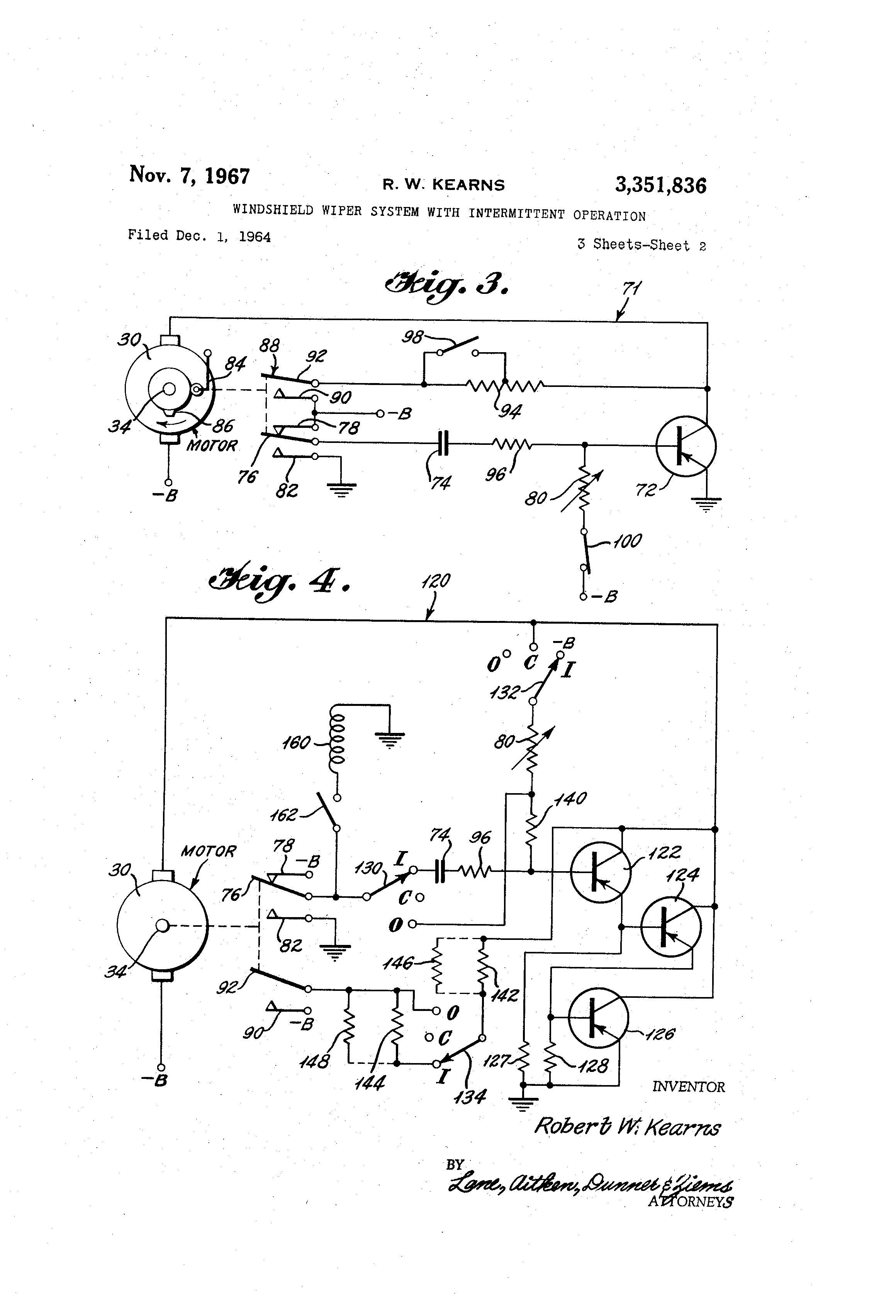
Figure 3 adds a brake resistor, 94. It is switched across the motor as it coasts, so the motor works as a generator and stops sooner. Its value, the patent says, is chosen to work with the drag of the blades: a pause on damp glass, no pause on wet (col. 6). A second resistor, 96, slows the capacitor's charging to about a second, so that "a full wiping cycle occurs under full power" (col. 7).
Figure 4 puts a knob on the dashboard, with three settings: intermittent, continuous and off (cols. 7-8). Turned to continuous, the capacitor is switched out, and the same variable resistor sets the speed of the motor instead of the length of the pause. Try it on the model above: at C the pause slider becomes a speed control.
What the patent leaves out
It gives no values for the capacitor or the resistors, names no type of transistor, and reports no test of the blades on wet and damp glass; the supply is given only as −B, the battery. The physics is stated, not measured: "When the windshield is wet, viscous friction dominates and when the windshield is dry, Coulomb friction dominates" (col. 6). Our model uses exactly that, a drag that grows with speed and a steady rub that grows as the glass dries, with values of our own.
The man and the meetings
No photograph of Kearns is in the public domain or licensed to us, so the episode shows his name as the patent prints it. He grew up in River Rouge, beside Detroit, served in the Office of Strategic Services in the Second World War, and in the 1960s taught engineering at Wayne State University (Baltimore Sun, 1995; Detroit Free Press obituary, 2005; Los Angeles Times, 2008). According to the Sun, he built a laboratory in his basement, and tested his wipers on a dashboard and windshield from a junkyard.
Where the idea came from is told two ways. In 1995 the Sun reported that a champagne cork had hit his eye on his wedding night, and set him thinking about eyelids: "God doesn't have eyelids move continuously. They blink." But in 1993, when a reporter asked him about the cork, he called the story baloney: "Hey, I cold-bloodedly started out to be in business. I set out to manufacture" (Reed Johnson, Los Angeles Times, 2008, recalling that interview). The patent mentions neither. Its reason is the smearing on wet-dry glass.
According to the Sun, in October 1963 he drove to Ford in Dearborn with his control sealed in a red box labelled "Do Not Open". Ford's engineers, the paper says, showed him a Mercury with an intermittent wiper of their own under development, and asked how his worked. He told them. In 1965, it says, they stopped calling. In 1969 Ford put an electronic intermittent wiper on the market (Baltimore Sun, 1995; Invention & Technology, 2007). In 1976 one of his sons brought home a Mercedes wiper control. Kearns took it apart. "It was a copy," he told the Sun.
We have found no record of the Ford meetings except what newspapers and magazines reported decades later. The court opinion we read does not describe them.
Ford, 1978 to 1990
On 3 April 1978 Kearns sued Ford in the federal court in Detroit: Kearns v. Ford Motor Co., Case No. 78-70740, Eastern District of Michigan, Judge Avern Cohn (the court's historical society). The case took twelve years to reach a jury; the trial began on 3 January 1990. On 29 January the jury found unanimously that Ford "had not proved by clear and convincing evidence" that claim 16 of the '836 patent, claim 6 of the '374, claim 14 of the '790 and claim 6 of the '178 were invalid or unenforceable. On 9 March the judge entered partial judgment that those claims were "valid, enforceable, and infringed by Ford".
That July a second jury set damages at $5,163,842 ≈ $13 million in today's money, for Ford's sales from 3 April 1978 through 1988. Then the two sides settled. The appeals court's opinion gives no figure. Newspapers reported that Ford paid $10.2 million ≈ $25 million, "slightly more than 50 cents" for each of 20.2 million cars (Deseret News, 19 June 1992; Tampa Bay Times, 15 November 1990; Baltimore Sun, 1995).
Ford withdrew its pending motions and "waived its appellate rights". That detail mattered later. Ford had fought the patents' validity in front of a jury, and lost. As Judge Cohn put it: "I know that I entered a Partial Judgment of Validity, after a hotly contested trial. … Validity was contested. Kearns won, Ford lost and it chose not to appeal, and it withdrew its Motions JNOV or New Trial" (Kearns v. Chrysler, n. 6).
Chrysler, 1982 to 1995
Kearns had sued Chrysler in 1982. On 22 October 1982 that case was put on hold, and Chrysler agreed to be bound by the Ford case on whether the patents were valid: "bound by the judgment (excluding a consent judgment) in the Kearns v. Ford case … as to the validity and enforceability of the patents involved in that action" (the stipulation, entered 15 February 1990). After Ford settled, Chrysler argued that the Ford judgment was a consent judgment. The court said no: validity had been fought out in front of the jury, not agreed. "Public policy," the appeals court wrote, "will not rescue Chrysler from a decision which it later finds to be imprudently made."
So Chrysler "was barred under the stipulation from introducing prior art evidence". Its jury heard no evidence about earlier wipers. It was asked only whether Chrysler's 1977 and 1980 circuits came within Kearns's claims. On 10 December 1991 it found that they did. On 11 June 1992 it found the infringement not wilful, and set a reasonable royalty of 90 cents a unit on 12,564,107 units (the court later revised the count to 12,563,107). Kearns had asked for $29.19 a car, a wire report said; Chrysler's lawyers had argued for 5 cents a car (Deseret News, 19 June 1992). With prejudgment interest and costs, less costs and fees awarded to Chrysler, the judgment came to $18,740,465.43 ≈ $43 million (n. 4).
By then Kearns had dismissed his lawyers (in March 1992, the Sun reported), and he argued the appeal himself: the opinion lists "Robert W. Kearns, pro se". On 11 August 1994 the Federal Circuit wrote: "We affirm the judgment in all respects." In March 1995, the Baltimore Sun reported, the Supreme Court let it stand (certiorari denied, 514 U.S. 1032).
What the courts decided, and what they did not
So what did the courts say Kearns owned? Not the pause itself. The claims of four patents, as written, against the circuits Ford and Chrysler built.
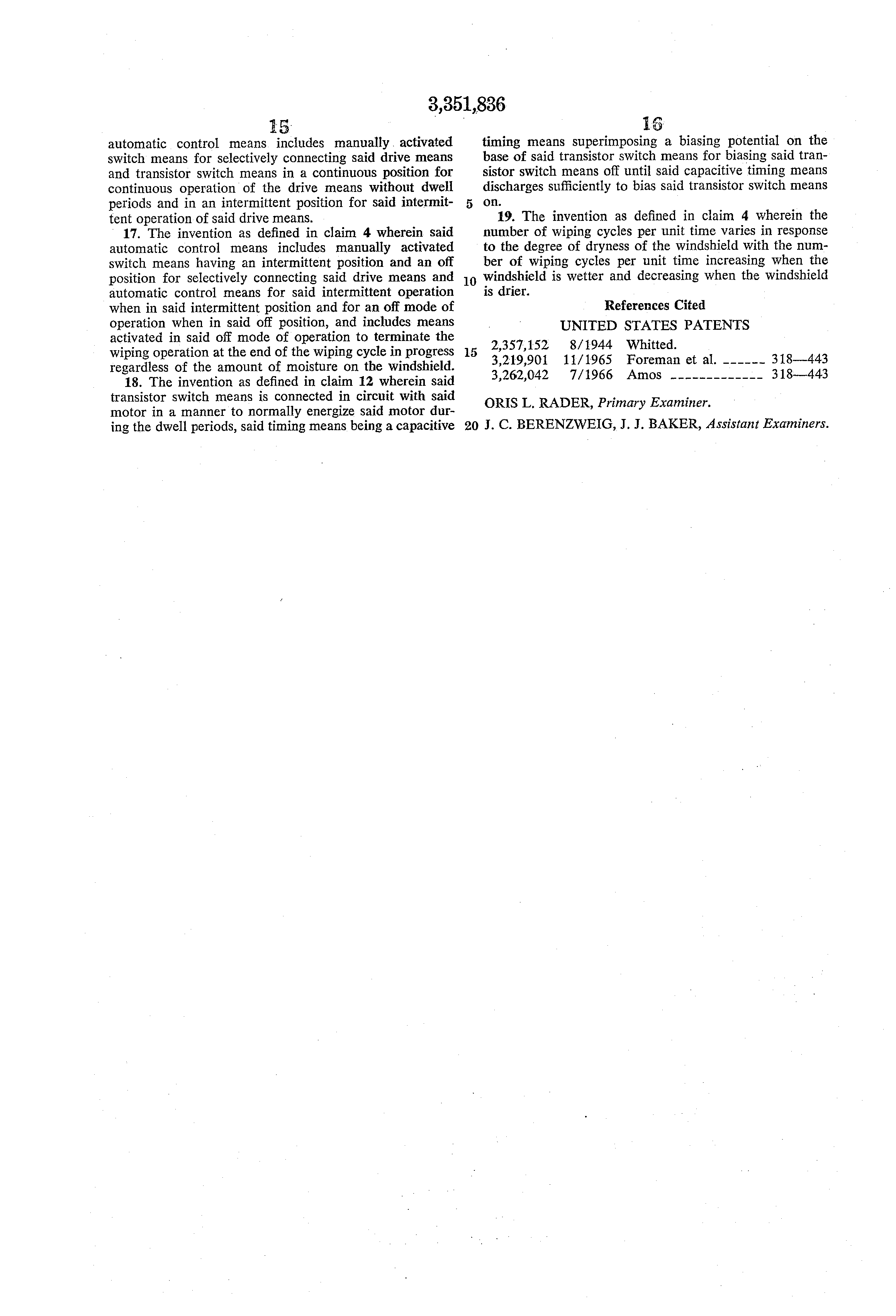
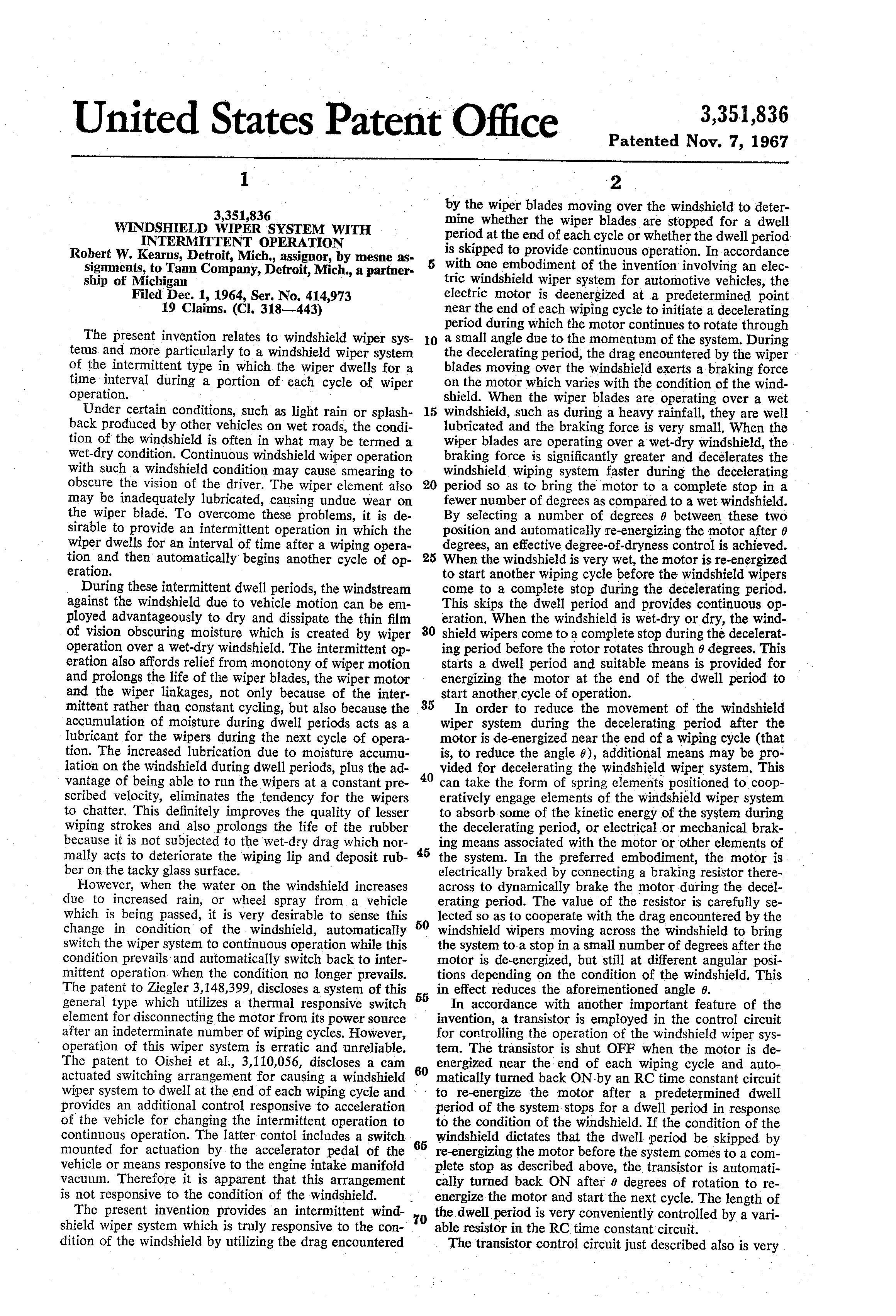
The claim of this patent that went to the juries was claim 16: the Ford verdict names it (the opinion's account of the Chrysler verdict names claim 12 in one place and claim 16 in another). Claim 16 adds a knob to claim 12. Together they cover a transistor switch, a timer for the pause, a switch worked by the position of the wiper, and a knob with "a continuous position" and "an intermittent position" (cols. 14-15). They say nothing about the dryness of the glass. The patent claims that idea separately, in claim 4, and no court named claim 4.
The claims are written as means for doing things. To infringe, "an accused device must (1) perform the identical function recited in the means limitation and (2) perform that function using the structure disclosed in the specification or an equivalent structure" (n. 8, quoting Carroll Touch v. Electro Mechanical Systems, 1994).
The appeals court saw what that left him: "We sympathize with Kearns' complaint that his patents have expired without his ever being able to exclude others from practice of his invention, especially since he is an individual inventor contending with a multitude of giant corporations." The '836 patent had expired in 1984, before either trial (n. 10). So the court would not stop Chrysler making the wipers: "Granting the relief requested by Kearns would impermissibly extend the statutory term beyond that established by Congress." Nor would it give him the profits of a wiper business. His plans to make wipers, the trial judge had found, were "tentative, speculative and contingent".
What no court decided
- Who first made a wiper that pauses. Ford's attack on validity failed, and Chrysler's was never heard: it was barred by its own stipulation.
- The dryness idea. The drag of the blades telling the circuit how wet the glass is, claim 4, was never named by a court. The claim the juries heard, claim 16, says nothing about it.
- What happened at Ford in the 1960s. That story rests on interviews and articles decades later.
After
Kearns went on to sue General Motors and other carmakers; the appeals court's footnote names General Motors, Toyota, Ferrari and American Motors (n. 1), and his obituary says "more than 20 other manufacturers". Those cases he lost. By one account, several were dismissed after he missed filing deadlines (Invention & Technology, 2007). He died on 9 February 2005, aged 77 (Detroit Free Press obituary).
"He was feisty, determined, and he established the fact that he made a contribution to the auto industry that was unique, and he was frustrated because he wanted to be a manufacturer."
That was Avern Cohn, the judge in both his Ford and Chrysler cases, in the Detroit Free Press obituary (February 2005).
Today the pause is an ordinary setting. A current owner's manual says: "When intermittent windshield wiper operation is selected, the wiper interval can be also adjusted" (Toyota, 2025 Tacoma Owner's Manual, OM04011U). What the courts upheld was one way to make that pause: a transistor, a timer, and a switch the wiper trips itself.
Next episode, Tuesday 10 November: the first United States patent, signed by George Washington in 1790, and why it is not patent number one; and the fire of 1836 that burned the Patent Office.
Read the original patents
All are US patents of 1903 to 1971, in the public domain. Click a page for full resolution; drawing sheets come first, then the specification. On the front pages of US 3,602,790 and 3,581,178 we have blanked the inventor's street address, as on our other pages; those two are linked to Google Patents rather than copied here.
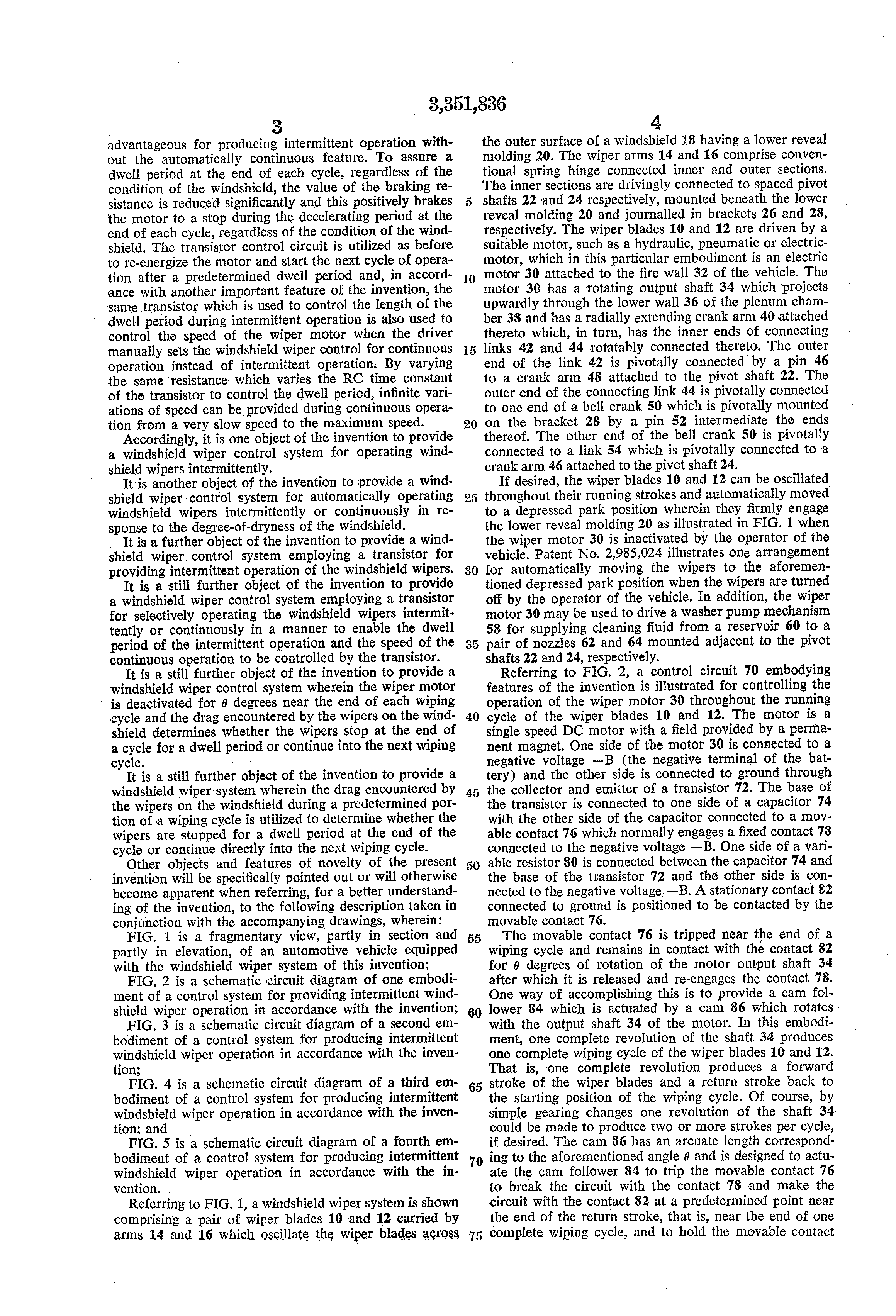
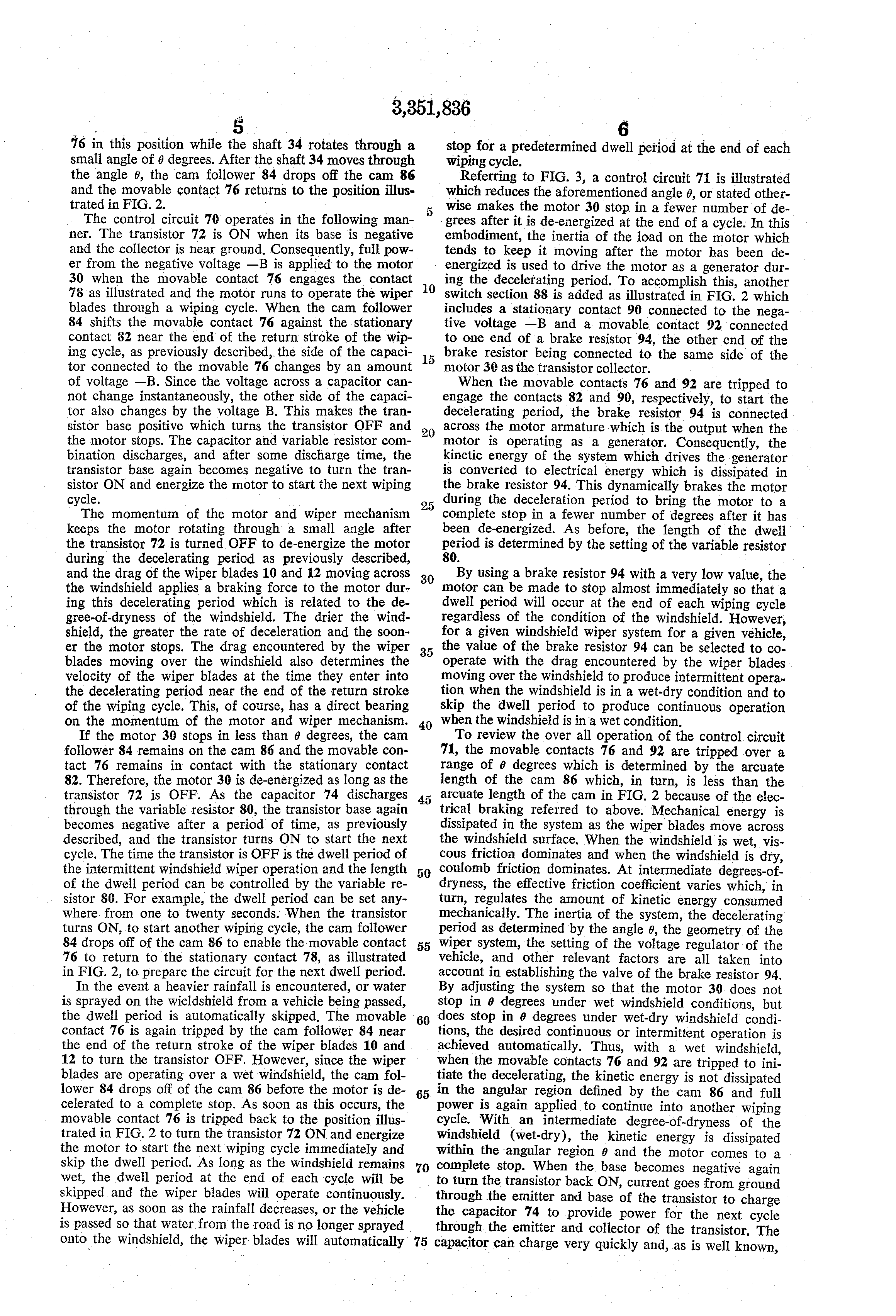
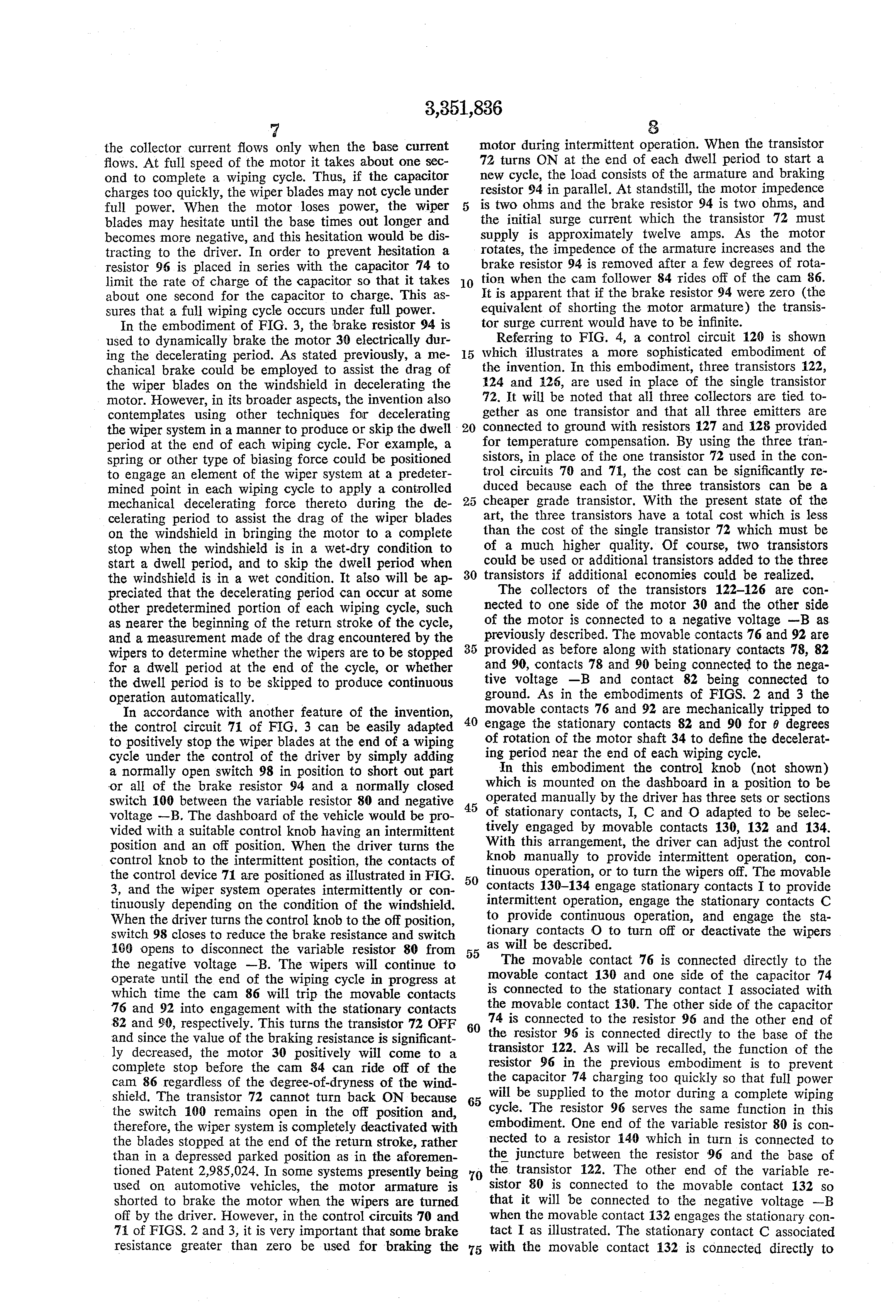
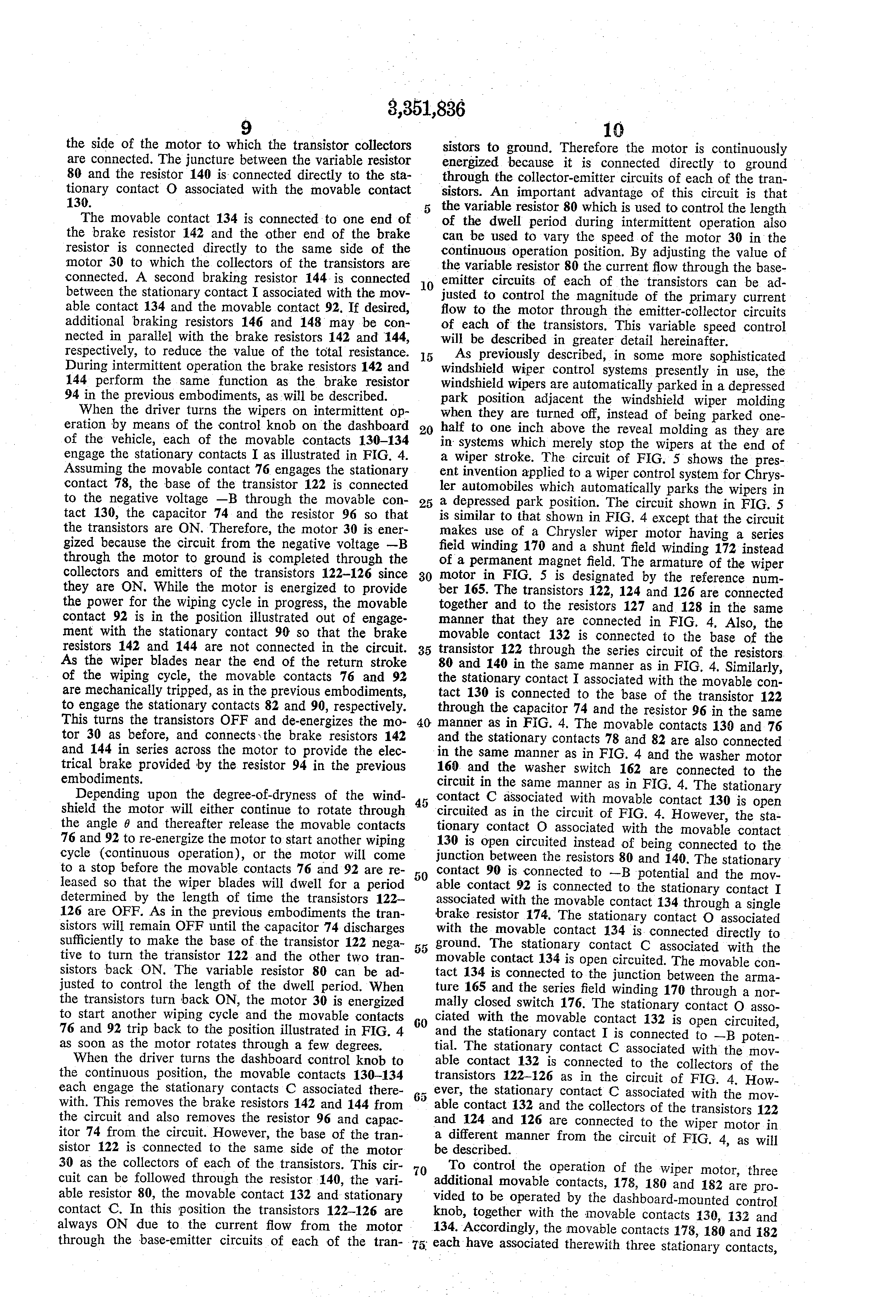
US 3,351,836, Robert W. Kearns, Windshield Wiper System with Intermittent Operation, filed 1 December 1964, granted 7 November 1967
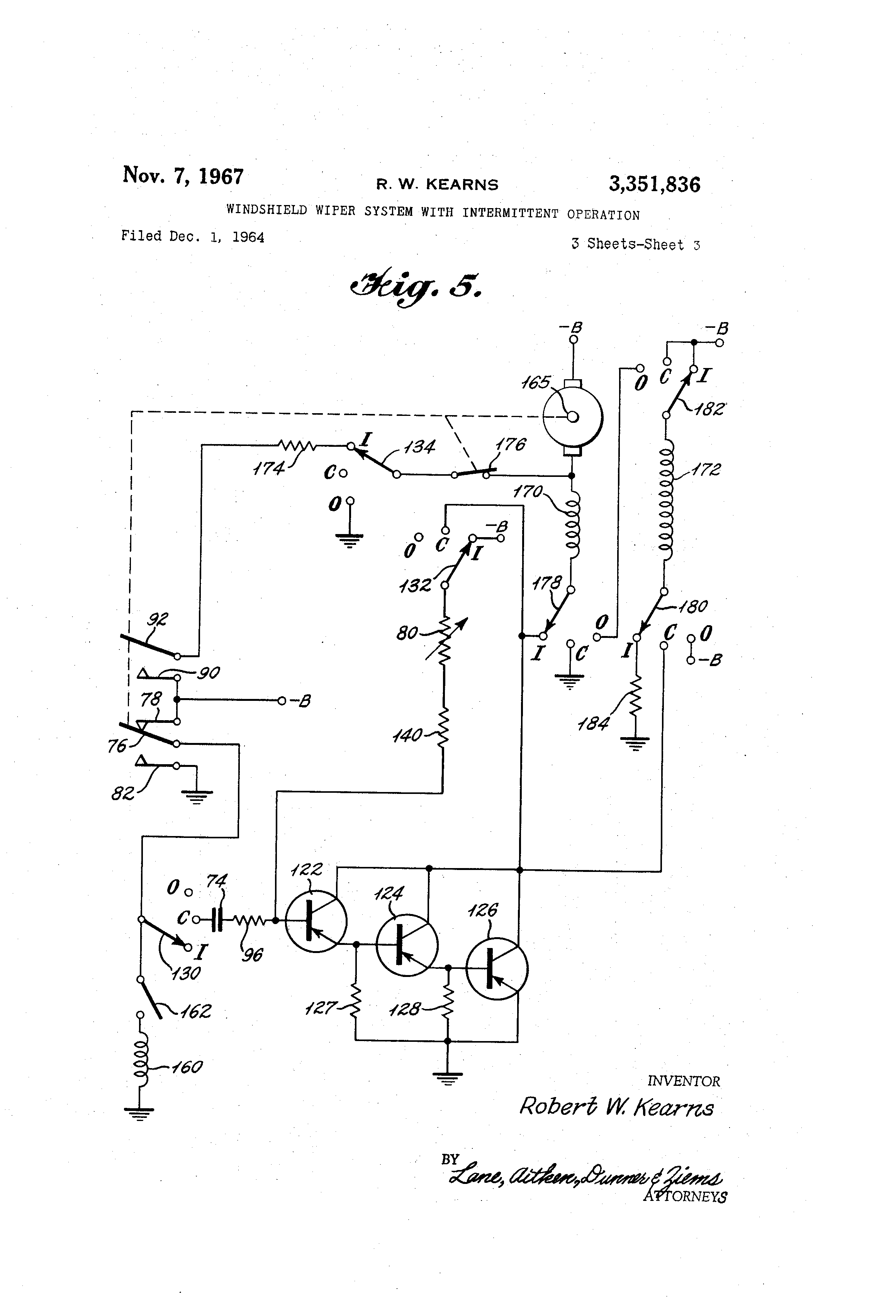
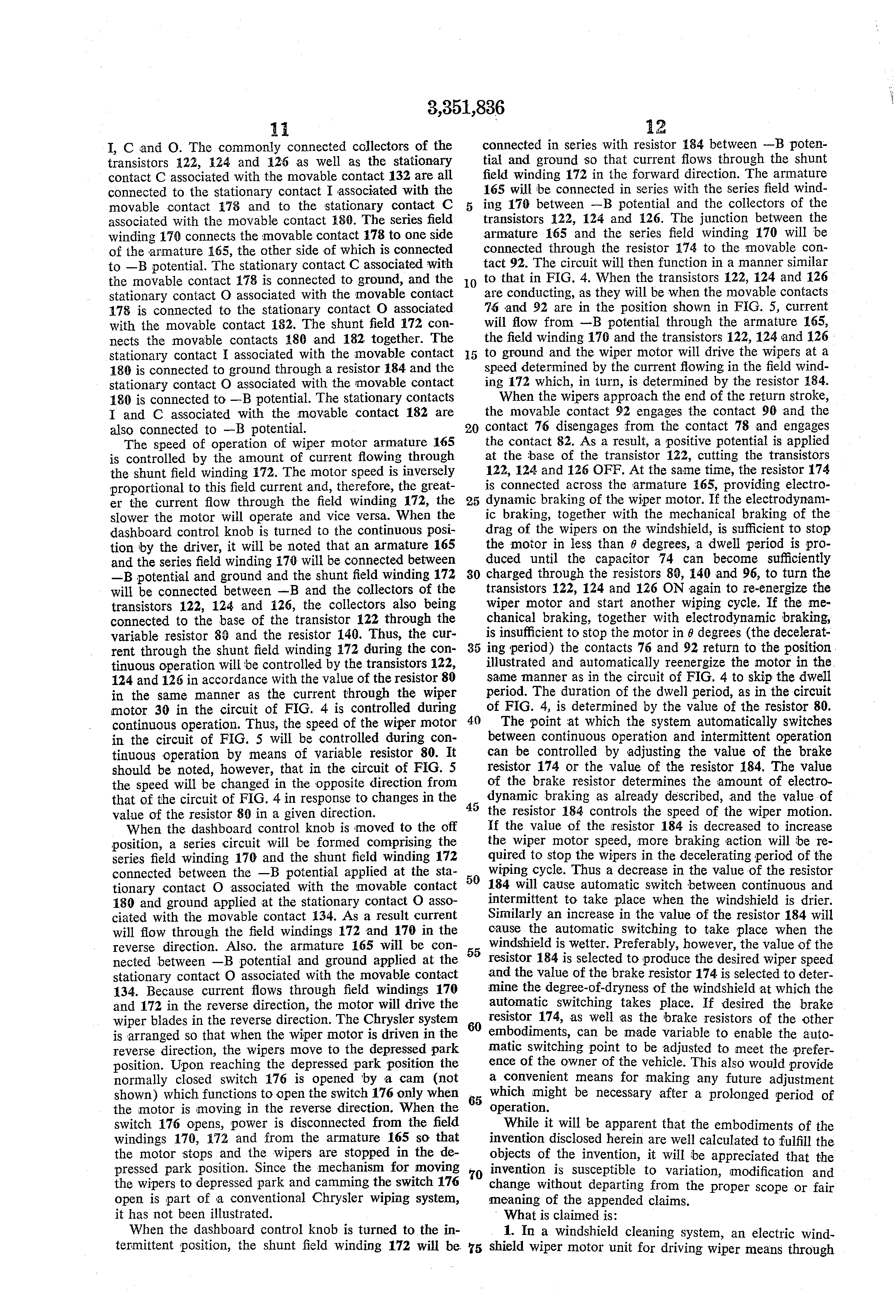
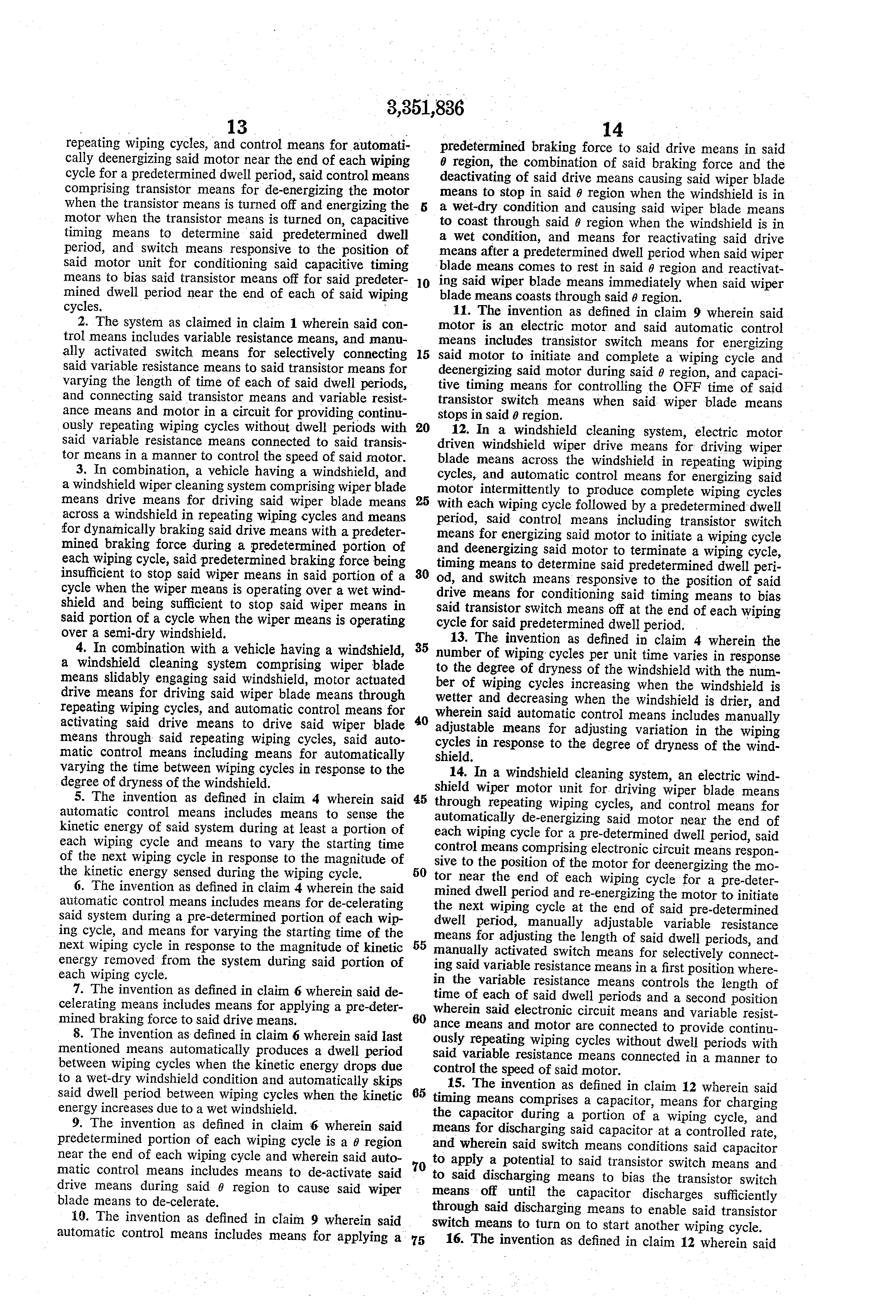
The three other patents in the suits, all granted in 1971
The pauses before Kearns
Sources
Every fact on this page comes from these, as in the episode. Where a fact rests on a newspaper or magazine rather than a court record or a patent, the text says whose account it is.
Patents (US, public domain; page scans from Google Patents' image store)
- R. W. Kearns, US 3,351,836 (filed 1 December 1964, granted 7 November 1967; 19 claims, three sheets): the assignment to the Tann Company (front page); the wet-dry condition and the smearing, the earlier systems, "erratic and unreliable", "truly responsive", "the drag encountered by the wiper blades" (cols. 1-2); the linkage of Fig. 1 and the cam (col. 4); "is ON when its base is negative", "cannot change instantaneously", the coast, "The drier the windshield …", "one to twenty seconds" (col. 5); brake resistor 94, viscous and Coulomb friction (col. 6); "about one second", resistor 96, the knob (cols. 7-8); claims 1, 4, 12 and 16 (cols. 13-15).
- R. W. Kearns, US 3,564,374 (16 February 1971, a division of the 1964 application), US 3,602,790 (31 August 1971) and US 3,581,178 (25 May 1971).
- The earlier pauses: R. Anderson, US 1,588,399 (filed 1923); Oishei, Horton and others, Trico Products, US 2,987,747 (filed 1958); J. C. Amos, Joseph Lucas Ltd., US 3,262,042 (British priority 1961); E. R. Ziegler, General Motors, US 3,148,399 (filed 1963). M. Anderson, US 743,801 (1903), the sheet from Wikimedia Commons.
The court record
- Kearns v. Chrysler Corp., 32 F.3d 1541 (Fed. Cir. 11 August 1994), text from the Caselaw Access Project: the four patents; the Ford litigation (the verdict of 29 January 1990, the partial judgment of 9 March 1990, the second damages jury, the settlement and the waiver); n. 6 (Judge Cohn); the stay and the stipulation; "Public policy will not rescue Chrysler …"; the bar on prior art; the verdicts of 10 December 1991 and 11 June 1992, the royalty and the units; the judgment and n. 4; "Robert W. Kearns, pro se"; "We affirm the judgment in all respects"; "never enjoyed an exclusive status"; "We sympathize …"; the expiry (n. 10) and the injunction; lost profits; n. 1 (the later suits); nn. 7-8 (means-plus-function).
- Docket, Kearns v. Ford Motor Co., No. 78-70740 (E.D. Mich.), filed 3 April 1978, Judge Avern Cohn: Historical Society for the U.S. District Court, E.D. Mich.
Newspapers, magazines and a manual
- Alec Matthew Klein, "Millions of dollars can't wipe away pain", Baltimore Sun, 26 March 1995: River Rouge, Wayne State, the basement laboratory, the cork, the red box and the Ford meetings, 1965 and 1969, the Mercedes control, the lawyers dismissed in March 1992, the Supreme Court in March 1995, the Ford settlement as reported.
- Reed Johnson, "The cantankerous man behind the wipers", Los Angeles Times, 3 October 2008: the 1993 interview, "baloney", "I set out to manufacture".
- Curt Wohleber, "The Windshield Wiper", Invention & Technology 23:1 (2007): hand, vacuum and electric wipers; the red box; 1969; the missed deadlines.
- "Inventor of intermittent wipers wins again", Deseret News, 19 June 1992: the Ford settlement and "slightly more than 50 cents" a car on 20.2 million cars; the per-car royalties Kearns asked for and Chrysler argued for.
- Tampa Bay Times, 15 November 1990: the Ford settlement (we could read only the headline and first sentence; the rest is behind a paywall).
- Detroit Free Press obituary, as printed in The Press Democrat, 26 February 2005: the OSS, his death on 9 February 2005 at 77, "more than 20 other manufacturers", Judge Cohn's words.
- Toyota, 2025 Tacoma Owner's Manual (OM04011U), "Windshield wipers and washer".
- Today's money: US consumer prices, Federal Reserve Bank of Minneapolis, "Consumer Price Index, 1800-", 2025 as today, rounded to two figures. Per-car figures are not converted.