 Curious Patents
Antigravity, Granted
In 1971 the US Patent Office granted a patent for a spinning brass wheel, with the claim that things inside its field would lose their weight. In 2005 it granted a second, for a spaceship driven by bending spacetime, and in 2018 a third went to the United States Navy. Work the 1971 test rig and open up the two craft as their patents describe them, read all three patents and the Navy's own test reports, and see every source. Nothing on this page says any of these devices works.
Watch the episode
Three grants
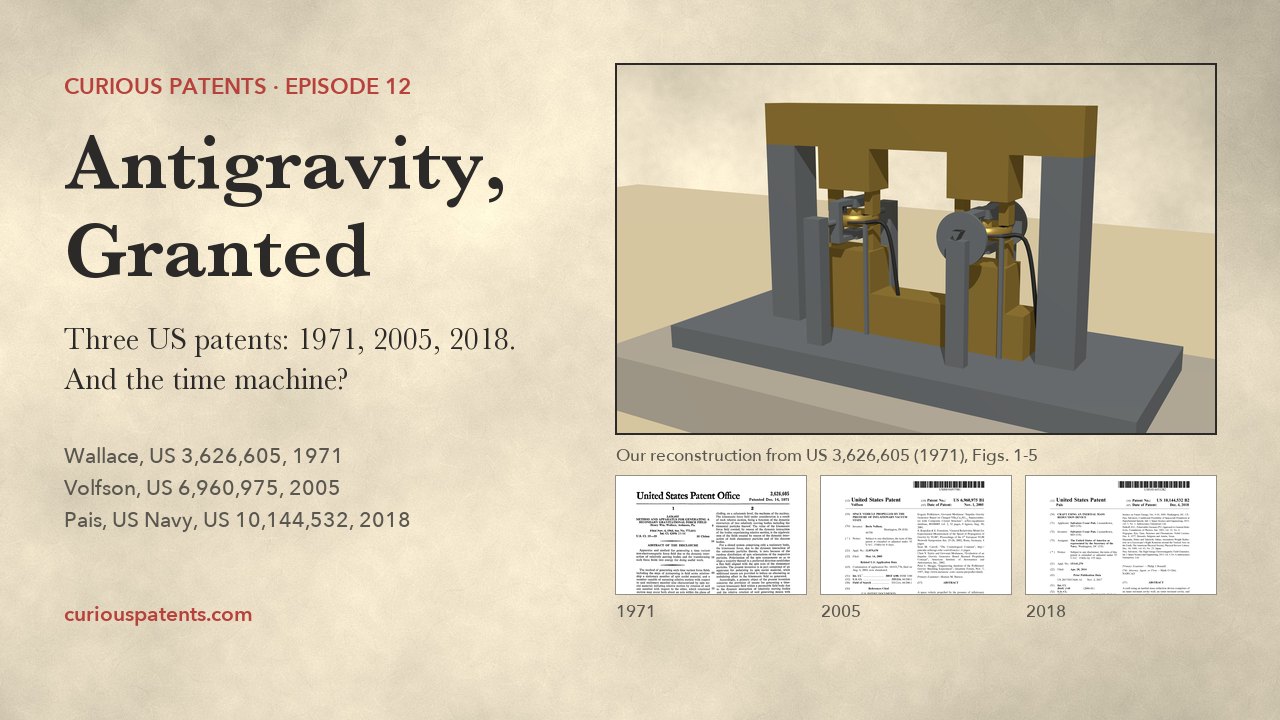
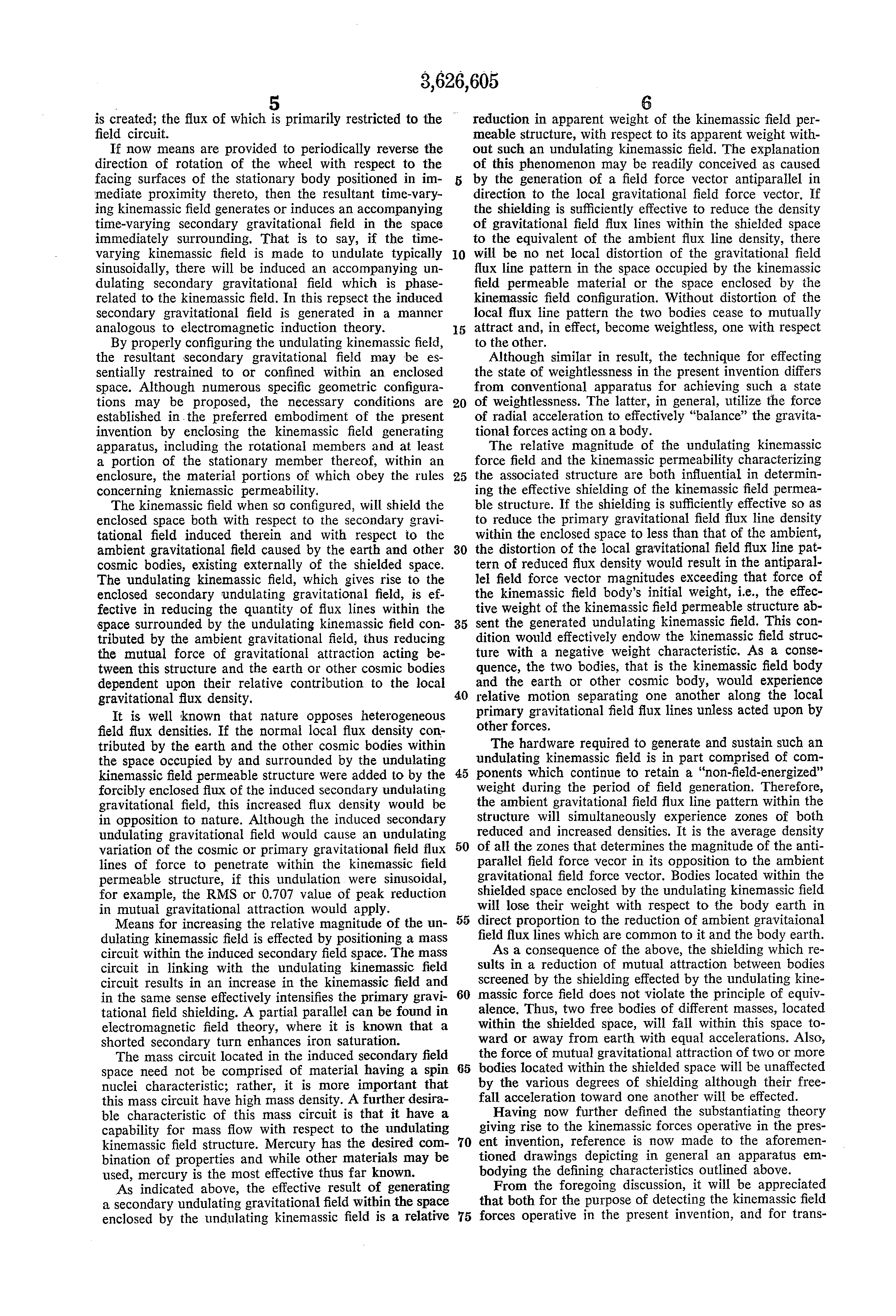
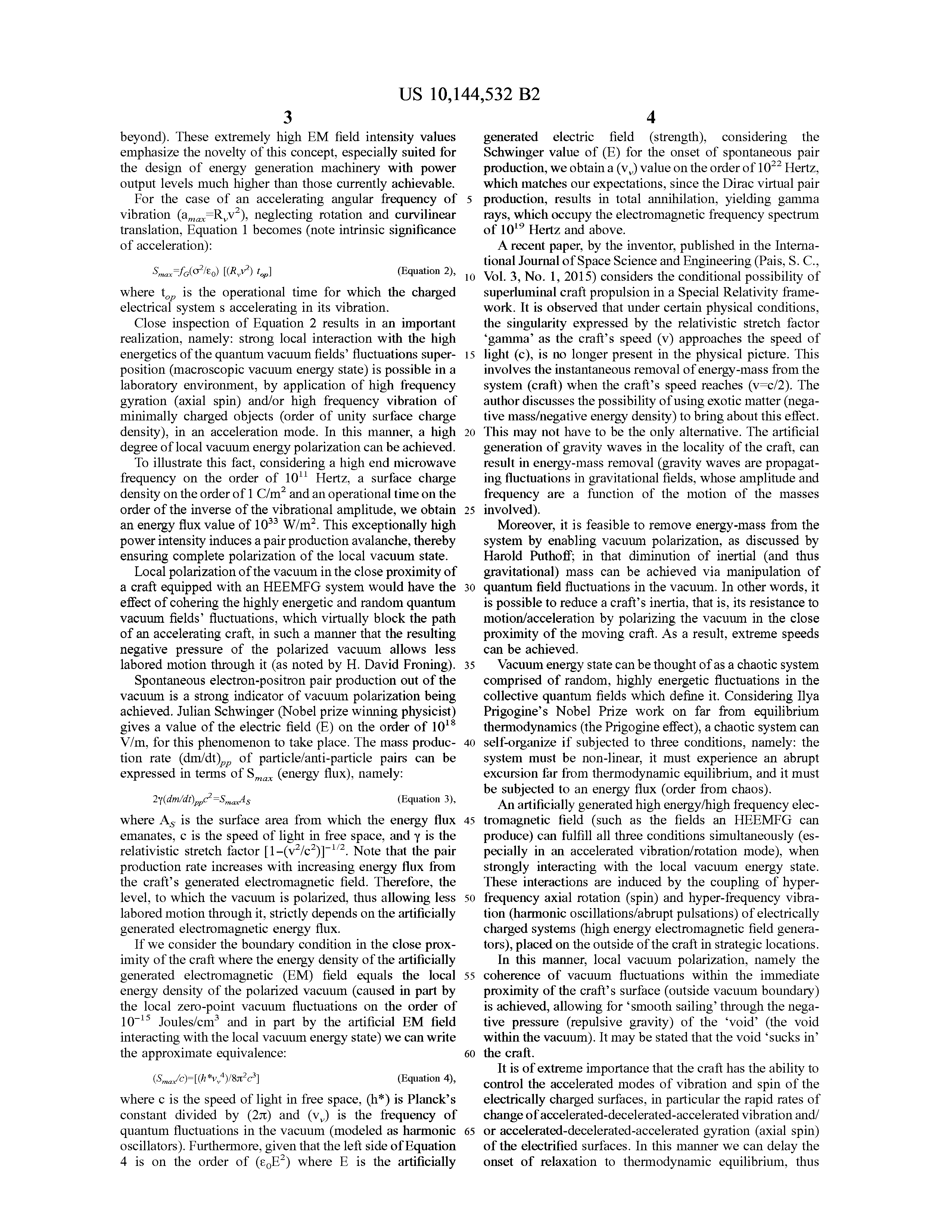
Henry Wallace's patent, granted on 14 December 1971, is for a spinning brass wheel. Things inside its field, it says, "will lose their weight with respect to the body earth" (US 3,626,605, col. 6). Boris Volfson's, granted on 1 November 2005, is for a "space vehicle propelled by the pressure of inflationary vacuum state": a ship moved by bending spacetime (US 6,960,975). The third, granted on 4 December 2018, went to the United States Navy: a "craft using an inertial mass reduction device", by a Navy engineer, Salvatore Pais (US 10,144,532).
How did three patents for antigravity get through? And what did the Navy find when it tested the idea behind its own? This page follows the episode: what each patent says, what was measured, and what the Navy's own reports found, with the three machines rebuilt as their patents describe them.
A time machine?
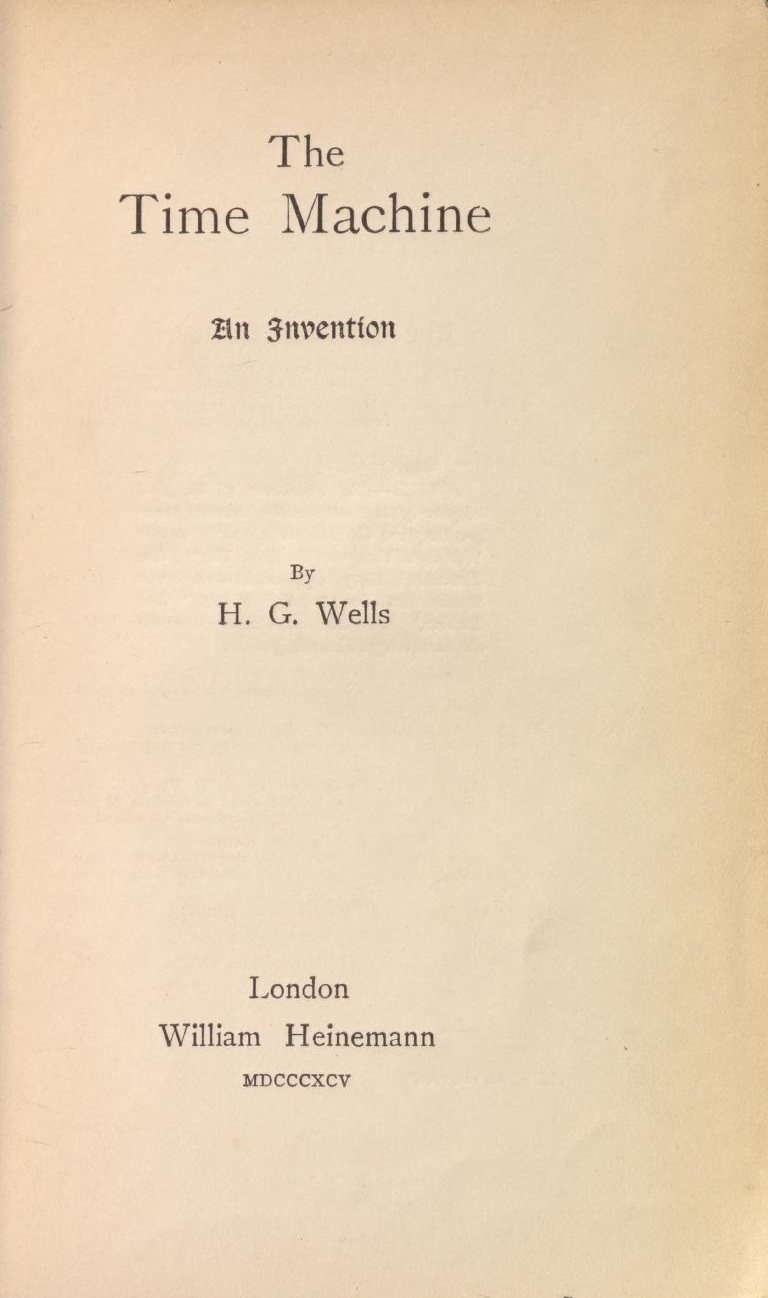
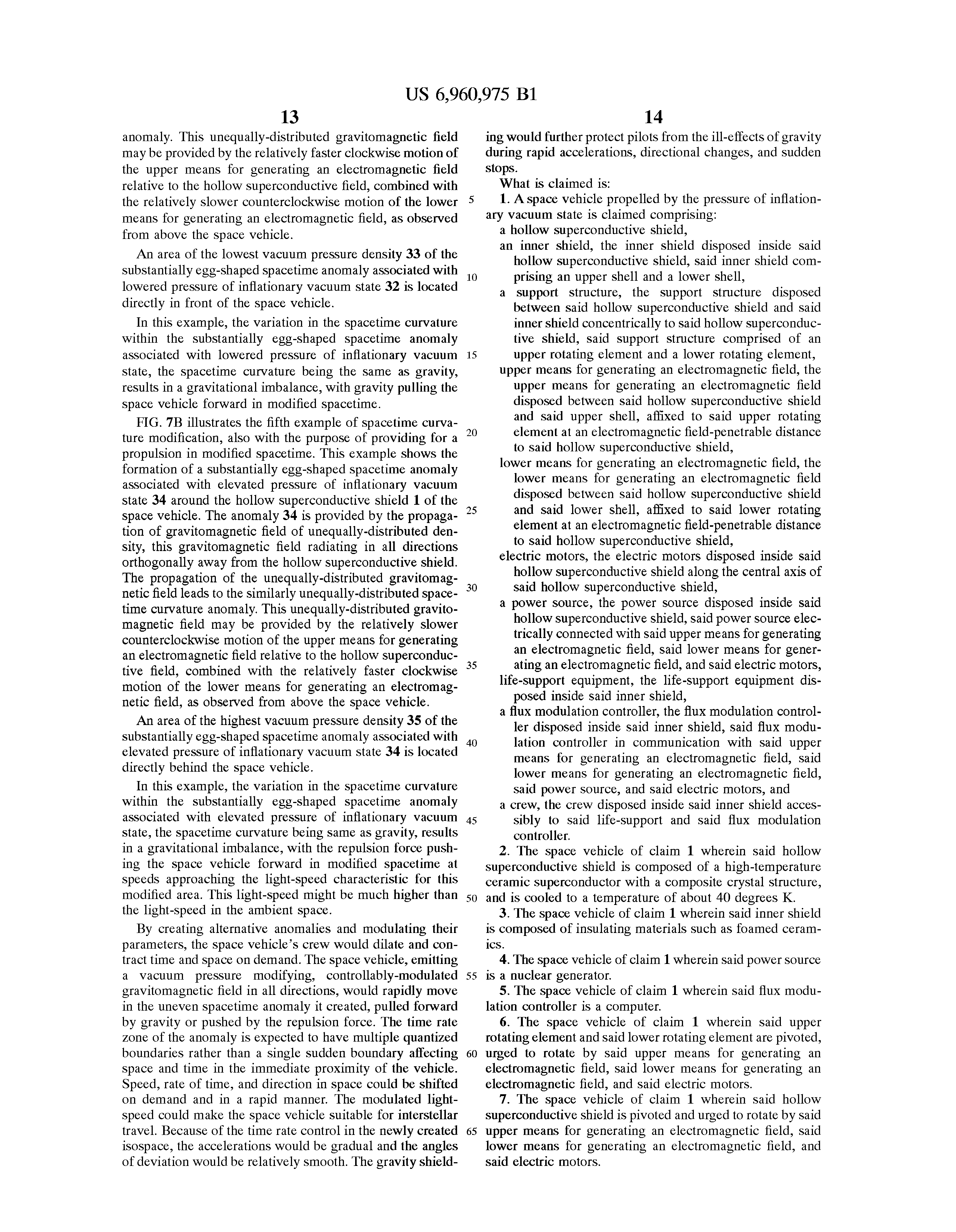
The 2005 patent goes beyond gravity. Its crew, it says, could shift "Speed, rate of time, and direction in Space ... on demand" (US 6,960,975, col. 14), and "would dilate and contract time and Space on demand" (col. 13).
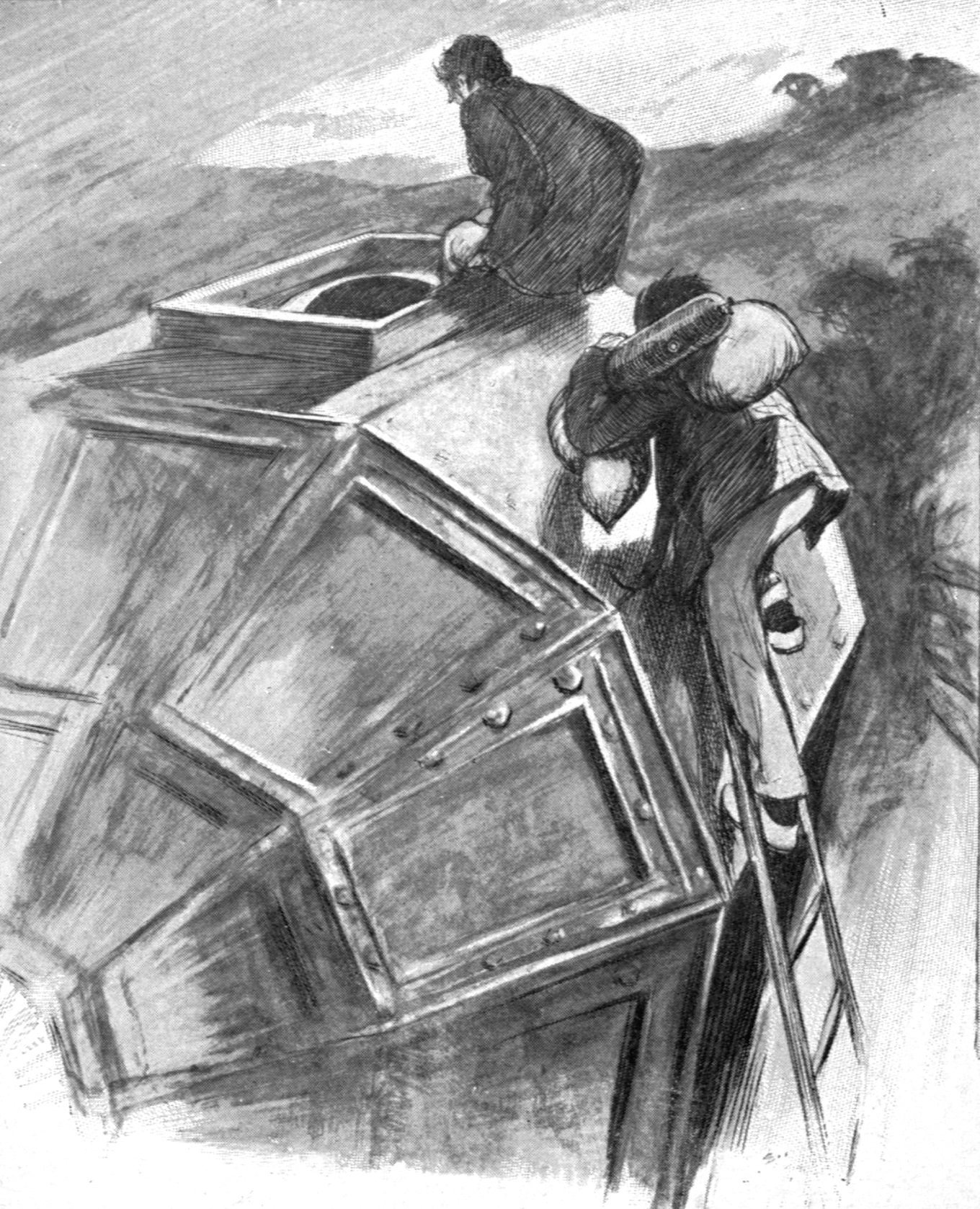
Time really can run at different rates. Einstein's relativity predicts it (1905), and in 1971 atomic clocks flown around the world came back out from the ones left behind at the US Naval Observatory: 59 billionths of a second behind after the eastward trip, 273 billionths ahead after the westward one (Hafele and Keating, Science, 1972). That is not time travel, not the kind H. G. Wells wrote about in 1895. But Wells also wrote about a substance that blocks gravity, "cavorite", in The First Men in the Moon (1901), and the 2005 patent names it.
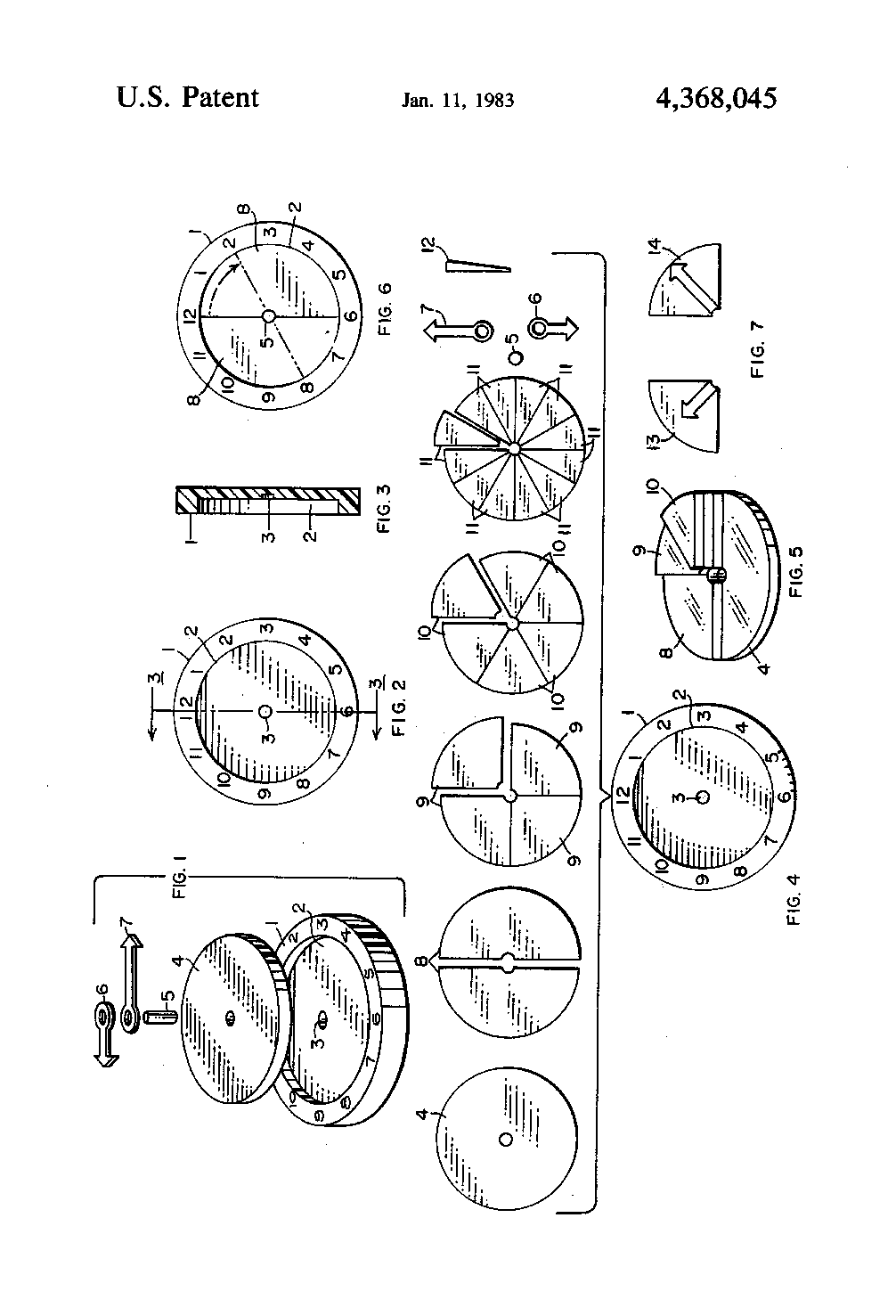
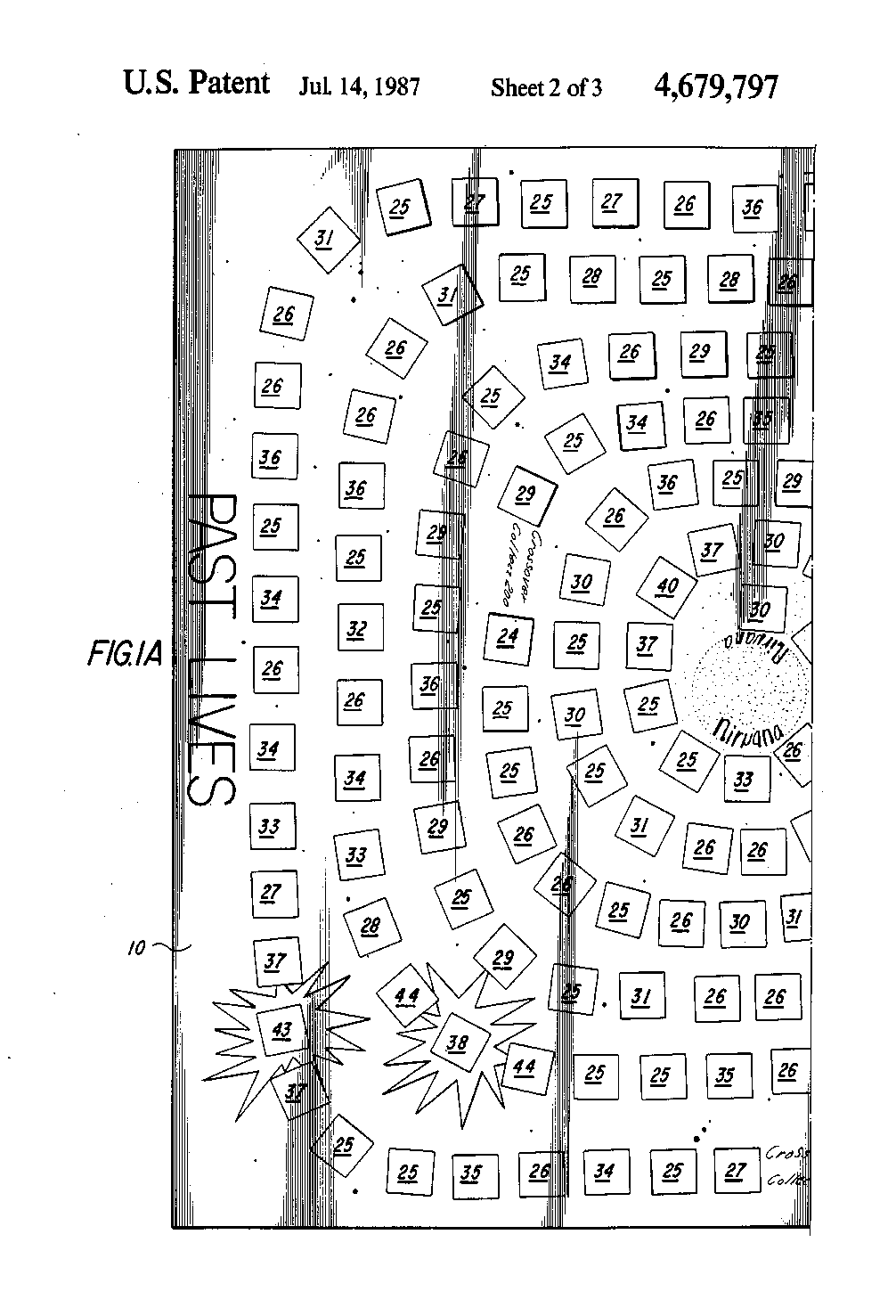
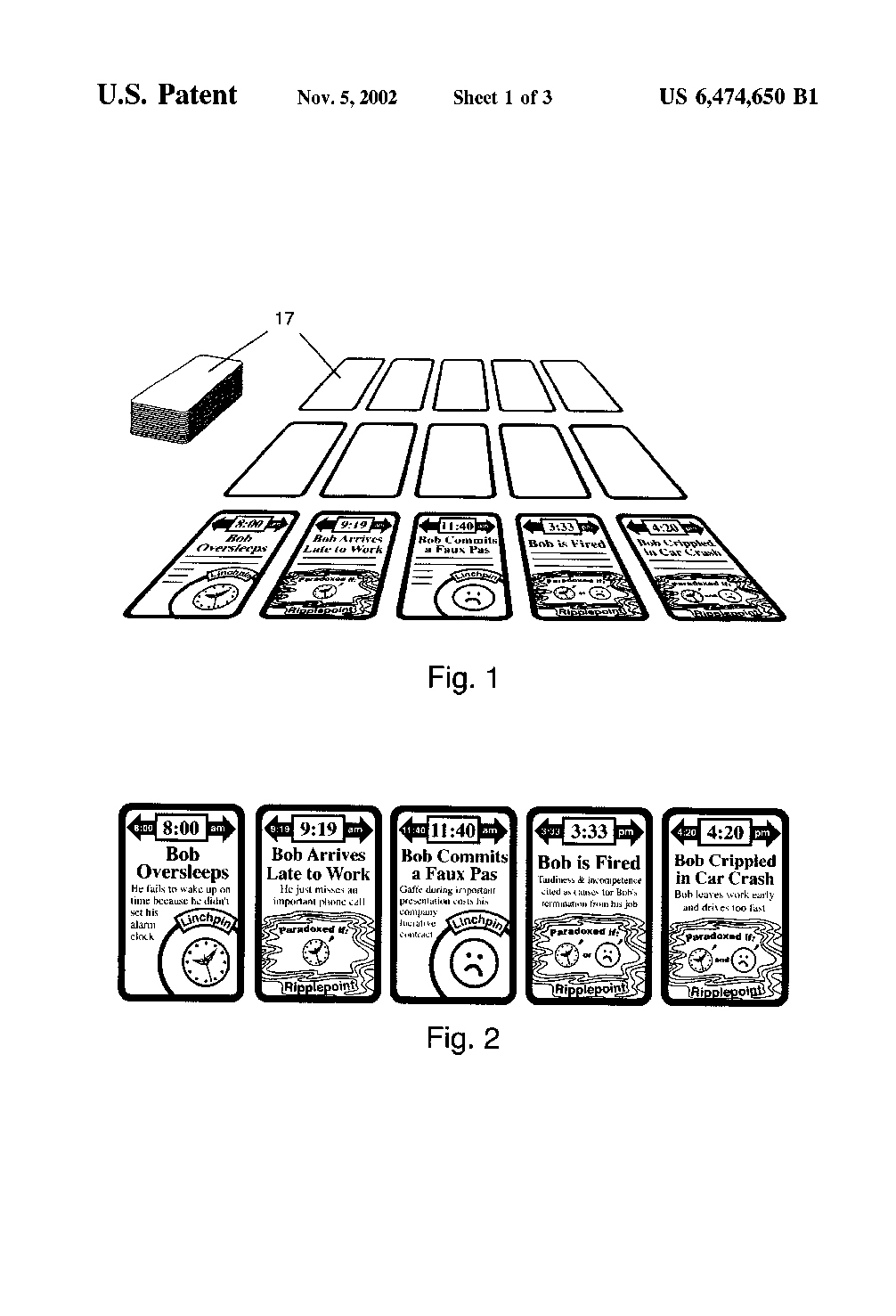
So we checked: has the Patent Office ever granted a patent for a time machine? We searched the titles of granted US patents on 25 October 2026: in the USPTO's Patent Public Search (1971 on: "time machine", "time travel", "time warp", "wormhole" and others; every title read) and in Google Patents (110 of 139 "time machine" titles). The closest we could find were a puzzle, a board game and a card game. That is a search of titles only: a patent that avoids the words would not be found.
Antigravity is another matter.
What the Office asks of an invention
The Patent Office's manual for examiners is plain about machines that do not work. An invention that is "inoperative", it says, "is not a 'useful' invention in the meaning of the patent law" (MPEP § 2107.01 II). It cites Newman v. Quigg (1989), the perpetual motion case from our fourth episode.
But the examiner has to make the case. Examiners "must treat as true a statement of fact made by an applicant", unless they have evidence against it (§ 2107.02 III), and they must "set forth factual reasons which would lead one skilled in the art to question the objective truth of the statement of operability" (§ 2107.02 IV, quoting In re Gaubert).
A "Method of Gravity Distortion and Time Displacement" was rejected on those grounds and abandoned in 2008 (application US 2006/0073976). Applications for a wormhole generator, a teleportation system and a warp drive were abandoned too, a patent lawyers' journal reports (M. Cocks, "Interstellar IP", AIPLA; we have not read those files ourselves).
What would antigravity take?
So what would an examiner's factual reasons be? Newton described gravity as "a power of gravity tending to all bodies, proportional to the several quantities of matter which they contain" (Principia, tr. Motte, 1729, Book III, Prop. VII). Electric charge comes in two kinds, so a metal box can shut electric forces out. Mass has only ever been found with one sign, and gravity only ever attracts, so, as the physicist Raymond Chiao put it, "it is impossible to construct a gravitational Faraday cage" (2002).
Gravity pulls on every kind of matter the same way. In 1971, the year Wallace's patent was granted, the astronaut David Scott dropped a hammer and a falcon feather on the Moon, and they landed together. In 2022 the satellite MICROSCOPE compared falling titanium and platinum and found no difference, to about one part in a million billion. Even antimatter falls down: in 2023 the ALPHA experiment at CERN released atoms of antihydrogen and watched which way they went. They fell, and the team wrote: "Repulsive 'antigravity' is ruled out."
On paper, though, there are ways in. In 1957 Hermann Bondi worked out how negative mass would behave if it existed: beside an ordinary mass, the pair would run off together, faster and faster. But mass, he noted, has always been found to be positive. In 1994 Miguel Alcubierre found a warp drive in Einstein's equations; it needs what he called "exotic matter", with negative energy. The one place negative energy has been measured is the Casimir effect, between metal surfaces less than a thousandth of a millimetre apart (Mohideen and Roy measured it at 0.1 to 0.9 µm, 1998).
And spin really does drag on spacetime. In 2011 Gravity Probe B measured the spinning Earth twisting space around it: 37 thousandths of a second of arc a year, against the 39 Einstein's theory predicts. A physicist, Martin Tajmar, looked for a far larger drag near spinning superconductors. He reported signals in 2006 and 2007; by 2011, testing again: "No such anomalies were found." So there are three ways in, all on paper: negative mass, negative energy and the drag of spin. Wallace's patent leans on spin, Volfson's on bending spacetime, and the Navy's on reducing mass.
Brown: the patents that never say gravity
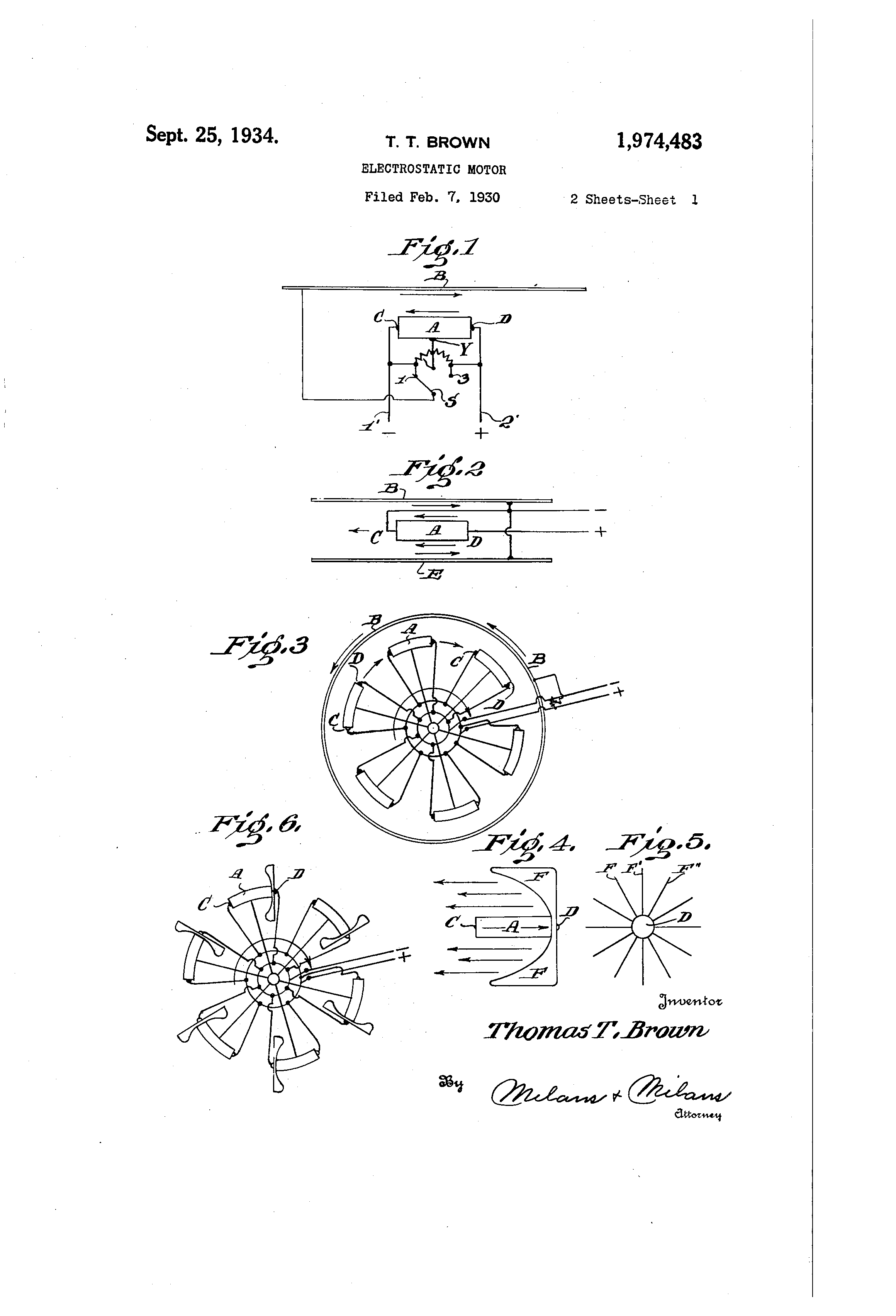
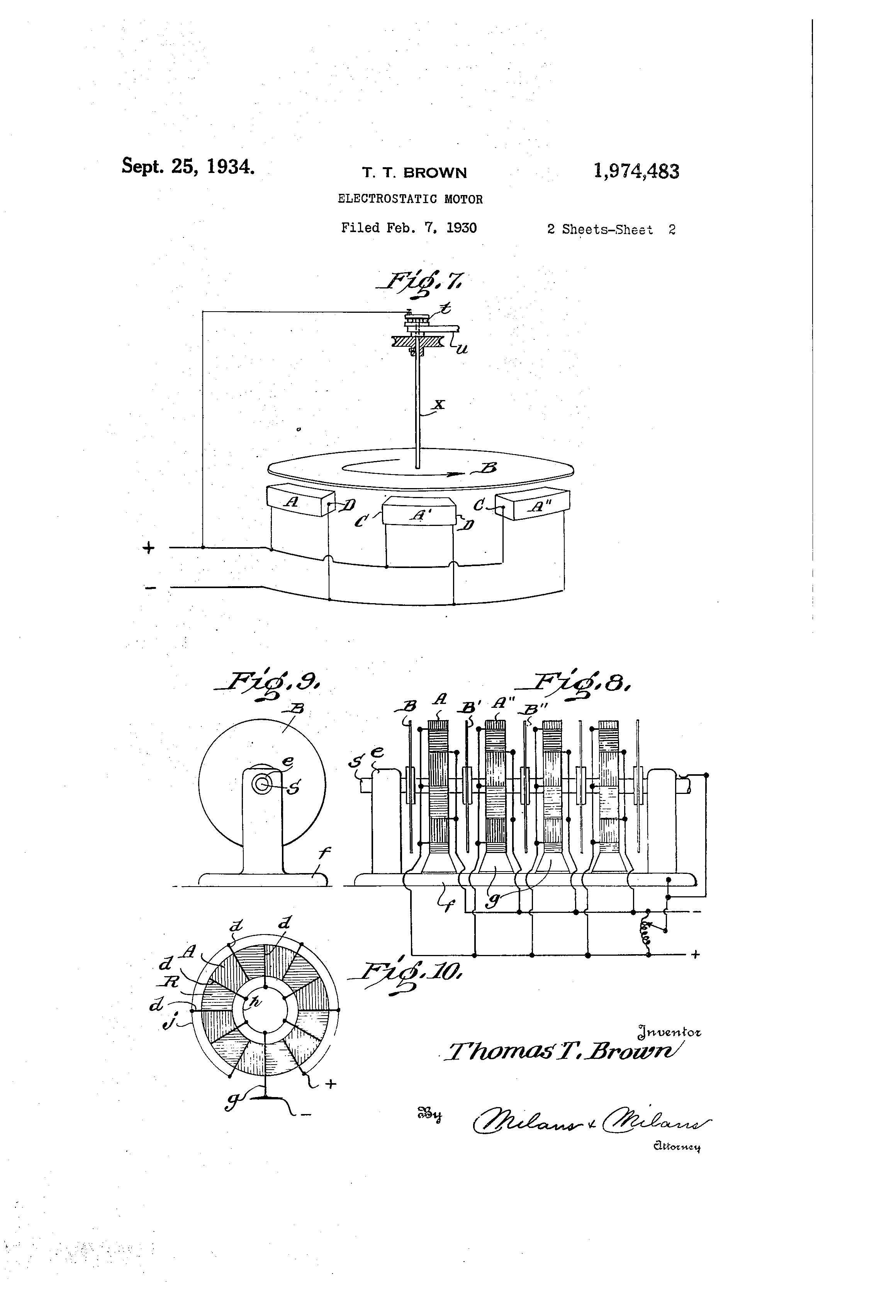
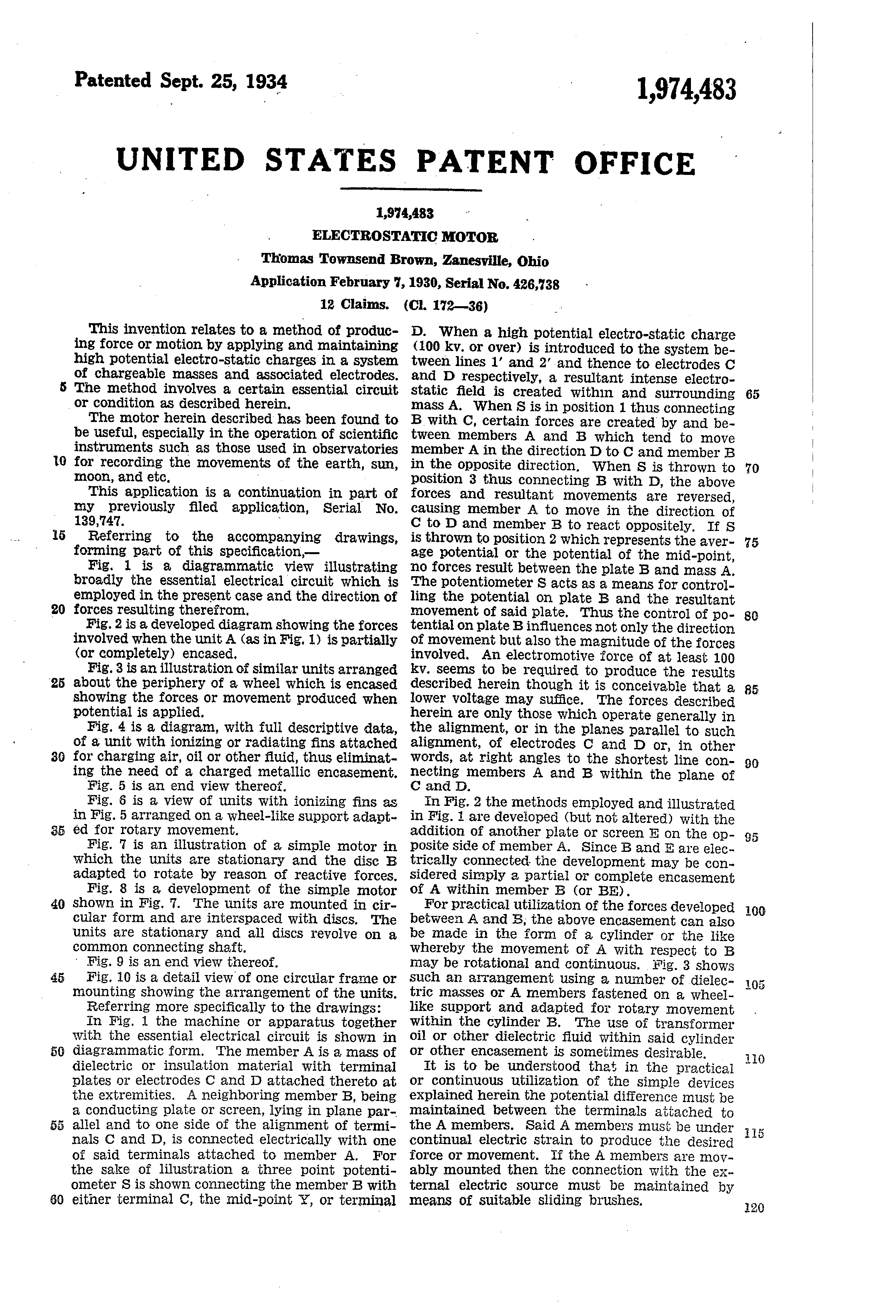
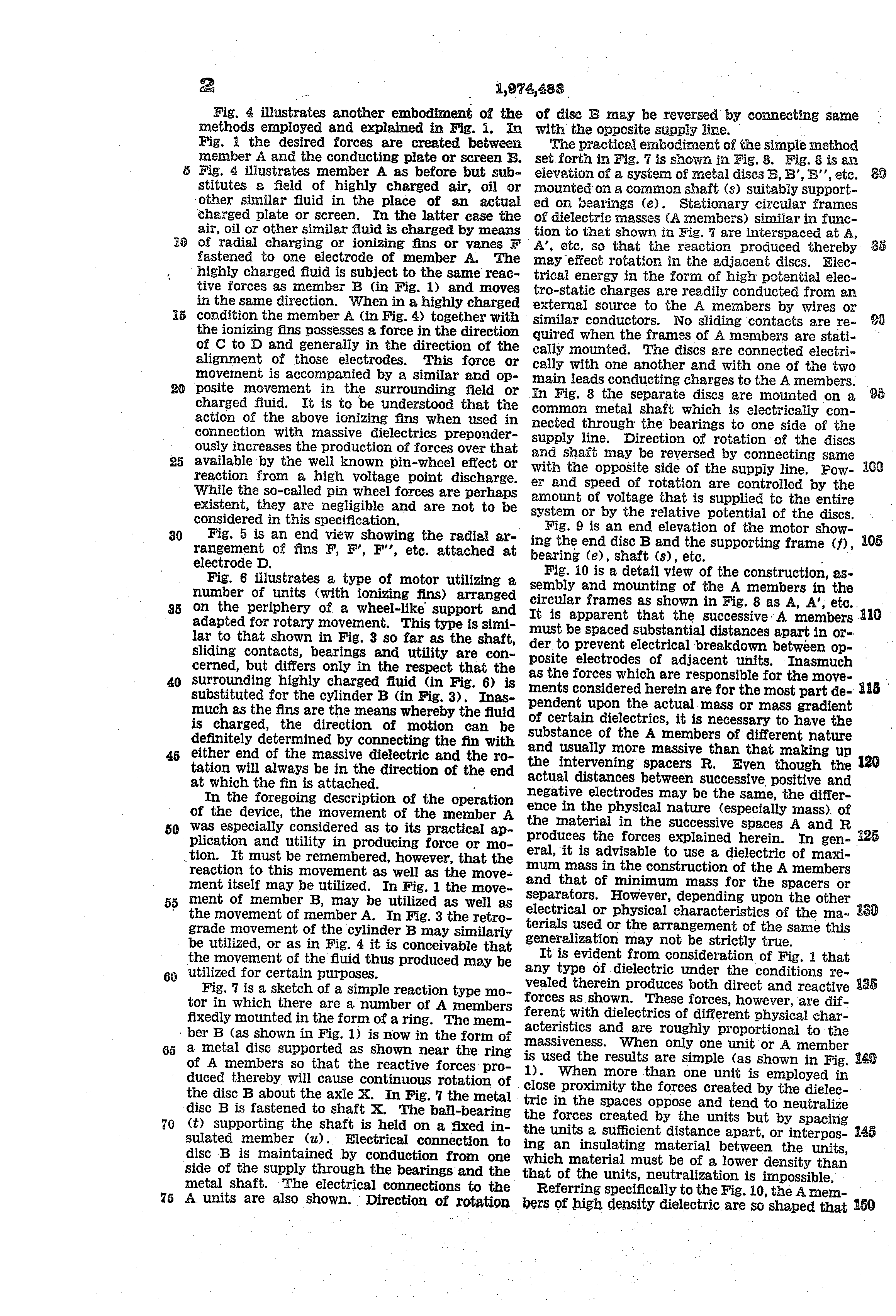
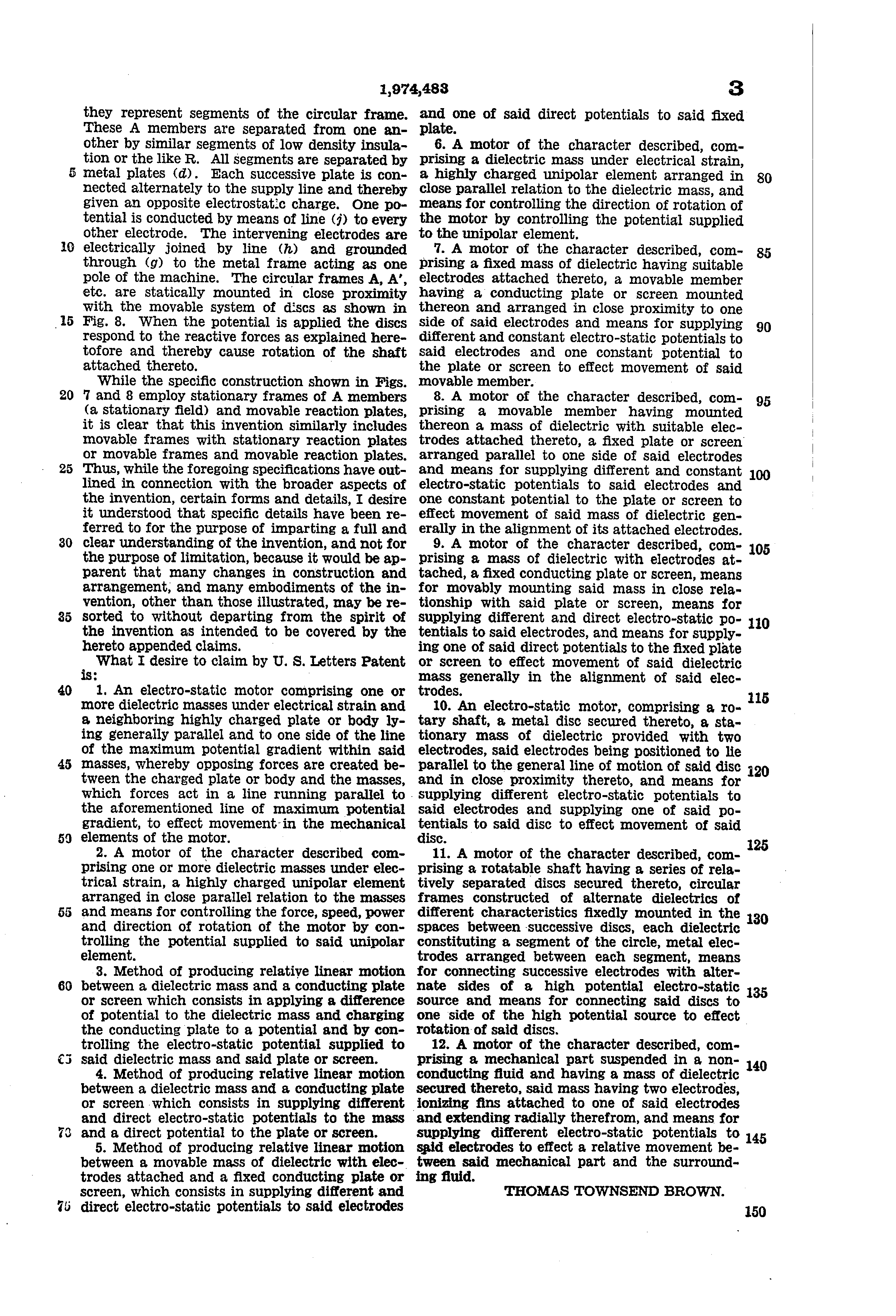
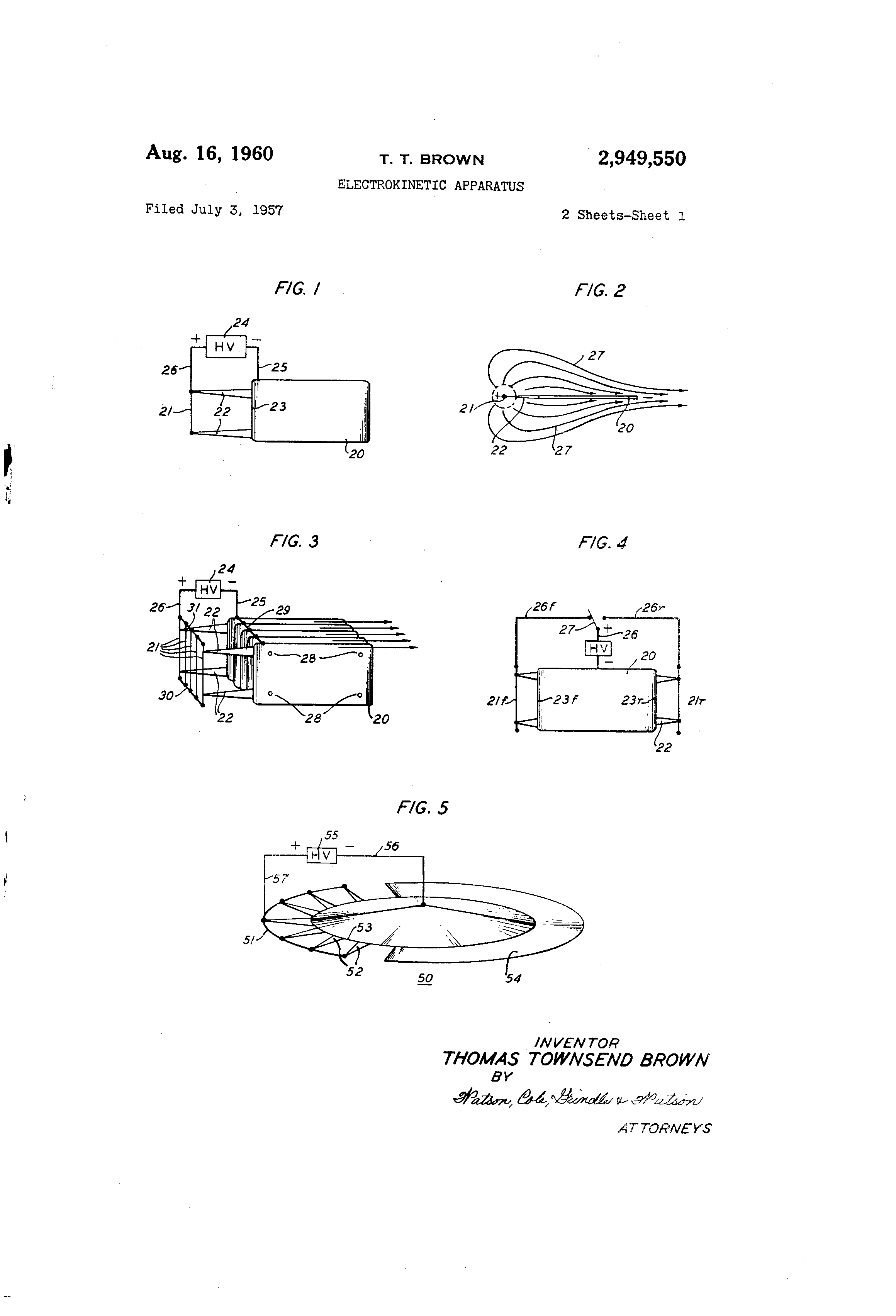
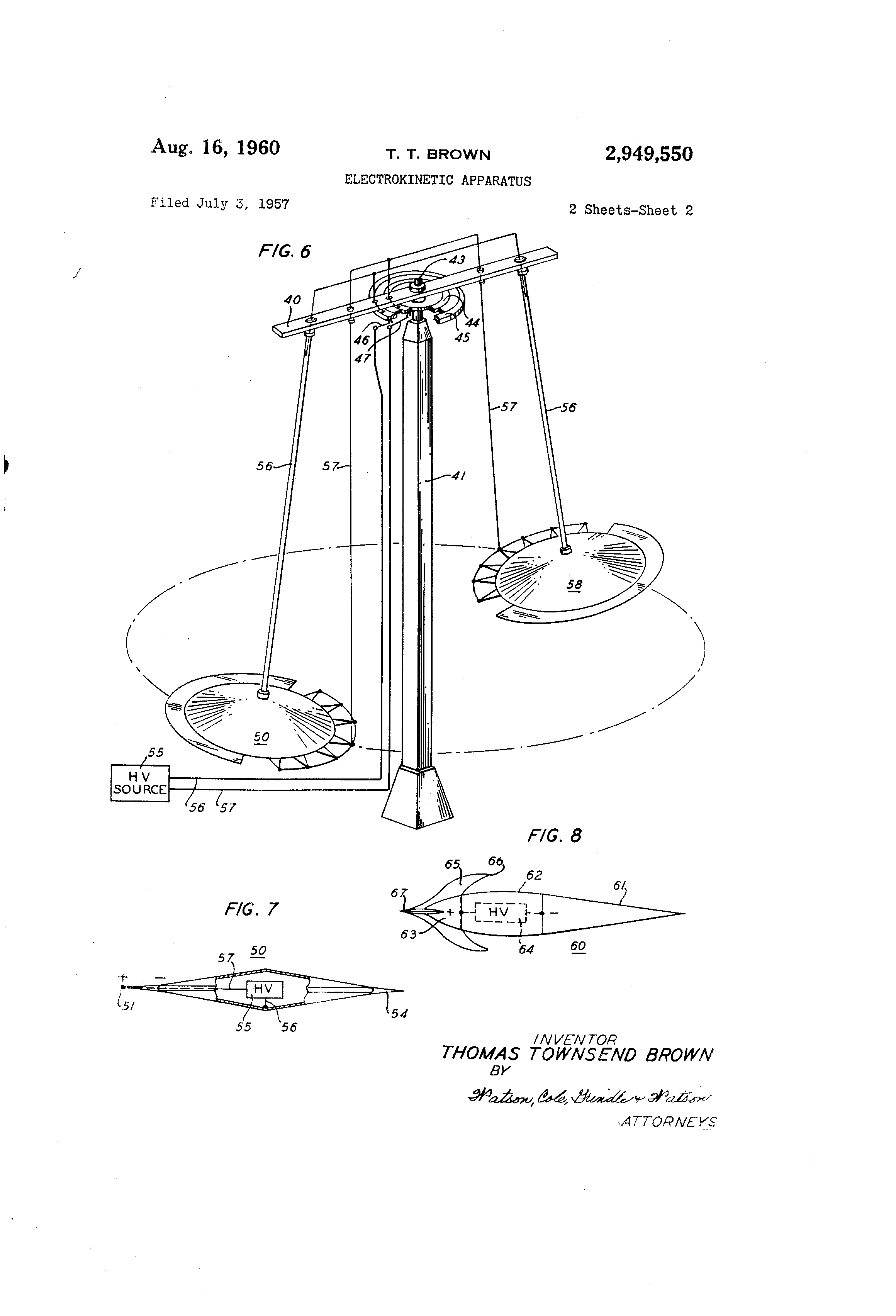
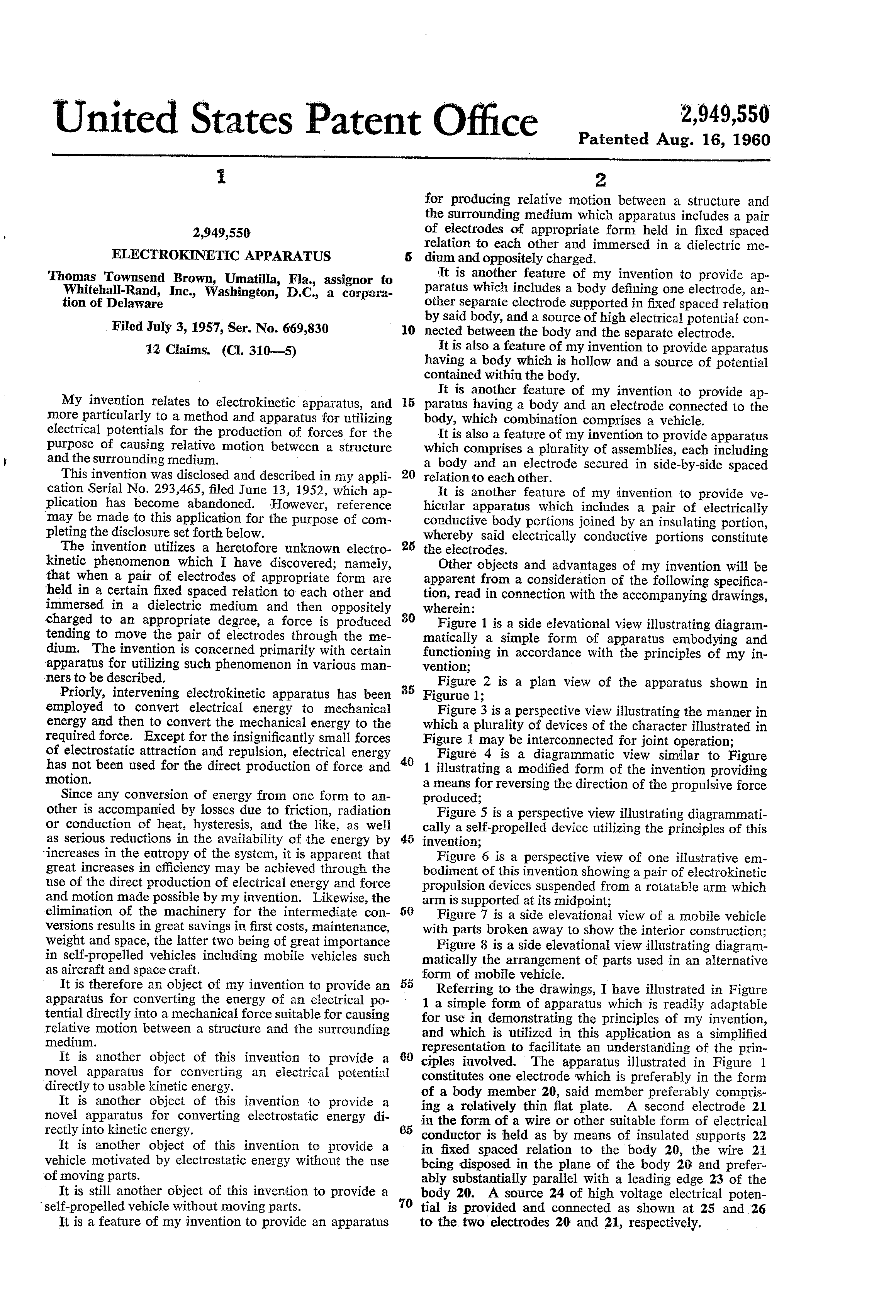
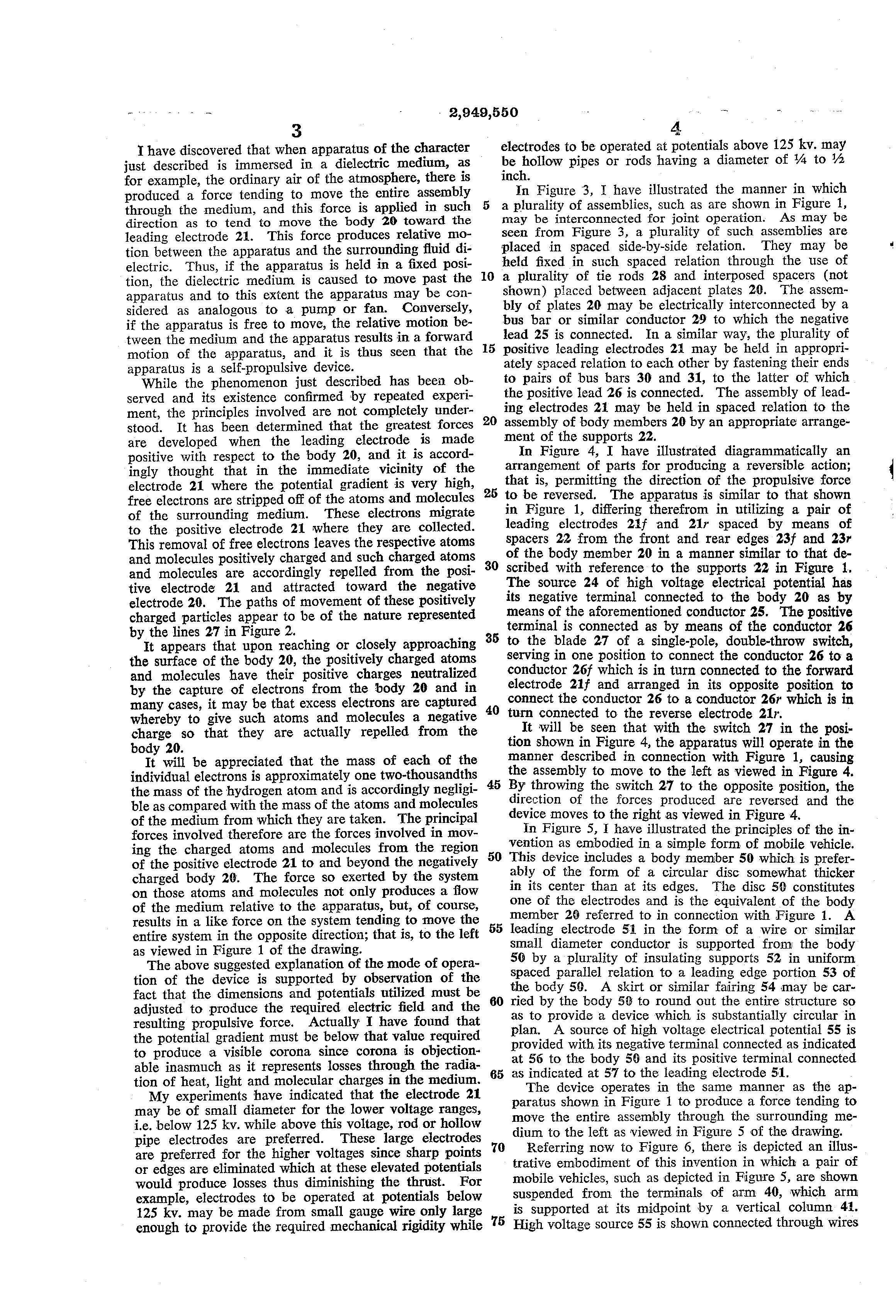
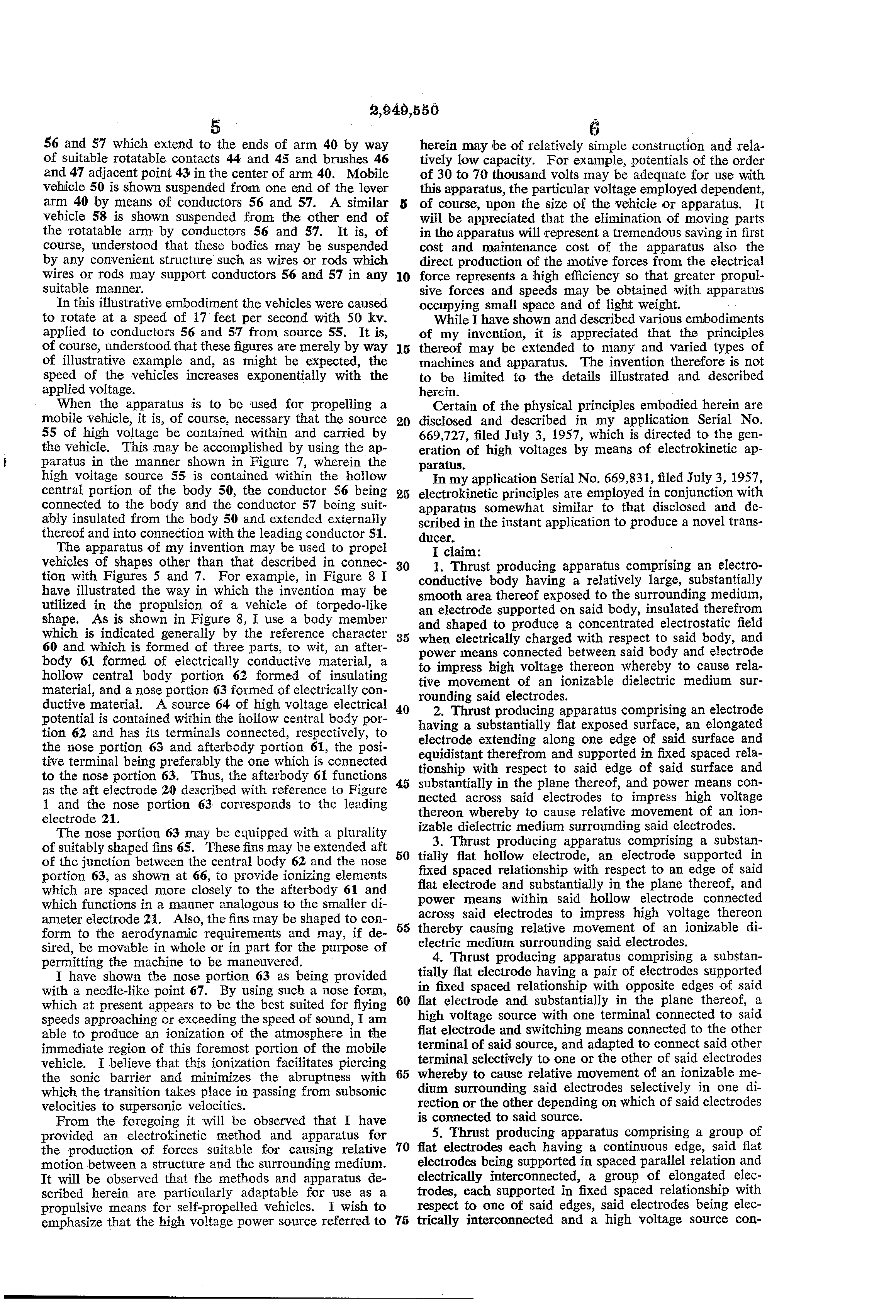
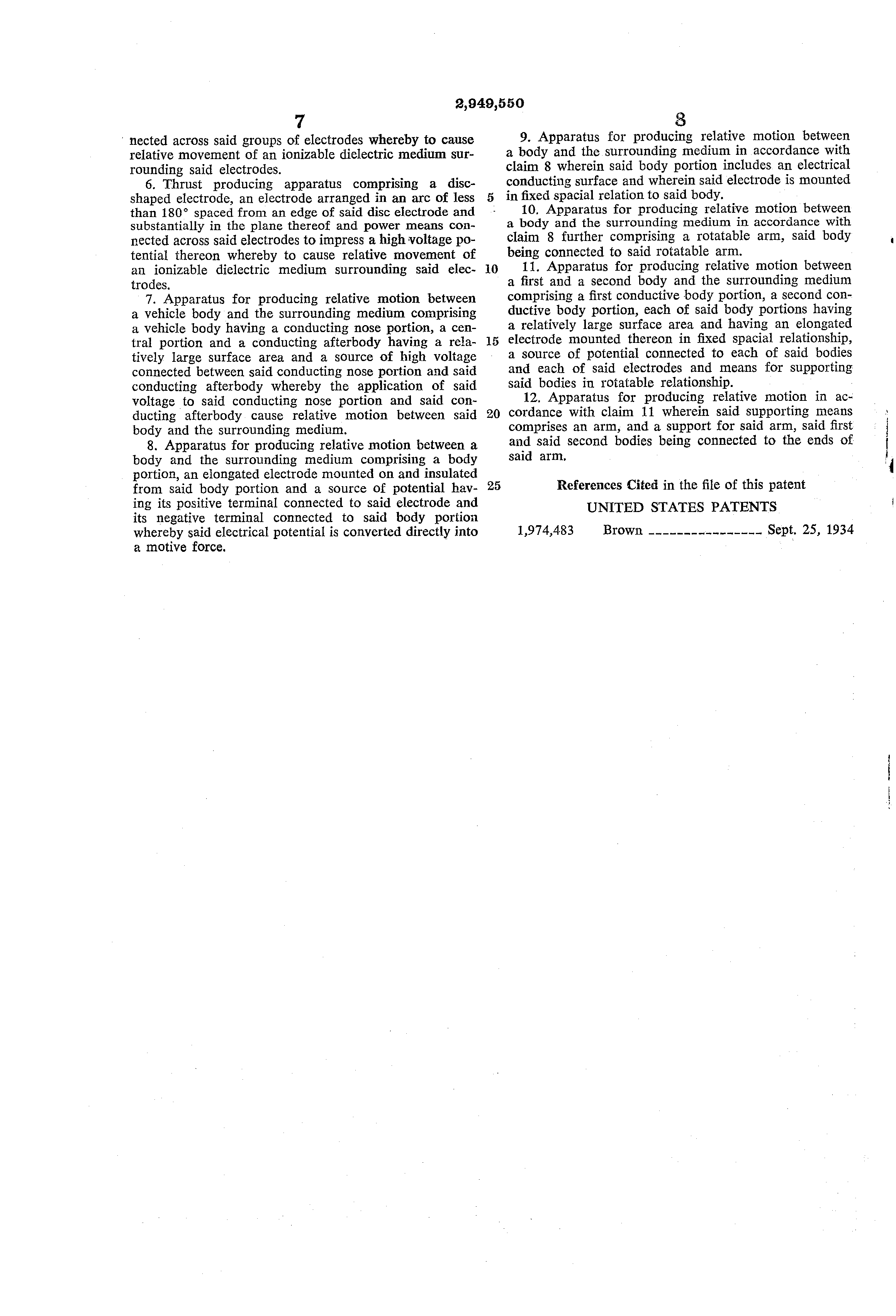
The patents that started the legend came earlier. In 1934 Thomas Townsend Brown of Zanesville, Ohio, was granted a patent for an "electrostatic motor" (US 1,974,483). A block of insulating material sits between two electrodes; charge them to "100 kV. or over", and "certain forces are created" that move it. He wrote that it was useful for scientific instruments, "such as those used in observatories". In 1960 he was granted another, for an "electrokinetic apparatus": charged electrodes that cause "relative motion between a structure and the surrounding medium". Its claims are for "thrust producing apparatus" (US 2,949,550). Neither patent uses the word gravity: we searched both texts.
The force itself is real. In 2003 a report from the US Army Research Laboratory measured it on four capacitors and said its physical basis was "not understood" (Bahder and Fazi). A year later an Austrian researcher, Martin Tajmar, tested for any thrust not caused by the wind of charged air around the electrodes, found none, and concluded that the wind had been "misinterpreted as a connection between gravity and electromagnetism" (AIAA Journal, 2004). So the rule for this episode: read each patent for its own words.
Wallace, 1971: the patent on the page
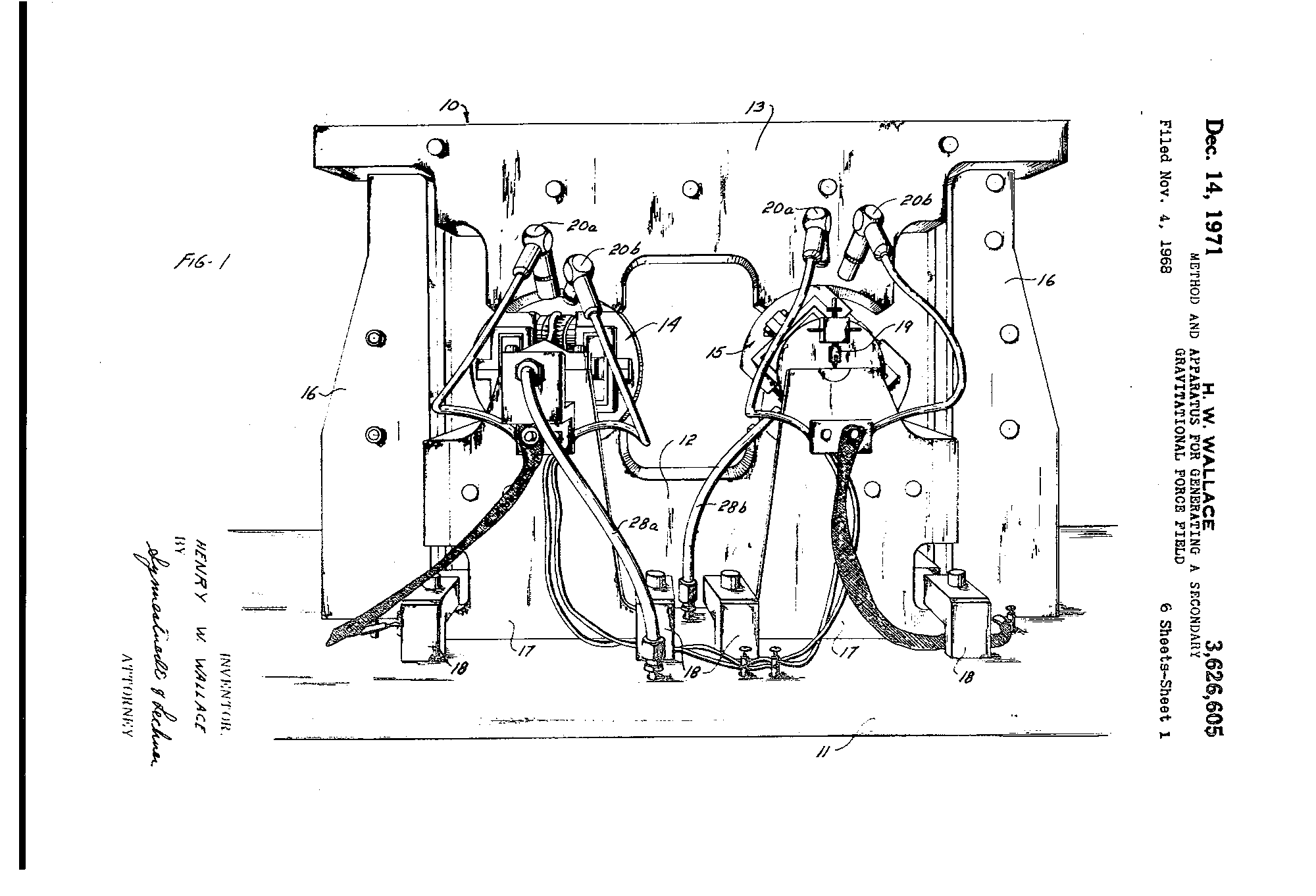
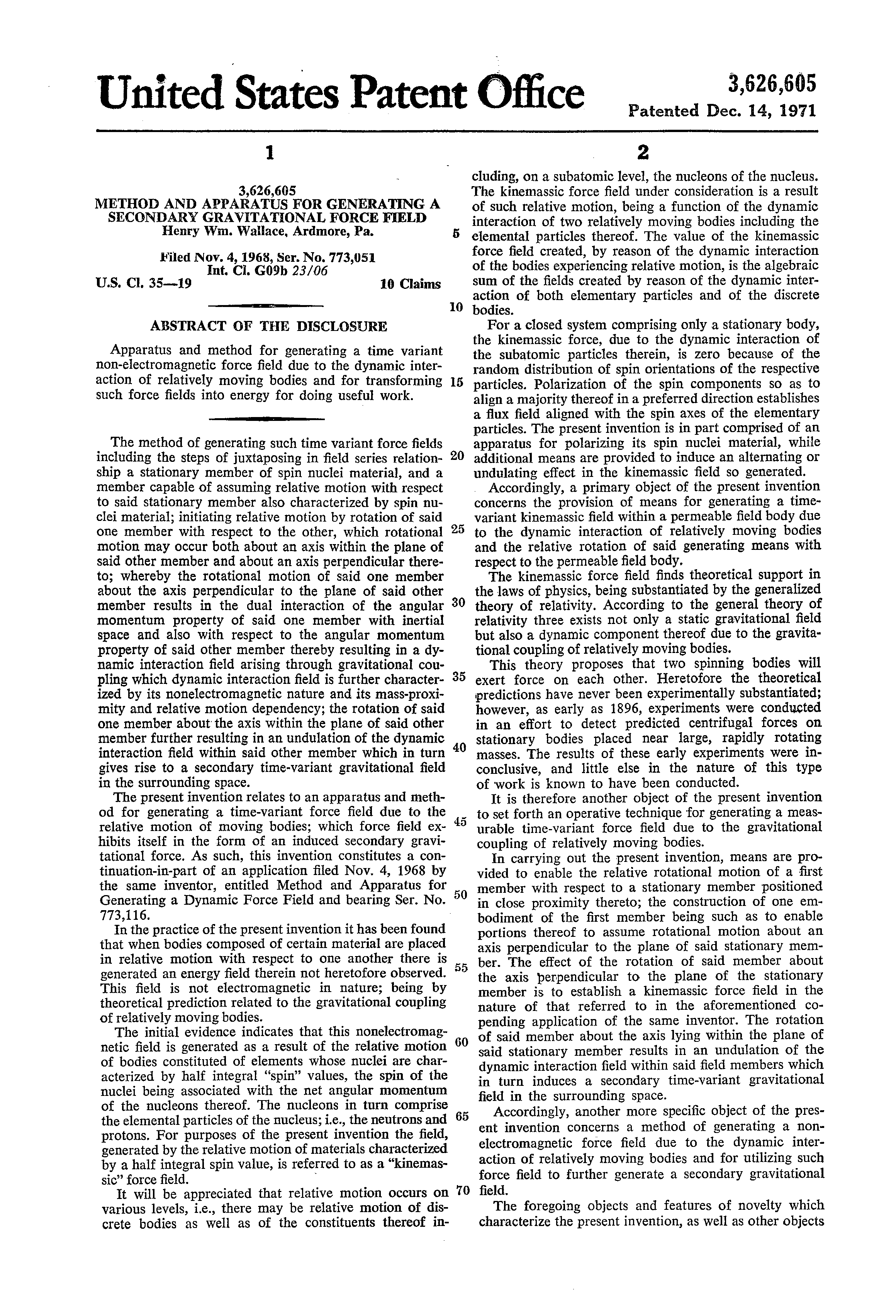
Henry Wm. Wallace of Ardmore, Pennsylvania, filed in November 1968. His patent was granted in December 1971: a "method and apparatus for generating a secondary gravitational force field". He is reported to have been an engineer at General Electric (Tajmar and de Matos, 2001); the patent does not say.
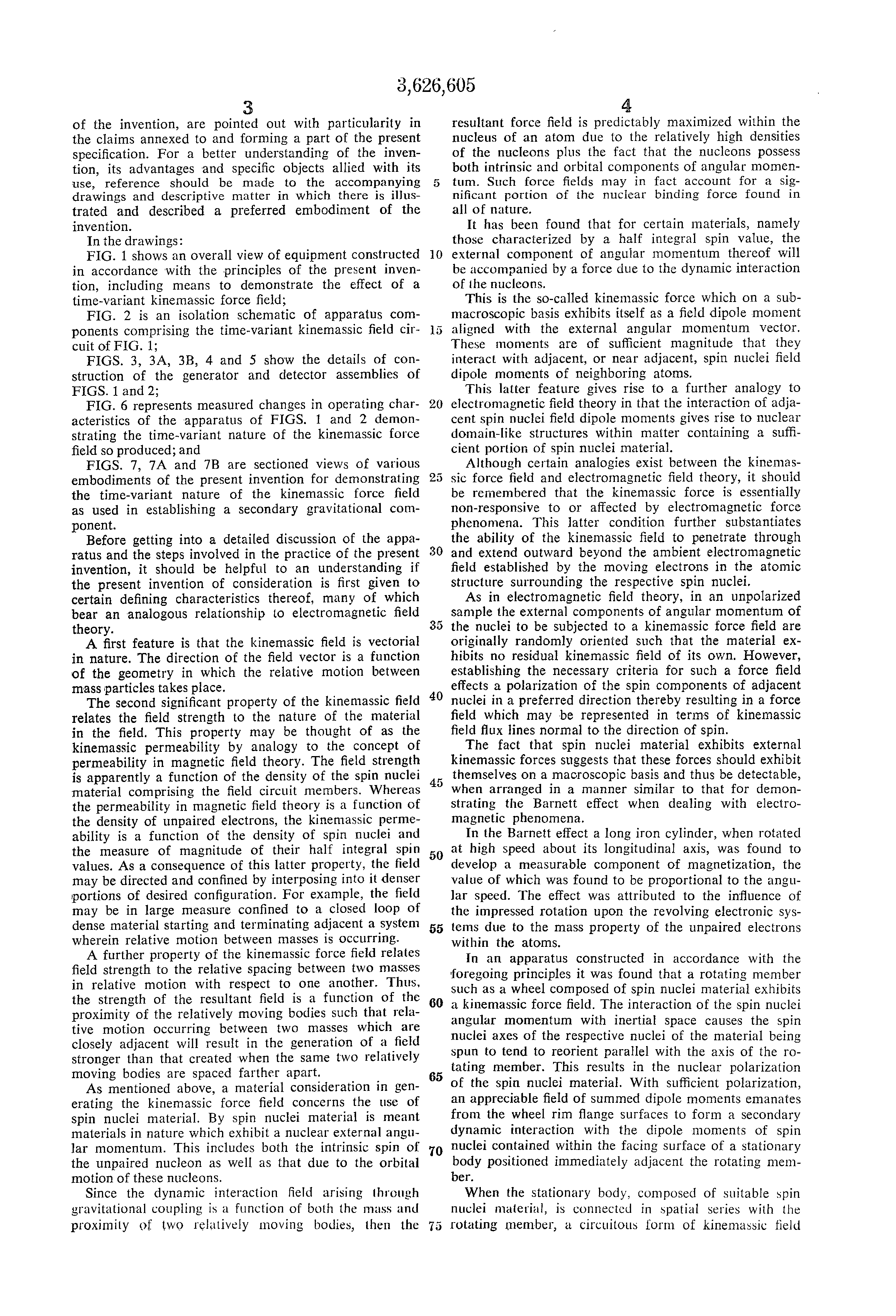
His idea starts inside the atom. Materials with "a half integral spin value", he wrote, carry a force of their own. Spin a wheel made of one fast enough, and its nuclei line up and send out a field. He called it "kinemassic" (col. 1-4). He compared it to something real, the Barnett effect: "a long iron cylinder, when rotated at high speed about its longitudinal axis, was found to develop a measurable component of magnetization" (cols. 3-4). He knew no one had shown such a thing: experiments as early as 1896 were "inconclusive, and little else in the nature of this type of work is known to have been conducted" (col. 2).
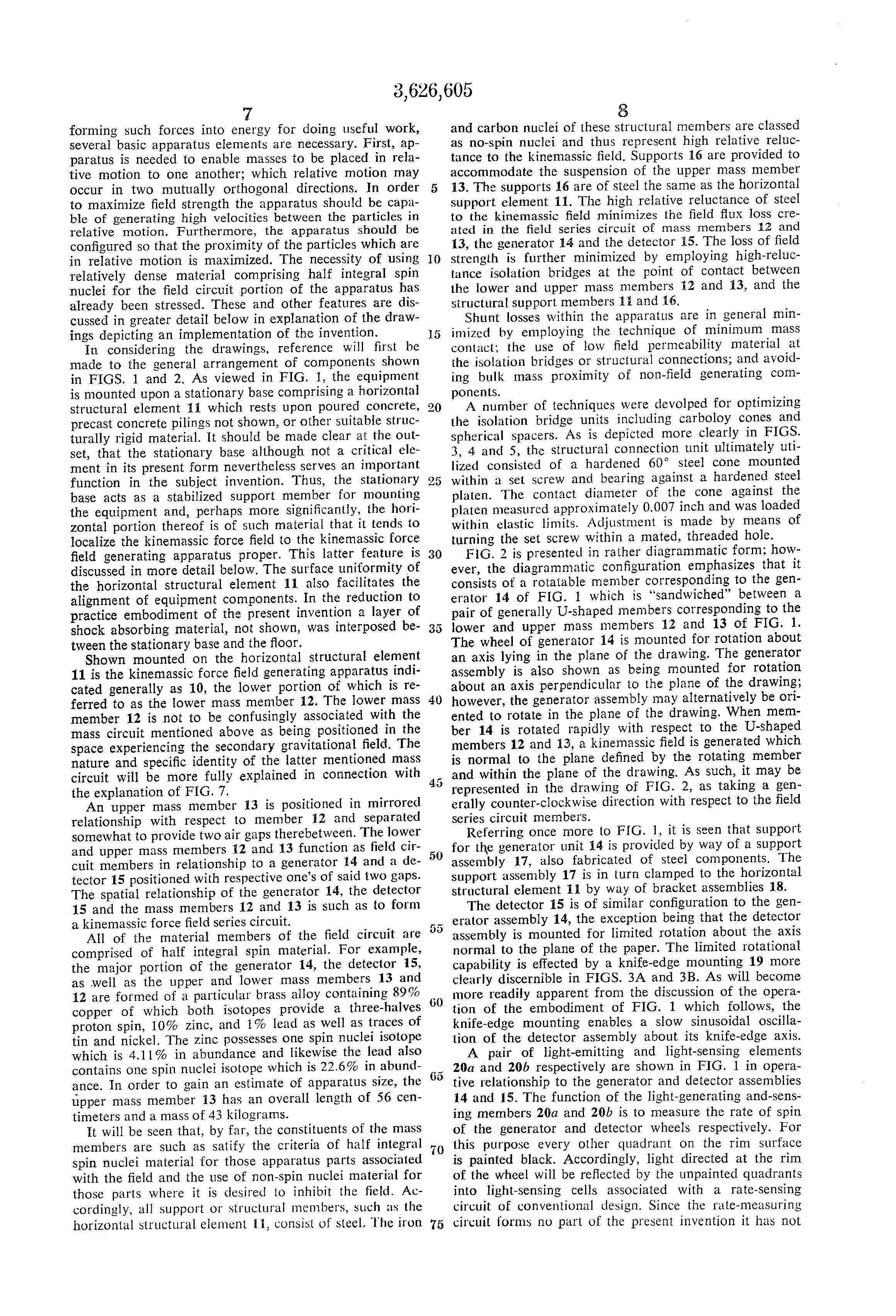
Copper's nuclei have the spin he wanted, and brass is mostly copper (his: 89% copper, 10% zinc, 1% lead, col. 7). Iron and carbon, he said, have none. So he built in brass wherever the field should go, and in steel everywhere else.
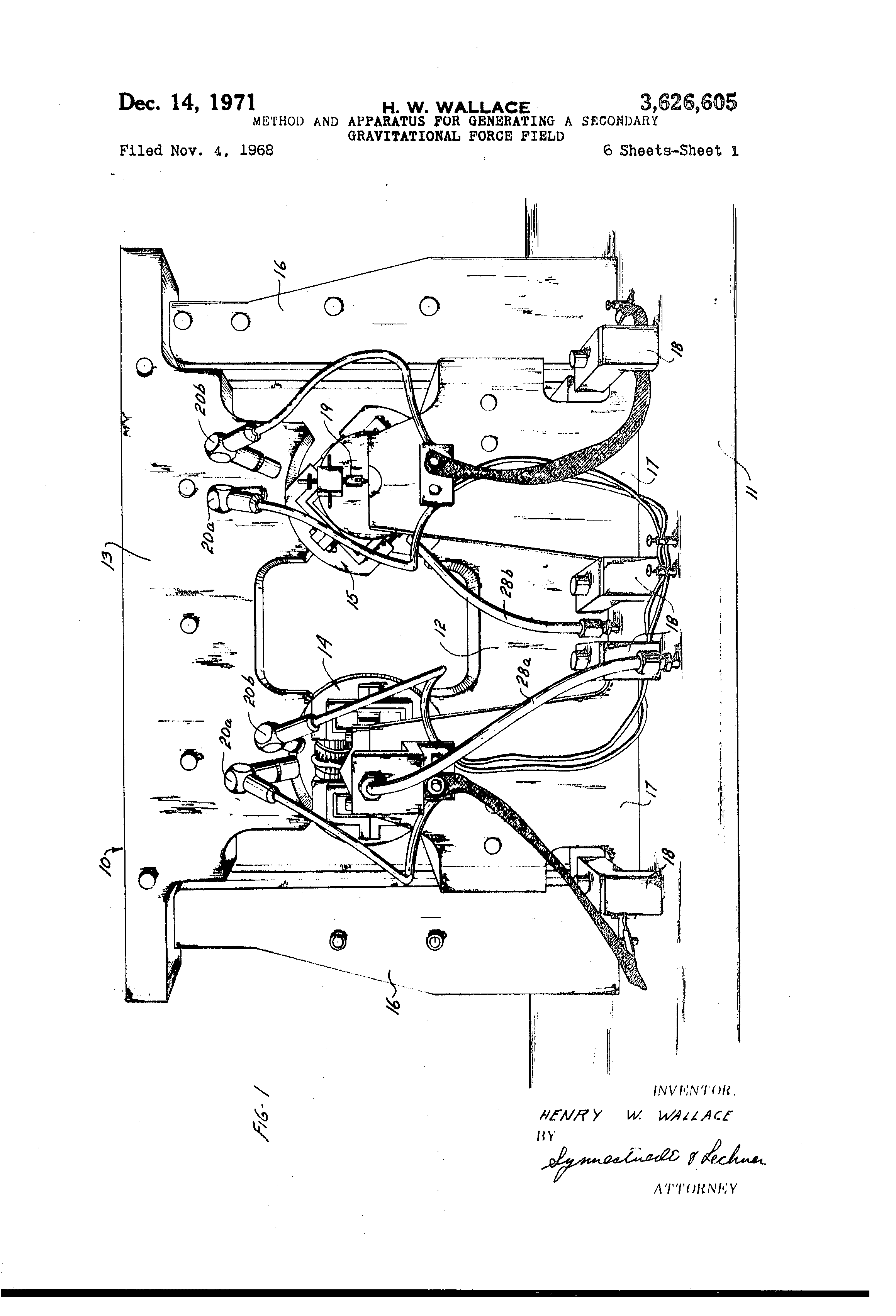
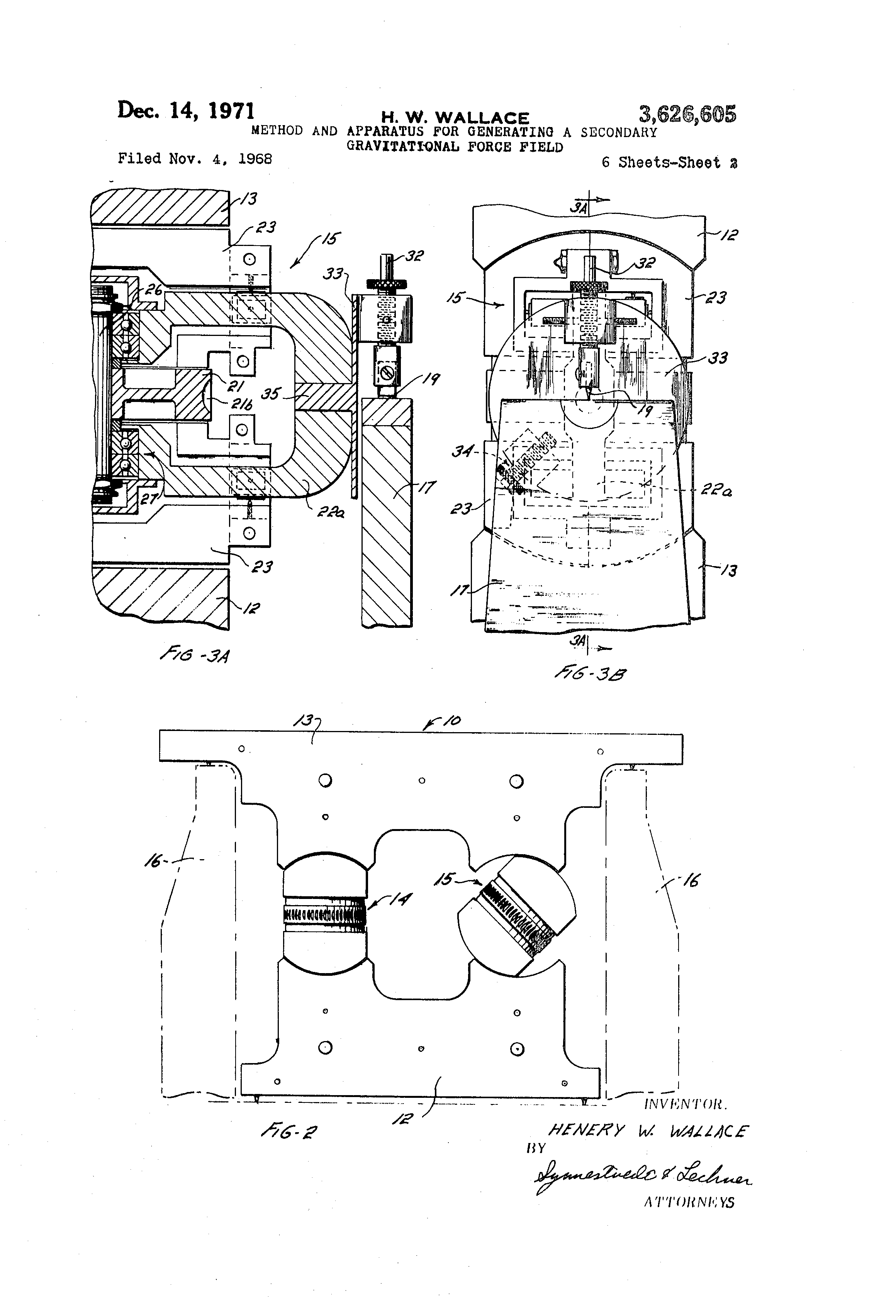
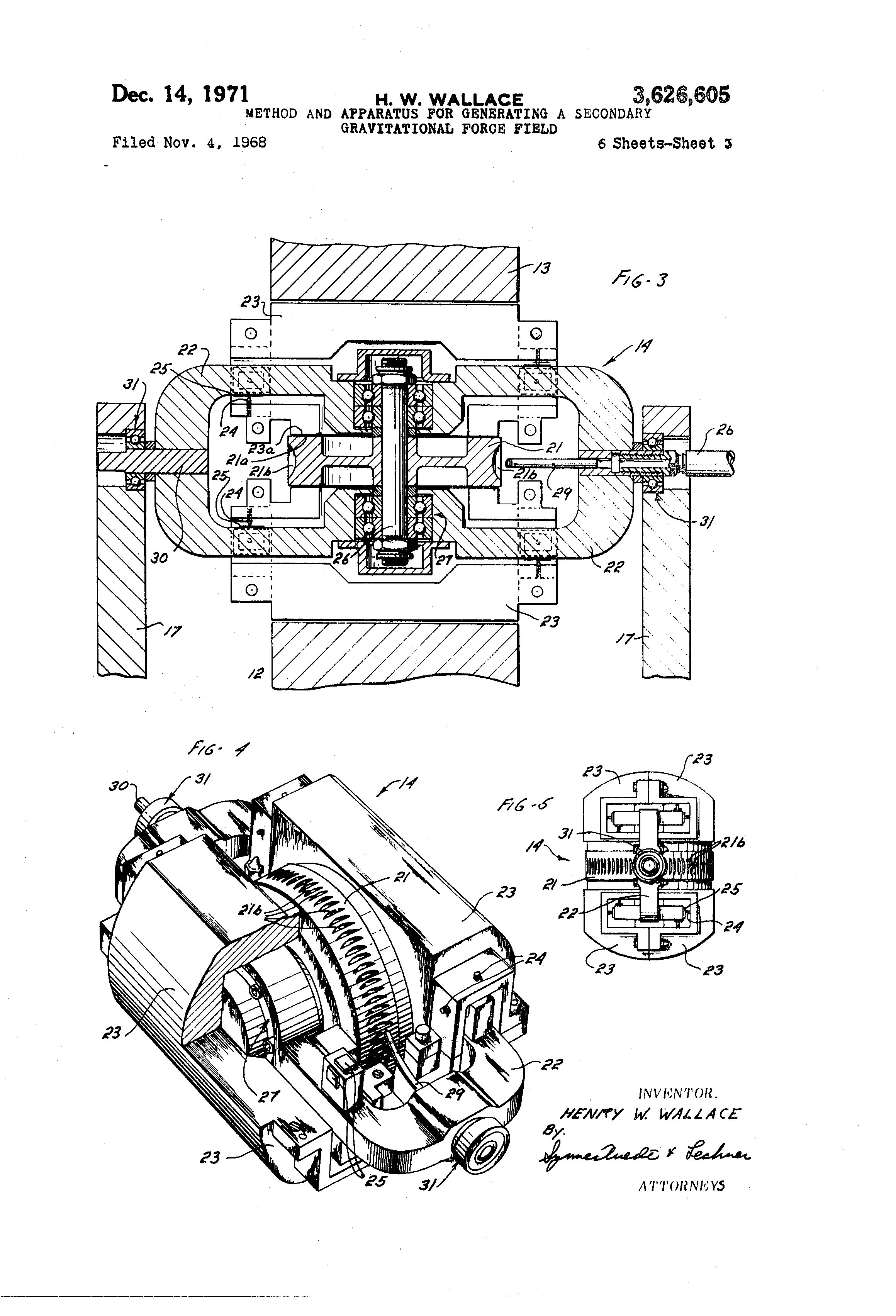
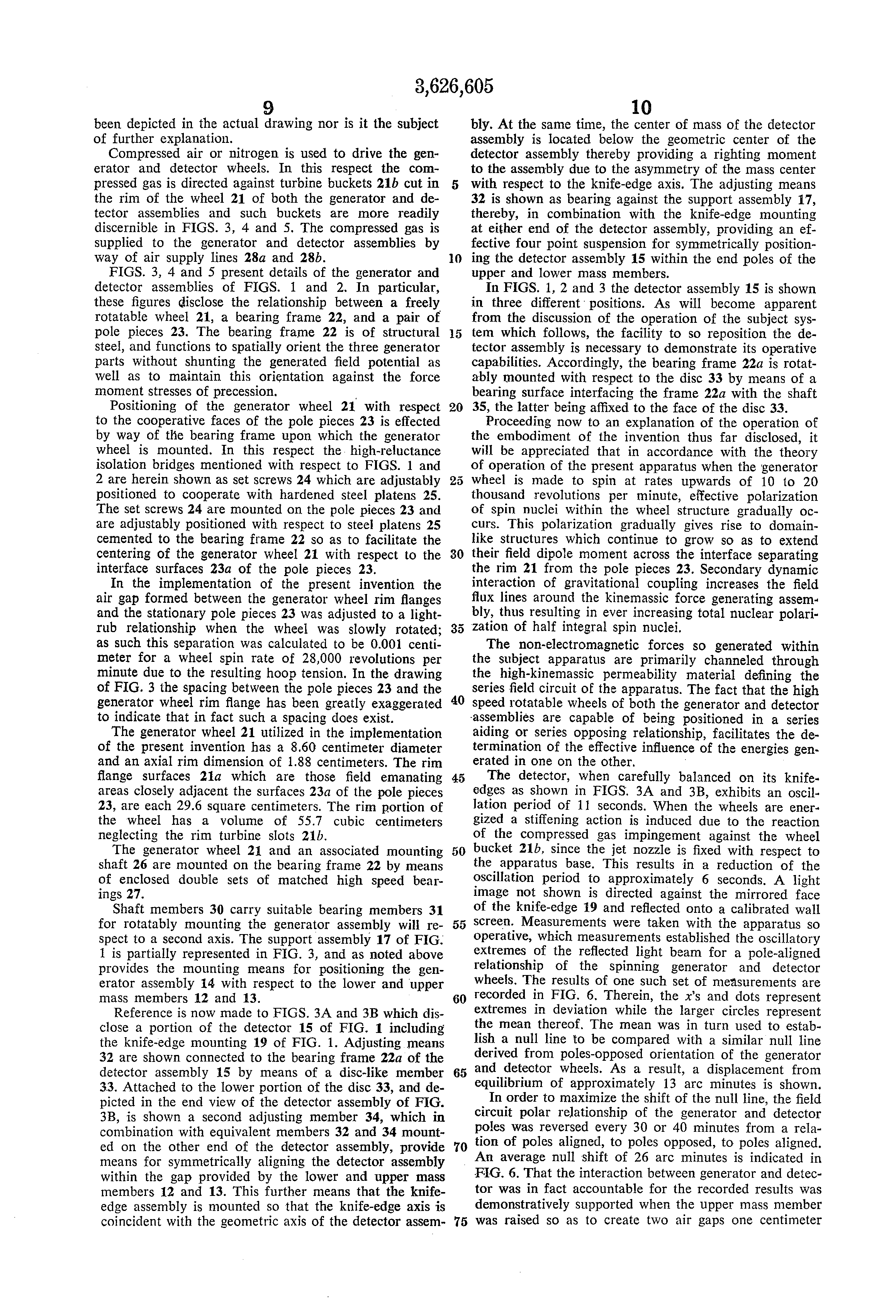
His test rig: a steel base on concrete; two brass members shaped like a U, facing each other across two gaps; the upper one, member 13, has "an overall length of 56 centimeters and a mass of 43 kilograms". In one gap sits the generator: a brass wheel of "8.60 centimeter diameter", with buckets cut in its rim, between brass pole pieces "adjusted to a light rub relationship when the wheel was slowly rotated". Compressed air on the buckets spins it "upwards of 10 to 20 thousand revolutions per minute". A lamp and a sensor count the turns off the rim, where "every other quadrant on the rim surface is painted black". In the other gap is the detector: the same wheel in the same kind of frame, balanced on knife edges so that it can rock. Left alone, it swings once every 11 seconds; with the air on, about every six. A light is "directed against the mirrored face of the knife-edge" and "reflected onto a calibrated wall screen" (cols. 7-10). That spot of light is the measurement.
From the patent (Figs. 1-5, cols. 7-10): base 11 on concrete, brass members 12 and 13 with member 13's 56 cm and 43 kg, steel supports 16, the generator 14 and detector 15 "of similar configuration", wheel 21 of 8.60 cm with rim flanges and buckets 21b, steel bearing frame 22, brass pole pieces 23 a light rub from the rim, set screws 24 and platens 25, lamp and sensor 20a, 20b on the half-black rim, support assembly 17 and brackets 18, shafts 30 and bearings 31, the detector on knife edges 19 with shaft 35, disc 33 and adjusting means 32, 34; the swing every 11 s, or about 6 with the air on; the light on the knife edge's mirrored face, thrown onto a wall screen. Ours: the members' thickness (from the 43 kg), sizes the drawings show only roughly, the bucket count, the seat clearance, the detector's nozzle stand, how the lamp and sensor are held, which face of the knife edge is mirrored, the lamp's and the wall screen's places, the swing's size (90 arc minutes), and the spin, shown slowed. The shift of the swing's middle is drawn as the patent reports it, with the poles opposed, the generator running and member 13 down; the patent does not say how the poles were reversed. The screen inset records an x at each end of a swing and a circle at its middle, as Fig. 6 does. Checked by a test of our own, the episode's, run again on this page's copy: 65 checks, all pass (the members' mass from Fig. 2's outline, the parts' places and sizes, nothing passing through anything, the jet along the wheel's turn, the light path).
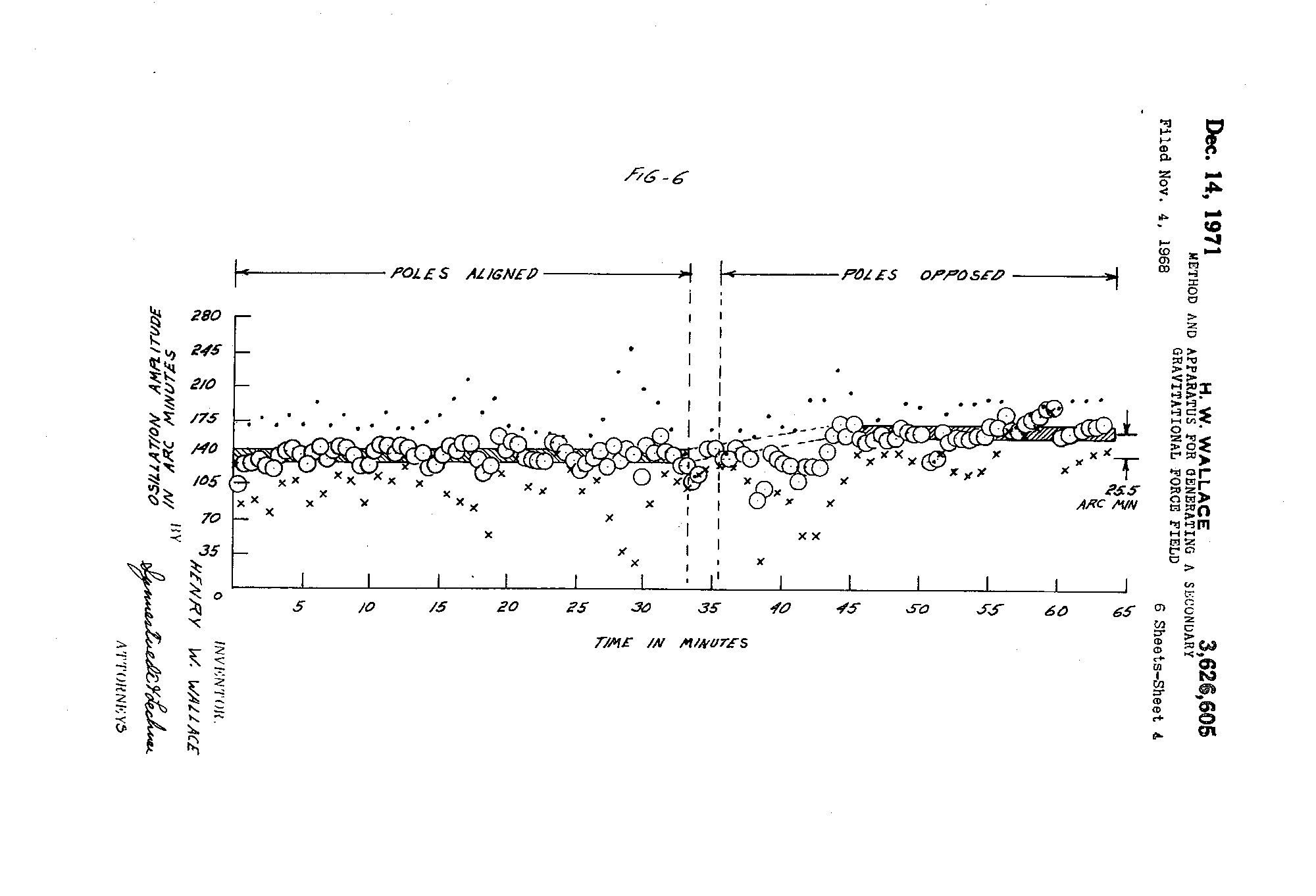
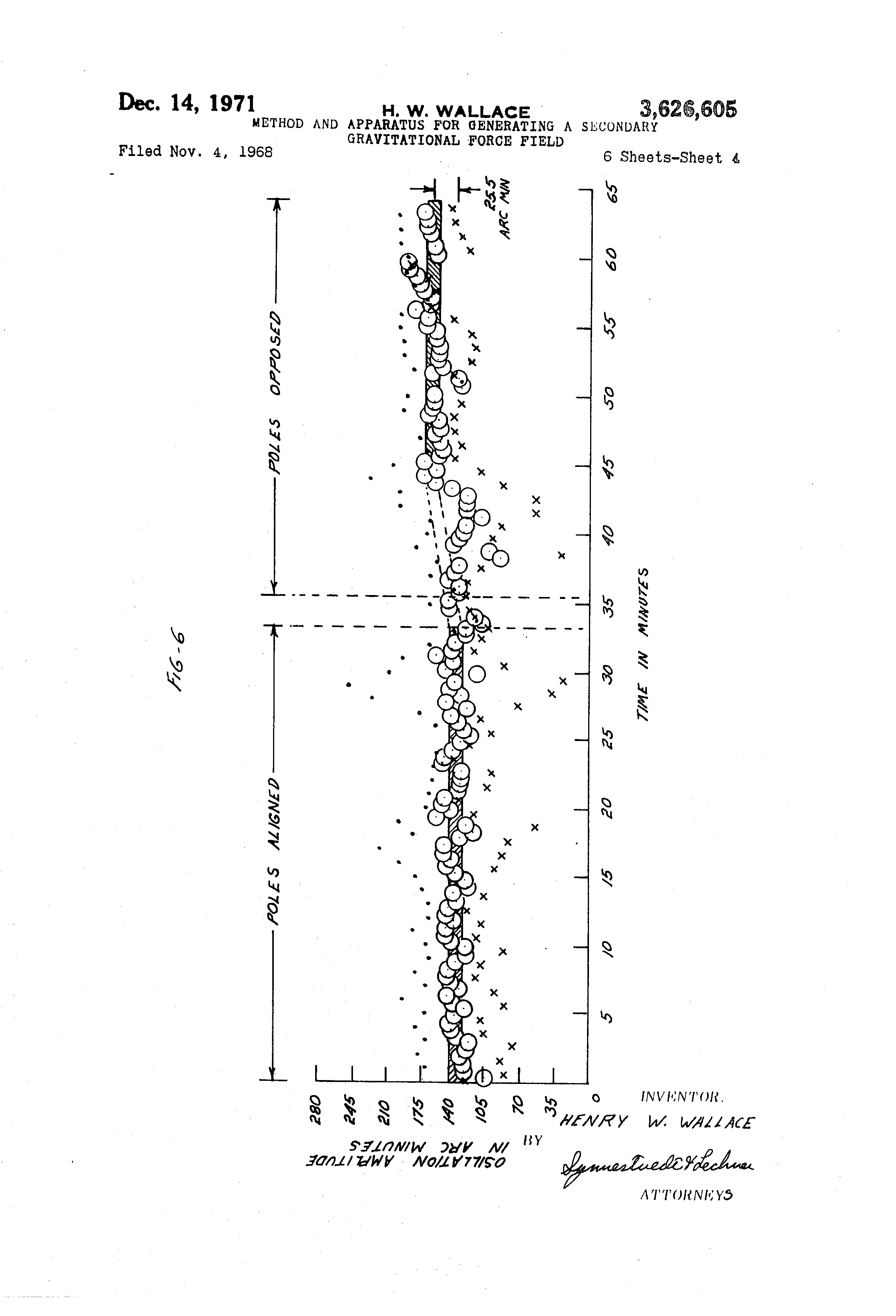
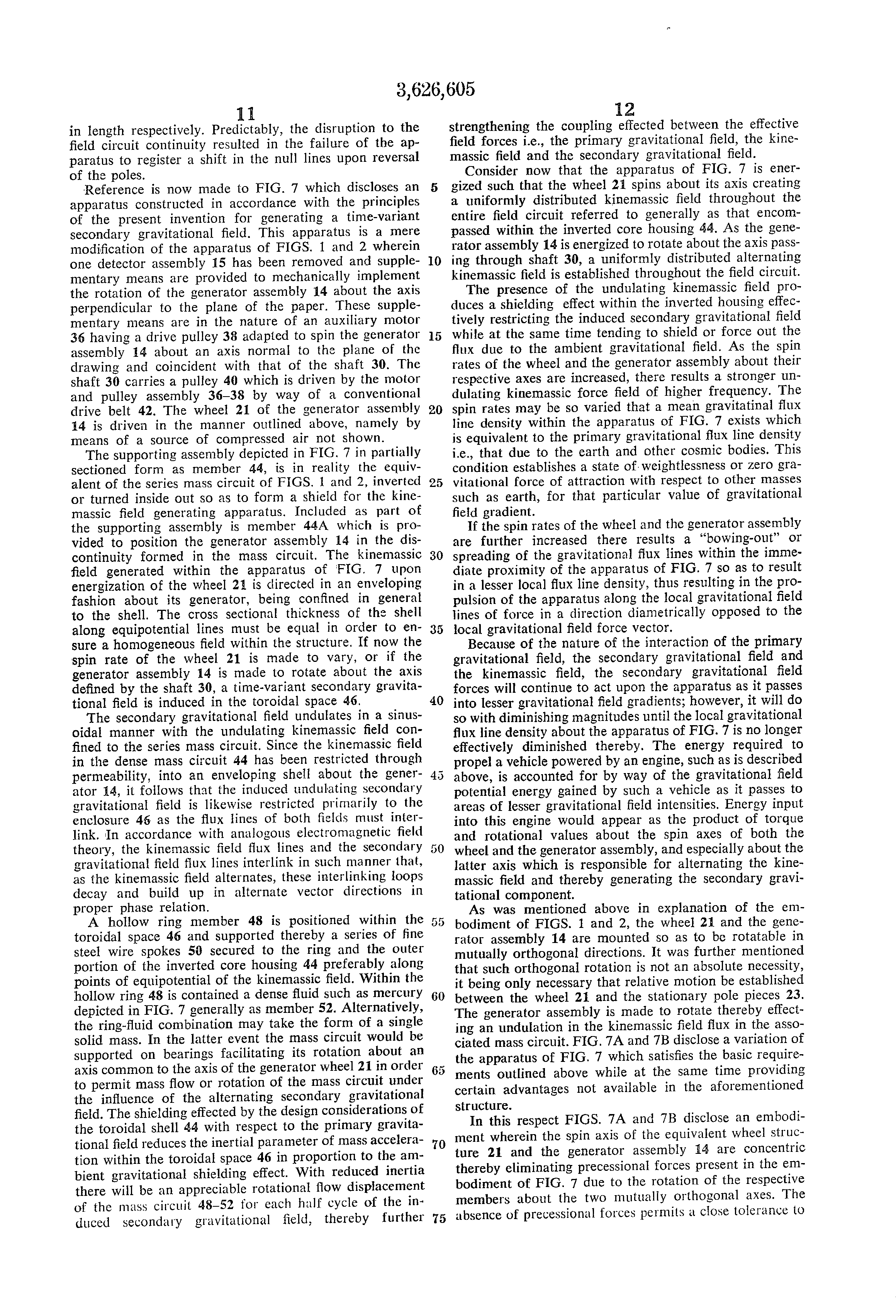
Every 30 or 40 minutes the poles were reversed, so the two wheels went from aligned, to opposed, and back. And the middle of the spot's swing, Wallace reported, moved: about 13 arc minutes, and "an average null shift of 26 arc minutes" with the reversals (col. 10; Fig. 6). That is less than half a degree. As a check, he raised the upper member to open two gaps a centimetre wide. Then, he wrote, came "the failure of the apparatus to register a shift" (col. 10-11).
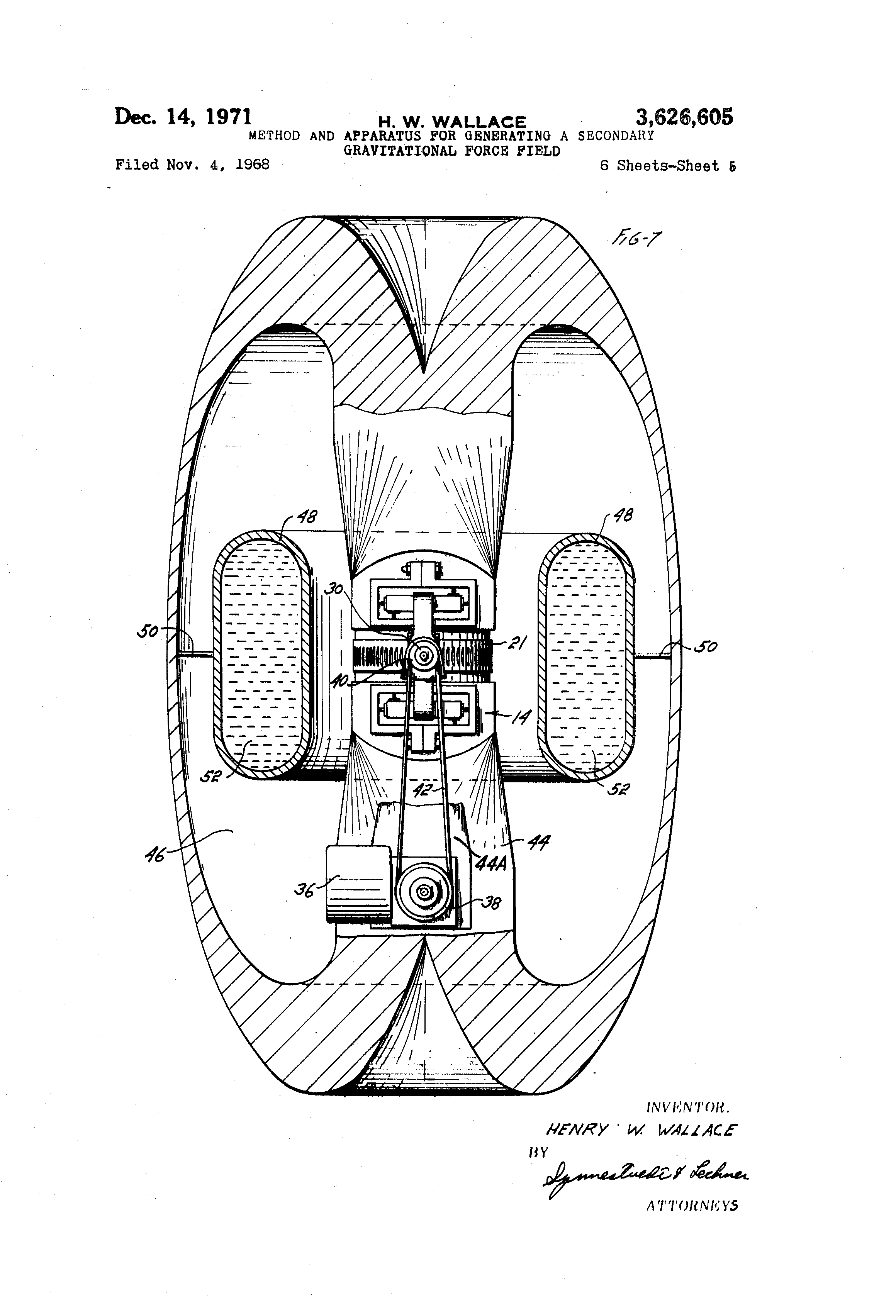
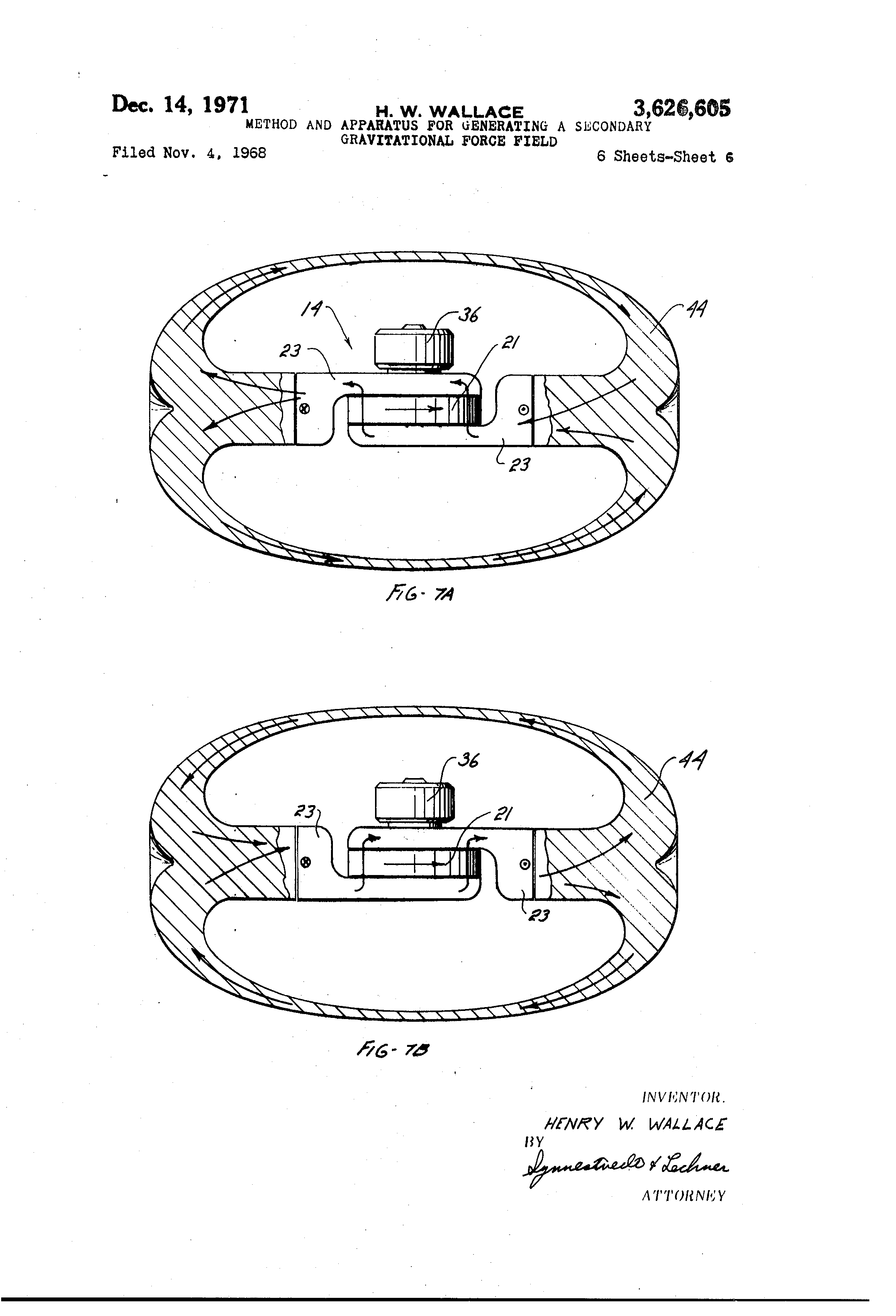
His bigger design (Fig. 7) wraps the generator in a brass shell, with a ring of mercury hung inside on fine steel spokes, and turns the whole generator on a second axis. The patent says a machine like this would lose its weight and rise "in a direction diametrically opposed to the local gravitational field force vector" (col. 12). No measurements are given for it.
What was measured, and what was not
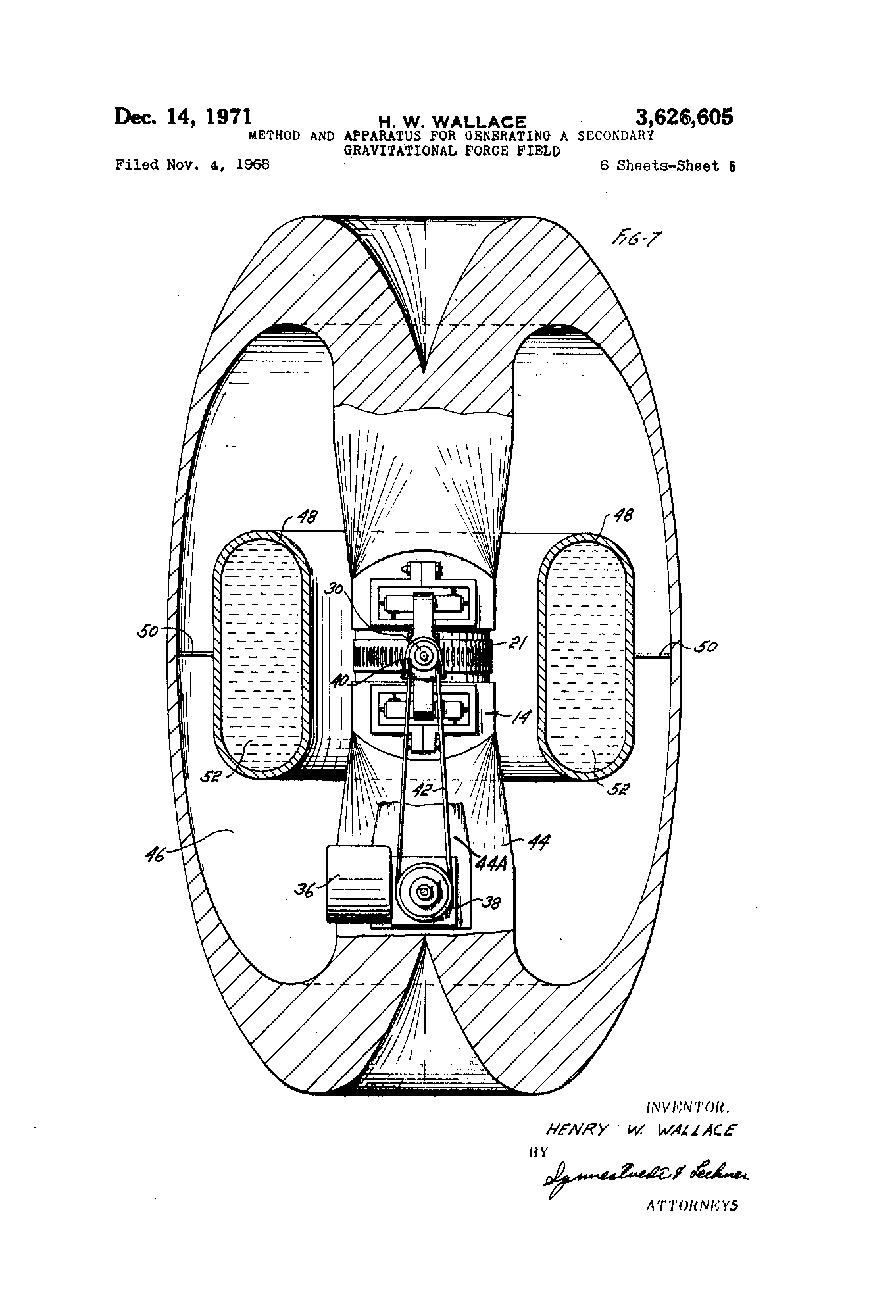
So what was measured was a spot of light: the resting point of a slowly rocking wheel, moving by a fraction of a degree. No weight was measured. The weightlessness, the "gravitational shielding for housing medical patients", the propulsion: all are described with no data (cols. 12-13).
The patent does not say how many runs there were, on which days, or whether anyone repeated them. It does not say whether the air jet, the building or the temperature were ruled out. The examiner cited nothing against it: the front page says "No references cited." Why it was granted, the patent does not say.
In 2001 two physicists reviewing such claims wrote that if Wallace's experiments "were reproducible this would represent a breakthrough" (Tajmar and de Matos). We found no one who has reproduced them. His patent ran its full term and expired in 1988.
Volfson, 2005: a ship with a superconducting shell
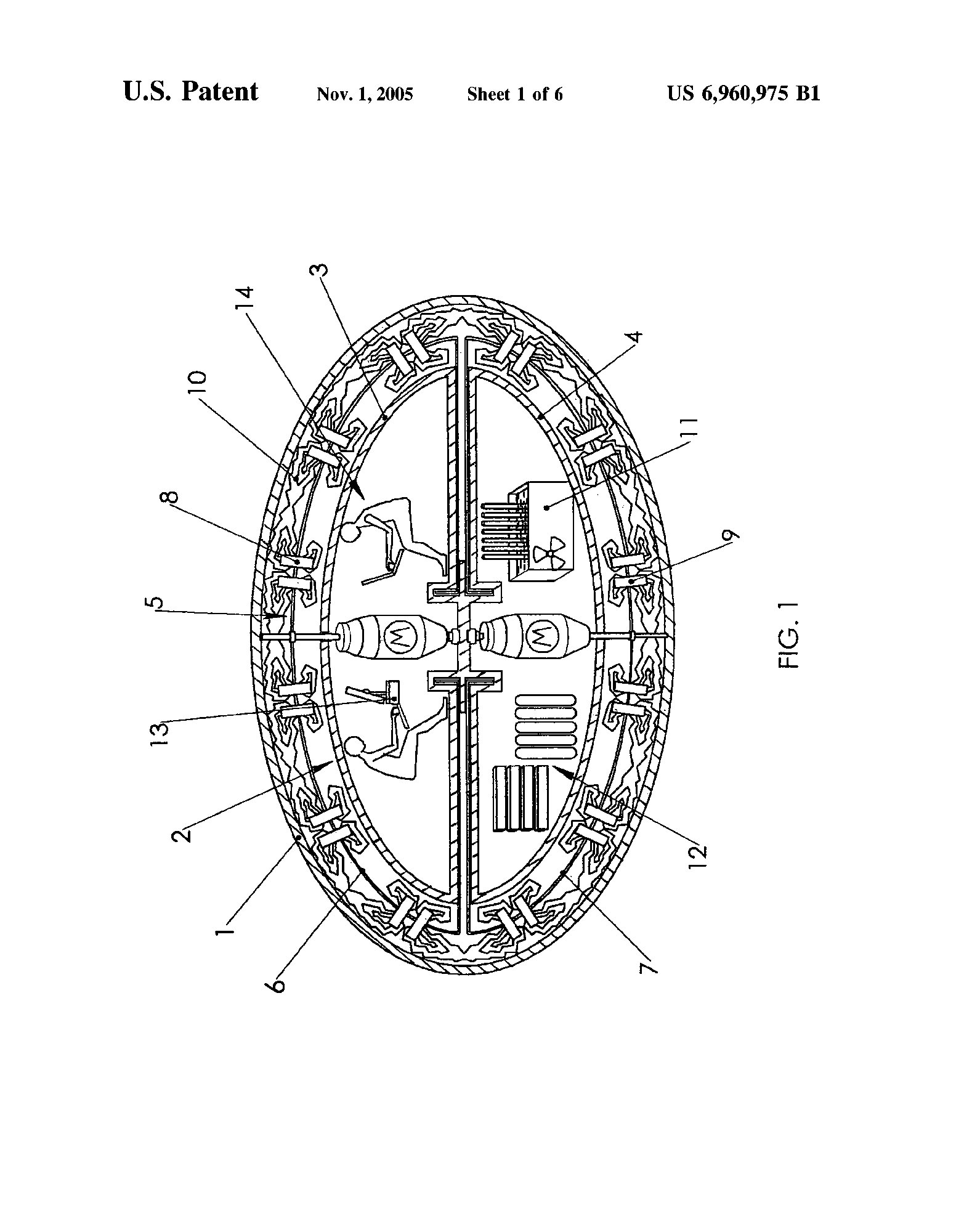
Thirty-four years later, Wallace's patent turned up again, in the references of another. Boris Volfson of Huntington, Indiana, filed in March 2005, and his patent was granted that November. Volfson listed his references himself: none is marked as cited by the examiner. They include all three of Wallace's patents: the 1971 one, a second granted the same day for a "dynamic force field" (US 3,626,606), and a 1974 "heat pump" (US 3,823,570). They also cite experiments by Podkletnov and Nieminen in the early 1990s, which "reportedly resulted in a reduction of the weights of objects" above a spinning superconducting disc; "The maximum weight loss reported by Podkletnov was 2.1%" (cols. 2, 9).
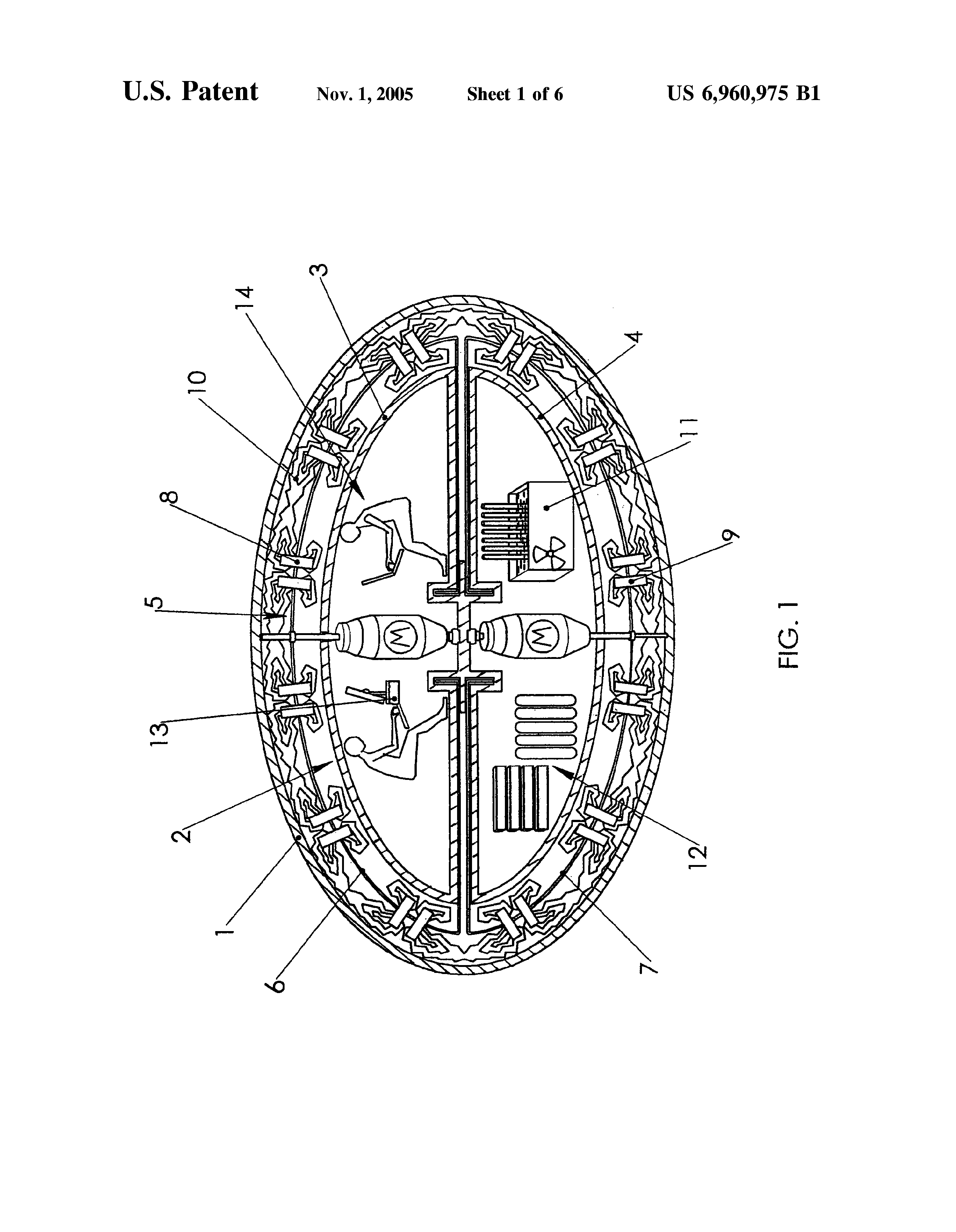
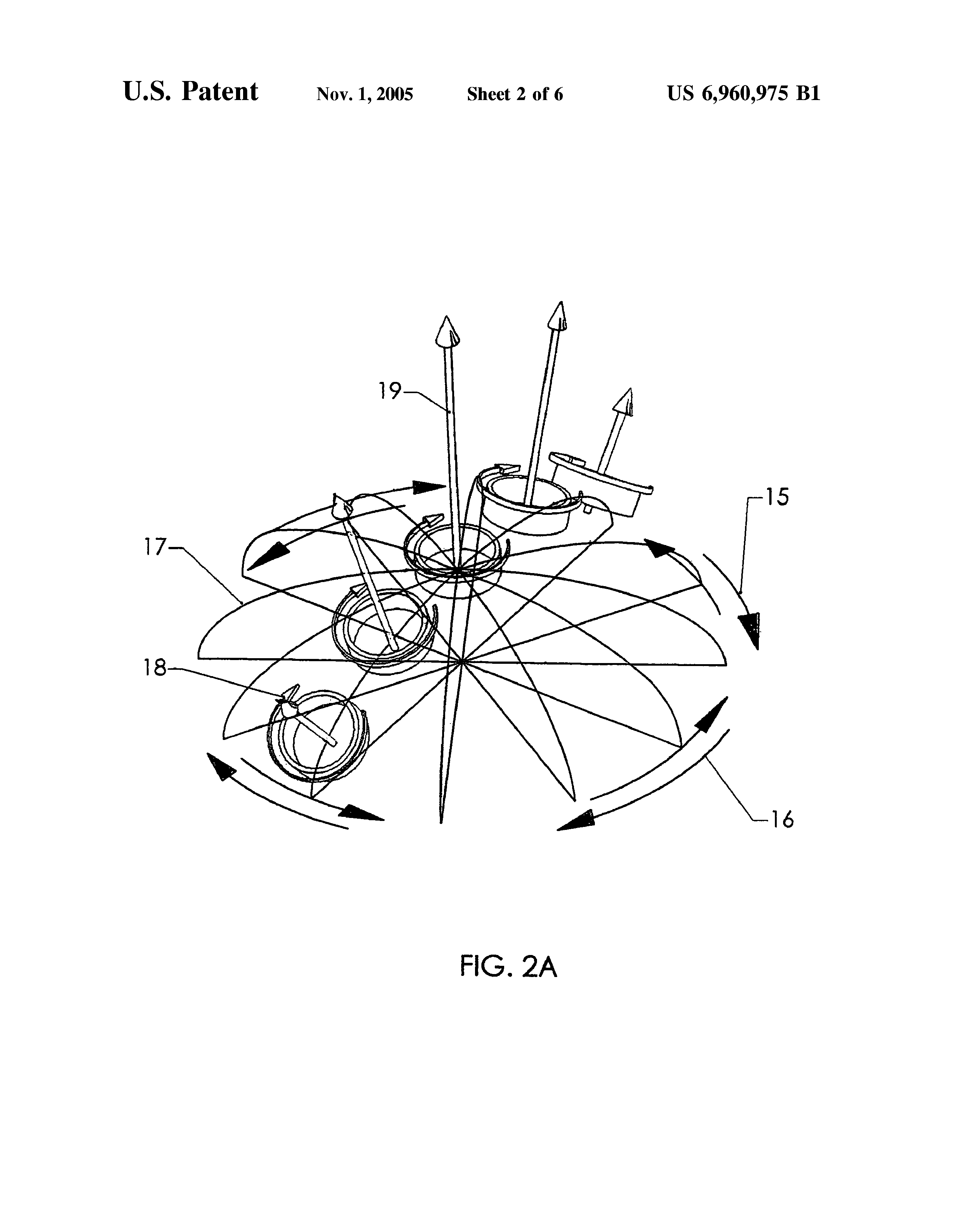
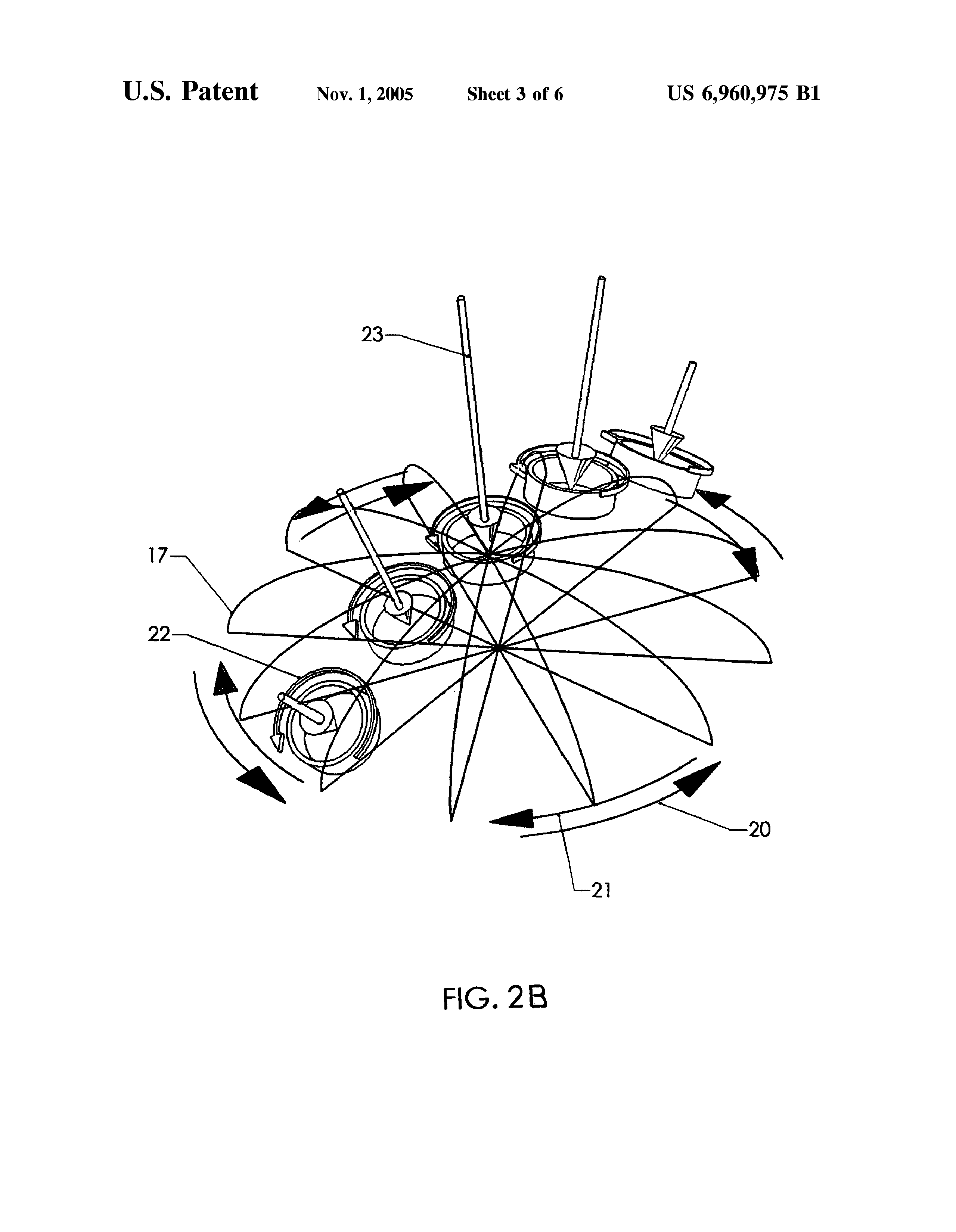
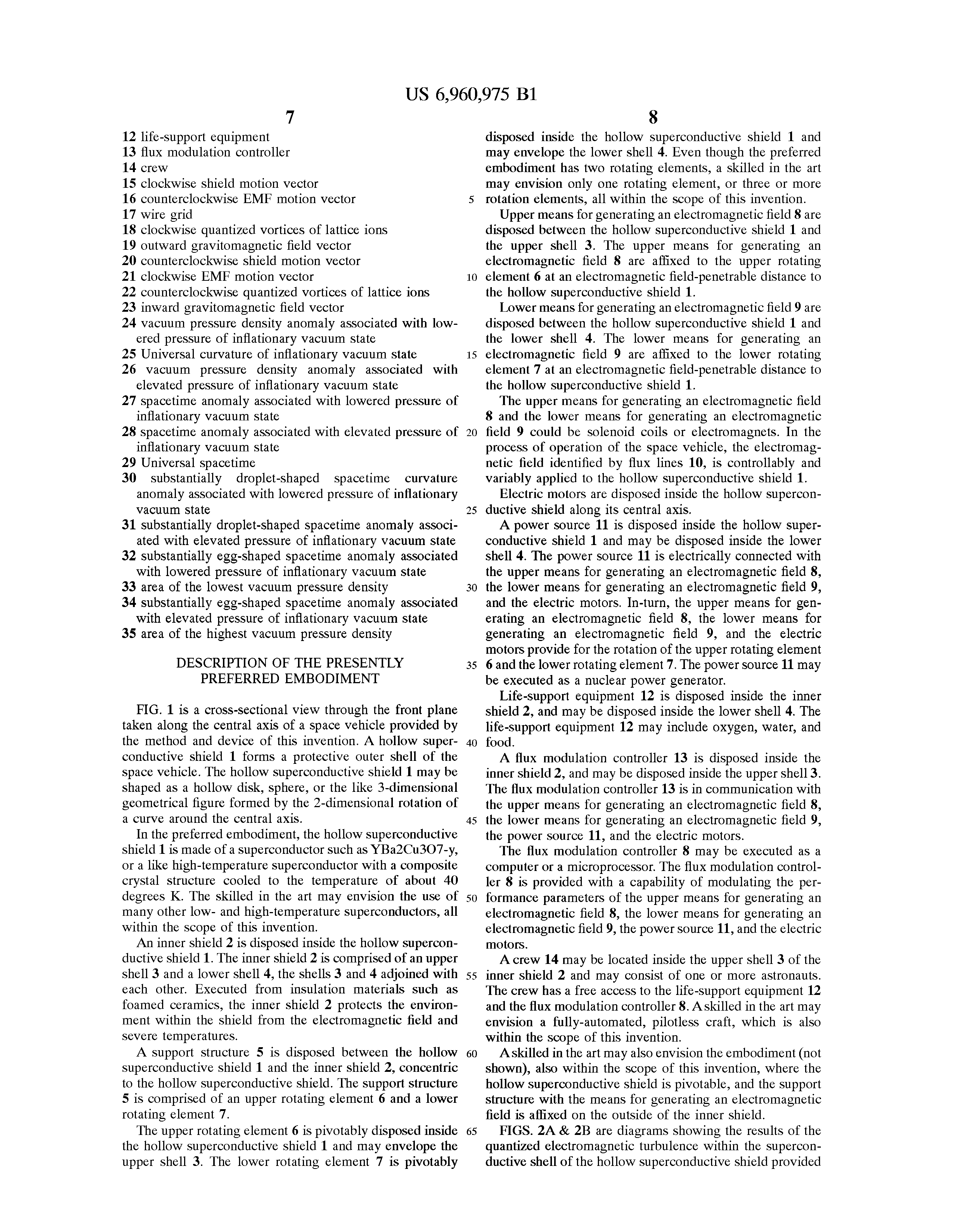
His craft is a hollow superconducting shell, "about 5 meters in diameter", of "YBa2Cu3O7-y ... cooled to the temperature of about 40 degrees K", with electromagnets turning against it, a power source that "may be executed as a nuclear power generator", and a crew (cols. 7-9). Its fields, the patent says, would curve spacetime around the ship, and "the spacetime curvature being the same as gravity, provides for the space vehicle's propulsion" (abstract).
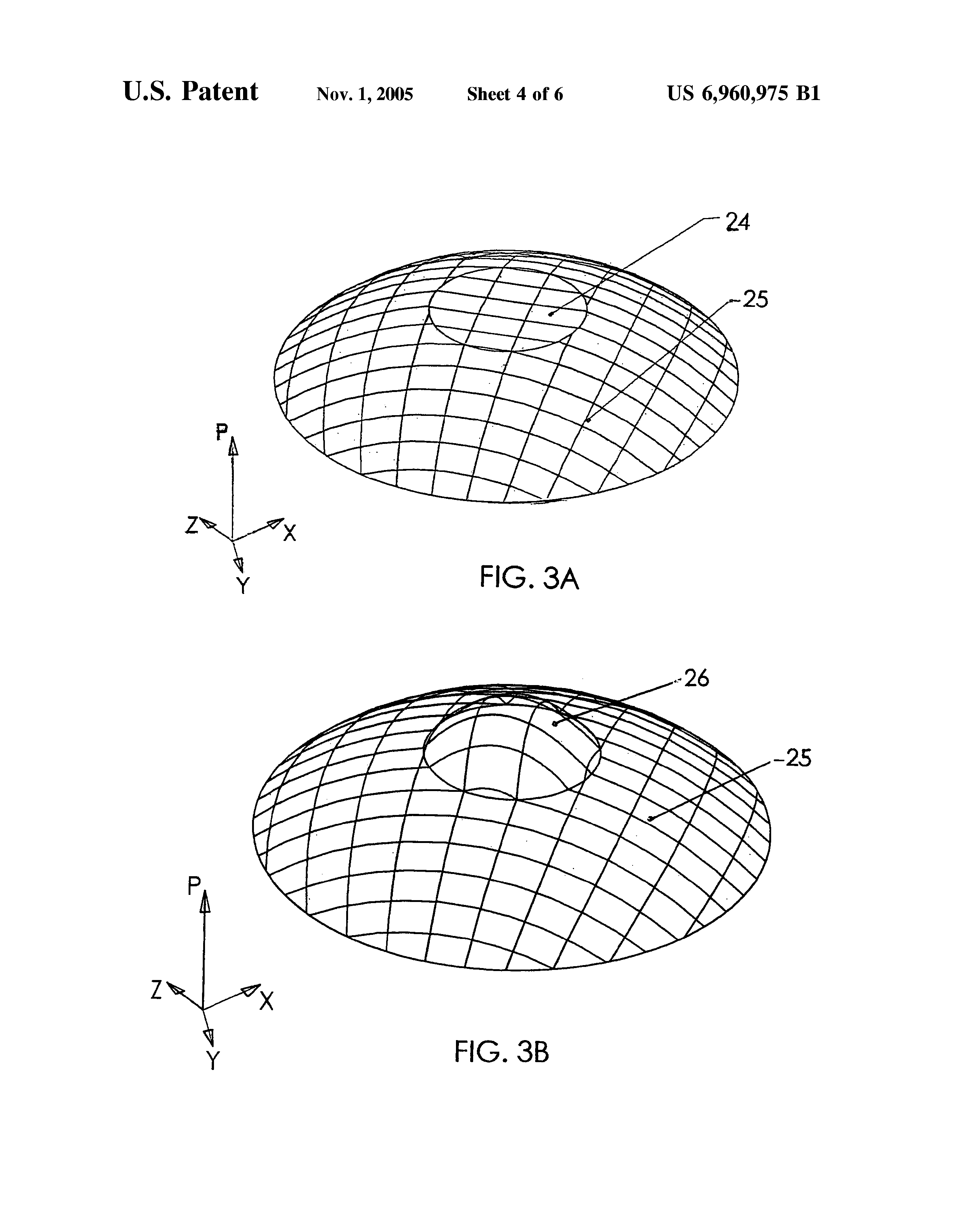
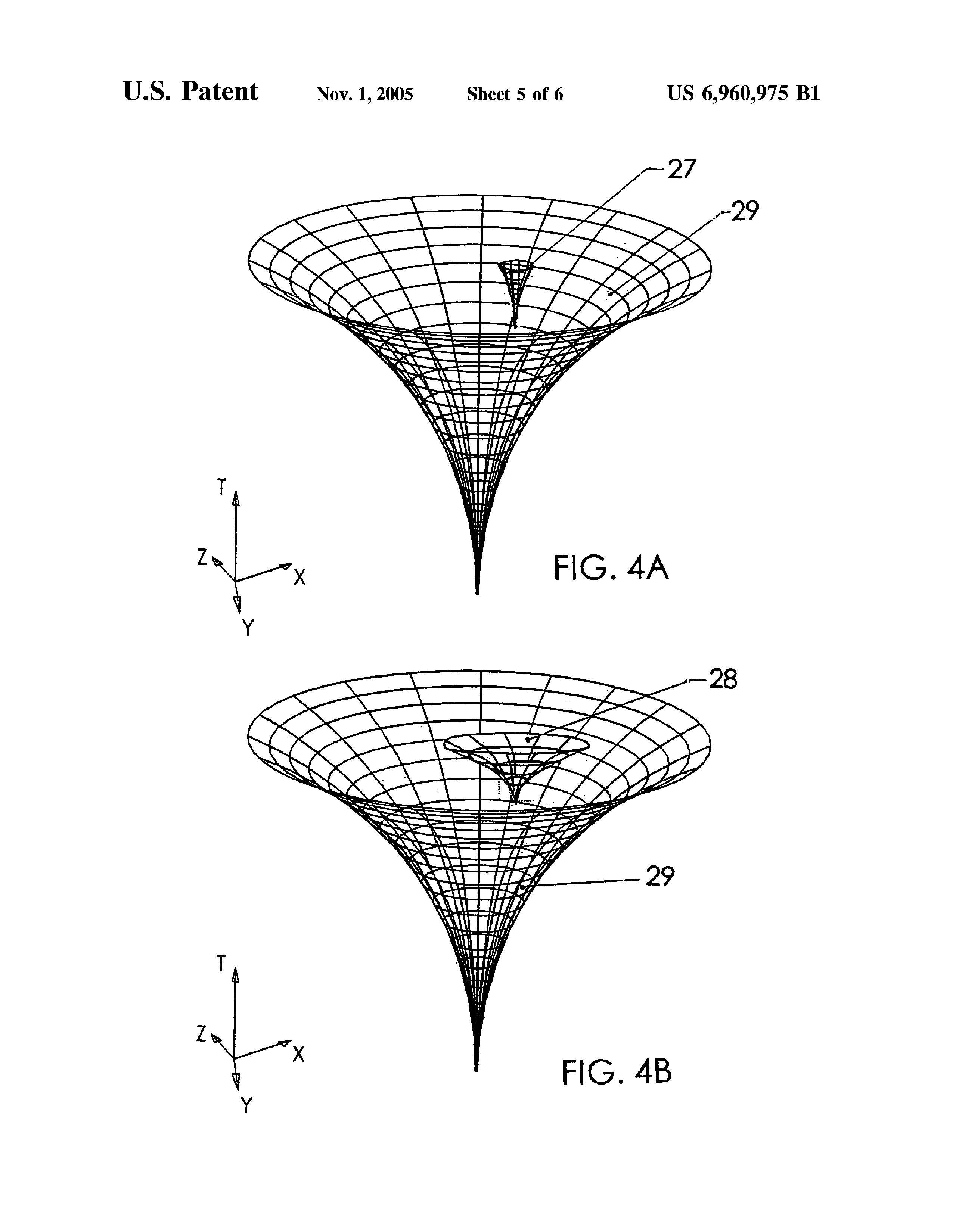
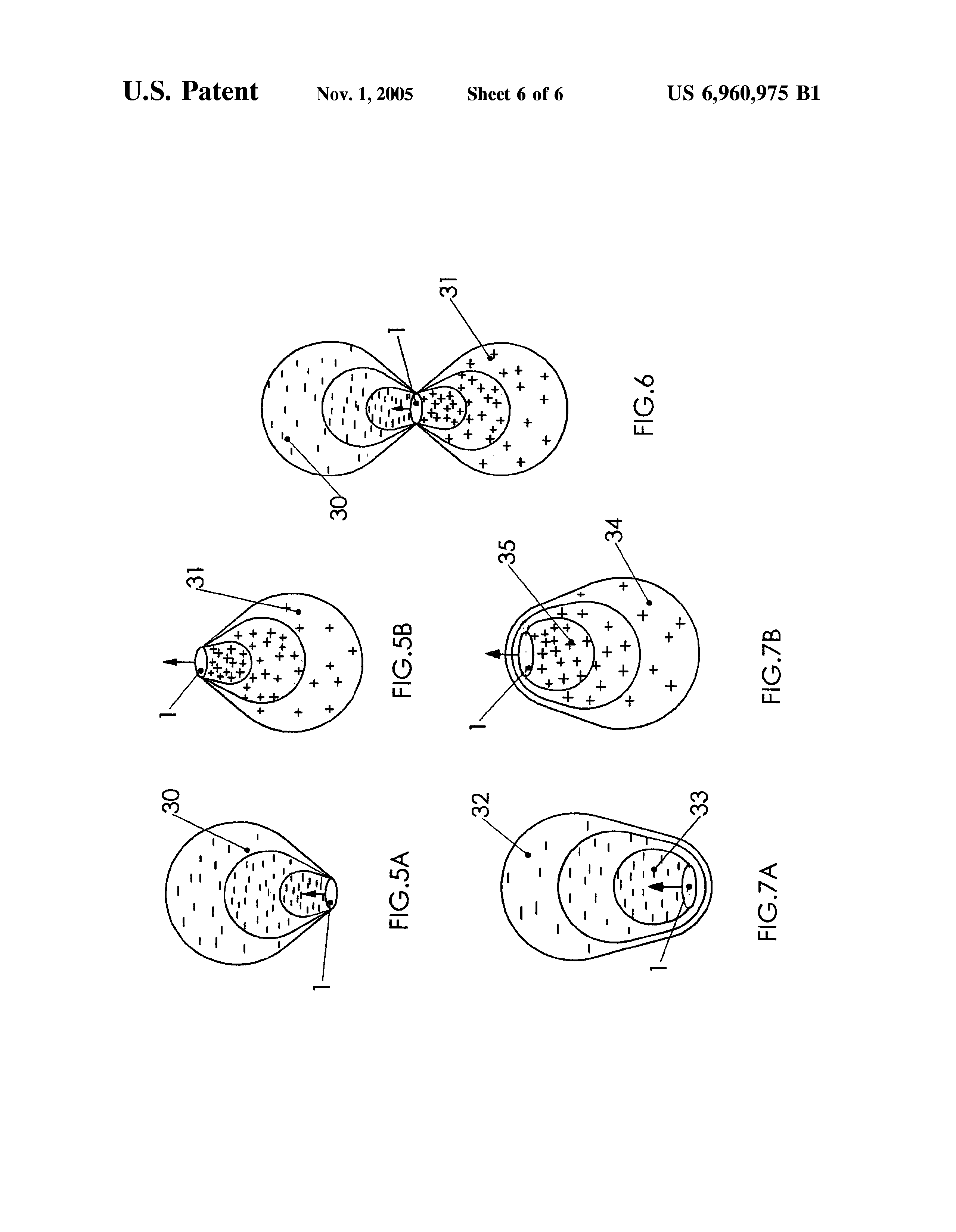
From the patent (Fig. 1, cols. 5-14): hollow superconductive shield 1, about 5 m across, cooled to about 40 K; inner shield 2 of upper and lower shells 3 and 4, foamed ceramics; support structure 5 with upper and lower rotating elements 6 and 7; coils 8 and 9 on them, 124 in all, a field-penetrable distance short of shield 1; flux lines 10; electric motors on the central axis; power source 11, life support 12, flux modulation controller 13, crew 14; the turning "against" shield 1, clockwise seen from above (Figs. 5A, 5B); the field vectors inward at the front and outward behind (Figs. 2A, 2B), and Fig. 6's two "droplets" of lowered and raised vacuum pressure. Ours: every size but the 5 m width (proportions measured from Fig. 1), the layout of the 124 coils, the bearings at the poles, the cable runs, the seats, the crew drawn at Fig. 1's proportions (smaller than life), the colours, the speeds of turning and travel, and the sizes of the field diagrams. The field and pressure steps are diagrams of what the patent says, not to scale, and the last step moves the craft only because the patent says it would move. It was never built or shown to work. Checked by a test of our own, the episode's, run again on this page's copy: 32 checks, all pass (the parts under the patent's numbers, 124 coils, the coils clear of shield 1 through a full turn, the turn clockwise seen from above, nothing passing through anything).
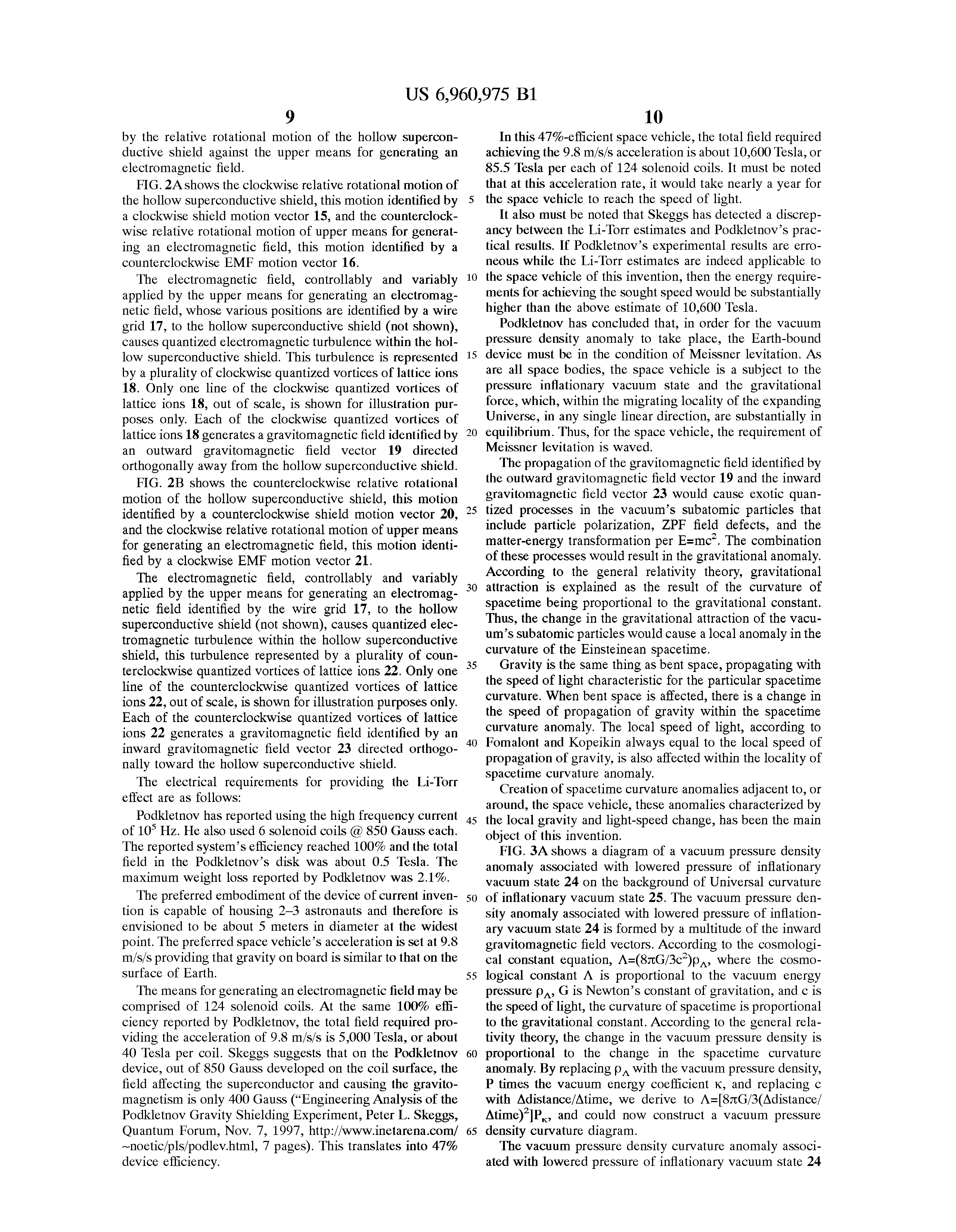
It works out the numbers: 124 coils, "about 10,600 Tesla, or 85.5 Tesla per each of 124 Solenoid coils". At that rate, it says, "it would take nearly a year for the Space vehicle to reach the speed of light" (cols. 9-10). For comparison, the strongest steady magnets at America's National High Magnetic Field Laboratory reach 45 tesla. Each of those coils would need nearly twice that.
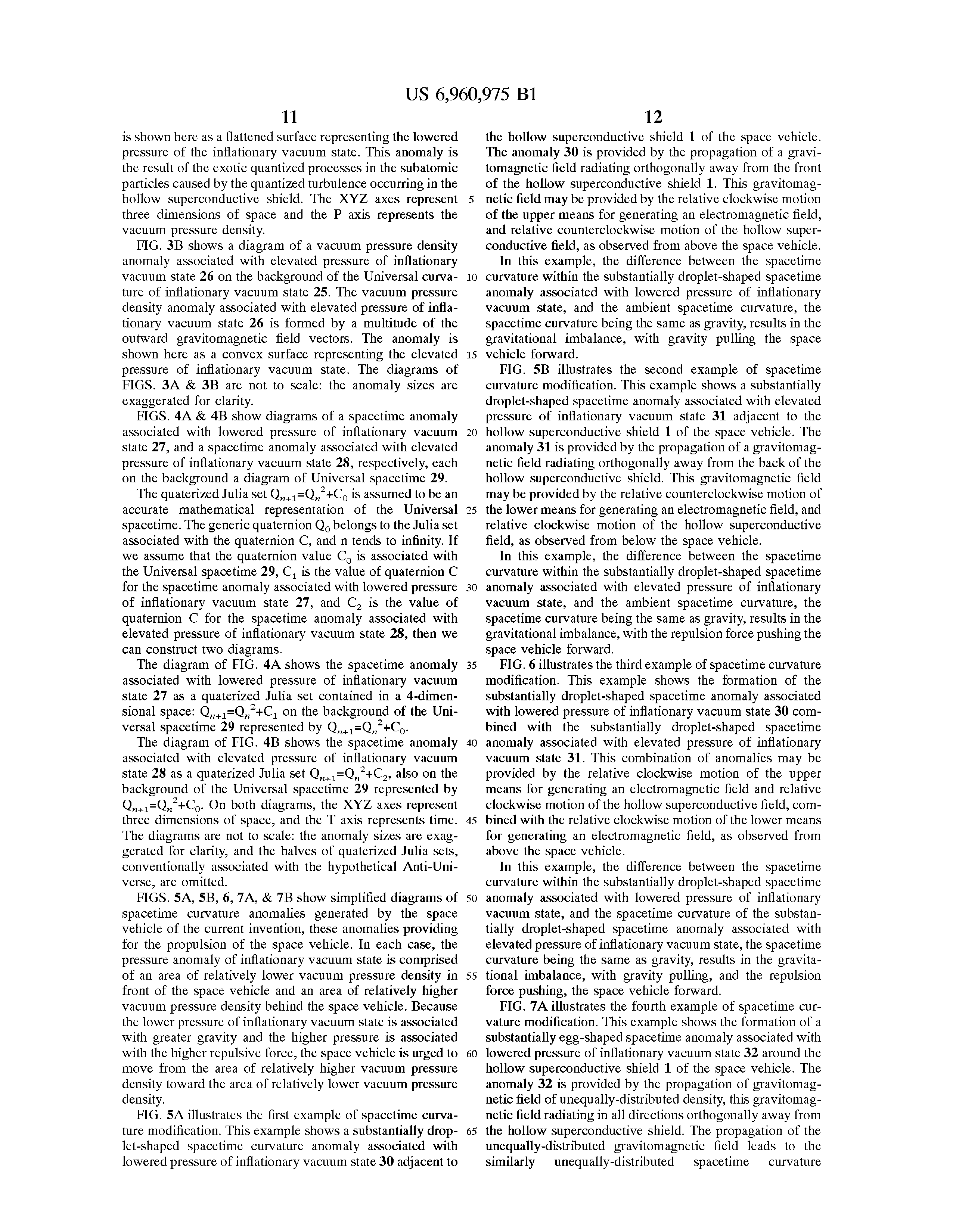
It names its inspiration: H. G. Wells's The First Men in the Moon, and its gravity-repelling "cavorite". "Until today," the patent says, "no cavorite has been discovered" (cols. 4-5). There is no test or measurement anywhere in it: we read all fourteen columns.
The journal Nature reported the grant that month, under the headline "Antigravity craft slips past patent officers" (P. Ball, 10 November 2005; we have read the headline and subtitle, not the article). In 2009 the maintenance fee was not paid, and the patent lapsed.
The Navy's craft, 2018, and the letter
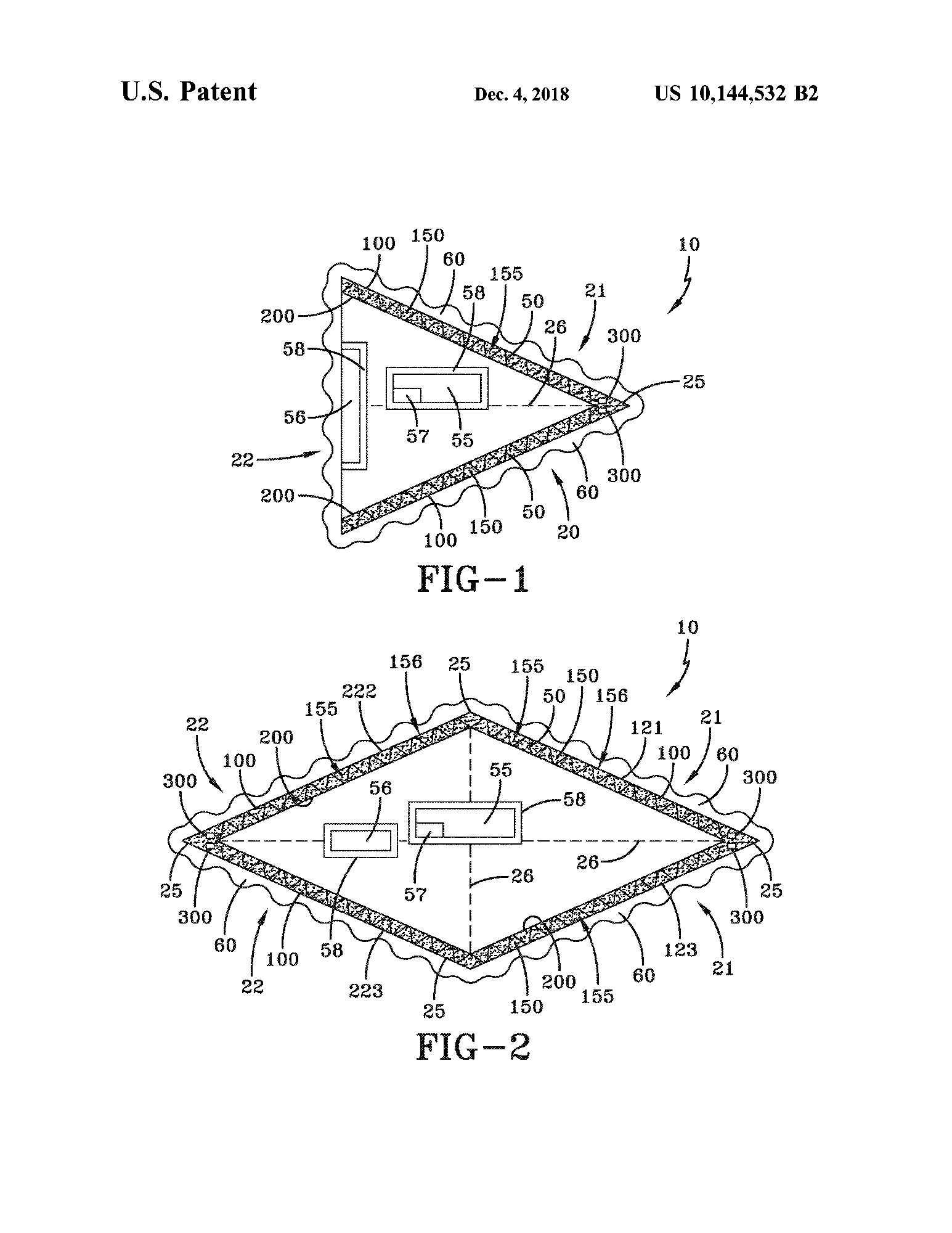
In April 2016 a patent application was filed for the United States Navy, from its air warfare centre at Patuxent River, Maryland (NAWCAD). The inventor was a Navy engineer, Salvatore Pais. The title: "craft using an inertial mass reduction device".
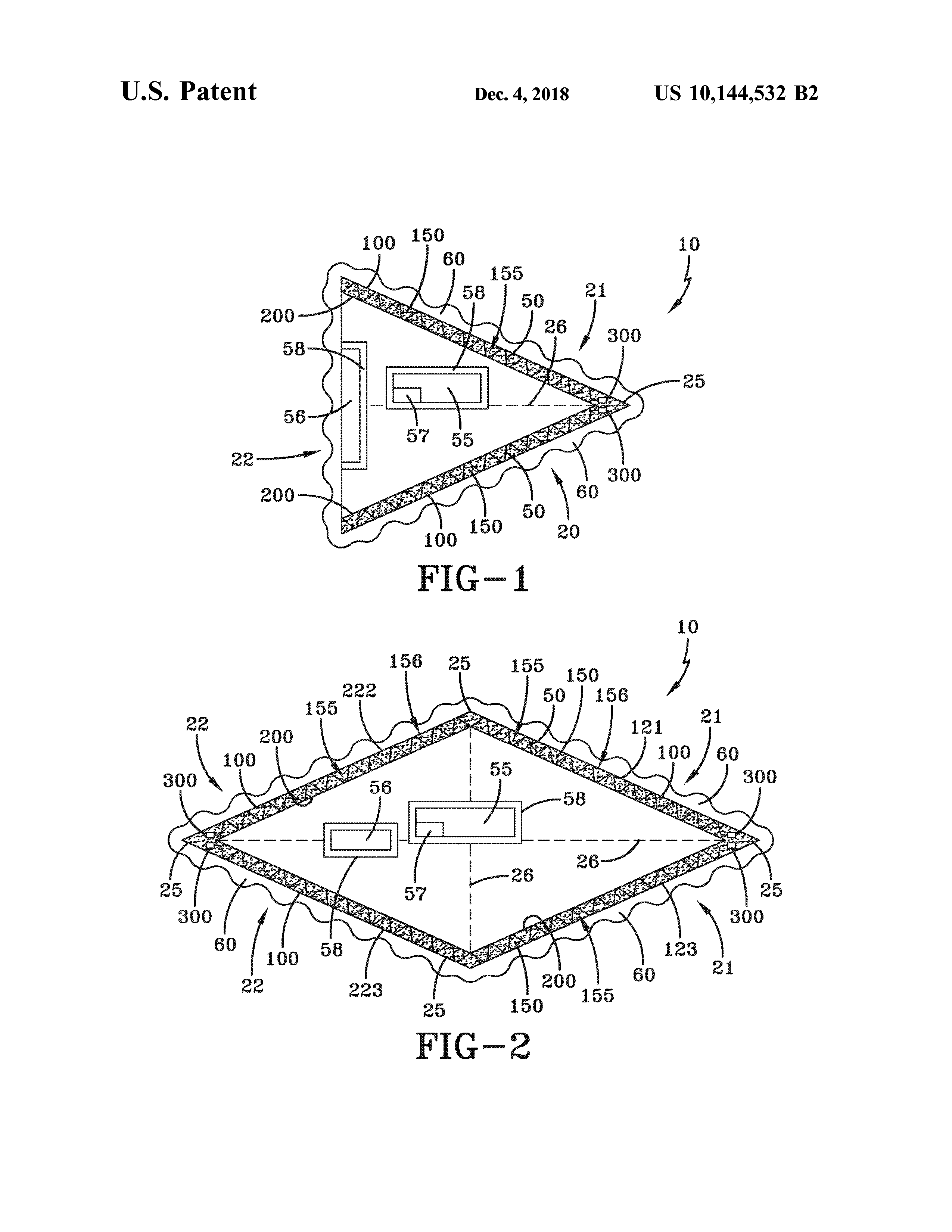
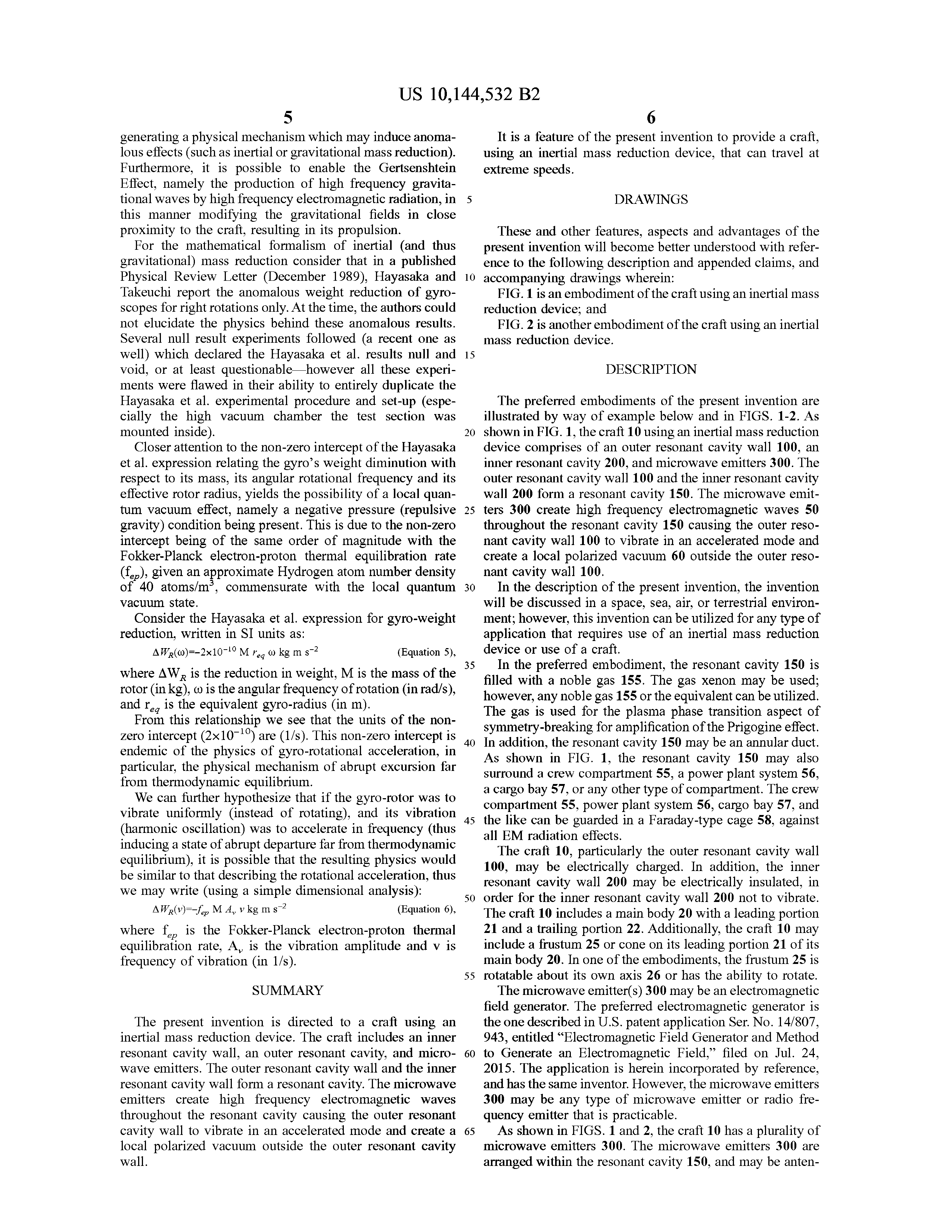
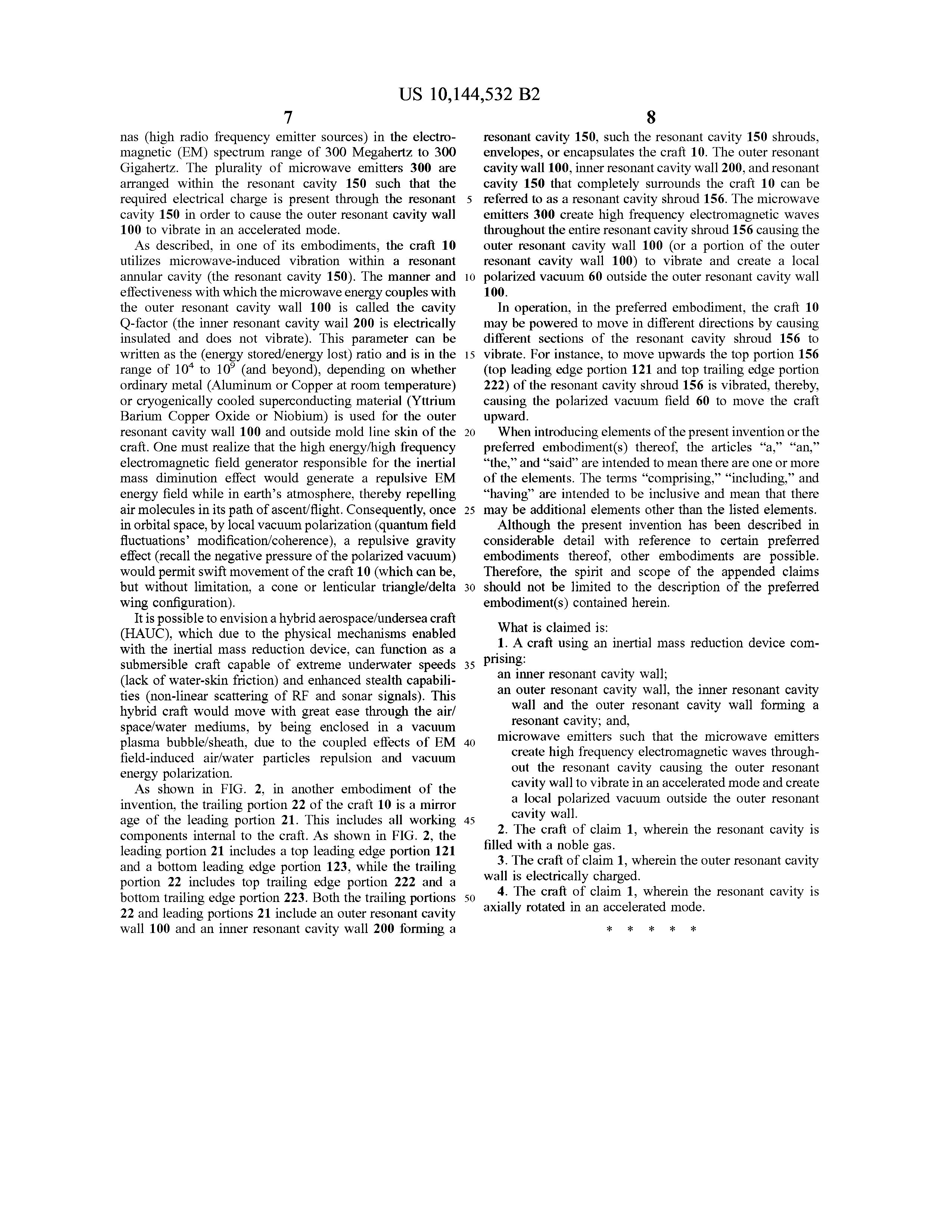
Between the inner and outer walls of the hull is a resonant cavity, "filled with a noble gas 155. The gas xenon may be used". Microwave emitters make the outer wall "vibrate in an accelerated mode", and with it "electrically charged" and the cavity "axially rotated in an accelerated mode", the patent says, it creates "a local polarized vacuum" outside (claims 1-4; col. 6). The craft would then move into the void ahead of it: "It may be stated that the void 'sucks in the craft'" (col. 4). The title and claims never say gravity; the text does, "repulsive gravity", four times.
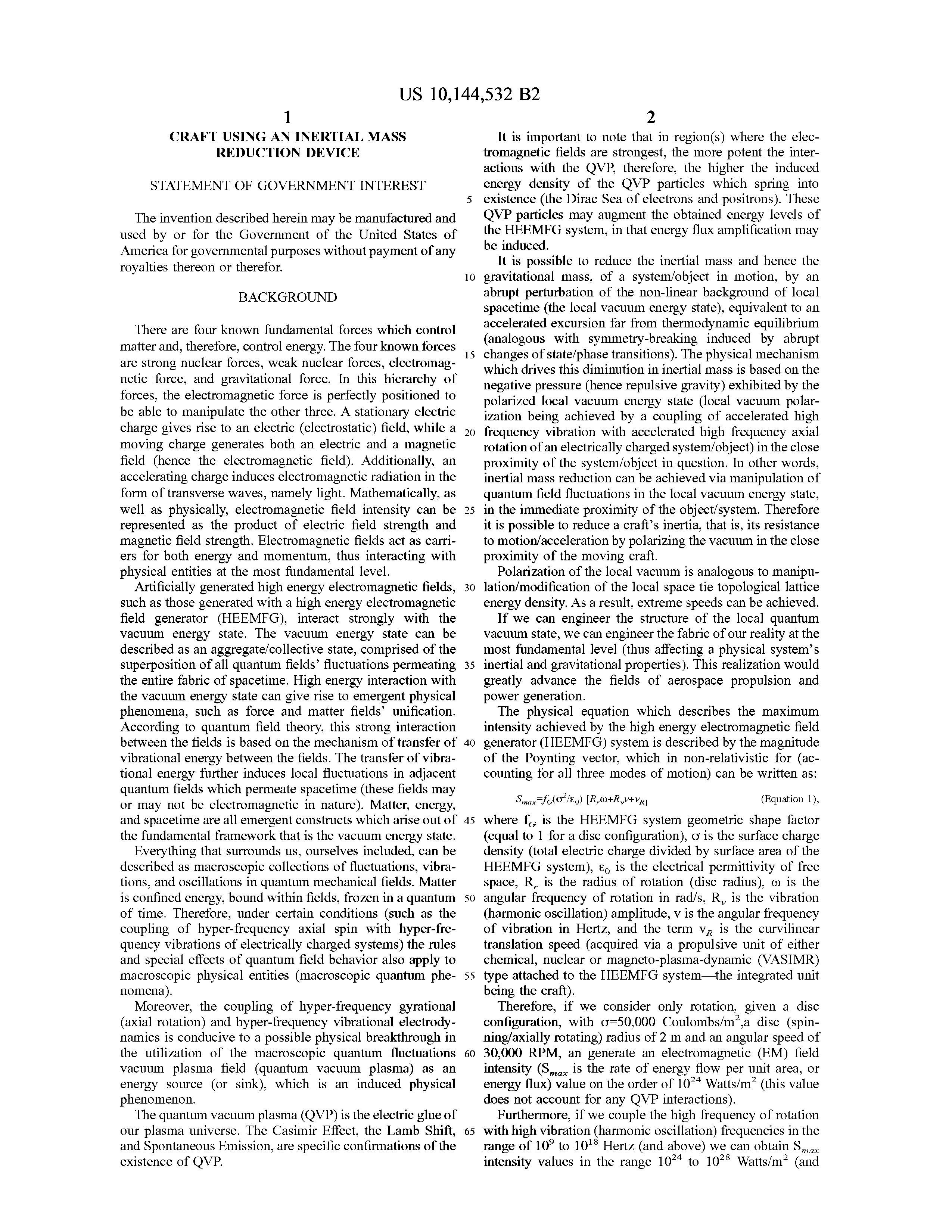
It reasons from equations, with a disc of "radius of 2 m and an angular speed of 30,000 RPM" (col. 2). It reports no experiment.
From the patent (Figs. 1 and 2, cols. 4-8, claims 1-4): craft 10 with outer resonant cavity wall 100 and inner wall 200 forming resonant cavity 150, filled with noble gas 155 (xenon); microwave emitters 300 sending waves 50 through the cavity, 300 MHz to 300 GHz; wall 100 charged and vibrating "in an accelerated mode", wall 200 insulated so as not to vibrate; the cavity "axially rotated in an accelerated mode"; frustum 25 rotatable about axis 26; crew compartment 55, power plant system 56 and cargo bay 57 in Faraday-type cages 58; the "local polarized vacuum 60" drawn round the craft; in Fig. 2, the trailing portion a mirror image of the leading one, and the top of shroud 156 vibrated to move the craft upward. Ours: every size (the patent gives none: 10 m from base to tip, proportions measured from Fig. 1), the wall thicknesses, the cavity's rear seal, the spindle carrying frustum 25, the number and place of emitters 300, the compartments' depth, the colours, the vibration (exaggerated and slowed), the spin and travel speeds, and the size and wave of envelope 60, which is a diagram. The last steps move the craft only because the patent says it would move. It was never built or shown to work. Checked by a test of our own, the episode's, run again on this page's copy: 49 checks, all pass (the walls, the cavity and the cages where the figures put them, the inner wall still while the outer vibrates, nothing passing through anything).
The examiner, Philip Bonzell, rejected all four claims, in November 2017 and again in March 2018. The ground was not that it could not work, but that no one skilled in the field could make it (35 U.S.C. 112(a), enablement). To polarize the vacuum, he wrote, "it would take 109 [T]eslas and 1018 V/m", which he held was "not feasible with current technology" (as quoted in the Navy's appeal brief).
On 15 December 2017, between the two rejections, the Navy's chief technology officer for naval aviation wrote to the examiner:
"Dr Pais has shared your review of his patent disclosure and I agree with your main point that this mode of acceleration / movement is beyond the state of the possible, at least at present."
He said the inventor was "currently one year into the project and has already begun a series of experiments". And:
"China is already investing significantly in this area and I would prefer we hold the patent as opposed to paying forever more to use this revolutionary technology."
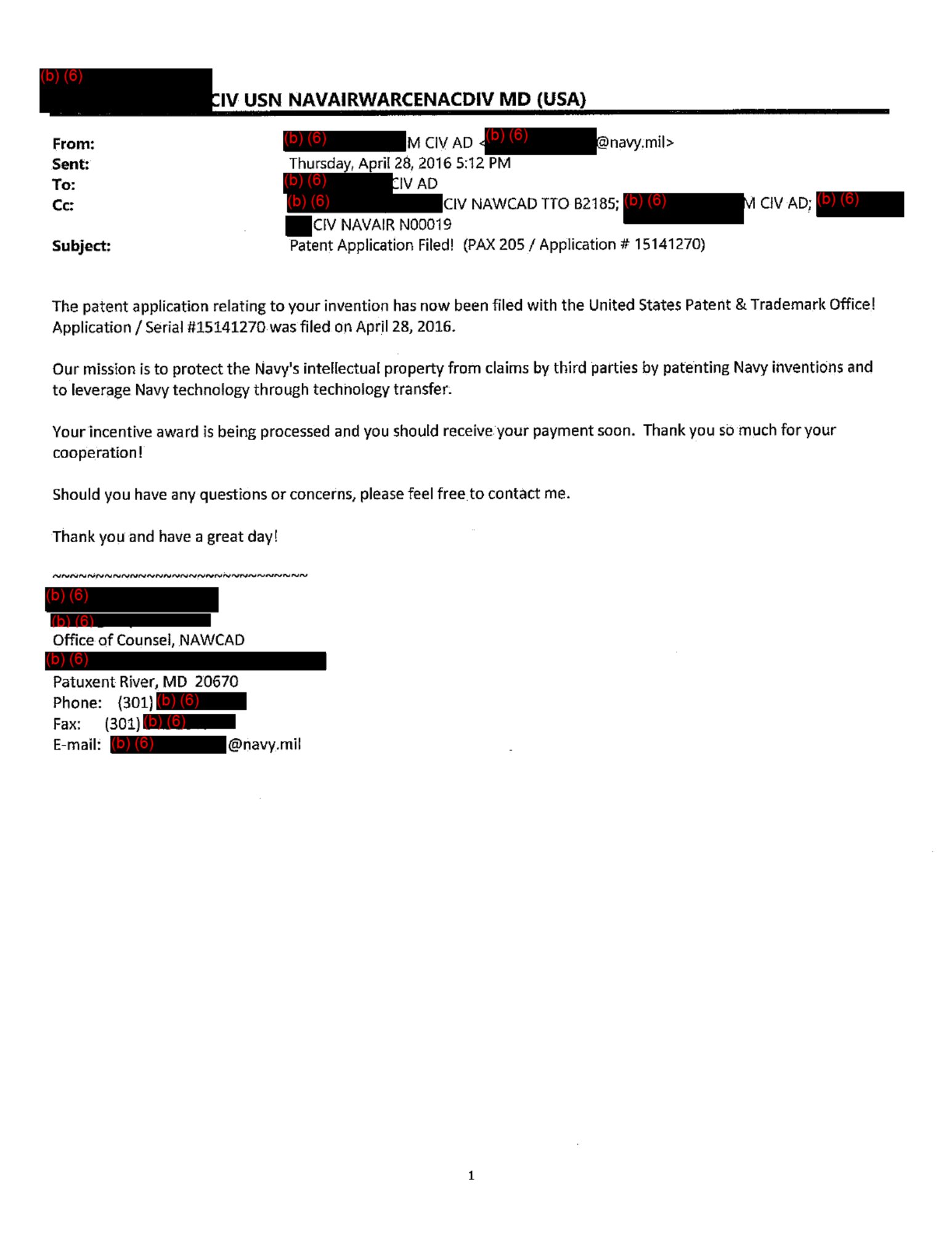
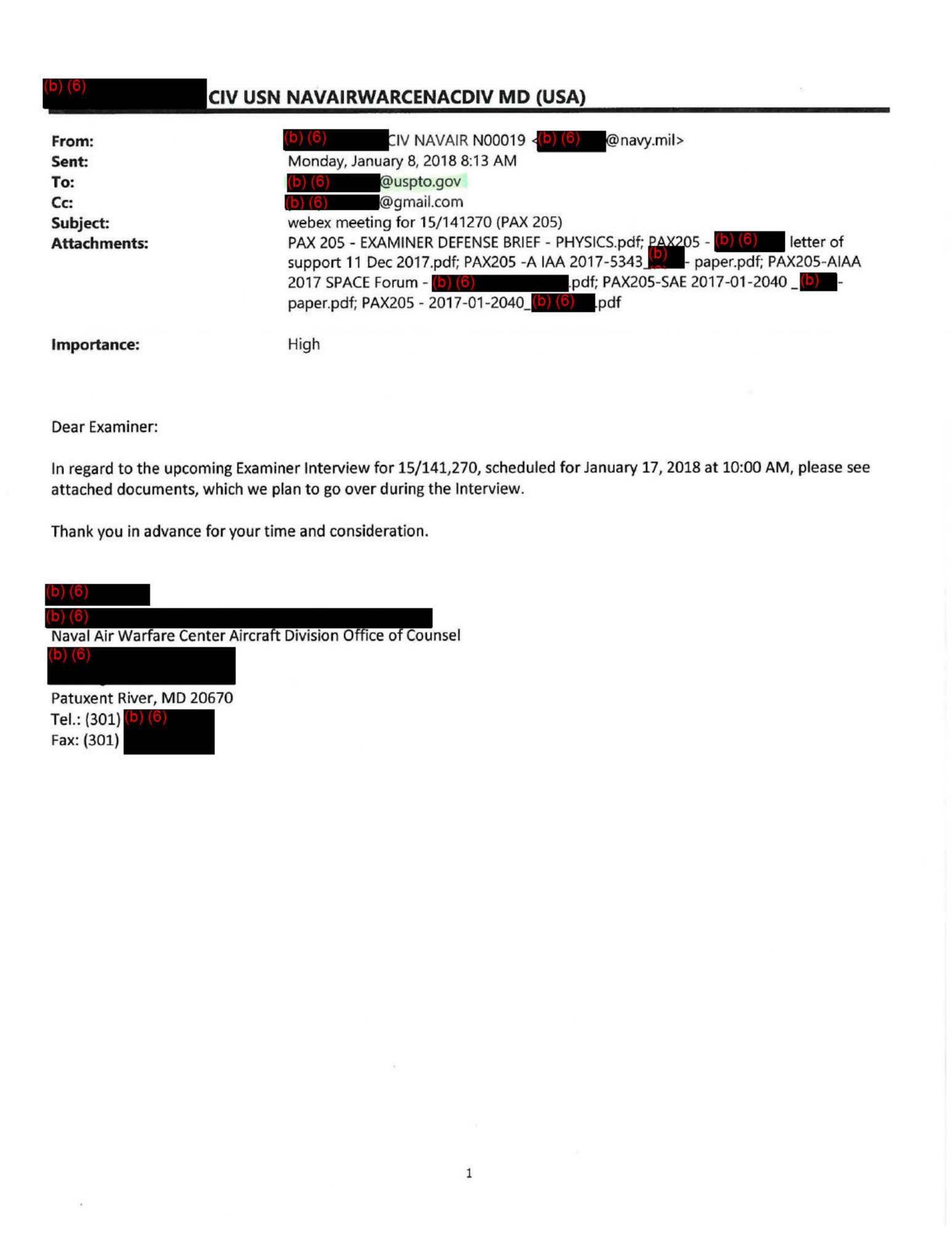
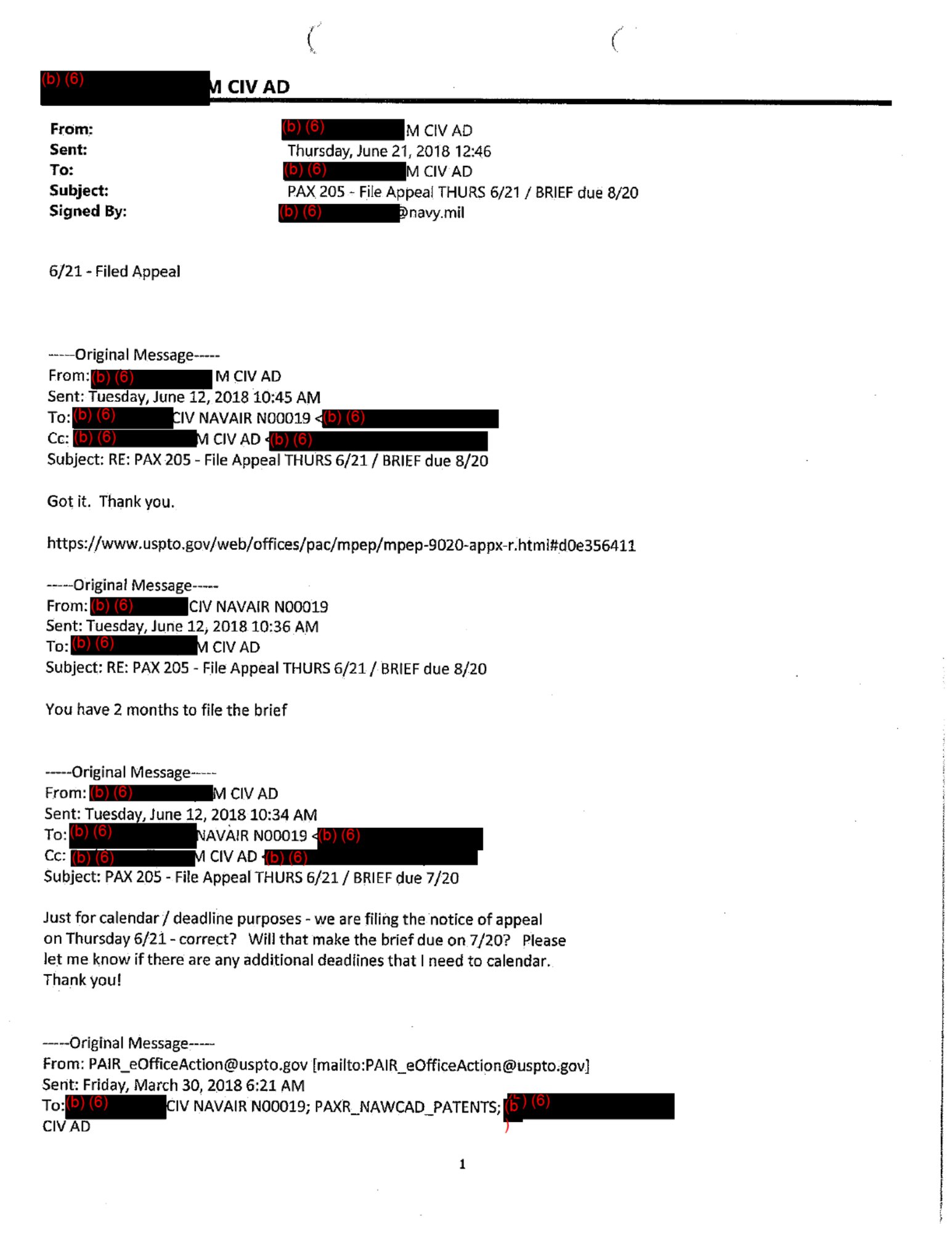
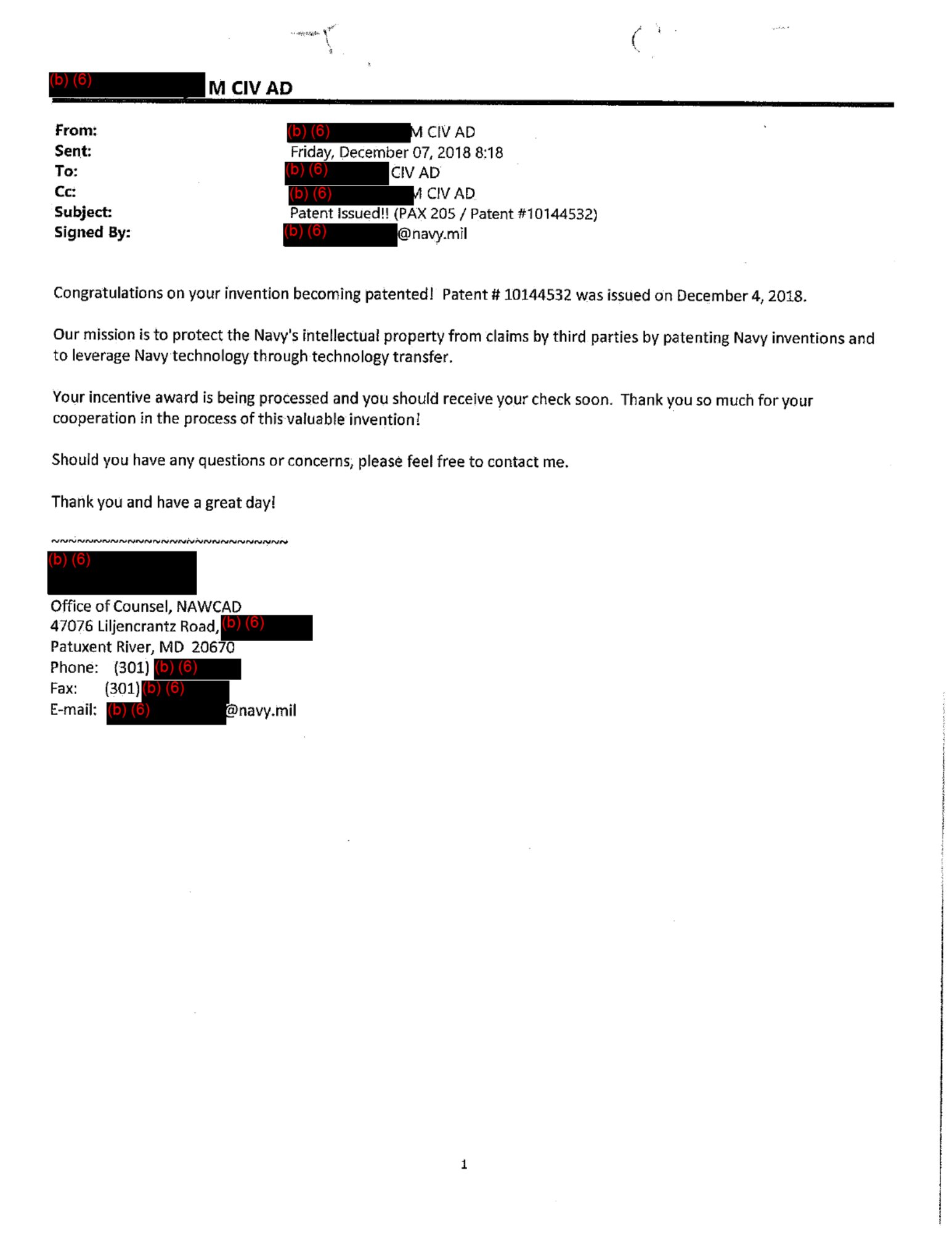
In January 2018 the Navy's lawyers sent the examiner that letter and a physics brief, to go over at an interview. The final rejection came anyway, in March. The Navy appealed in June. The application was then allowed, and the patent was granted on 4 December 2018. Why it was allowed after the appeal is not in any document we could read. The letter is in the file; the examiner's reasons, if he gave any, we have not seen. On 7 December the Navy's patent office e-mailed the inventor: "Congratulations on your invention becoming patented!"
| 28 April 2016 | Filed for the Navy |
|---|---|
| 28 November 2017 | All four claims rejected (enablement) |
| 15 December 2017 | The chief technology officer's letter to the examiner |
| 17 January 2018 | Interview set with the examiner |
| 30 March 2018 | Final rejection |
| 21 June 2018 | Notice of appeal filed |
| 4 December 2018 | Granted |
What the Navy tested
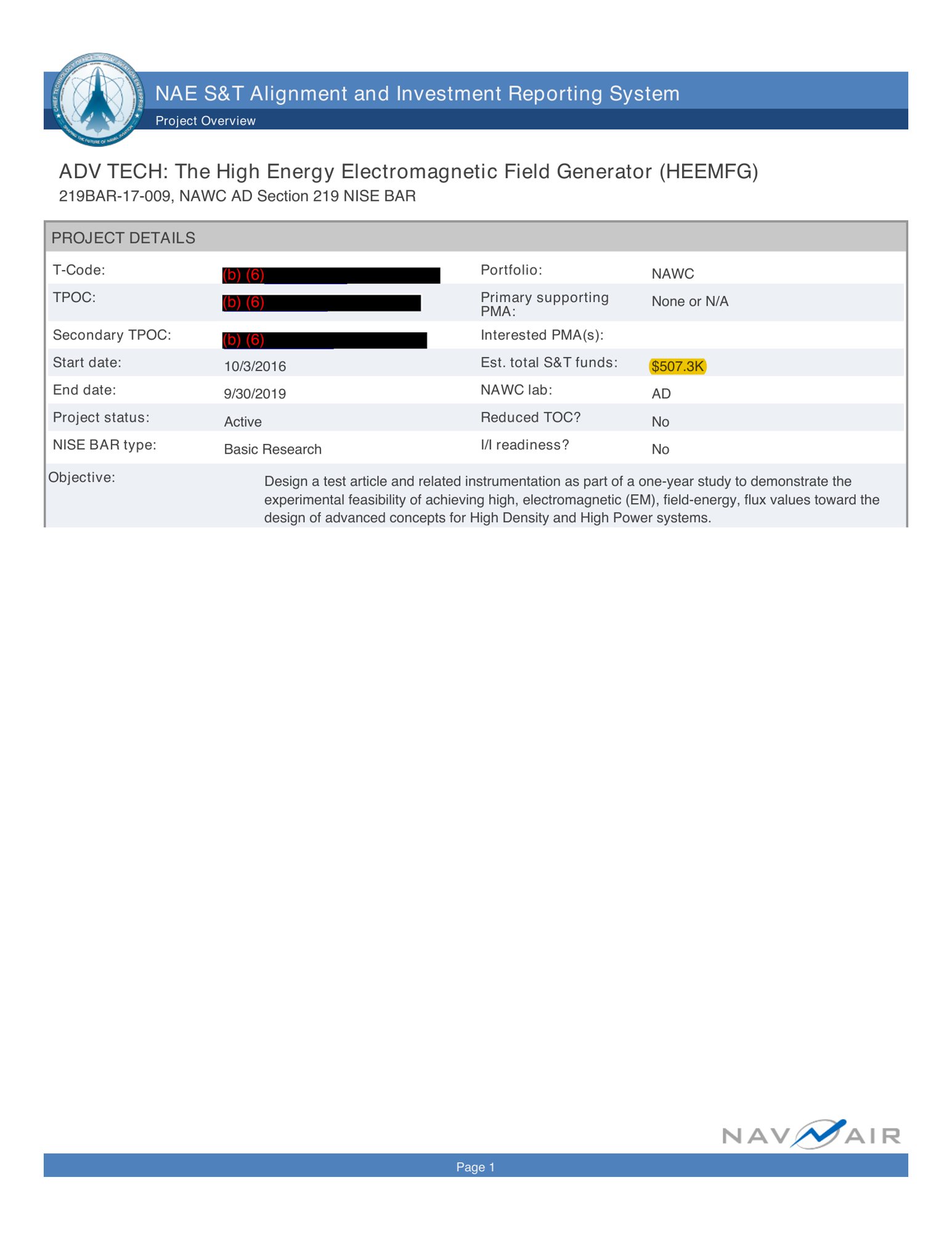
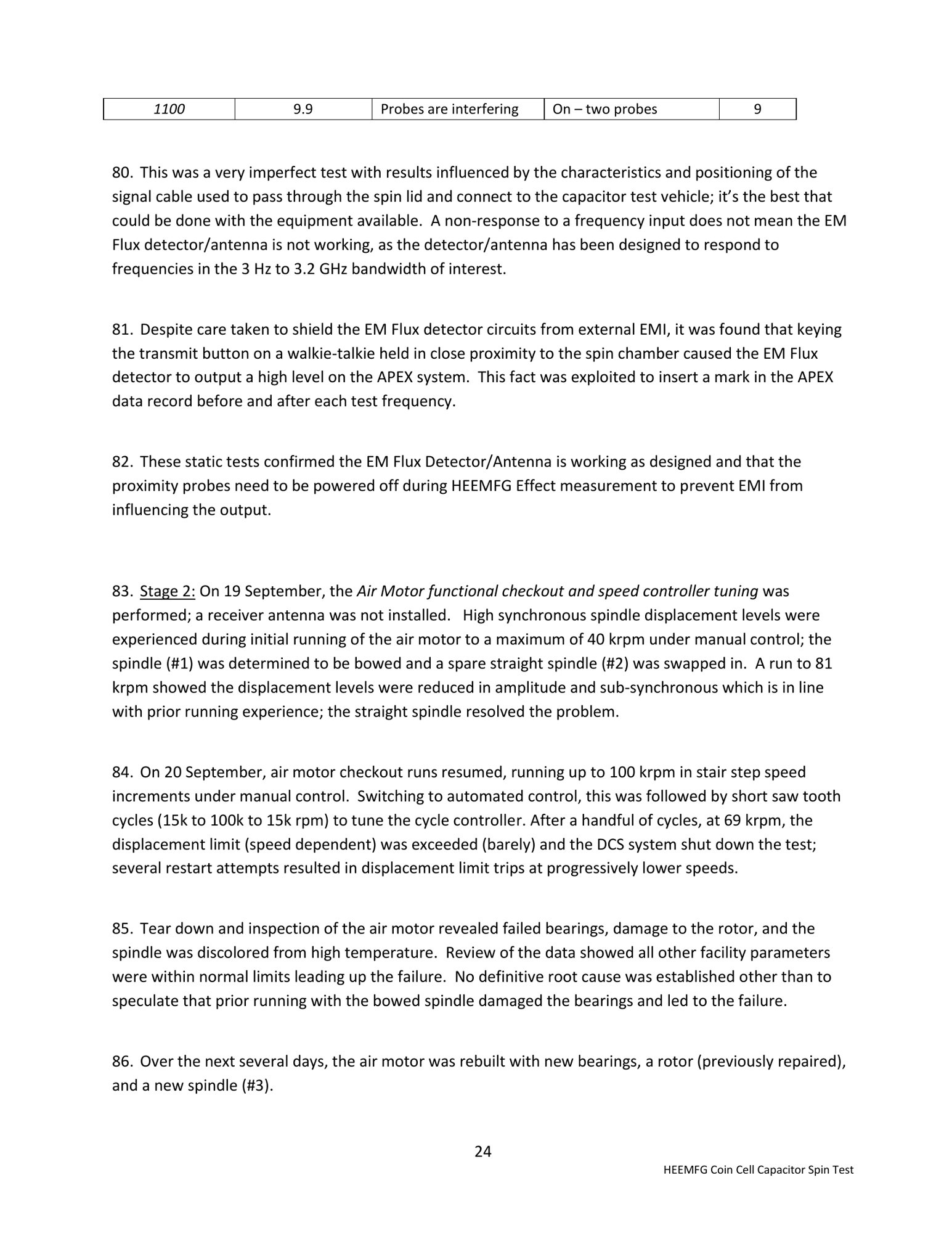
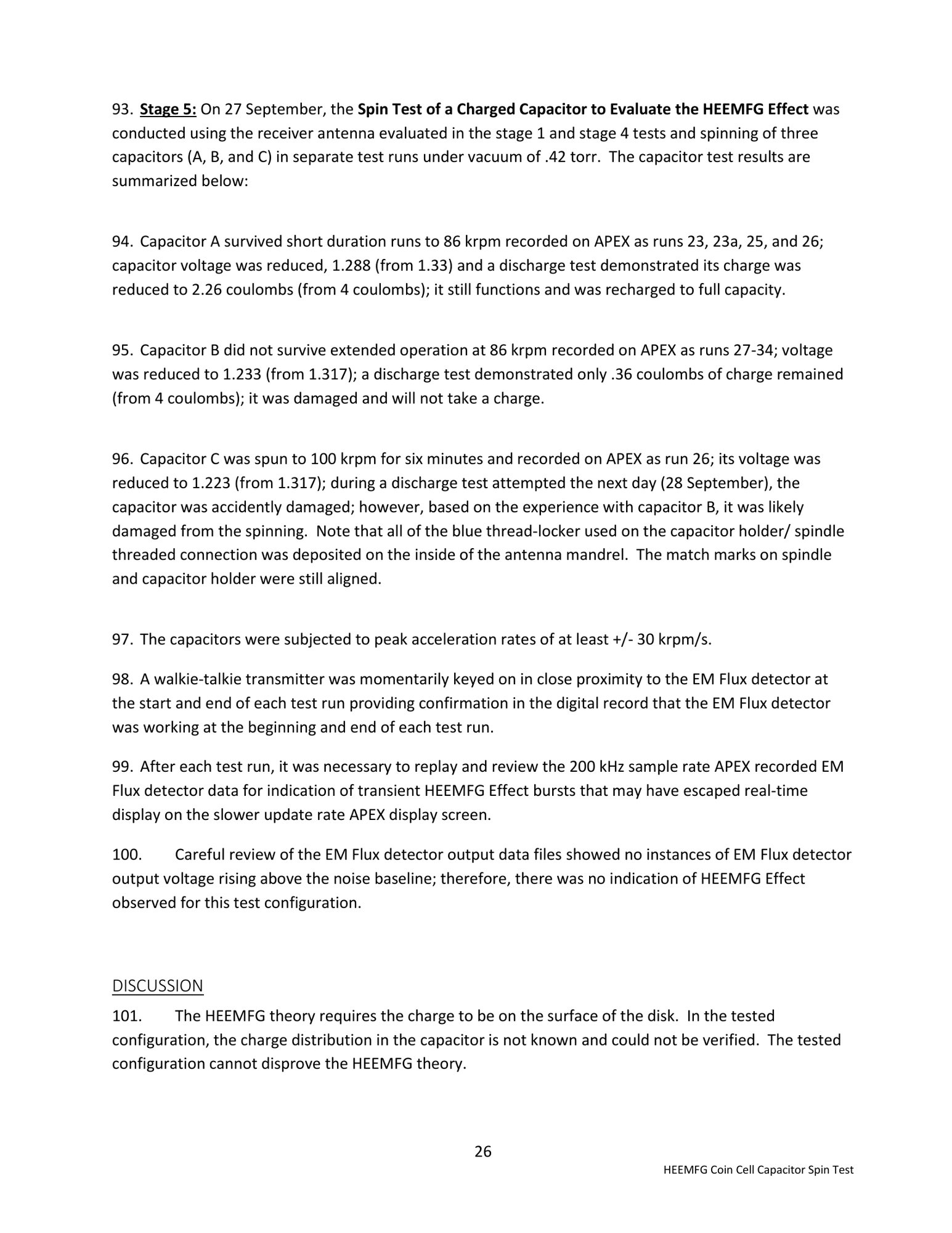
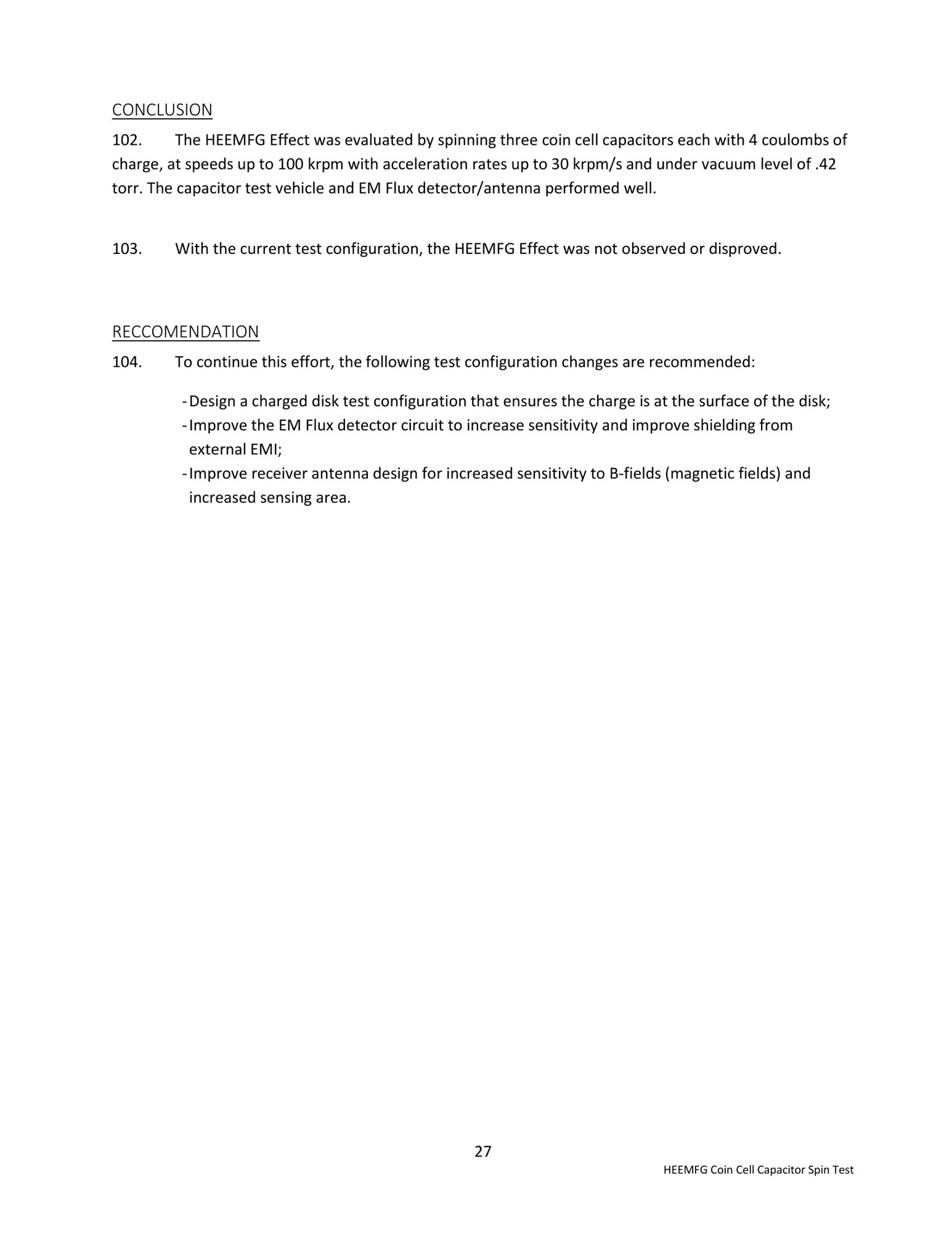
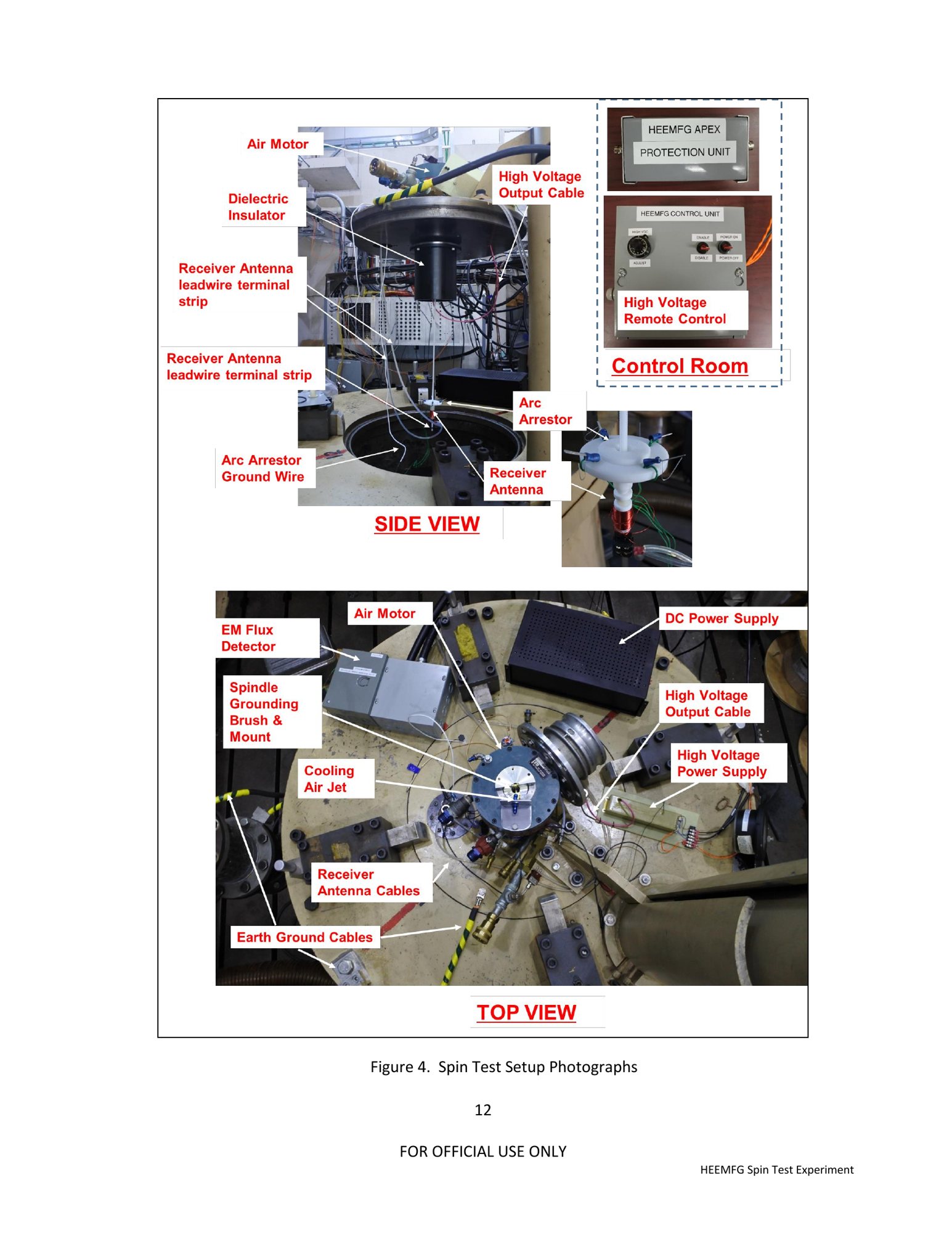
By then the Navy was already testing the idea underneath the craft: that a charged object, spun and vibrated fast enough, would give off extremely strong electromagnetic fields. The project was called the High Energy Electromagnetic Field Generator (HEEMFG). It started in October 2016, with an estimated budget of $507,300 ≈ $670,000 in today's money (FOIA Part 1, p. 1). It tested that idea, not the craft itself: the craft's patent describes no such test.
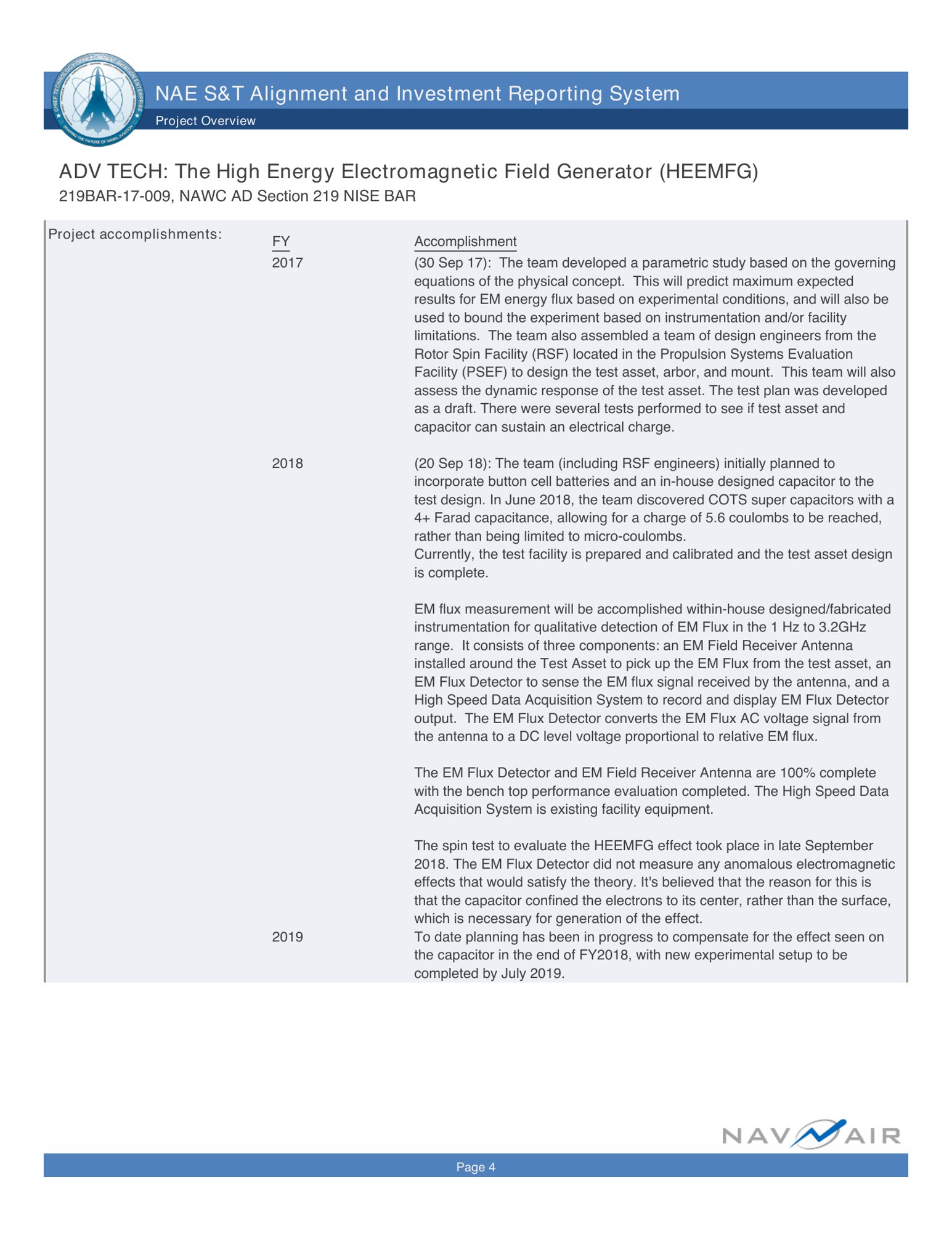
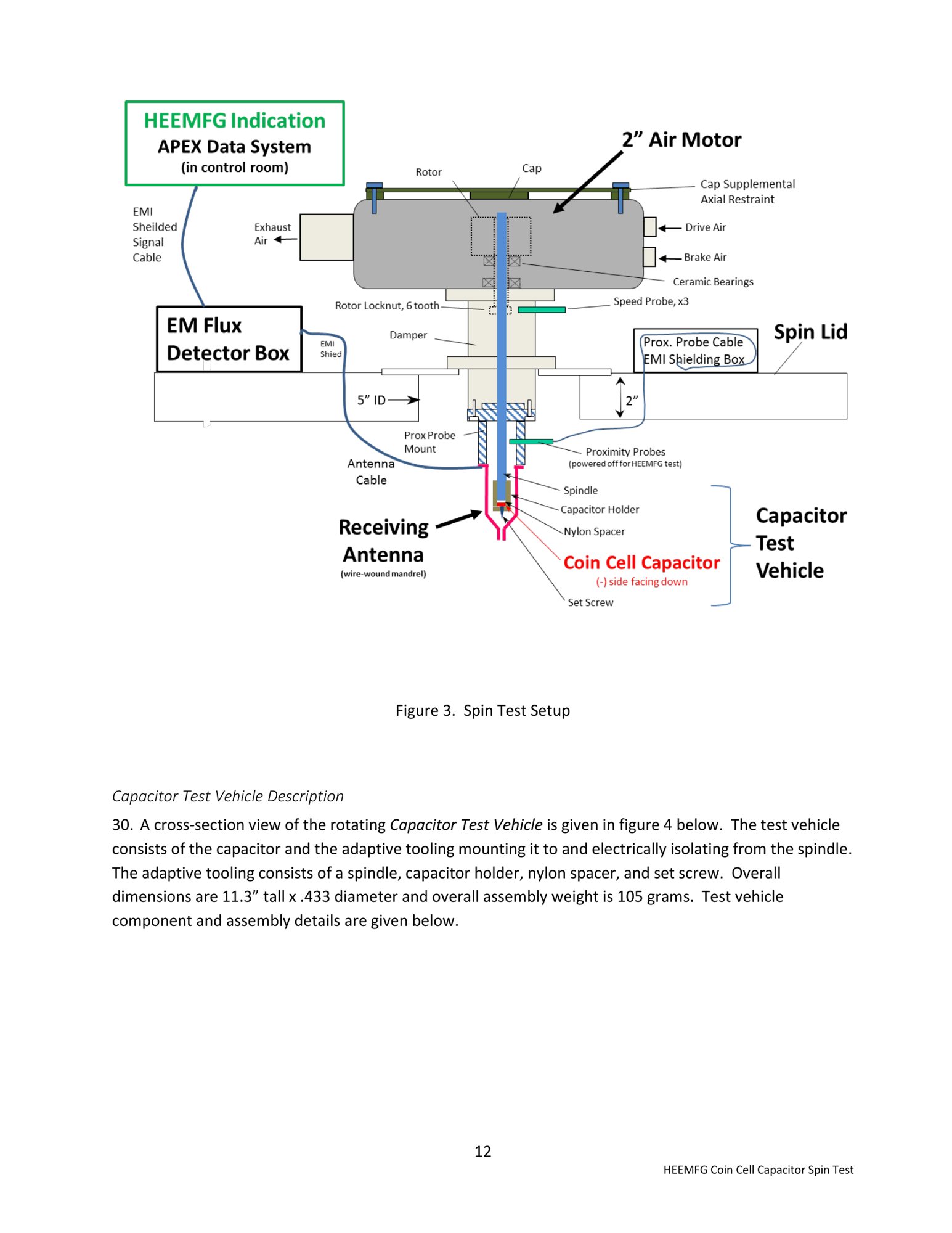
From 18 to 27 September 2018, in a vacuum spin chamber, they spun small charged capacitors at "speeds up to 100 krpm", with a detector beside them. The detector "did not measure any anomalous electromagnetic effects" (Part 1, p. 4). The report called it "a very imperfect test", "the best that could be done with the equipment available" (Part 3, p. 24). The charge may have sat in the middle of the capacitors, not on the surface, where the theory needs it. So "The tested configuration cannot disprove the HEEMFG theory" (p. 26).
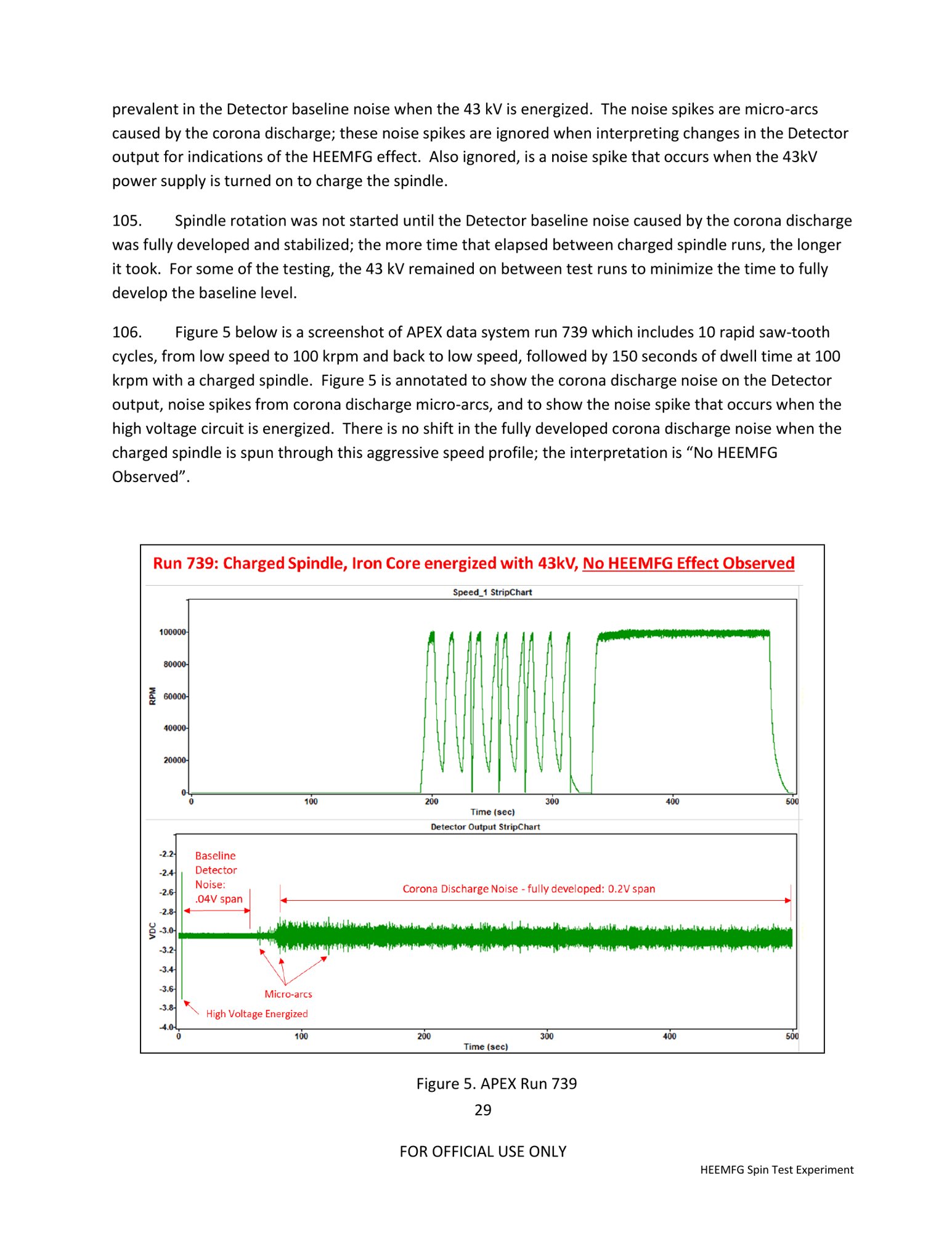
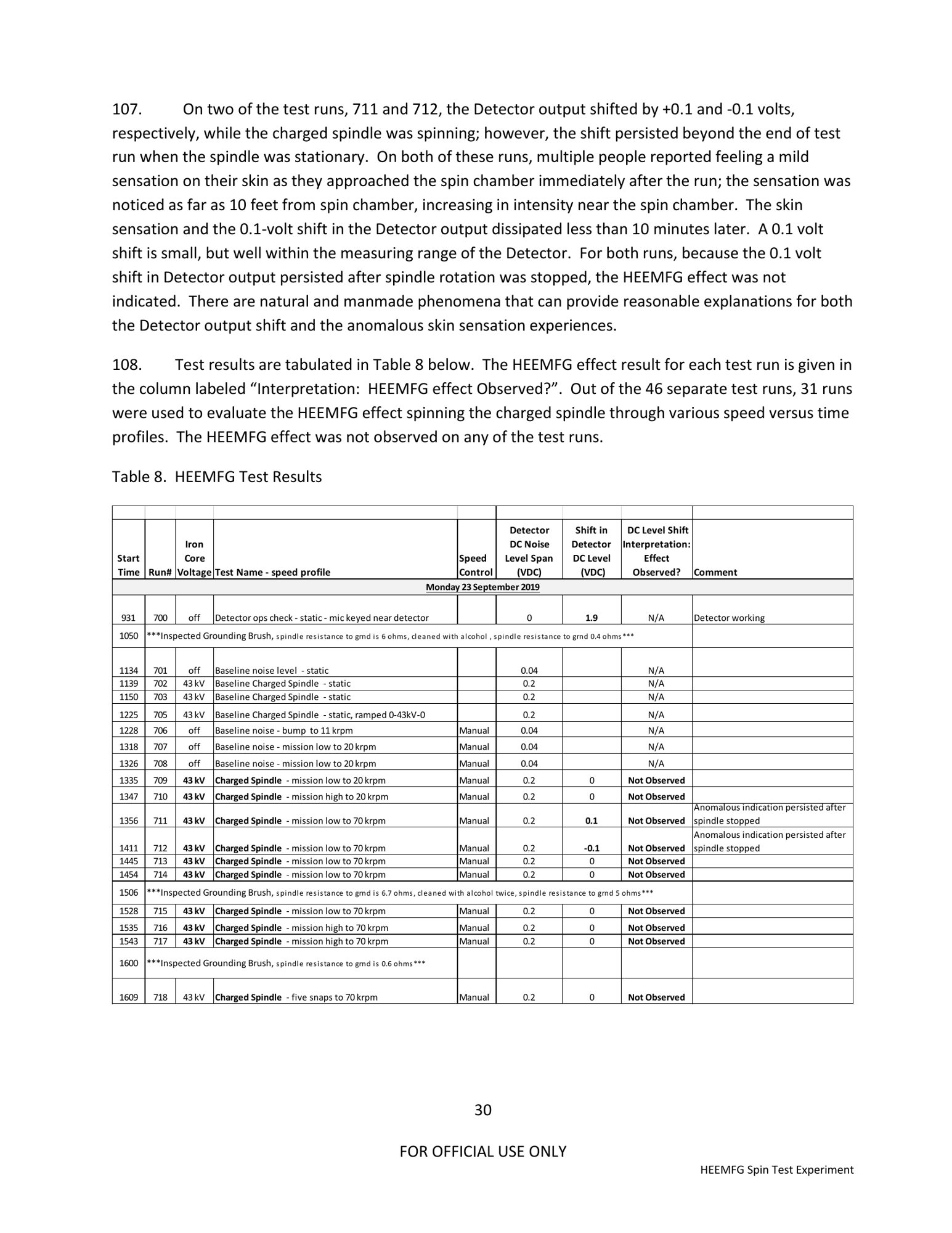
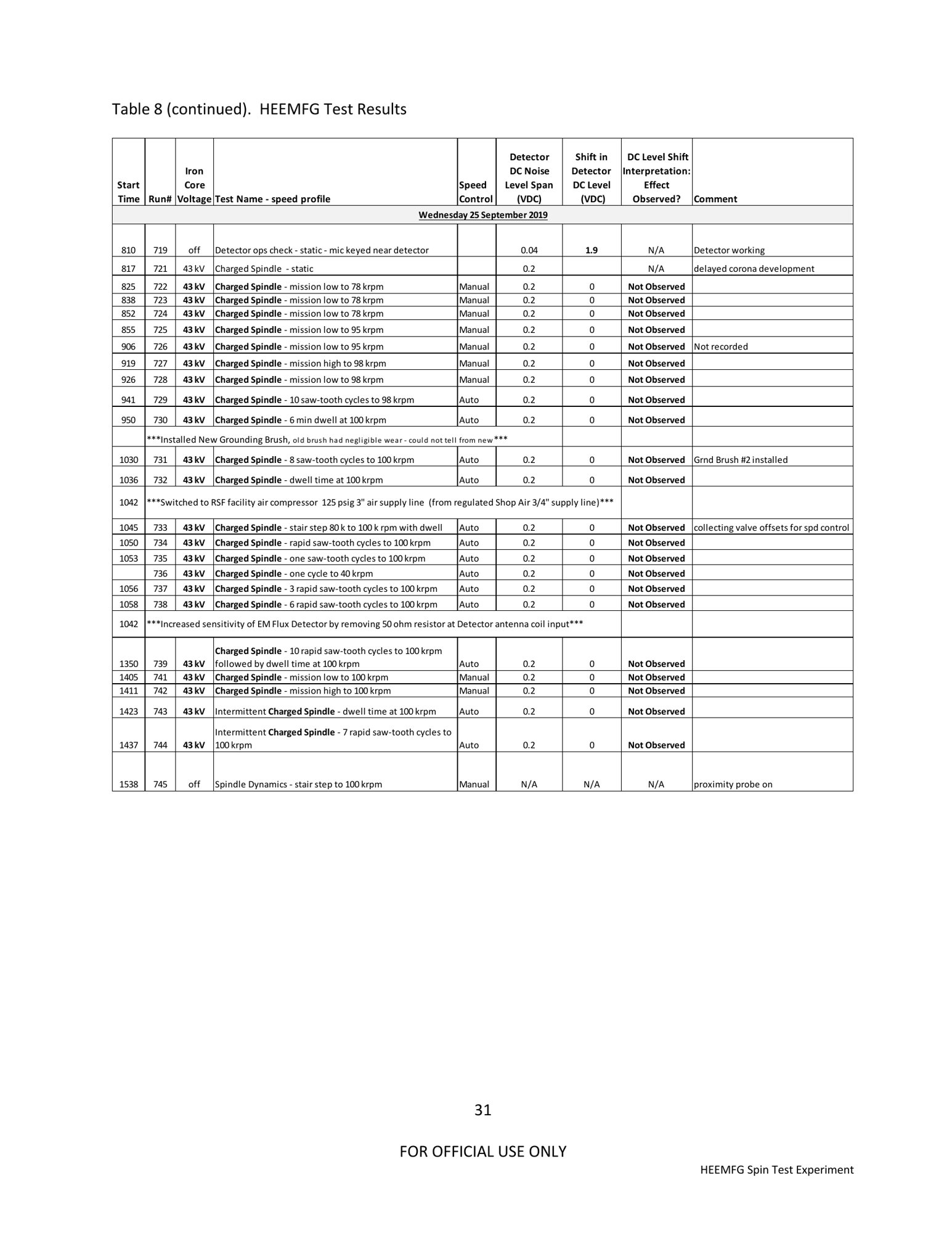
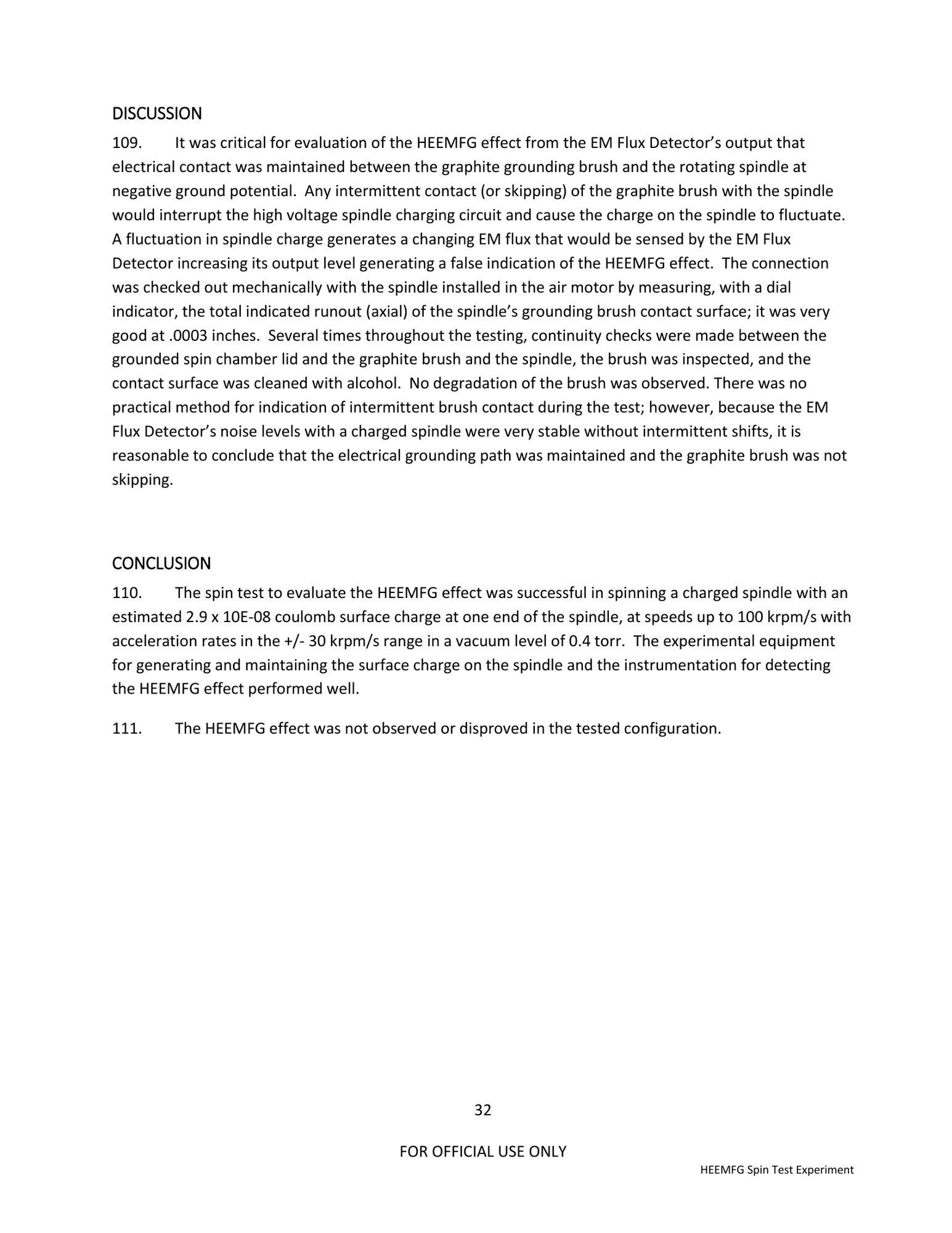
A year later they tried again, with a charged spindle at 43,000 volts, spun up to 100,000 revolutions a minute, in 46 runs. On two runs the detector shifted slightly, and people near the chamber felt a mild sensation on their skin; the report says "There are natural and manmade phenomena that can provide reasonable explanations for both" (Part 4, para. 107). Its conclusion: "The HEEMFG effect was not observed or disproved in the tested configuration" (para. 111).
The last runs are dated 25 September 2019. In February 2021 a Navy spokesman told The War Zone that testing ended then, and "No further research has been conducted" (as reported).
What a grant means
| US 3,626,605 | Wallace, granted 14 December 1971. Measured a spot of light. Expired in 1988, at the end of its term. |
|---|---|
| US 6,960,975 | Volfson, granted 1 November 2005. Measured nothing. Lapsed in 2009: the maintenance fee was not paid. |
| US 10,144,532 | Pais, assigned to the Navy, granted 4 December 2018. Came with a letter from the Navy. Lapsed when its first maintenance fee was not paid (entered 9 January 2023). |
A patent is a description the Office accepted. The rule from Newman v. Quigg still stands: an invention that does not work is not patentable. But the examiner has to show it, on the record.
And the time machine? As far as we can find, still not granted.
Next episode, Friday 6 November: a patent for a pause between two wipes, Robert Kearns's intermittent windshield wiper (US 3,351,836), and the two car companies that went to court over it.
Read the original patents
All five are US patents, in the public domain; none carries a copyright notice. Click a page for full resolution; drawing sheets come before the text. On two front pages the inventor's street address is blanked, as in the episode, and so in their PDFs here; Google Patents has the originals.
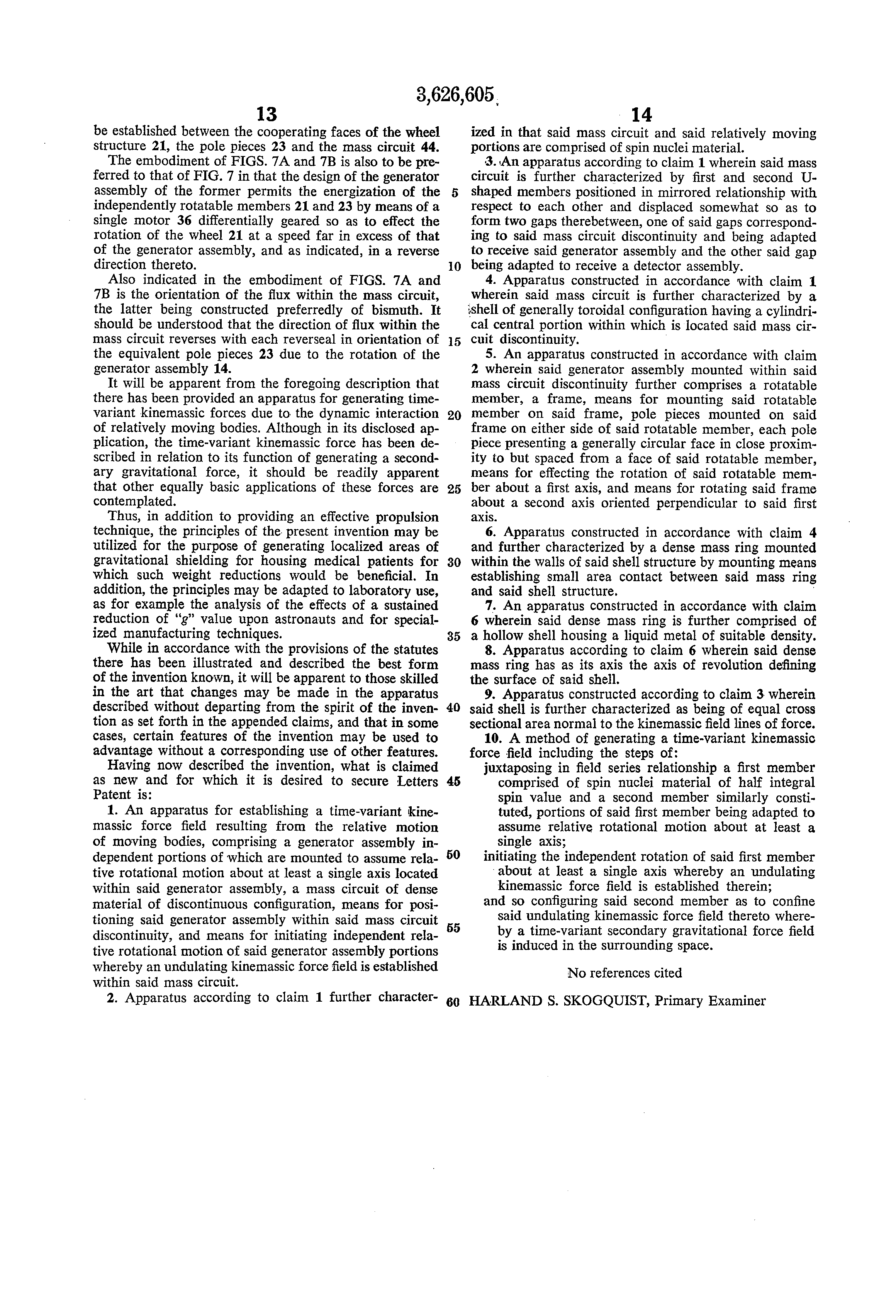
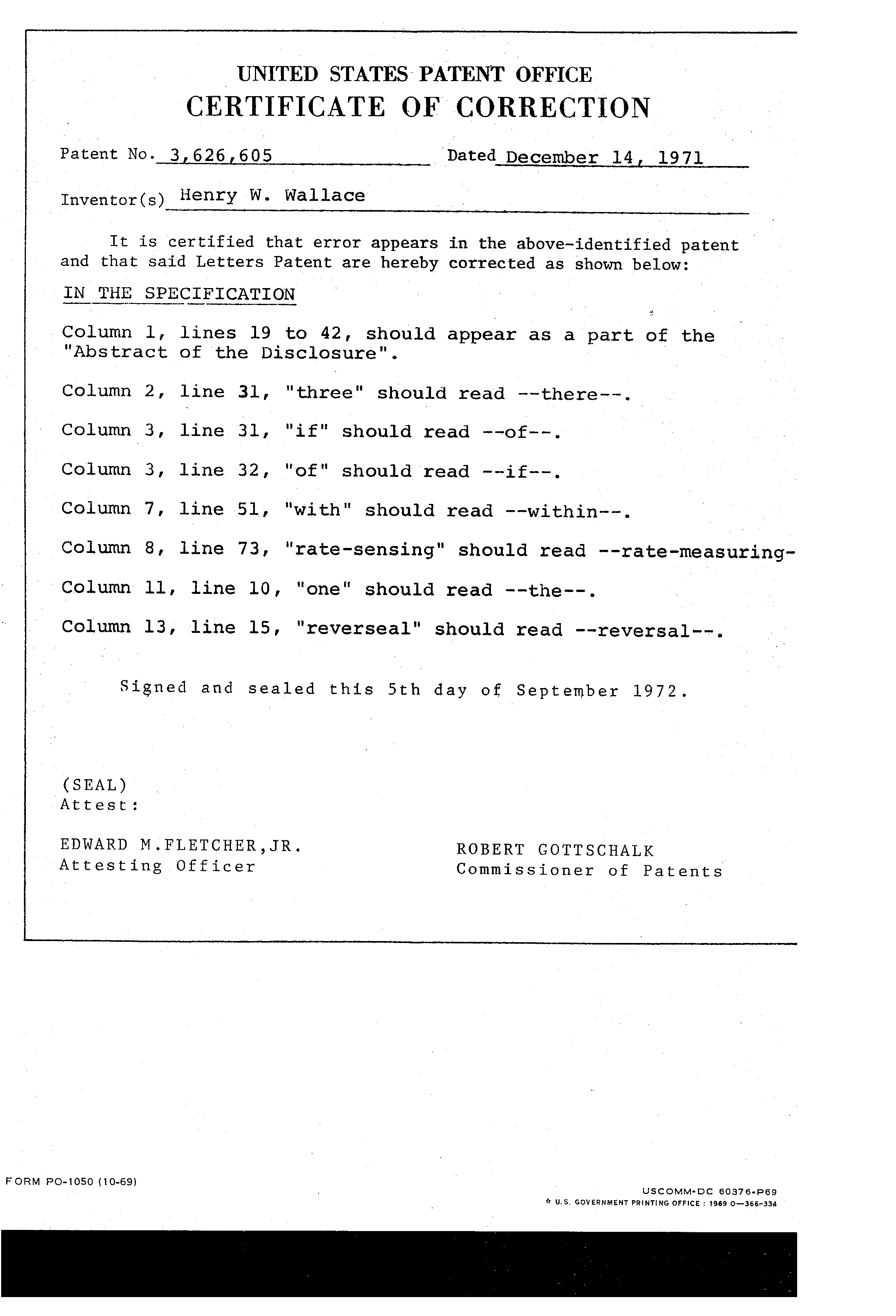
US 3,626,605, Henry Wm. Wallace, Method and Apparatus for Generating a Secondary Gravitational Force Field, filed 4 November 1968, granted 14 December 1971
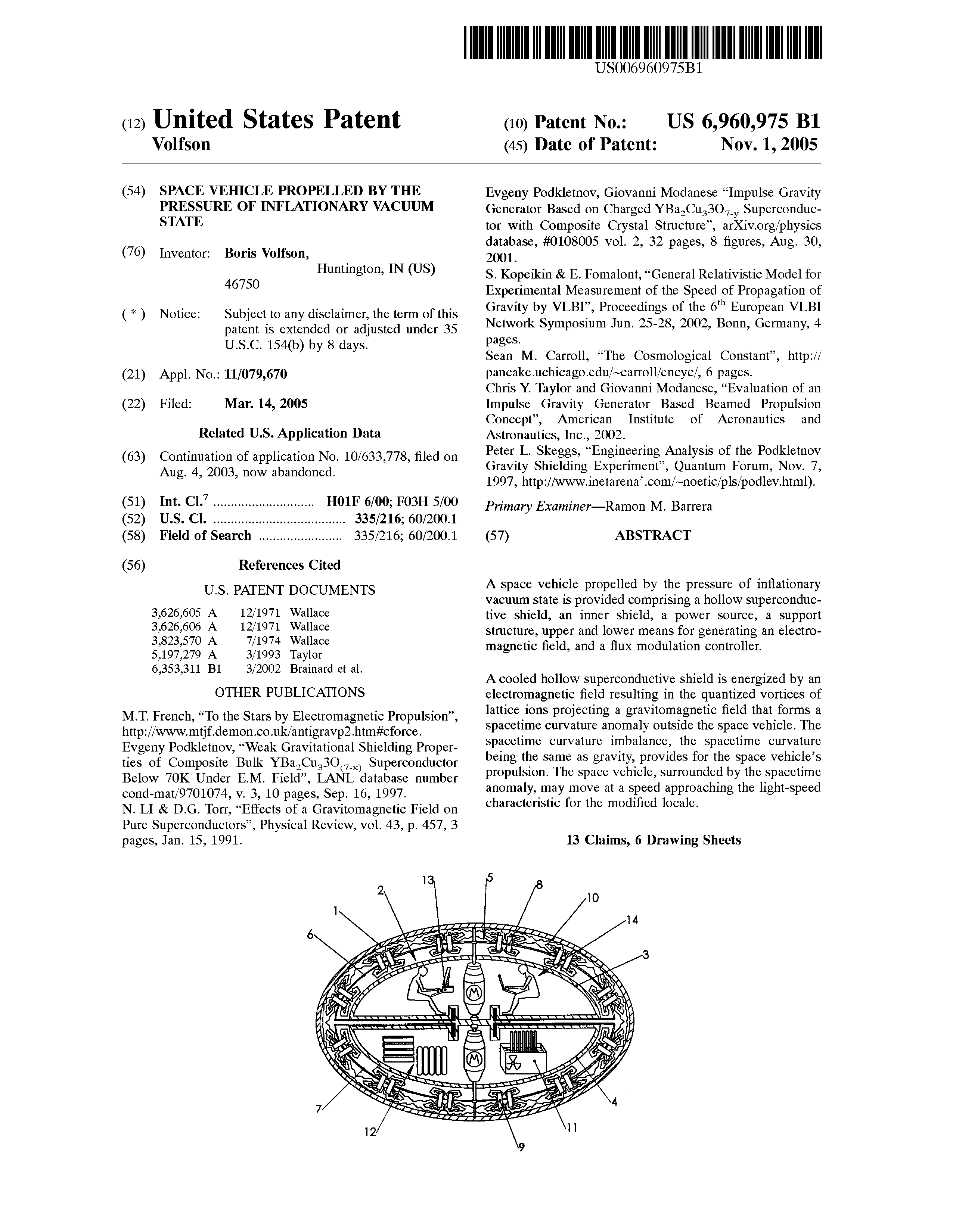
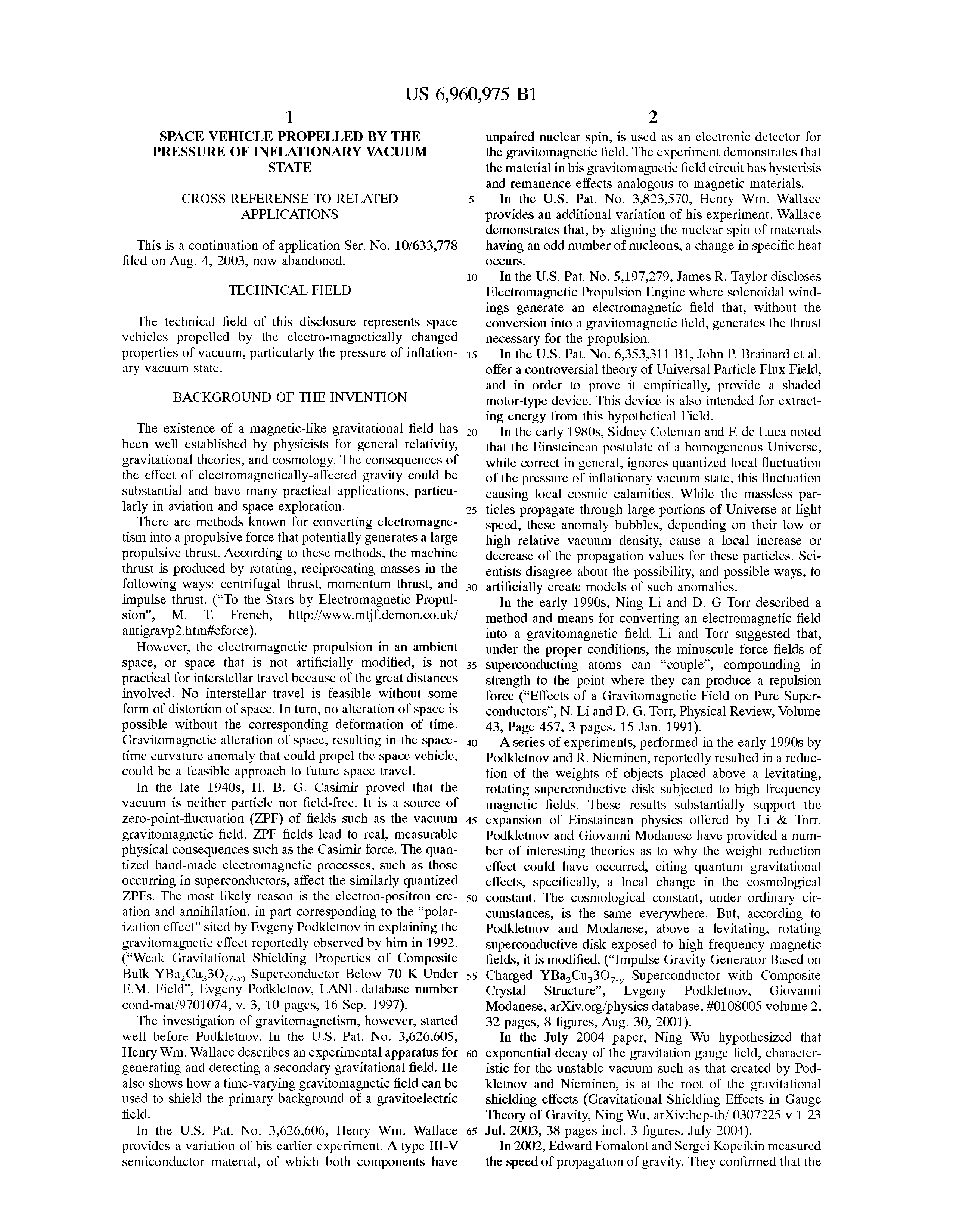
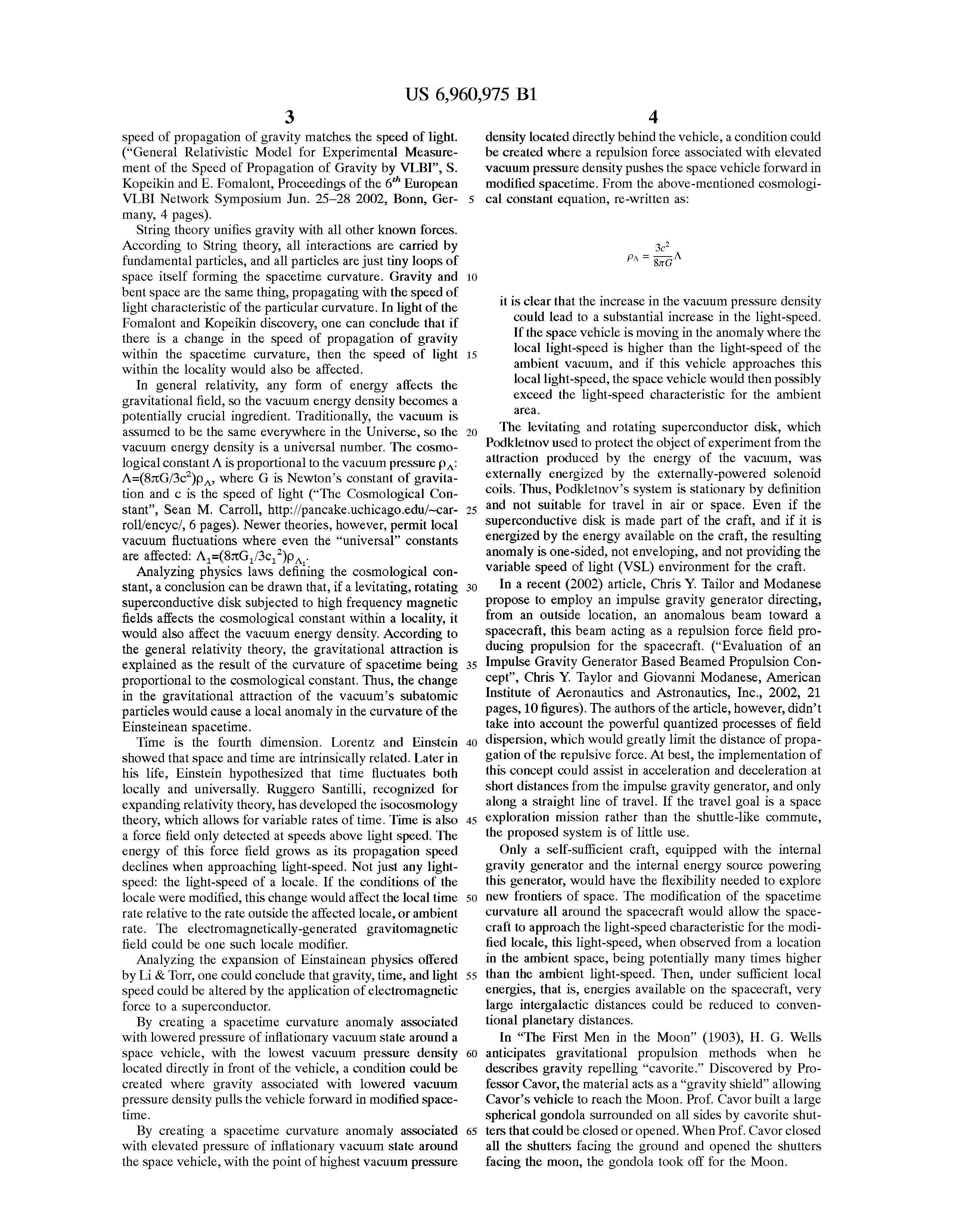
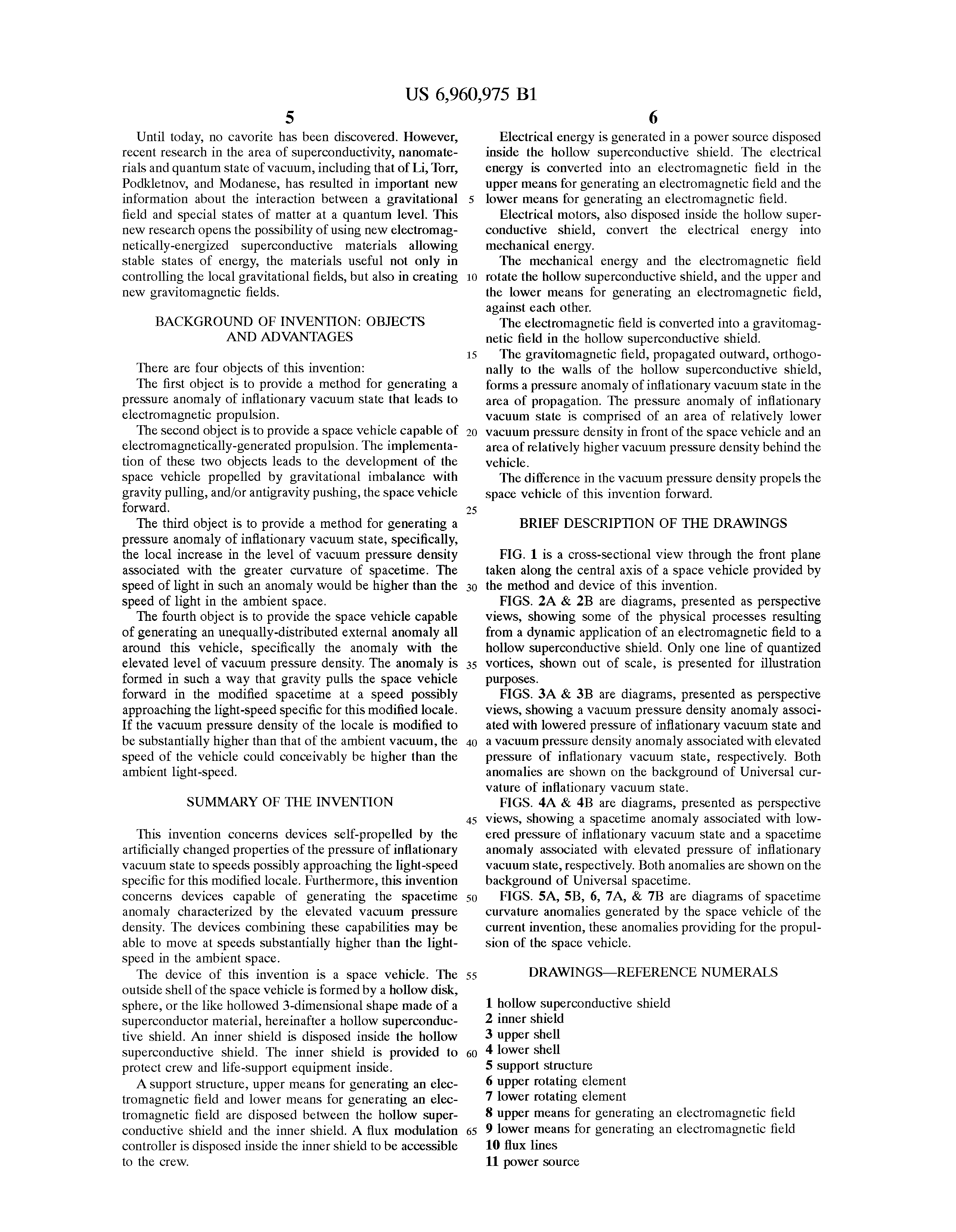
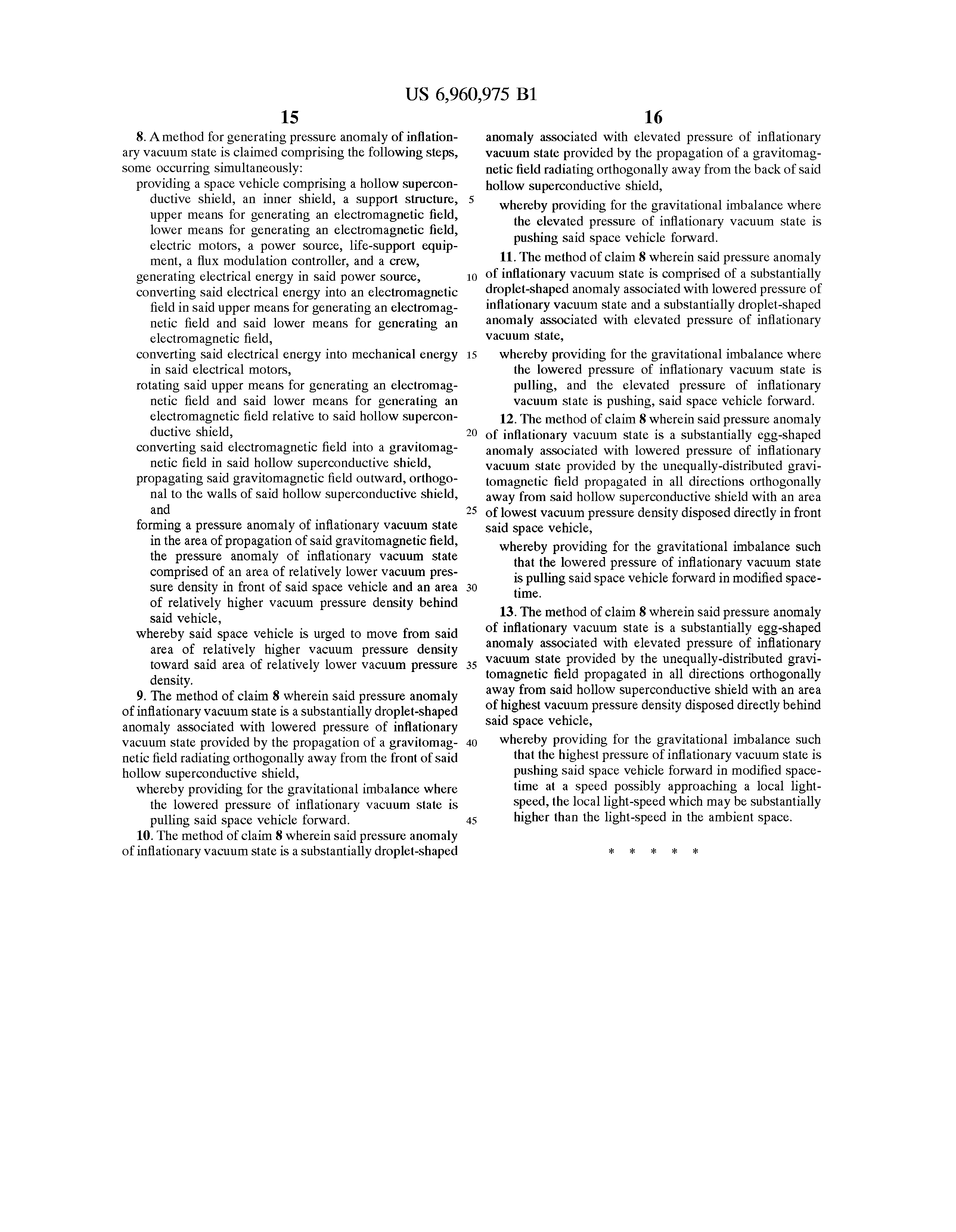
US 6,960,975 B1, Boris Volfson, Space Vehicle Propelled by the Pressure of Inflationary Vacuum State, filed 14 March 2005, granted 1 November 2005
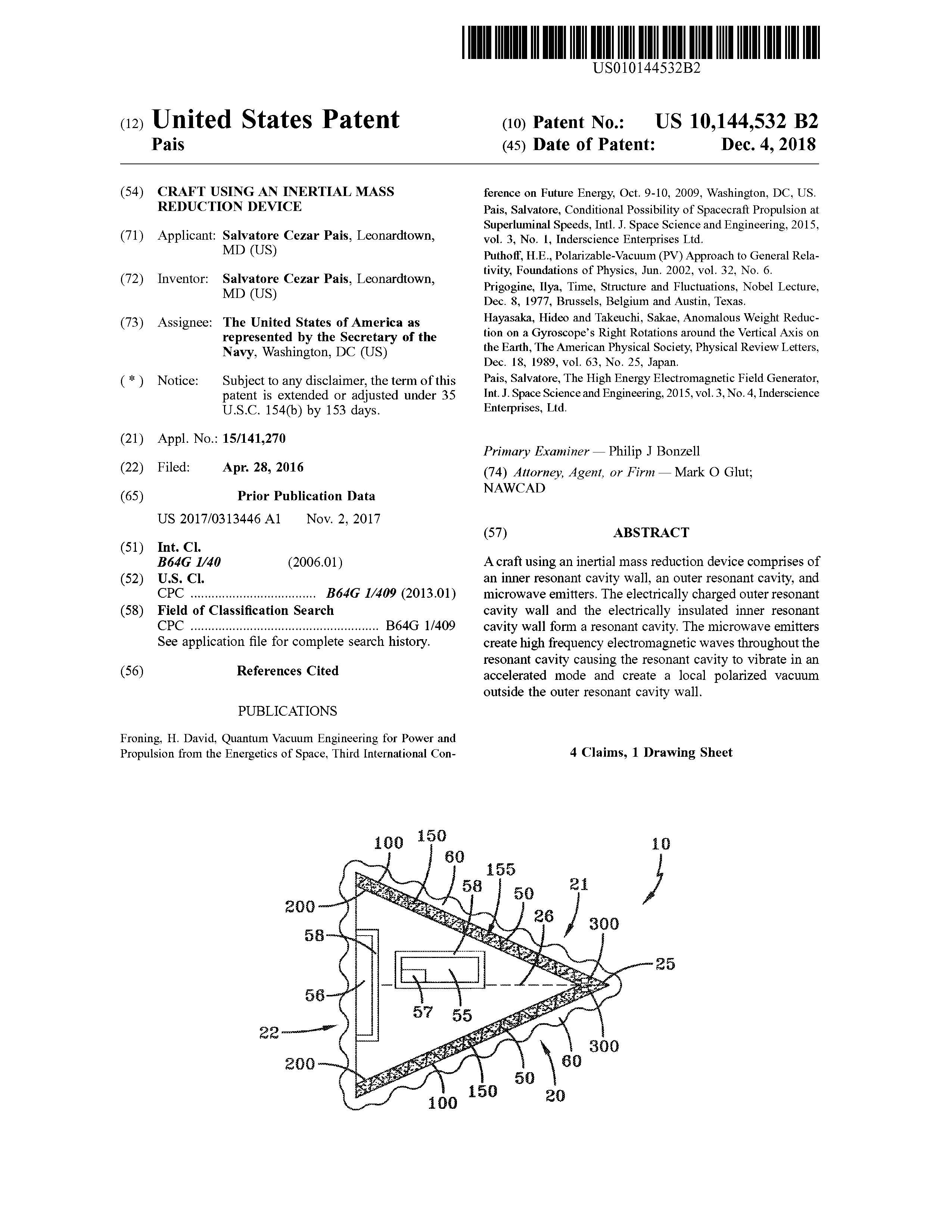
US 10,144,532 B2, Salvatore Cezar Pais, assignee the United States (Secretary of the Navy), Craft Using an Inertial Mass Reduction Device, filed 28 April 2016, granted 4 December 2018
US 1,974,483, Thomas Townsend Brown, Electrostatic Motor, granted 25 September 1934
US 2,949,550, Thomas Townsend Brown, Electrokinetic Apparatus, granted 16 August 1960
Sources
Every fact on this page comes from these, as in the episode. Where we have read a source only second-hand, or only in part, the text says so.
Patents (US, public domain; page scans from Google Patents' image store)
- H. W. Wallace, US 3,626,605 (filed 4 November 1968, granted 14 December 1971): "kinemassic", the half-integral spin, the Barnett effect (cols. 1-4); "inconclusive" (col. 2); "will lose their weight with respect to the body earth" (col. 6); the rig, member 13's 56 cm and 43 kg, the brass (cols. 7-8); the wheel, the pole pieces, the lamp and sensor (cols. 8-9); the speeds, the swing, the wall screen, the reversals, the 13 and 26 arc minute shifts and the control (cols. 10-11; Fig. 6); Fig. 7 and the propulsion (cols. 11-12); "gravitational shielding for housing medical patients" (cols. 12-13); "No references cited" (front page). Also his US 3,626,606 (1971) and US 3,823,570 (1974). Expiry: Google Patents, anticipated expiration 14 December 1988.
- B. Volfson, US 6,960,975 B1 (filed 14 March 2005, granted 1 November 2005): the references (front page; none carries the examiner's mark); Podkletnov and Nieminen (cols. 2, 9); cavorite (cols. 4-5); the craft (cols. 7-9); "about 10,600 Tesla, or 85.5 Tesla per each of 124 Solenoid coils" and "nearly a year" (cols. 9-10); time (cols. 13-14); the abstract. Lapse: Google Patents, "2009-11-01 Lapse for failure to pay maintenance fees".
- S. C. Pais, assignee the United States (Secretary of the Navy), US 10,144,532 B2 (filed 28 April 2016, granted 4 December 2018): claims 1-4; the gas, the cages, the frustum, Fig. 2 (cols. 6-8); "sucks in the craft" and "repulsive gravity" (cols. 3-6); the 2 m disc at 30,000 RPM (col. 2). The front page carries a Statement of Government Interest (the Government may make and use it without royalties); no copyright notice. Lapse: Google Patents, "2023-01-09 Lapse for failure to pay maintenance fees".
- T. T. Brown, US 1,974,483 (25 September 1934) and US 2,949,550 (16 August 1960). The word gravity: our search of both texts, 25 October 2026, re-checked 29 October.
- The time-machine search: titles of granted US patents, searched 25 October 2026 in USPTO Patent Public Search and Google Patents; US 4,368,045, US 4,679,797, US 6,474,650.
US government records
- USPTO, Manual of Patent Examining Procedure § 2107 (revision 07.2022): §§ 2107.01 II, 2107.02 III and IV.
- US Navy (NAWCAD), High Energy Electromagnetic Field Generator project records and test reports, 2016-2019, released under FOIA: Part 1 (pp. 1, 4), Part 3 (pp. 12, 23-27), Part 4 (pp. 28, 45-48); NAWCAD Office of Counsel e-mails, FOIA 2020-004558 (pp. 1, 4, 47, 54, 55). Copies as posted by The War Zone with "The Navy Finally Speaks Up About Its Bizarre UFO Patent Experiments" (B. Tingley, 2021), which also reports the Navy spokesman's statement.
- The Naval Aviation Enterprise Chief Technology Officer's letter to the examiner (15 December 2017, Ser 40T/33) and the Navy's appeal brief, application 15/141,270, read in the copies of the USPTO record published by The War Zone (J. Tingley and T. Rogoway, 28 June 2019). The file wrapper in USPTO Patent Center we have not read.
Physics
- I. Newton, The Mathematical Principles of Natural Philosophy, tr. A. Motte (1729), vol. 2, p. 225, Book III, Prop. VII (Internet Archive).
- R. Y. Chiao, arXiv gr-qc/0208024 (2002): "only positive signs of masses ... it is impossible to construct a gravitational Faraday cage".
- Apollo 15, the hammer and feather: NASA, "50 Years Ago: Apollo 15 on the Moon at Hadley-Apennine", and NSSDC.
- P. Touboul et al. (MICROSCOPE), Phys. Rev. Lett. 129, 121102 (2022): η(Ti, Pt) = (−1.5 ± 2.3 stat ± 1.5 syst) × 10−15.
- E. K. Anderson et al. (ALPHA), Nature 621, 716 (2023); CERN press release, 27 September 2023.
- H. Bondi, Rev. Mod. Phys. 29, 423 (1957), pp. 423-424. M. Alcubierre, Class. Quantum Grav. 11, L73 (1994) (arXiv gr-qc/0009013). M. Bordag et al., Physics Reports 353 (2001) (arXiv quant-ph/0106045); U. Mohideen and A. Roy, Phys. Rev. Lett. 81, 4549 (1998) (arXiv physics/9805038).
- C. W. F. Everitt et al. (Gravity Probe B), Phys. Rev. Lett. 106, 221101 (2011) (arXiv 1105.3456): frame dragging −37.2 ± 7.2 mas/yr against −39.2 predicted.
- M. Tajmar et al., arXiv gr-qc/0603033 (2006), arXiv 0707.3806 (2007), and Supercond. Sci. Technol. 24, 125011 (2011): "No such anomalies were found."
- A. Einstein, Annalen der Physik 17, 891 (1905), sec. 4. J. C. Hafele and R. E. Keating, Science 177, 168-170 (1972): eastward −59 ± 10 ns, westward +273 ± 7 ns against the US Naval Observatory's clocks.
- H. G. Wells, The Time Machine (1895) and The First Men in the Moon (1901).
- National High Magnetic Field Laboratory, "Tesla" (MagLab Dictionary, read 29 October 2026): 45 tesla, the strongest steady field.
Other sources
- T. B. Bahder and C. Fazi, "Force on an Asymmetric Capacitor", US Army Research Laboratory (2003; arXiv physics/0211001).
- M. Tajmar, "The Biefeld-Brown Effect: Misinterpretation of Corona Wind Phenomena", AIAA Journal 42, 315 (2004).
- M. Tajmar and C. J. de Matos, arXiv gr-qc/0107012 (2001): Wallace at General Electric; "were reproducible this would represent a breakthrough".
- P. Ball, "Antigravity craft slips past patent officers", Nature 438, 139 (10 November 2005): the headline and subtitle only.
- M. Cocks, "Interstellar IP", AIPLA: the abandoned applications (their file histories not read).
- Today's money: the ratio of annual-average consumer prices (Federal Reserve Bank of Minneapolis, "Consumer Price Index, 1800-"), 2025 as today, rounded to two figures.
- The reconstructions are our own work, as described under each model, each checked by the episode's test, run again on this page's copy.
Images
- Patent drawings and specifications: US patents, public domain. Wallace's Figs. 1 and 6 are turned upright here.
- The Navy's pages and photographs: US Navy records released under FOIA, US government works (17 U.S.C. 105), from the copies posted by The War Zone; names redacted by the Navy.
- H. G. Wells, The Time Machine (Heinemann, 1895), title page: University of Illinois copy, digitised for HathiTrust, via the Internet Archive; public domain. Claude A. Shepperson's illustration for The First Men in the Moon (Newnes, 1901), facing p. 54: scan via Wikimedia Commons; public domain.
- The video also uses AI illustrations, each labelled on screen "AI illustration" with what it is based on. None is used on this page.