 Curious Patents
The Adding Machines
In 1884 a young machinist in Chicago started an adding machine in a macaroni box. In St. Louis a former bank clerk was building another. Both had to settle what a machine should do when a column goes past nine. Felt's answer, patented in 1887, became the Comptometer; Burroughs's became the adding machine that printed. Press the keys of Felt's machine, watch it carry the one, and read the patents and every source.
Watch the episode
The macaroni box
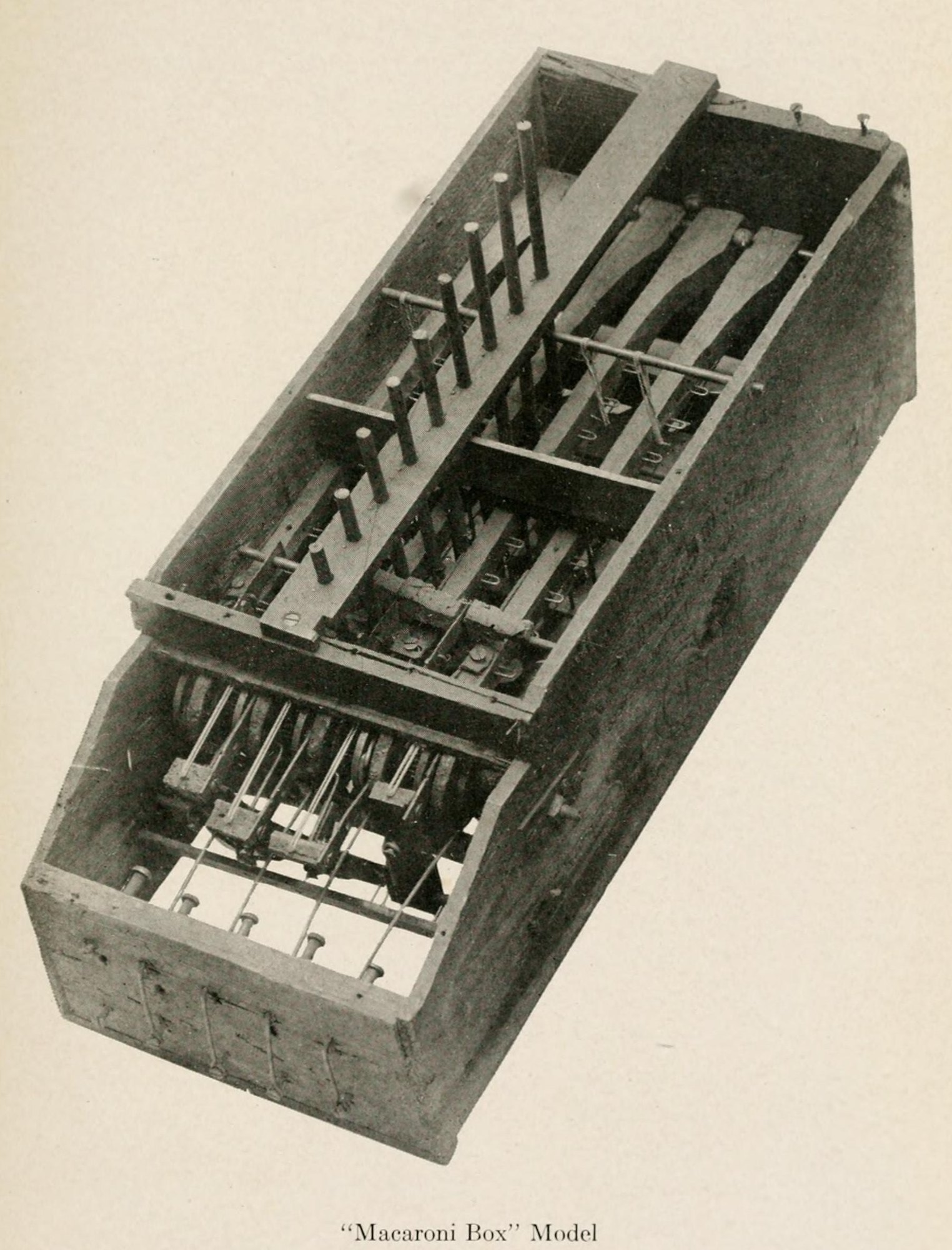
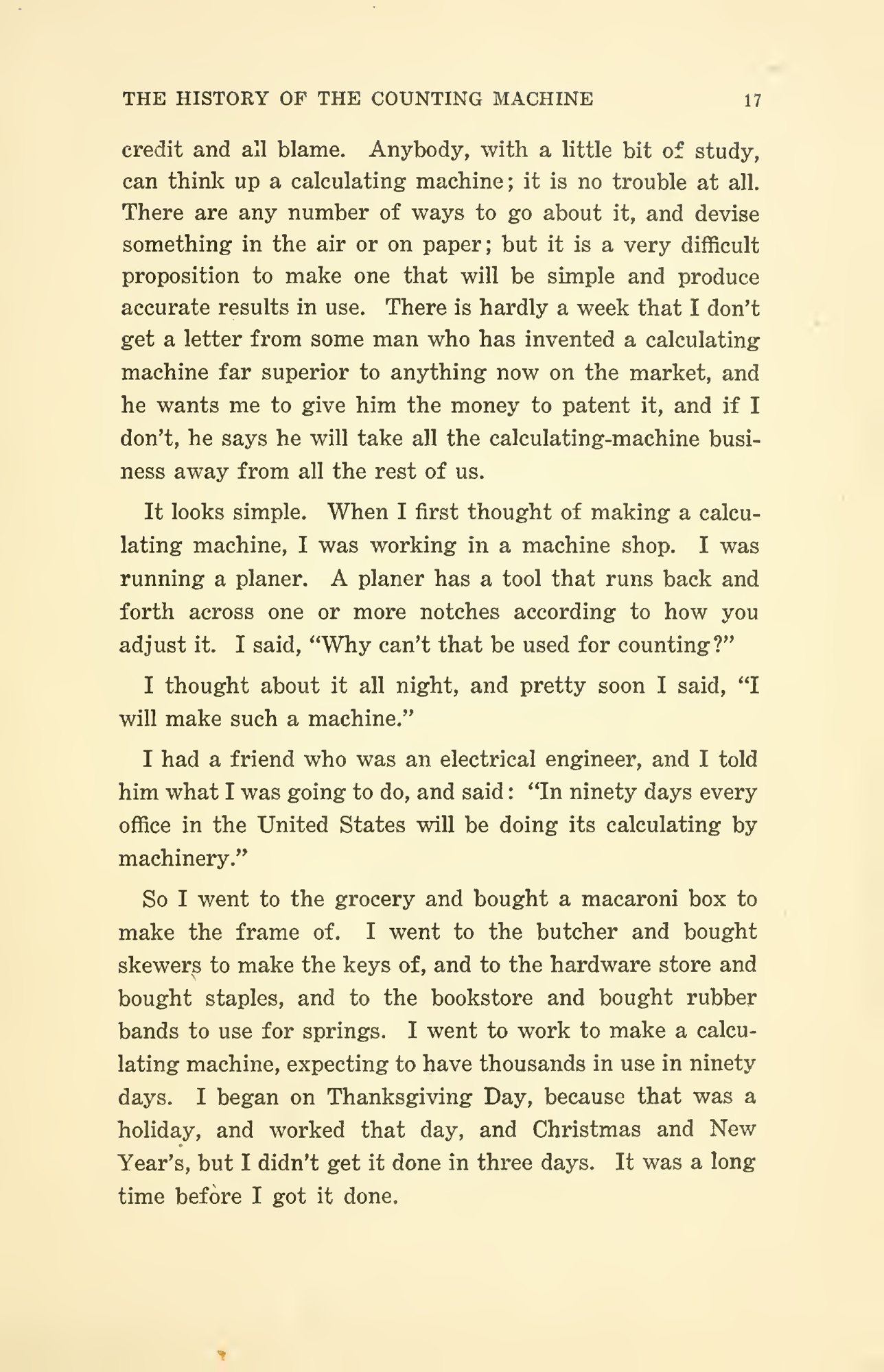
In the autumn of 1884 a young machinist in Chicago, Dorr E. Felt, set out to build a calculating machine. He told the story himself in a lecture printed in 1916: "So I went to the grocery and bought a macaroni box to make the frame of. I went to the butcher and bought skewers to make the keys of, and to the hardware store and bought staples, and to the bookstore and bought rubber bands to use for springs."
He began on Thanksgiving Day, "because that was a holiday". The lecture gives no year. The year comes from the version that J. A. V. Turck printed in 1921 as Felt's own statement: "It was near Thanksgiving Day of 1884", and he "finished the model soon after New Year's day, 1885". Turck added that "This model is extant". Felt's company magazine told it differently in 1926: there the box failed at first, and "on Thanksgiving Day, 1887, the first Comptometer was begun". That date cannot be right: Felt had applied for his patent in July 1886.
What he built added a number the moment its key was pressed. In the words of the patent he was granted in 1887, each key serves, "when struck … to rotate the wheel to the point required to indicate that the number represented by the key has been added". The machine became the Comptometer.
At the same time, in St. Louis, a former bank clerk named William S. Burroughs was building a very different adding machine; his first application was filed on 10 January 1885. Both men had to solve the same problem: what a machine should do when a column goes past nine.
Machines that added
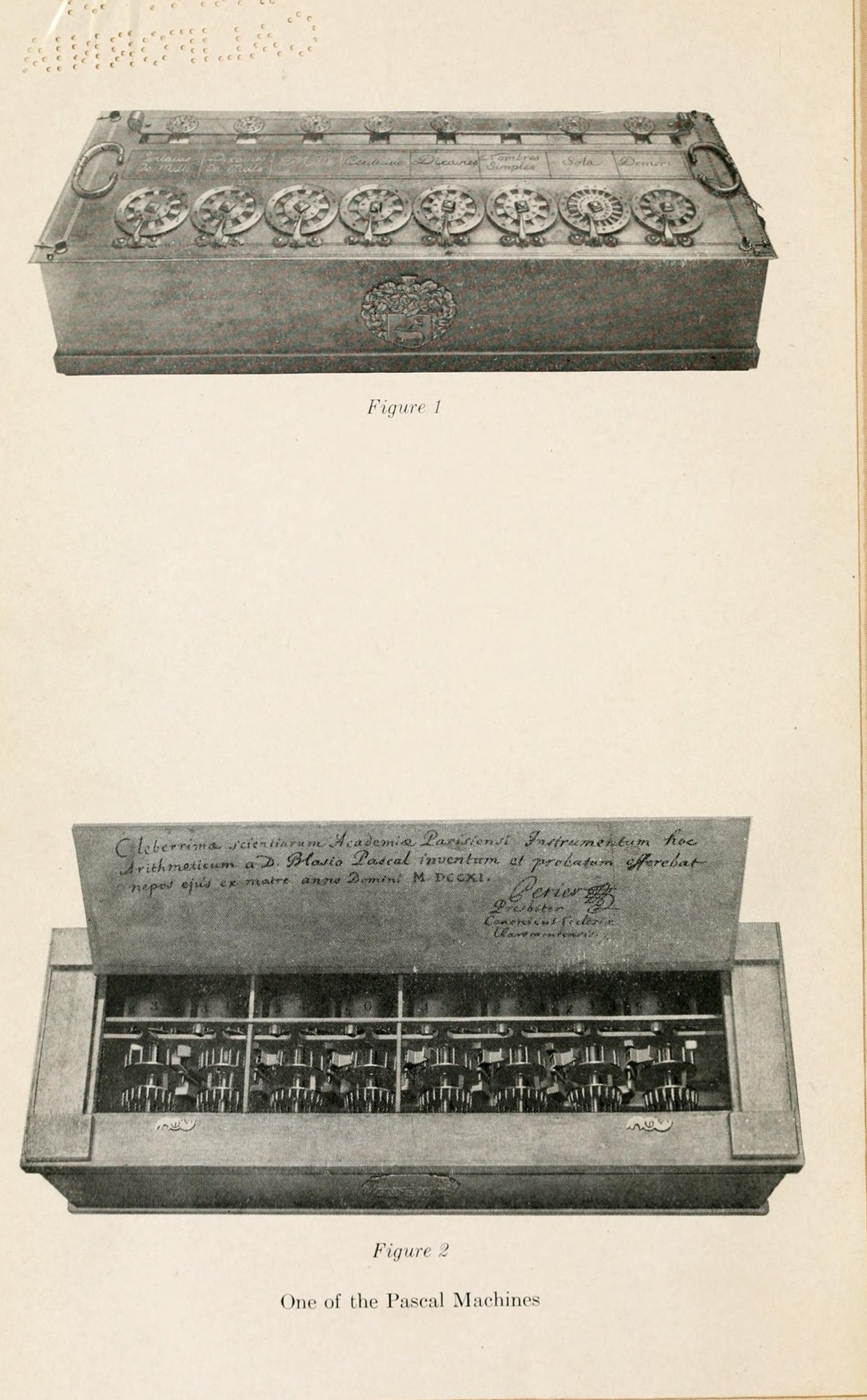
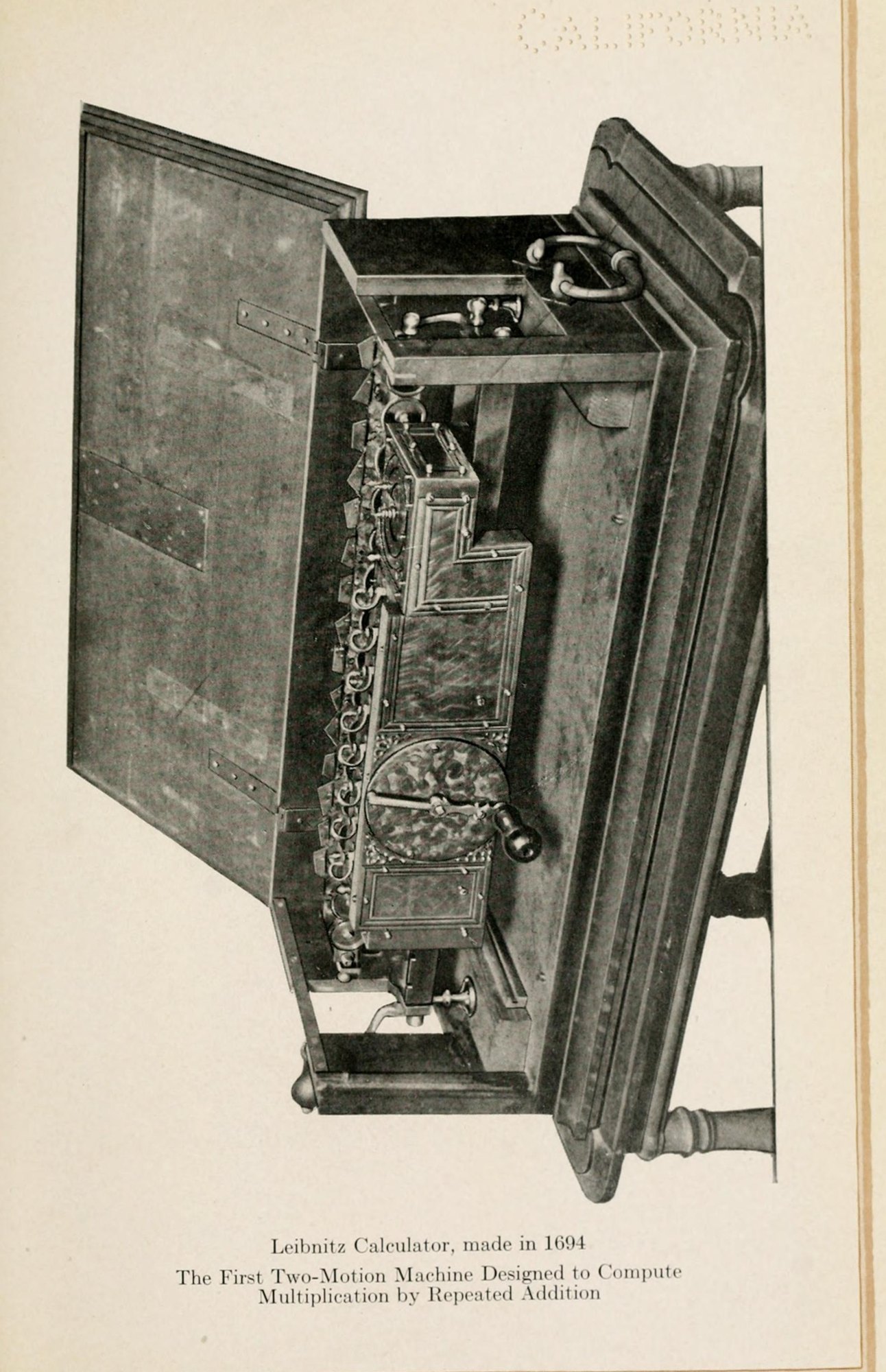
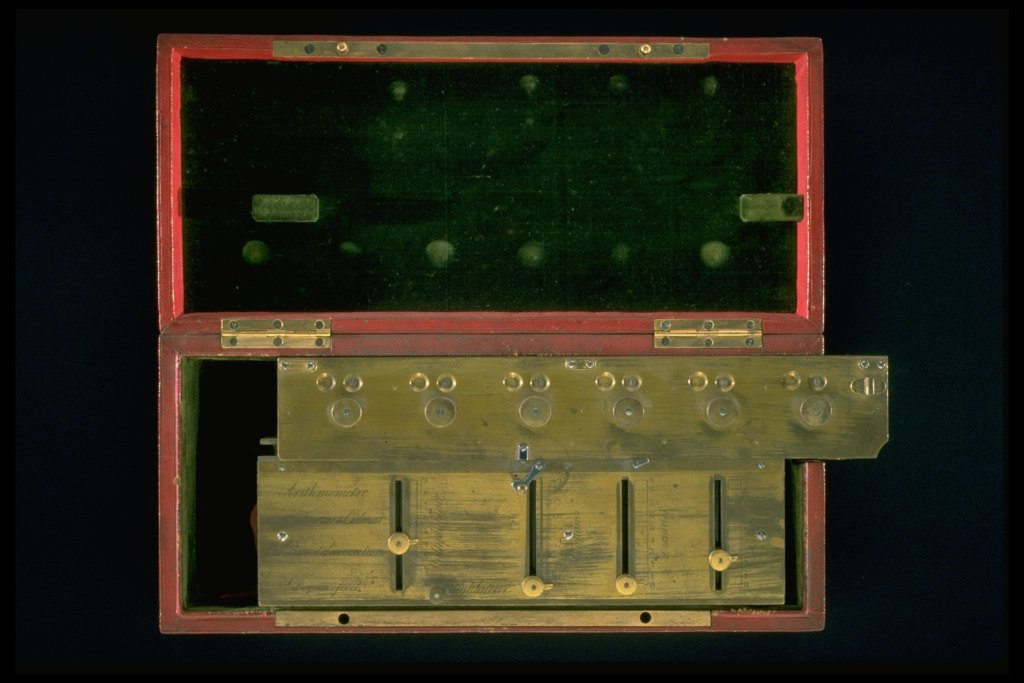
Machines that could add were not new. Blaise Pascal built one in 1642, and Gottfried Leibniz another later in that century; Turck's caption dates Leibniz's machine to 1694. The first to be made and sold in numbers was the arithmometer of Charles Xavier Thomas, a Frenchman. He patented it in 1820, and it was on sale from about 1851. You set a number on it with sliders and turned a crank. Felt himself said that "the first machine that was accurate enough to be of any practical value was the Thomas machine of 1820".
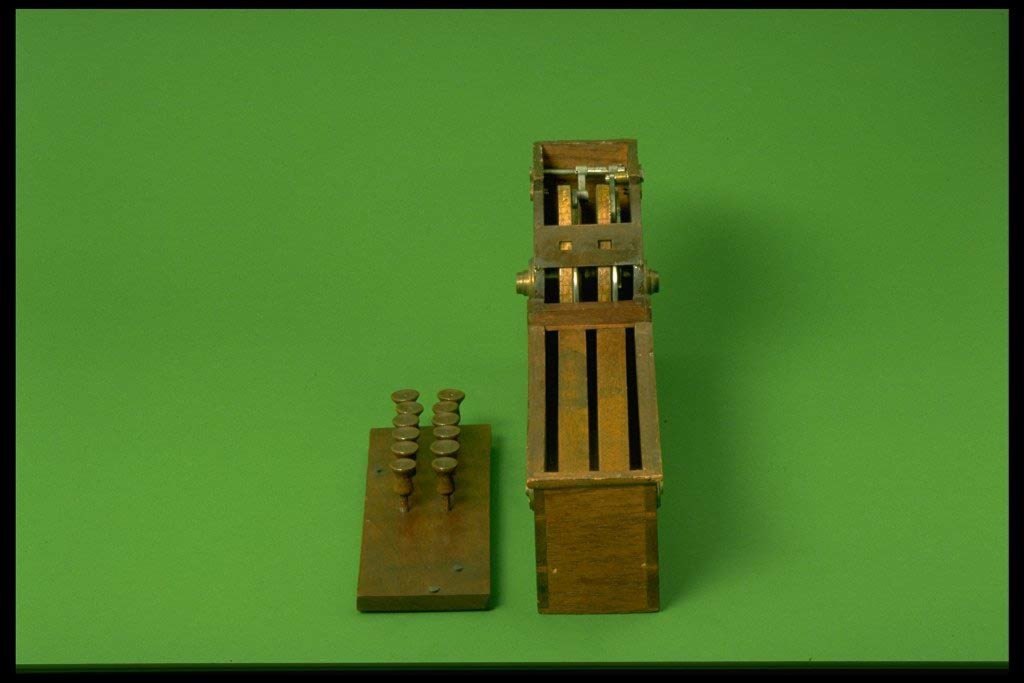
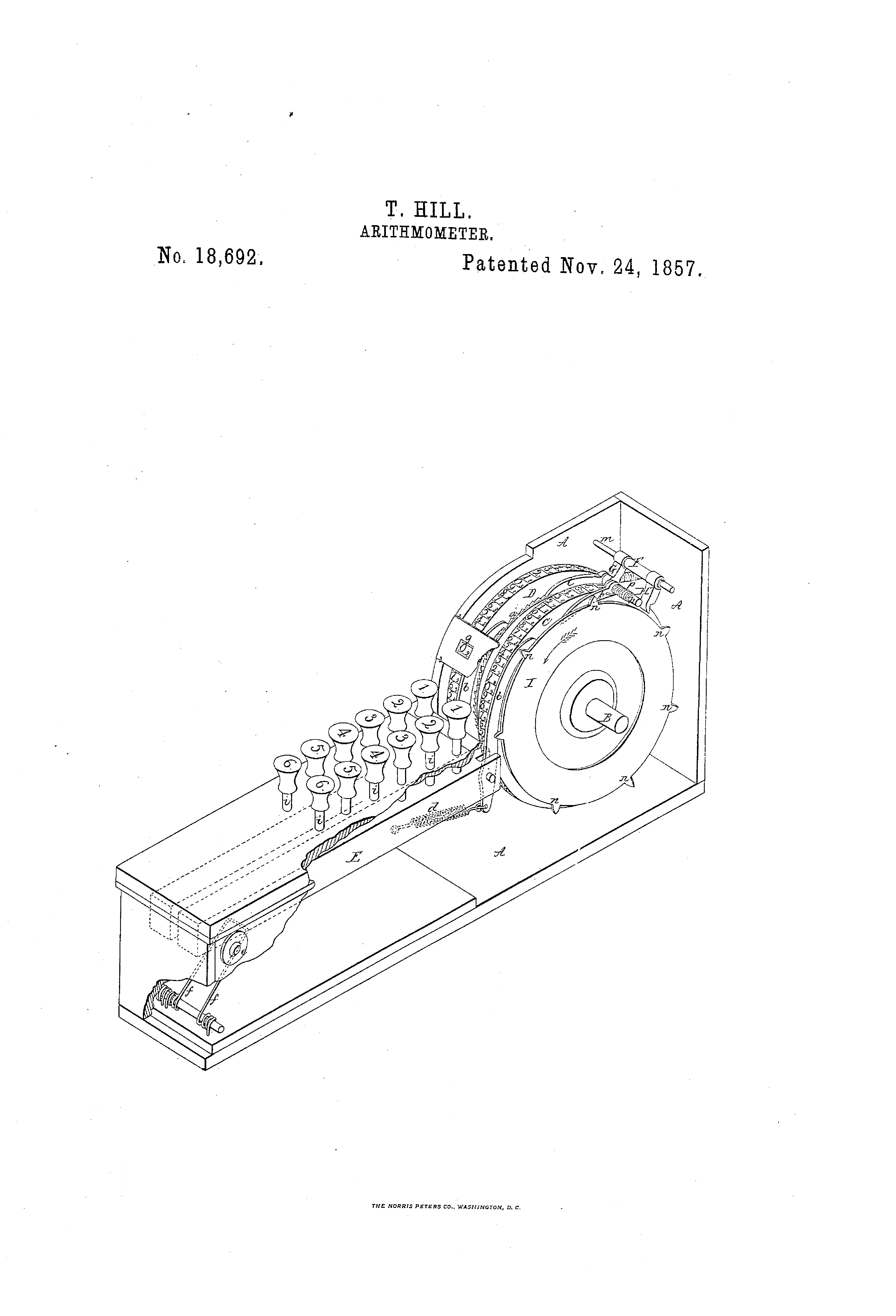
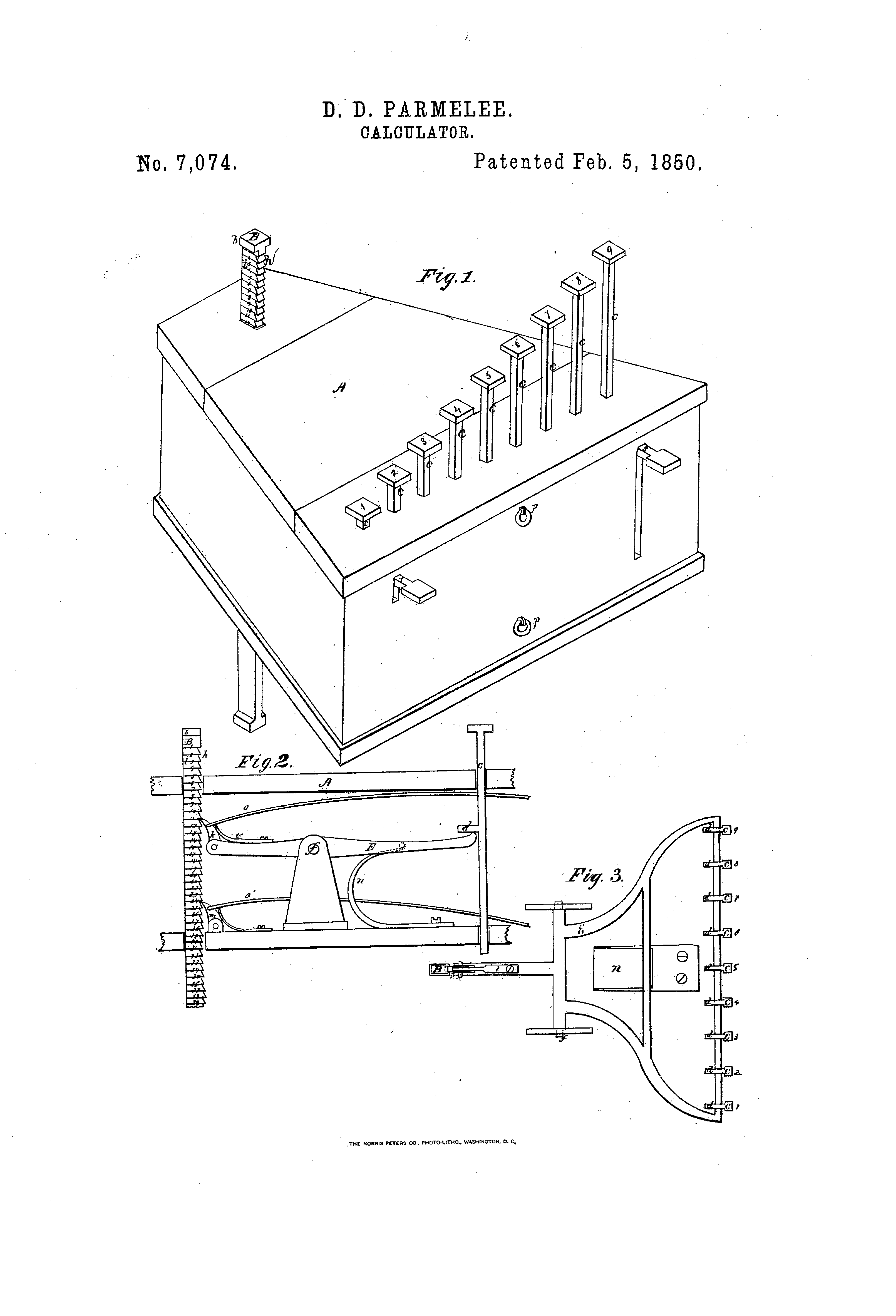
In America, keys came early. In 1850 D. D. Parmelee of New Paltz, New York, patented a "Calculator" (US 7,074) in which keys of graded length pushed up a single ratchet bar. In 1857 Thomas Hill of Waltham, Massachusetts, patented an "Improved Arithmometer" (US 18,692), with several columns of keys and a carry. Hill's patent model is at the Smithsonian; the museum's record says his patent "did not result in a product". Turck, writing for Felt's side in 1921, granted both machines but argued that neither worked at speed: on Parmelee's you "would have to use a pussyfoot key-stroke or the numeral bar would over-shoot". Speed was the problem Felt set out to solve.
Dorr Felt
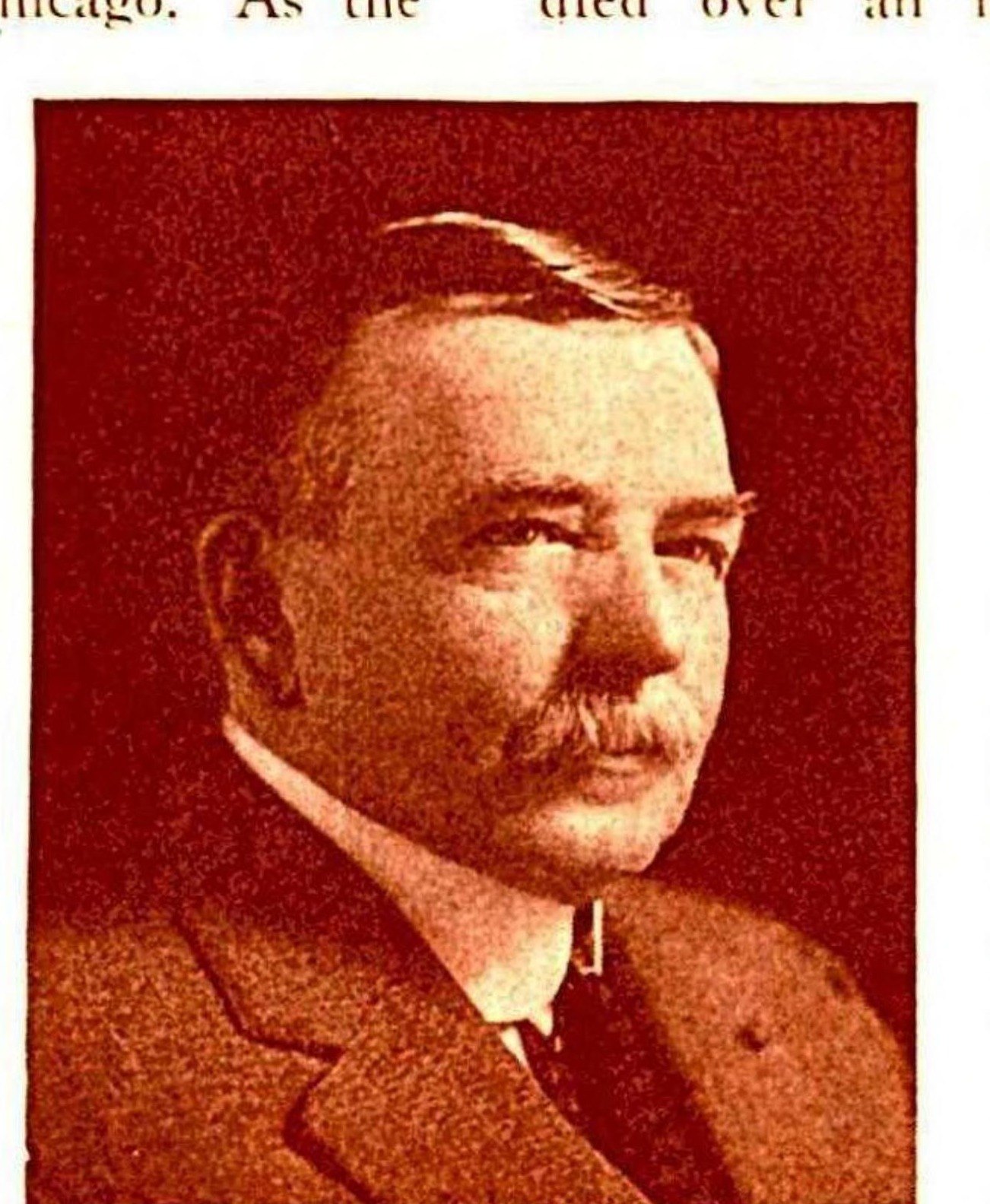
Dorr Eugene Felt was born in Rock County, Wisconsin, on 18 March 1862, and worked in a machine shop in Beloit from the age of fourteen. In 1882 he moved to Chicago, where he worked as a mechanic. He later said the idea came to him at work: "I was running a planer. A planer has a tool that runs back and forth across one or more notches according to how you adjust it. I said, 'Why can't that be used for counting?'"
He applied for a patent on 6 July 1886, and by that autumn, Turck says, he had "a finished practical machine made of metal". The patent was granted on 19 July 1887 as US 366,945. A second, US 371,496, followed on 11 October, with changes for a machine "driven very rapidly". Both are assigned to Felt and Chauncey W. Foster of Chicago; who Foster was, we did not find.
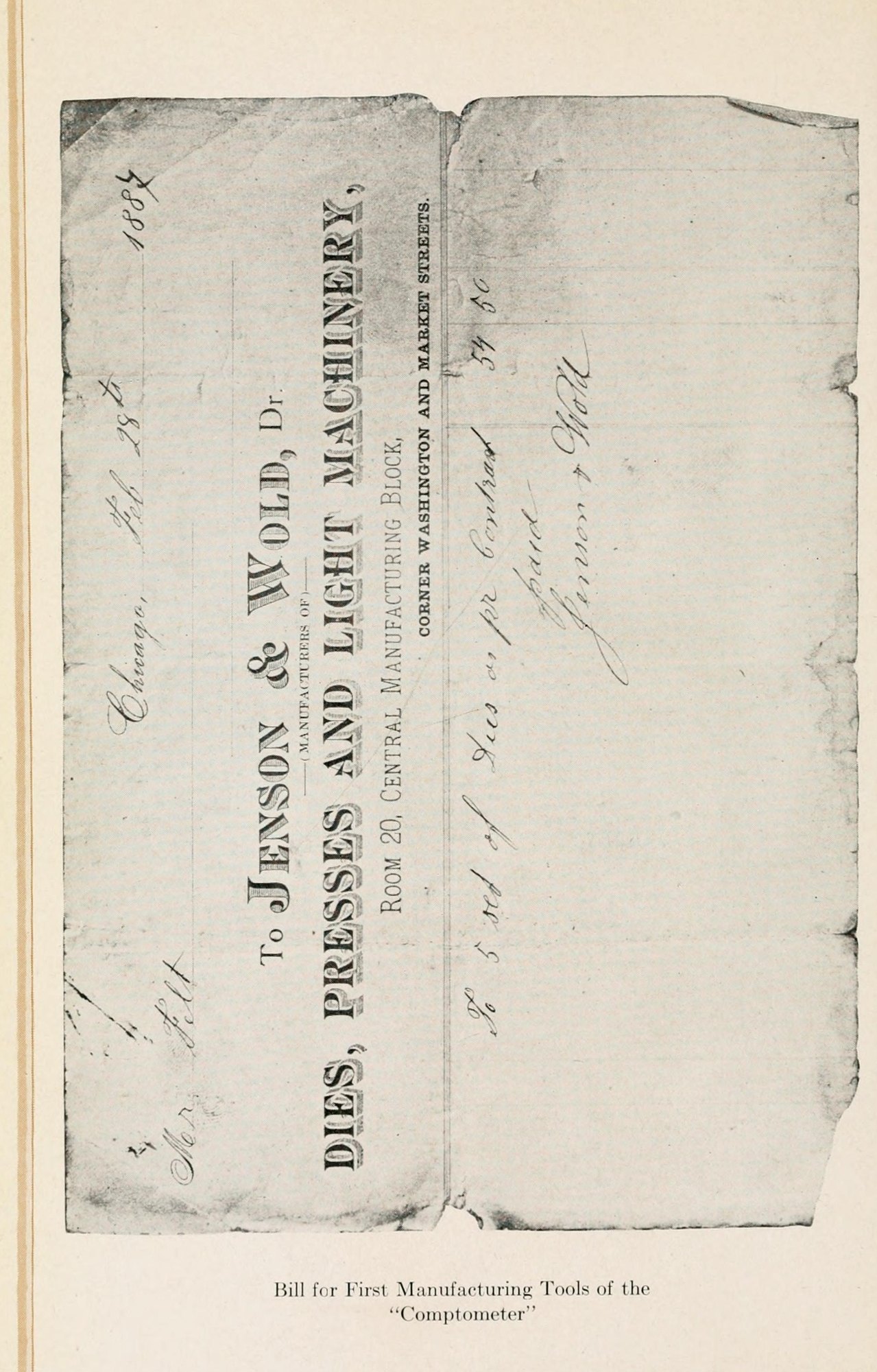
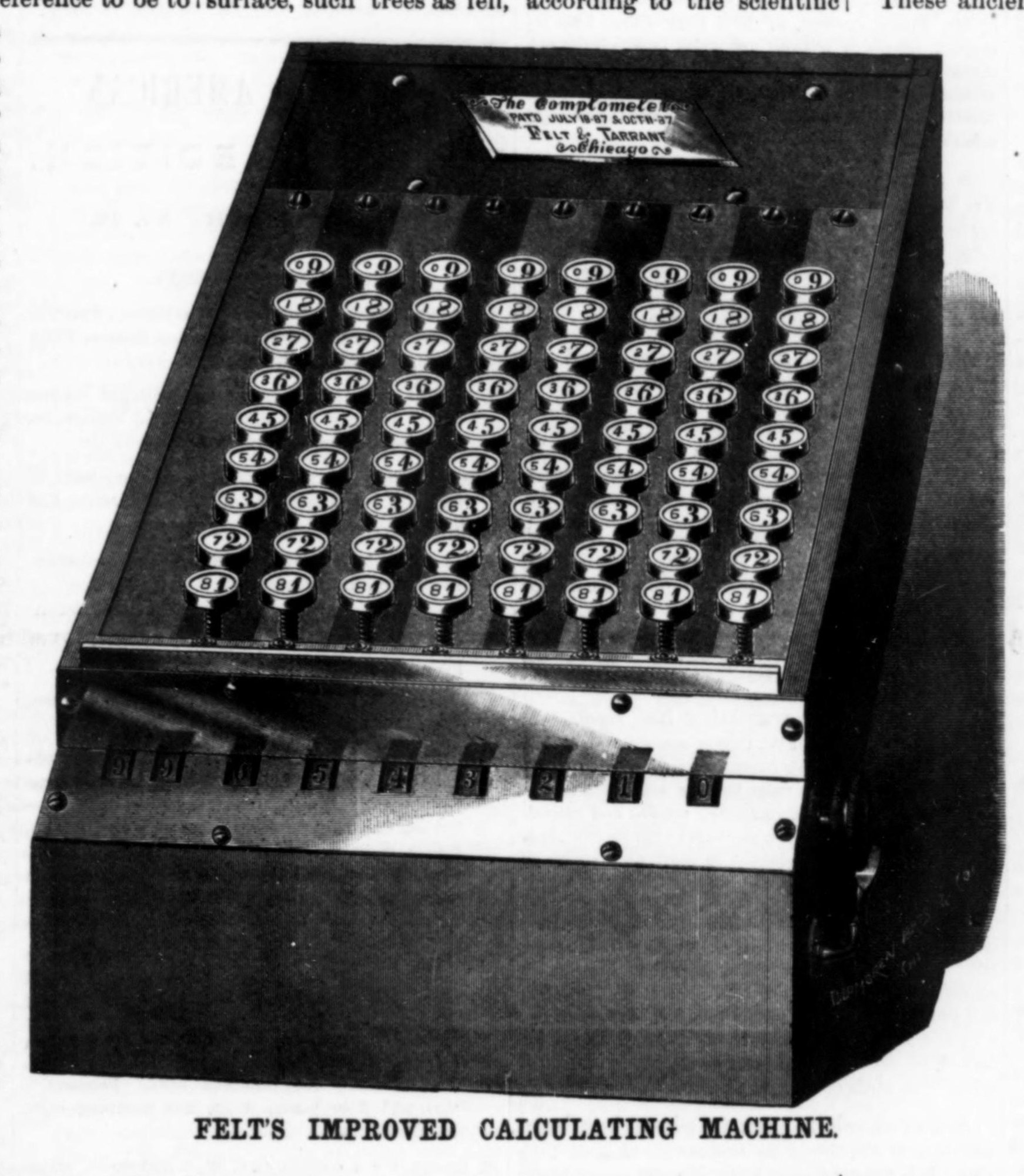
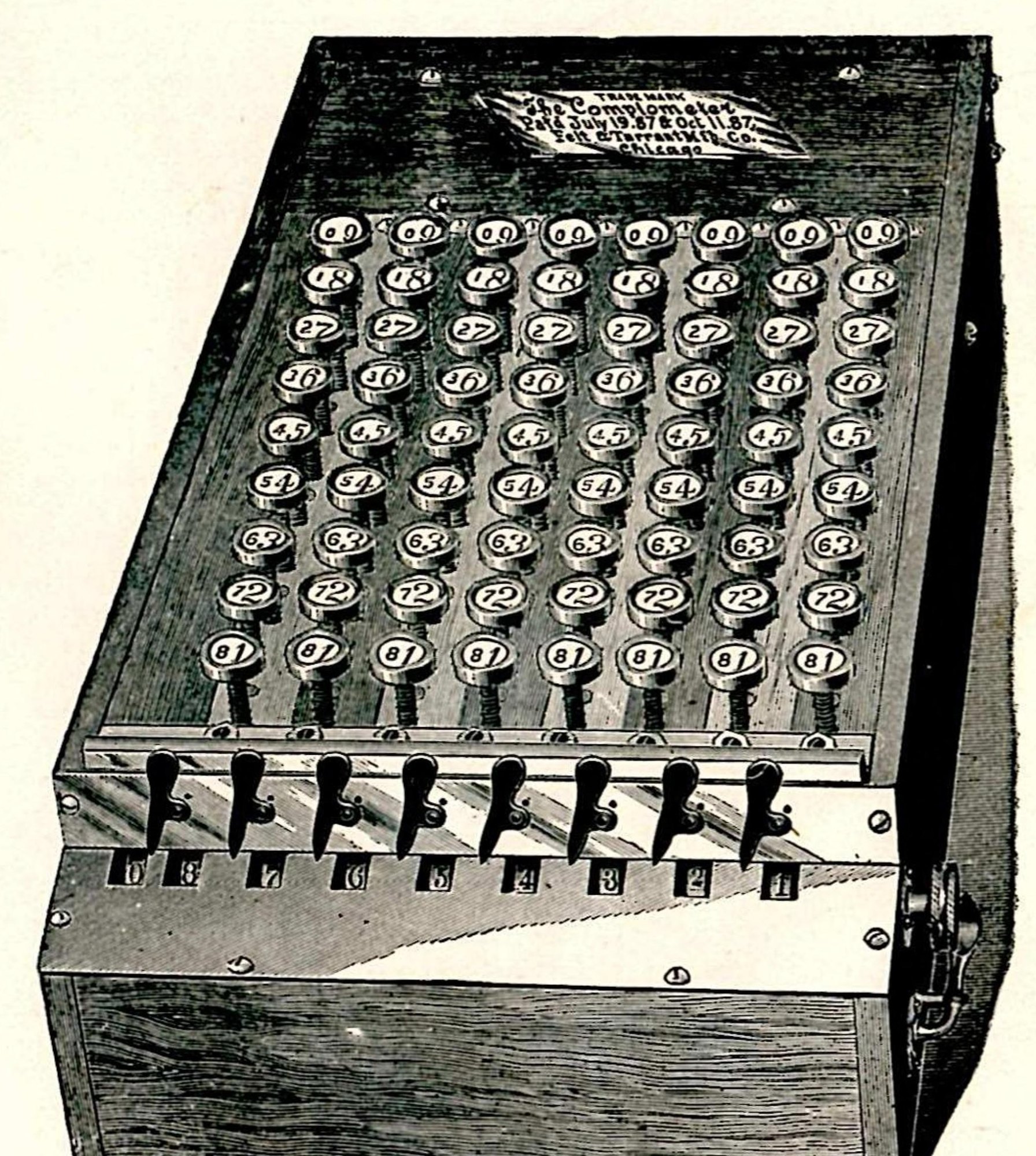
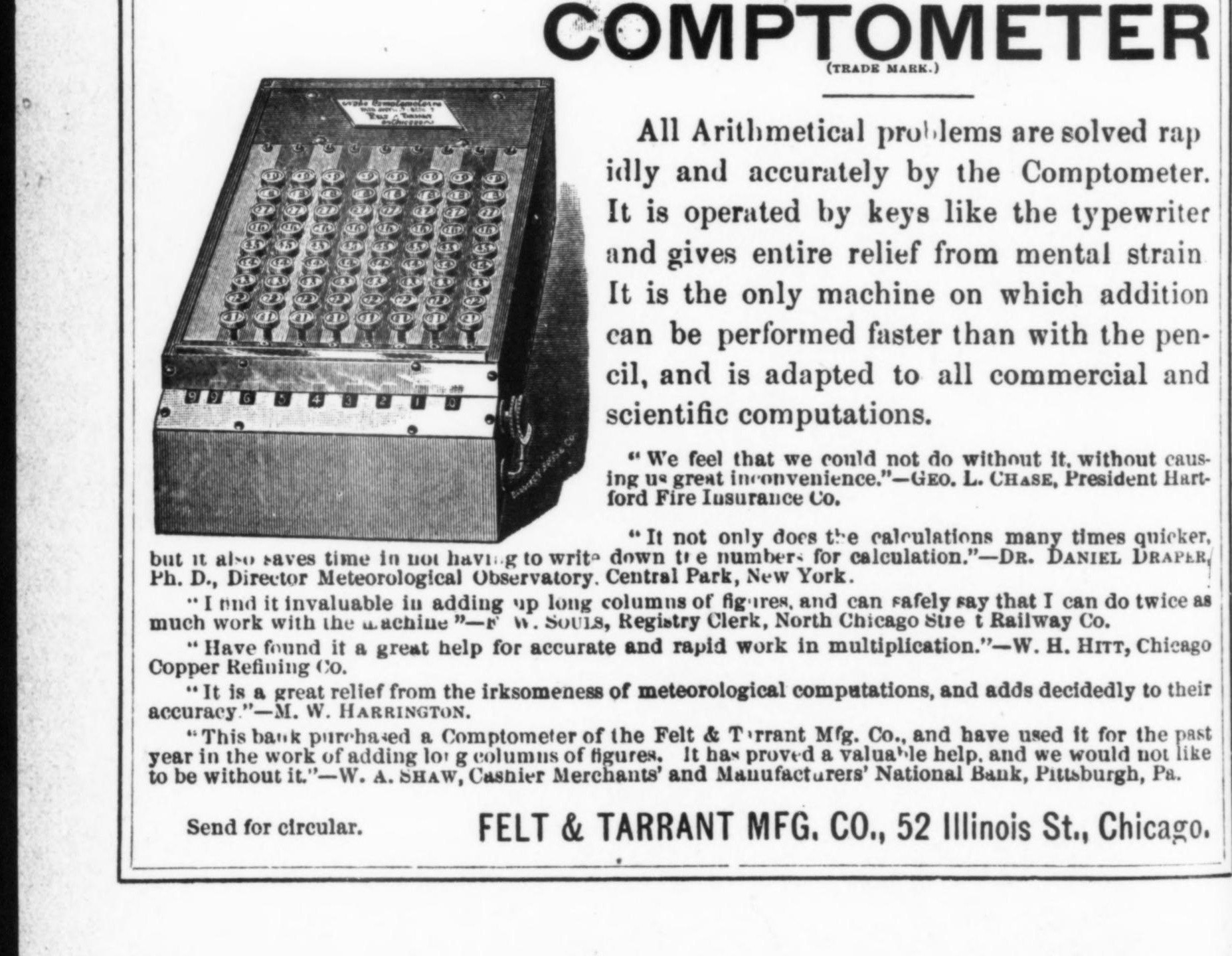
In February 1887 he paid the toolmakers Jenson & Wold for dies to stamp the parts (Turck reproduces the bill), and "he was able to produce eight finished machines before September, 1887". That September he showed one to General W. S. Rosecrans, Register of the Treasury, and left it with E. B. Elliott, the Treasury's Actuary; Turck prints letters from both men. On 28 November 1887 Felt signed a partnership with Robert Tarrant of Chicago. The machines were sold under the trademark "Comptometer", and in January 1889 the partnership became the Felt & Tarrant Manufacturing Company.
It sold slowly. "It took him almost three years to sell the first hundred machines," says the introduction to his 1916 lecture.
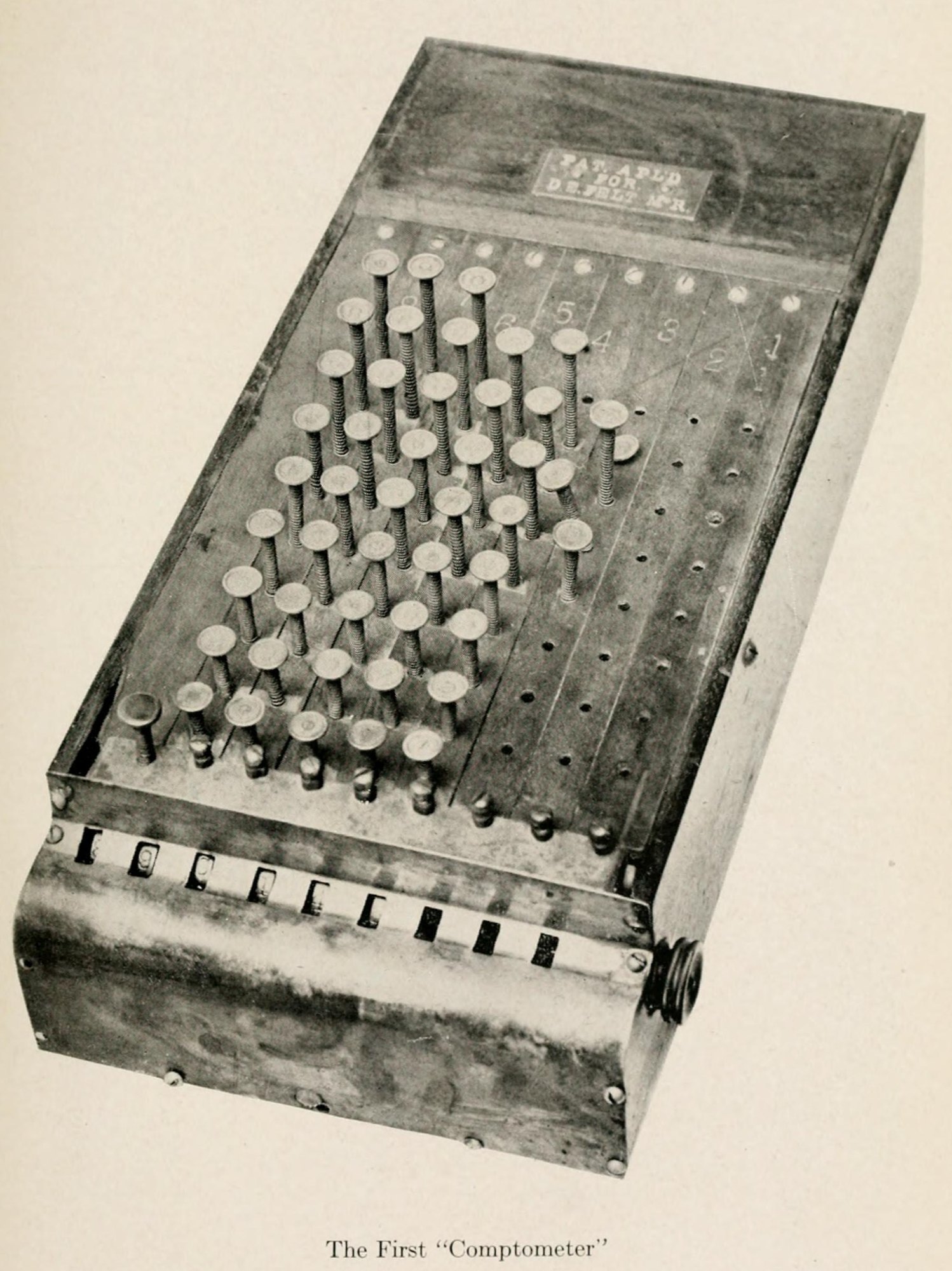
How it works: one key
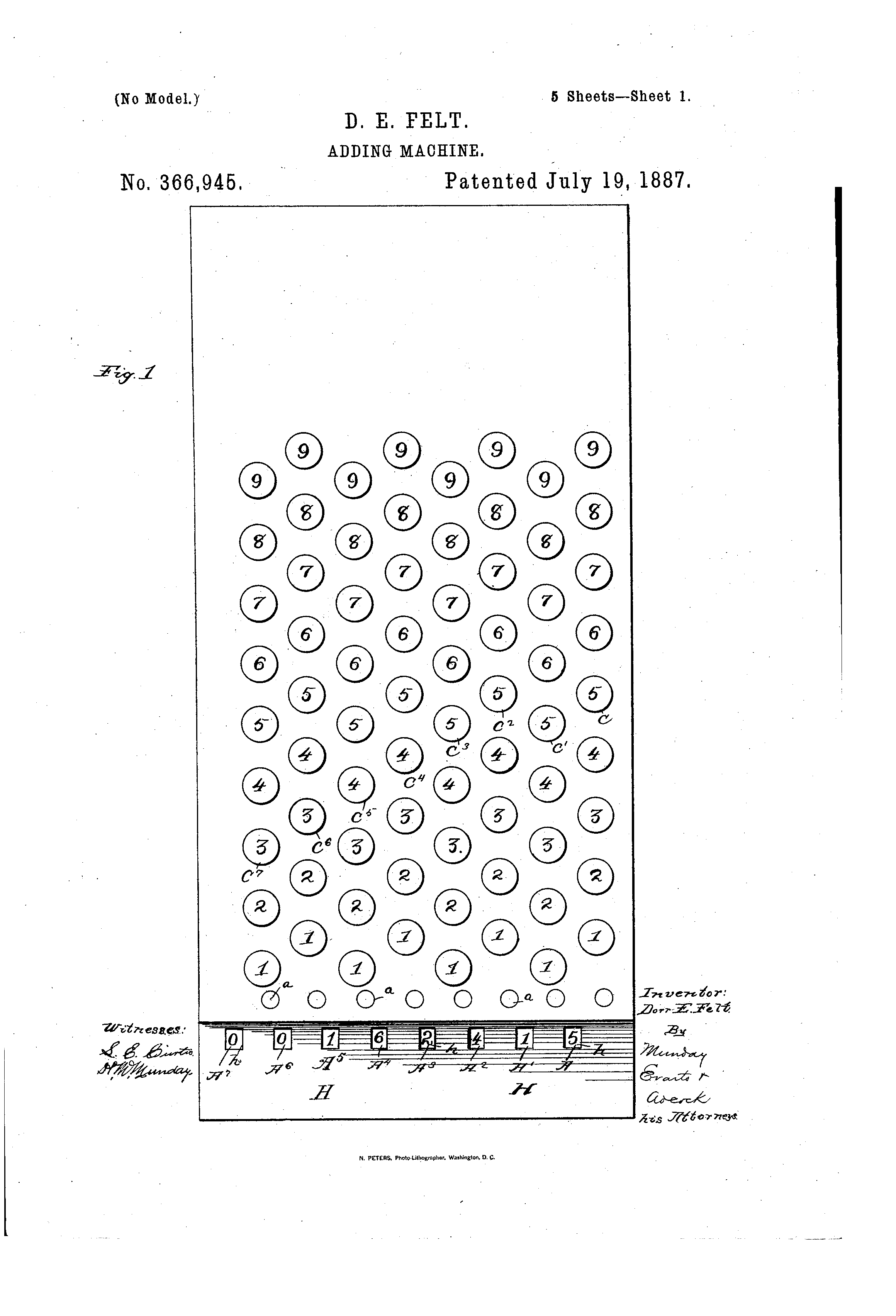
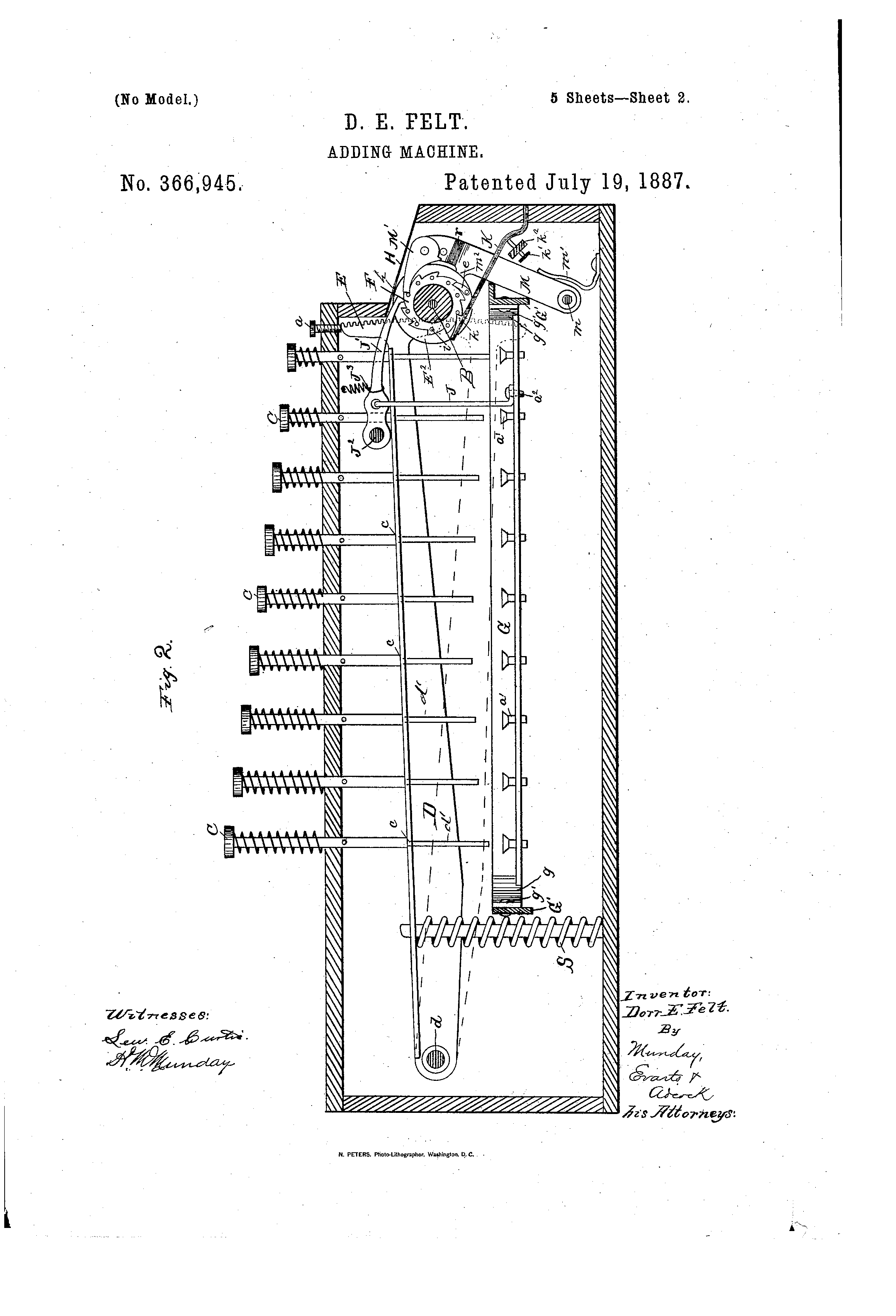
Felt's first patent has five sheets of drawings. Along the front of the machine is a row of numeral wheels on one shaft, B, each with the figures 0 to 9 round its rim, "so that but one figure of any wheel is exposed at a time". Fig. 1 draws eight of them. Each wheel has its own column of nine keys, "numbered from 1 to 9", and under each column lies a long lever, which Felt calls a "segment-lever", D.
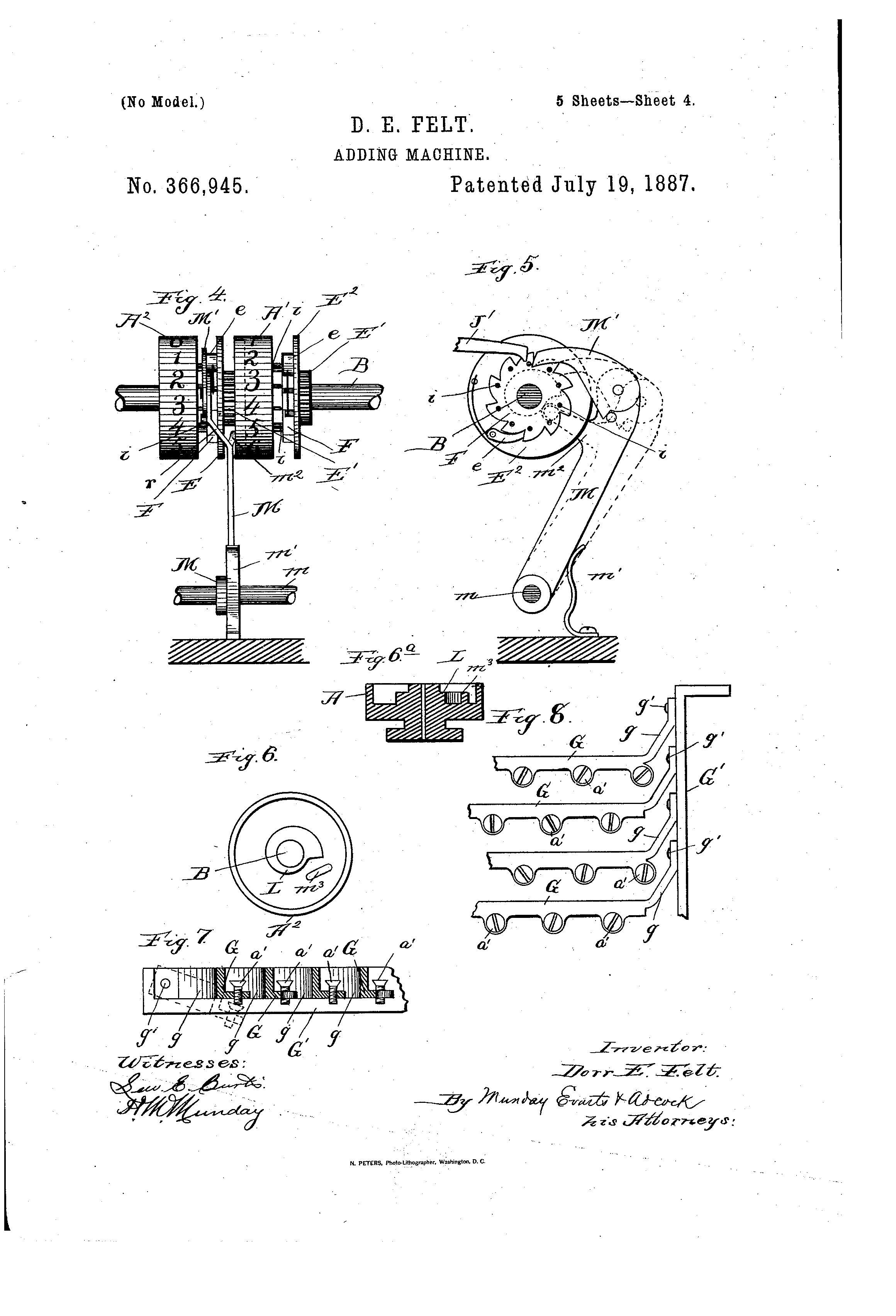
Press a key and its shoulder pushes the lever down. At the front, the lever's toothed segment E turns a small pinion E′ on the wheel's shaft. Fast to the pinion is a disk E² carrying a spring pawl e, a small catch that drives the ratchet F on the side of the wheel. The pawls "engage with and rotate the ratchet-disks F, but do not move the latter during the contrary rotation caused by the return-stroke of the levers", so the wheel only ever turns forward.
How far it turns depends on the key: "the keys numbered 1 are calculated to rotate the wheels one-tenth of a revolution, keys 2 to rotate them two-tenths, and so on through the series of nine keys". The keys stand at different distances along the lever, and "are graduated in length". In the drawings of both patents the 1 keys are the ones nearest the windows.
So that the wheel cannot fly on, each key, at the bottom of its stroke, presses a stop-lever G, which pulls a rod J and drops a detent J′ between the pins i on the side of the wheel. That gives "the absolute stopping of the rotation of the indicator-wheel", and it also results "in limiting the down-stroke of the keys, so that no special device for this purpose is necessary": the key stops because the wheel stops. Felt calls it "an automatic positive stop, for preventing them from being rotated too far by momentum".
The machine's keys, as on Fig. 1: a column of 1 to 9 for each wheel, the 1 keys nearest the windows. Units on the right.
From the patents: eight columns of nine keys, the 1 keys nearest the windows and the columns staggered by half a key; the wheels on one shaft B under the sloping plate with its sight openings; each key's shoulder on the segment-lever D, its segment E turning the pinion E′, the disk E² and its pawl e driving the ratchet F; the stop-lever G, rod J and detent J′; ten figures, ten pins and ten ratchet teeth a wheel; the cam L and guard L′, the carrying lever M with its spring m, arm m′, push-pawl m² and stud P, and the lock N on every wheel; the timing of the carry (the lever at rest to 4, pushed back from 4 to 9, let go from 9 to 0; the lock drawn clear from 7). Ours: every size and every speed (the patents give neither), the tooth counts and tooth shapes, the exact curves of the cams, the shapes of the pawls, the lock and the brackets, the look of the springs, and the case's materials and colours. The catch o′ on the bell-crank lever O hooks on the bar q and holds the lock clear through the carry, and the stud P knocks it off as the lever returns; how far it hooks, and the lock's travel, are ours. Left out: the spring-stops K and the zeroing parts, so "Clear" simply resets the wheels. The four-wheel and carry views draw only the lowest four and two columns, as the episode does. Keys are played one at a time, each after the last has risen; slow motion is ours.
- A
- The numeral wheels, "the wheel A representing units, the wheel A′ tens, the wheel A² hundreds, and so on", one figure of each seen through its sight opening h.
- C, D
- The keys, nine to a column, and the segment-lever under each column, "pivoted upon bar d".
- E, E′, E², e, F
- The toothed segment on the lever, the pinion it turns, the disk fast to the pinion, its pawl, and the ratchet on the wheel.
- G, J, J′, i
- The stop-lever under the keys, the rod, the detent, and the pins on the wheel it drops between.
Carrying the one
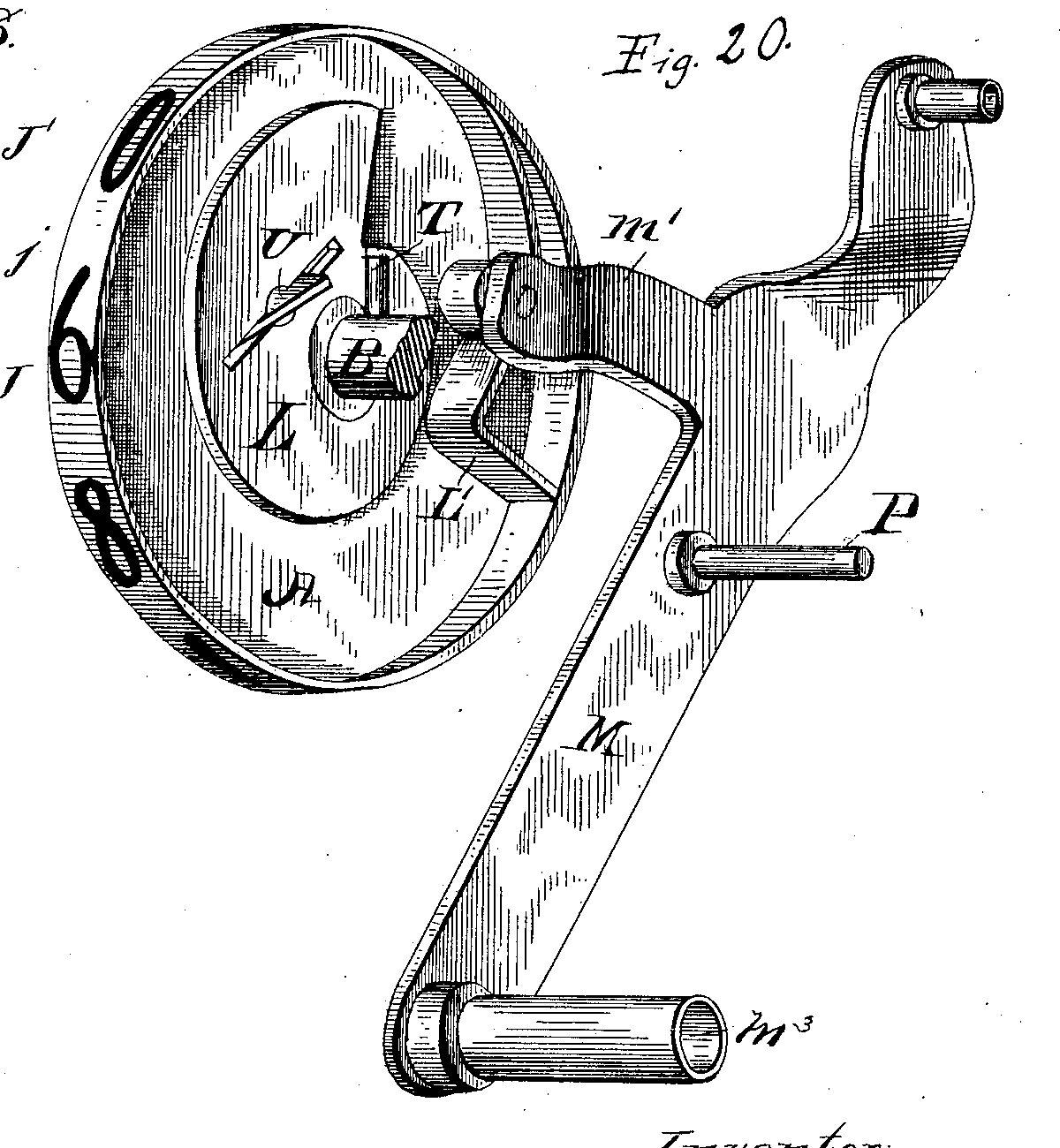
One column is easy. The hard part is what happens after nine. On the side of every wheel but the highest is a cam, L, "the general outline of which is that of a spiral, except the larger or outer third, or thereabout, which is concentric". Beside each wheel stands a carrying lever, M, pushed toward the wheels by a spring, with an arm that rides on the cam.
As the wheel turns, the cam pushes the lever back and winds up its spring; the second patent says the lever moves back "from the time said wheel indicates 4 until it has reached 9". At the top of the lever is a push-pawl that reaches across to the pins of the next wheel, and the backward swing allows "the pawl M′ to fall back of the next tooth". When the wheel passes from 9 to 0, the arm drops off the high part of the cam, the spring throws the lever forward, and the pawl moves the next wheel "one tenth of a revolution, so the latter will indicate a number one higher than before". Switch the model to "The carry" and add 5 a few times, slowly, to watch it.
The key never pays for the carry. The spring was wound by the wheel's own turning, so "no more force is required to be put upon the key when numbers are to be carried than when they are not to be carried". And one carry can set off the next: with the wheels at 9 9 9, "a single unit added to the unit-column should result in the partial rotation by the carrying mechanism of the next three higher wheels as well, so as to indicate 1,000". Press "999 + 1" on the model to see it twenty times slower than real time.
The patent works through a whole sum: 327, 946 and 183, added column by column. The units keys 7, 6 and 3 make 7, then 13 ("We now have represented by the unit and the ten wheels the sum 13"), then 16. The tens keys 2, 4 and 8 take the tens wheel to 3, 7 and 5, carrying into the hundreds. The hundreds keys 3, 9 and 1 take that wheel to 4, 3 and 4, carrying into the thousands. "The four wheels mentioned now show the total result to be 1,456." Press "Felt's example" on the model to run it key by key, with Felt's words for each step. The patent adds that the numbers can as well be added one at a time, "striking first the 9 key in the hundreds, then the 4 key in the tens, and lastly the 6 key in the units; or this order may be reversed", which is how the box under the model adds a number.
The two patents letter the carry parts differently. In 366,945 the lever's spring is m′, its arm m² and its pawl M′; in 371,496 they are m, m′ and m². The model's labels use 371,496's letters for the carry, and 366,945's for the key drive, which 371,496 keeps.
- L
- The cam on the side of each wheel but the highest: a spiral, with its outer third or so concentric.
- M, m, m′
- The carrying lever beside each wheel, its spring, and the arm that rides the cam.
- m²
- The push-pawl on the lever, "engaging with the teeth i of the wheel next higher in order"; the lever is "bent laterally" to reach them.
- L′
- The guard cam (371,496), "to return the arm M positively when the motion is too rapid for the spring m".
- N, P
- The lock on every wheel (371,496), and the stud on the carrying lever that draws the next wheel's lock clear.
At speed
Felt's second patent explains what went wrong when the machine was worked fast. When a wheel is turned very quickly, the carrying lever is flung back so hard that "the spring m is occupied for a moment of time in overcoming and reversing this motion, and during that moment the numeral-wheel will pass so far forward that the carrying part will fail to act". His fix was a second cam, the guard L′, to drive the lever back by force.
He also locked every wheel whenever it was at rest, "because the correctness of the calculation depends upon the presence of each wheel in its true position at the time when it receives its forward impulse". Each wheel has a detent N that is "always in locking engagement therewith when at rest, except when the numeral-wheel next lower stands at 7, 8, or 9, or when released momentarily by the keys". A stud P on the carrying lever draws the next wheel's lock clear when the wheel below reaches 7, a catch holds it clear, and it drops back in just after the carry. In the model's carry view, the readout shows the tens wheel's lock going out and in. "So far as I am aware," Felt wrote, "no calculating-machine has been provided with means for locking its numeral-wheels during their periods of rest and for unlocking said locking means independently by the carrying device and by the wheel's own key-actuating device."
Neither patent says what happens when a key is struck in one column at the very moment a carry arrives there from the column below, so the model on this page plays its keys one at a time and never has to answer it.
William Burroughs
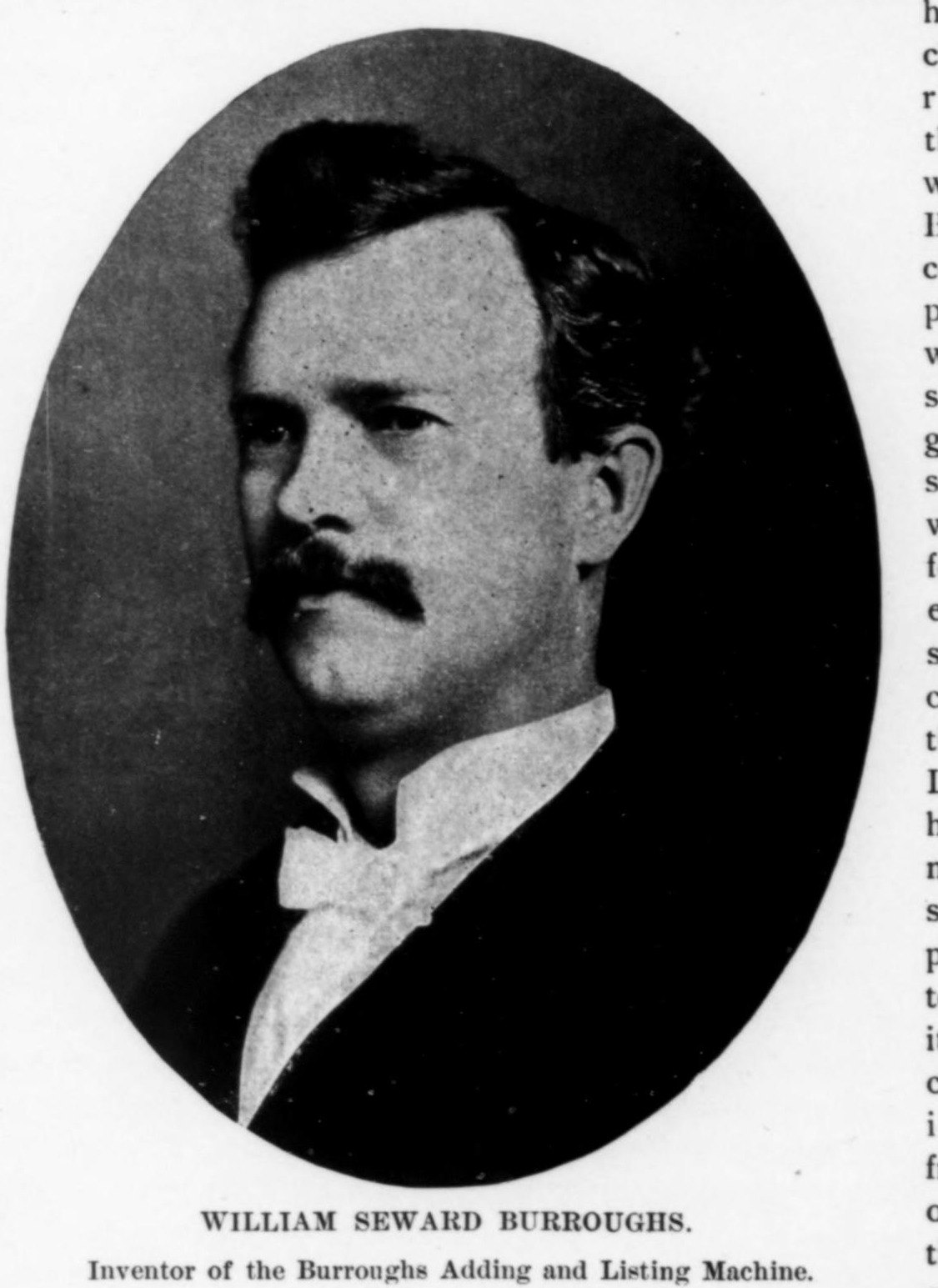
William Seward Burroughs was born in Rochester, New York, on 28 January 1857, and went to work in a bank in Auburn. Tuberculosis, "which had first seized him in the bank at Auburn", drove him out of clerical work. He moved to St. Louis, and took bench room, tools and "three or four of Mr. Boyer's workmen" at Joseph Boyer's machine shop on Dickson Street. Most of what is known of his early years comes from The Book of the Burroughs, his company's own history, published in 1912.
By the company's account, his first backer, in 1884, was a member of a St. Louis dry-goods firm who raised $700 ≈ $25,000 "in exchange for fourteen shares of stock in the company which he proposed to organize"; the Franklin Institute's account says roughly $300 ≈ $11,000. He filed his first adding-machine application on 10 January 1885, and in January 1886 the American Arithmometer Company was organised in St. Louis to make it. Four of his patents were granted on the same day, 21 August 1888.
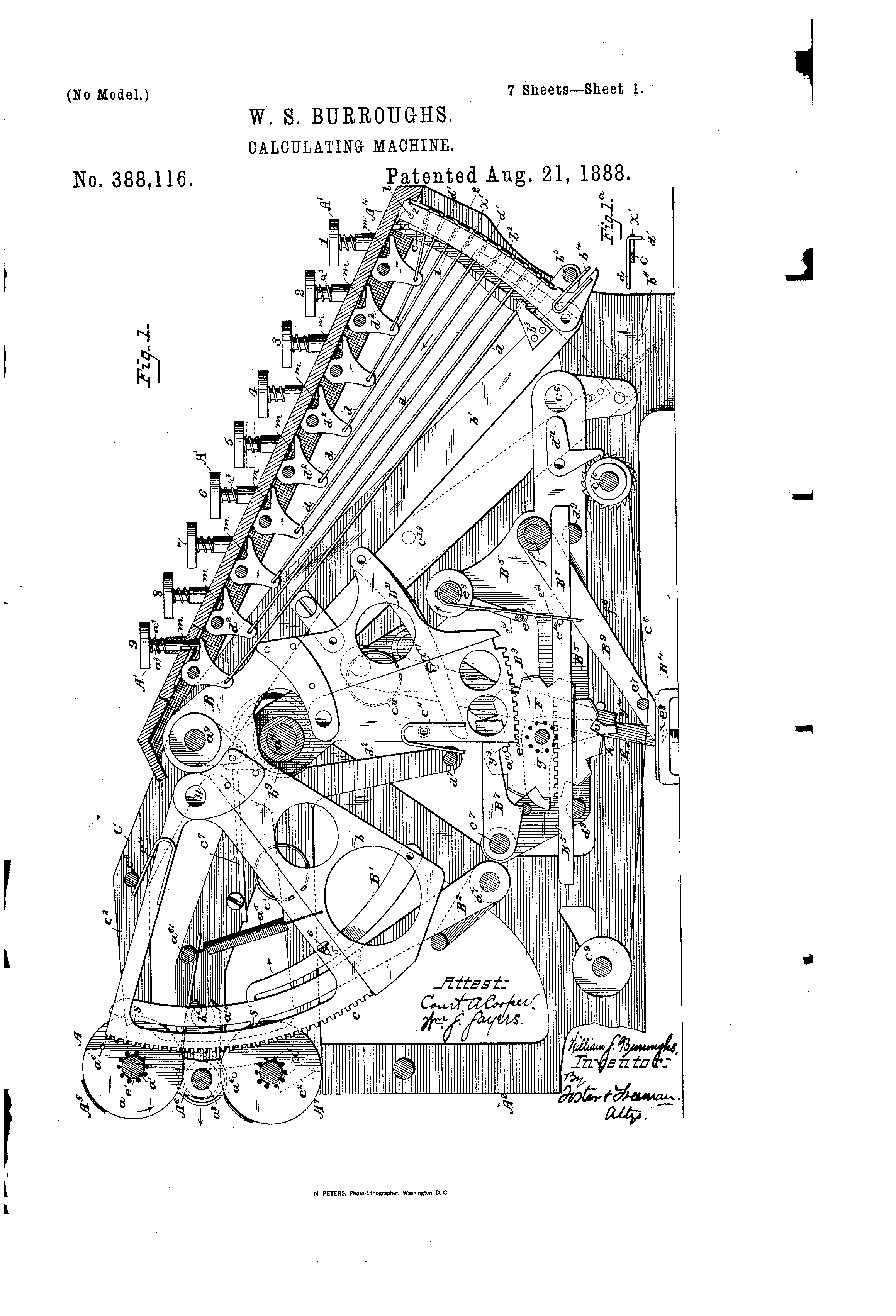
His machine went the other way from Felt's. In the machine he sold, you set the whole number on the keys first, then pulled a handle, and the machine added it and printed it. His first design, 388,116, was not yet that machine: in it each key added as it was struck, and the handle reset the machine between numbers.
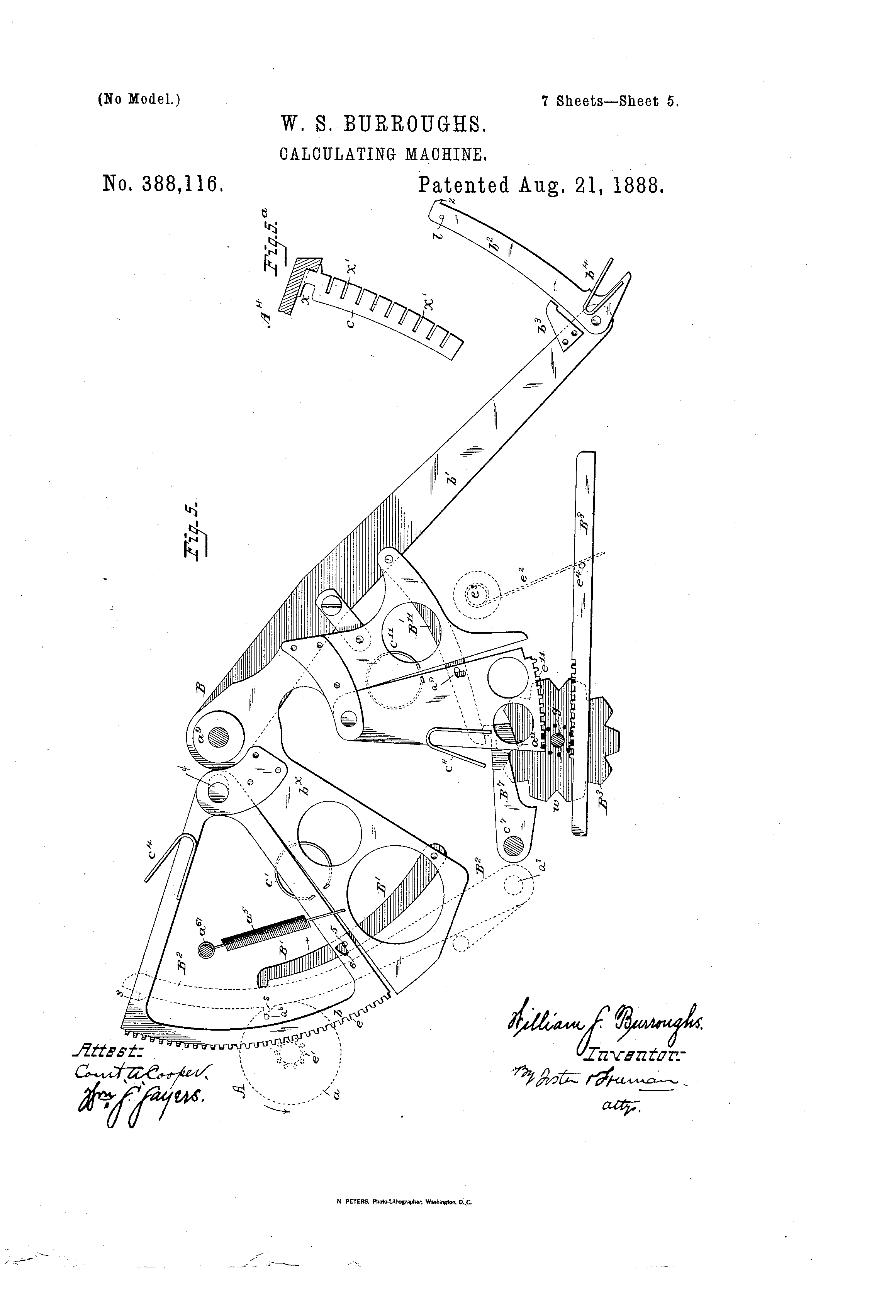
His carry works on the same idea as Felt's: a spring-loaded part, held one tooth short, and let go when the column below passes nine. In 388,116 it is the toothed segment b, pushed by a spring c′ and held by a pin 5 in an L-shaped slot 6. When the lower wheel's pin a⁶ comes round to 0, it knocks a lever B² against the latch B′, which lets the pin into the upright leg of the slot, and the segment jumps one tooth, turning the next wheel a tenth of a turn. But where Felt's spring is wound by the wheel as it turns, Burroughs's is wound by the handle: its stroke presses the segments back down and latches them again.
The handle
The handle was also his biggest problem. Early in 1889 he contracted with Boyer for fifty machines, and they began arriving in the spring of 1890. By the company's later account, "no two persons operated Burroughs' machine in the same way. One man would pull the lever slowly and evenly; another jerked it violently, and thus obtained results as amazing as those of the beginner on the piano."
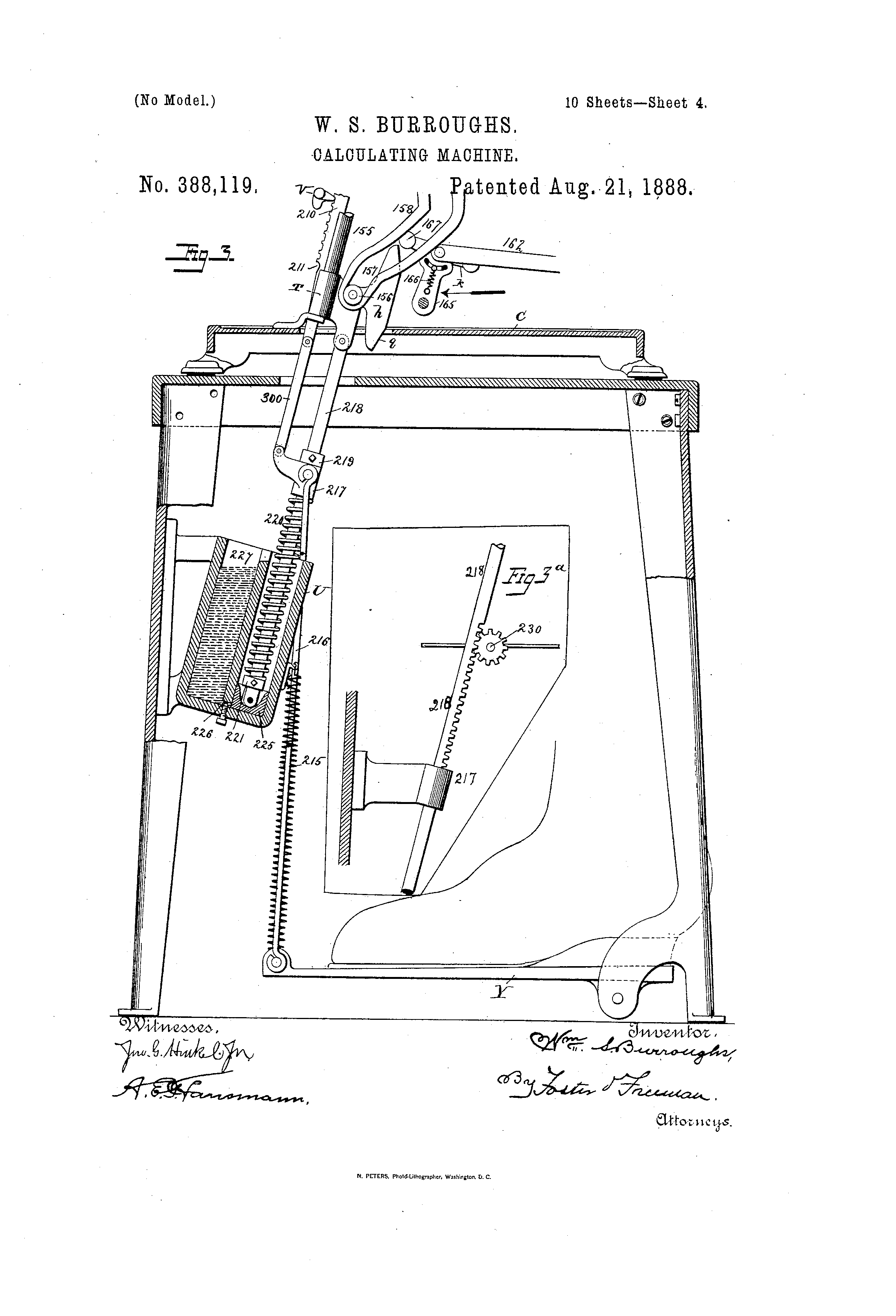
He had seen the danger coming. In an application filed on 30 November 1887 (US 388,119) he wrote: "Where the movements of a mechanical calculator are effected directly by the power of the operator, they are apt to vary in force and quickness, with a most detrimental effect upon the mechanism." His answer was to let the operator only wind up springs, and to set the pace with a dash-pot: a cylinder, a piston, and "a supply of oil that flows slowly back and forth through the port".
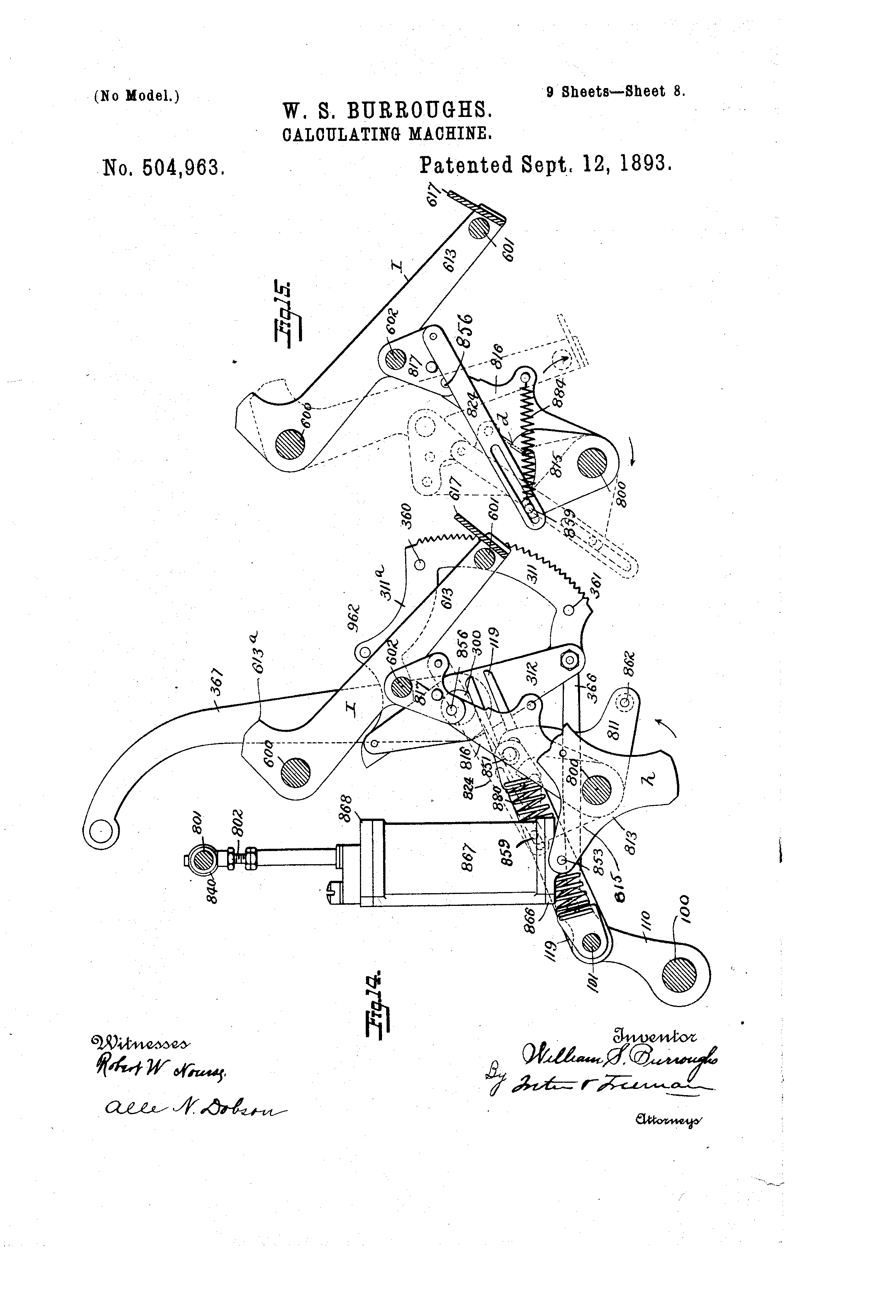
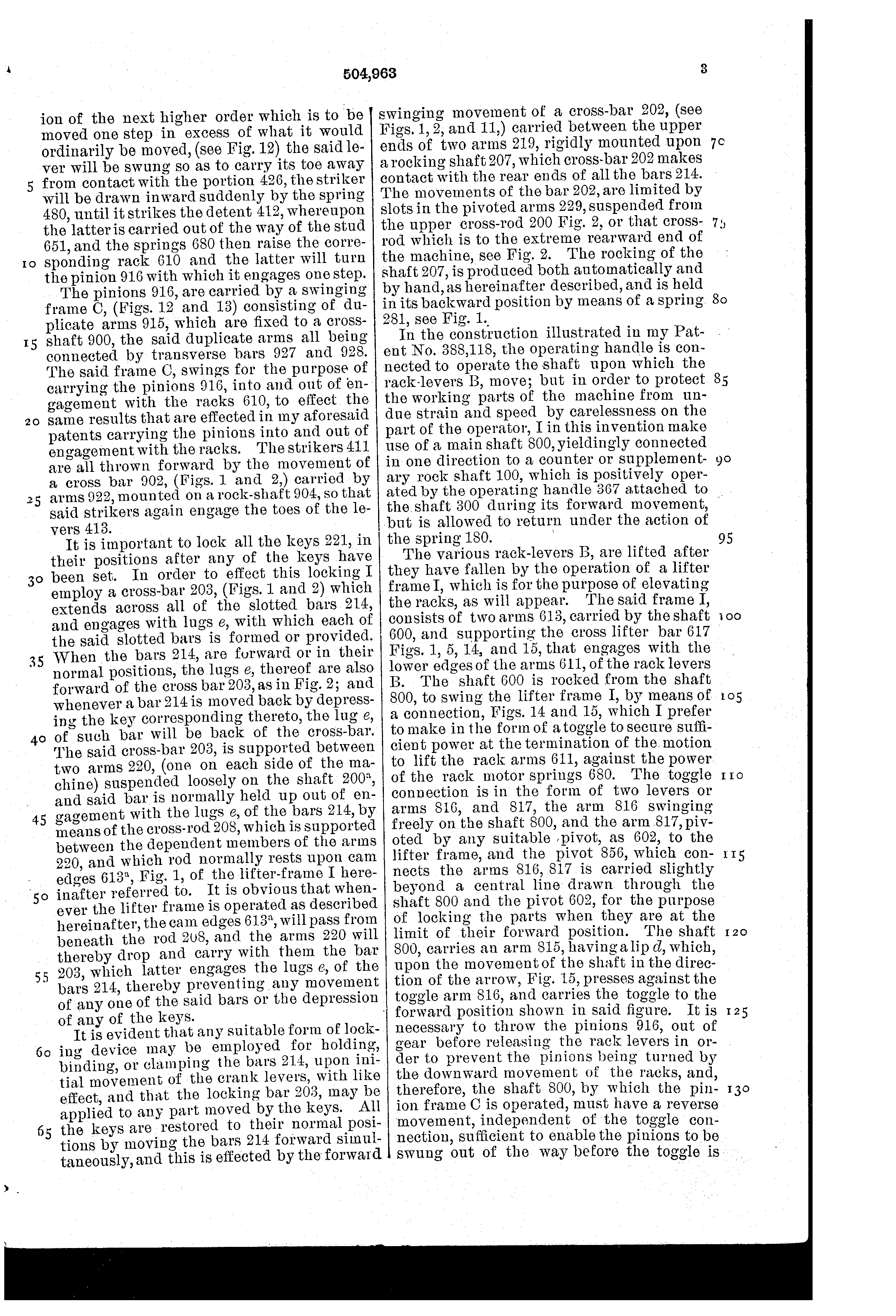
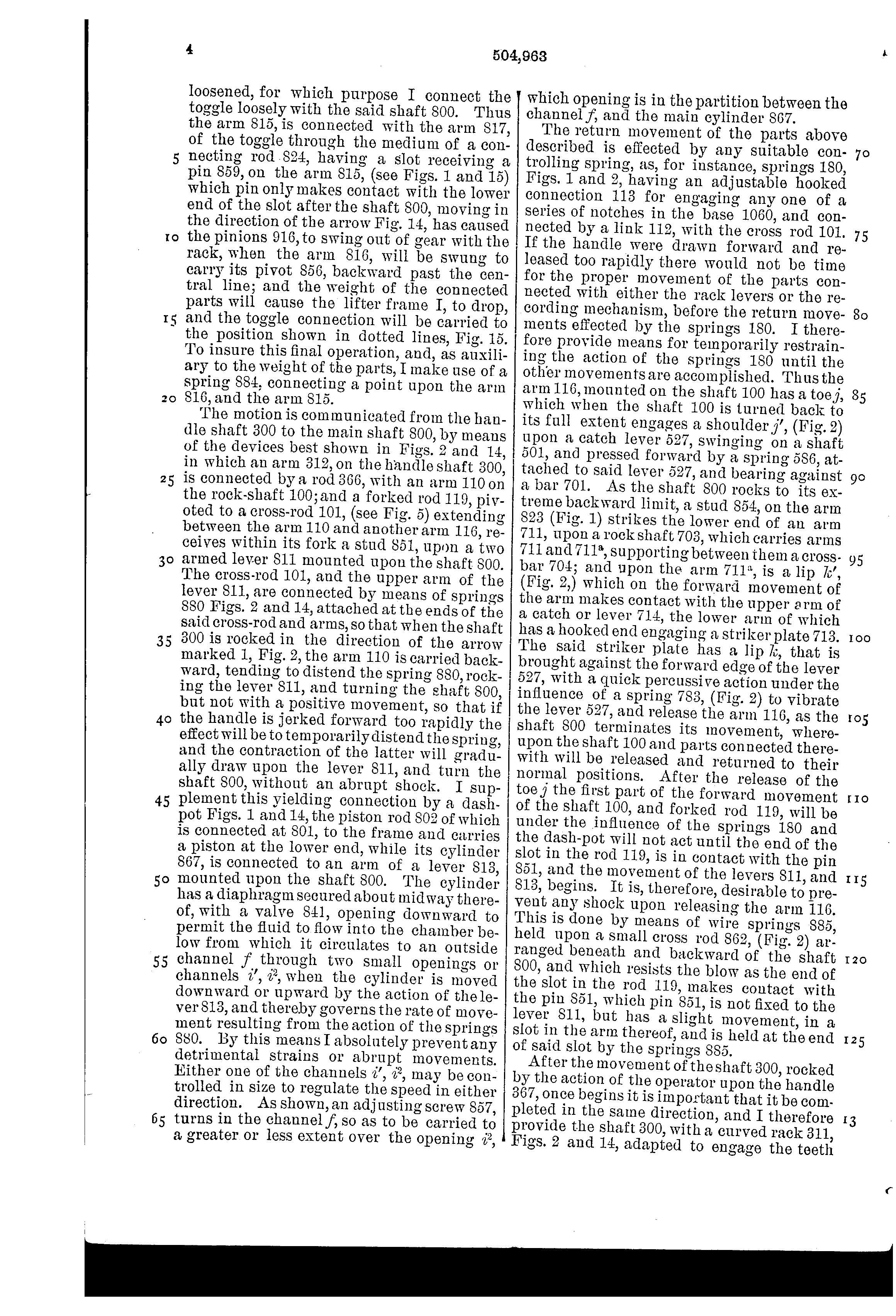
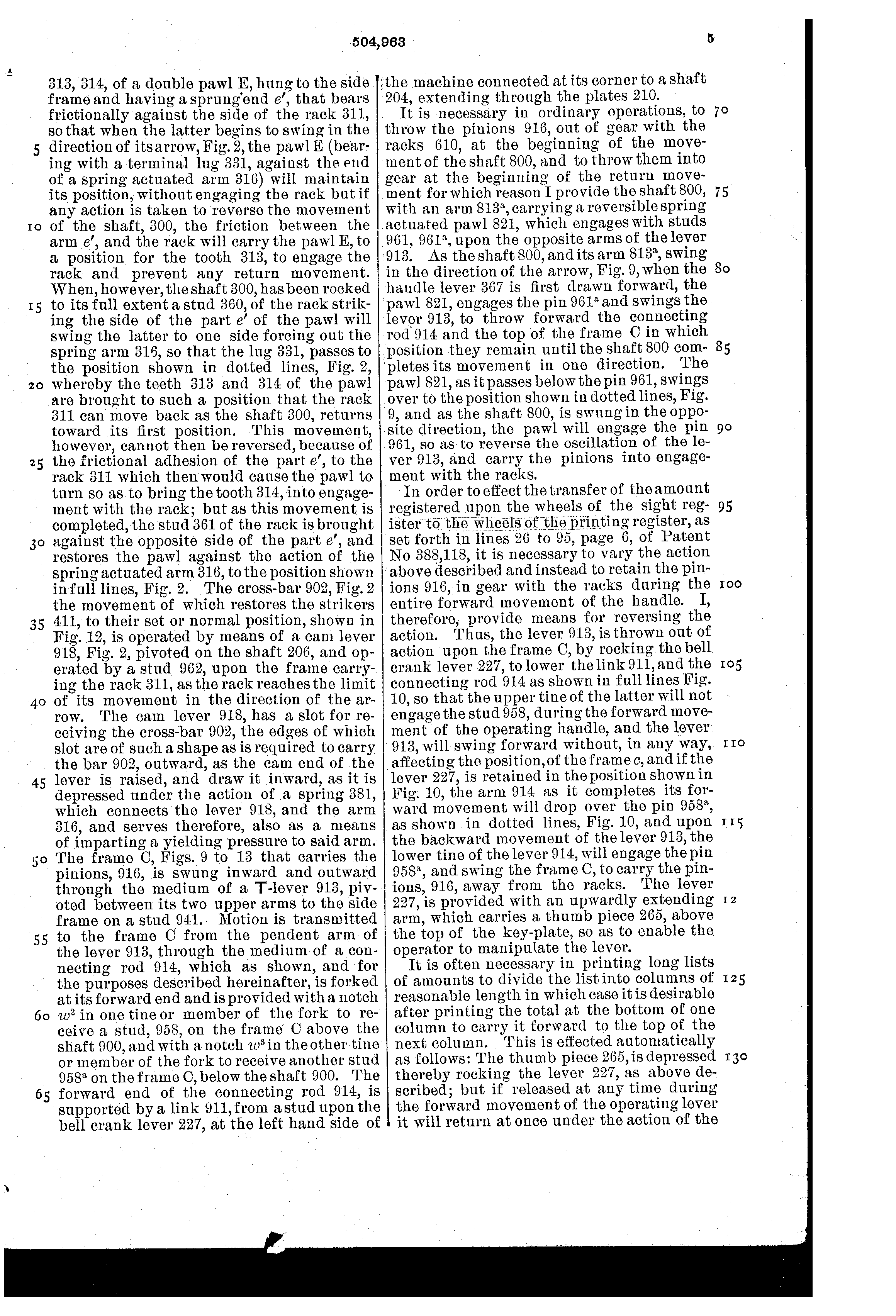
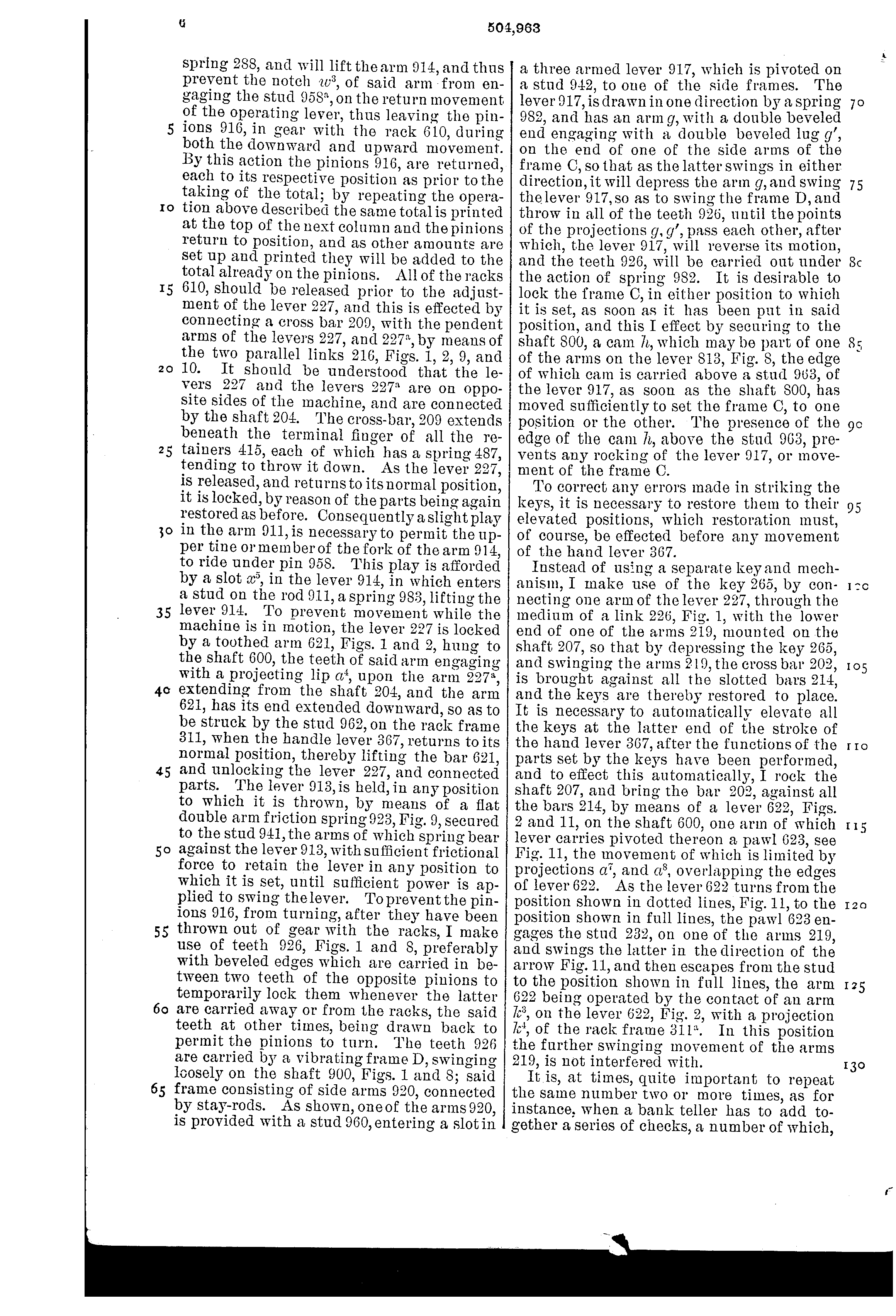
In his hand-lever version, filed in May 1892 and patented in September 1893 (US 504,963), the handle drives the machine through springs, "so that if the handle is jerked forward too rapidly the effect will be to temporarily distend the spring, and the contraction of the latter will gradually draw upon the lever 811, and turn the shaft 800, without an abrupt shock". A dash-pot on the main shaft "thereby governs the rate of movement". However hard you pull, the oil sets the pace.
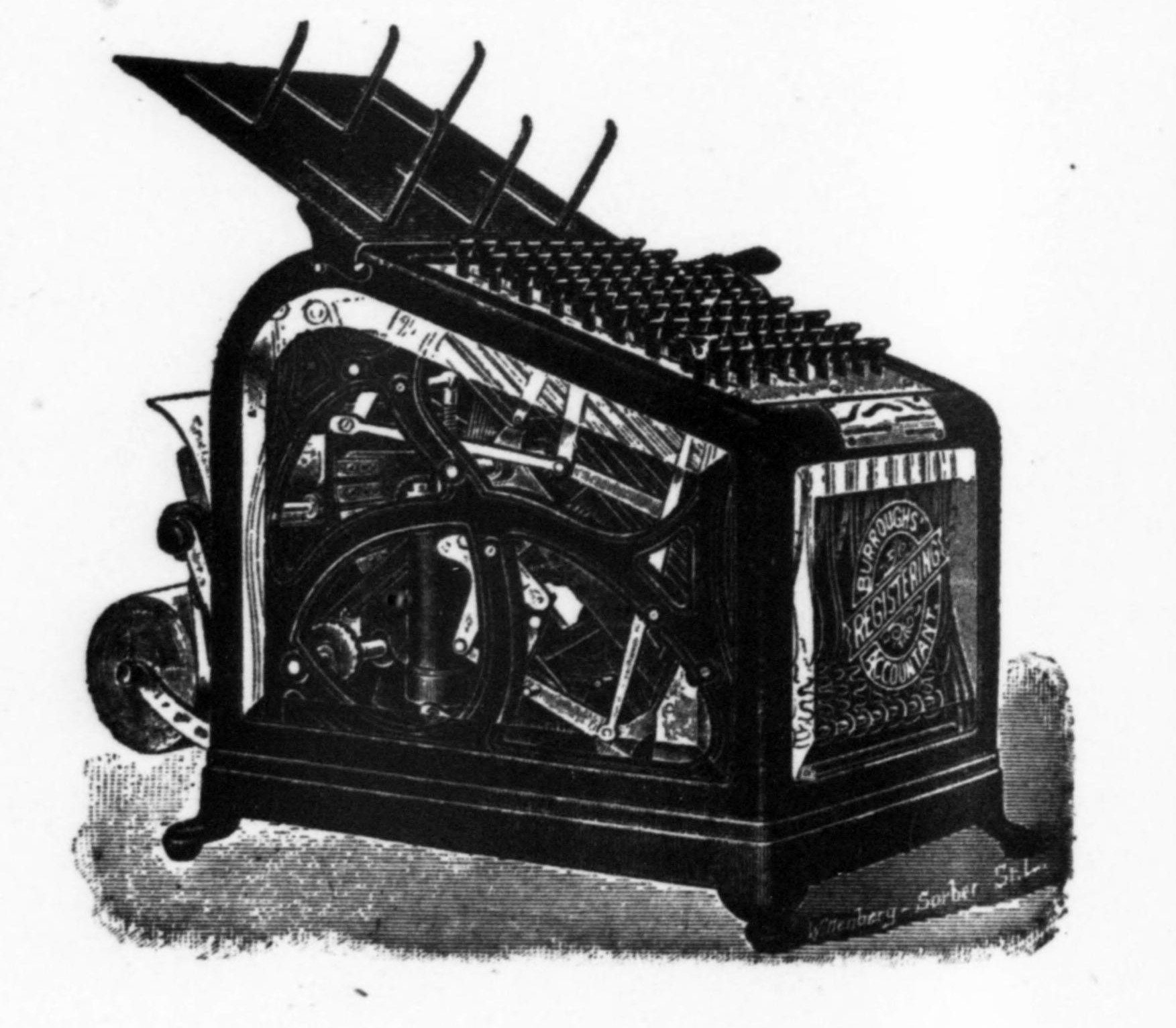
Late in 1890 he found new money, and in the summer of 1891 the first of a hundred new machines came out of Boyer's shop, with what the company called the "Burroughs Automatic Control".
The company later told a story about the first fifty: that Burroughs carried them "in his arms to the window" and hurled them "one by one a twisted mass of wreckage to the pavement below". The earliest printing of it we found is a company booklet, A Better Day's Work, of 1910, twelve years after his death, and it names no one who saw it. So it is company legend. The company's own 1912 book puts the fix before the window, and the dash-pot was already in his application of 1887, before any of the fifty were ordered.
The first production machine was sold about December 1892, according to the court testimony of H. B. Wyeth, once the company's sales agent, as Turck reports it.
Rivals
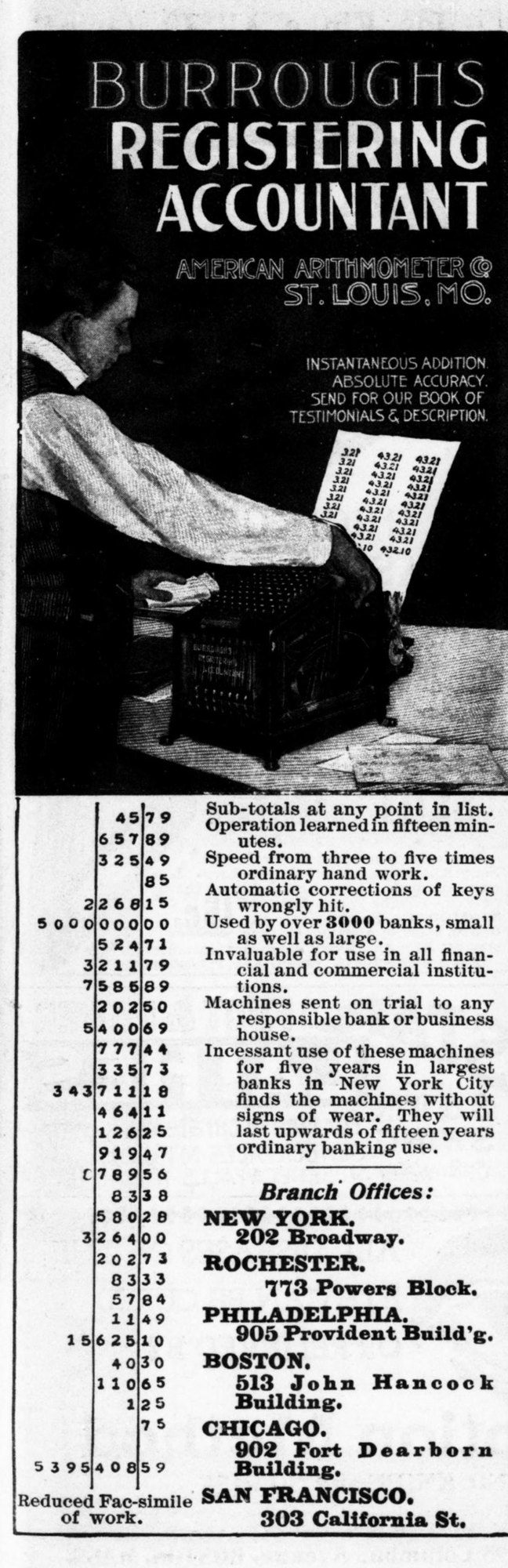
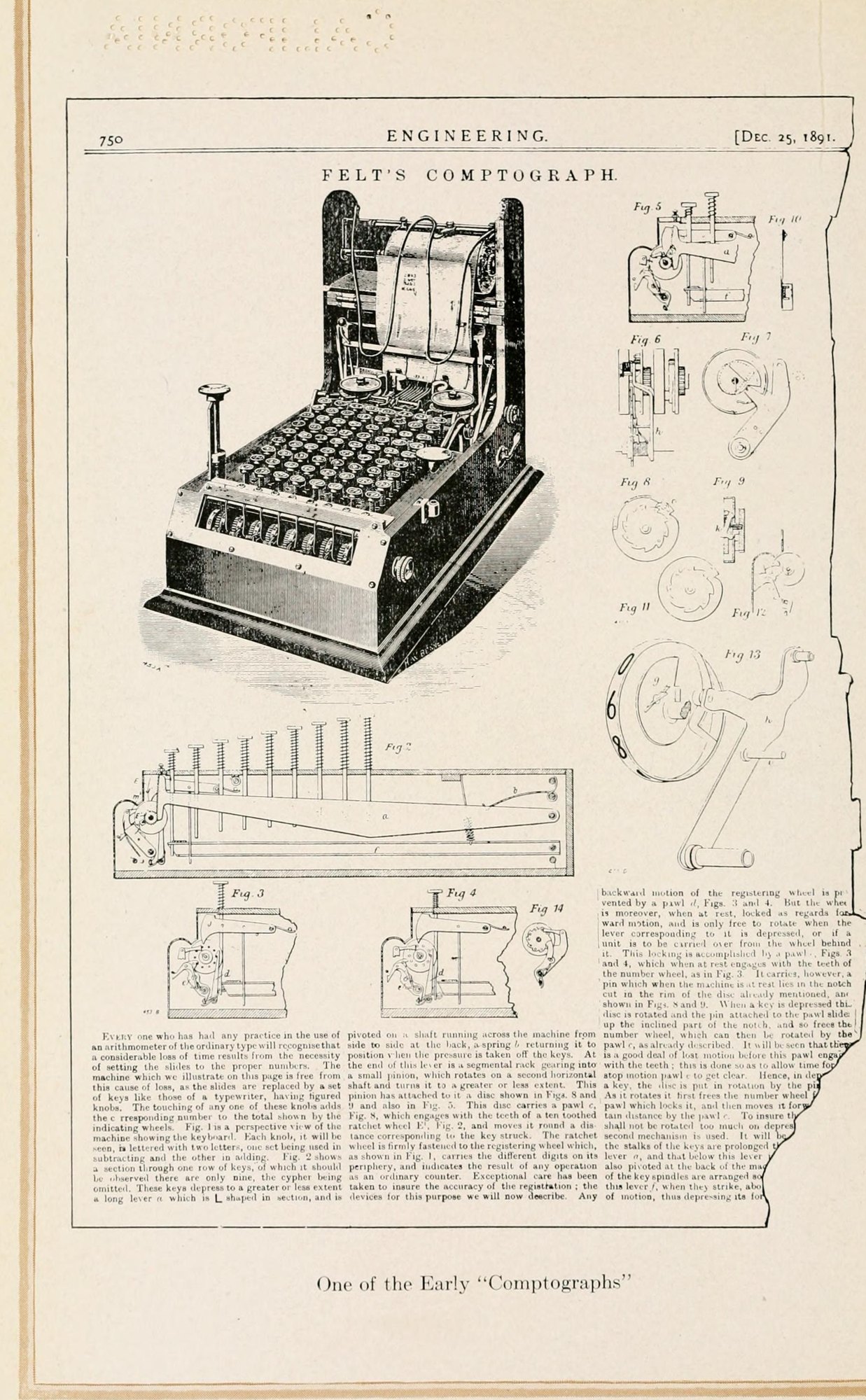
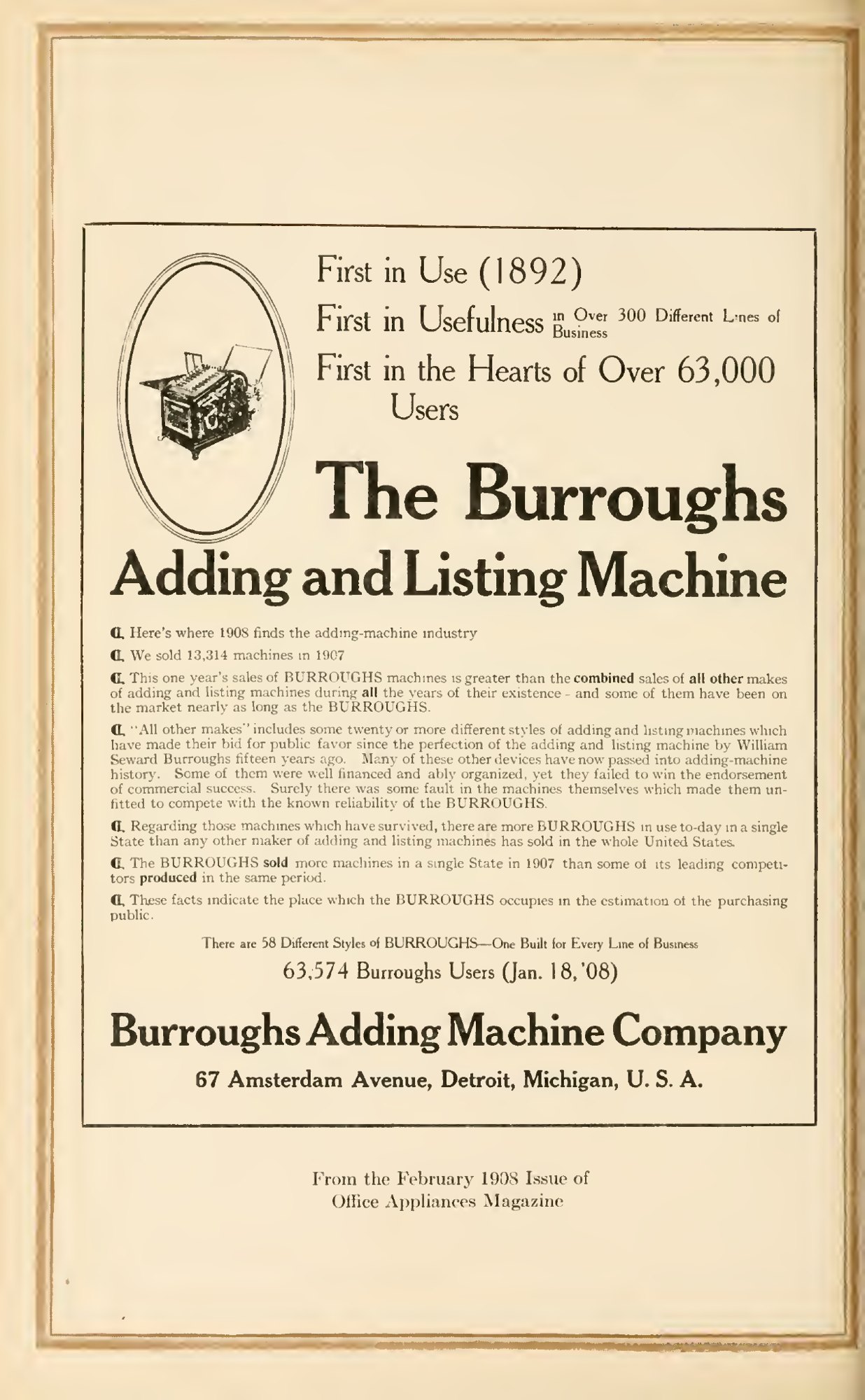
By the 1890s both machines were on sale. Felt had built a printing machine too, the Comptograph; Turck says the first was put on trial at the Merchants & Manufacturers National Bank of Pittsburgh in December 1889. His side argued for years that his, not Burroughs's, was the first practical adding machine that printed. Burroughs's side advertised its machine as "First in Use (1892)", and by its own count sold 13,314 machines in 1907 alone.
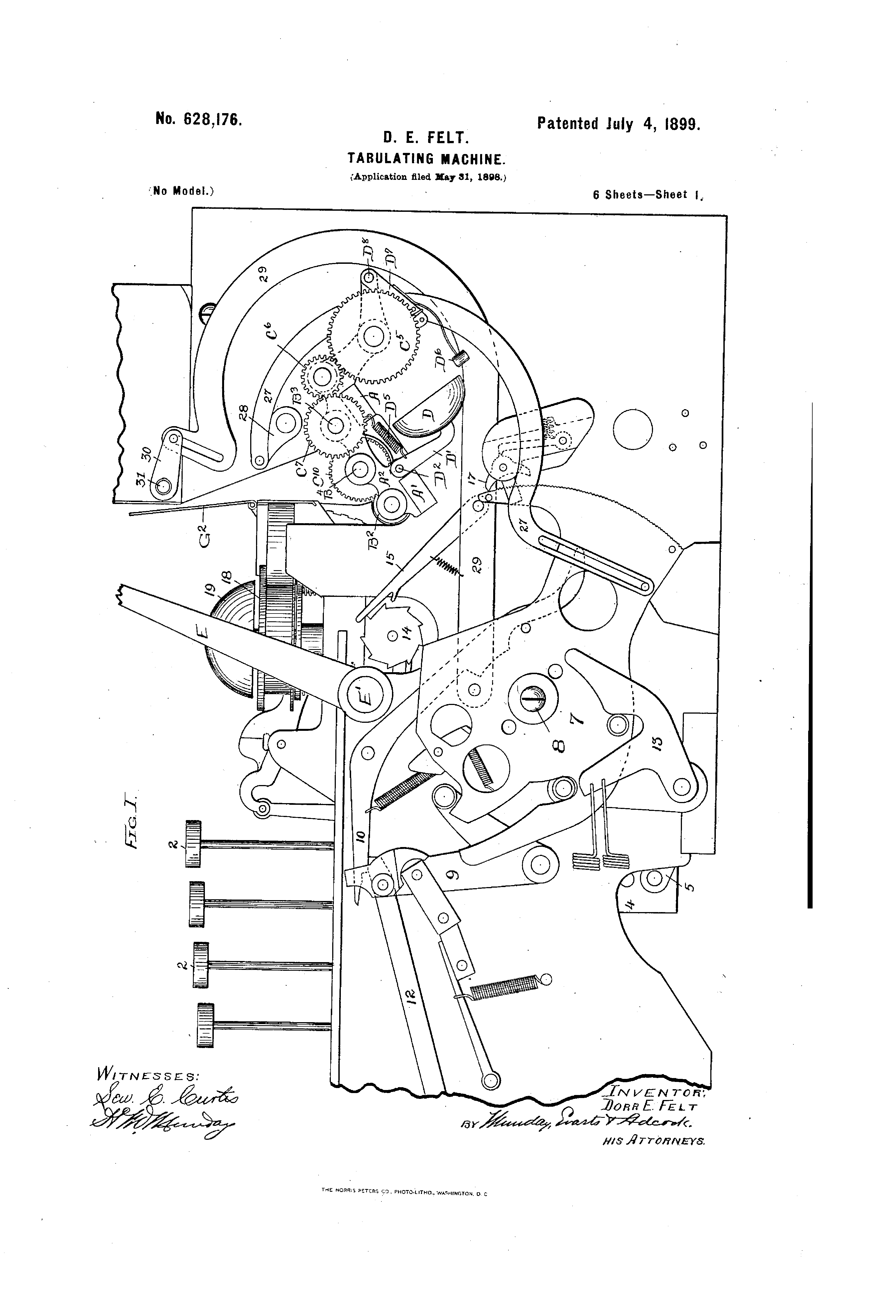
The fight that reached court was over a later Felt patent, US 628,176 of 1899, for a wide paper carriage that printed in columns side by side. In January 1904 Felt's side, by then the Comptograph Company, licensed it to Burroughs's company for $5,000 ≈ $180,000, with royalties while a test case ran against another maker. In August 1906 the appeals court in that case ruled the patent's claims void, "either for anticipation by the Hiett & Cable patent No. 580,863 or for abandonment if, as claimed, the invention was substantially perfected eight years before application was made". Felt's side went to court against Burroughs's company anyway, and lost, in 1909 and 1910, and again in Iowa in 1916, where it had asked for $500,000 ≈ $15 million.
In the market for printing machines, Burroughs won. Even Turck, writing for Felt's side, conceded that Burroughs's key-set, crank-operated recorder "proved to be more acceptable from an operative standpoint than the recorder made by Felt".
Felt and Tarrant had parted by then. In 1902, according to a company history of 1968, they agreed to split: Felt kept the Comptometer, and Tarrant took the printing machine, in a separate Comptograph Company. (We read that history only in short search extracts.)
What became of them
Burroughs never saw his company's success. His tuberculosis came back; he moved south to Citronelle, Alabama, and died there on 14 September 1898, at forty-one. The year before, the Franklin Institute had given him its John Scott Medal "for the ingenuity displayed in successfully combining a calculating machine with a printer so as to obtain a printed record of the operation of the machine".
His company moved to Detroit in 1904, and in January 1905 the Burroughs Adding Machine Company succeeded the American Arithmometer Company. Much later, merged with Sperry in 1986, it became Unisys. Felt & Tarrant went on making the Comptometer, and in 1961 merged with the Victor Adding Machine Company. Felt died in 1930.
And one more Burroughs. The inventor's grandson and namesake was the novelist William S. Burroughs. You will often read that the writer lived on an adding-machine fortune. His biographer, Ted Morgan, found otherwise: the inventor sold much of his stock and put the rest in trust for his children, the writer's father held on to only a few shares and sold them in 1929, and the writer's allowance came from his parents' shop, Cobblestone Gardens.
In Felt's machine you press a key and the wheel turns. In Burroughs's you set the keys and pull, and a cylinder of oil sets the pace. In both, a spring held one tooth short waits for a wheel to pass nine.
Read the original patents
All seven patents are in the public domain. Click a page for full resolution. Felt's two are shown first; Burroughs's five follow in a smaller grid, drawing sheets first, then the specification.
US 366,945, Dorr E. Felt, Adding-Machine, filed 6 July 1886, granted 19 July 1887
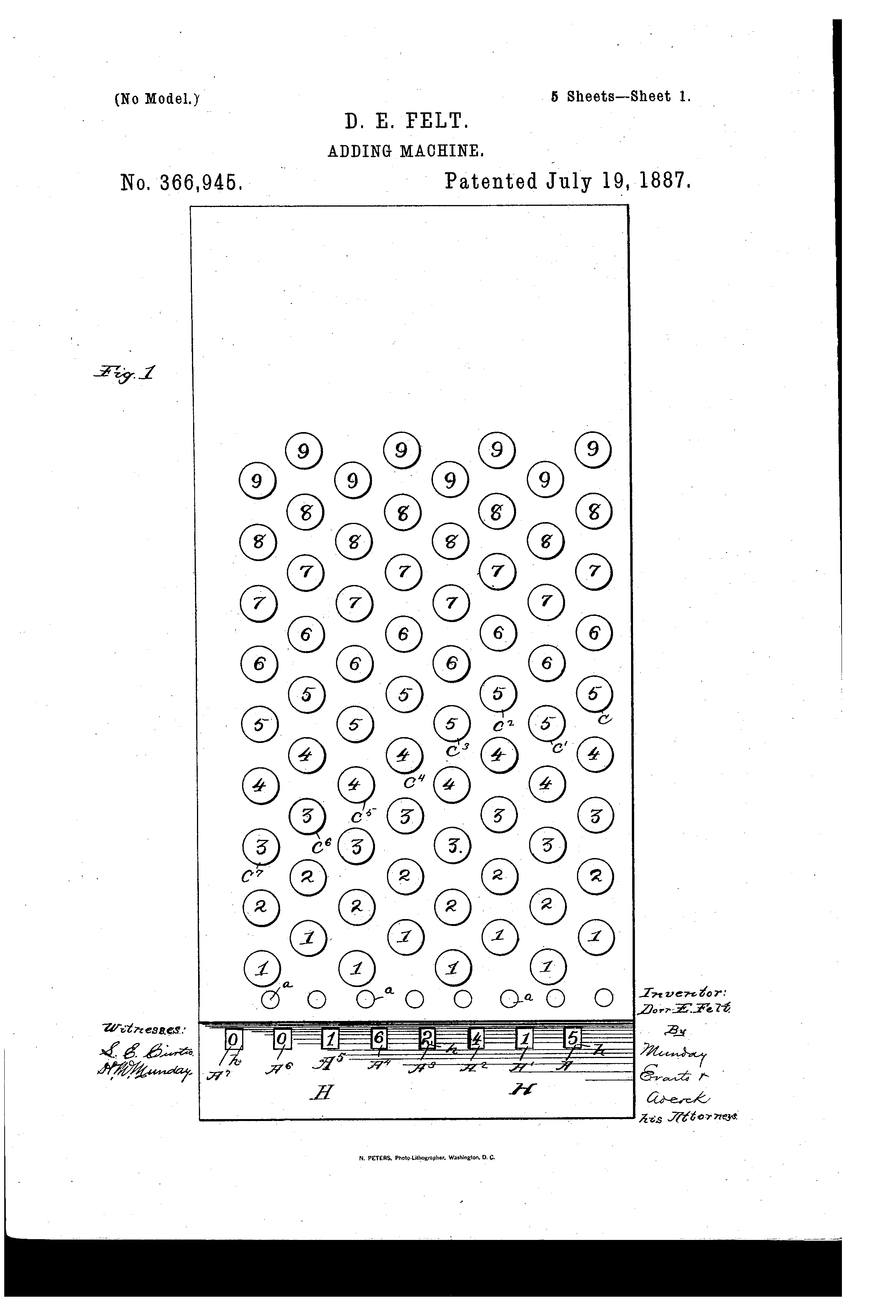
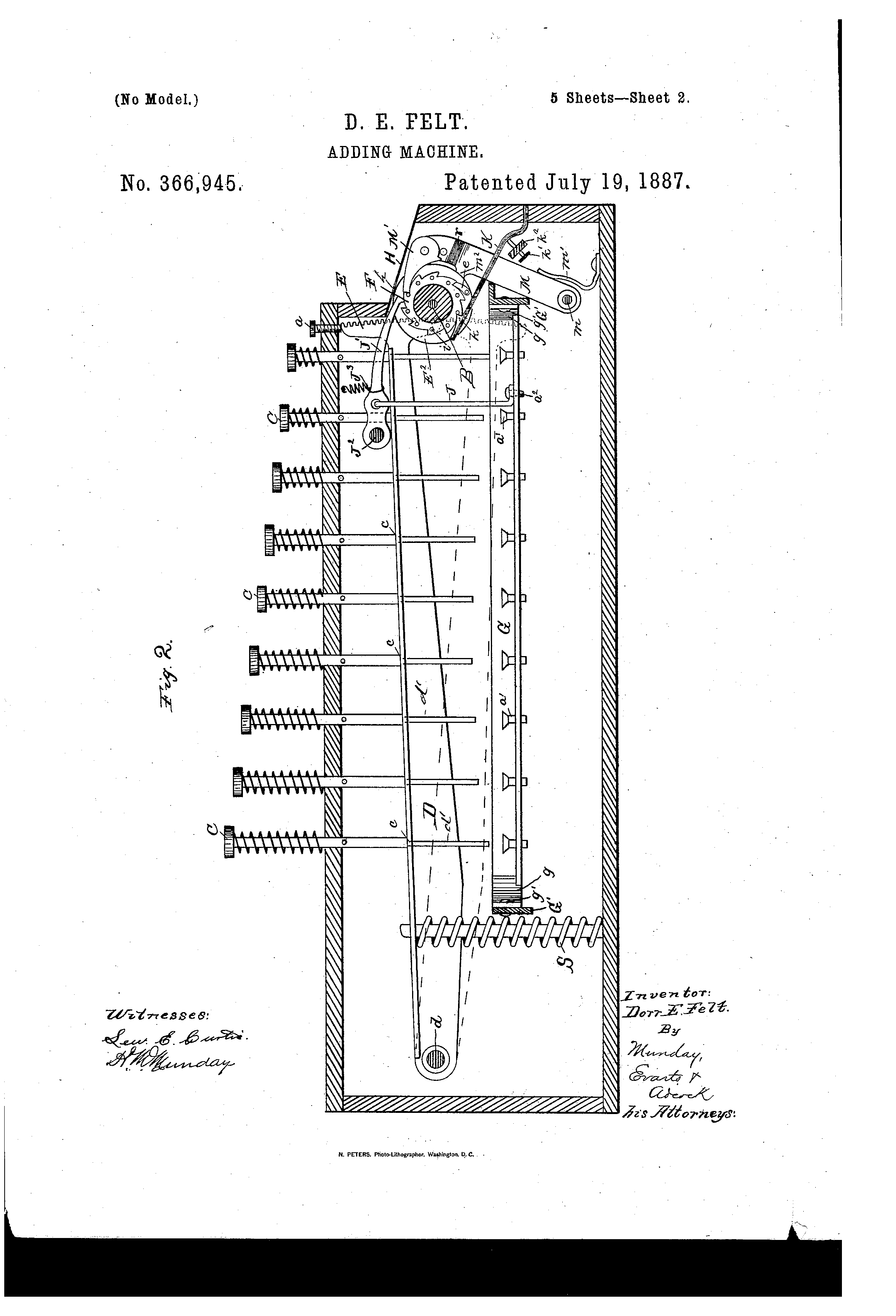
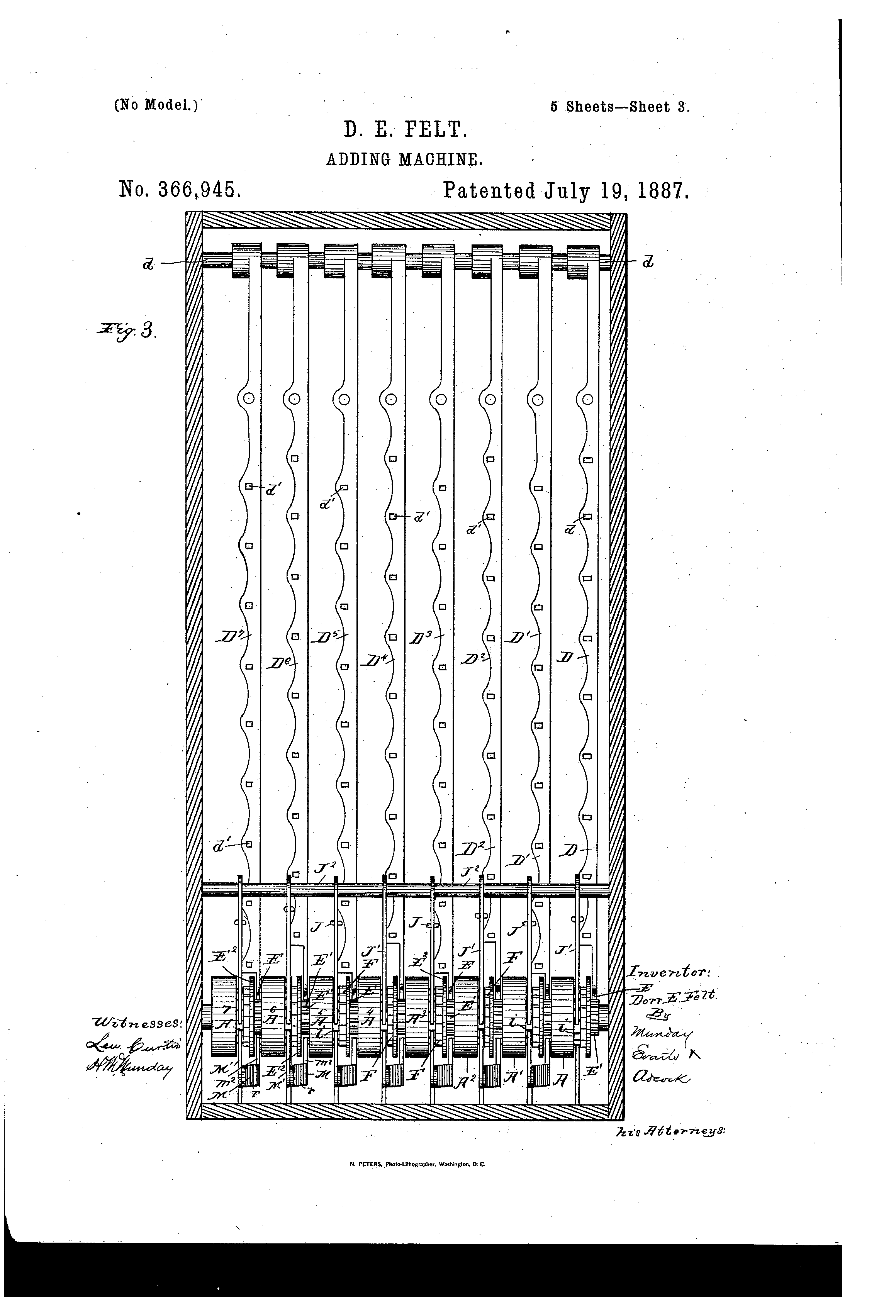
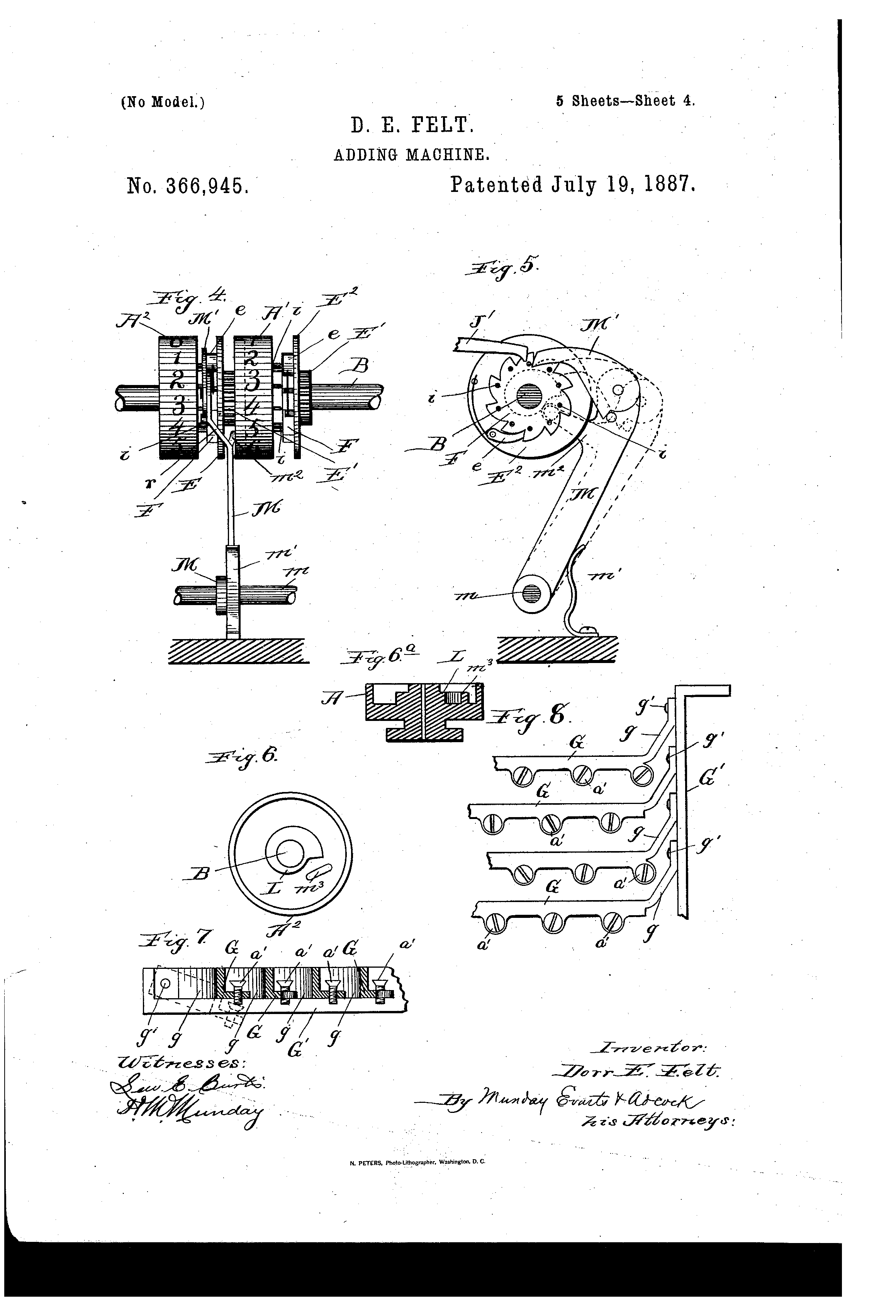
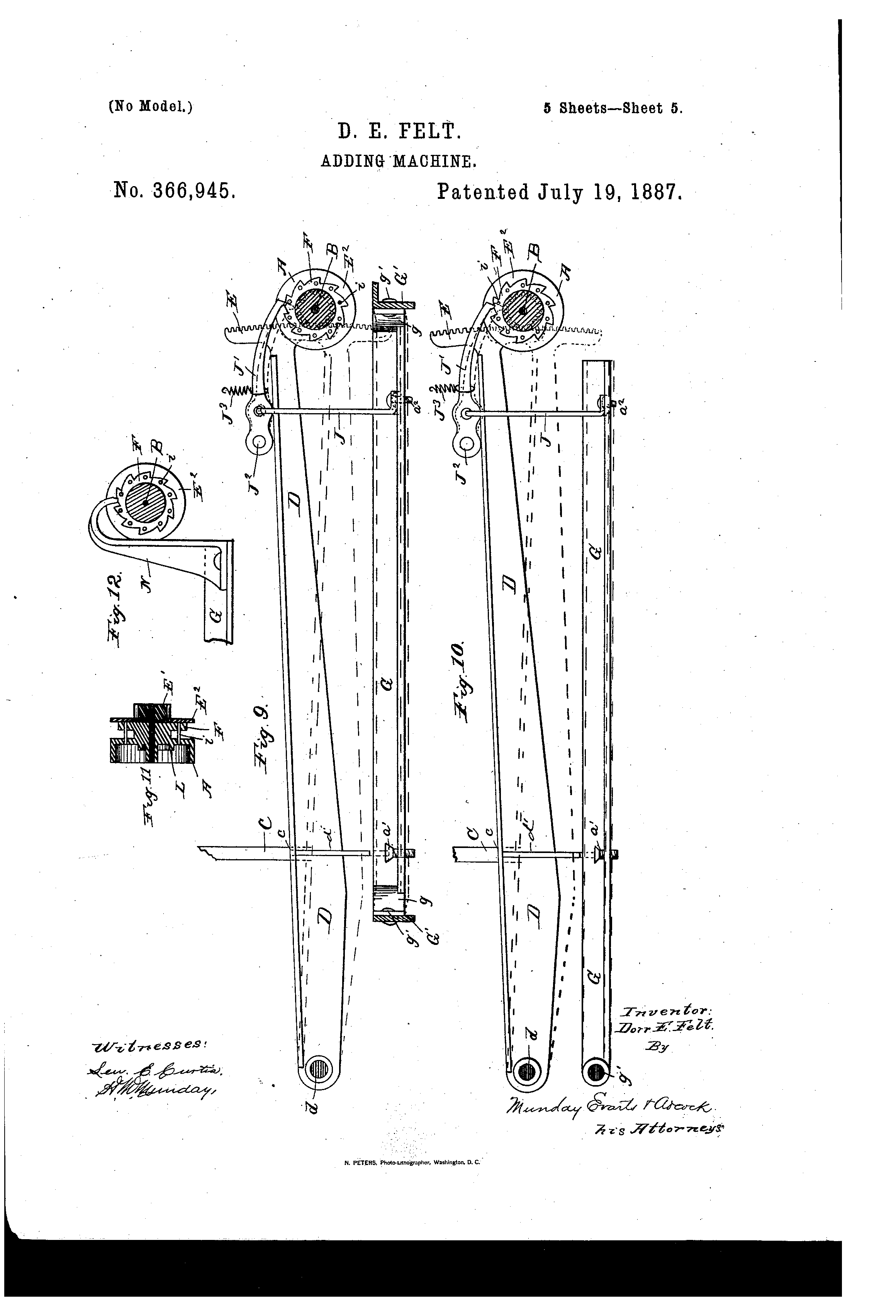
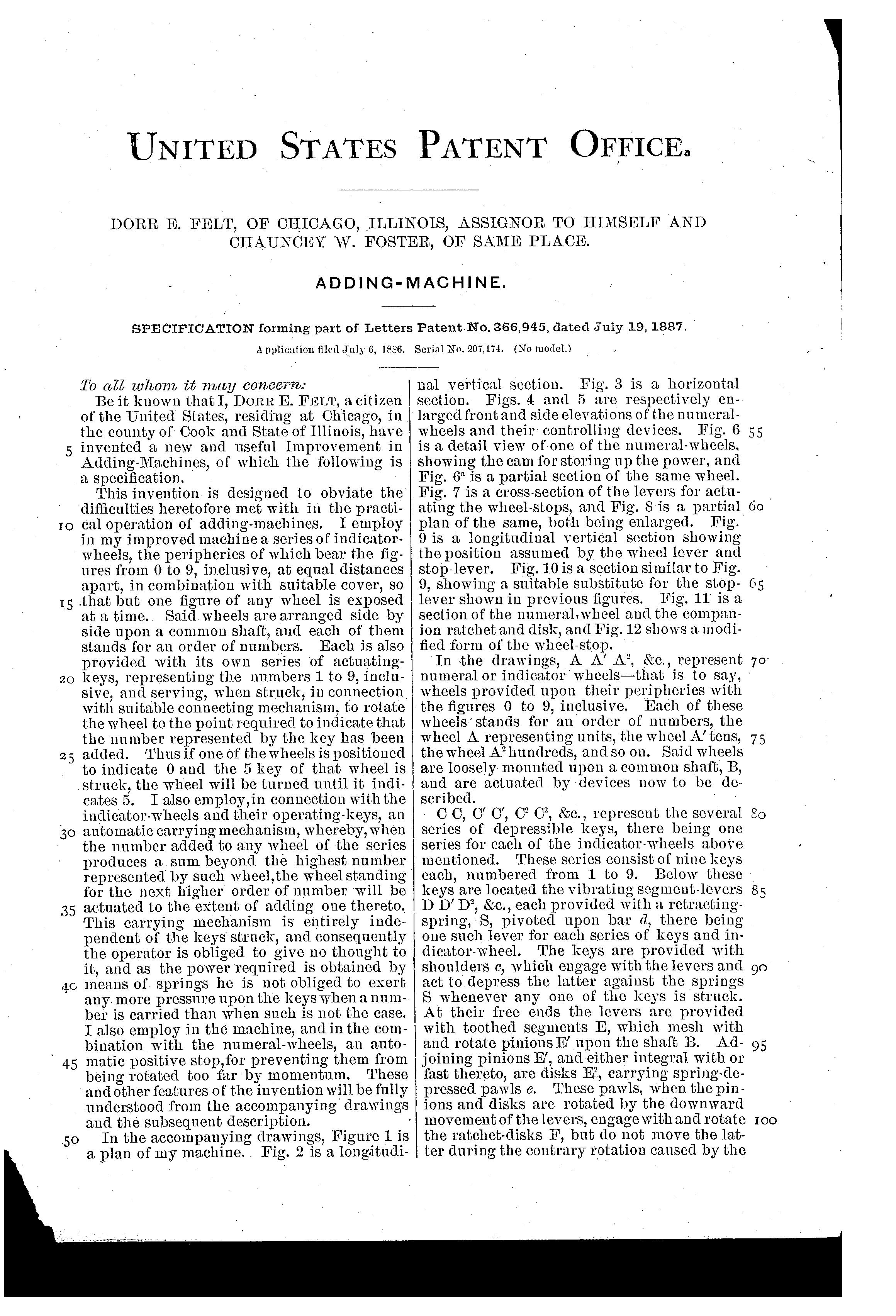
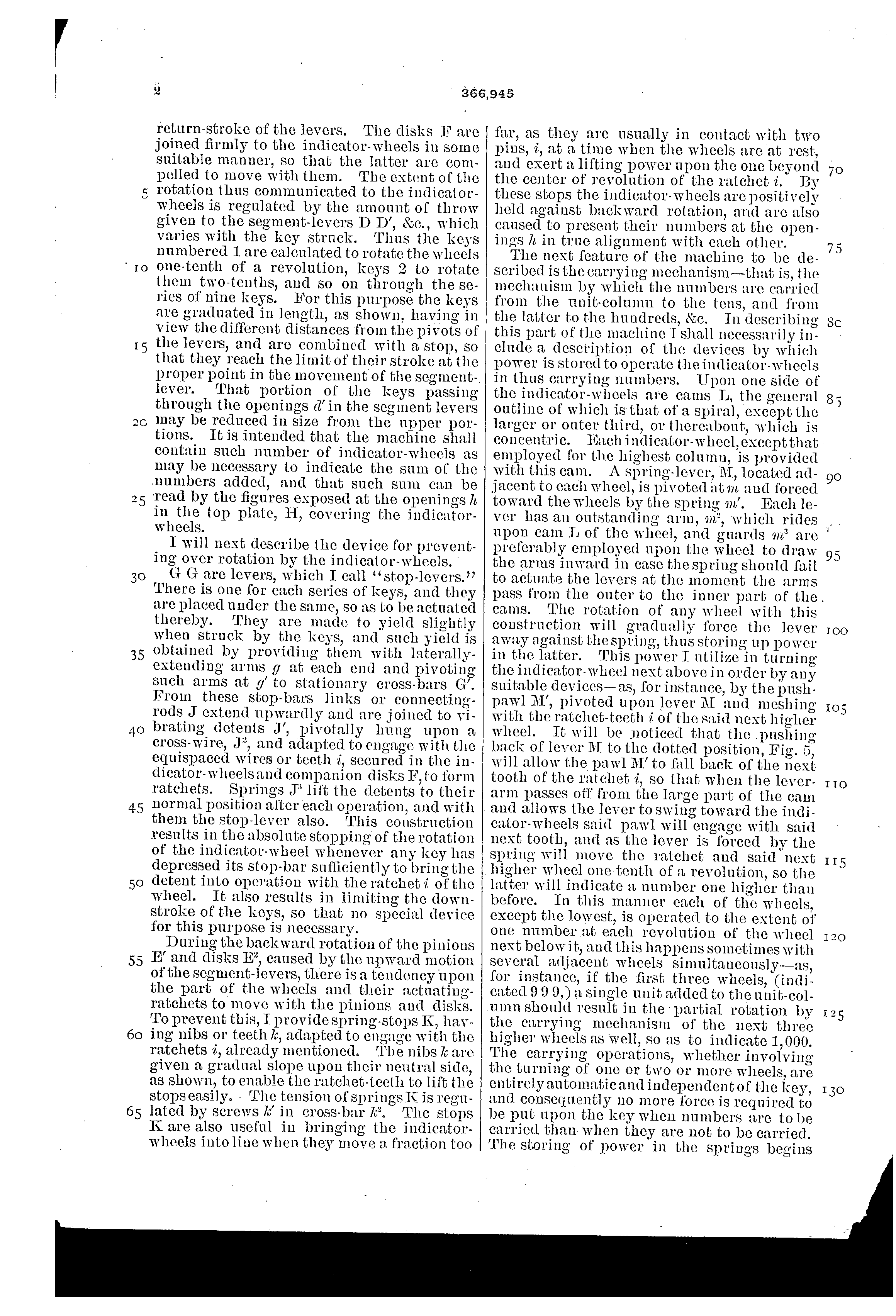
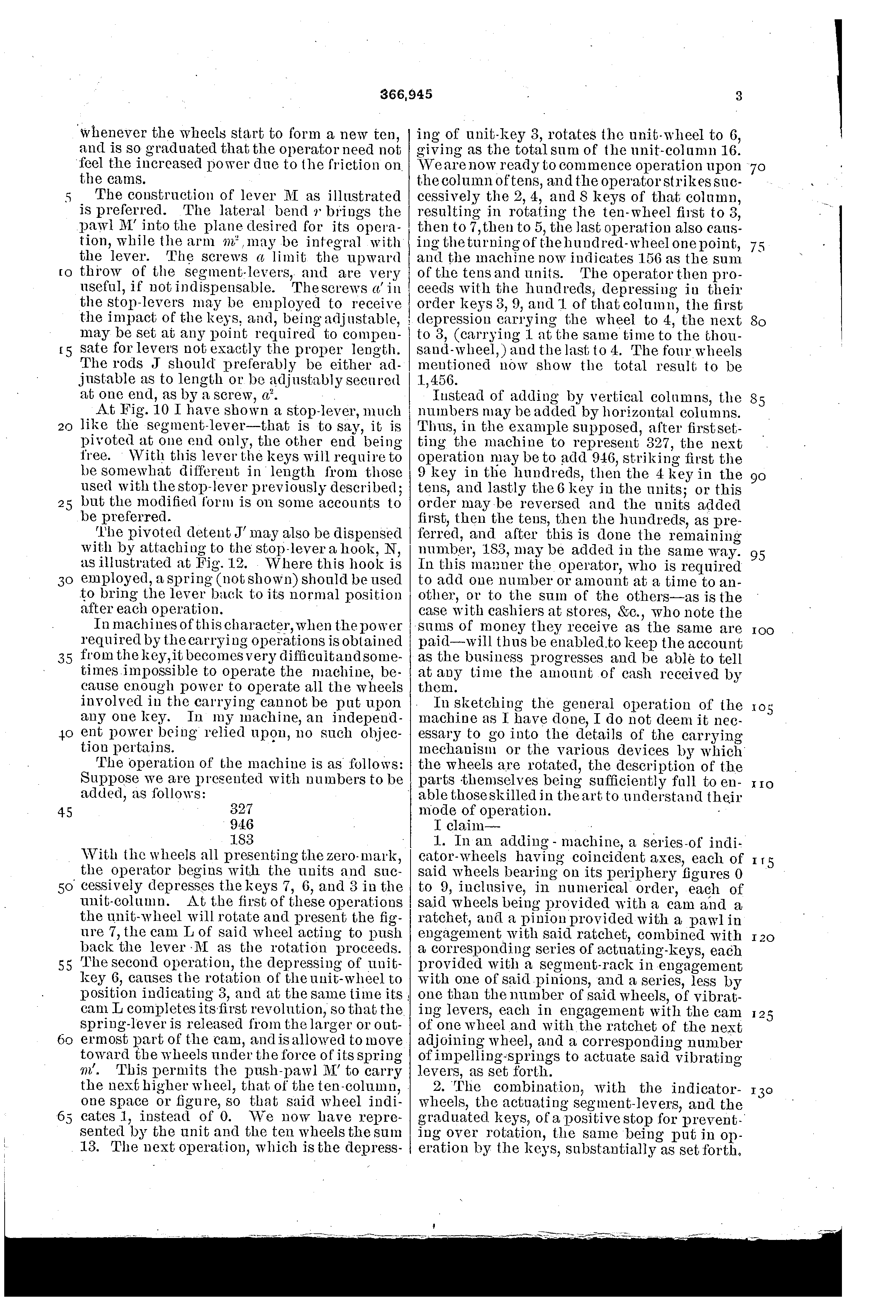
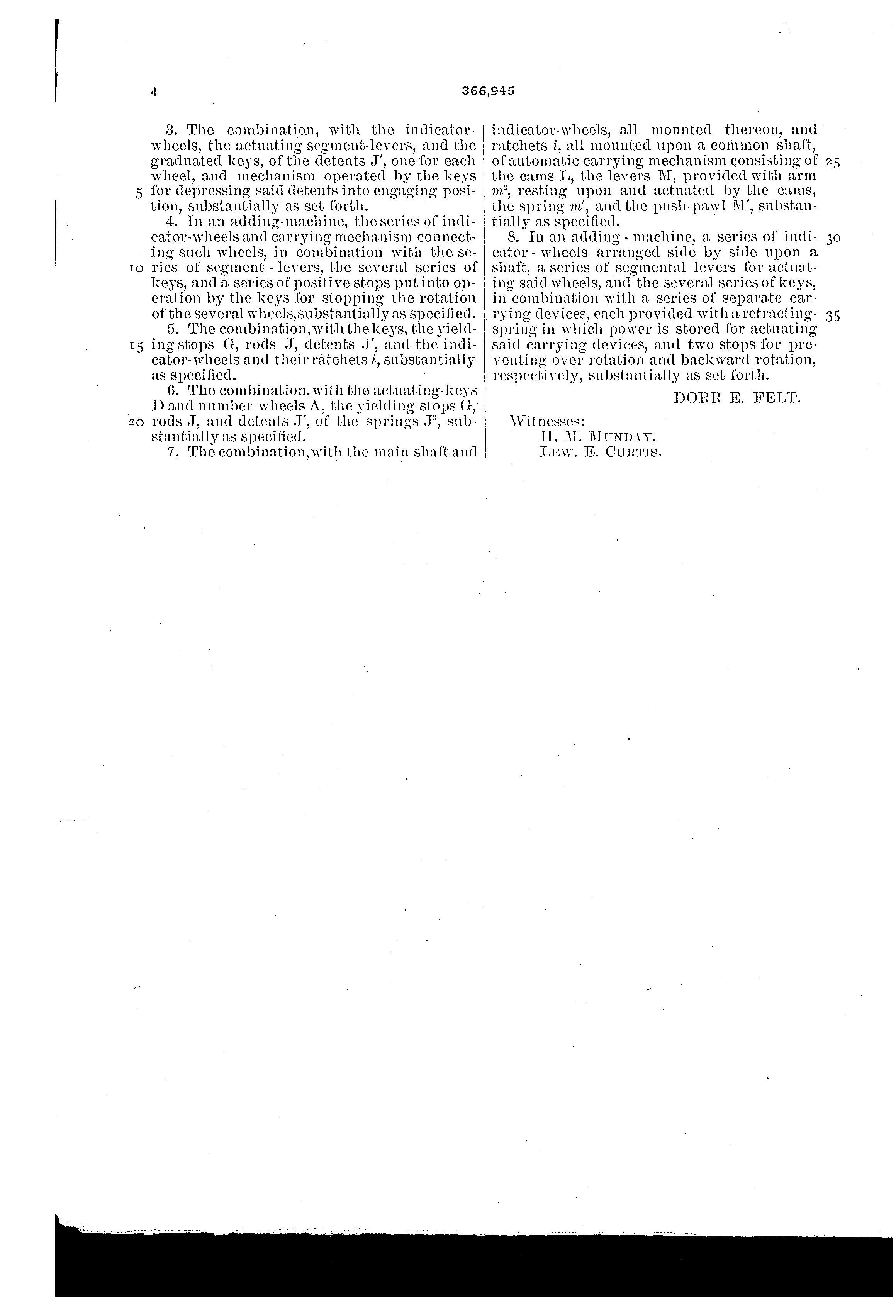
PDF · Google Patents · Assigned to Felt and Chauncey W. Foster of Chicago. Witnesses H. M. Munday and Lew. E. Curtis.
US 371,496, Dorr E. Felt, Adding-Machine, filed 12 March 1887, granted 11 October 1887
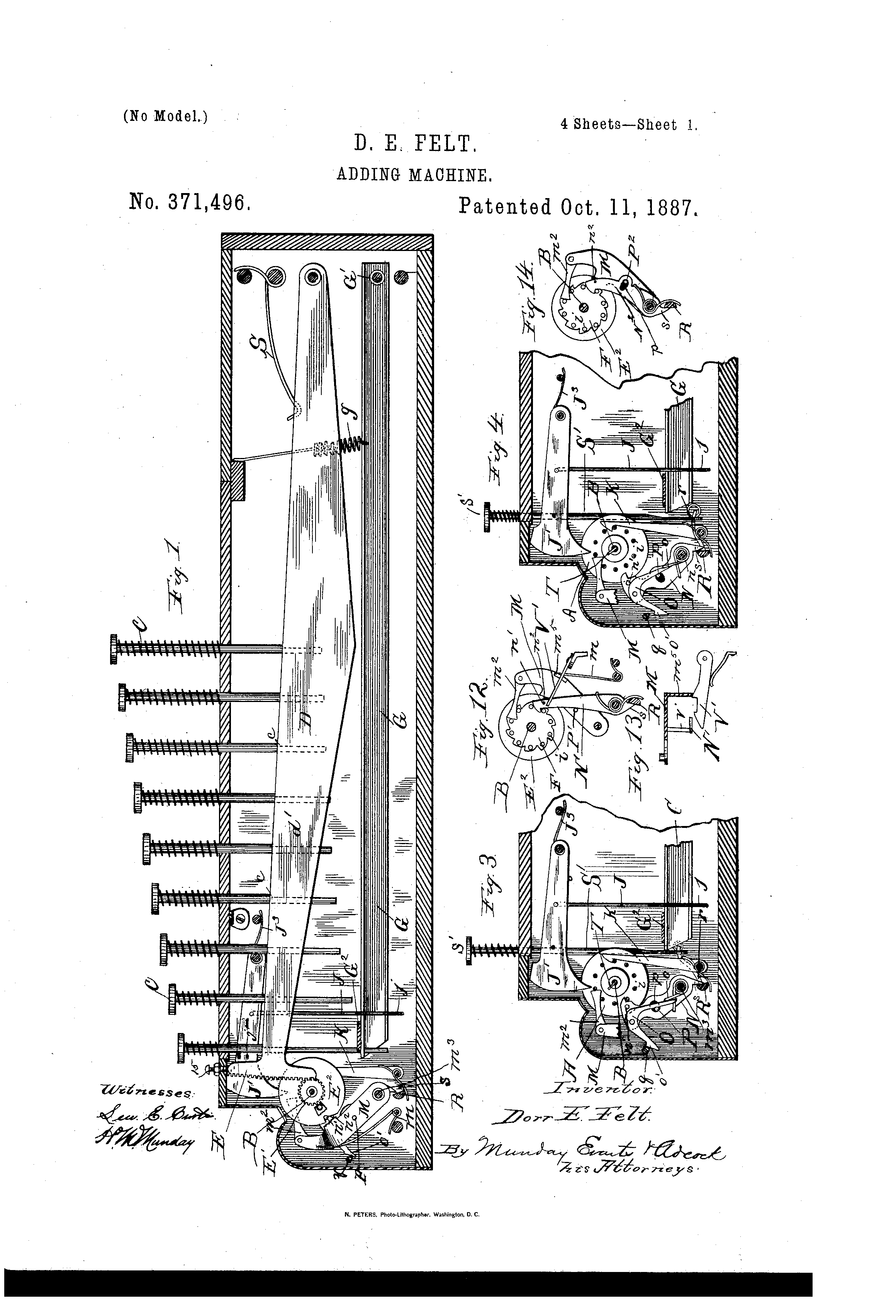
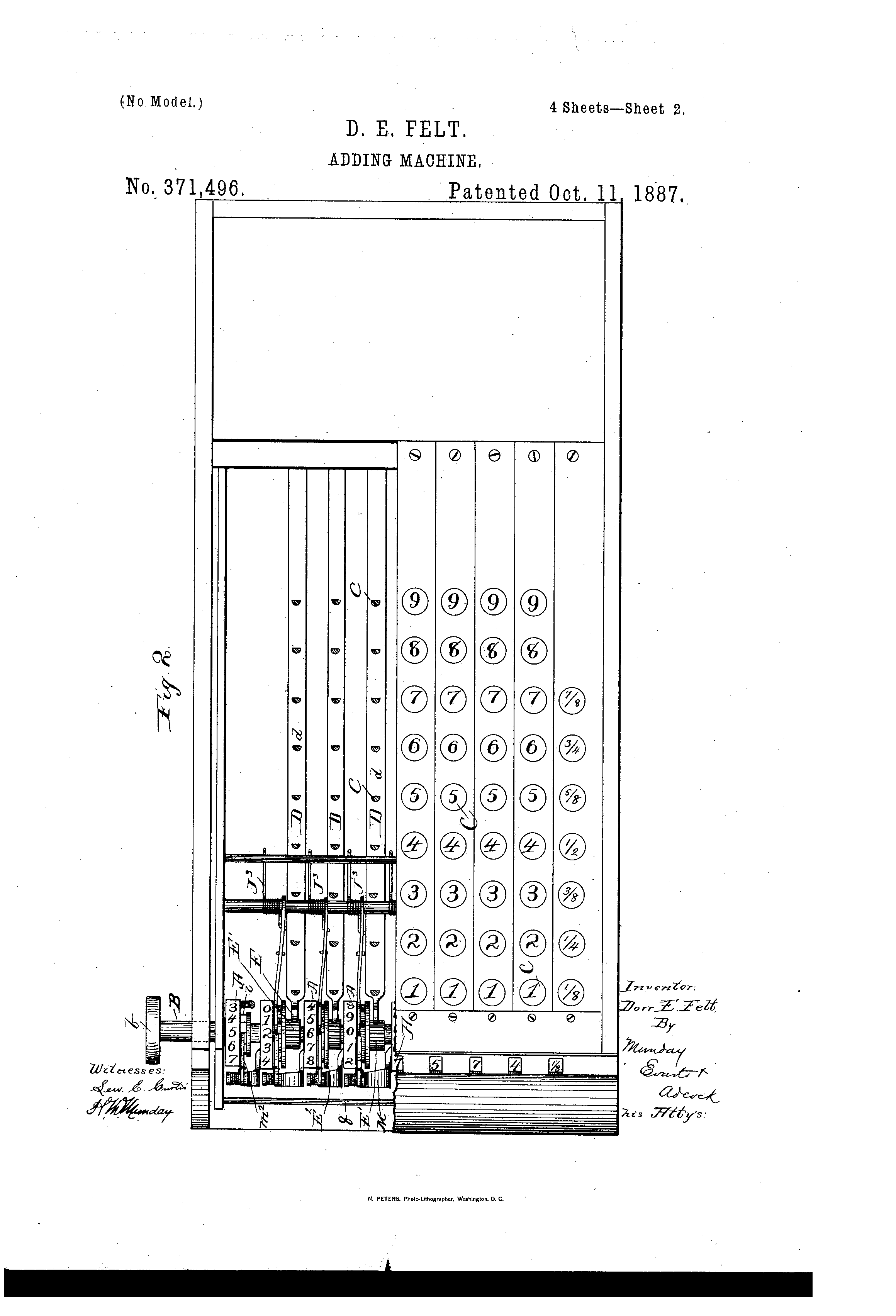
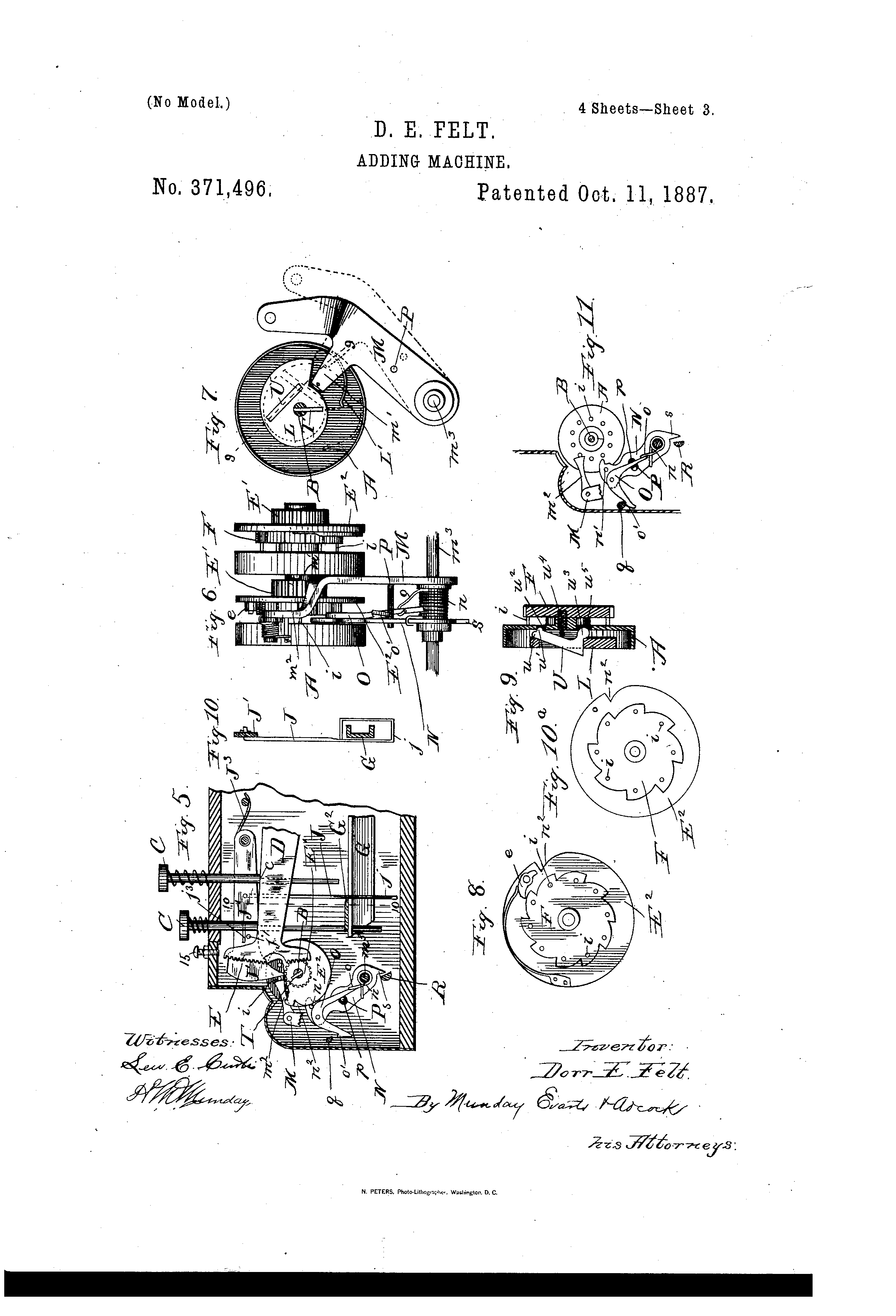
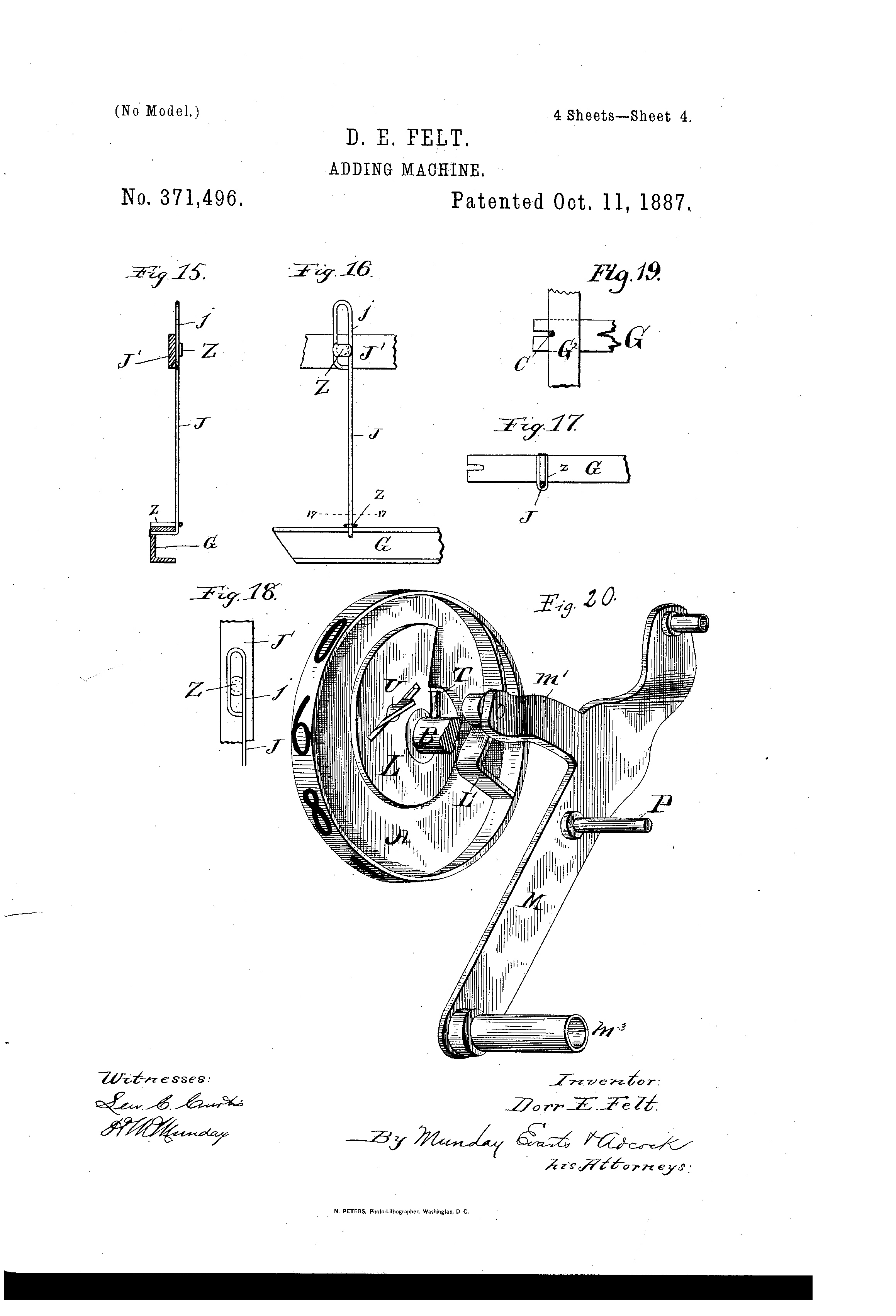
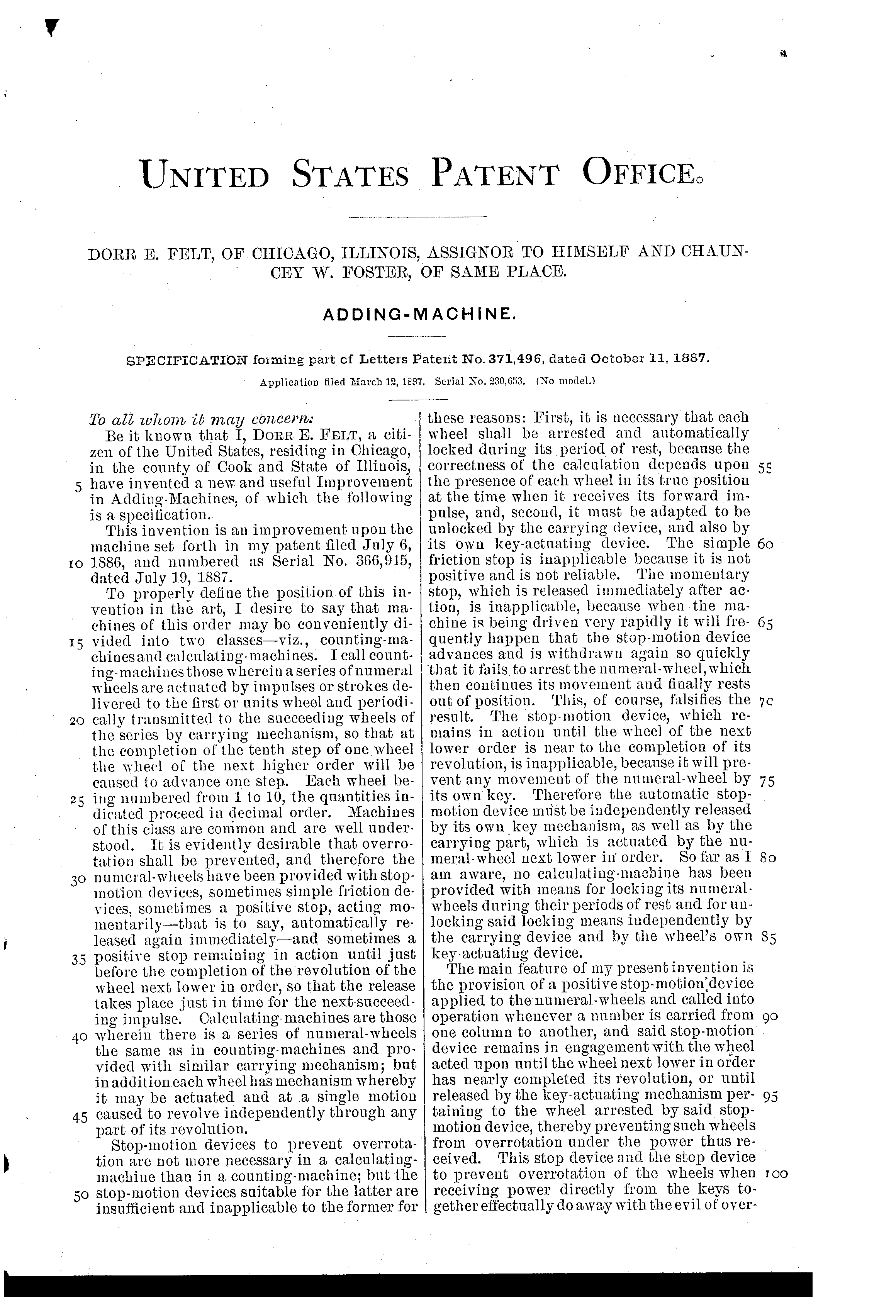
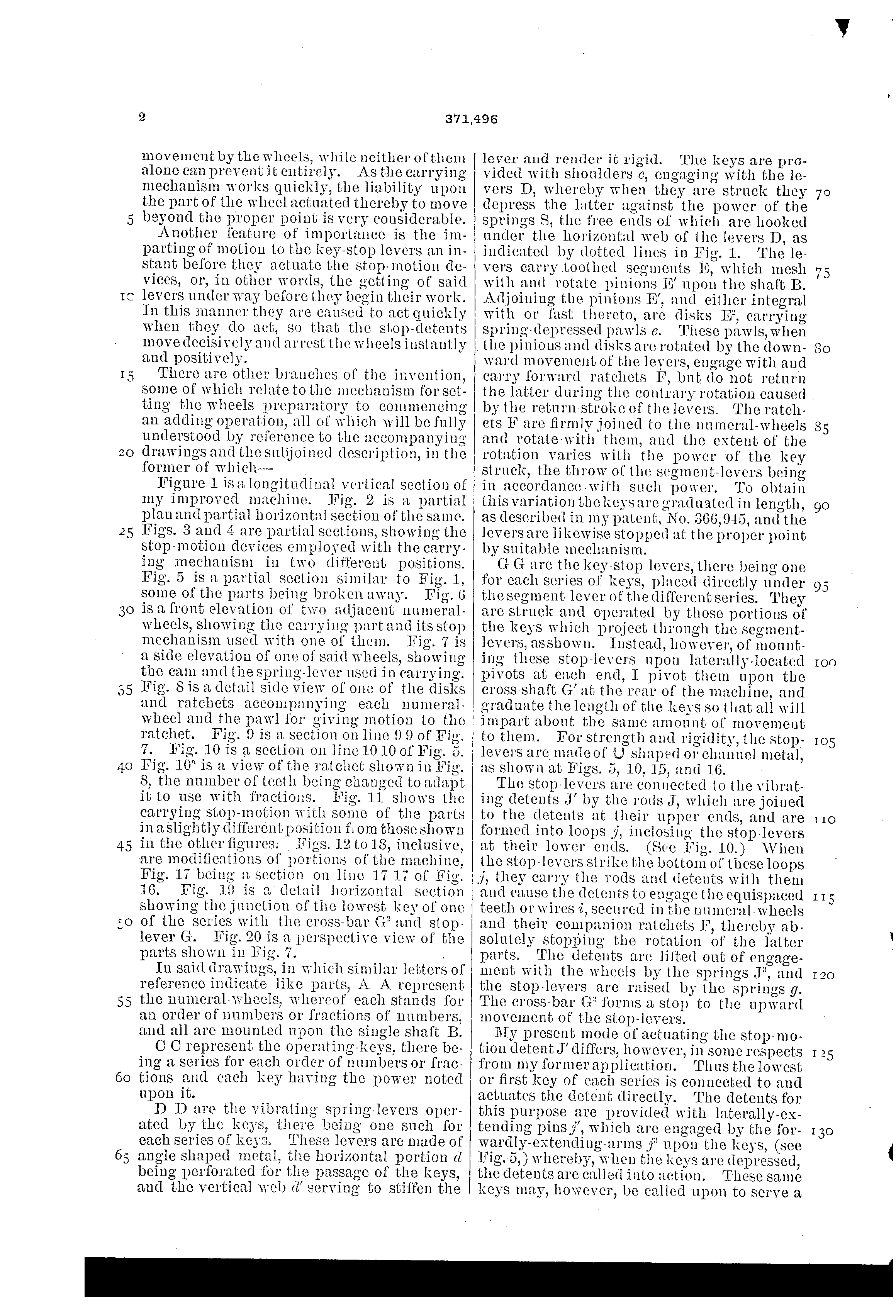
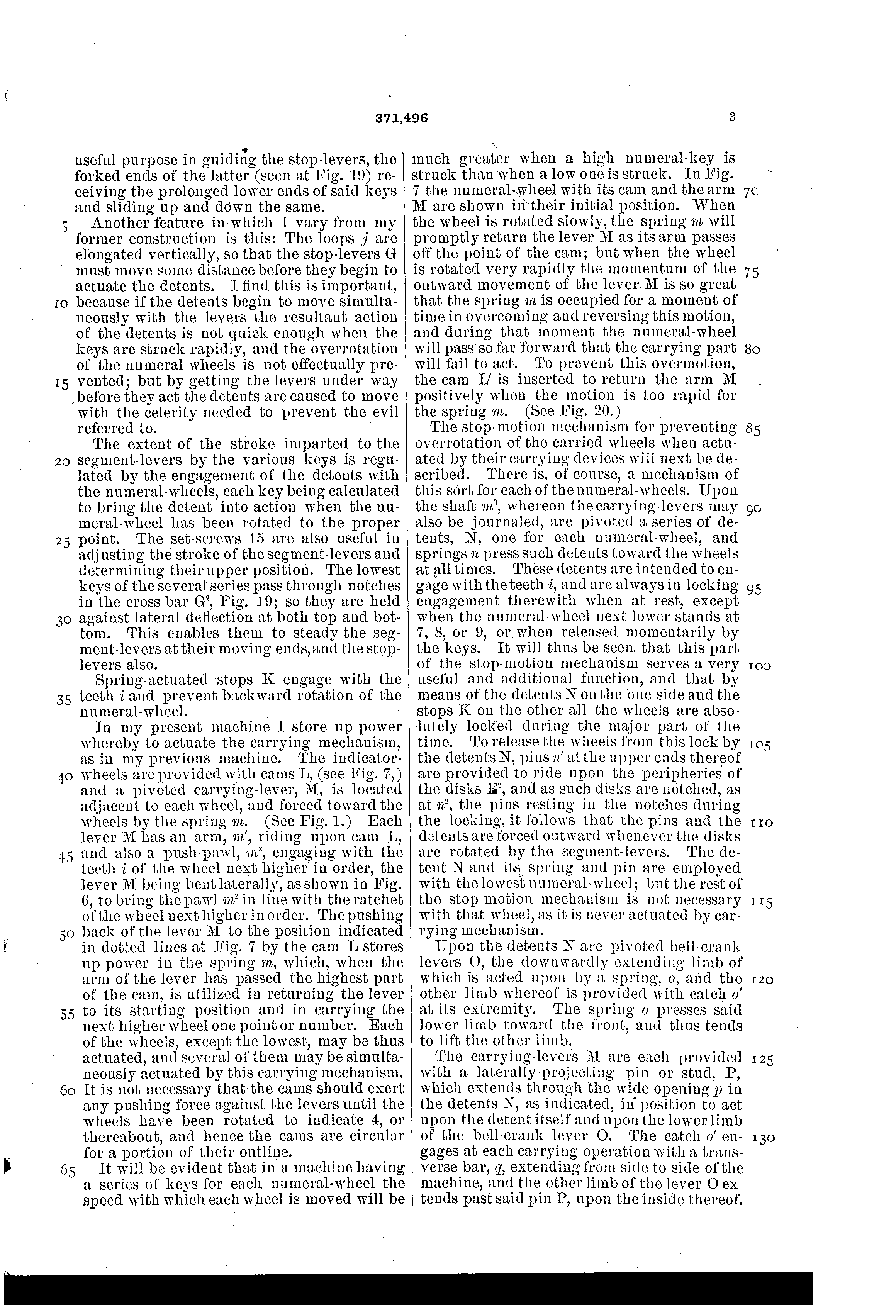
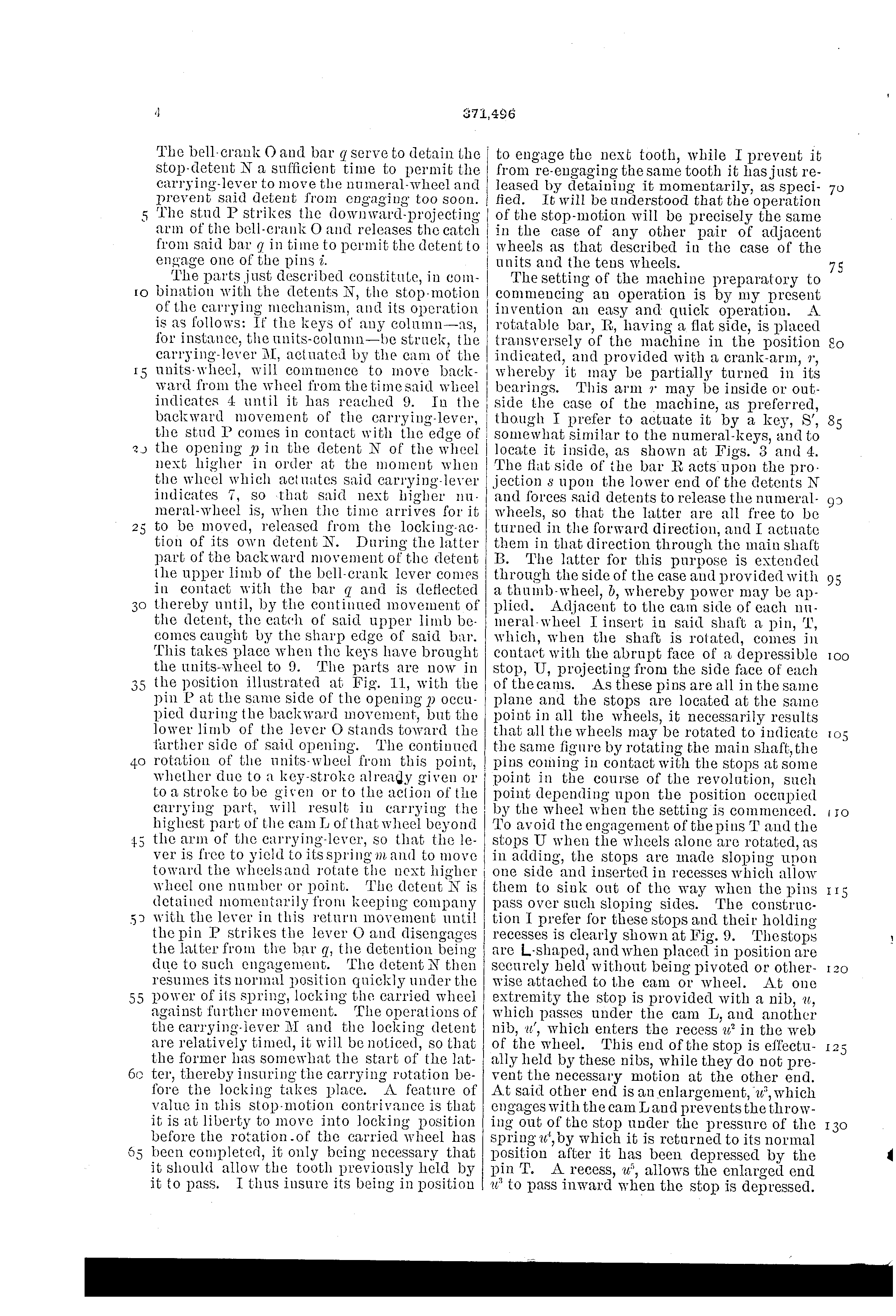
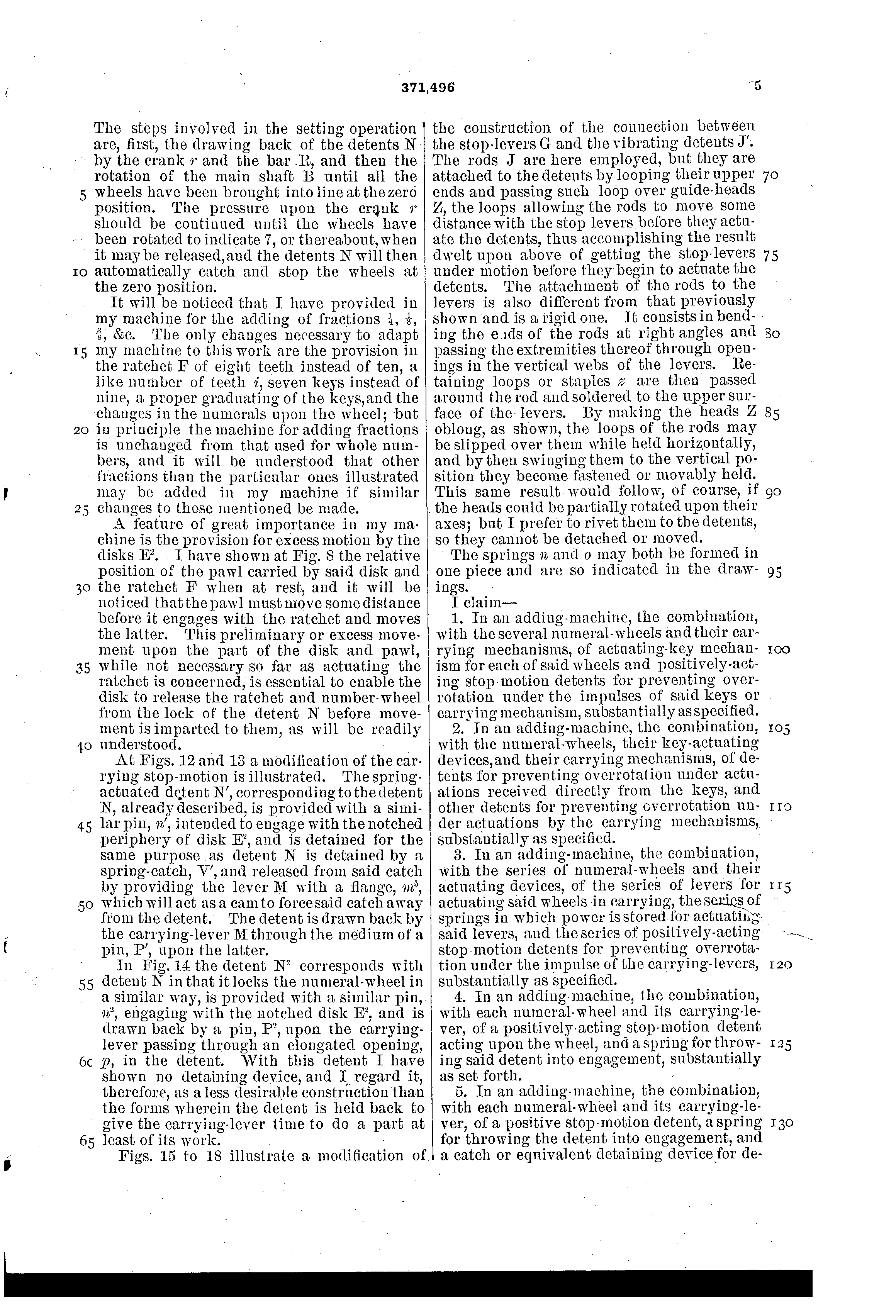
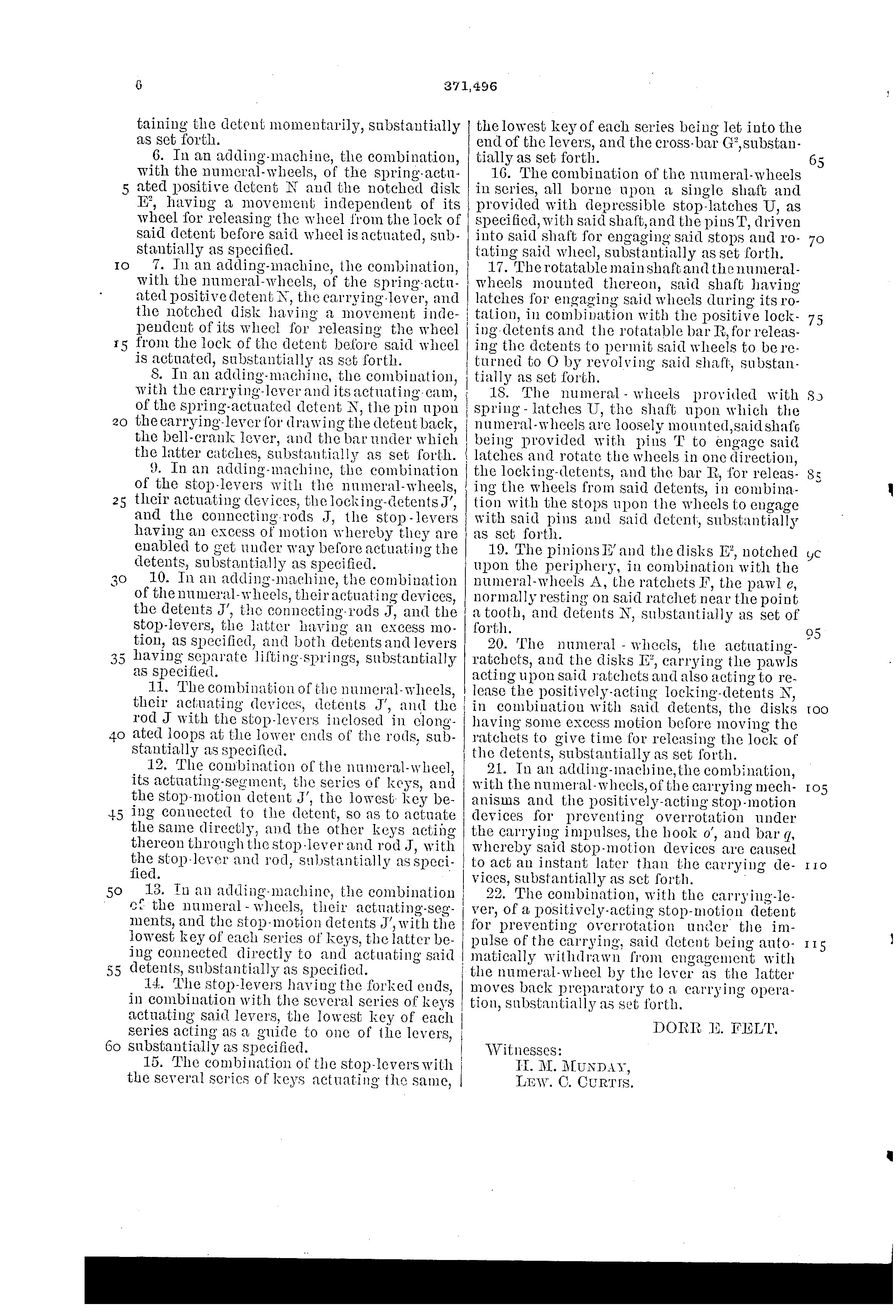
PDF · Google Patents · Felt calls it an improvement on 366,945. Same assignment and witnesses.
US 388,116, William S. Burroughs, Calculating-Machine, filed 10 January 1885, granted 21 August 1888
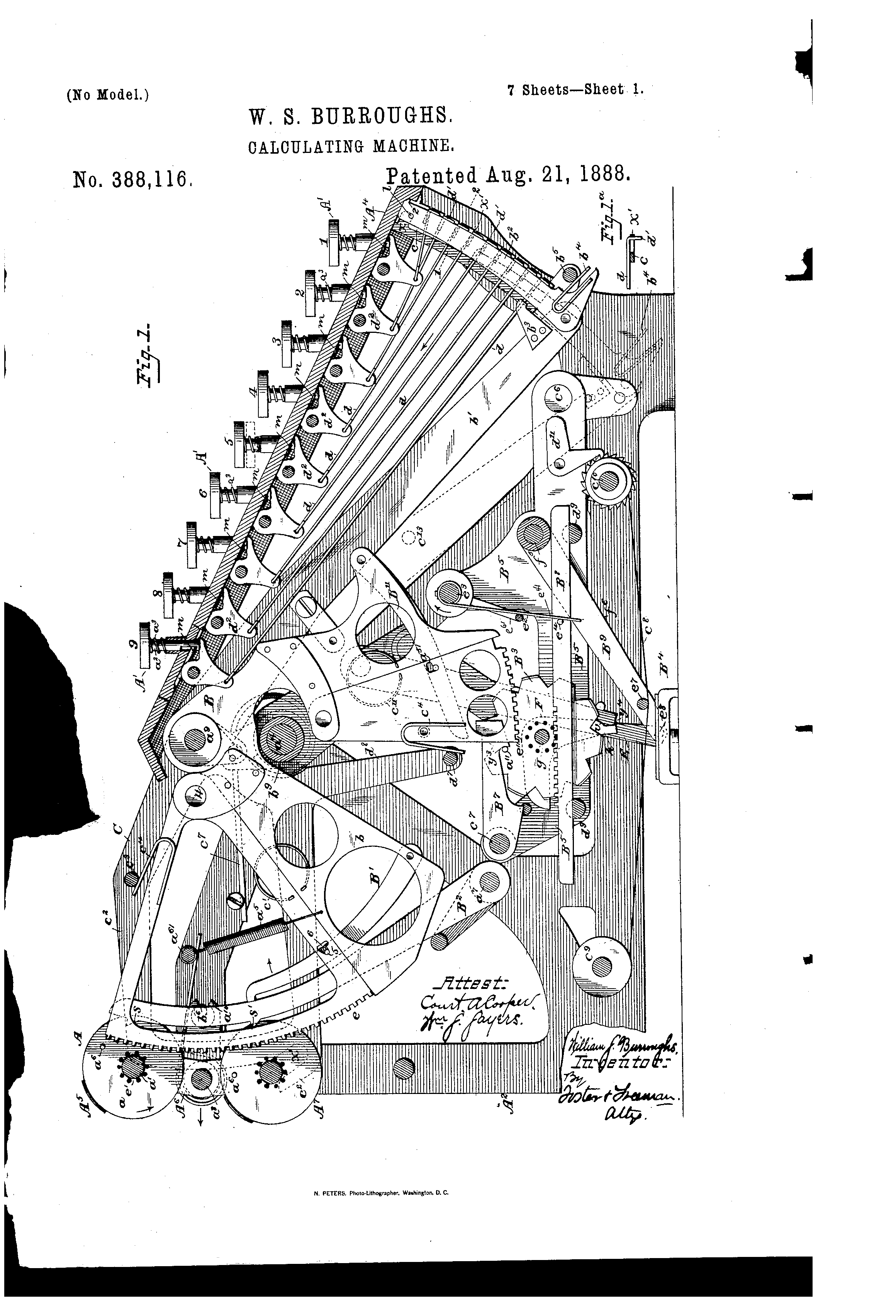
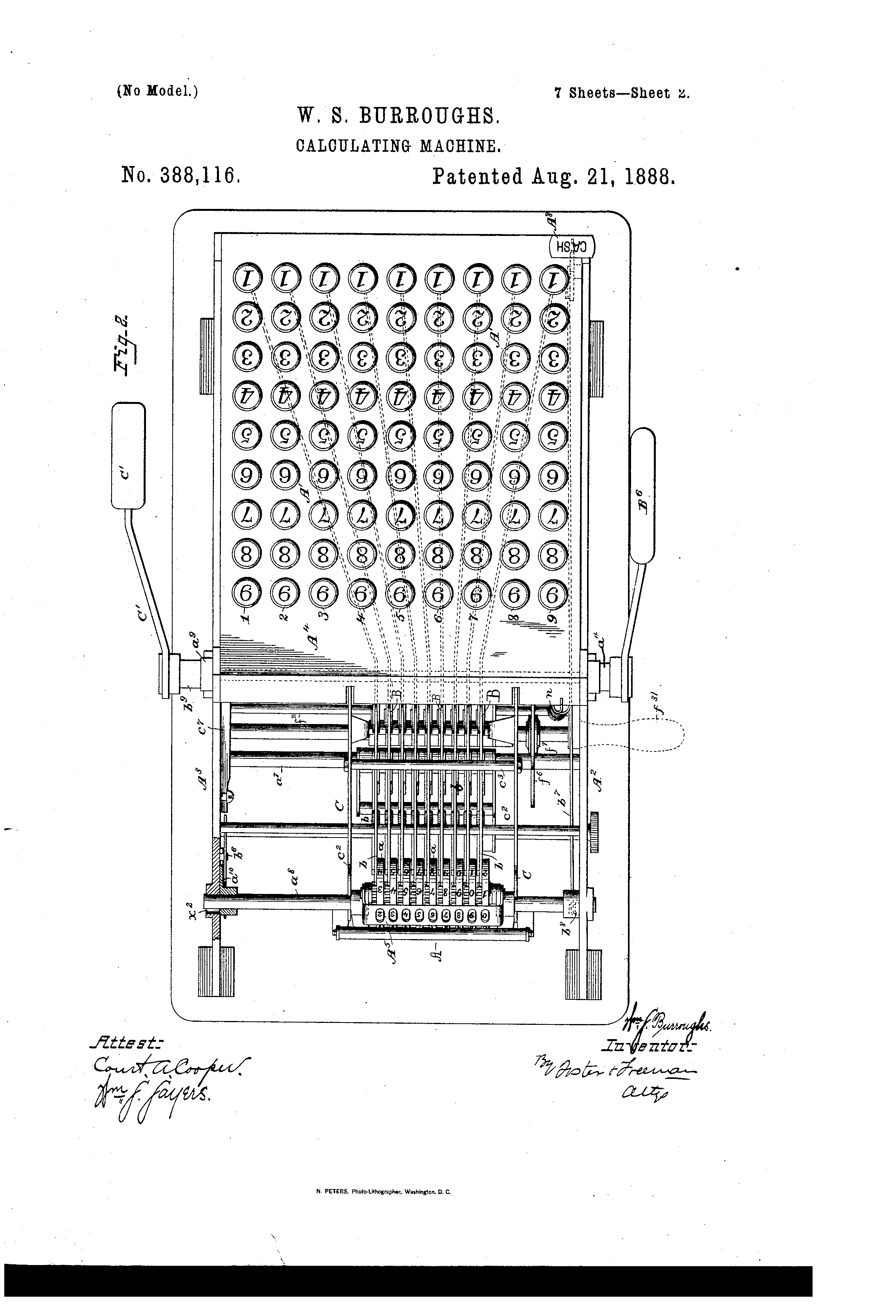
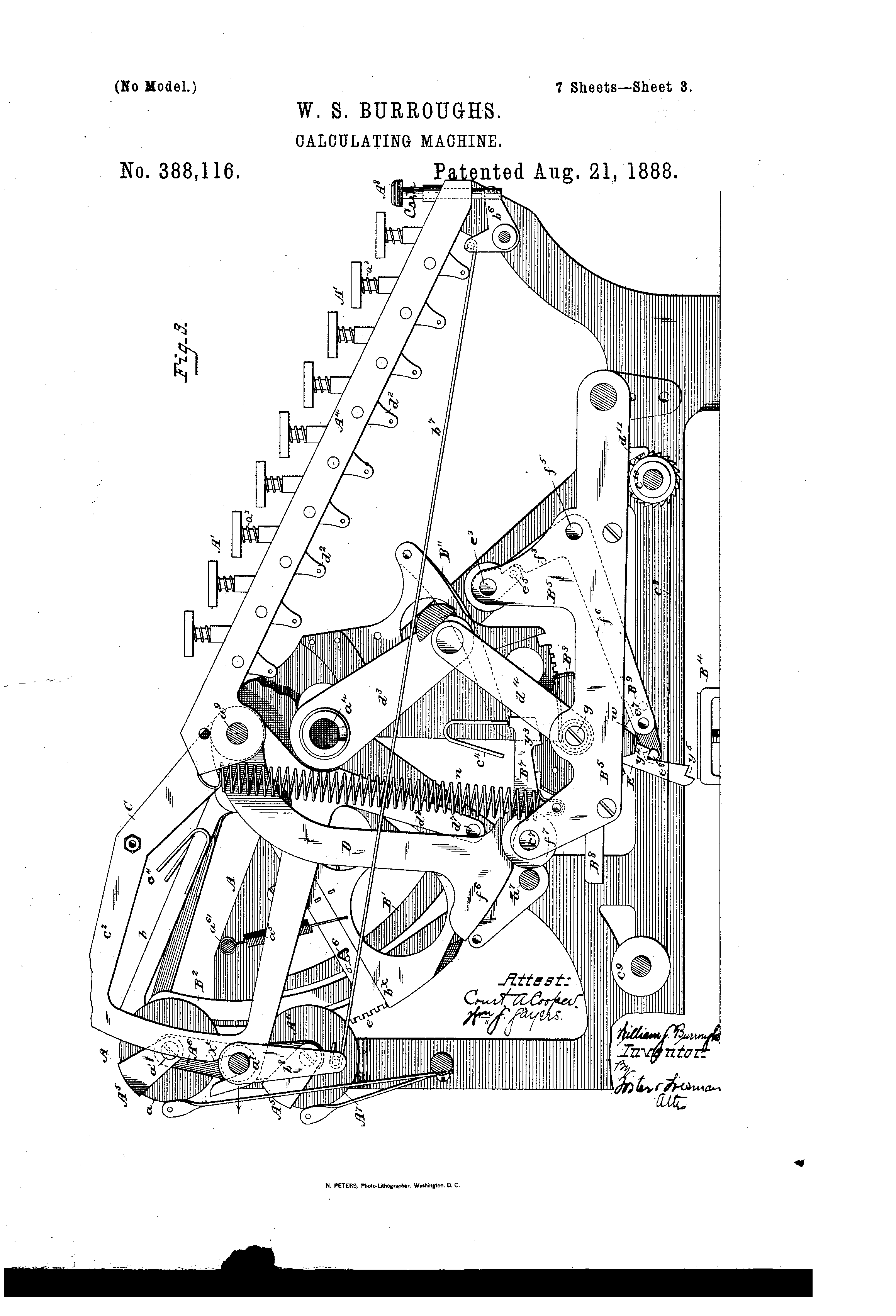
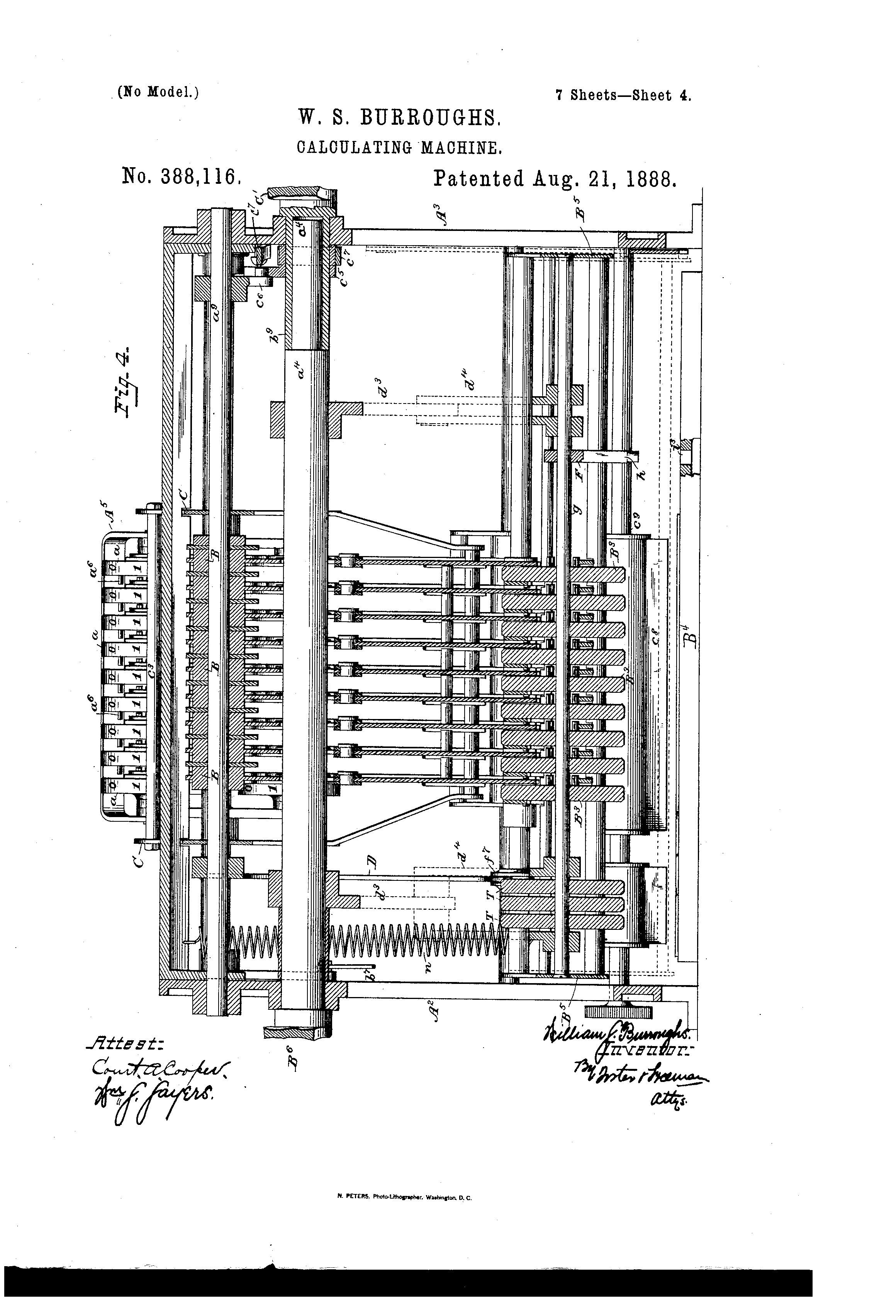
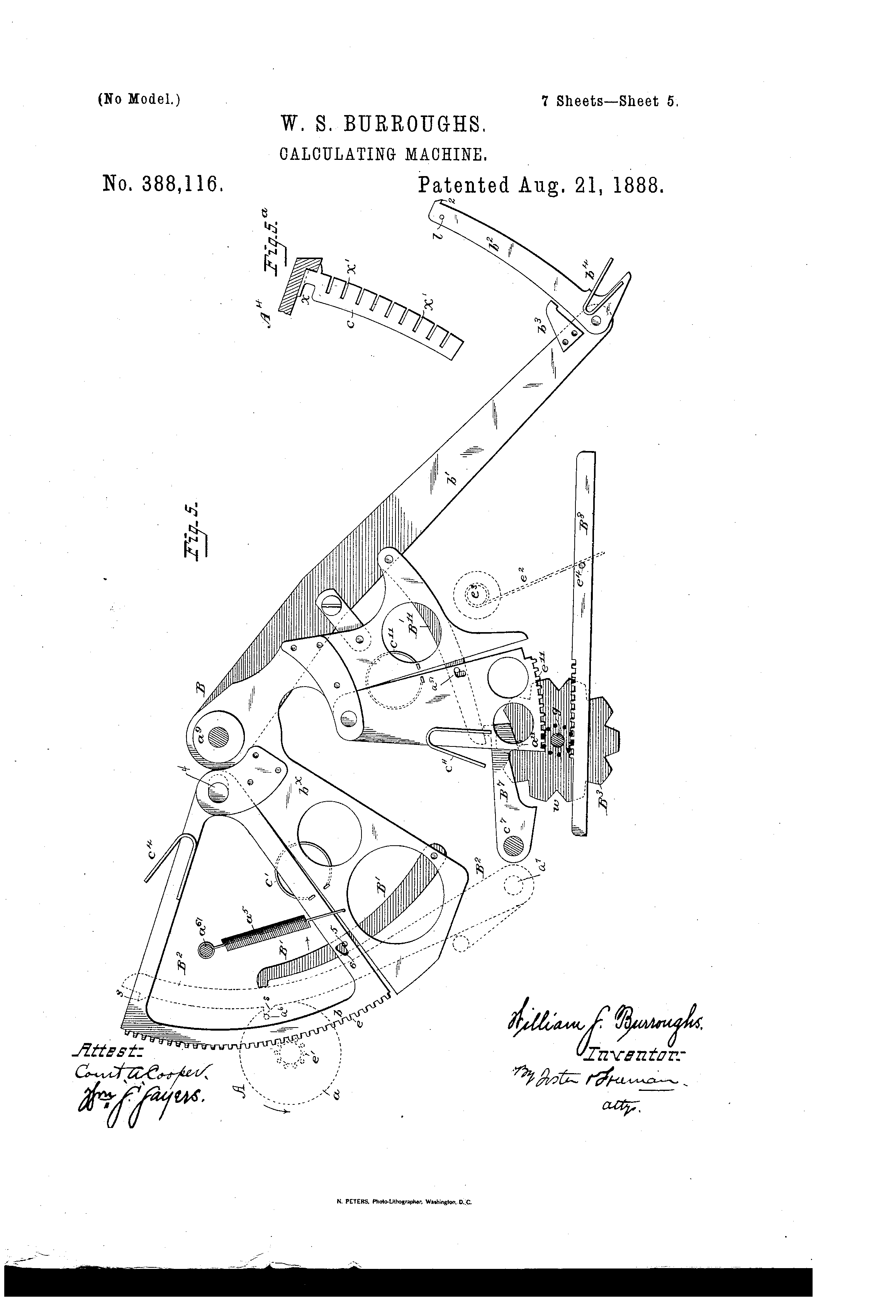
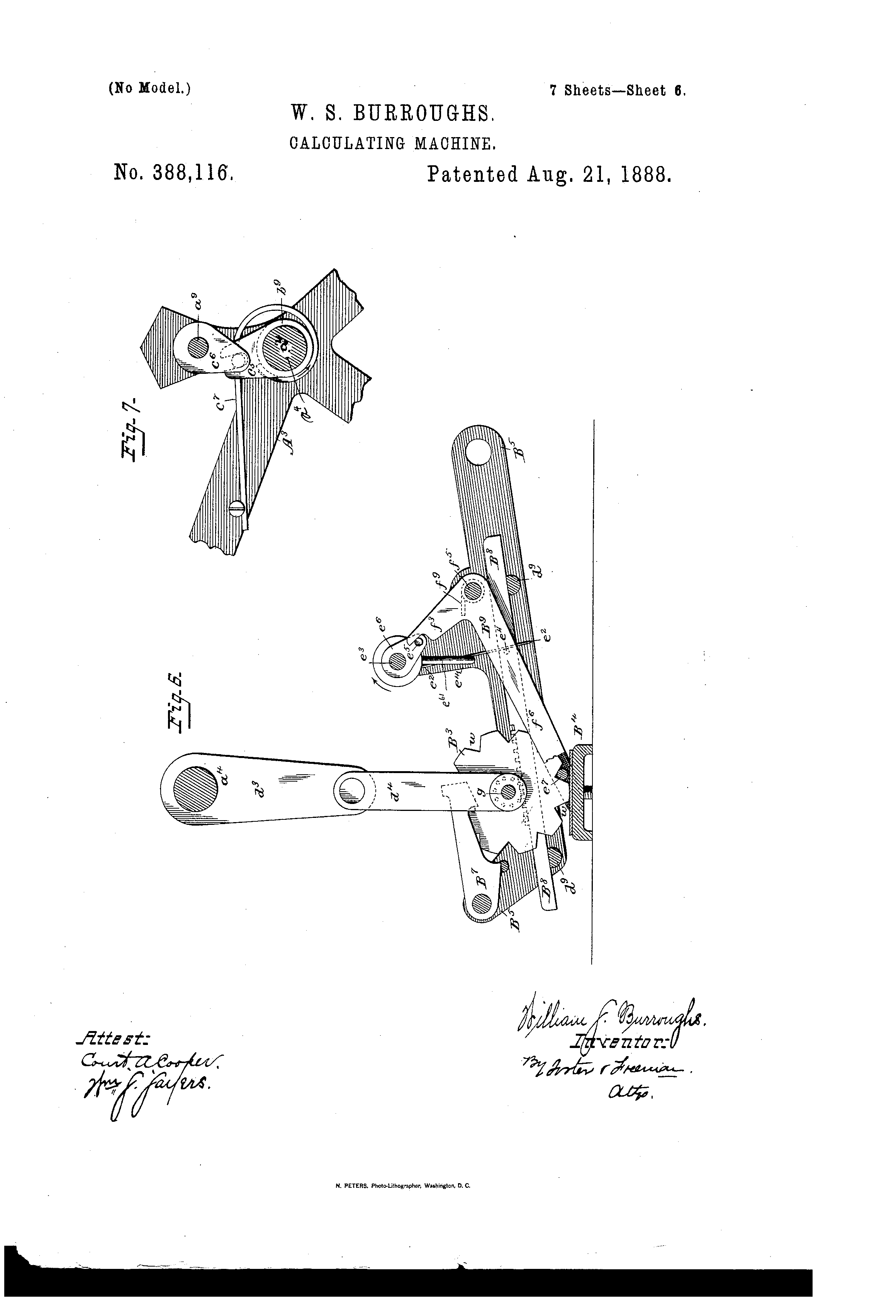
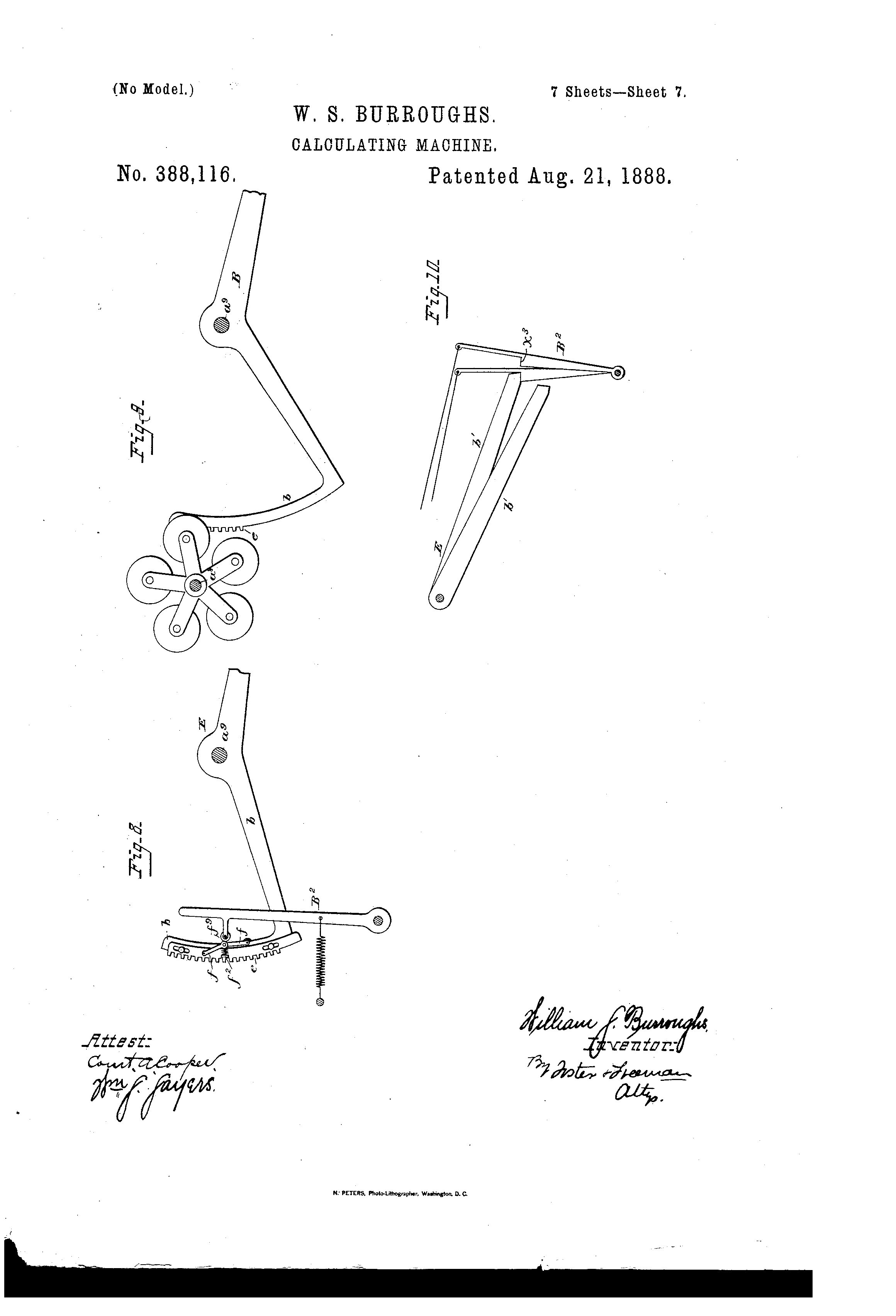
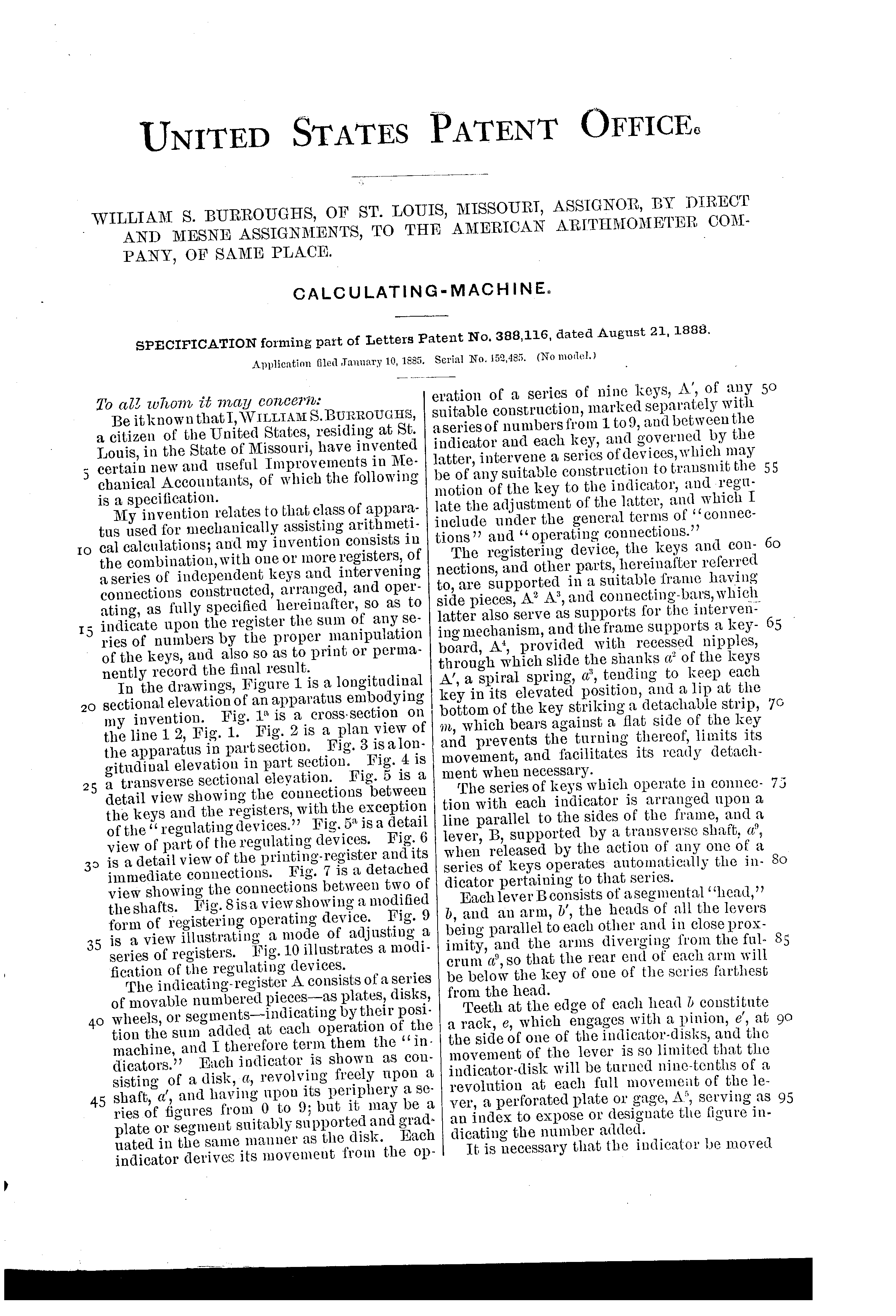
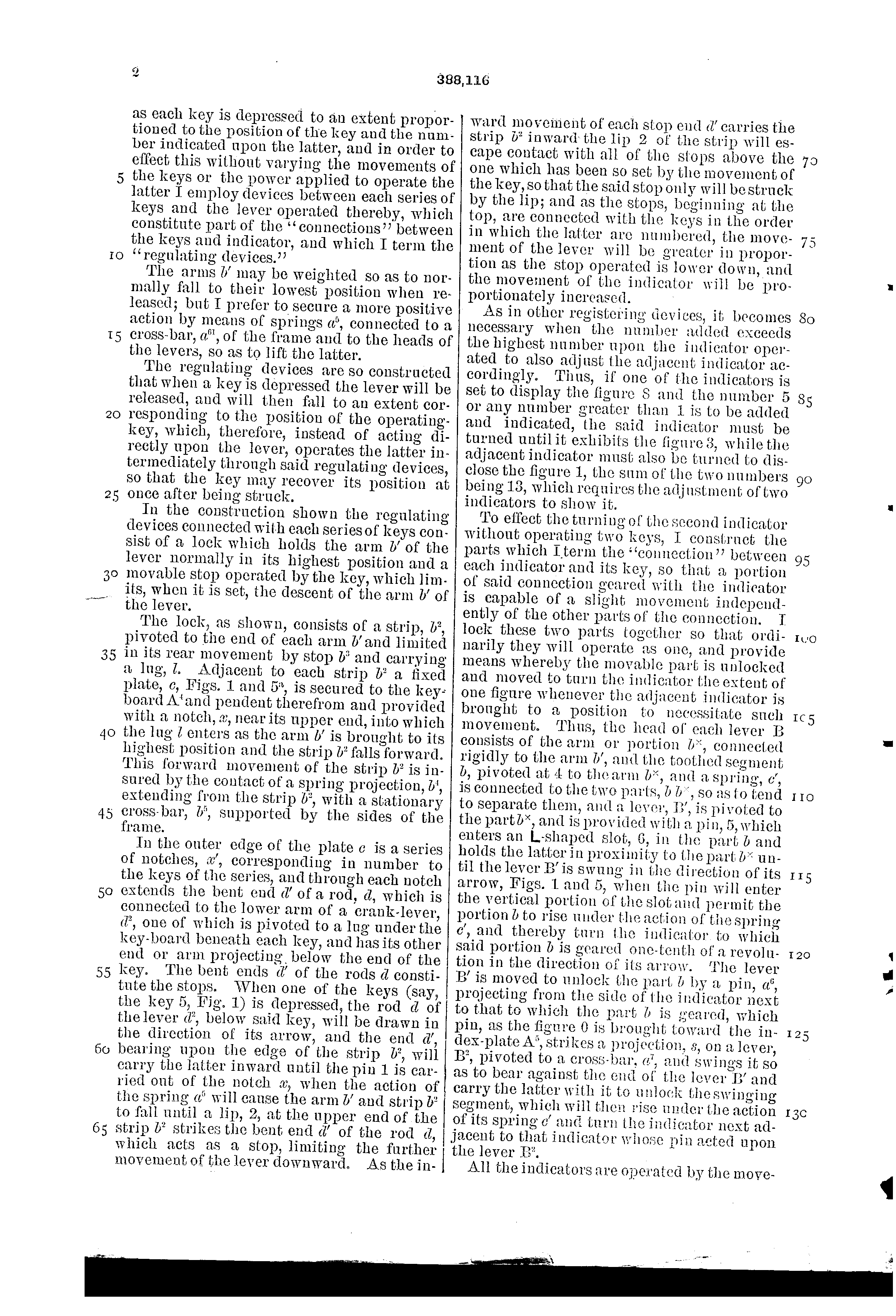
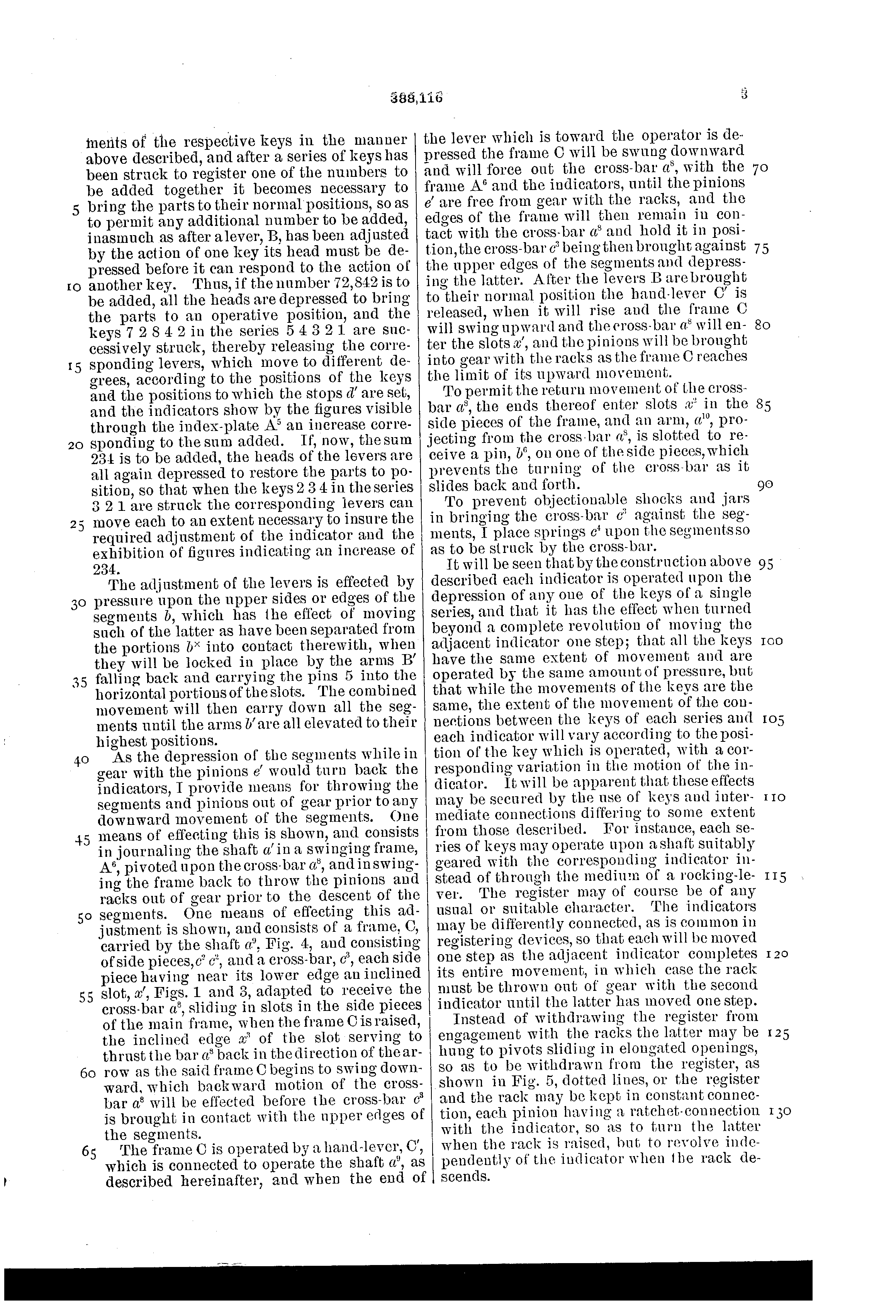
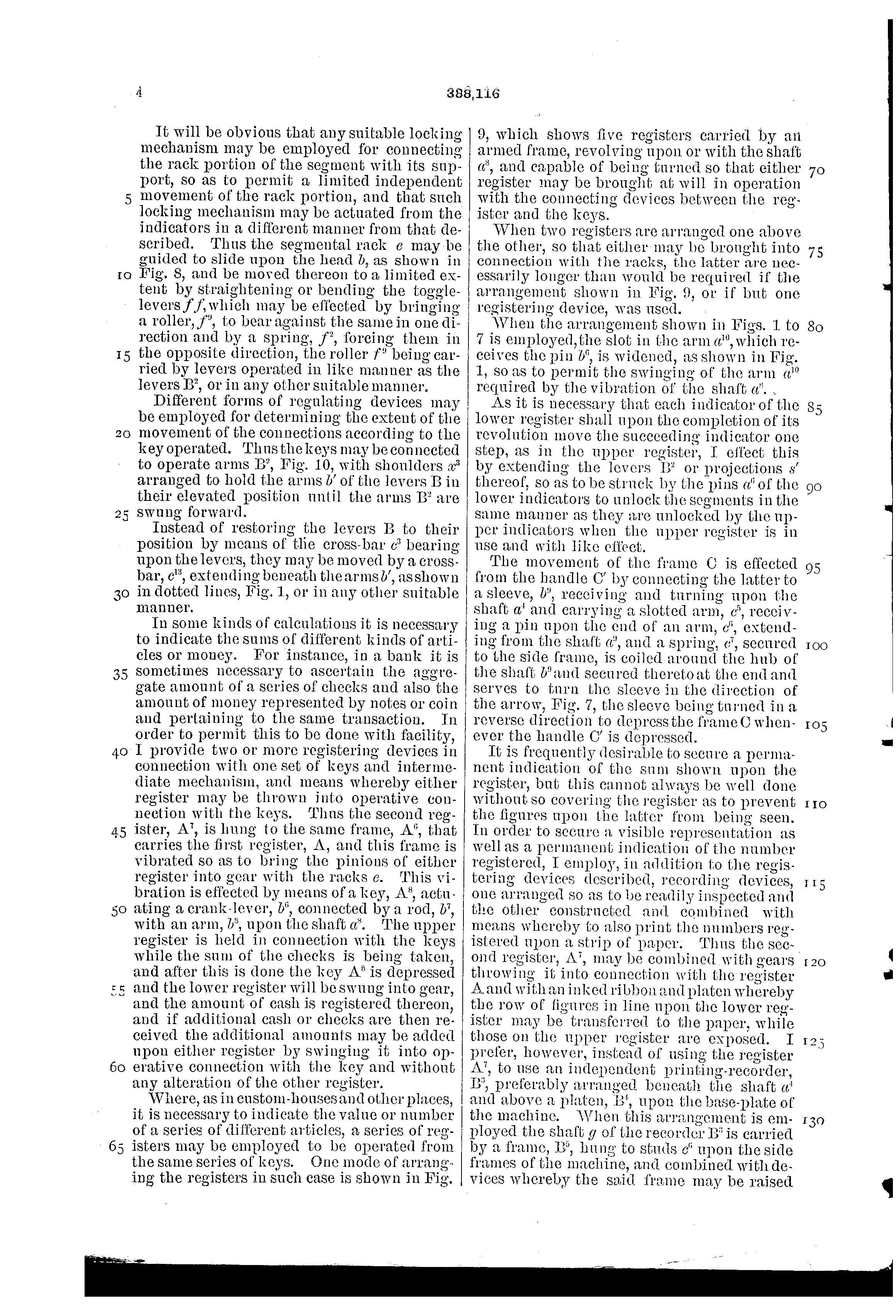
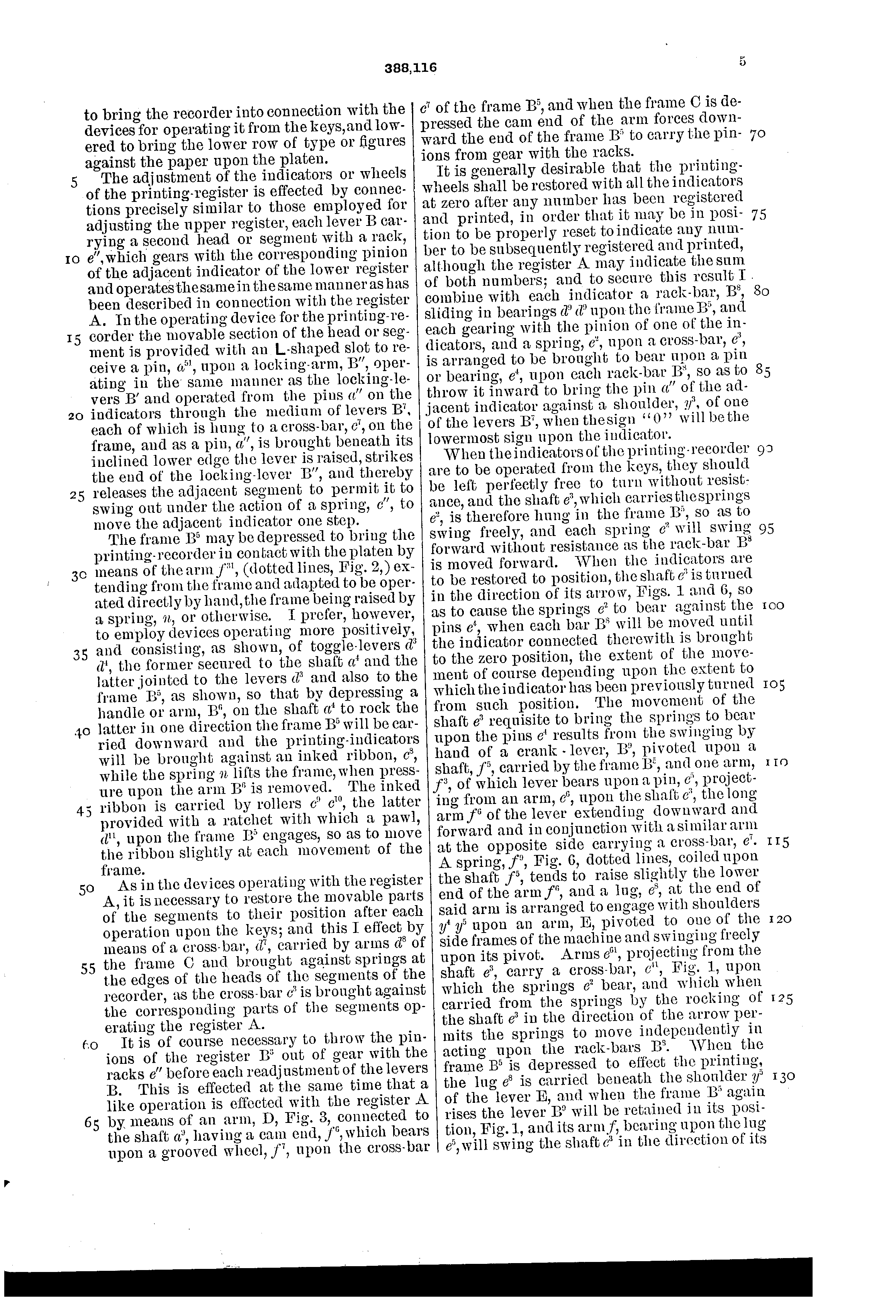
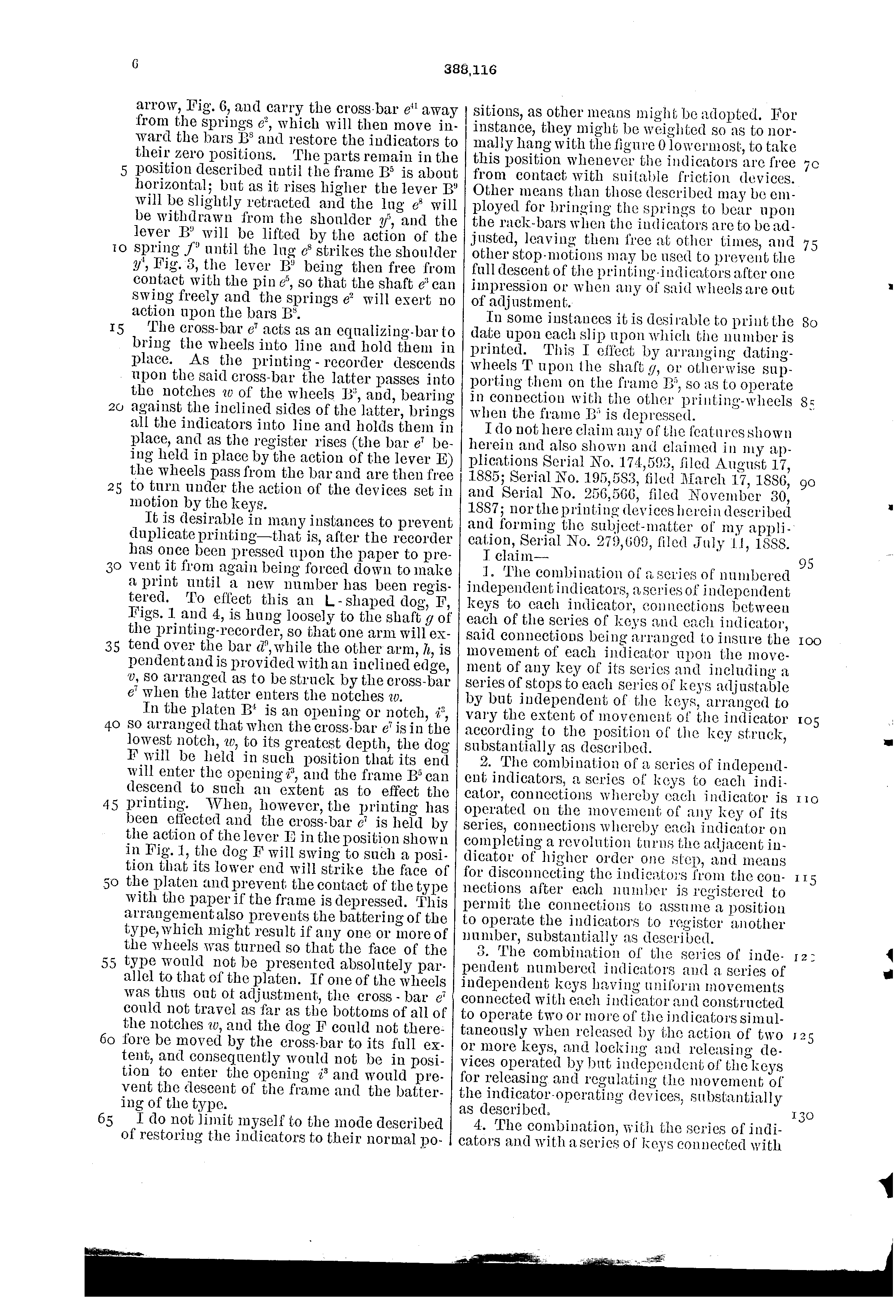
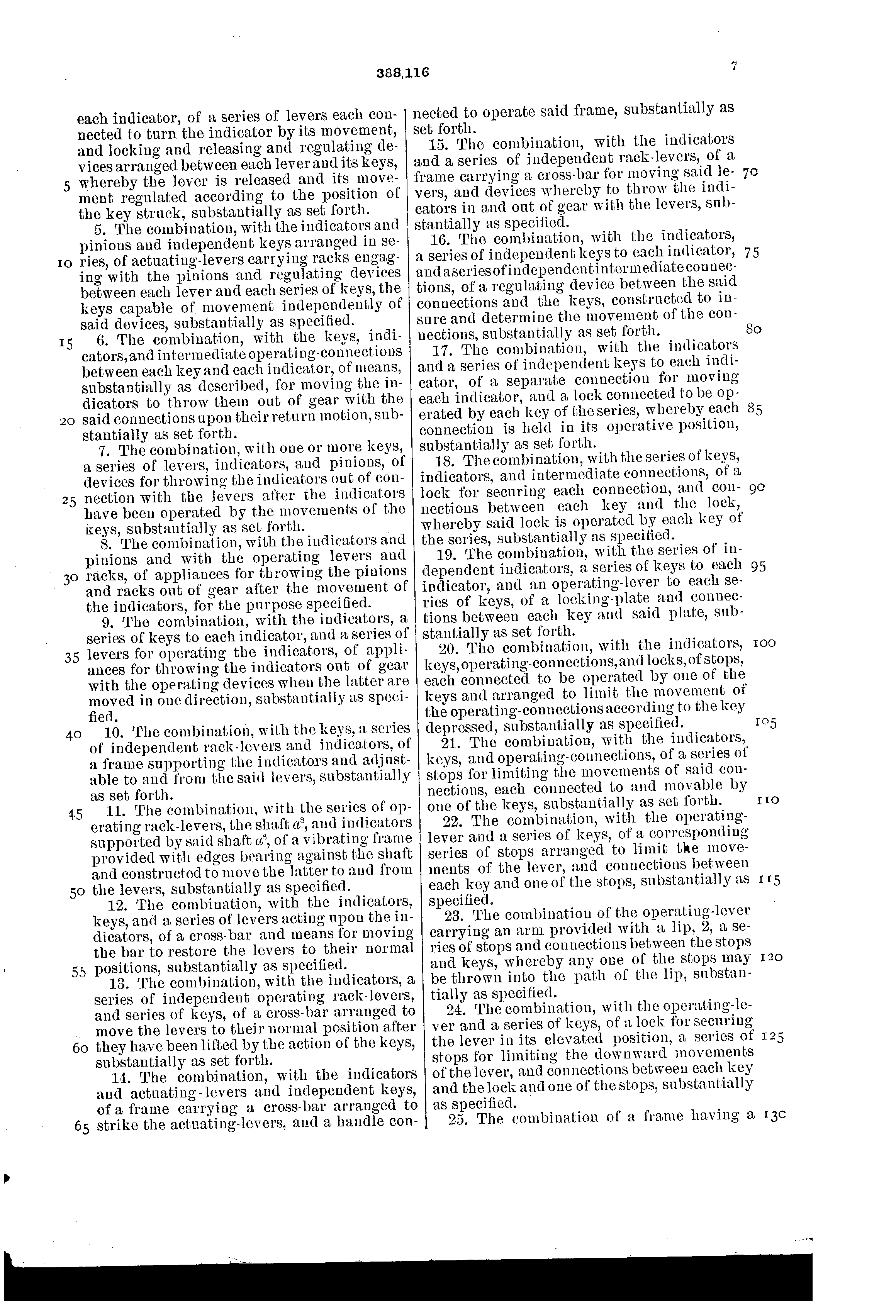
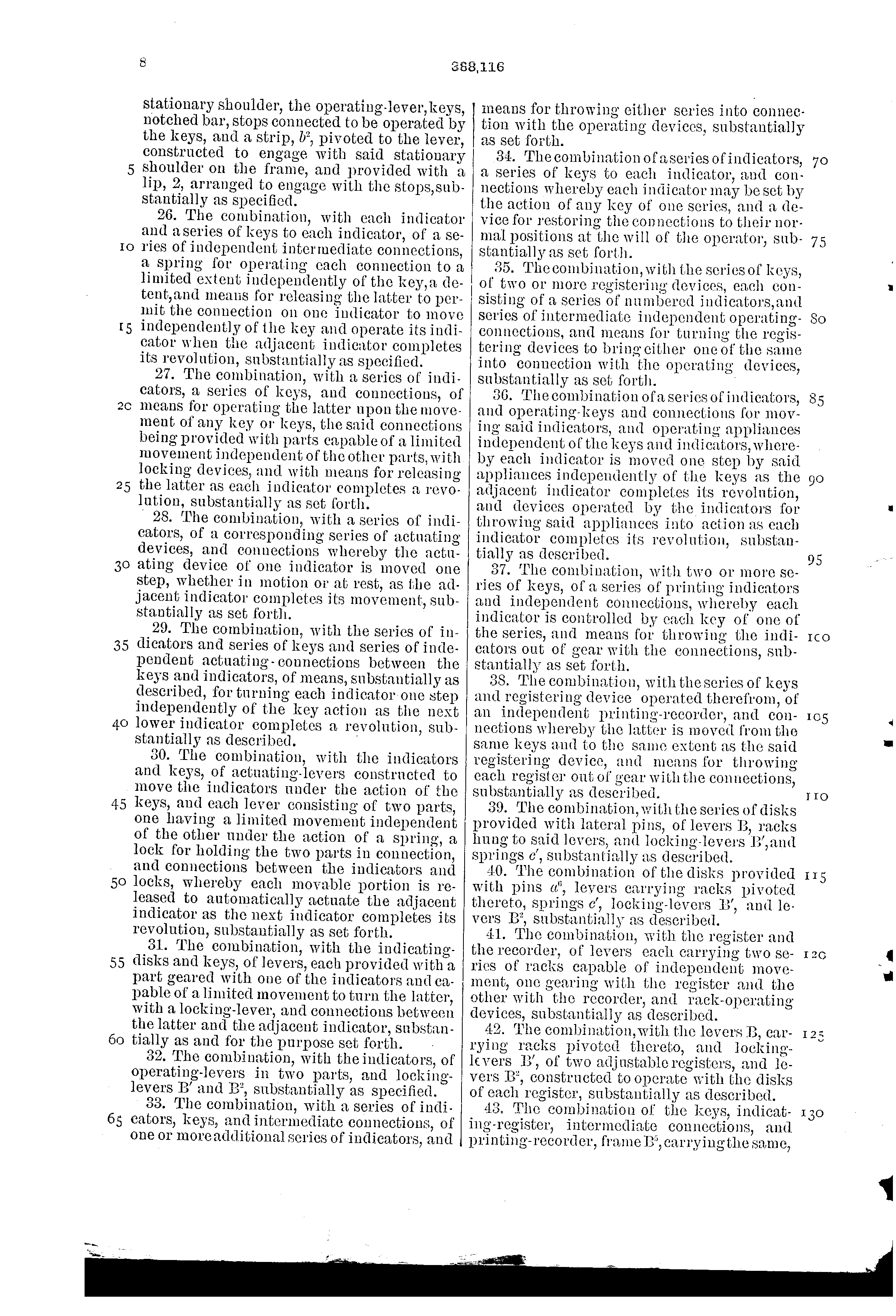
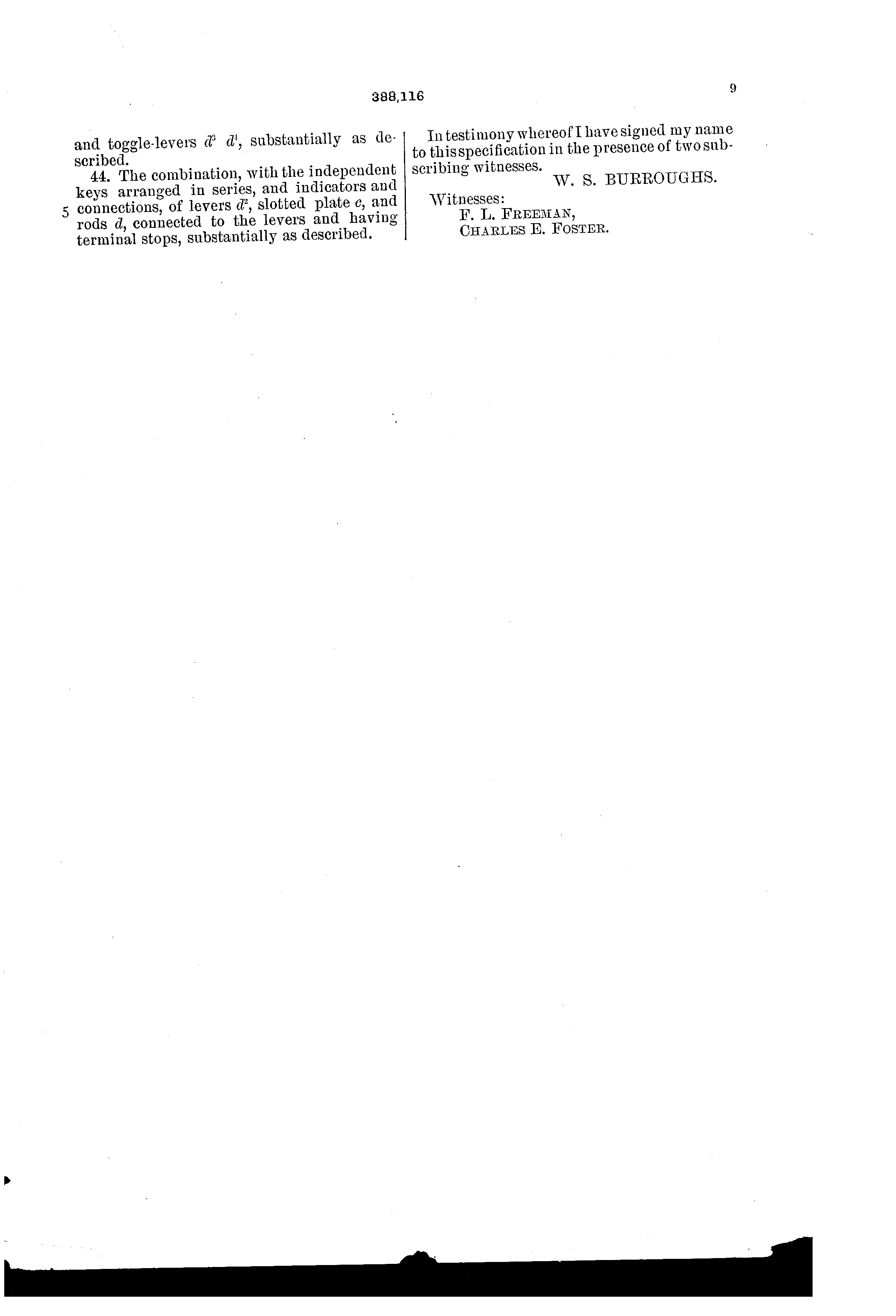
PDF · Google Patents · His first application. Assigned to the American Arithmometer Company.
US 388,117, Burroughs, Calculating-Machine, filed 17 August 1885, granted 21 August 1888
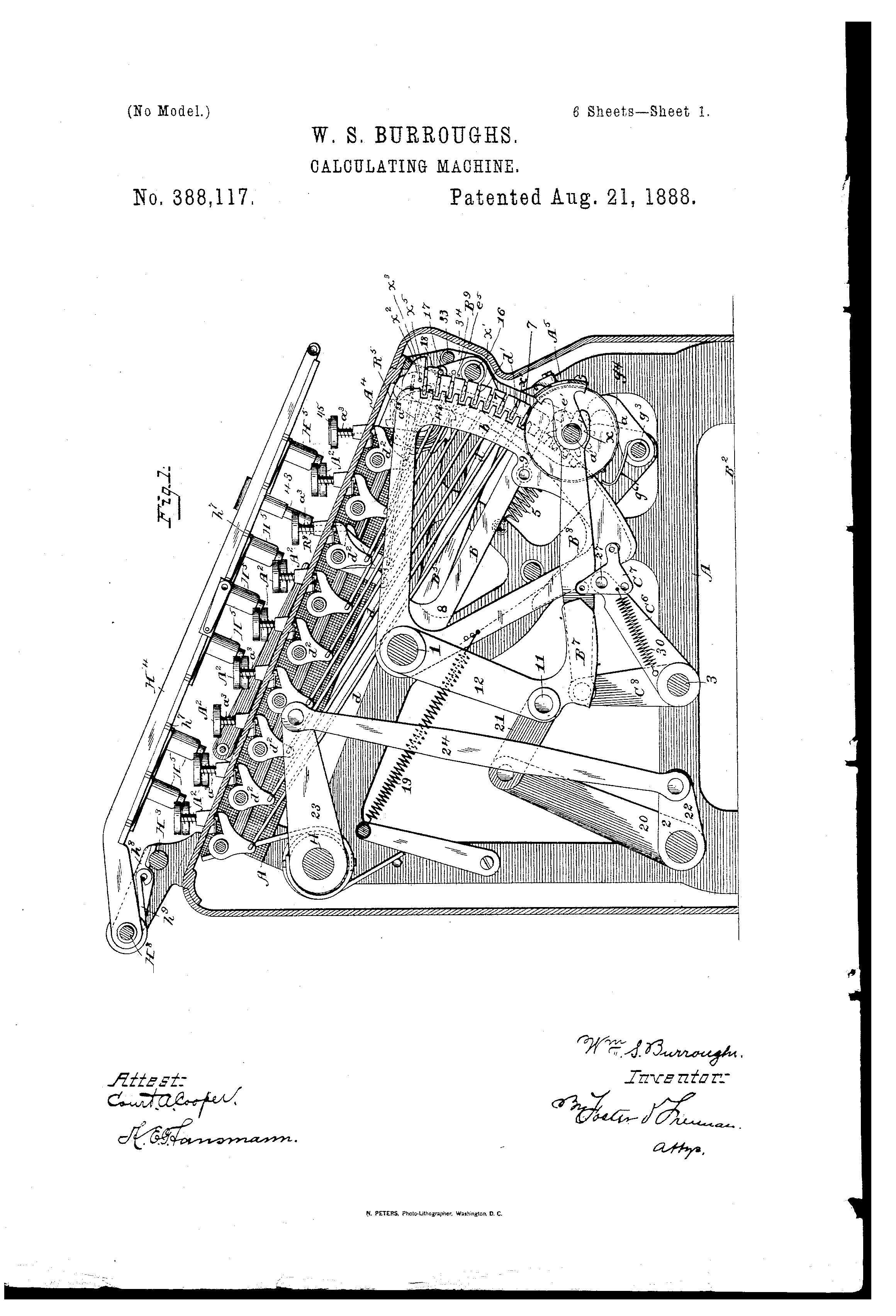
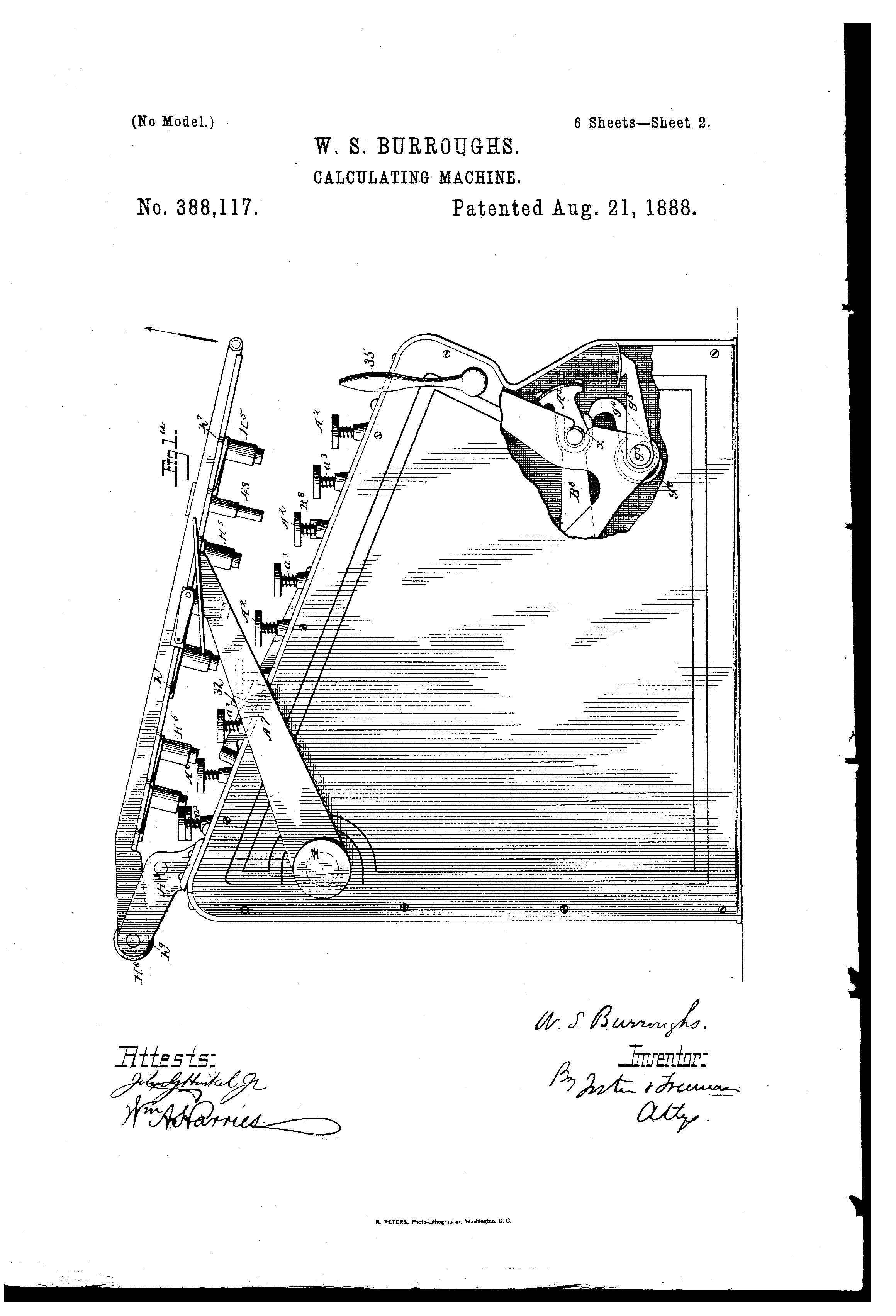
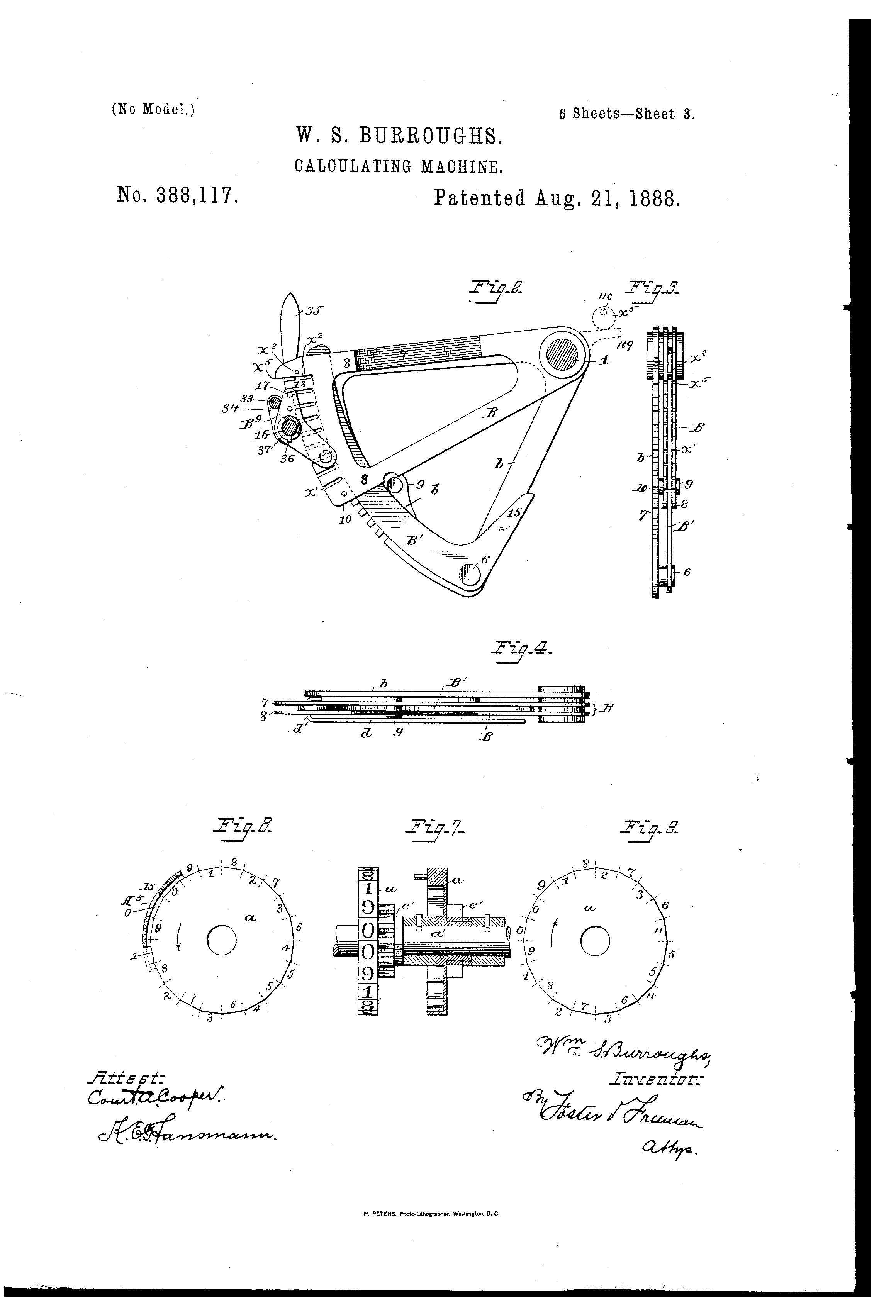
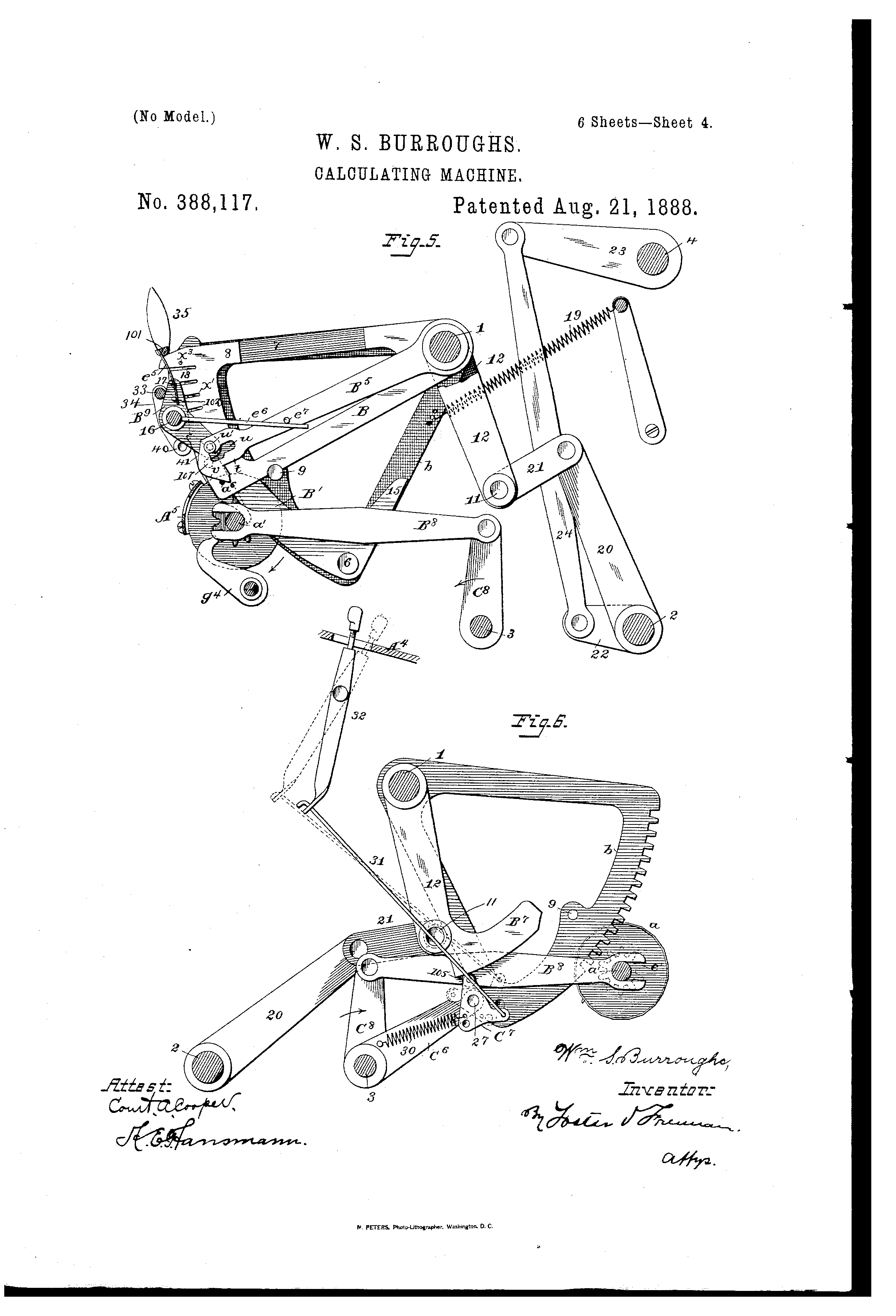
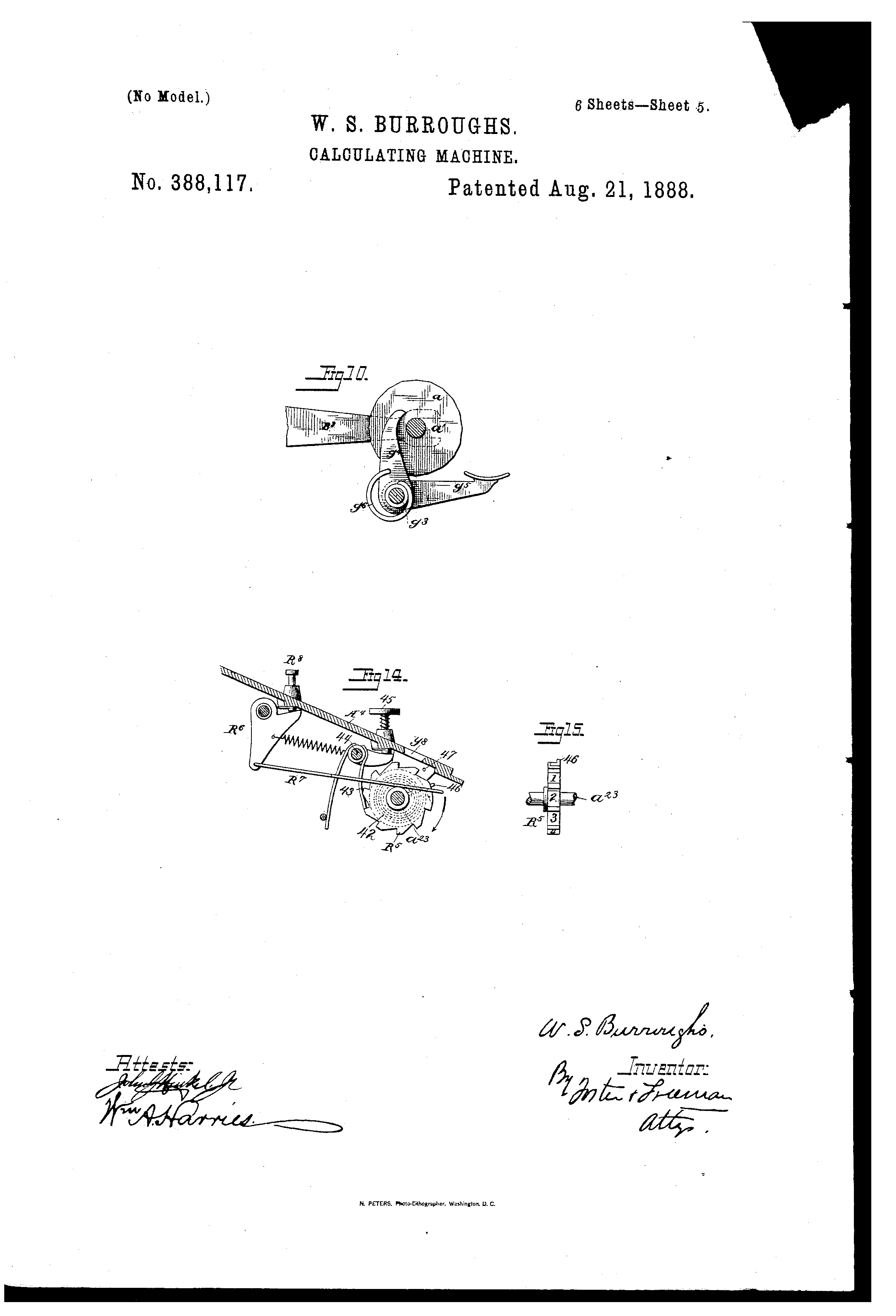
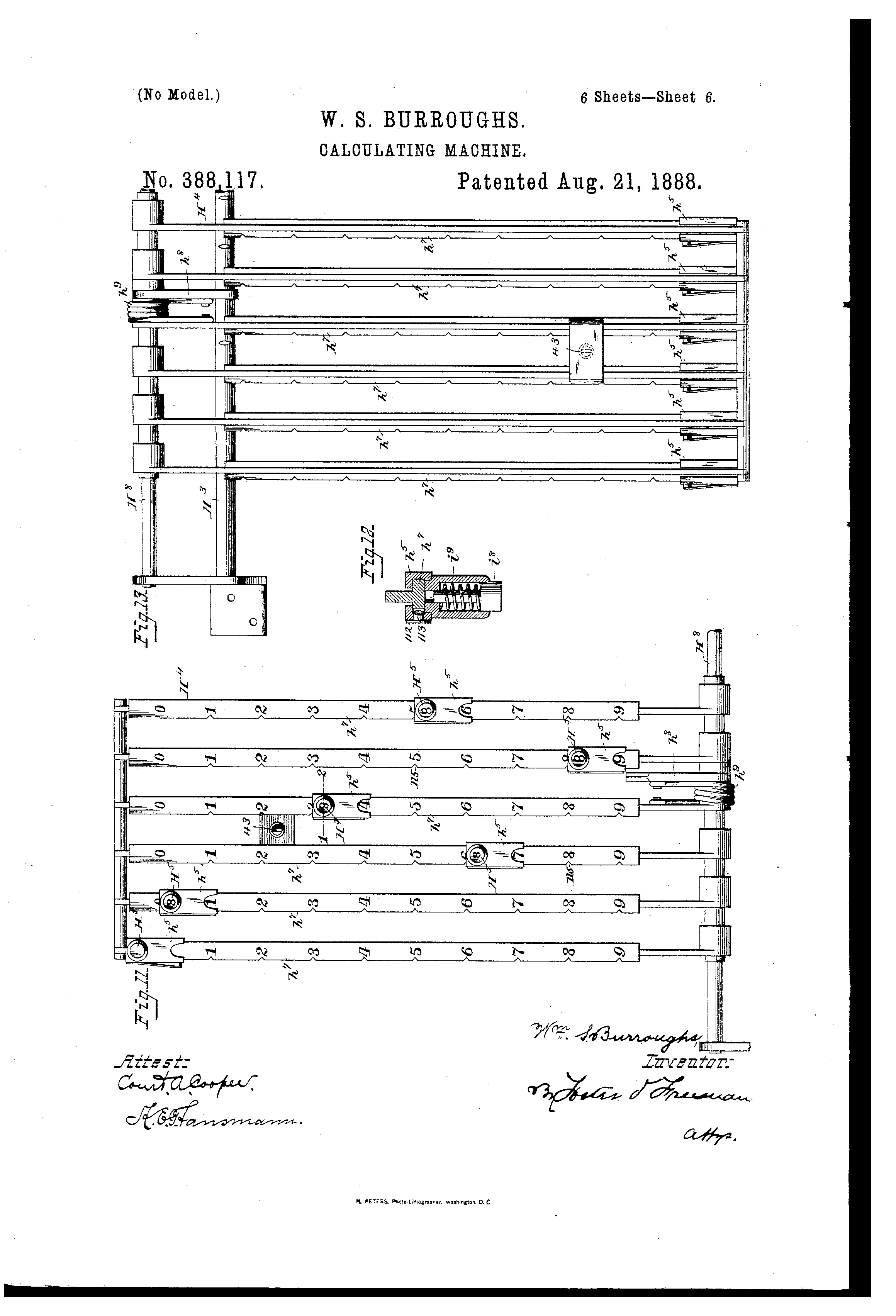
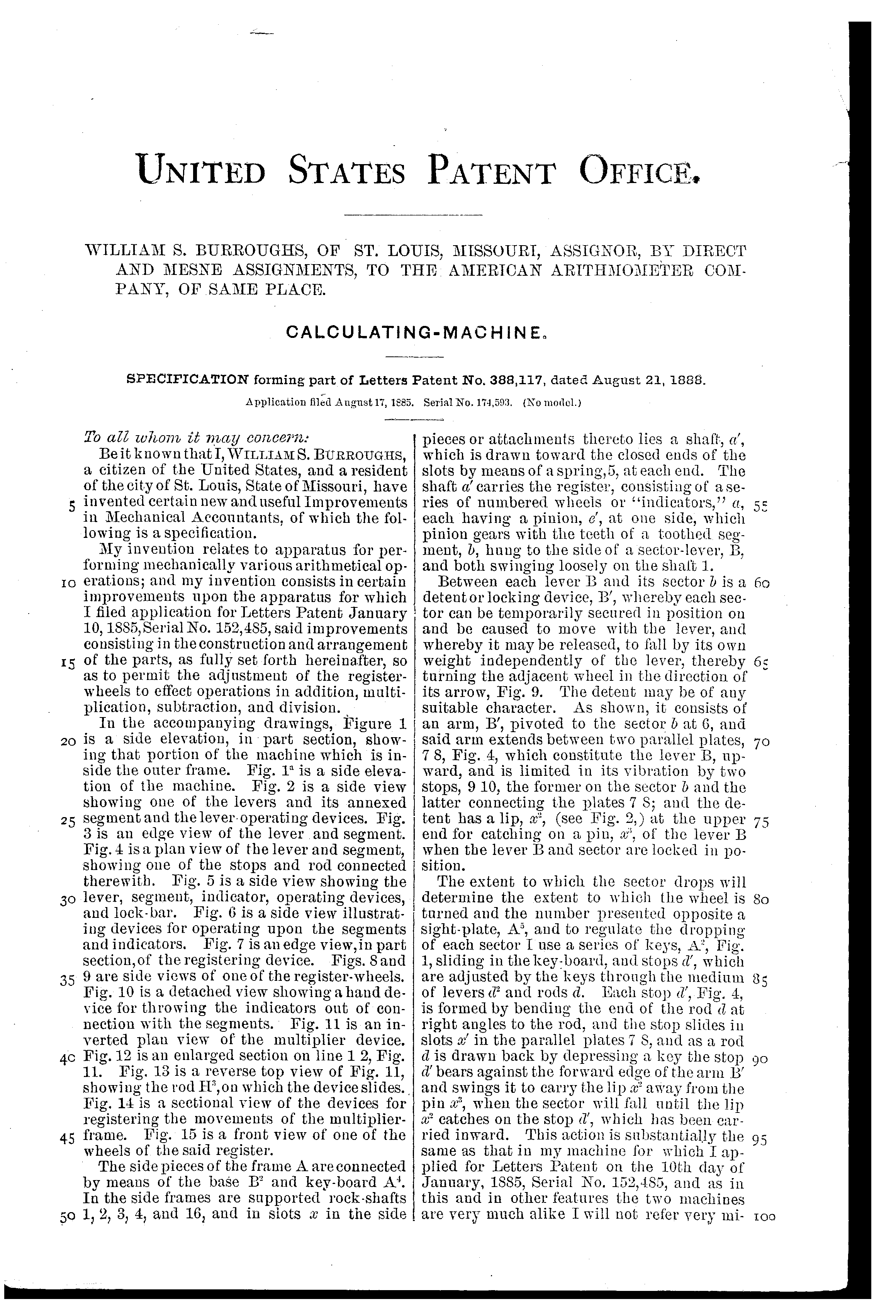
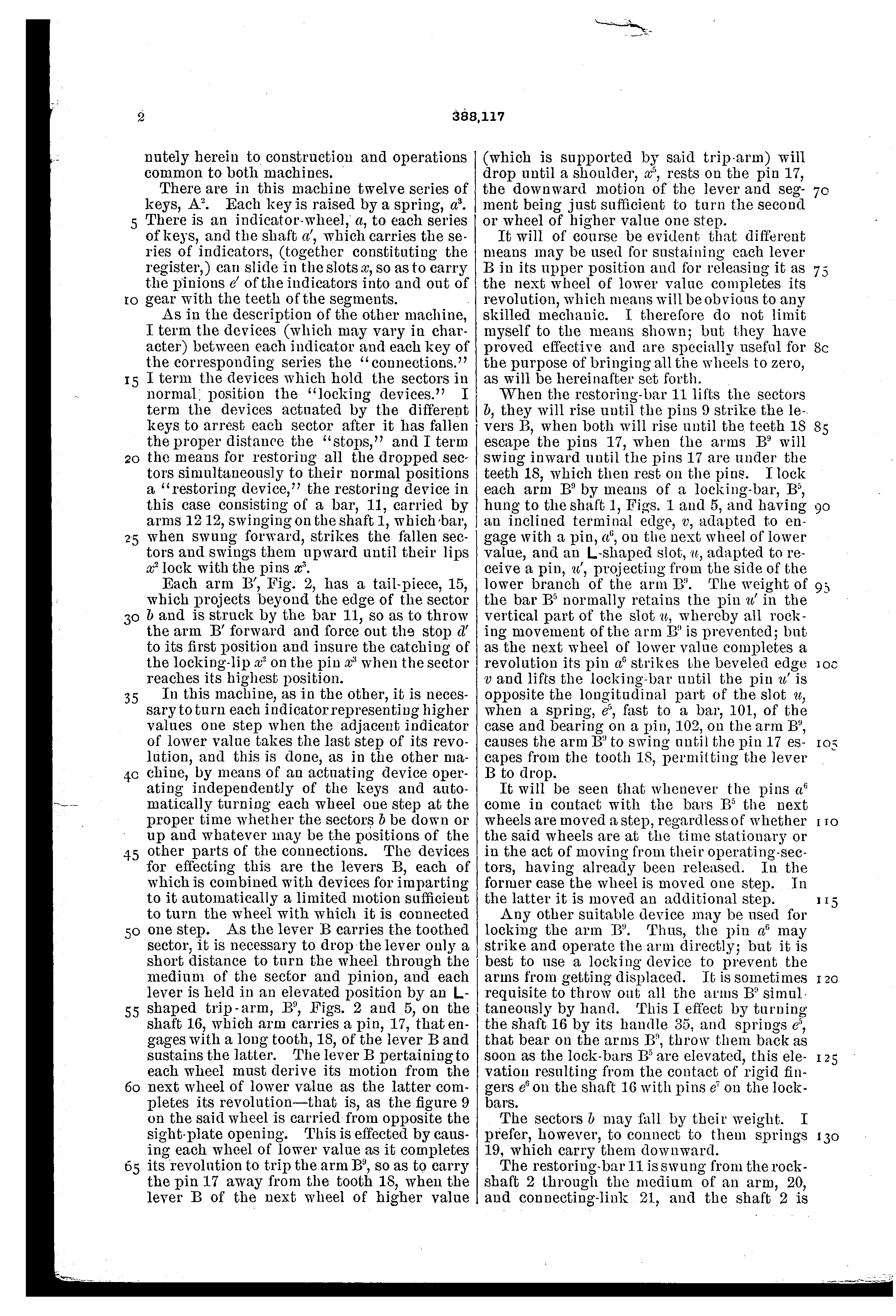
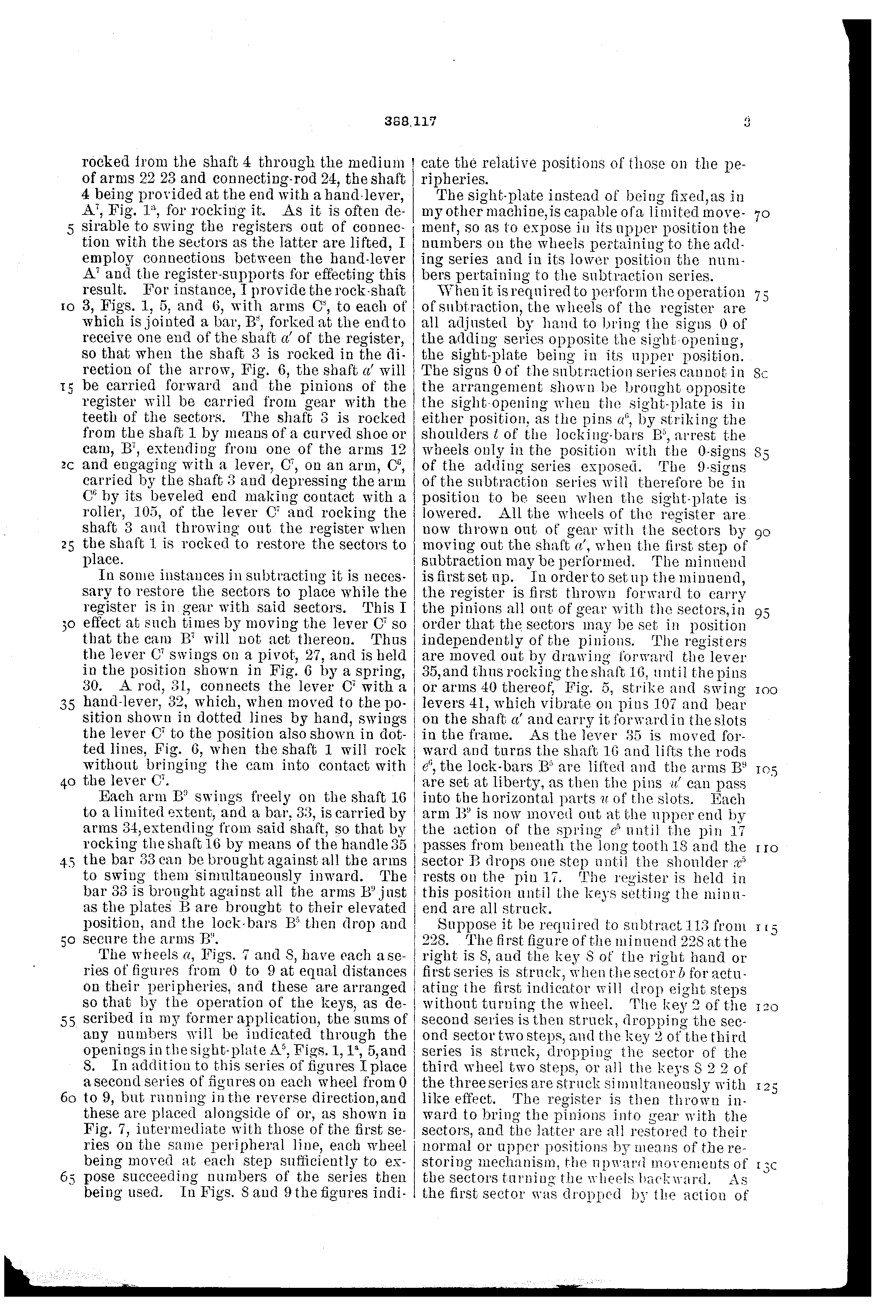
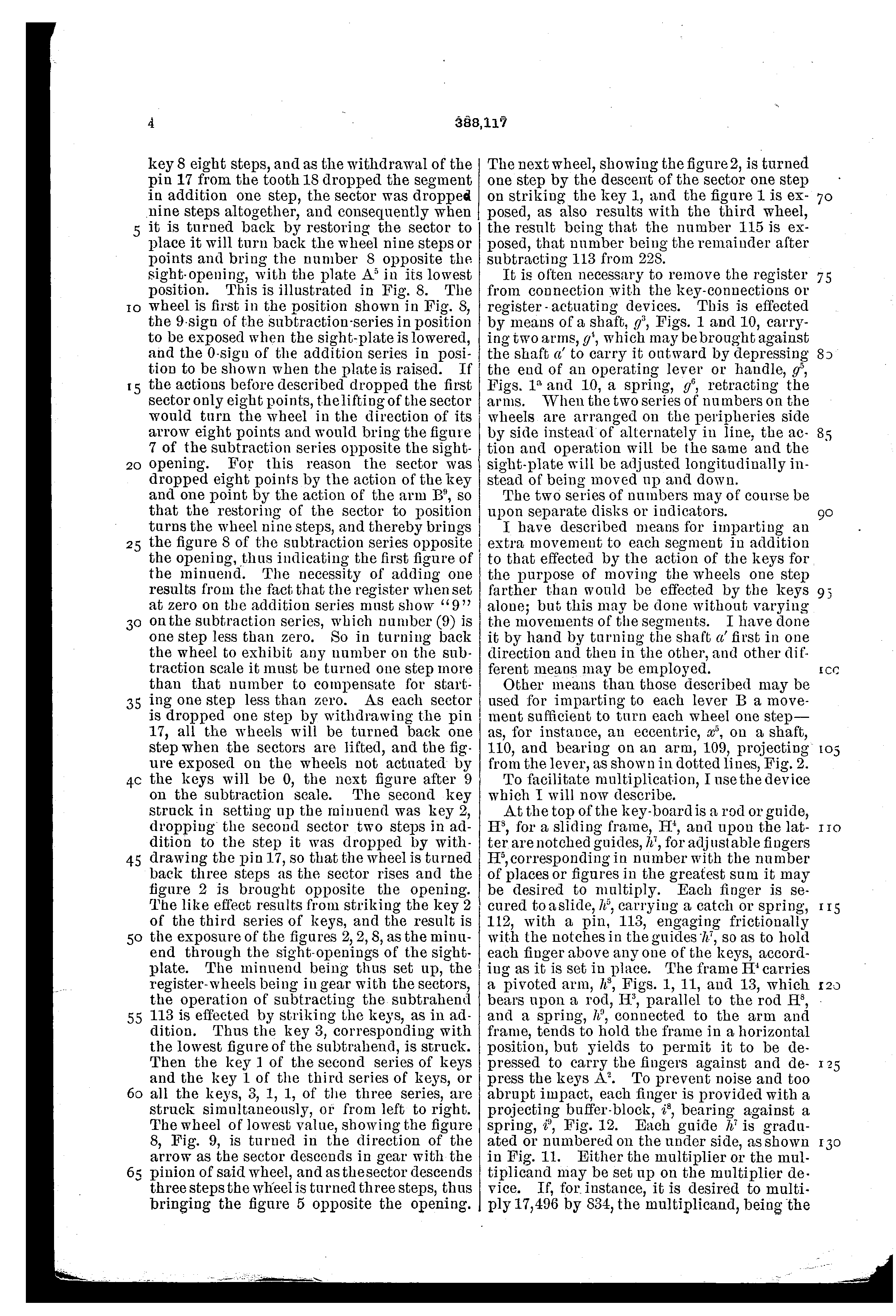
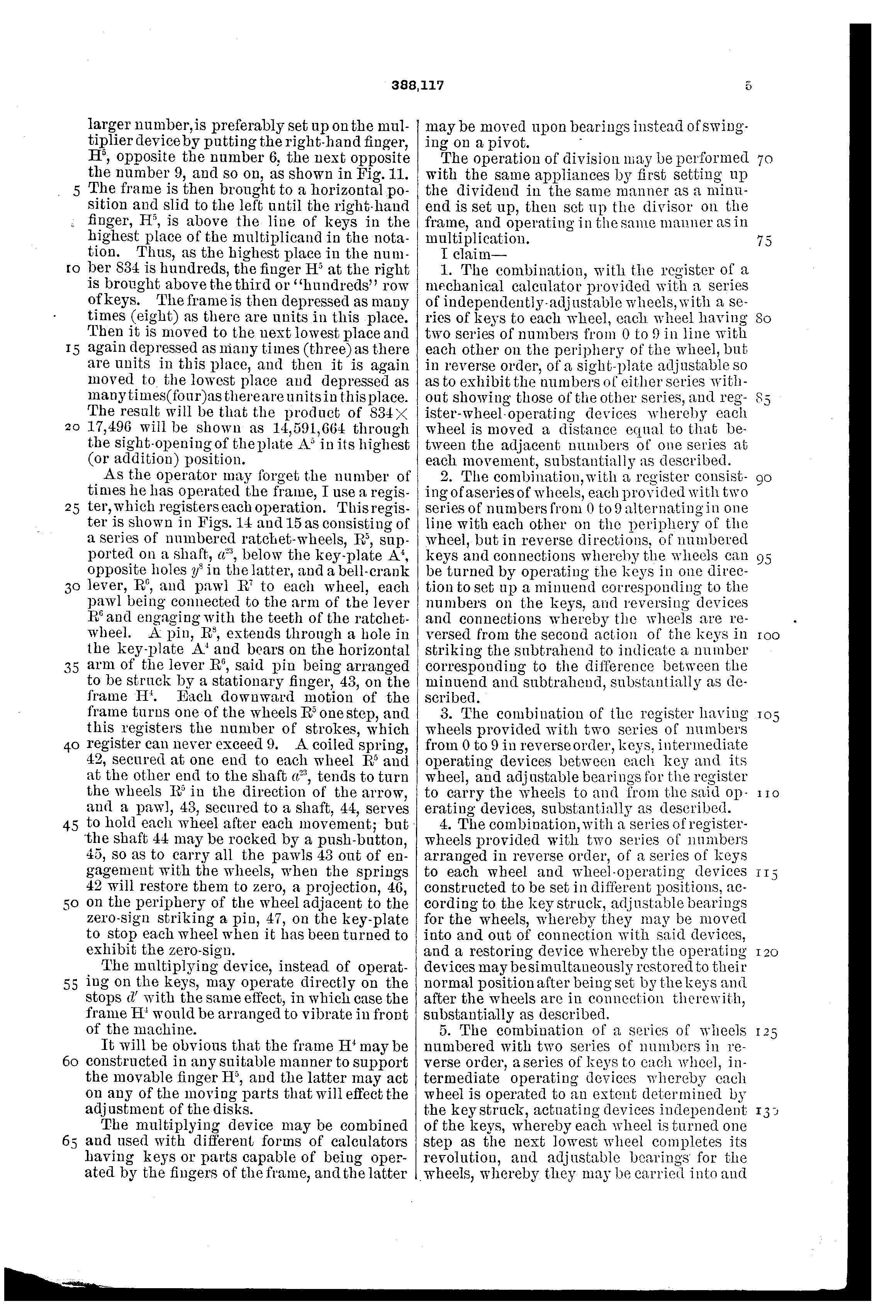
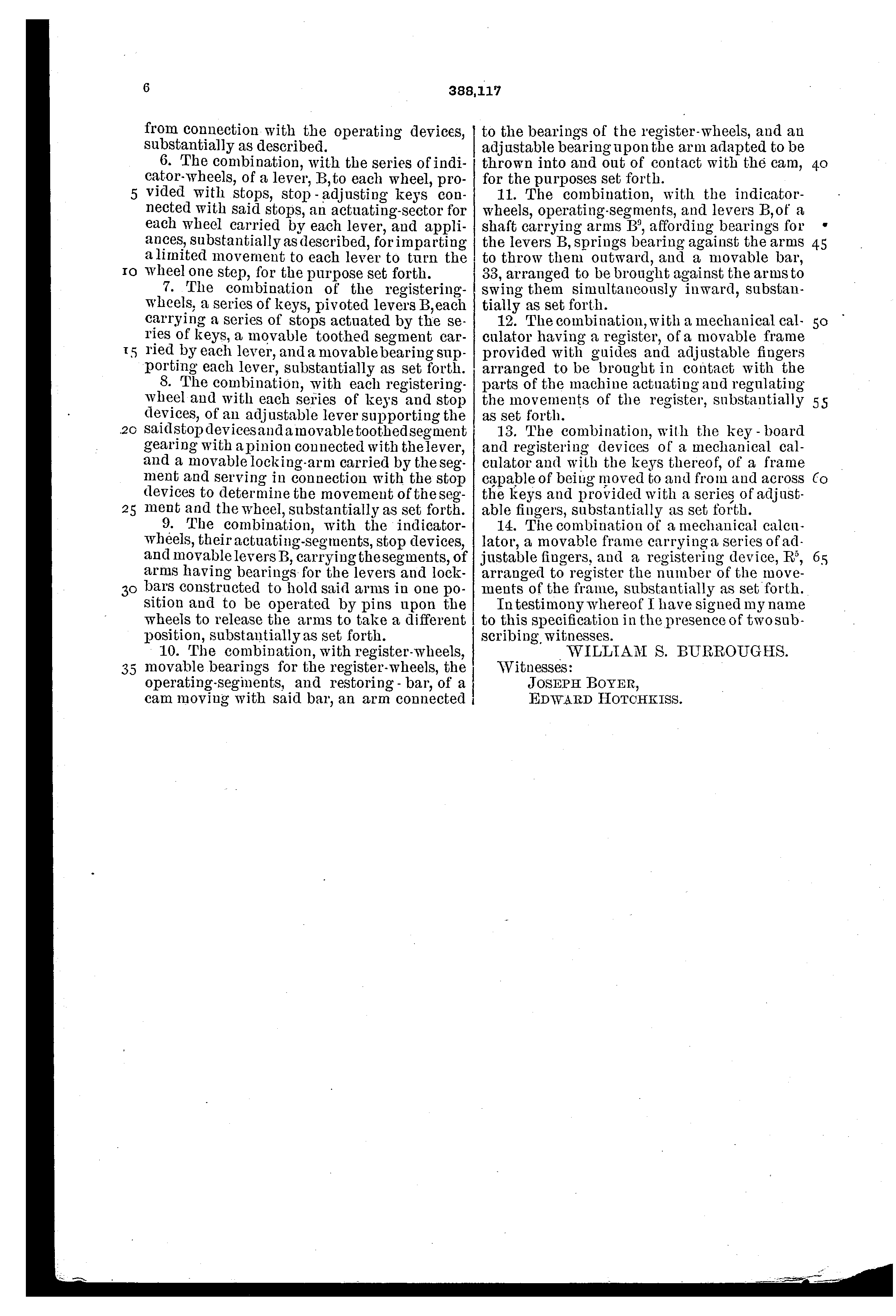
PDF · Google Patents · Adapts 388,116 for multiplication, subtraction and division.
US 388,118, Burroughs, Calculating-Machine, filed 17 March 1886, granted 21 August 1888
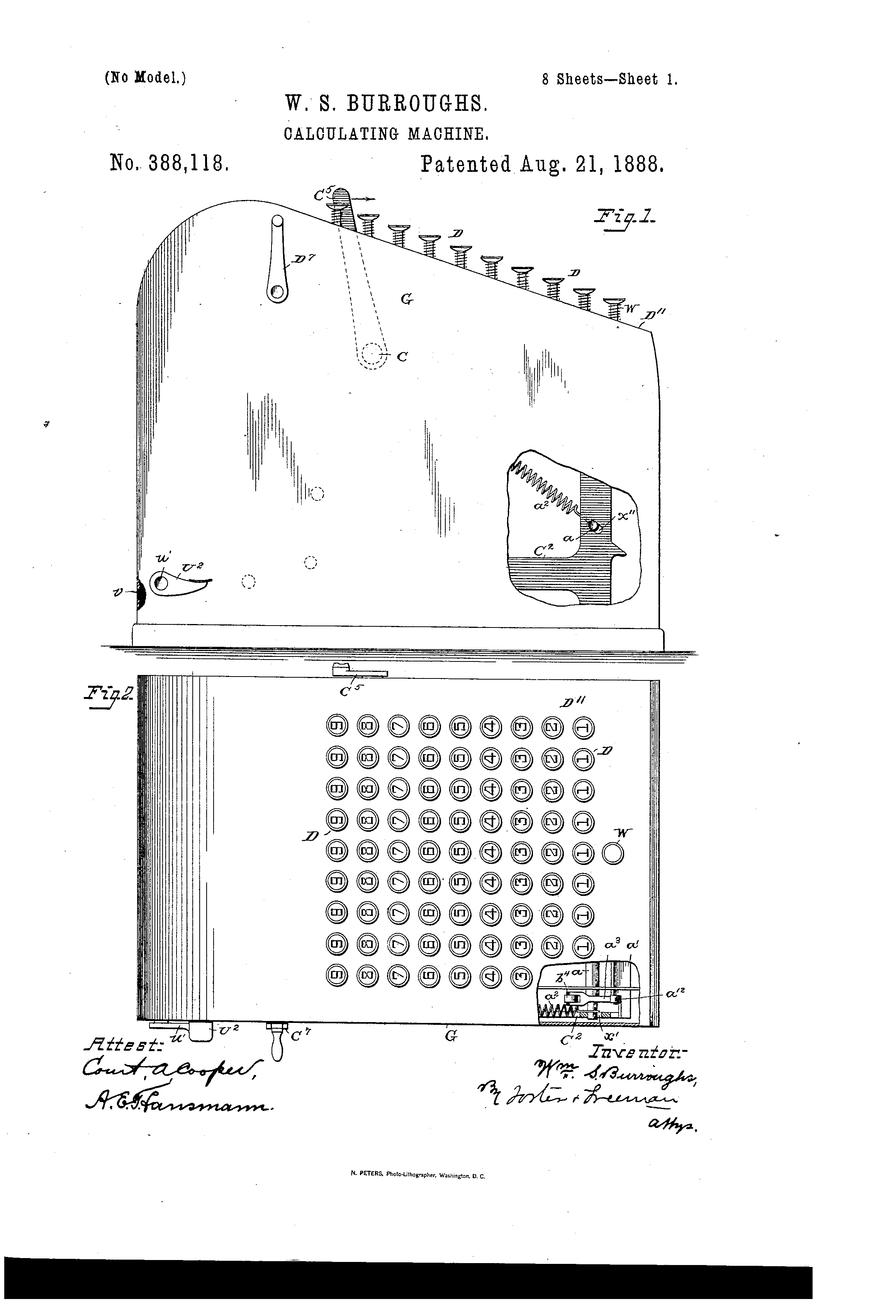
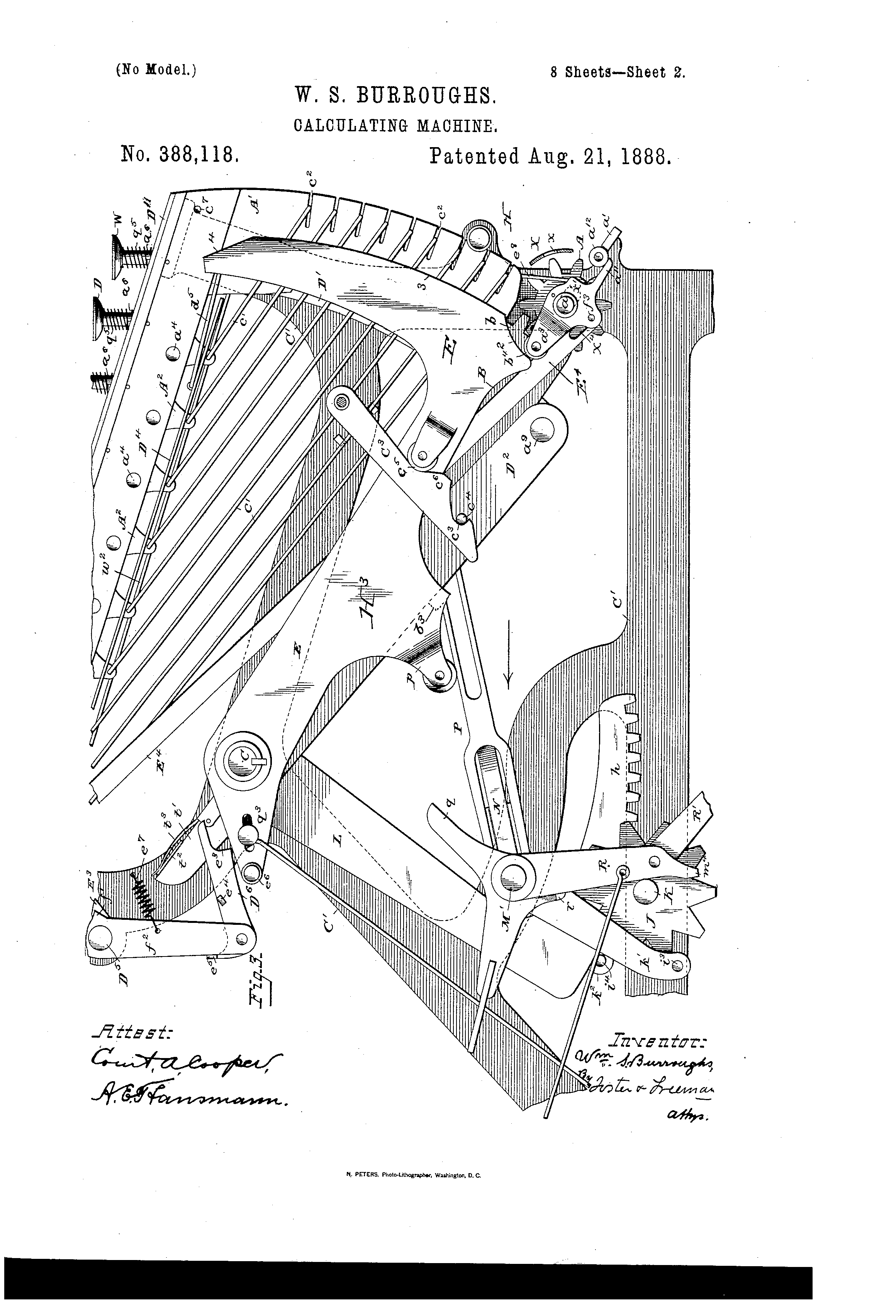
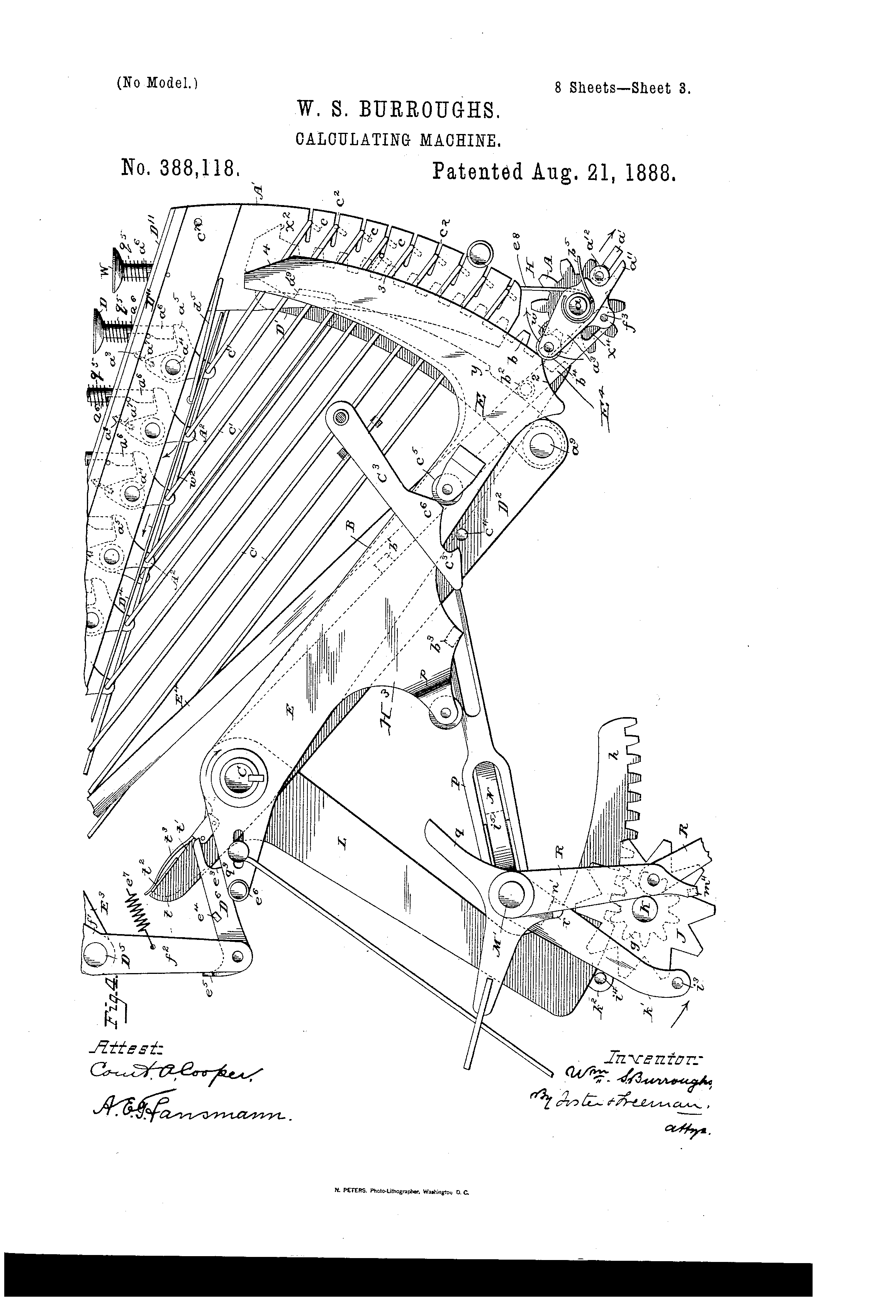
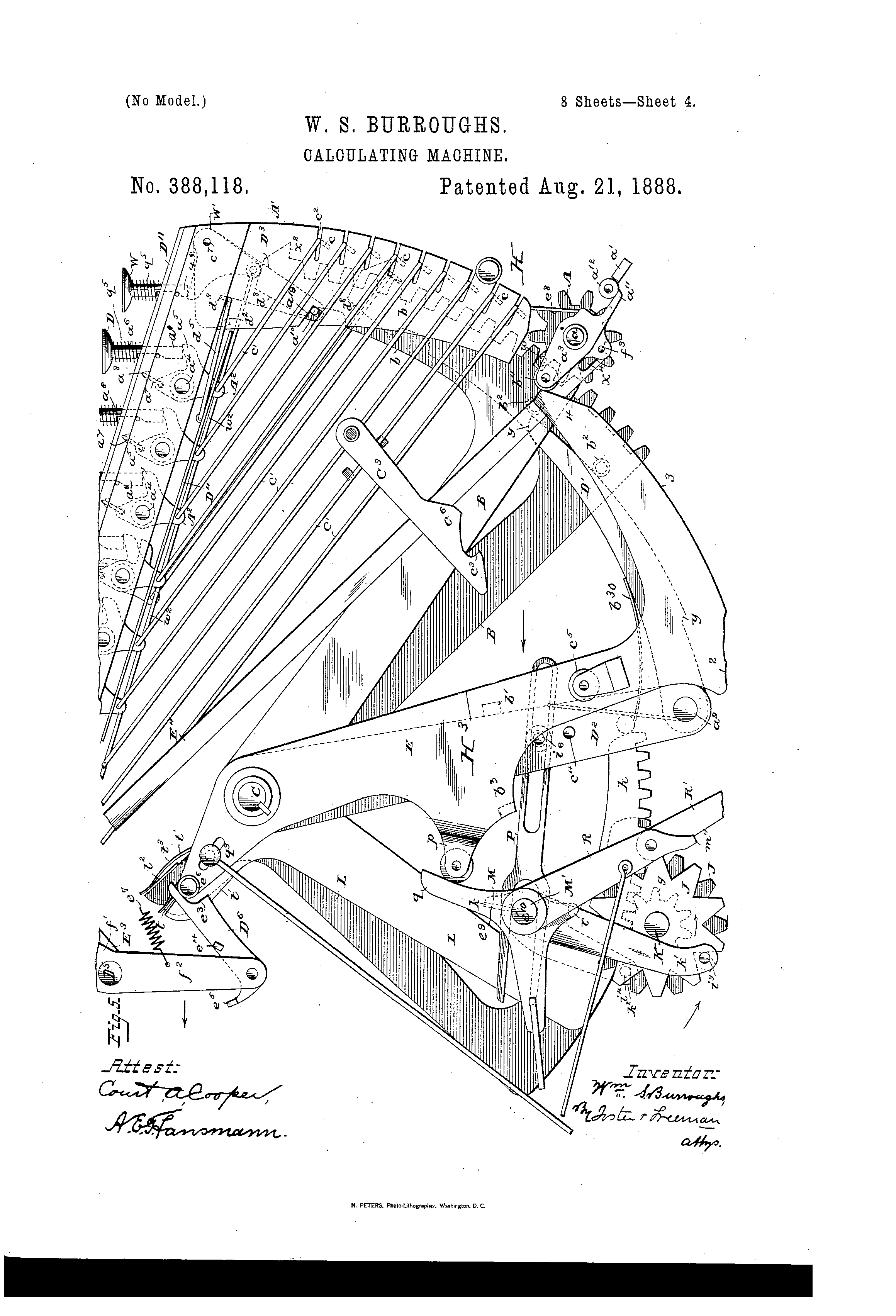
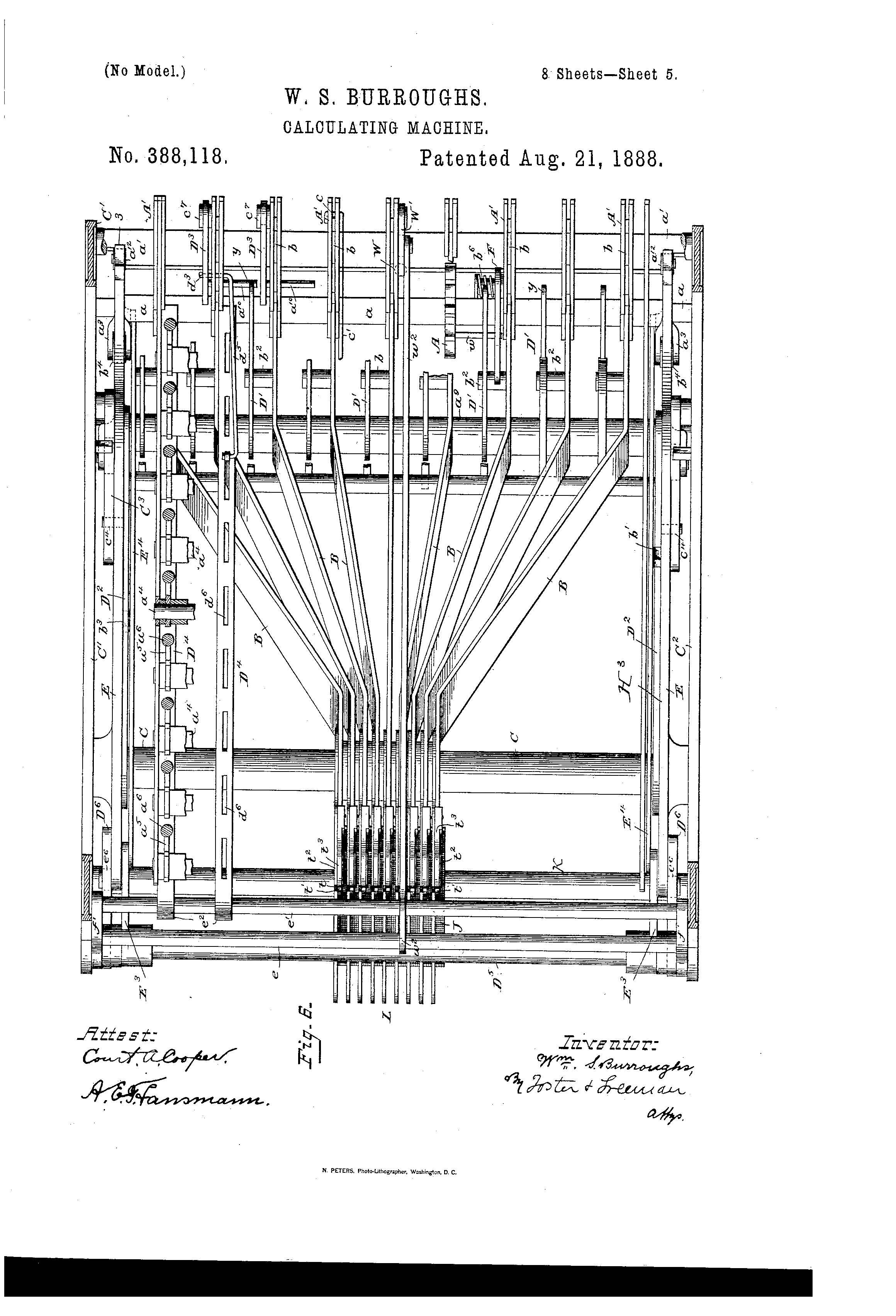
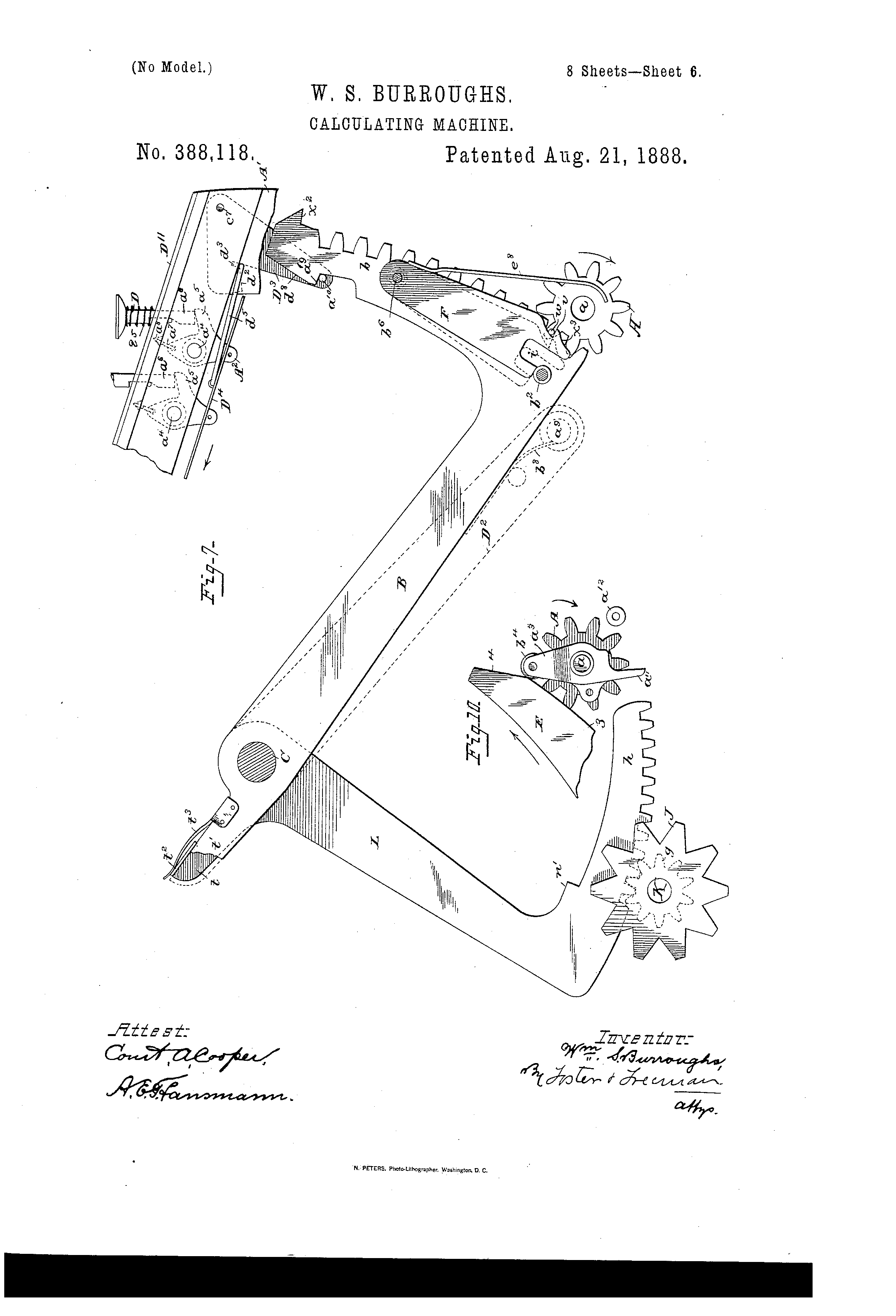
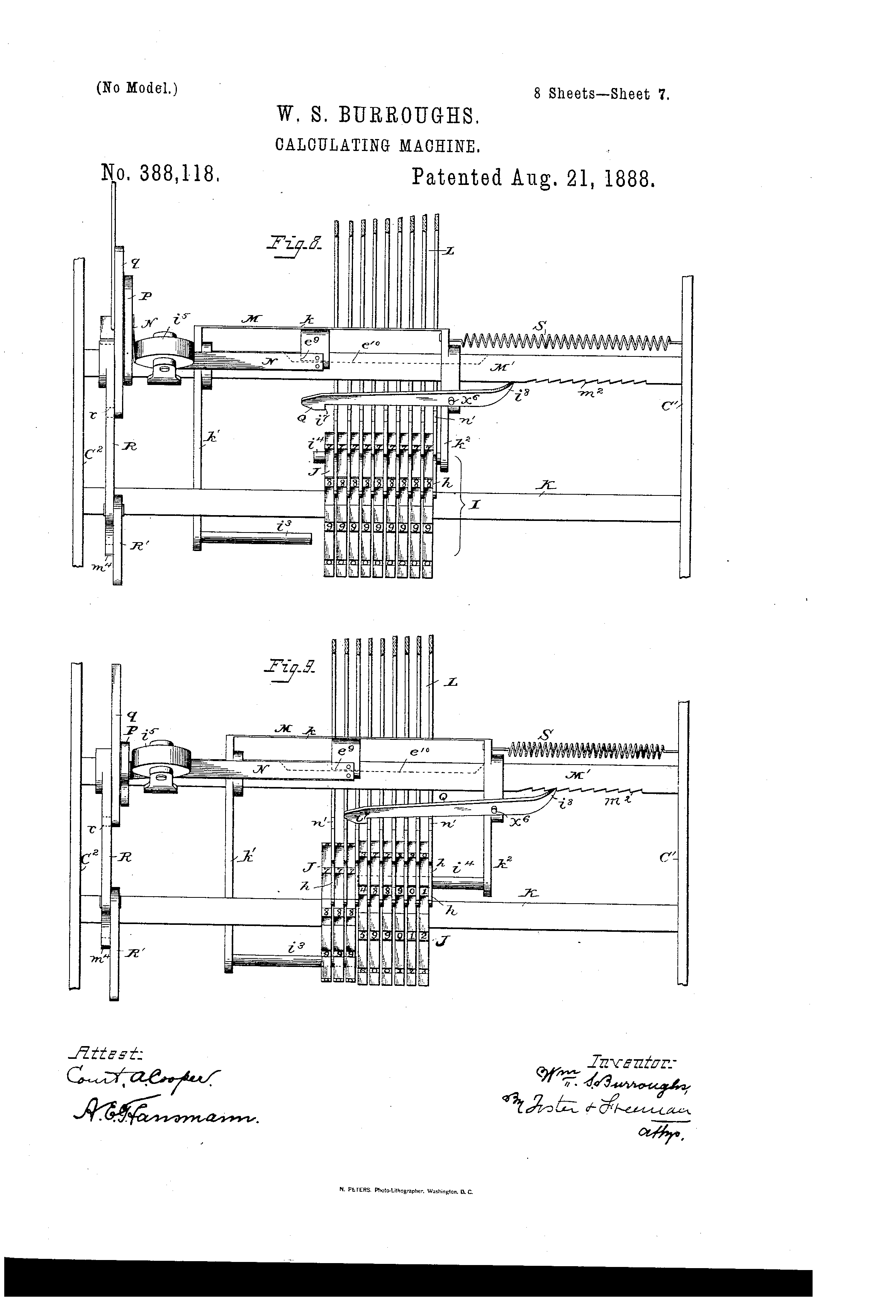
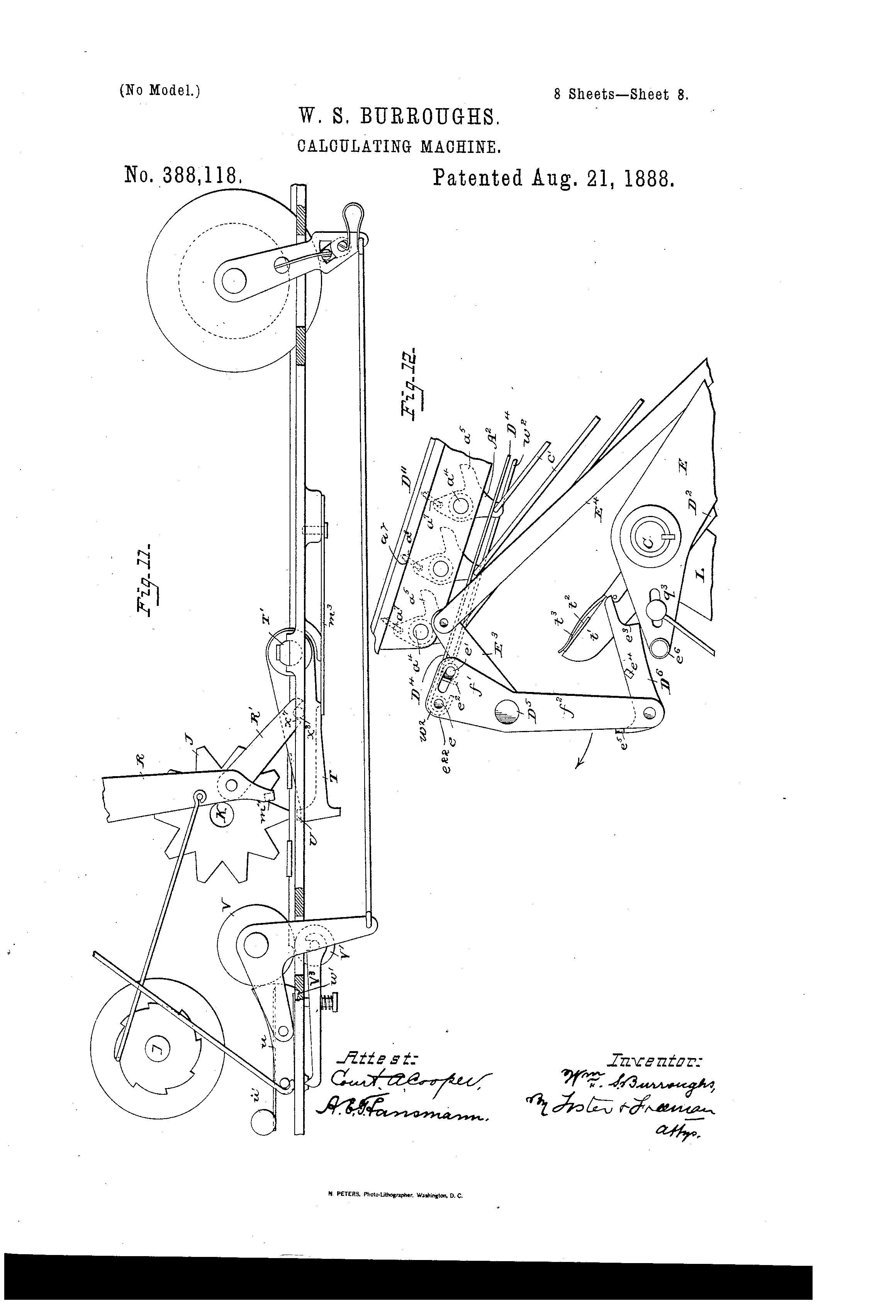
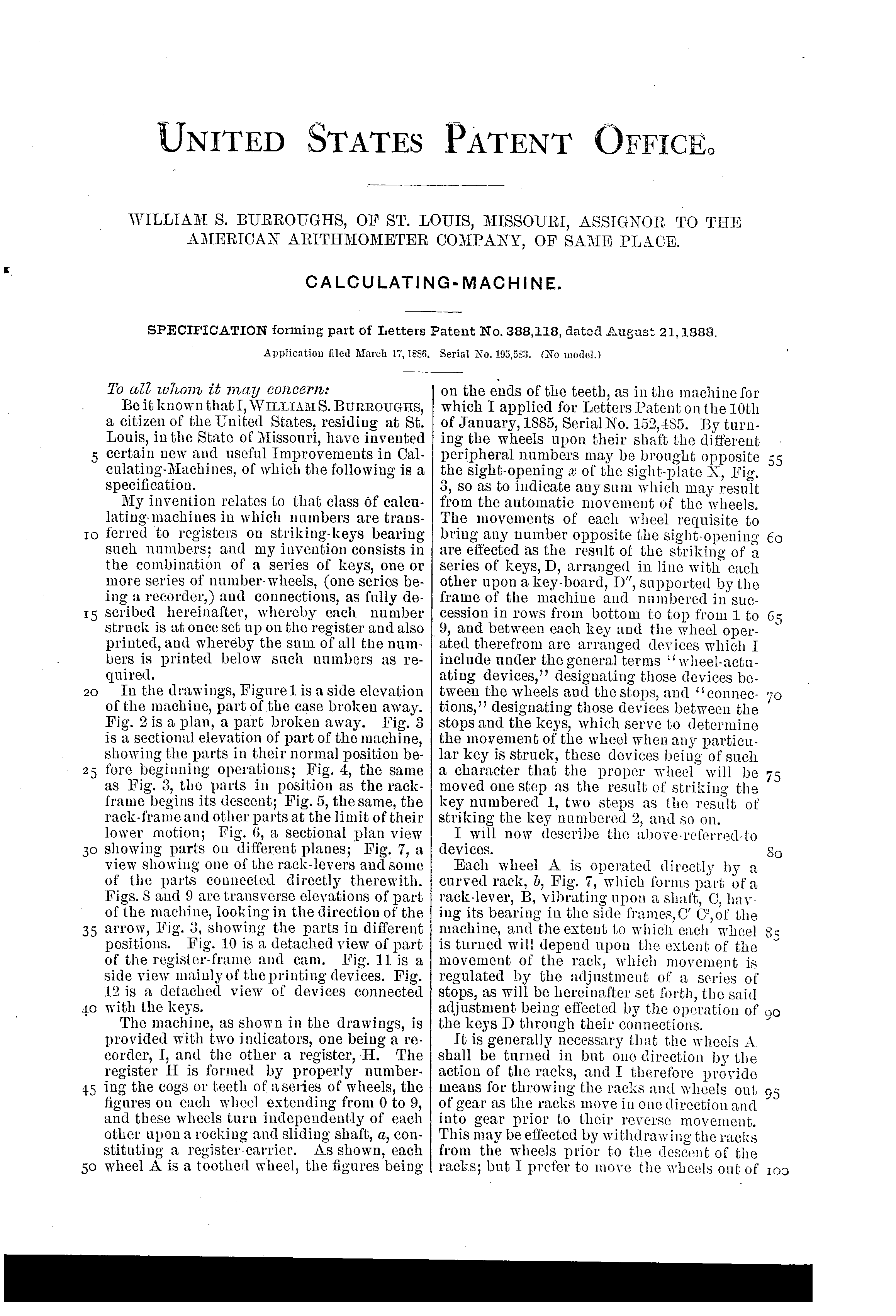
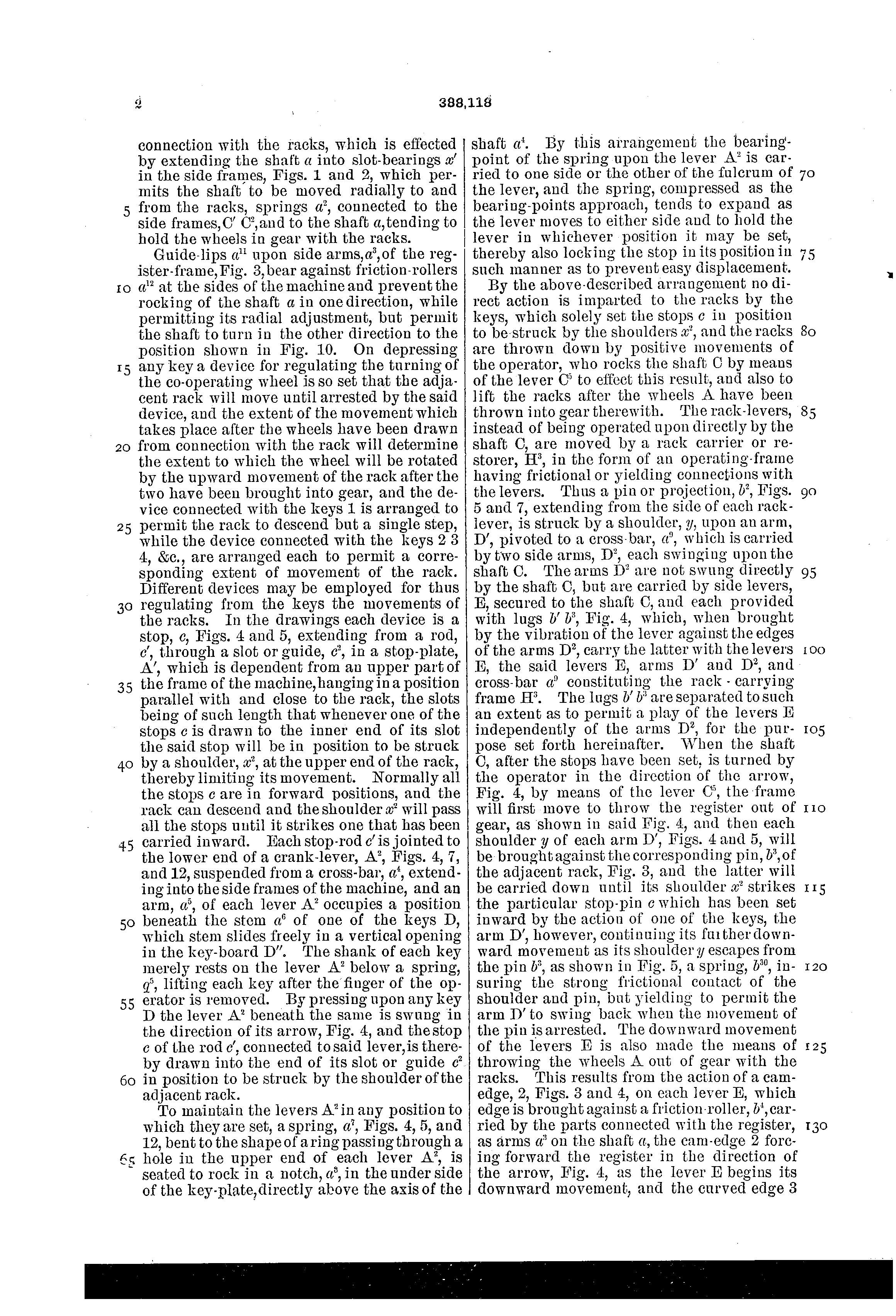
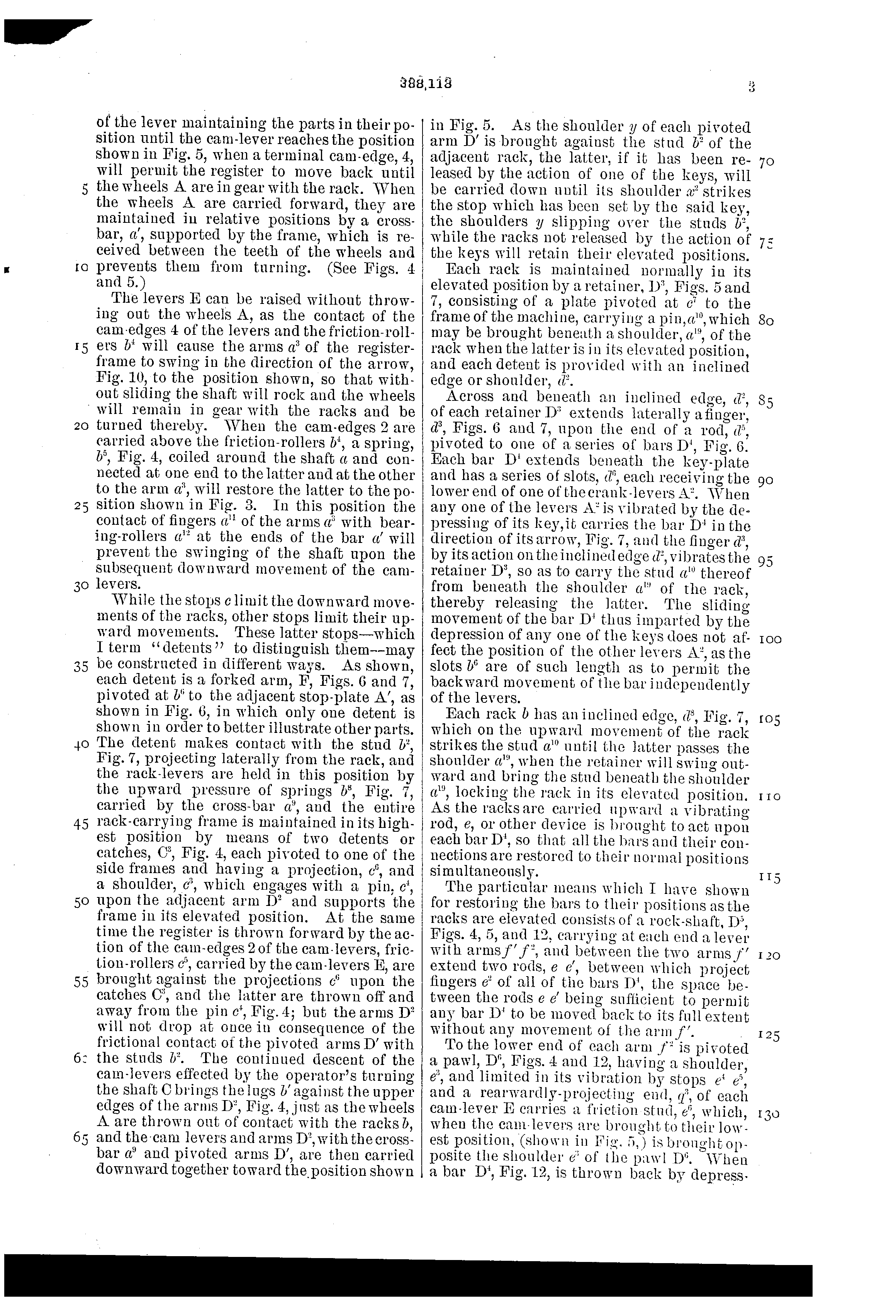
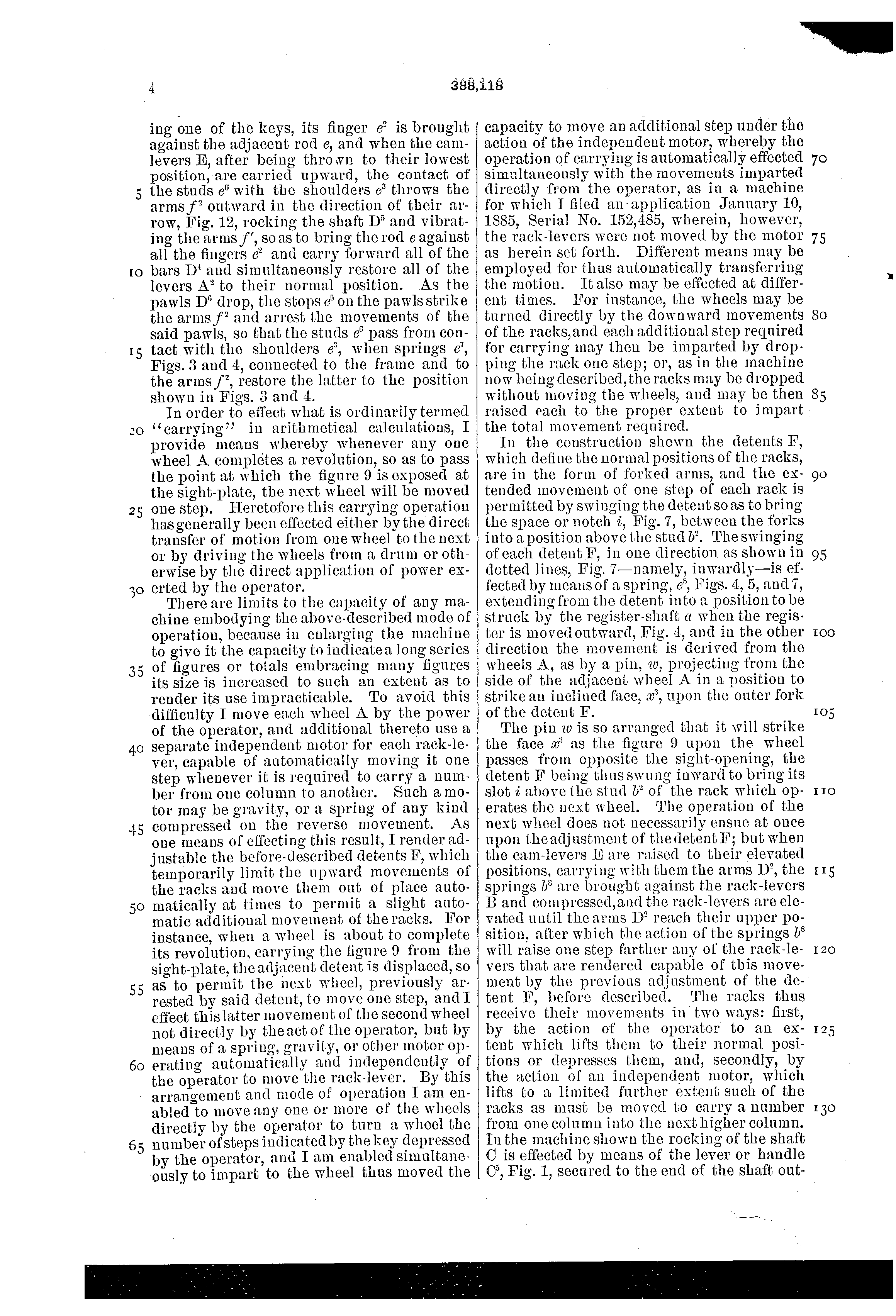
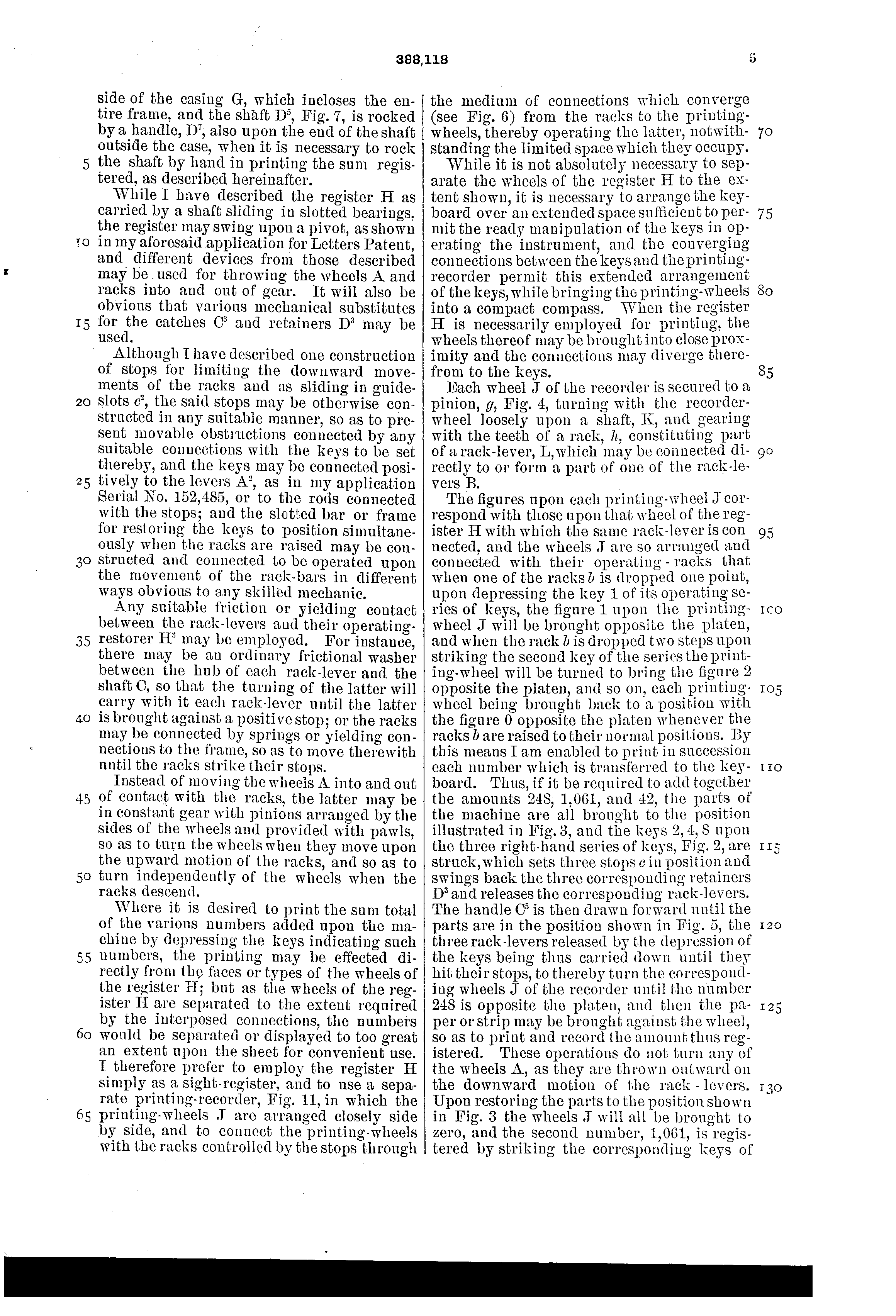
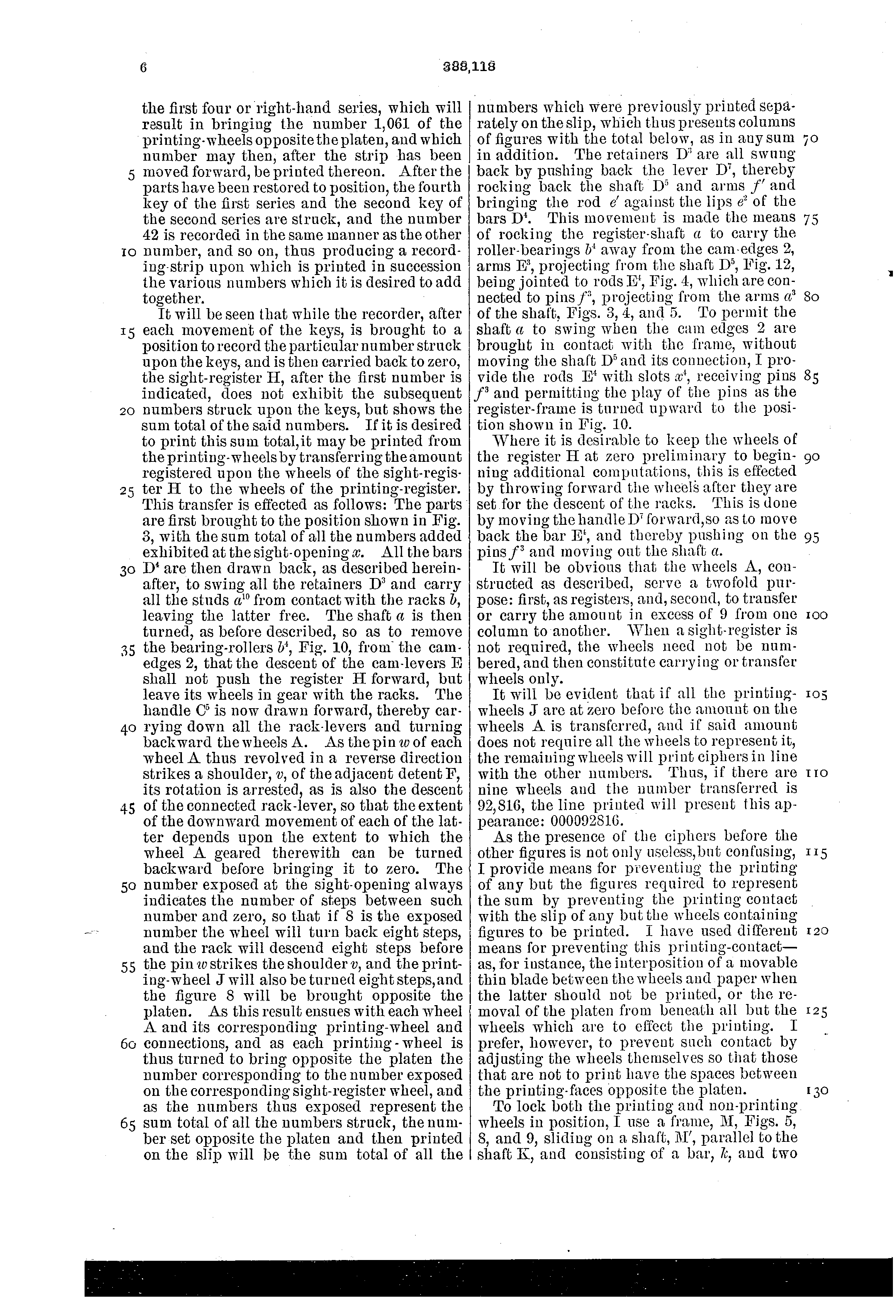
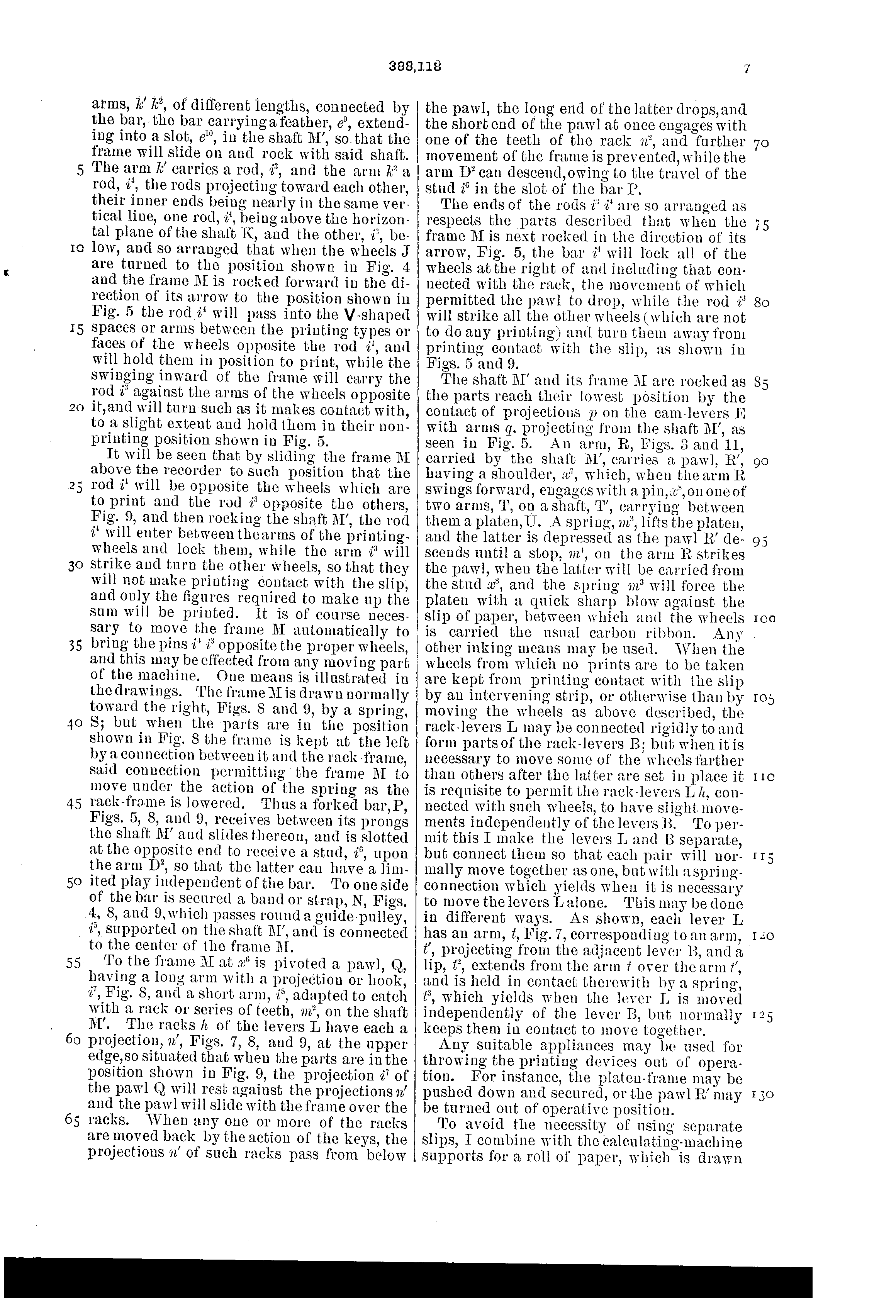
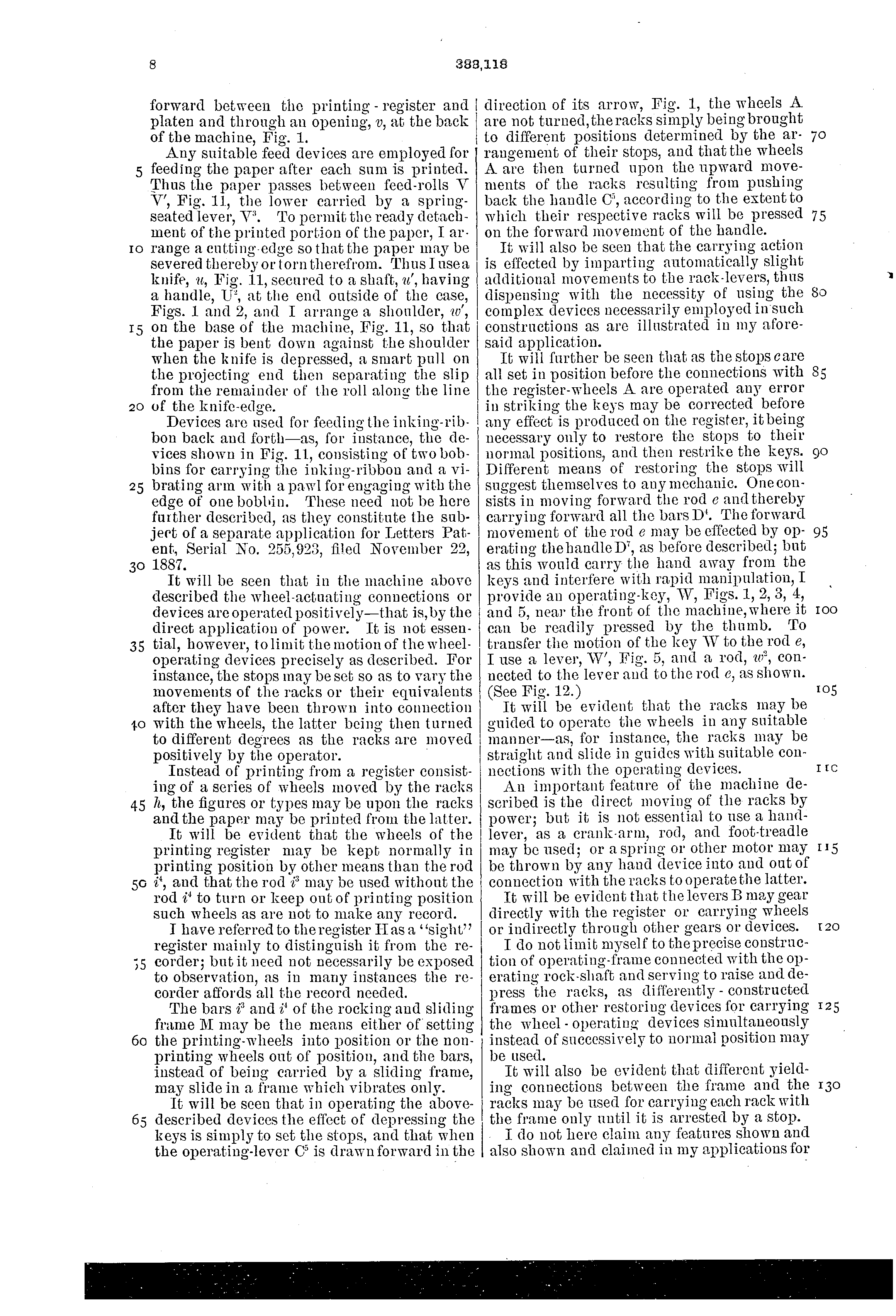
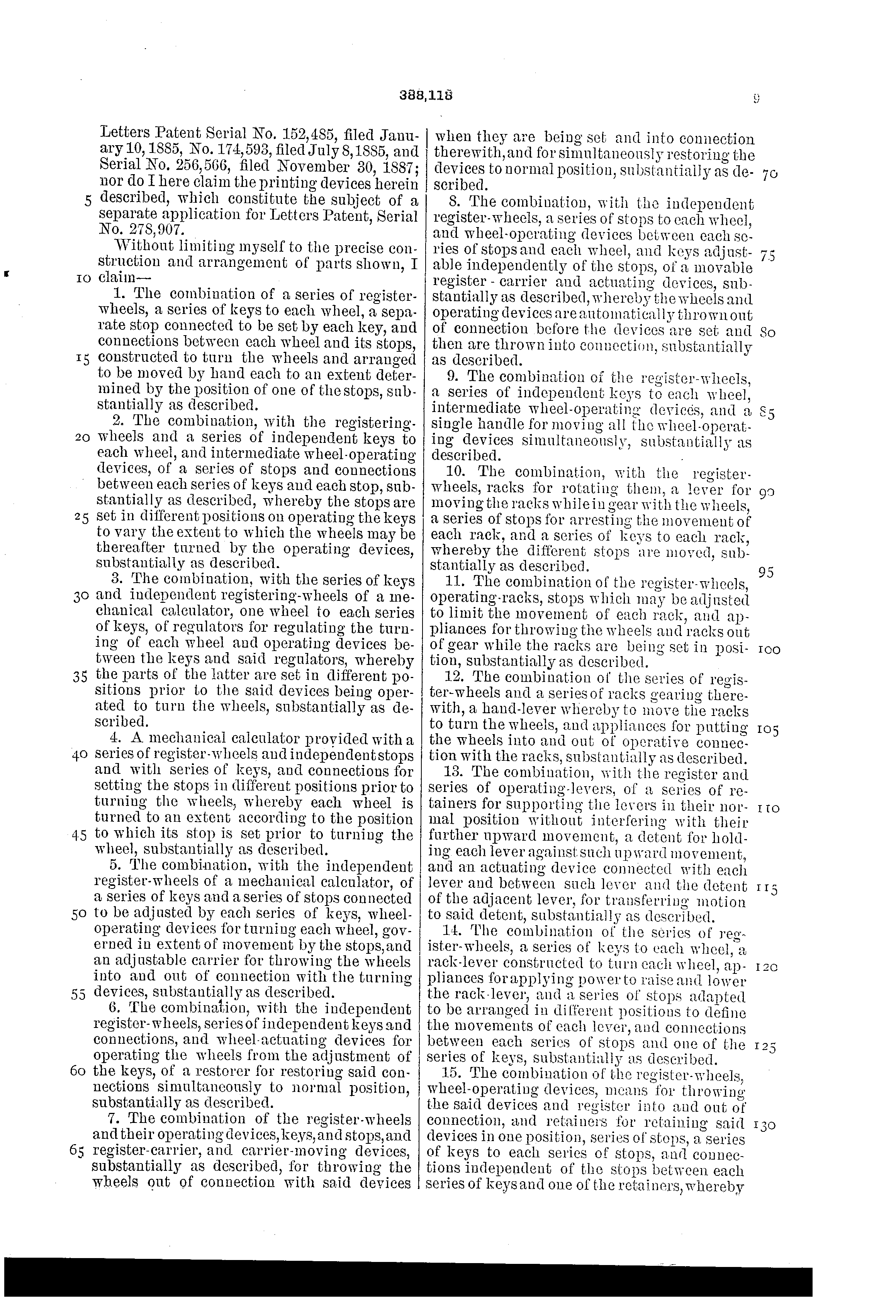
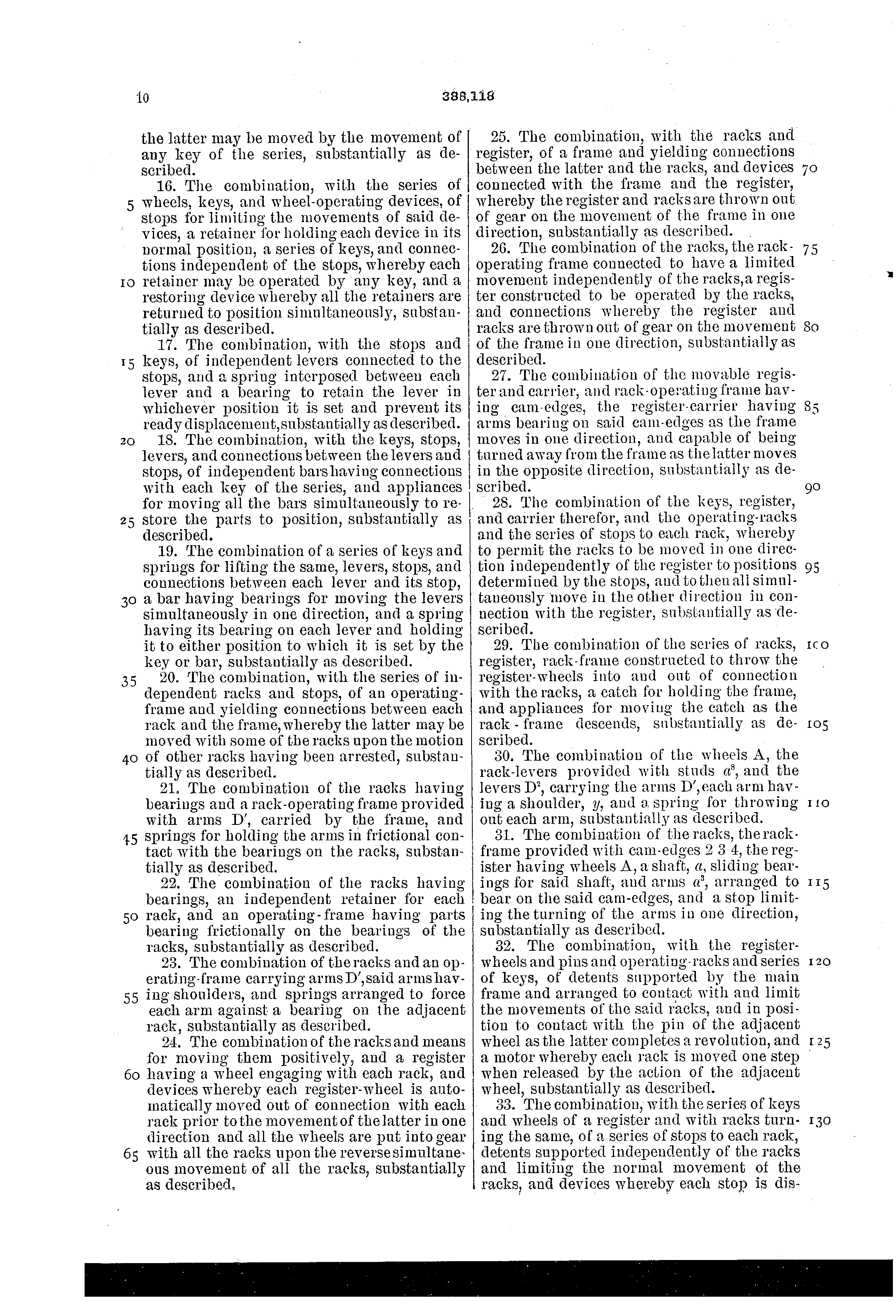
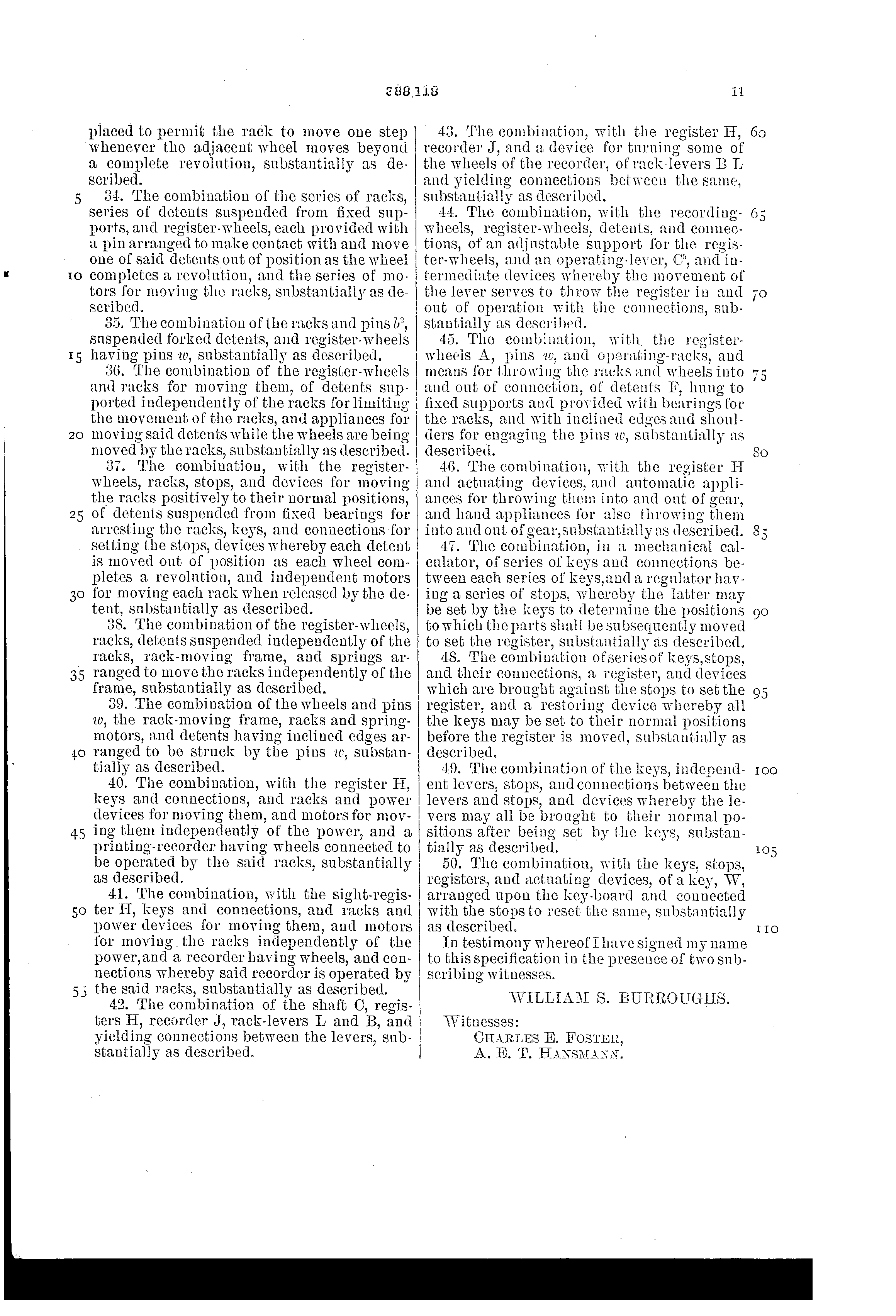
PDF · Google Patents · Prints each number and the total.
US 388,119, Burroughs, Calculating-Machine, filed 30 November 1887, granted 21 August 1888
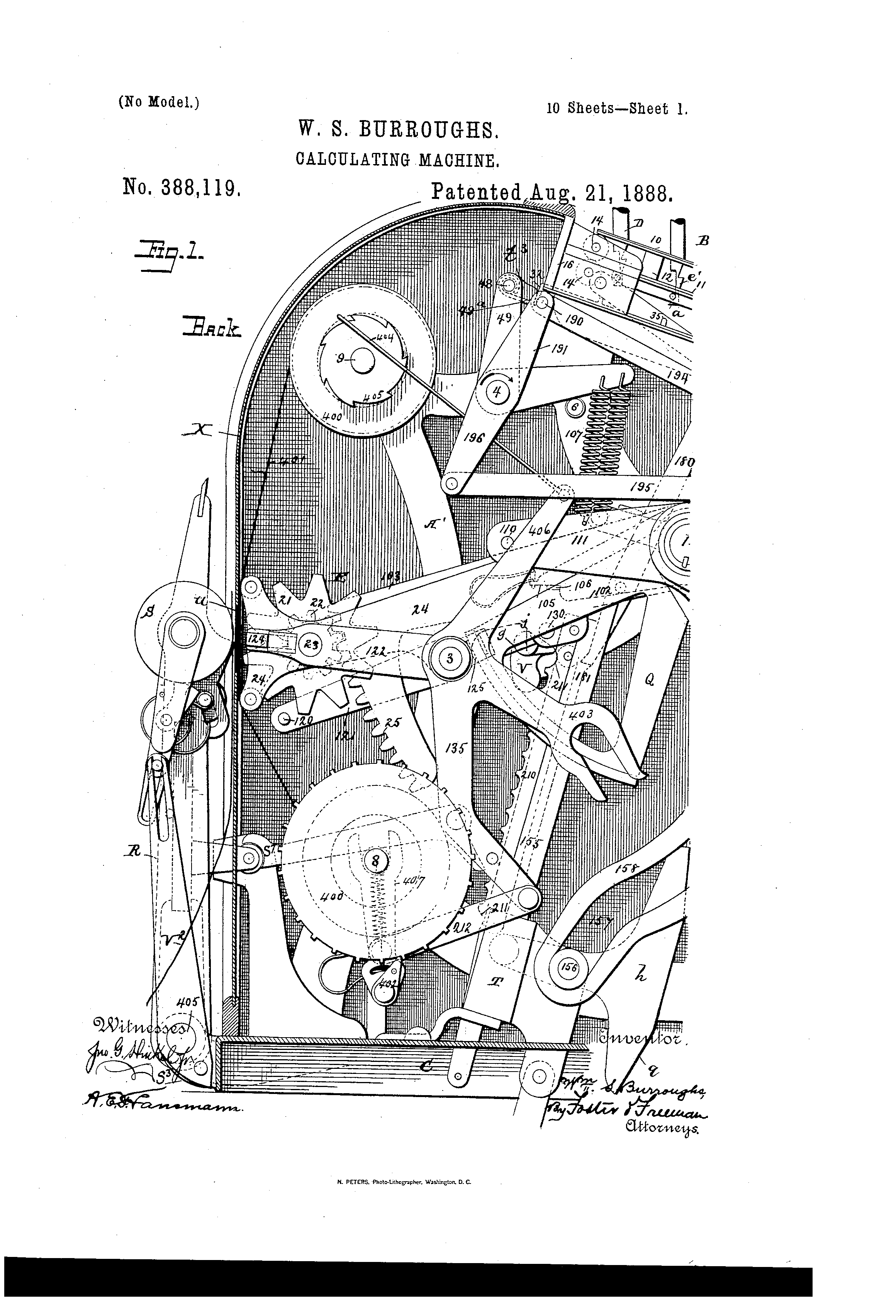
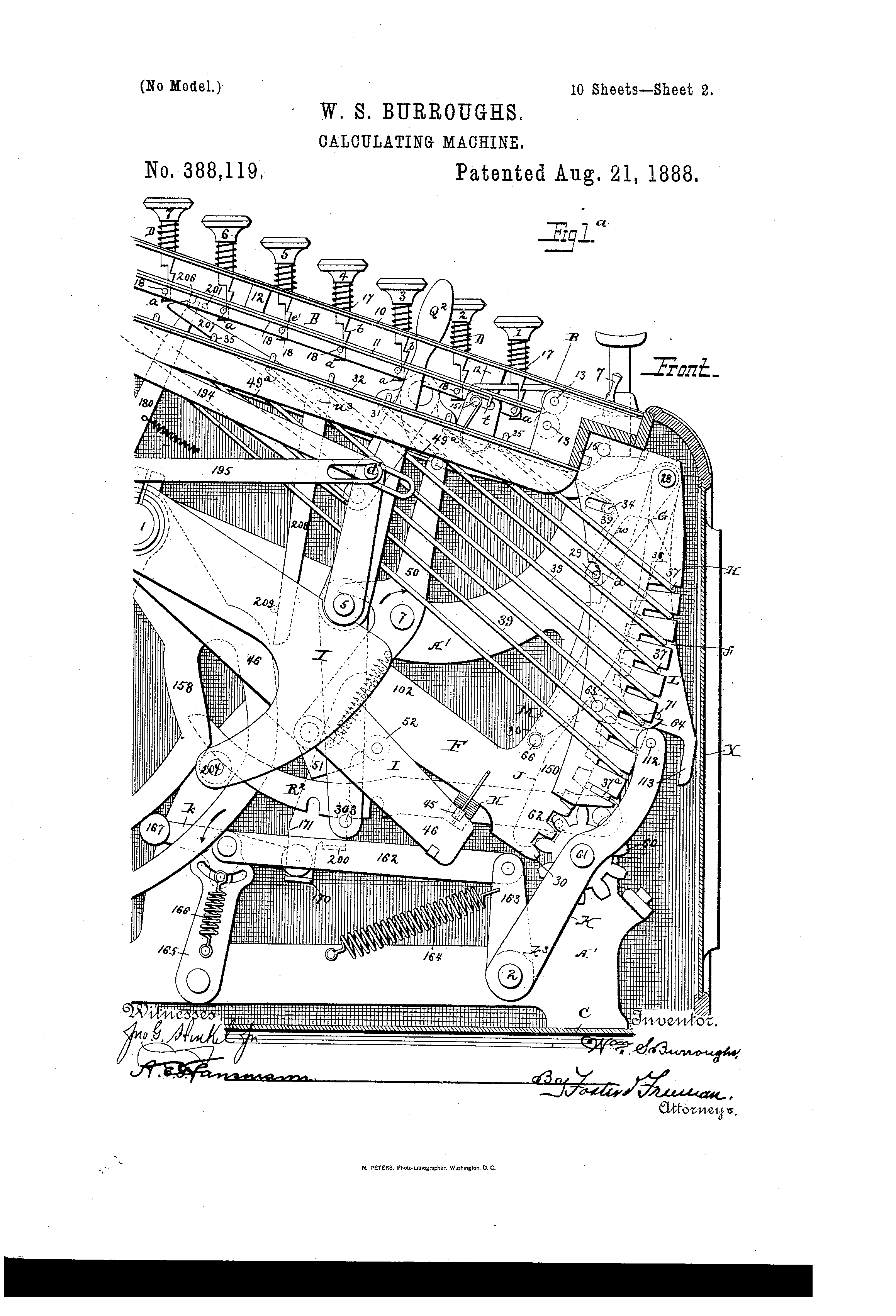
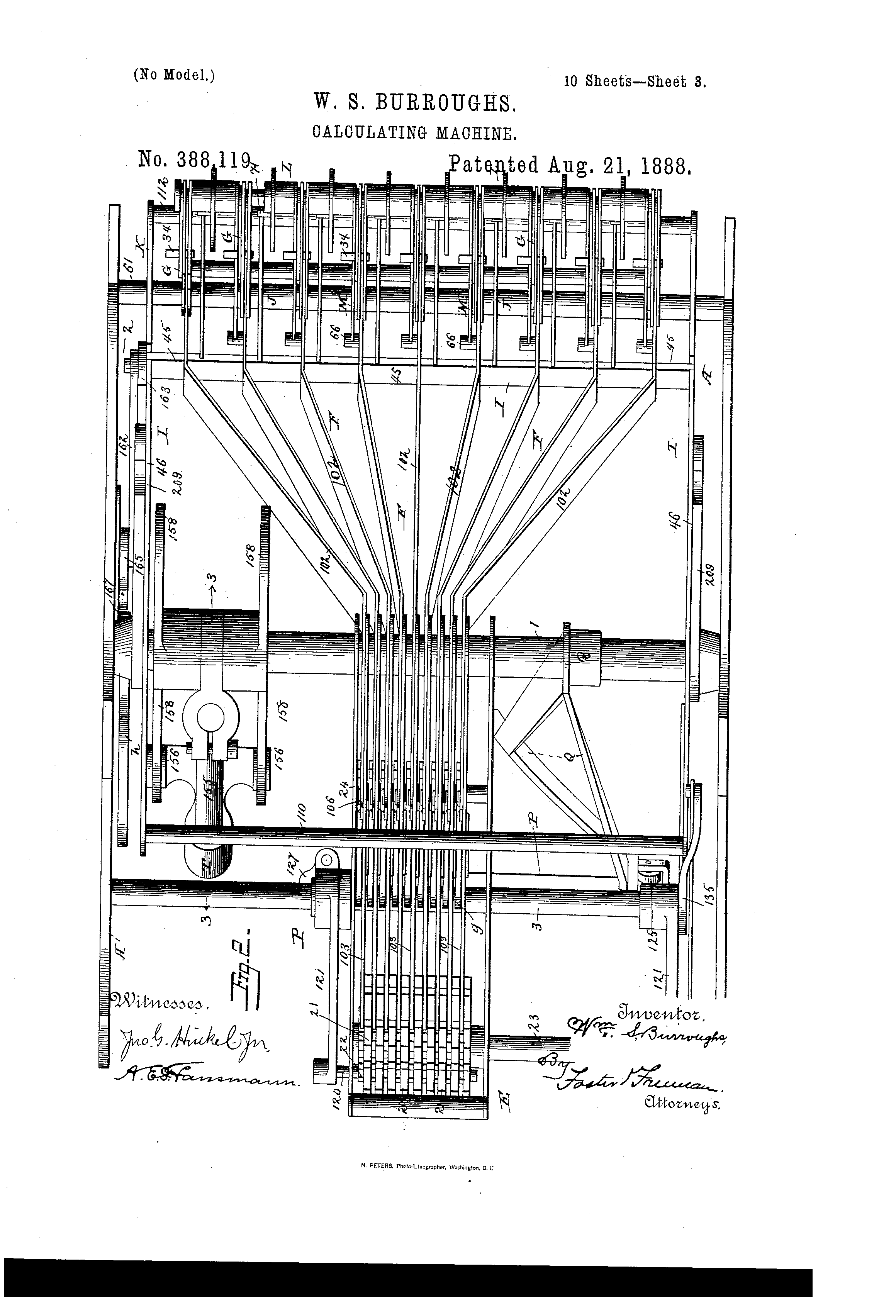
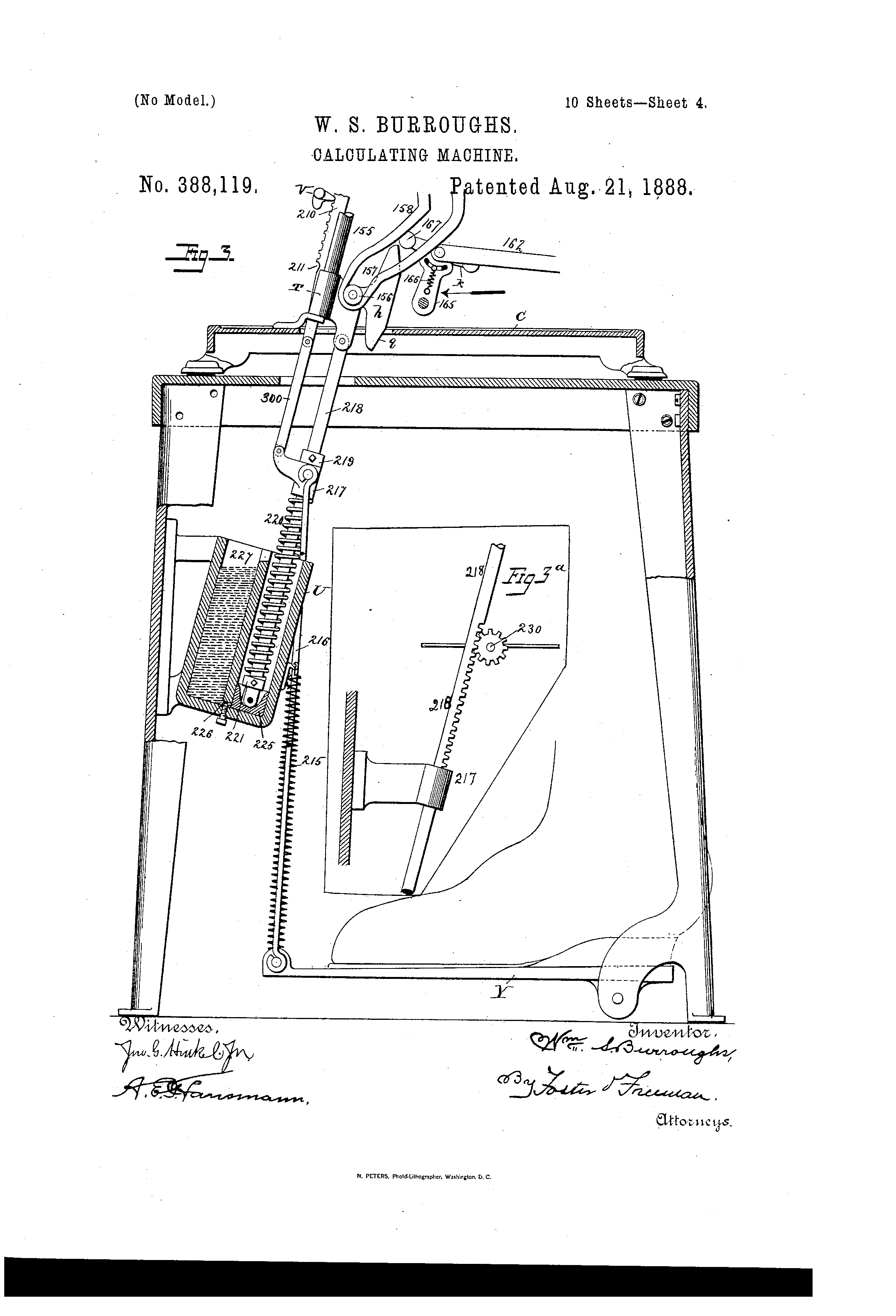
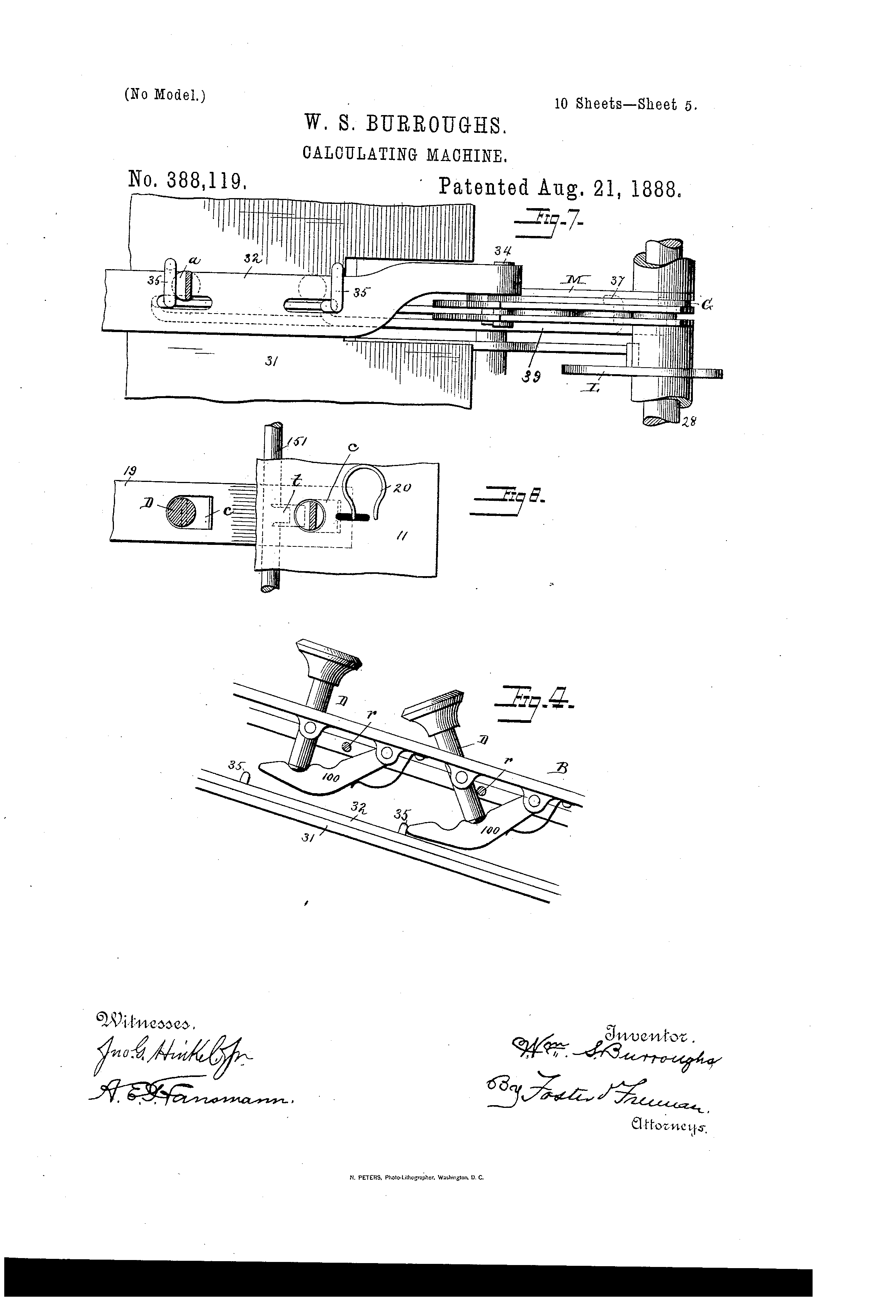
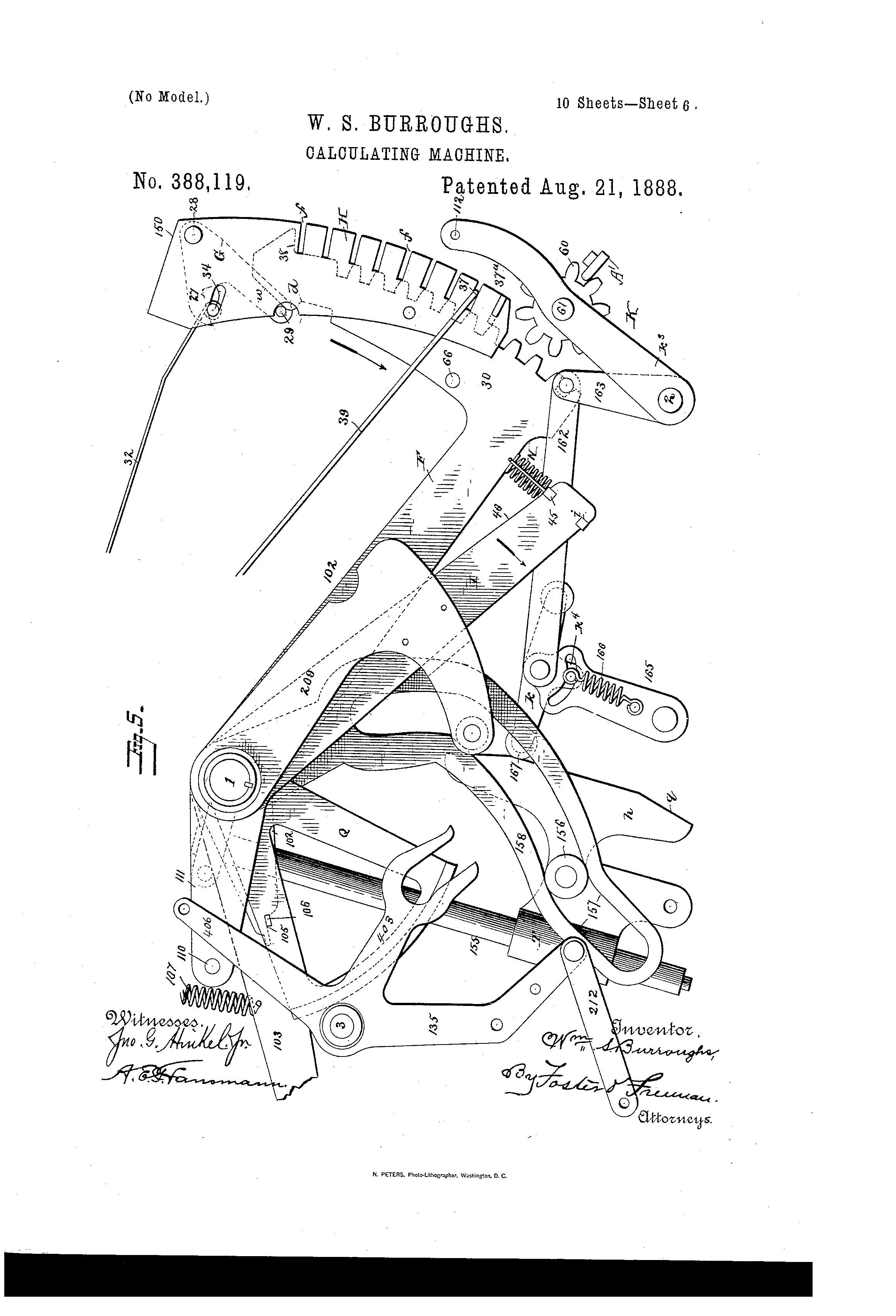
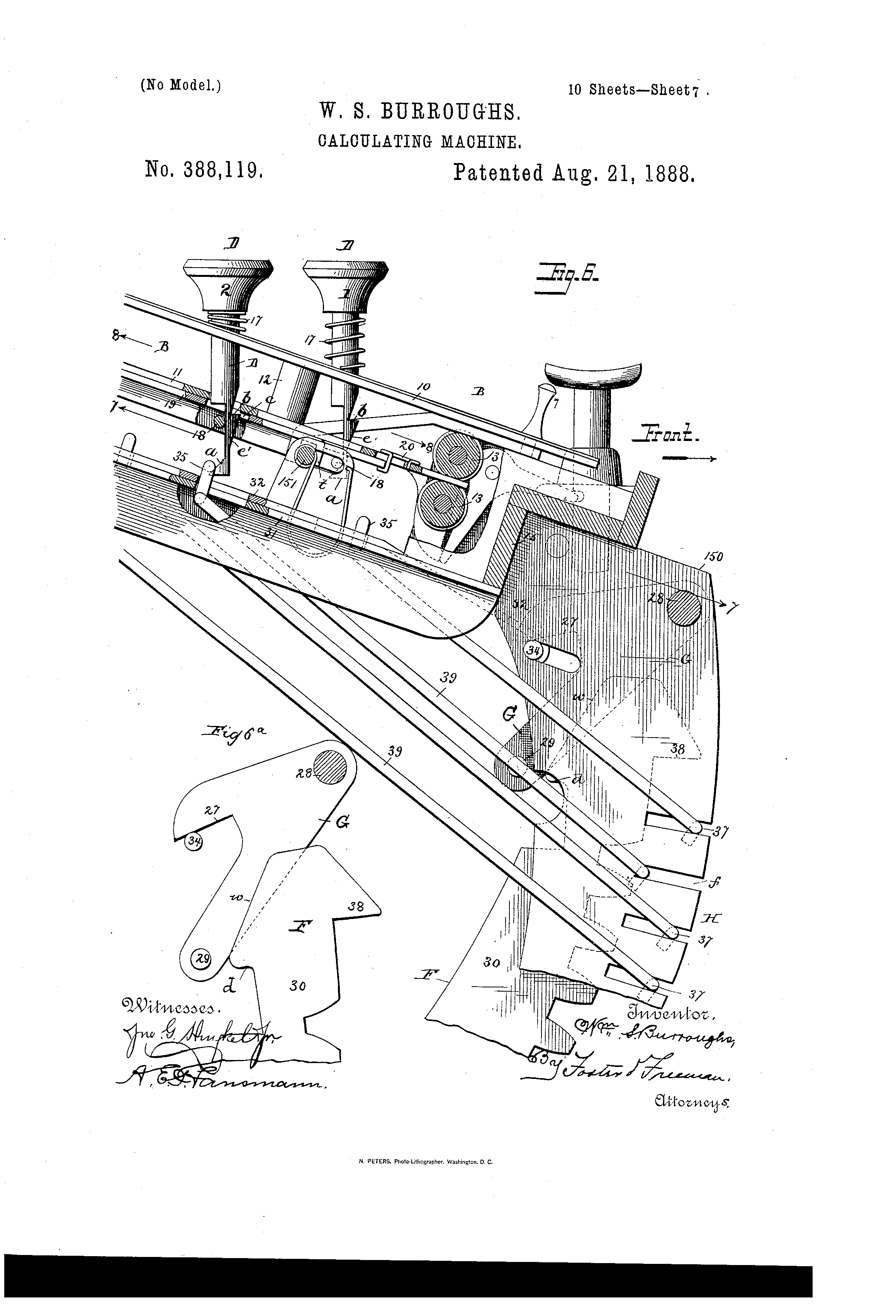
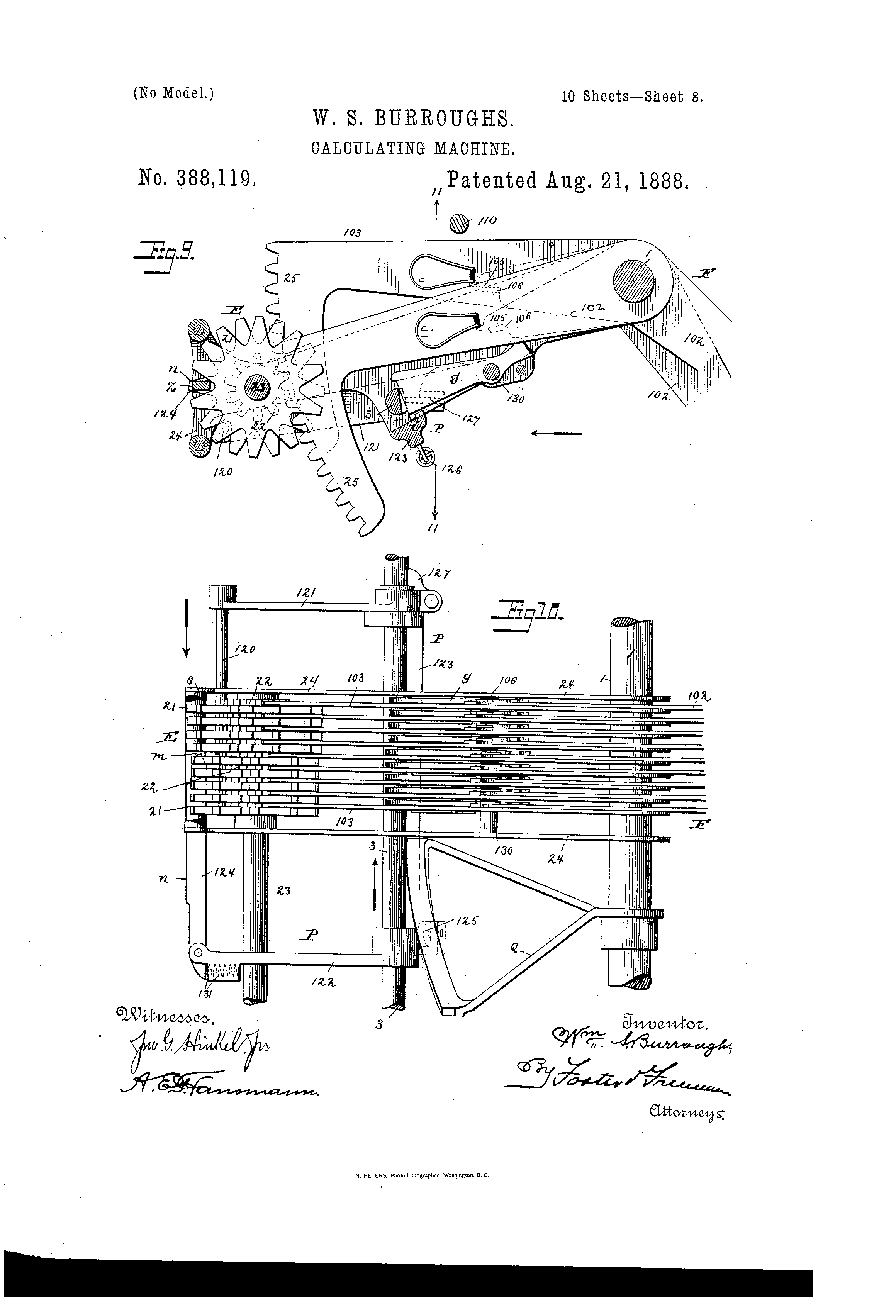
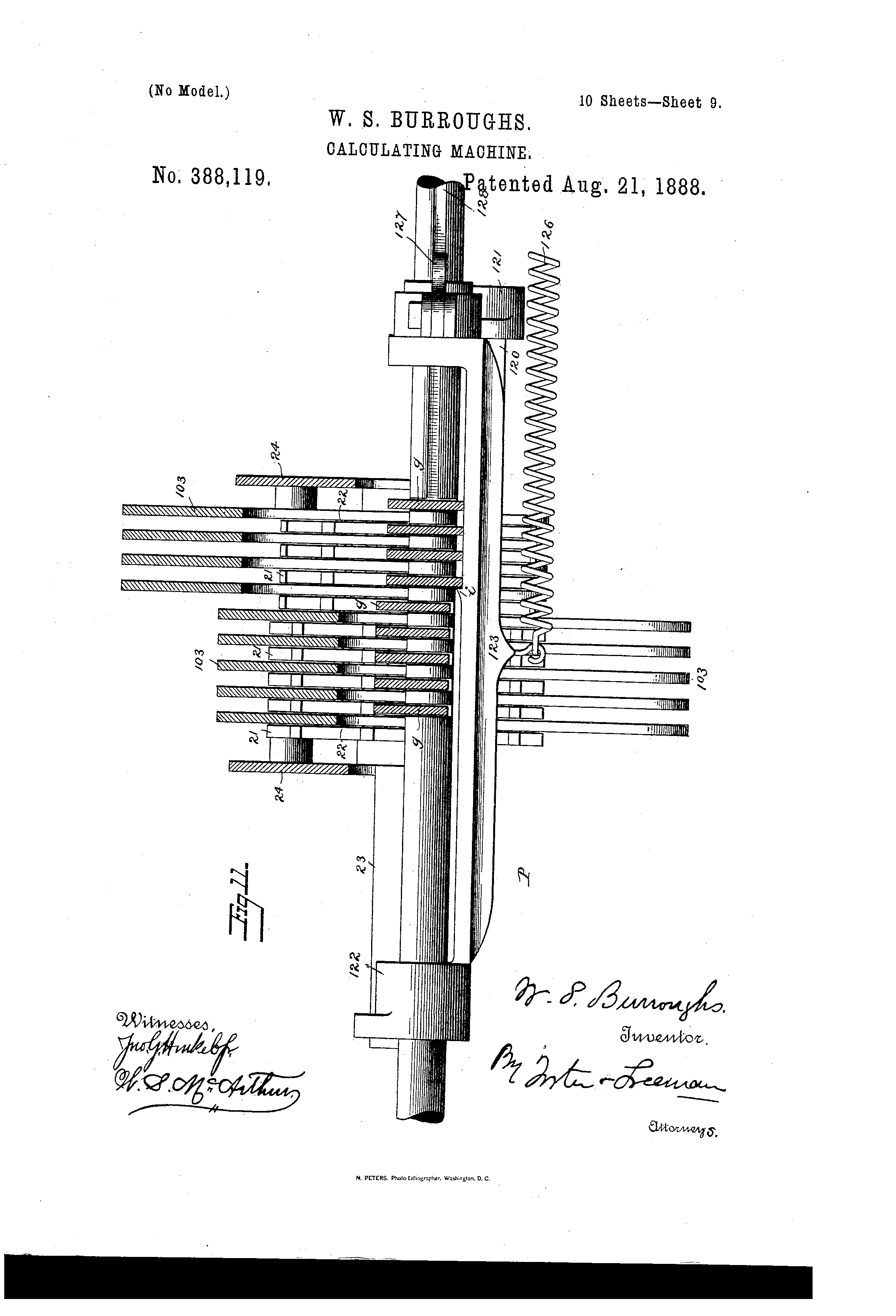
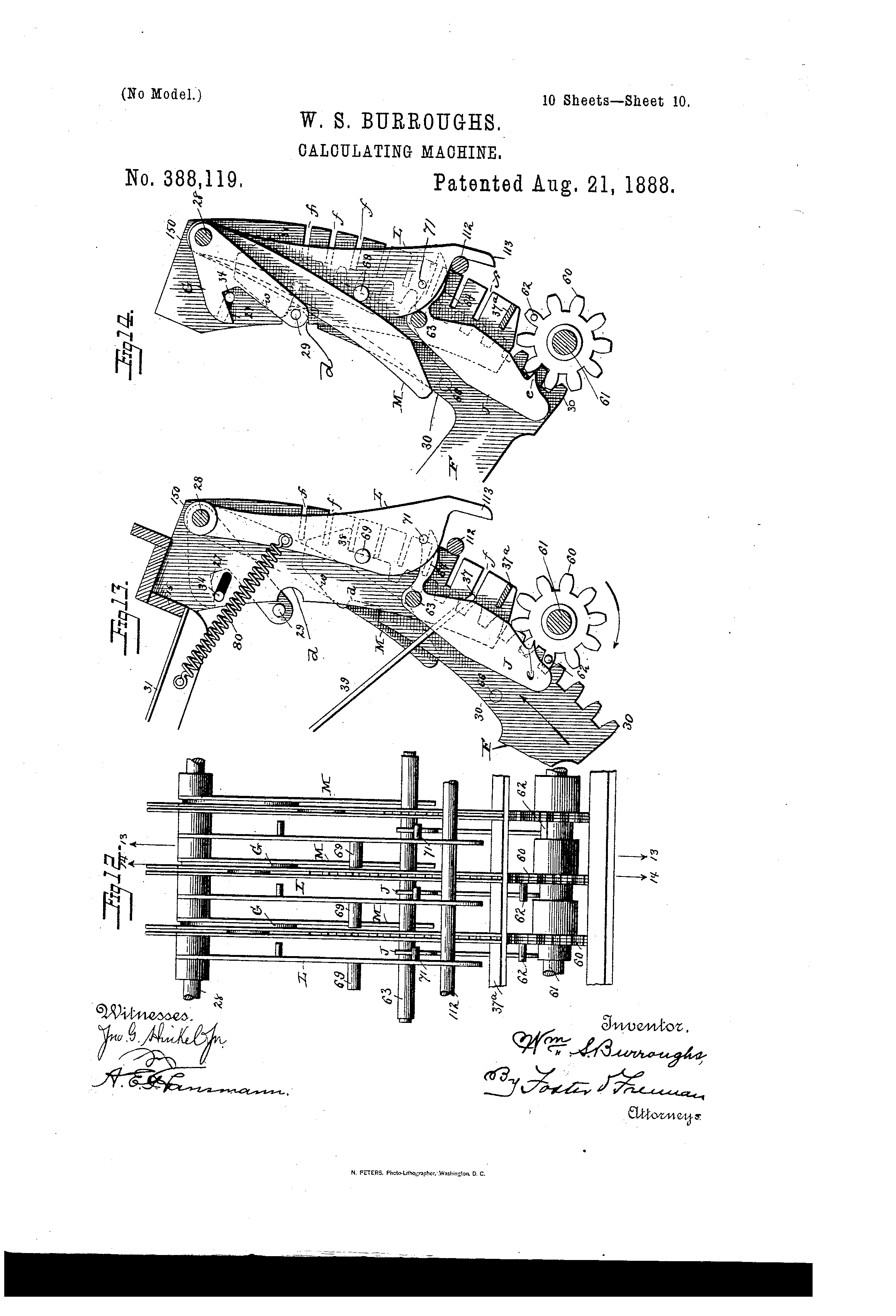
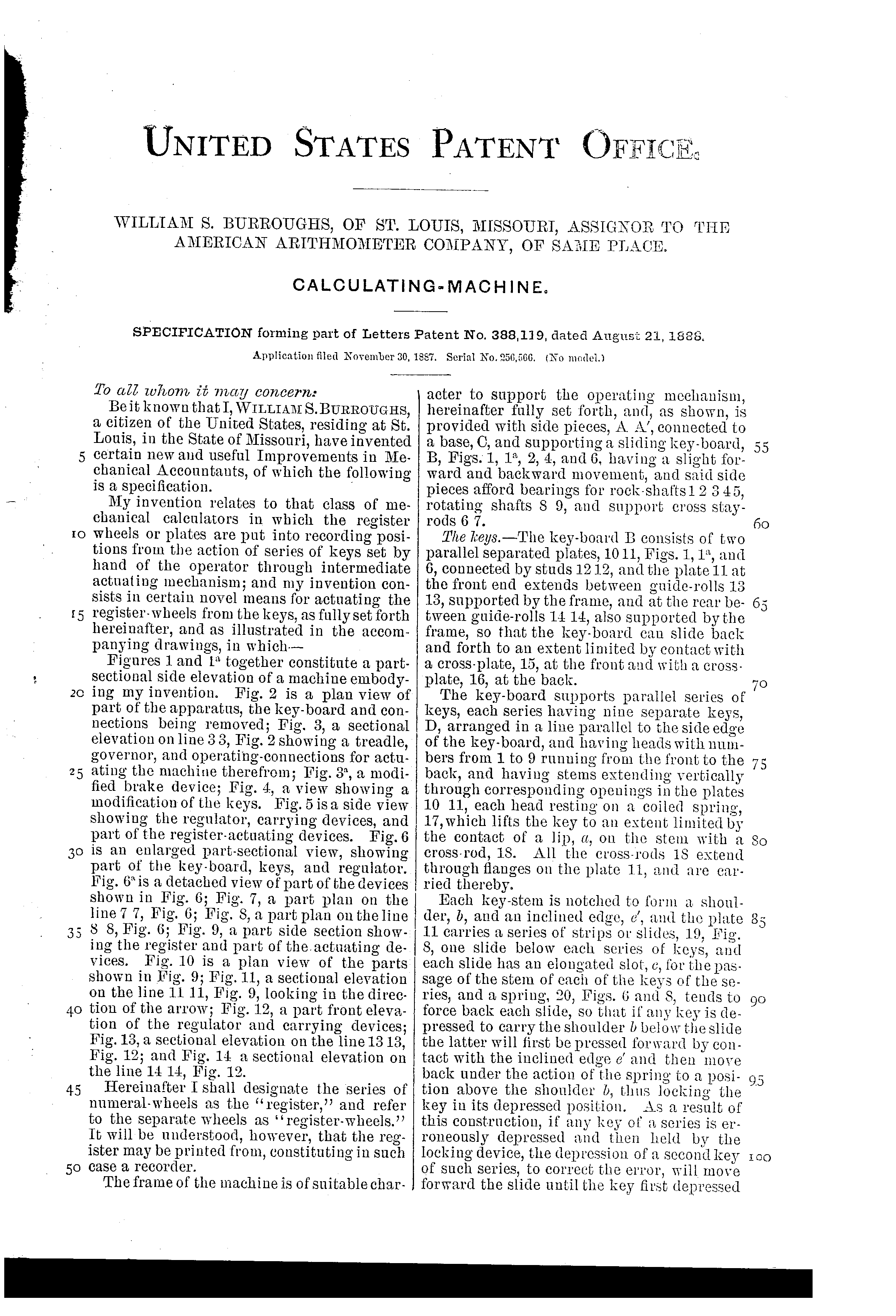
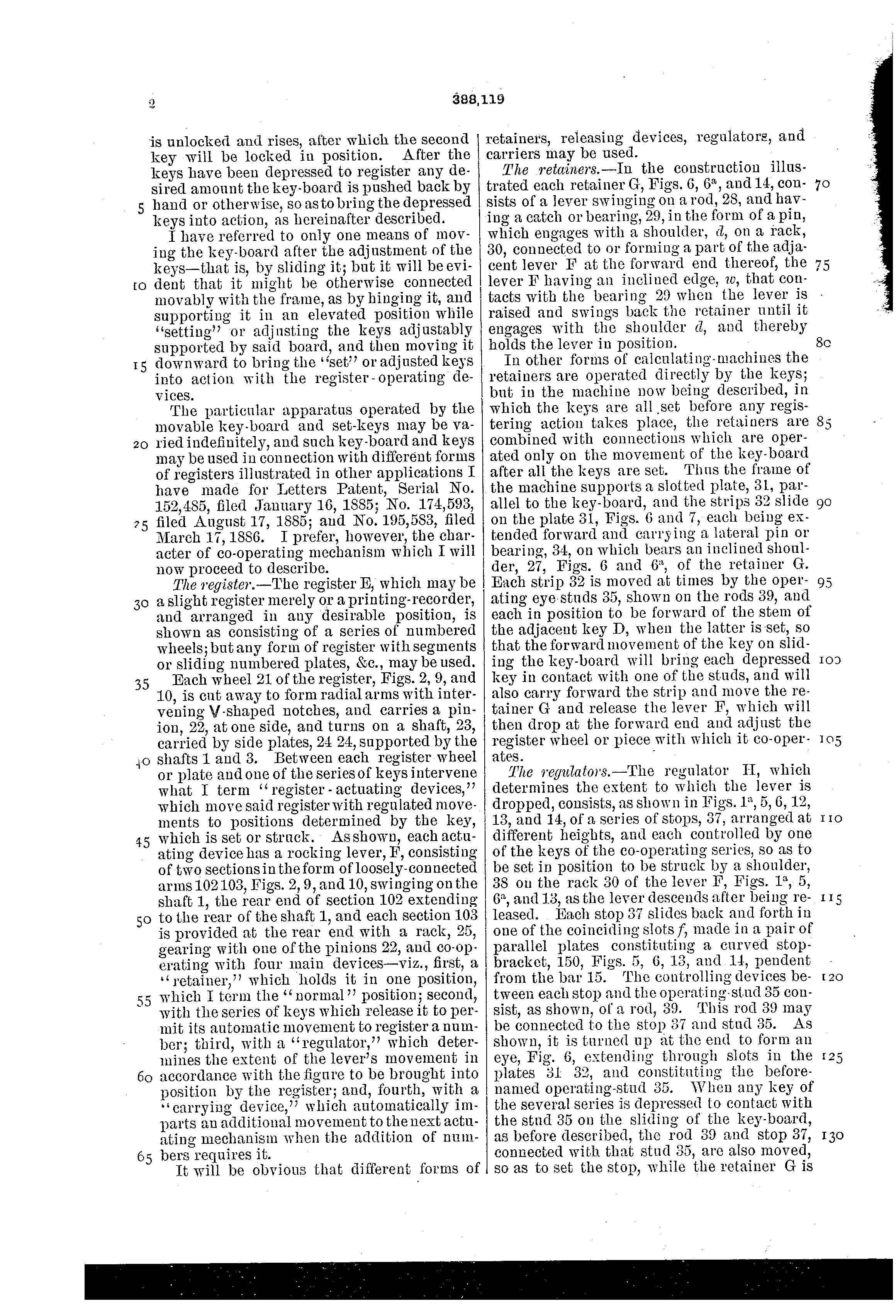
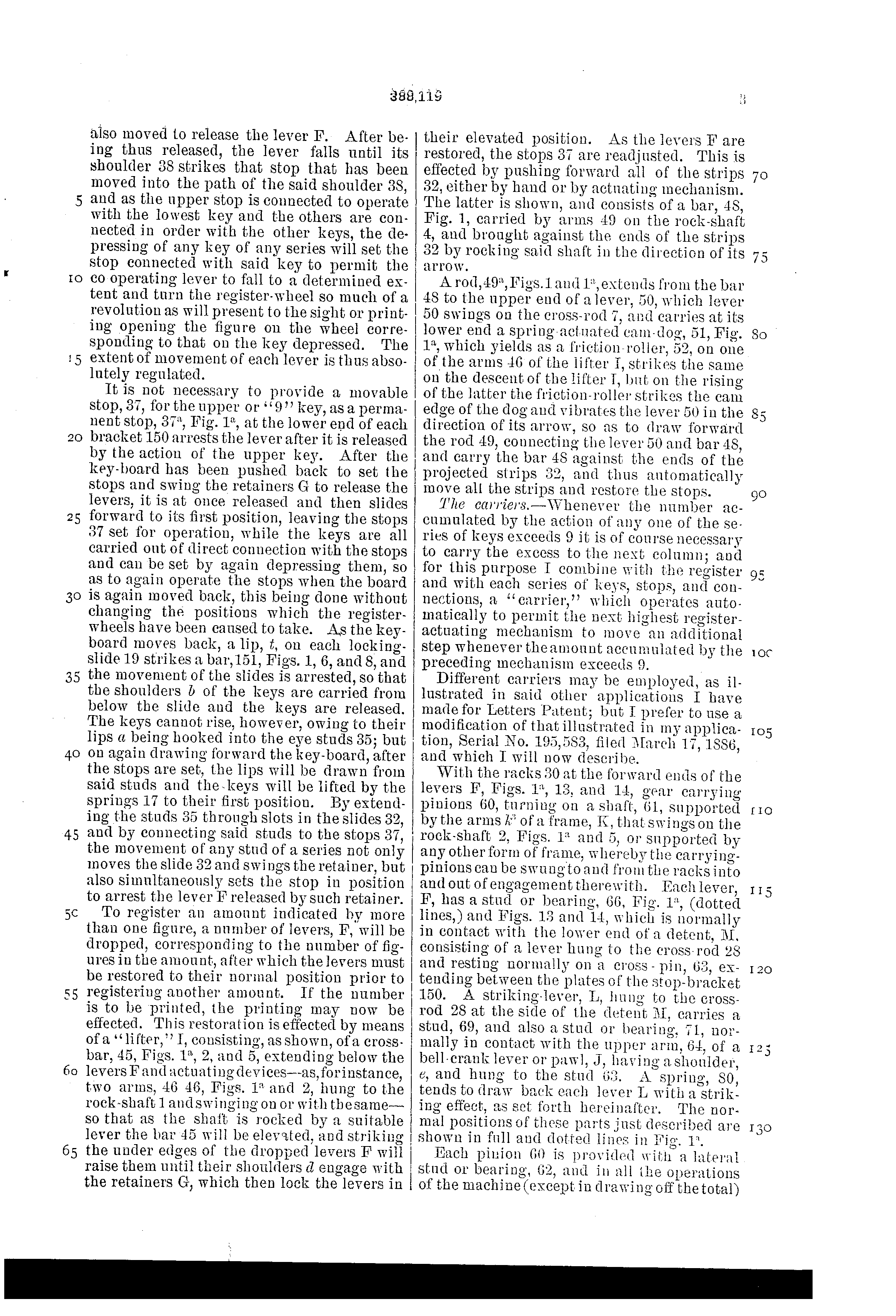
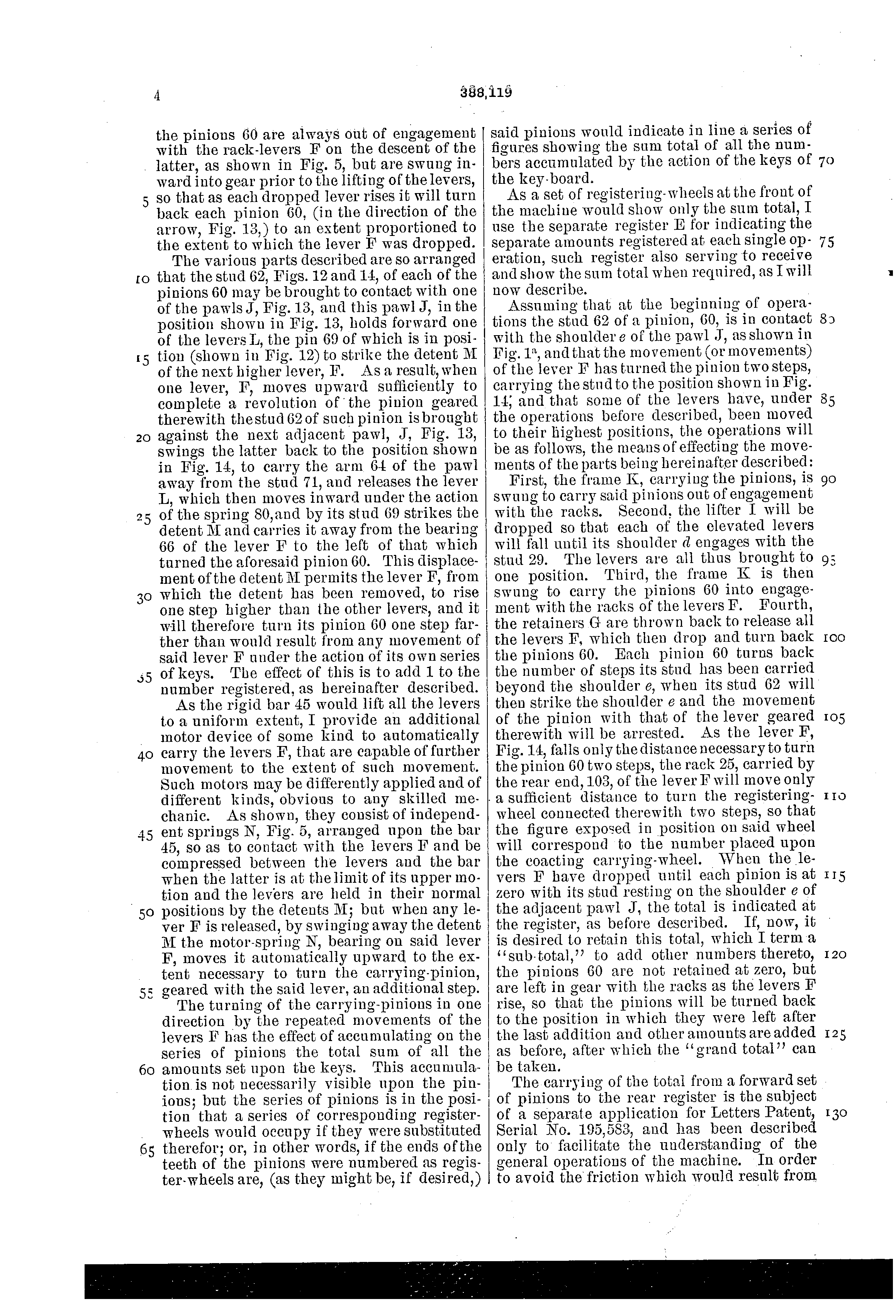
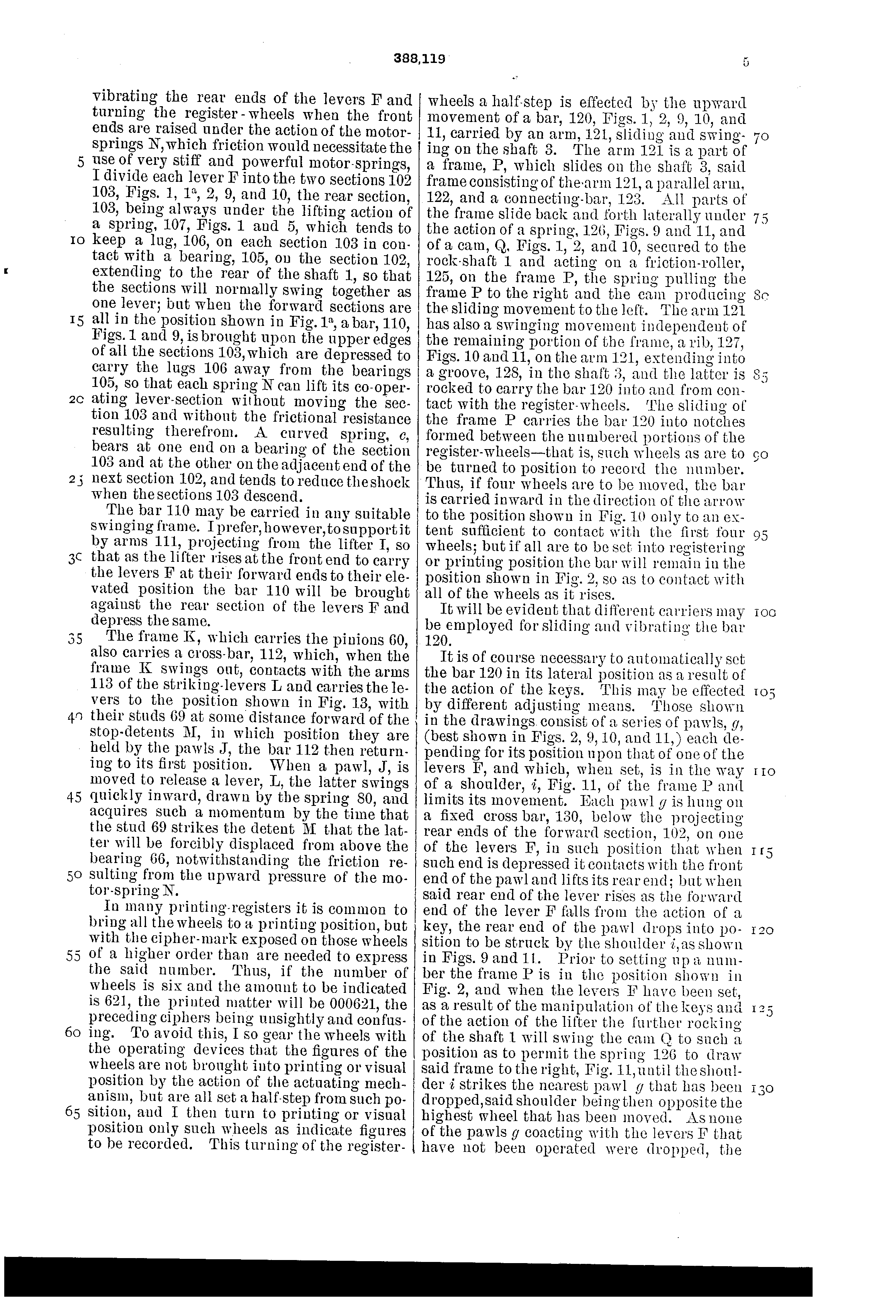
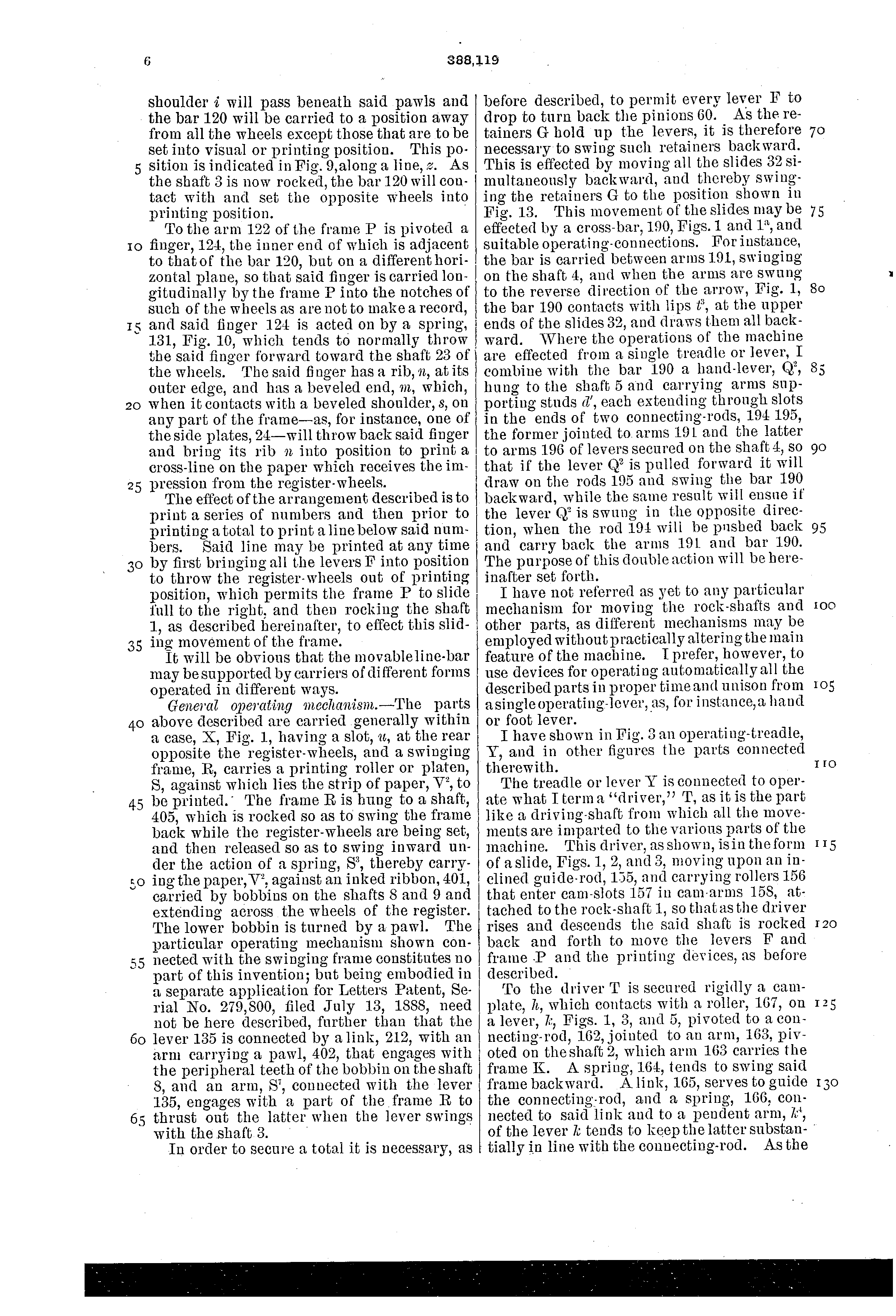
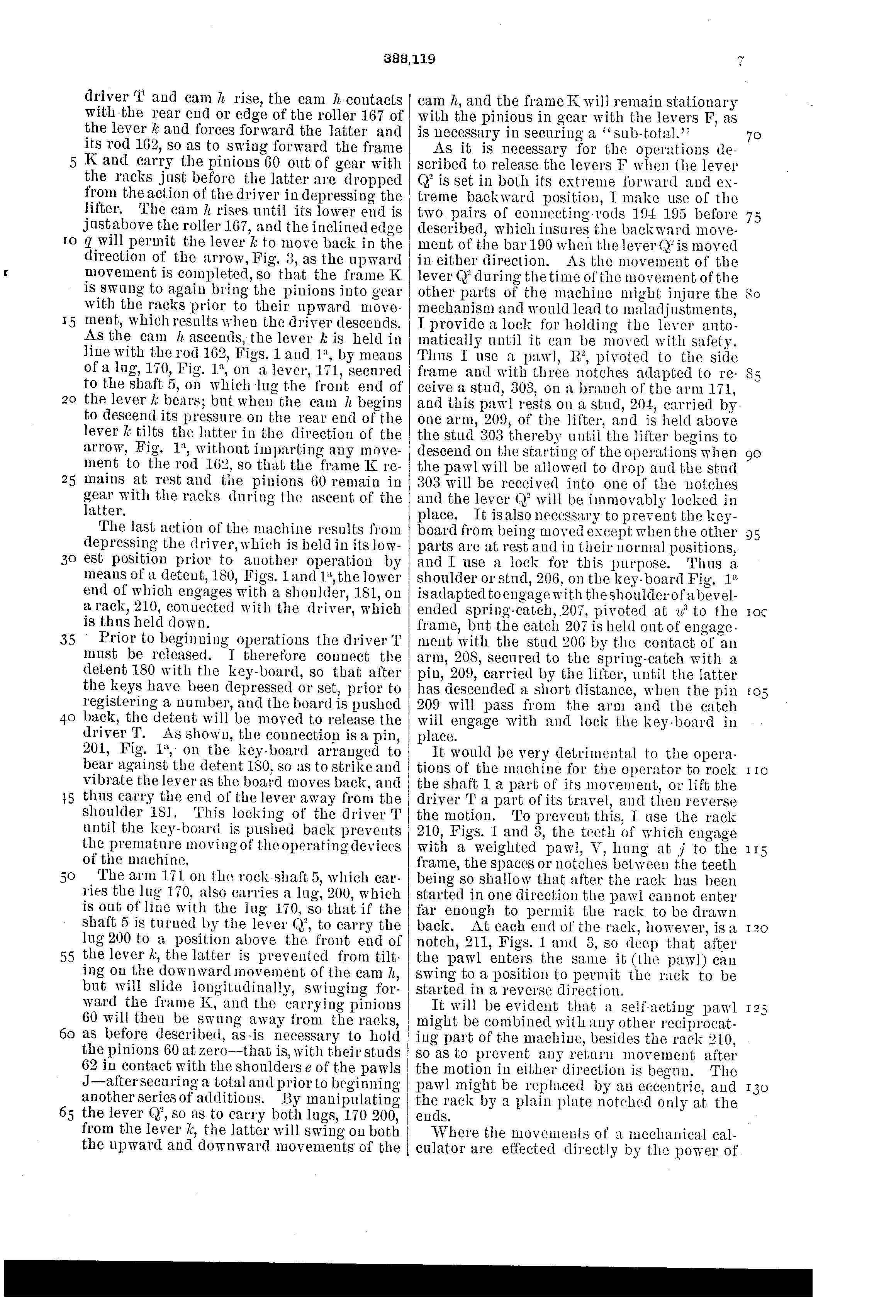
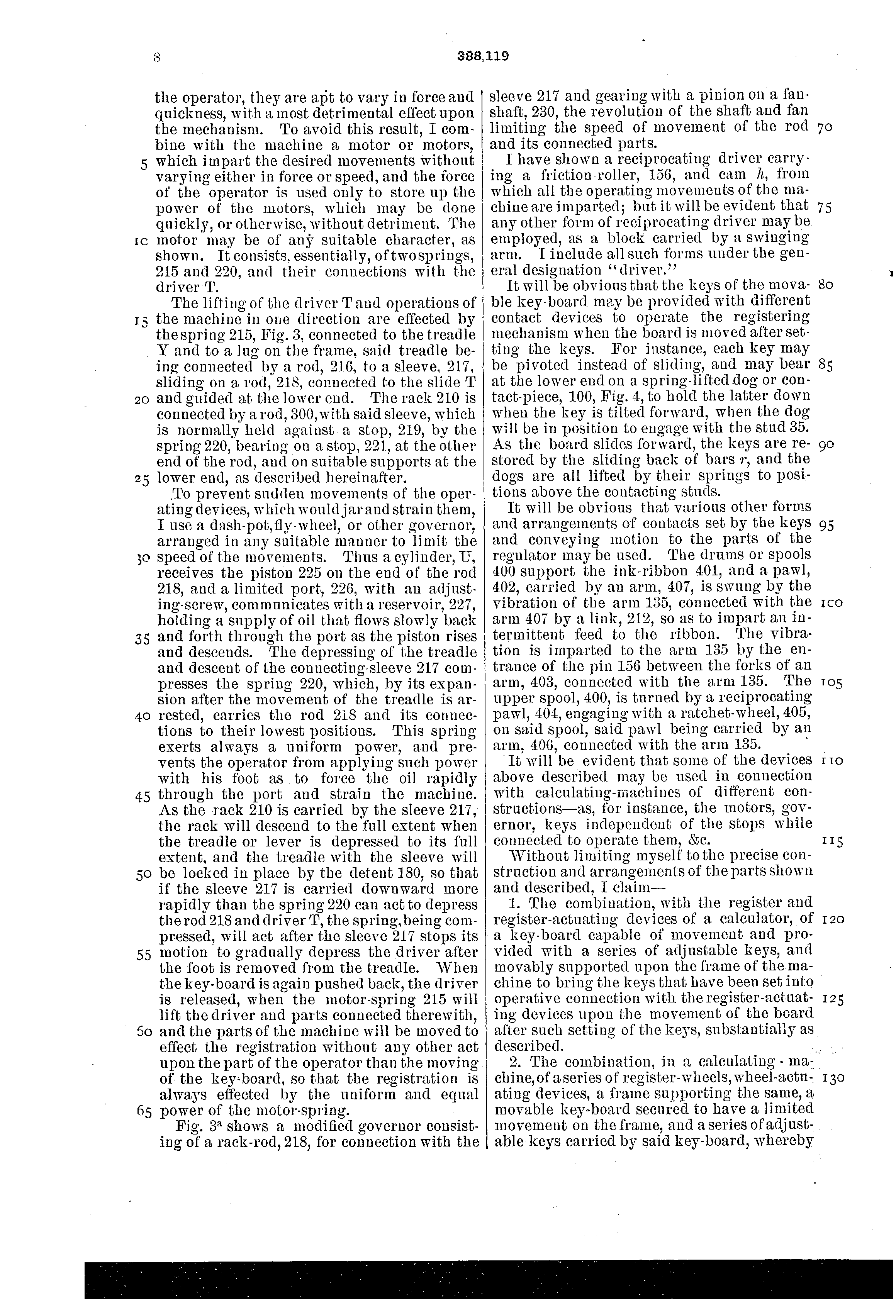
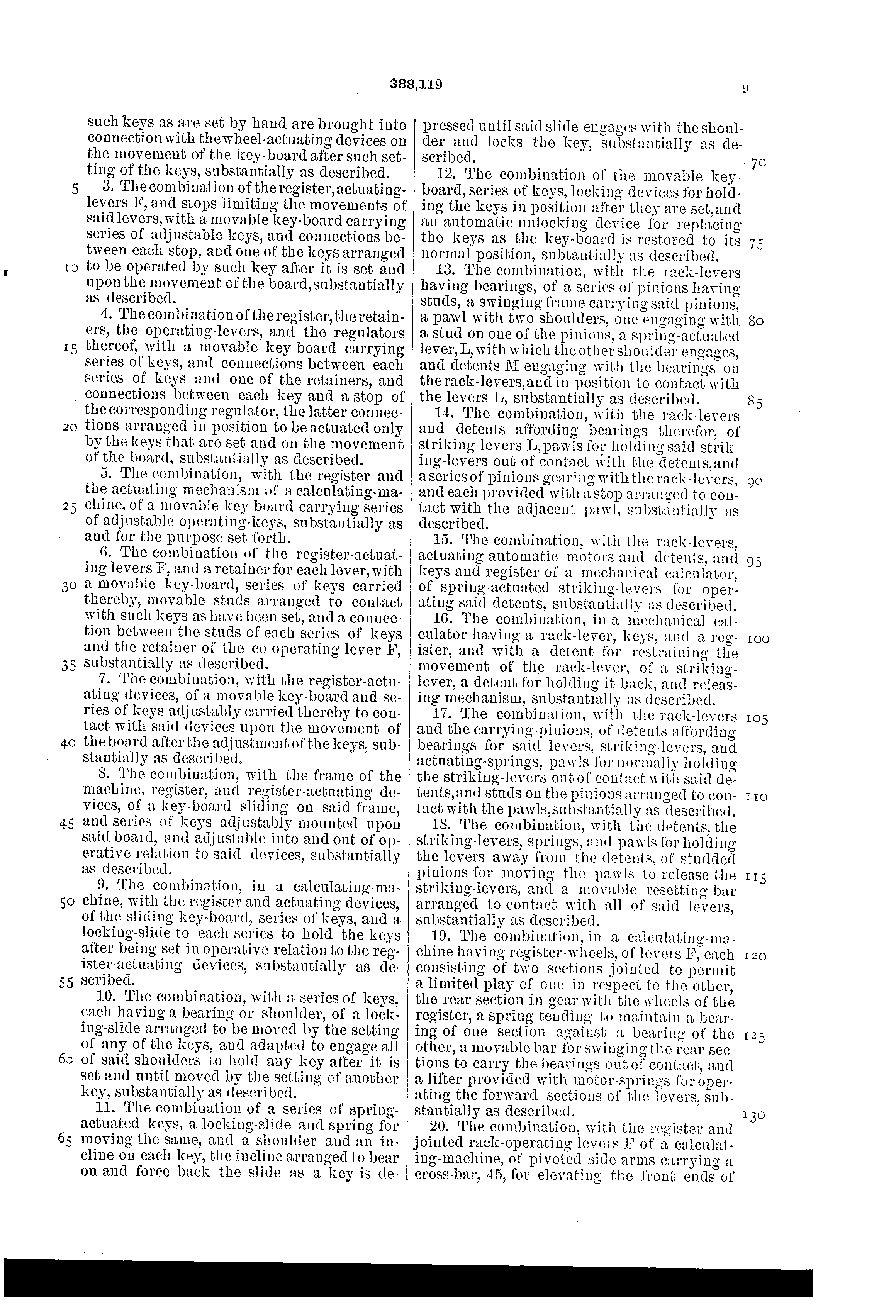
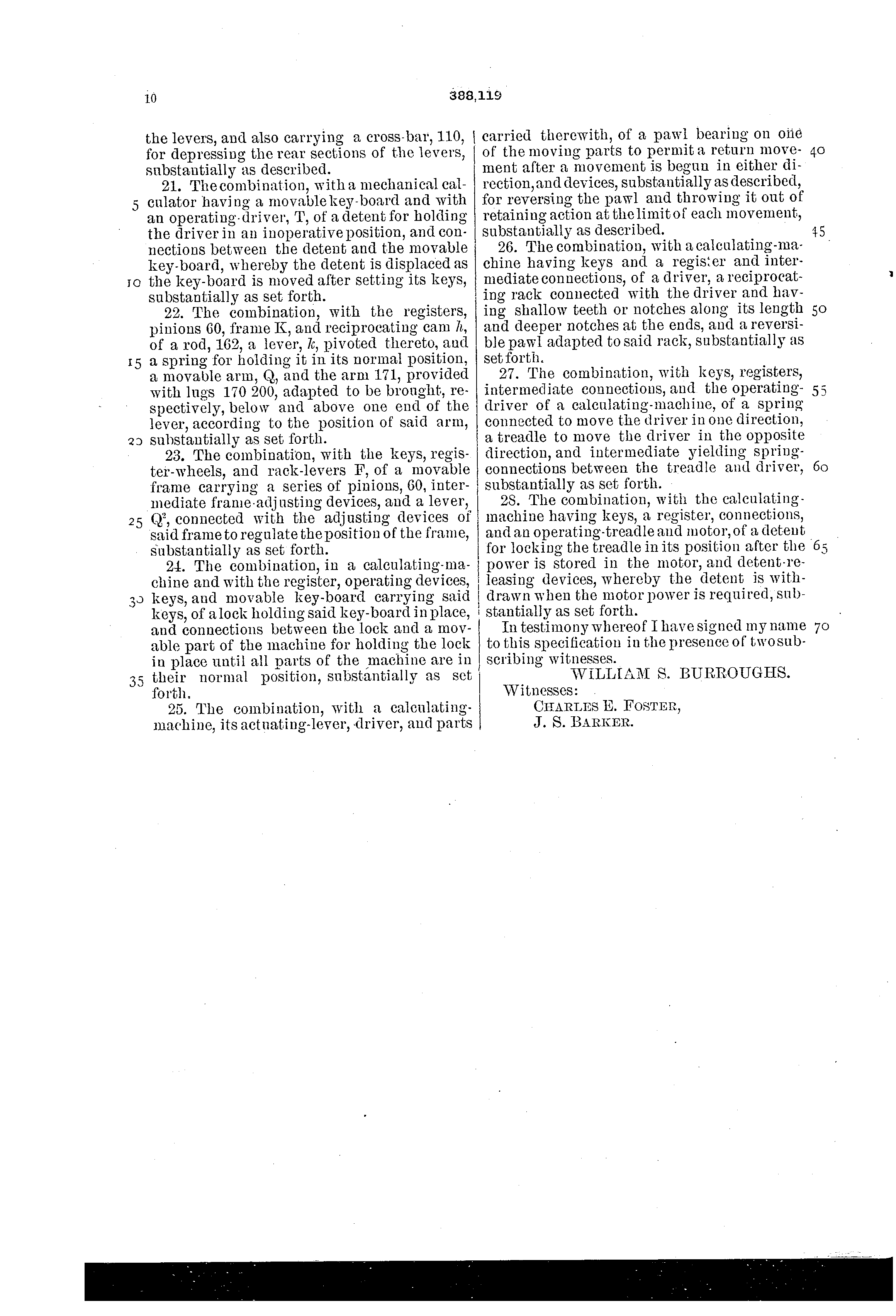
PDF · Google Patents · Keys set first, then one stroke of a treadle or lever; the dash-pot governor.
US 504,963, Burroughs, Calculating-Machine, filed 5 May 1892, granted 12 September 1893
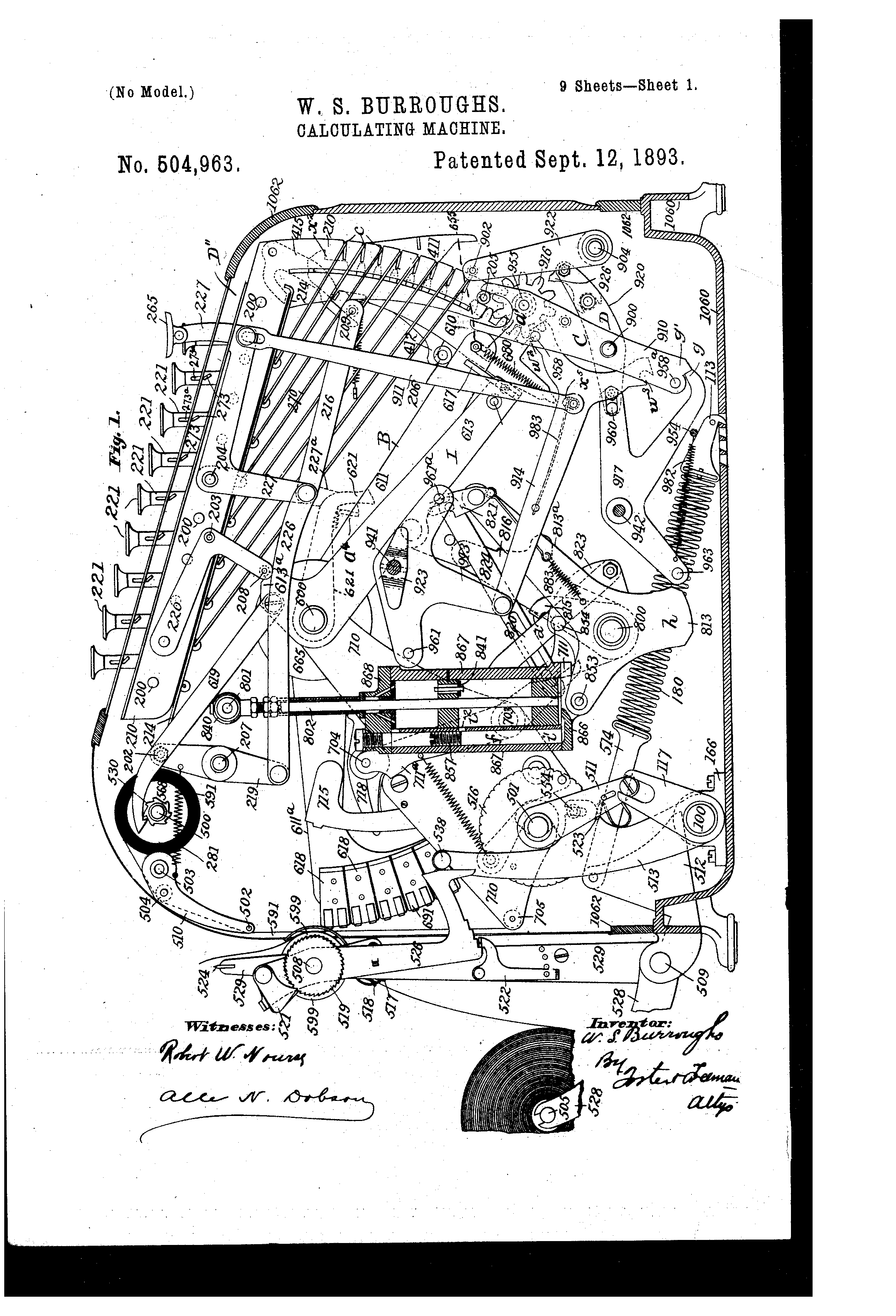
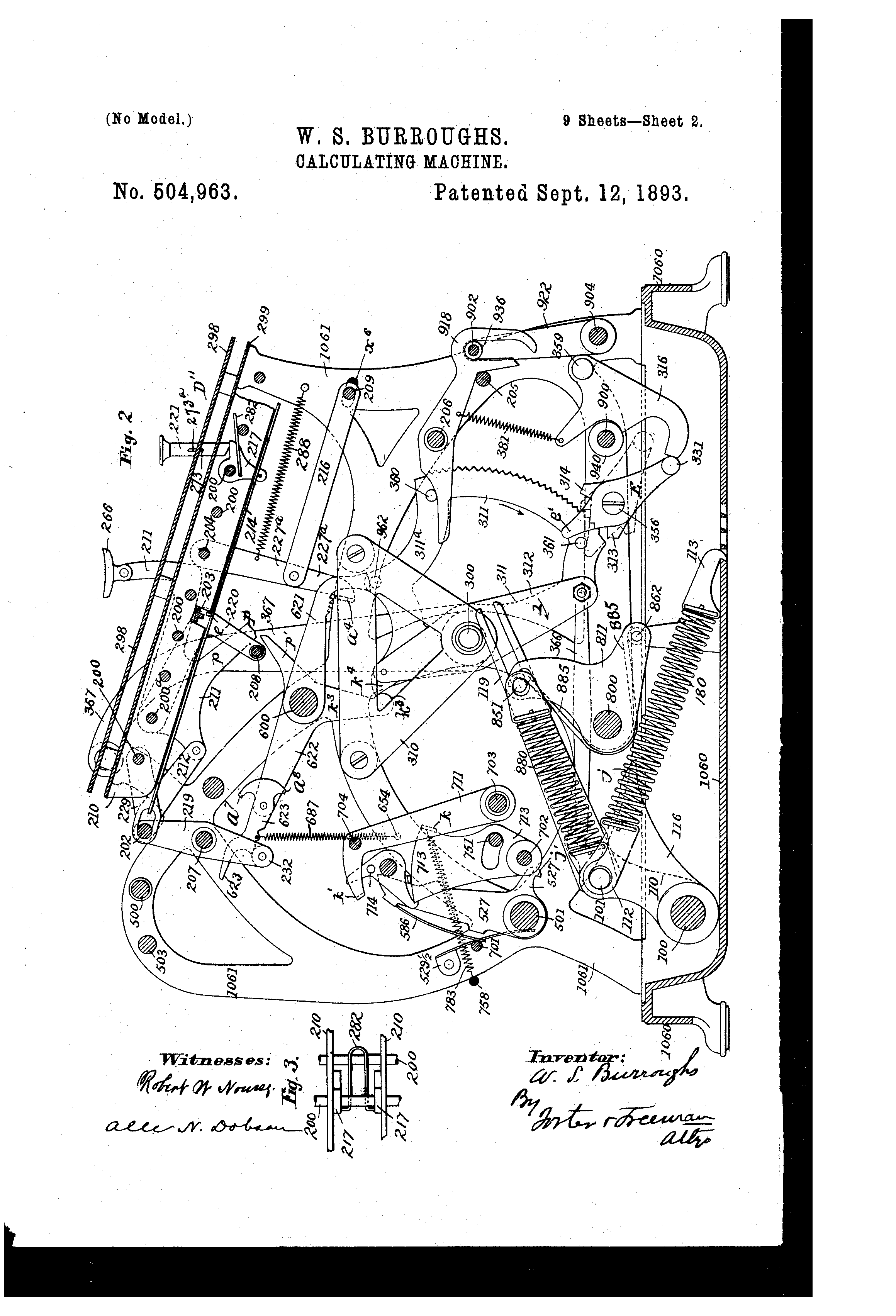
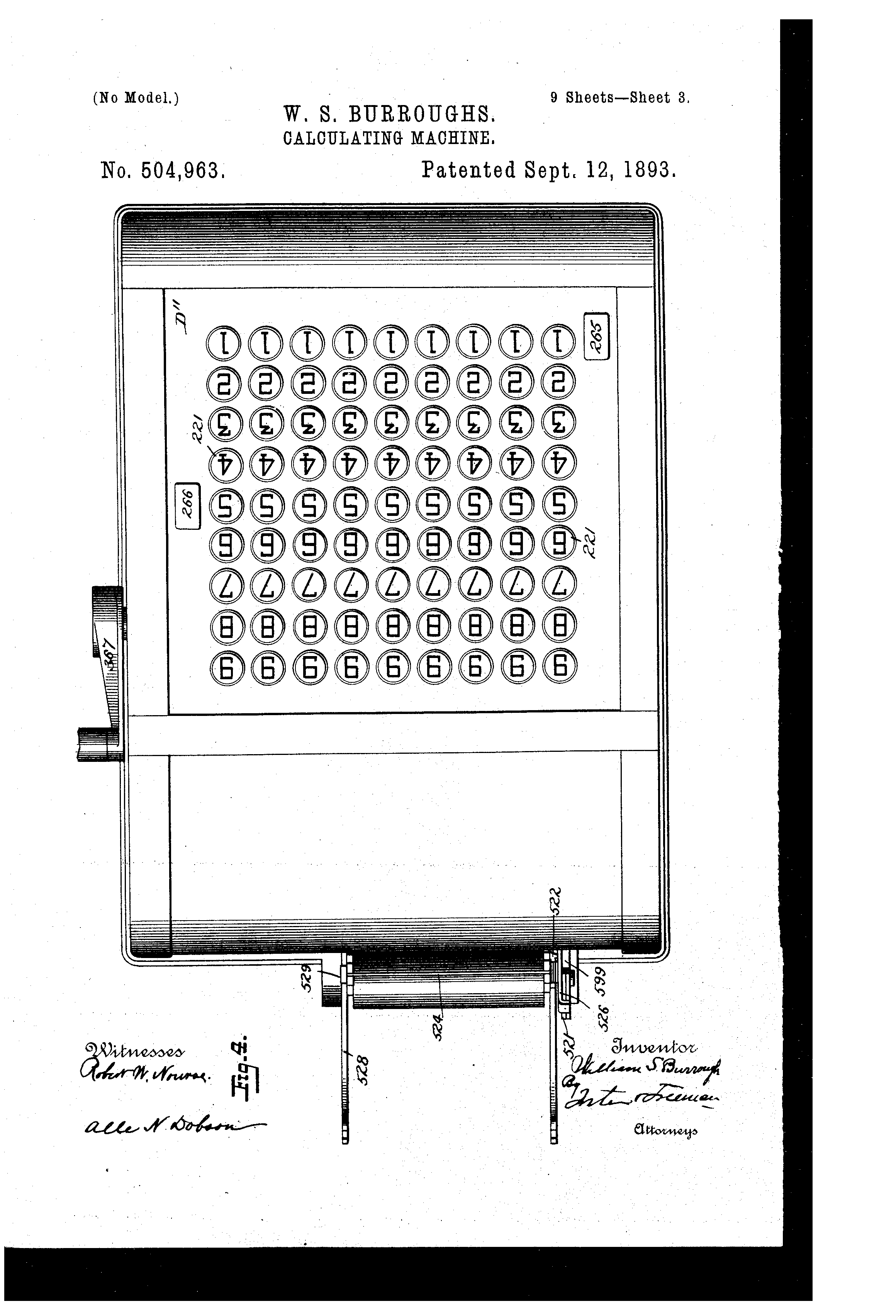
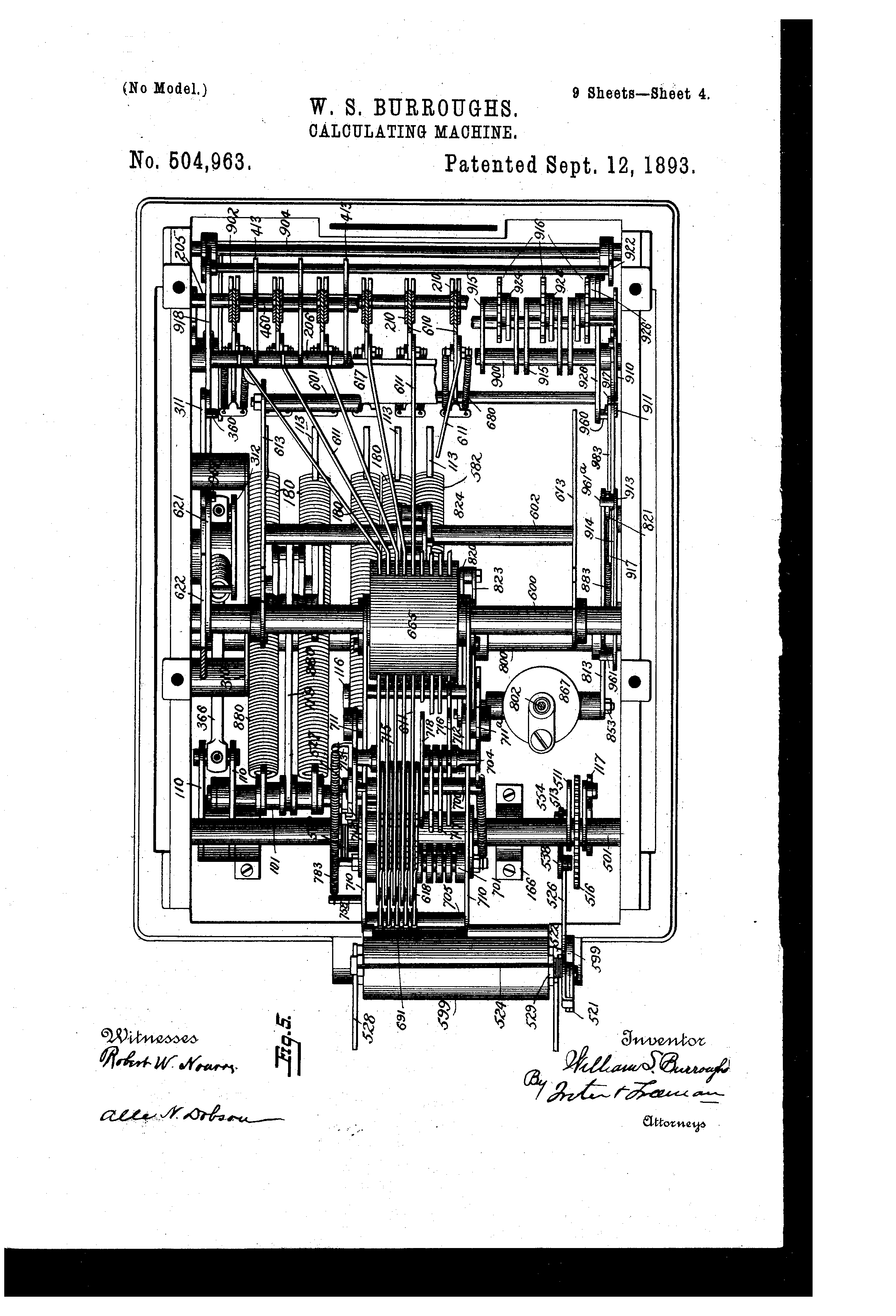
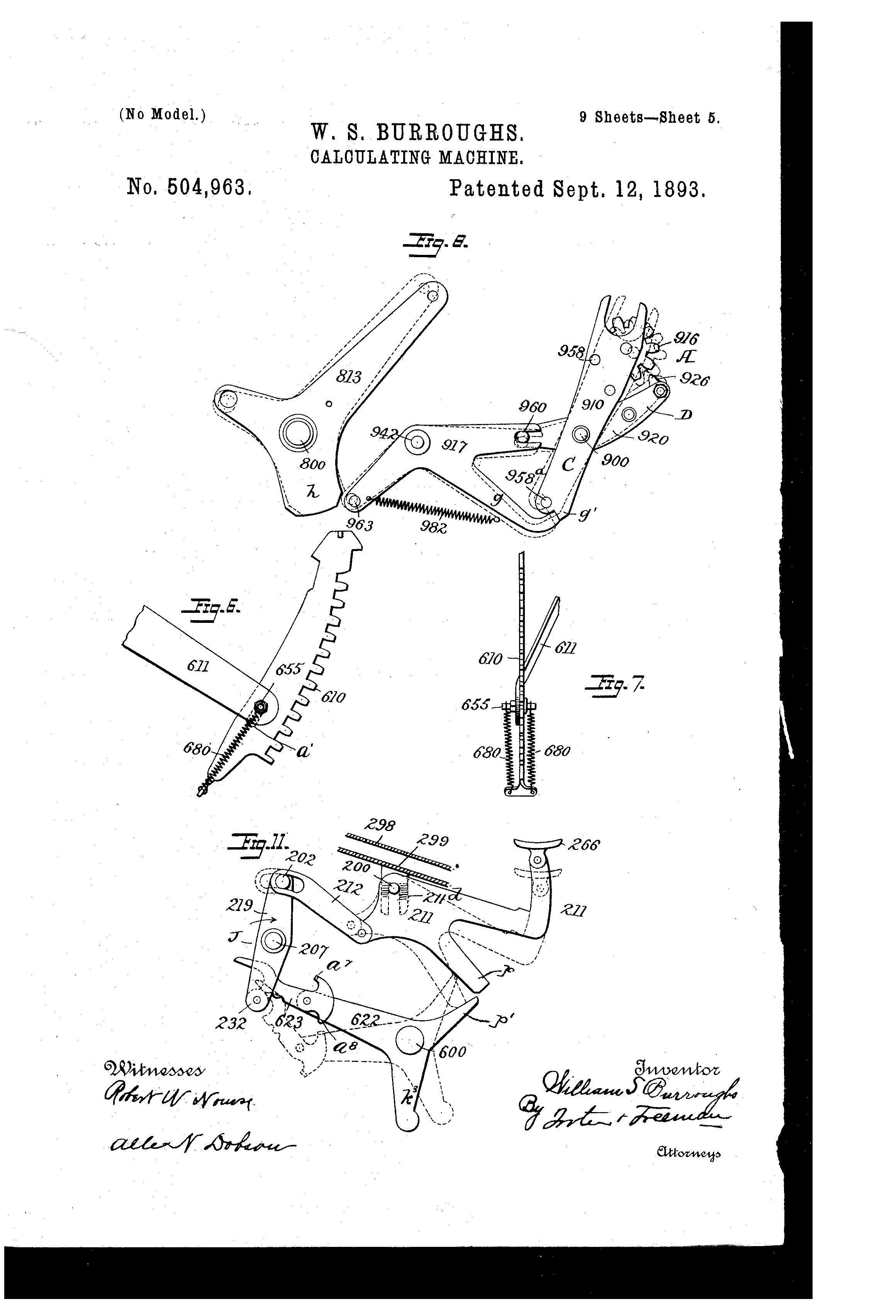
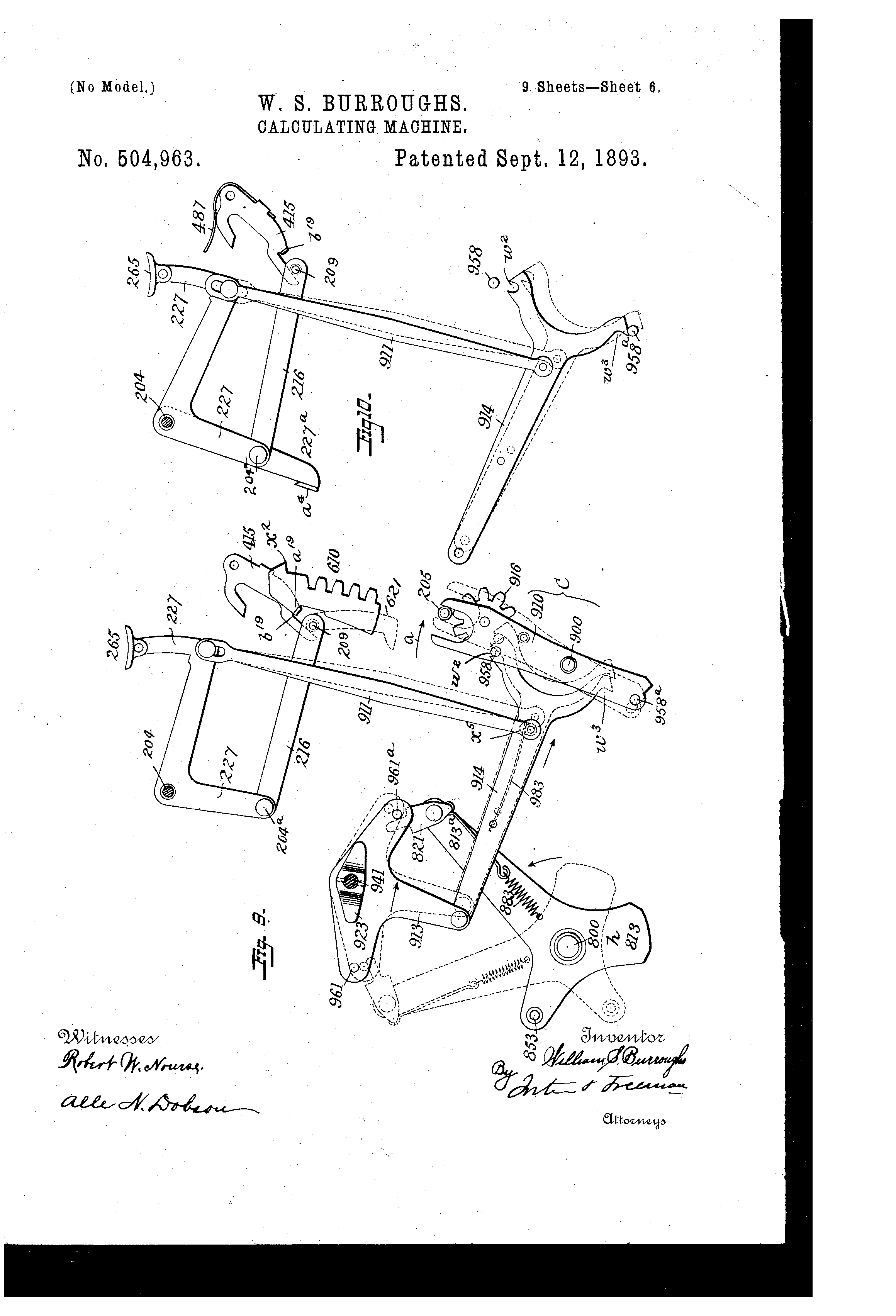
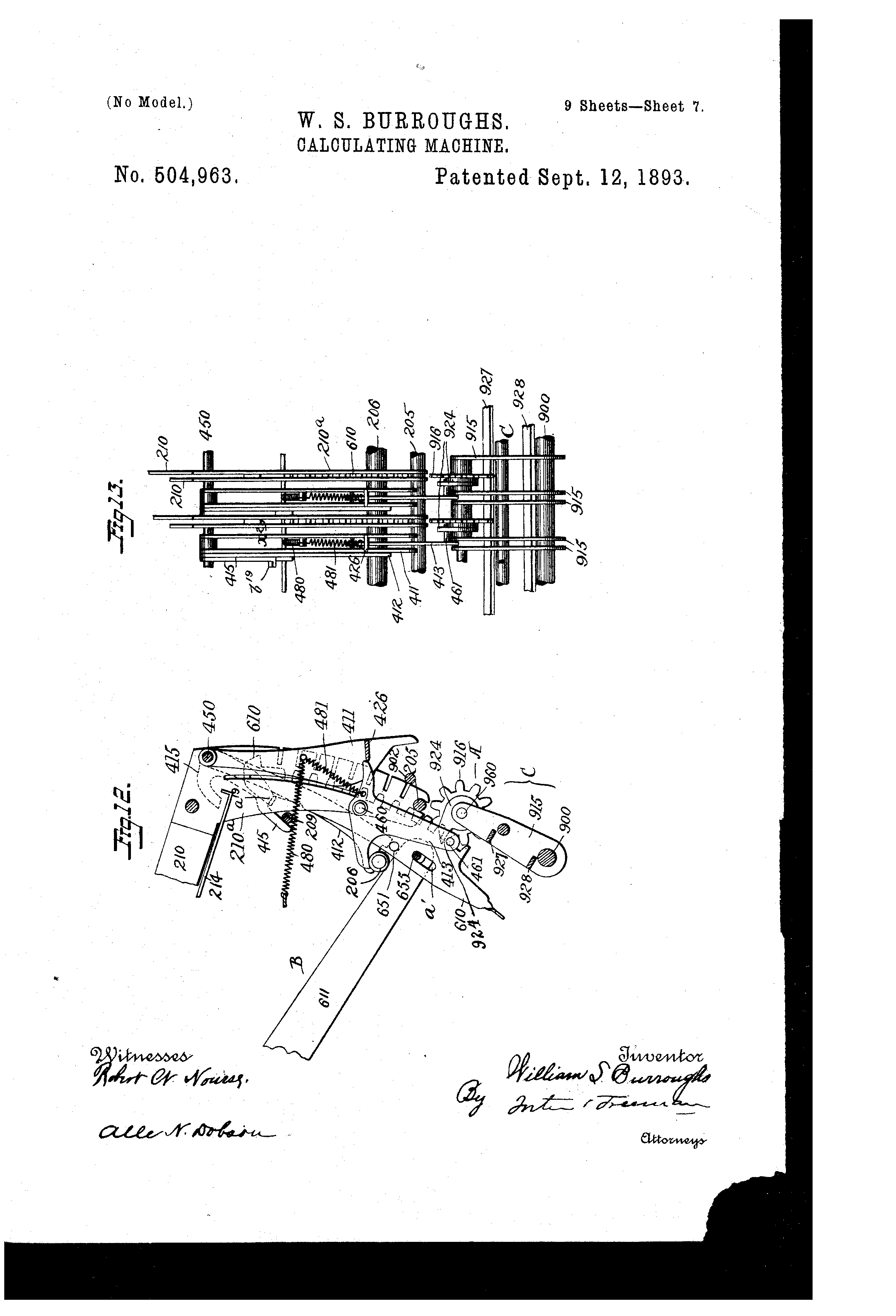
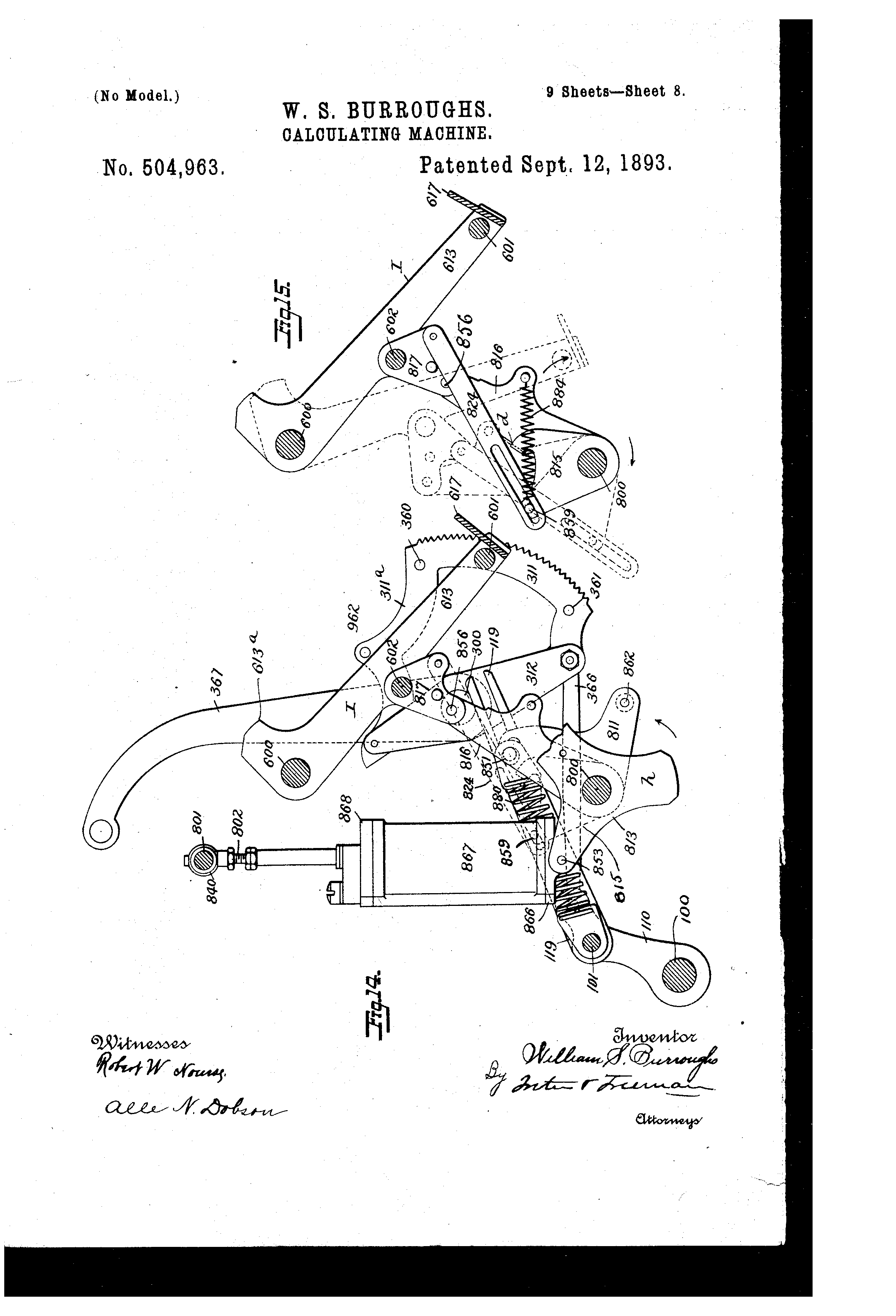
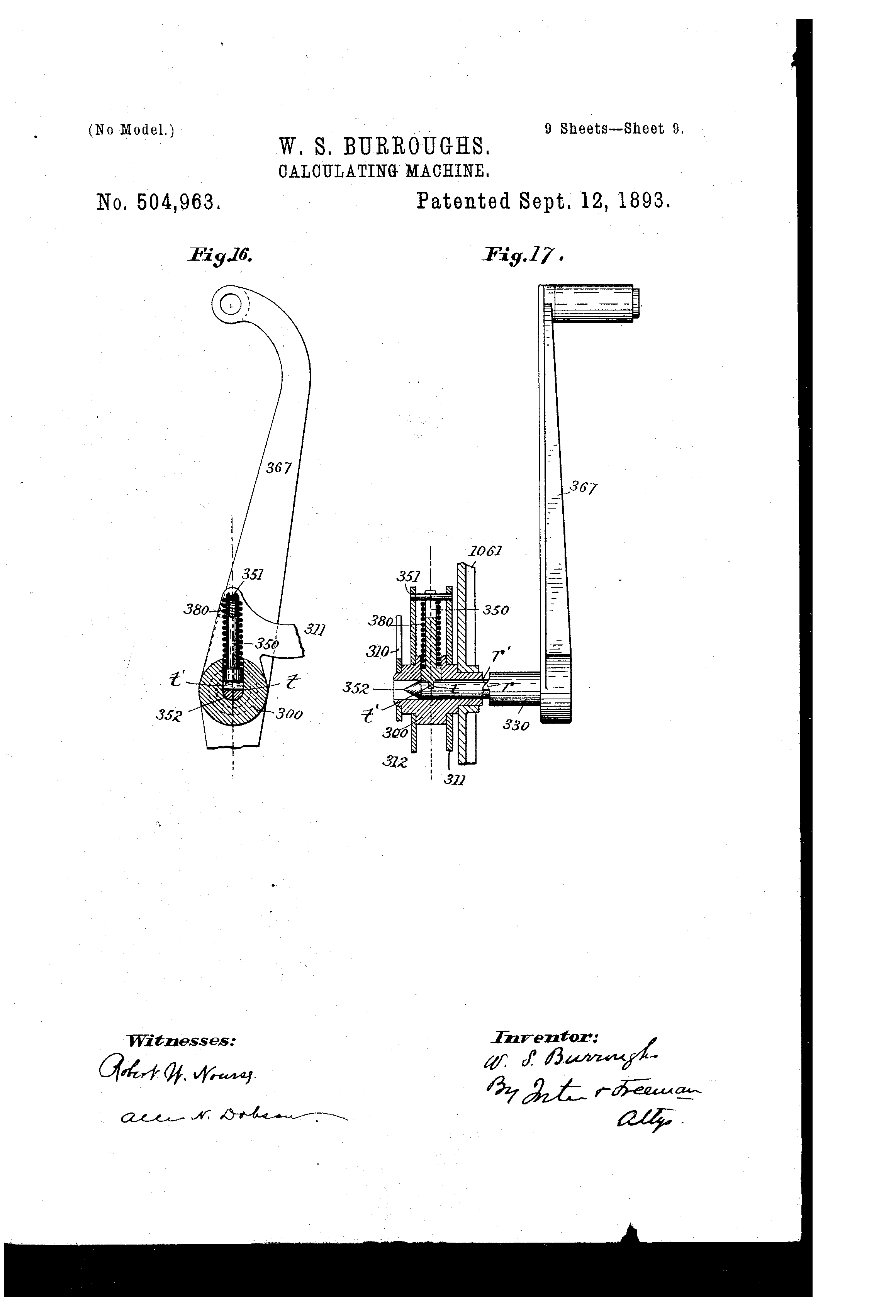
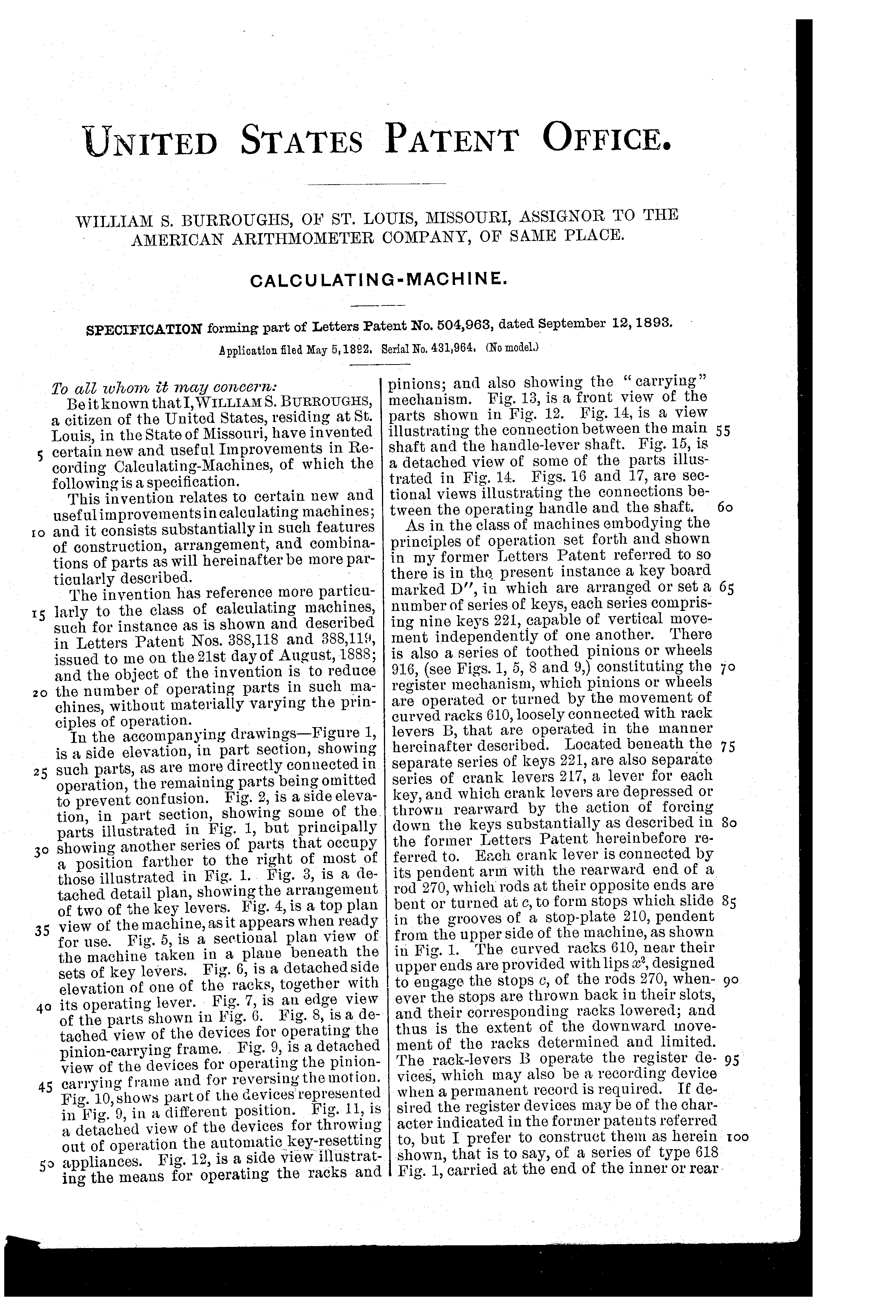
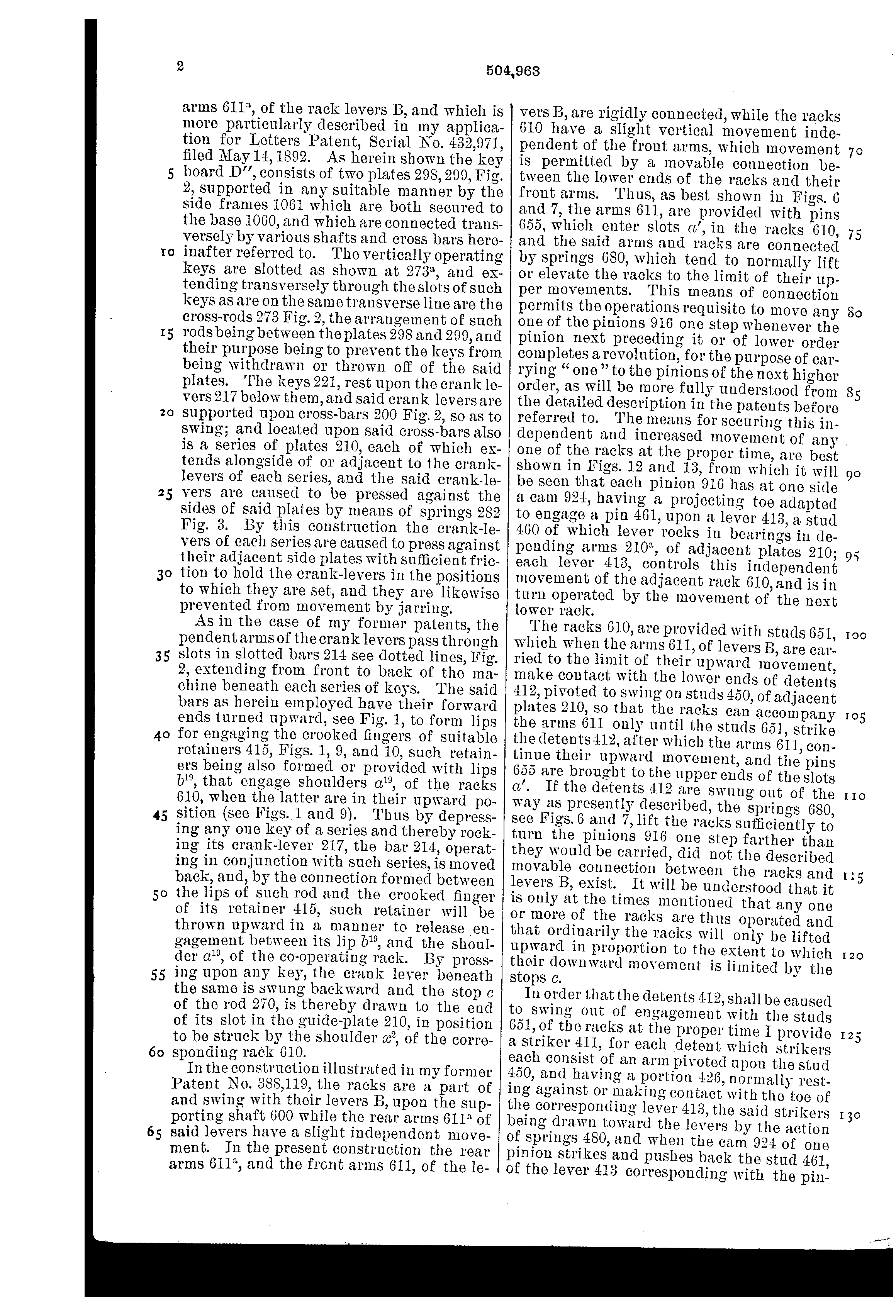
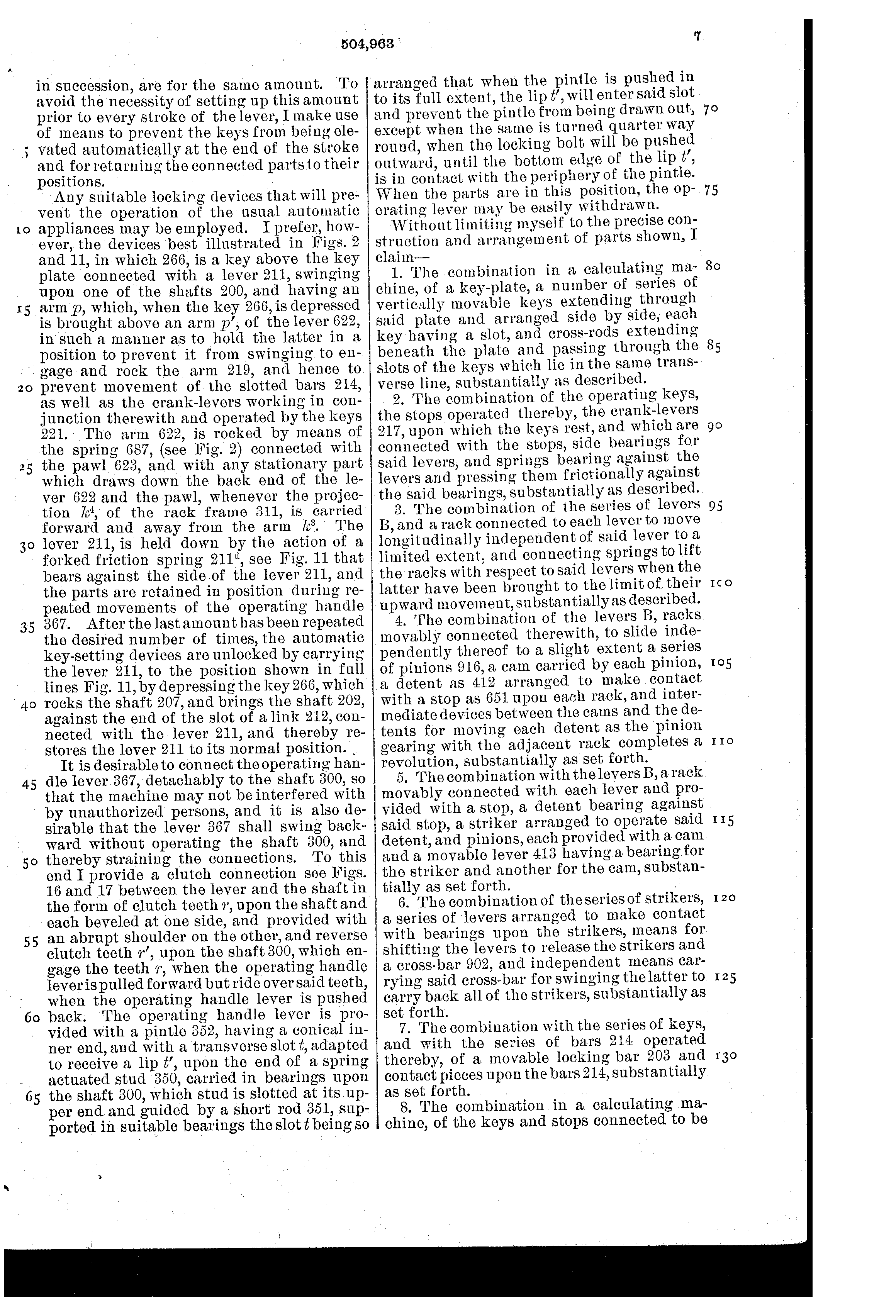
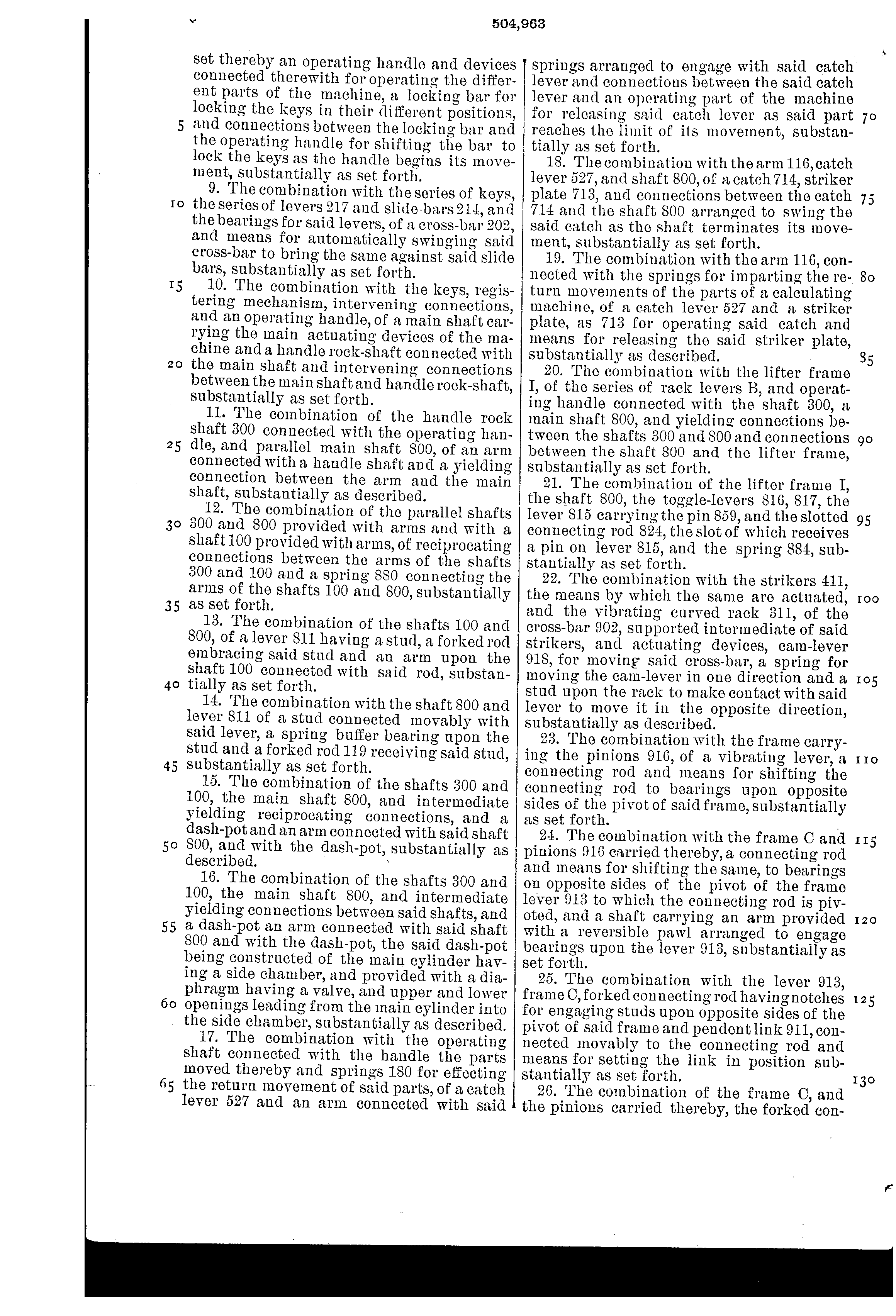
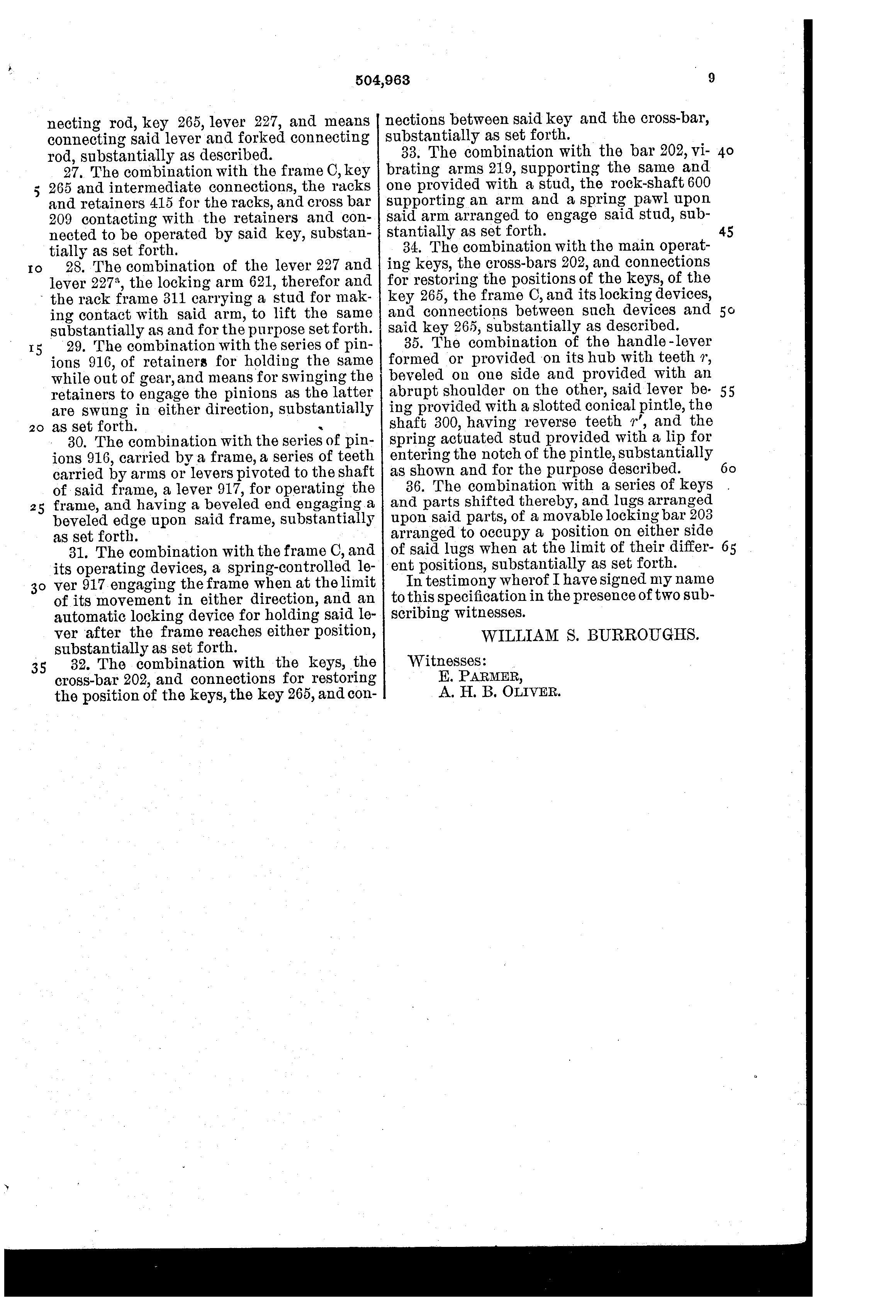
PDF · Google Patents · The hand-lever machine, with springs and a dash-pot on the handle.
Sources
Every fact on this page comes from these, as in the episode. Two of the main books take sides, and the page says so where it leans on them: Turck (1921) was written for Felt's side, and the Burroughs company's books of 1910 and 1912 are its own promotional histories.
Patents
- D. E. Felt, Adding-Machine, US Patent 366,945, filed 6 July 1886, granted 19 July 1887: the machine, its parts and the patent's words quoted above, the carry, 999 + 1 and the worked example (p. 3).
- D. E. Felt, Adding-Machine, US Patent 371,496, filed 12 March 1887, granted 11 October 1887: the fault at speed and the guard cam L′ (p. 3), the locks N (p. 1), the carry step by step (p. 4), Fig. 20.
- W. S. Burroughs, Calculating-Machine, US Patents 388,116 (filed 10 January 1885), 388,117, 388,118 and 388,119 (filed 30 November 1887: the governor and the dash-pot), all granted 21 August 1888; 504,963, filed 5 May 1892, granted 12 September 1893 (the handle, springs and dash-pot).
- D. D. Parmelee, Calculator, US Patent 7,074, 5 February 1850; Thomas Hill, Improved Arithmometer, US Patent 18,692, 24 November 1857; D. E. Felt, Tabulating-Machine, US Patent 628,176, filed 31 May 1898, granted 4 July 1899.
Court records
- Universal Adding Mach. Co. v. Comptograph Co., 146 F. 981 (7th Cir., 11 August 1906), text: the claims of 628,176 void.
- Comptograph Co. v. Burroughs Adding Mach. Co., 175 F. 792 (C.C.N.D. Ill., 1909), text; 183 F. 321 (7th Cir., 14 October 1910), text: the 1904 licence and its terms; 179 Iowa 83 (2 October 1916), text: the $500,000 ≈ $15 million claim, and "In January, 1905, the defendant succeeded the American Arithmometer Company".
History
- D. E. Felt, Mechanical Arithmetic, or The History of the Counting Machine (Chicago: Washington Institute, 1916): the planer and the macaroni box (p. 17), Pascal (p. 10), the Thomas machine (p. 19), and the editor's introduction ("almost three years to sell the first hundred machines"). Felt's own lecture, about thirty years after the events.
- J. A. V. Turck, Origin of Modern Calculating Machines (Chicago: Western Society of Engineers, 1921), written for Felt's side: Pascal and Leibniz (pp. 10–11, 132–134), Parmelee and Hill (pp. 14–22), the macaroni box in Felt's words (pp. 52–56), the first metal machine (pp. 56–57), the bill for the dies and the first machines (pp. 68–70), the Treasury letters (pp. 70–75), Tarrant (p. 75), the Comptograph (pp. 113–116, 130), the priority argument and Burroughs's recorder (pp. 131–143), Wyeth's testimony and the 1908 advertisement (pp. 141–143).
- The Book of the Burroughs (Detroit: Burroughs Adding Machine Co., 1912), the founder's chapter, pp. 77–97: his birth, the bank and his illness, Boyer's shop, the first backer, the company, the fifty machines, the Automatic Control, the window, his death. The company's own history.
- A Better Day's Work (Burroughs Adding Machine Co., 1910), pp. 33–45: the earliest printing of the window story we found.
- Comptometer News vol. 1 no. 1 (Felt & Tarrant, December 1926), "Romance of the Macaroni Box"; vol. 1 no. 4 (September 1927).
- Loyola University Chicago Archives, Dorr Felt Papers, 1918–1921, finding aid: Felt's birth, Beloit, Chicago, 1862–1930; the arithmometer on sale from 1851.
- The Franklin Institute, "Case Files: William S. Burroughs": the John Scott Medal of 1897, and its account of the first stake, roughly $300 ≈ $11,000.
- The Henry Ford, "Wherever There's Business There's Burroughs" (2020): Detroit and the company's names.
- Charles Babbage Institute, University of Minnesota, Burroughs Corporation records: the move to Detroit, the name of 1905 and the merger with Sperry as Unisys. Read only as search-result text; the page itself refused automated access.
- E. Darby, It All Adds Up: The Growth of Victor Comptometer Corporation (Chicago: Victor Comptometer Corp., 1968): the split of 1902, and the Victor merger (its contents list "Victor-Comptometer merger is sealed"; the year, 1961, is from secondary sites). Read only as short full-text-search extracts on the Internet Archive.
- T. Morgan, Literary Outlaw: The Life and Times of William S. Burroughs (New York: Holt, 1988): the grandson, Citronelle from 1896, the family's shares. Read only as short full-text-search extracts.
- Smithsonian Open Access records: the Thomas arithmometer, 1987.0731.02, record; Hill's patent model, MA.252686, record ("His patent did not result in a product").
- Dollar amounts in today's money: the ratio of annual-average consumer prices, from the Federal Reserve Bank of Minneapolis, "Consumer Price Index, 1800-", with 2025 as today, rounded to two figures. Prices before 1913 are estimates, which is why every figure is marked ≈.
Images
- Patent drawings and specifications: USPTO, public domain.
- Turck (1921), Felt (1916), Comptometer News (1926), Methods of Operating the Comptometer (1895), Appletons' Cyclopaedia of Applied Mechanics (1880, the Sellers planer), Scientific American (1888), American Meteorological Journal (1890), The Bankers Magazine (1900), Munsey's Magazine (1900) and The Banking Law Journal (1905): published in the United States before 1931, public domain; scans via the Internet Archive. Engineering (London, 1891) as reproduced by Turck.
- The Thomas arithmometer and Hill's patent model: National Museum of American History, Smithsonian Institution, Open Access, CC0. The museum's photographs of the macaroni box, the Comptometer and the Burroughs machine are not open access, so they are not shown.