 Curious Patents
The Stock Ticker
Edison didn't invent the stock ticker: Edward Calahan's were printing on Wall Street from December 1867, more than a year before Edison reached New York. Edison made the one that lasted, the Universal stock printer, and years later remembered being paid with a check for $40,000. The contract says something different.
Watch the episode
The Gold Room
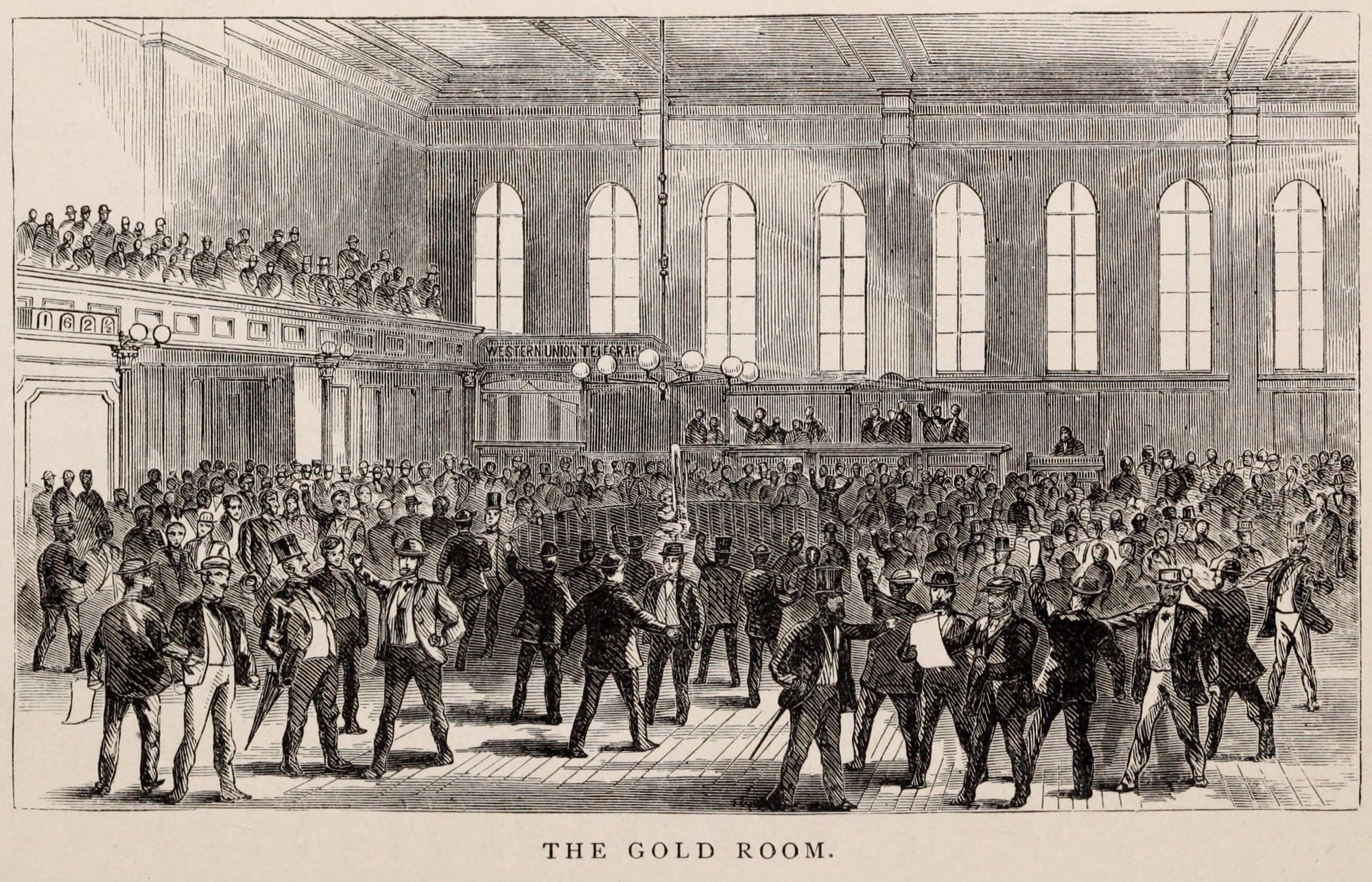
In the 1860s the price that mattered most in New York was the price of gold. During the Civil War gold coin traded at a premium over paper money, and, as the telegraph man Ralph Pope wrote in 1899, "by its fluctuations all other prices were influenced". Brokers bid for it in the Gold Room, near the Stock Exchange, round a fountain with "a Cupid playing with a dolphin".
Getting the price out of that room was the problem. For a while, Pope wrote, the tools were "a blackboard, a piece of chalk and a boy".
Laws's gold indicator, 1867
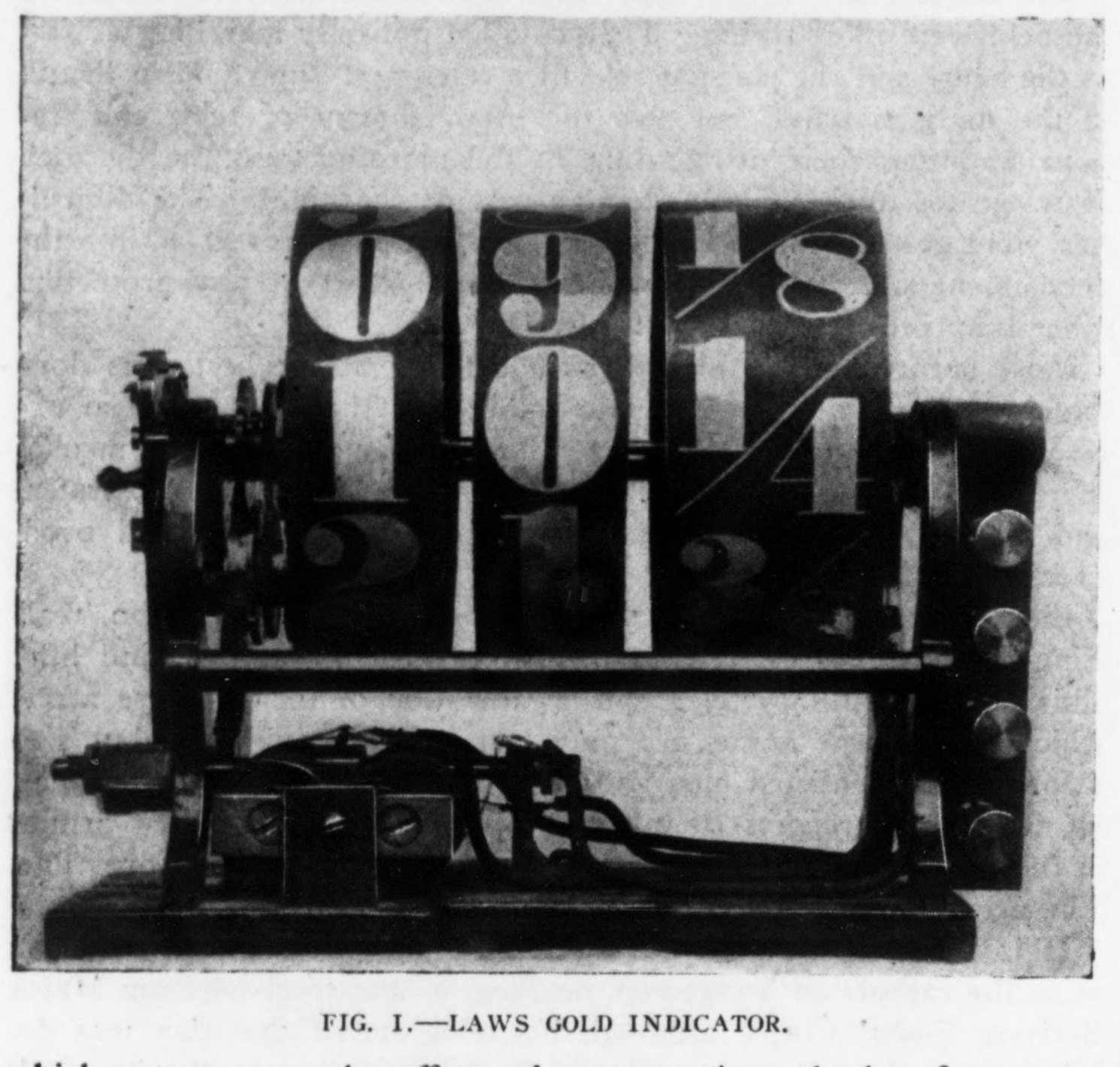
Samuel Laws, an officer of the Gold Exchange, patented an electrical indicator on 31 December 1867 (US 72,742): a figure wheel behind a window that stepped one figure each time a circuit closed. One magnet turned it forward, the other back. By August 1869 about a hundred and forty of his dials were running in brokers' offices in New York.
They ran until 1879, when paper money could be exchanged for gold again, which, in Pope's words, "terminated the career of the gold indicator". By then Laws was president of the University of Missouri, whose catalogue for 1879–80 thanks him for paying for its new telescope.
From the patent: wheel A carries the figures 0 to 9; ratchet E has "ten teeth corresponding in position relatively to the ten figures"; levers G and G², pulled by magnets P and P², push it one tooth either way, and stop pawls hold it between pulses. Every size, the curve of the levers and the springs are ours, and the pitman rods that withdraw the stop pawls are left out.
Calahan's ticker, 1867
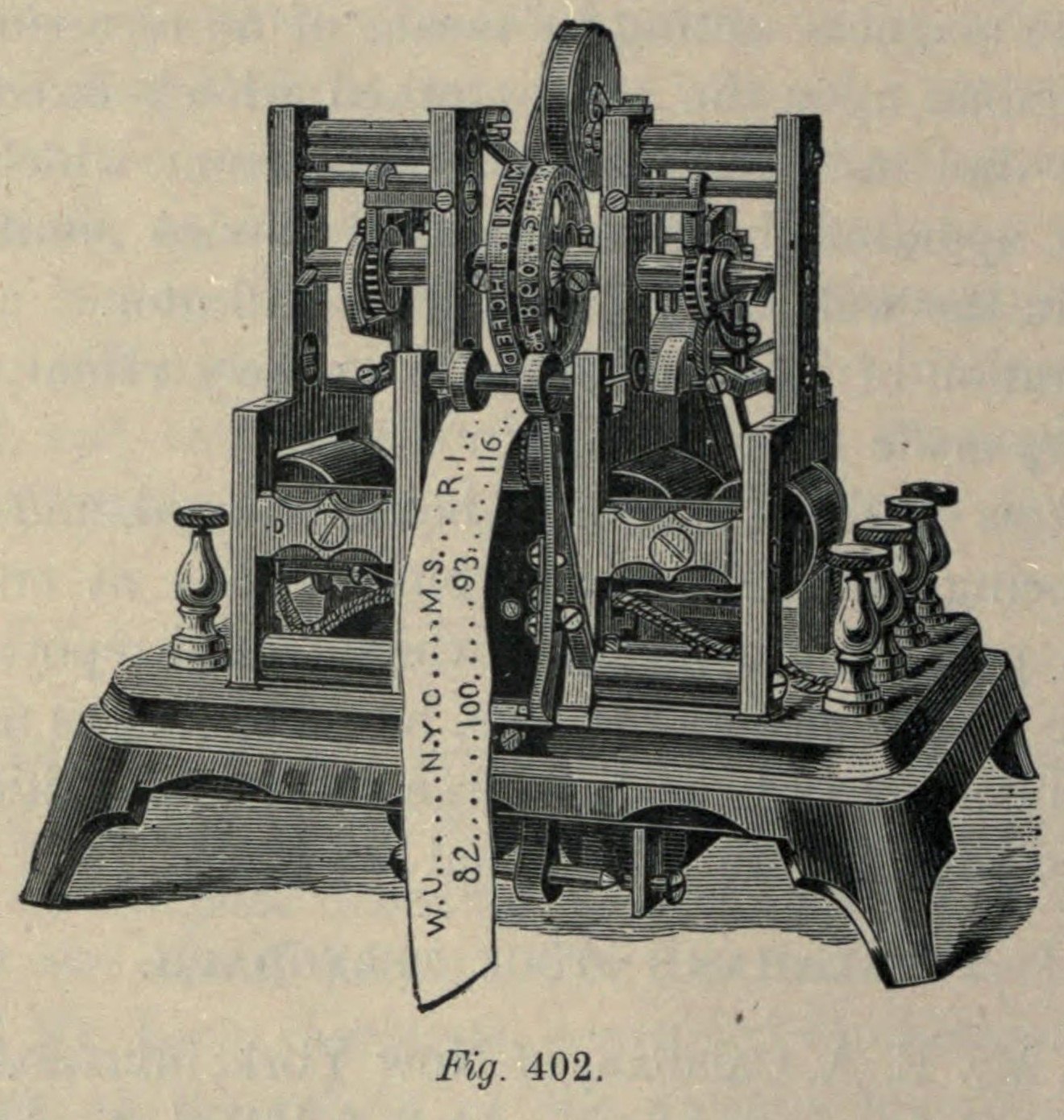
Edward Calahan had started in the telegraph as a messenger boy in Boston. In 1867, on Broad Street, he walked into a building where each broker's firm kept "its own army of boys" running out for prices. As he told it in 1901: "Pushing each other to get into these narrow quarters, yelling out the prices at the door and rushing back again for later ones… I was simply whirled into the street."
Laws held the right to send gold prices to dials, so Calahan turned to stocks, and to printing. His machine had two type-wheels, small wheels with raised characters round the rim, one of letters and one of figures, and it took three wires: one to turn each wheel, and one to press the paper tape up against the type. At the central office an operator worked the sender, which his patent describes as a dial with "a hand that is moved around from one letter to another, and in so doing makes and breaks the circuit", one pulse for each letter, and a finger-key that closes the printing wire. Every ticker on the line counted the same pulses, so each one came to rest on the same letter. "In December, 1867," he wrote, "we placed the first ticker in the office of David Groesbeck". The name, he said, came from "a lounger in a broker's office". His patent, US 76,993, was granted on 21 April 1868 to the Gold and Stock Telegraph Company, formed to put it to work. By April 1870 several hundred of his printers were at work in New York, at about thirty characters a minute.
The example is Prescott's: an operator printing "W. U. 82". Each wheel is turned on its own wire; while one wheel prints, the other stands at its blank ("Each of the wheels l and k has a blank space that is turned toward the paper while the other wheel only is being printed from," says the patent). The characters on each wheel, their order, the speed of the pulses and the paper reel are ours.
Edison arrives, 1869
Thomas Edison came to New York in the spring of 1869. He was twenty-two. A few months earlier he had quit his job as a Western Union telegraph operator in Boston to "devote his time to bringing out his inventions", among them a stock-quotation printer of his own for Boston's bankers and brokers. A new transmitter brought him to New York, and he stayed, the editors of his papers say, "to take advantage of the support available in the nation's telegraph center". That July he wrote to a friend in Boston that paying his debts there had left him "without a single penny" when he reached New York, and that "It is all I can do to keep the wolf from the door, and supply Redding with money to make the Printer": to feed himself, and still pay Jerome Redding, a Boston instrument maker, to build a machine he had promised a customer there. Forty years later he told a better story: that he was sleeping in the battery room of Laws's company when the machine that sent prices to every dial stopped "with a crash", that he found a broken contact spring jammed between two gear wheels, and that Laws put him in charge. That story is his alone, and his own versions disagree on the details. The one report we found from 1869, in The Telegrapher of 2 October, mocks a newspaper which said that during "the recent gold excitement" the gold indicators "stopped working" because "the changes had been so rapid as to heat and burn the wires". It names no one who fixed them.
The record shows that around the first of August 1869 Edison took over from Franklin Pope as Laws's superintendent, and on the seventeenth signed a patent application for a redesigned Laws printer (US 96,567). Ten days later Gold and Stock bought Laws out, for $25,000 in cash ≈ $600,000 and $75,000 in stock ≈ $1.8 million. Edison's patent went with the sale; Edison, in the words of the editors of his papers, "lost his four-week-old job".
By October he had a new firm, Pope, Edison & Co., and with Pope built a gold printer that ran fifty-six instruments on one circuit by April 1870. Gold and Stock bought the competition again: the agreement of April 1870 paid $15,000 ≈ $380,000, in instalments, to Pope, Edison and their partner James Ashley. Edison later remembered that the company's president set aside $1,500 ≈ $38,000 for him; we could not find how the money was actually divided. That president was Marshall Lefferts, a telegraph engineer who had once been Calahan's boss. With money from Gold and Stock men, Edison also set up his first real shop, in Newark, with William Unger.
Edison's Universal stock printer, 1872
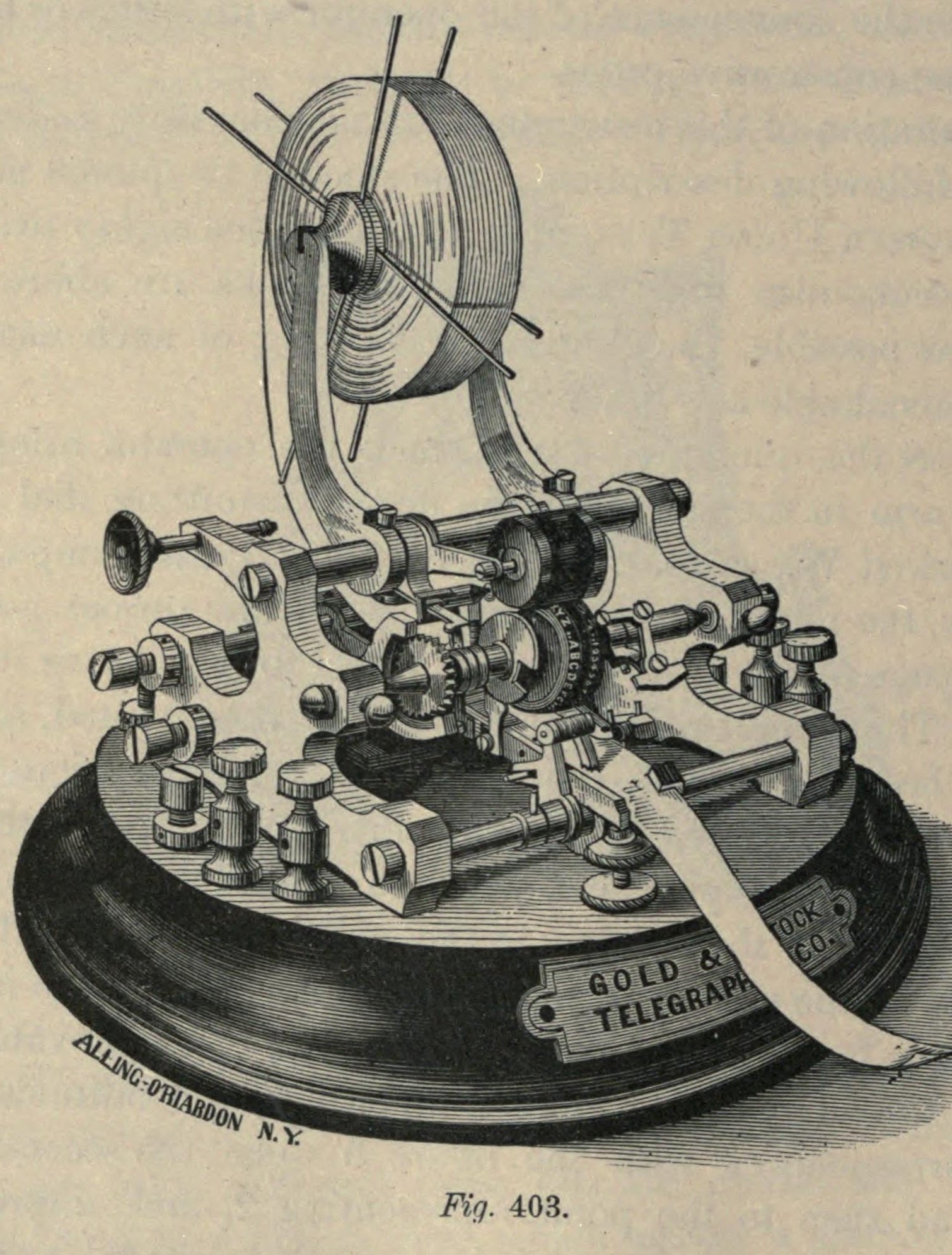
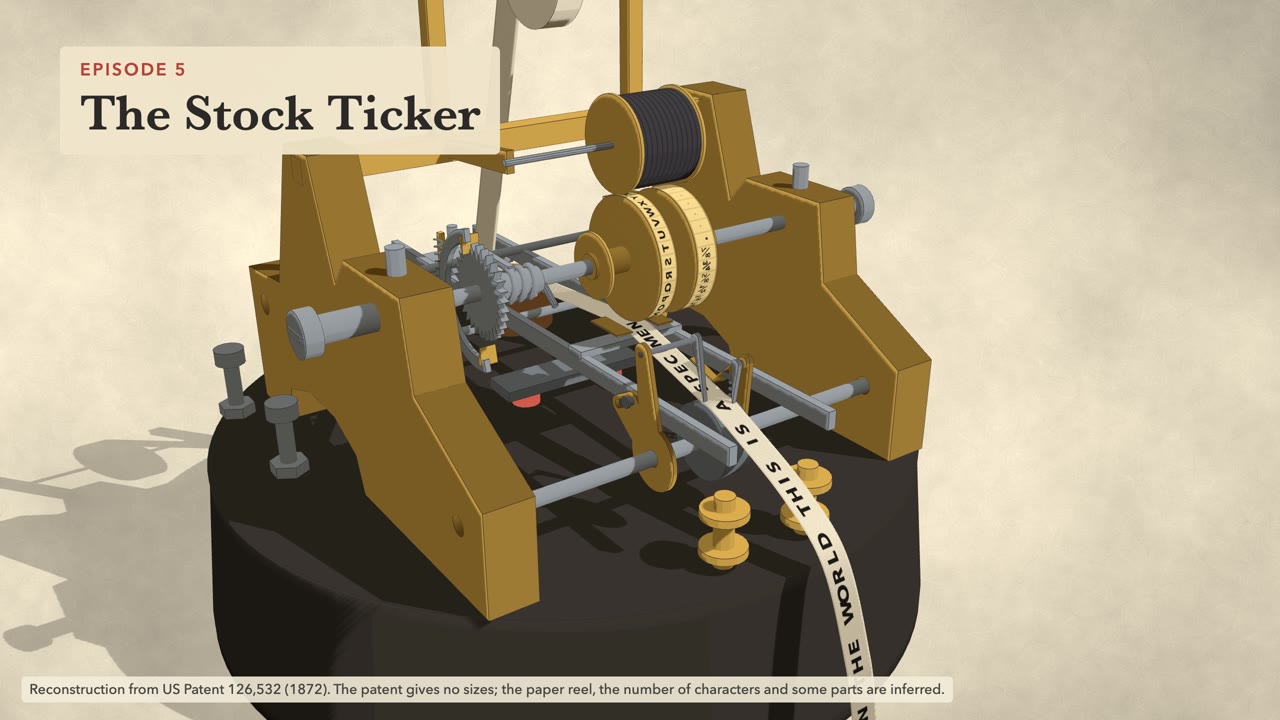
Edison's patent, US 126,532, was granted on 7 May 1872 and assigned to Gold and Stock. The model he sent with it was a production machine, number 568, delivered to the company the November before. It runs on two wires from the central office, one for each of its two electromagnets.
Each pulse on the first wire pulls an iron armature, and a lever rocks an escapement against a toothed wheel on the type-wheel shaft. Edison explained the stepping in a companion patent: the wheel "is moved half a space as the magnet … is energized, and the other half space is moved by the spring … when the pulsation … is arrested". So one pulse, on and off, moves the wheels one character, and to print a letter the central office sends as many pulses as it takes to bring it round to the bottom. Then a pulse on the second wire pulls down the short end of the printing lever; the far end rises and lifts a small pad, pressing the tape up against the inked letter, and on the same upward stroke a pawl pulls the tape on one space.
There are two type-wheels, letters and figures, side by side on a sleeve that slides along the shaft. To change wheels the central office turns them to a blank and sends a print pulse; nothing prints, and the rising lever slides the sleeve across. Prescott's textbook of 1888 gives the places: figures at "the period after the '&'", letters at "the period next to the letter 'A'".
Letters, figures, &, full stop and space print; other characters are left out. A change between letters and figures takes a print stroke of its own at a blank, and every stroke feeds the tape, so each change leaves a gap.The type-wheels' characters and their number (30 places a turn) are our reading of Fig. 1, and so are the paper reel, the spring of the escapement lever and the timing of the feed within the stroke. The speed is yours to set: Prescott gives battery sizes for type-wheels turning at up to 42 revolutions a minute, which with our 30 places a turn is 21 pulses a second. The specimen tape's words are those of a real Universal tape of 1871 pictured in the Edison Papers, set here in our type.
Out of step, and the unison
The harder problem was keeping every ticker in step. Dozens of machines on one line count the same pulses. If one misses a pulse it falls a character behind, and everything it prints after that is wrong. Telegraph men said it had "thrown out": an operator wrote to Edison in June 1871 that his "Inst had Thrown out once". Try it above: make the ticker miss two pulses, then send a message.
Edison's cure was a unison, a way to bring every machine on the line back to the same character at once. He cut a worm, a screw thread, on the type-wheel shaft, and the end of a swinging arm rides in it. Each time the ticker prints, the lever lifts the arm out and a spring pulls it back to the start, so in normal work it never gets far. To reset the line the central office turns the transmitter, in Prescott's words, "four times around without printing". Nothing lifts the arm now; it travels along the thread until it meets a pin in the shaft, and that ticker stops dead. A ticker that was behind keeps turning until it reaches the same pin. Then every wheel on the line rests on "the dot next to the letter A", and one print pulse frees them all together.
- i
- The type-wheel magnet, on the first wire. Its armature h rocks lever g, whose pallets step the toothed wheel f.
- h²
- The printing magnet, on the second wire. It pulls the short end of the printing lever f², which turns on pivot f³.
- l, m
- The letter and figure wheels, on a sleeve that slides along shaft c.
- t³
- The pad, or platen, that presses the tape up against the type.
- l⁶
- The ink-roller, made of "disks or washers of woven cloth", because felt fibres "wear off and clog the type-wheels".
- v, w, a²
- The unison: the worm on the shaft, the pin that stops it, and the swinging arm that rides in the thread.
The "$40,000"
In notes he wrote in 1908 for his official biography, Edison told how Lefferts called him in and said, "Now, young man, I want to close up the matter of your inventions, how much do you think you should receive?" Edison had settled on $5,000 ≈ $130,000, "but could get along with $3,000" ≈ $81,000. He lost his nerve and asked for an offer.
"How would forty thousand dollars strike you". "This caused me to come as near fainting as I ever got."
He said he signed without reading, and was "handed a check for $40,000 on the bank of the State of New York" ≈ $1.1 million. "This was the first check I ever had."
The teller handed it back, and Edison, "quite deaf", thought he had been cheated. His biographers tell the rest from his notes: he went outside "to let the cold sweat evaporate", then back to Lefferts, who laughed and explained that the check had to be endorsed, and sent a young man along to identify him. This time the teller paid out in bundles of small bills, "until there certainly seemed to be one cubic foot". Edison filled his pockets, took the money home to Newark and sat up all night with it "for fear it might be stolen". The pile of small bills was a practical joke, Dyer and Martin say, and Edison was "unaware that he was the victim" of it. Next morning Lefferts laughed again, told the clerk "the joke must not be carried any further", and had him put the money in the bank and open an account.
The documents tell it differently. In October 1870 a draft letter to Lefferts offered a new machine Edison called the "Universal Printer" for "a Maximum sum" of $30,000 ≈ $760,000, "payable in Stock". On 25 May 1871 Western Union took control of Gold and Stock, and the contract Edison signed the next day paid in shares:
| Contract of 26 May 1871 | Then | Today |
|---|---|---|
| For the "Universal Printer", "in shares of the capital stock" | $15,000 | ≈ $400,000 |
| For all his other printing-telegraph inventions, the pending unison among them, "the further sum of twenty thousand dollars, in shares" | $20,000 | ≈ $540,000 |
| In stock, in all | $35,000 | ≈ $940,000 |
| Salary for five years as consulting electrician, in cash | $2,000 a year | ≈ $54,000 a year |
| Bonus for any year in which the company adopted an improvement of his, in cash | $1,000 | ≈ $27,000 |
The company's committee noted that it had got the Universal "at one half the price originally expected". One more twist: the "Universal Printer" in that contract was not the stock printer animated above. It was a keyboard printer for private lines, still unfinished, which Edison never made practical. The stock printer came next; Gold and Stock received its first prototype that June, under the contract's claim on everything he invented for five years.
Edison remembered a check for $40,000 ≈ $1.1 million. The contract paid $35,000 in stock ≈ $940,000, with a salary, and we could not find a check.
Ticker tape
The Universal stock printers were made by Edison and Unger on Ward Street in Newark. By the end of 1871 Gold and Stock had six hundred, on lines in New York and other cities. Ralph Pope put the number made at about twelve hundred; from the shop's accounts, the editors of Edison's papers count about that many by the end of 1872, and about three thousand six hundred by late 1874. In 1872 the same machine went to London, to the Exchange Telegraph Company. Calahan was there too: his obituary says he left Gold and Stock in 1872 and went to London, where he helped organize that company. He died in Brooklyn in 1912.
Every ticker spooled out tape all day. On 20 October 1884 a club of Republican brokers marched up Broad Street for James Blaine, and the New York Times reported they were "showered with 'ticker' tape from the various brokers' offices". Two years later, on the day the Statue of Liberty was dedicated, part of the parade came down Wall Street, and office boys "began to unreel the spools of tape" from a hundred windows: "Every window appeared to be a paper mill spouting out squirming lines of tape. Such was Wall-street's novel celebration." That day is usually called the first ticker-tape parade; the brokers' march came two years before it. Granite strips in the sidewalk of lower Broadway now mark more than two hundred ticker-tape parades, and the list starts in 1886.
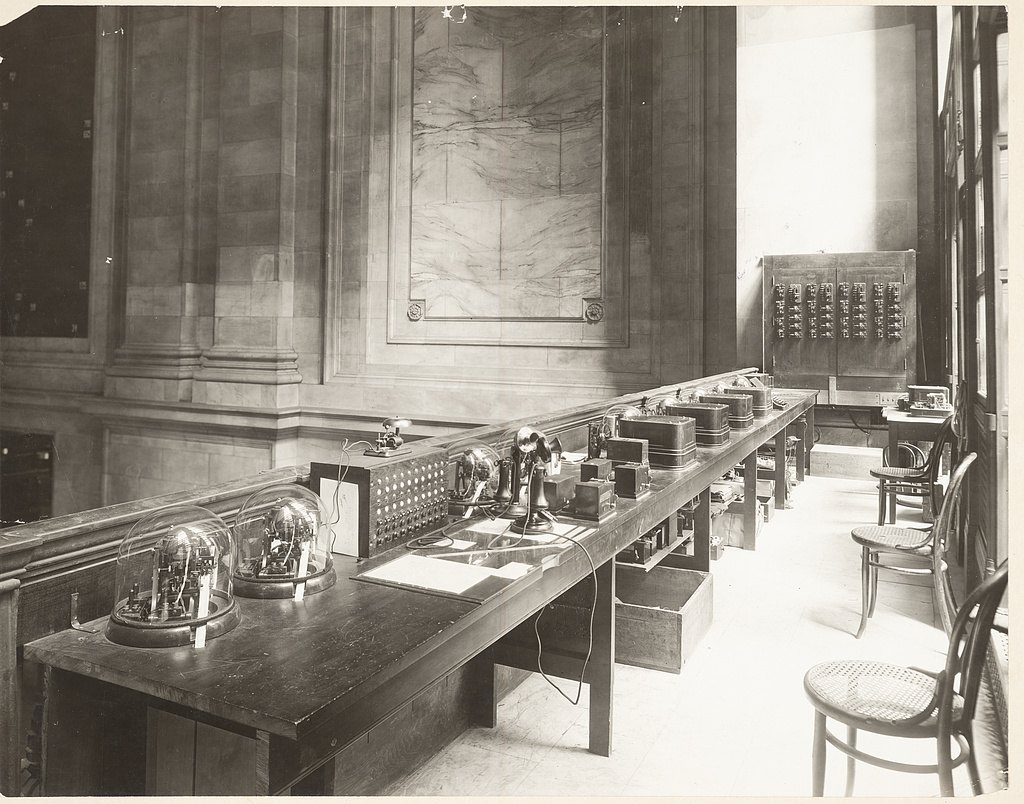
Edison moved on: in 1876 he moved his laboratory to Menlo Park, New Jersey, and the phonograph followed the next year. The Universal served the exchange for several years before it was replaced, the Edison Papers say, and went on working "until about 1960" for other jobs, "including the transmission of sports scores". The paper strip has gone, but a line of prices scrolling across a screen is still called a ticker.
Read the original patents
All three patents are in the public domain. Click a page for full resolution.
US 126,532, Edison, granted 7 May 1872
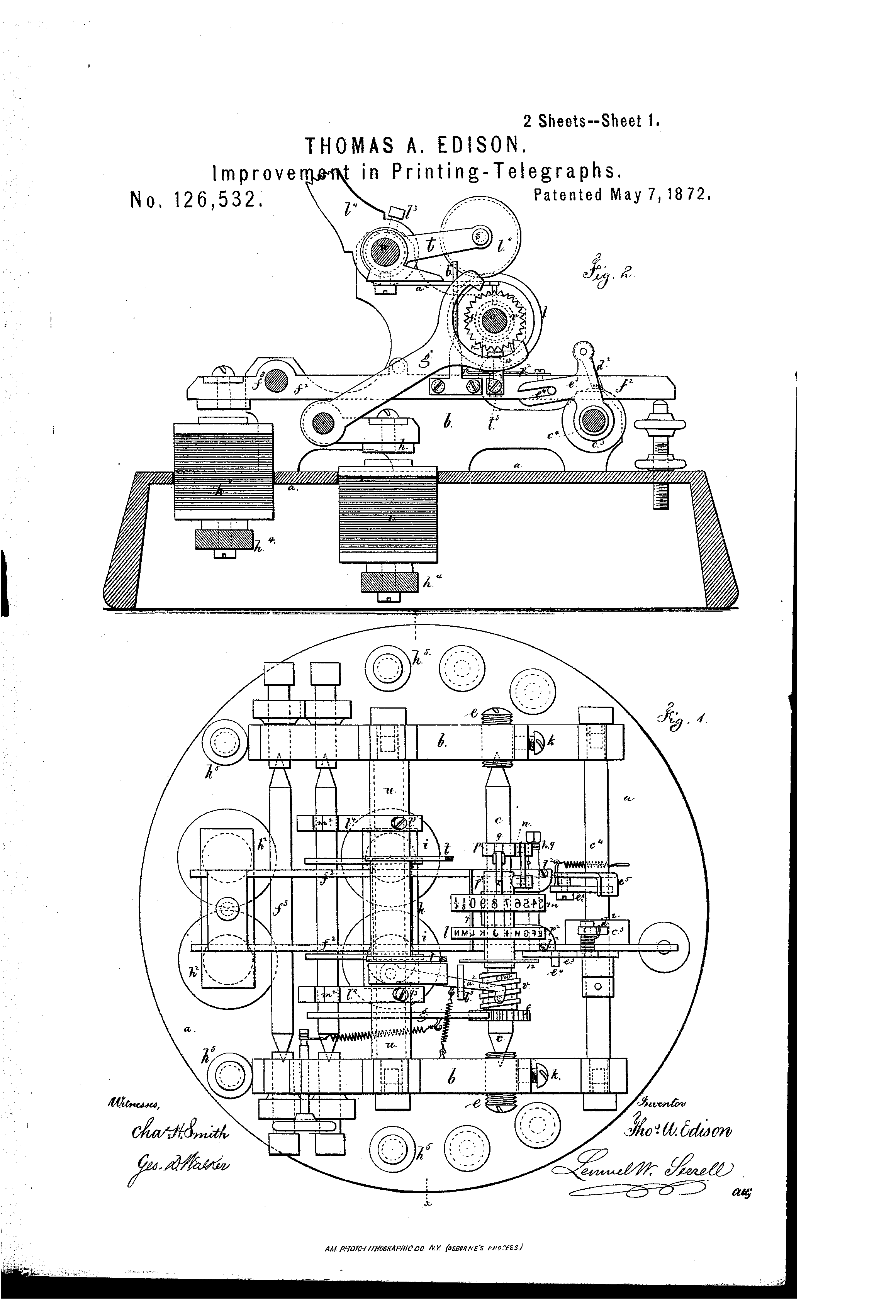
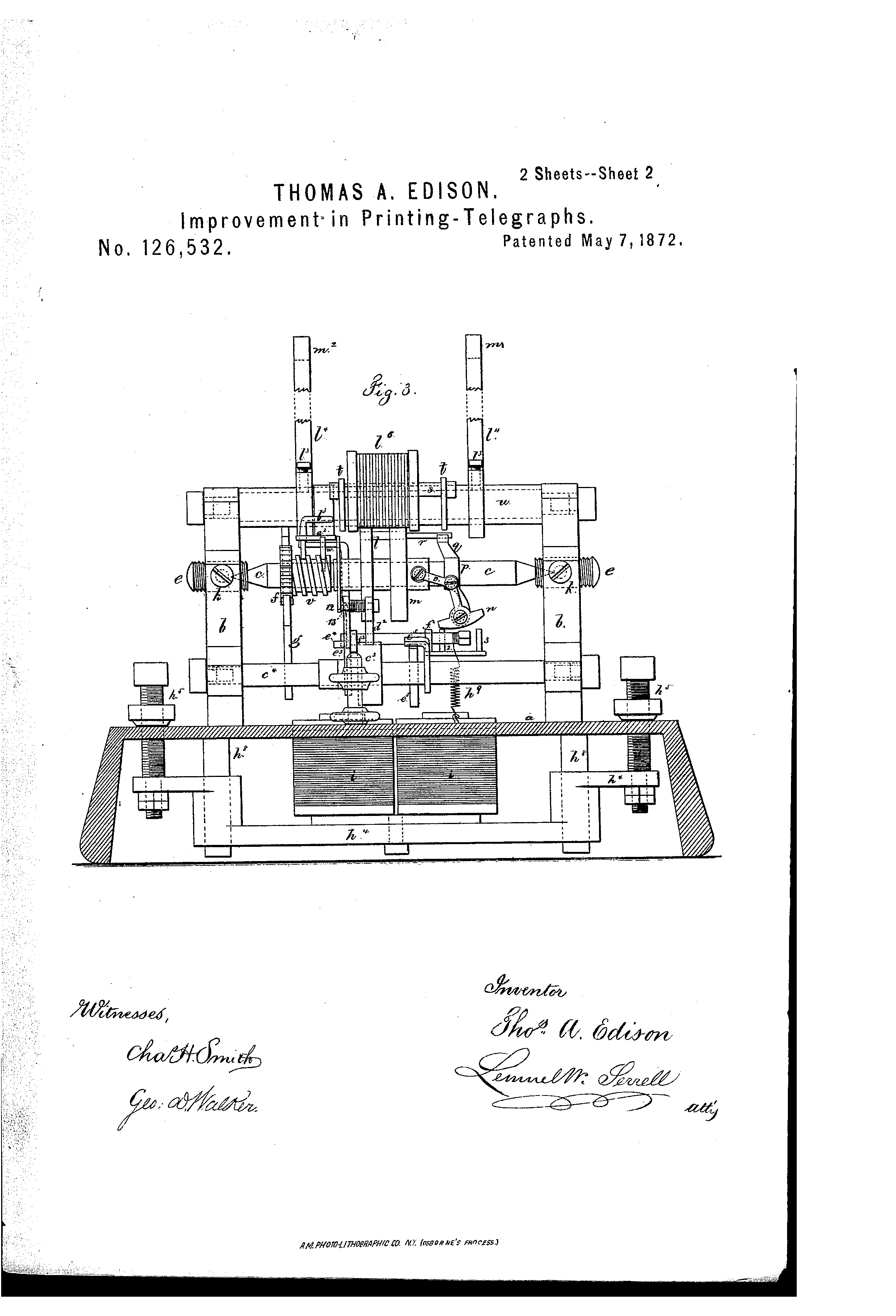
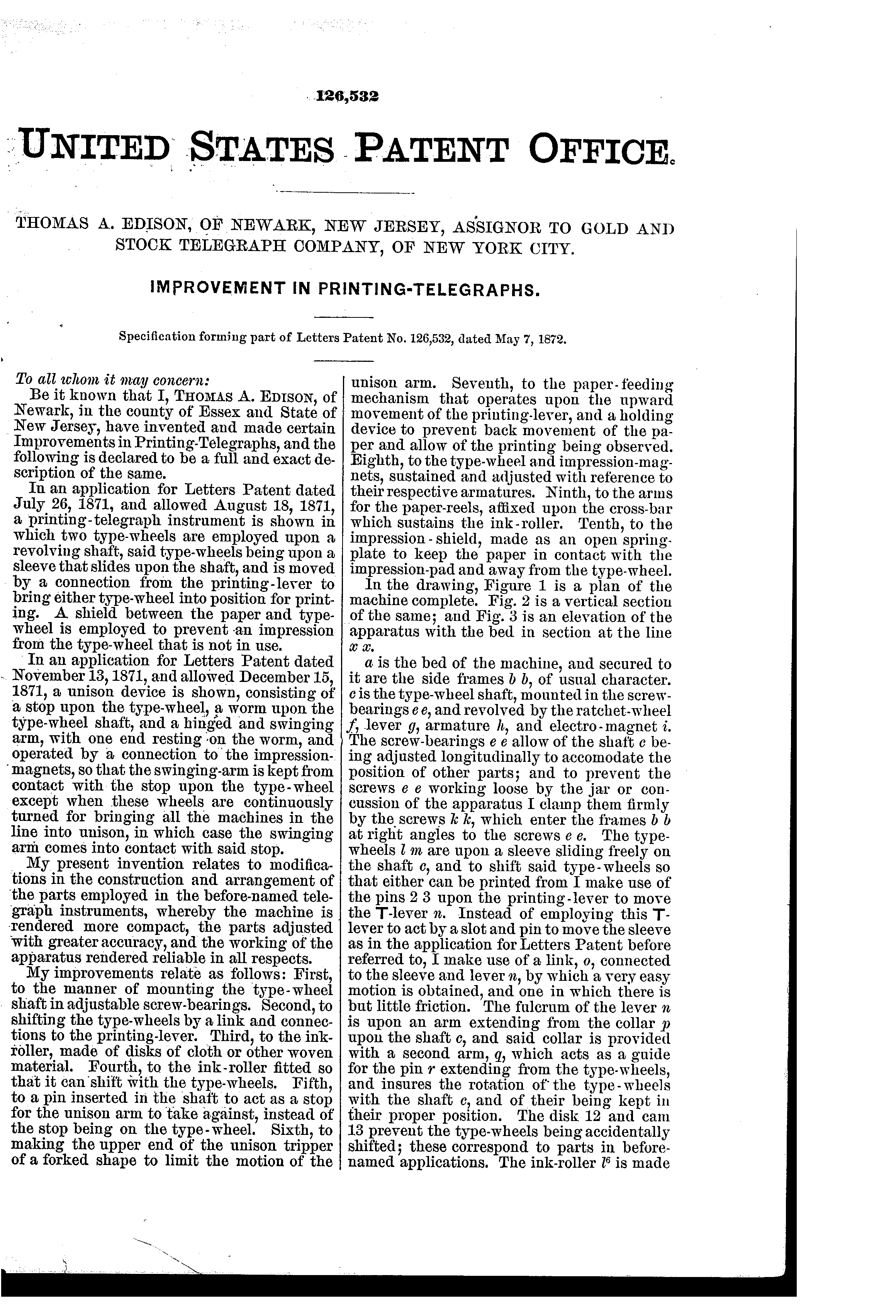
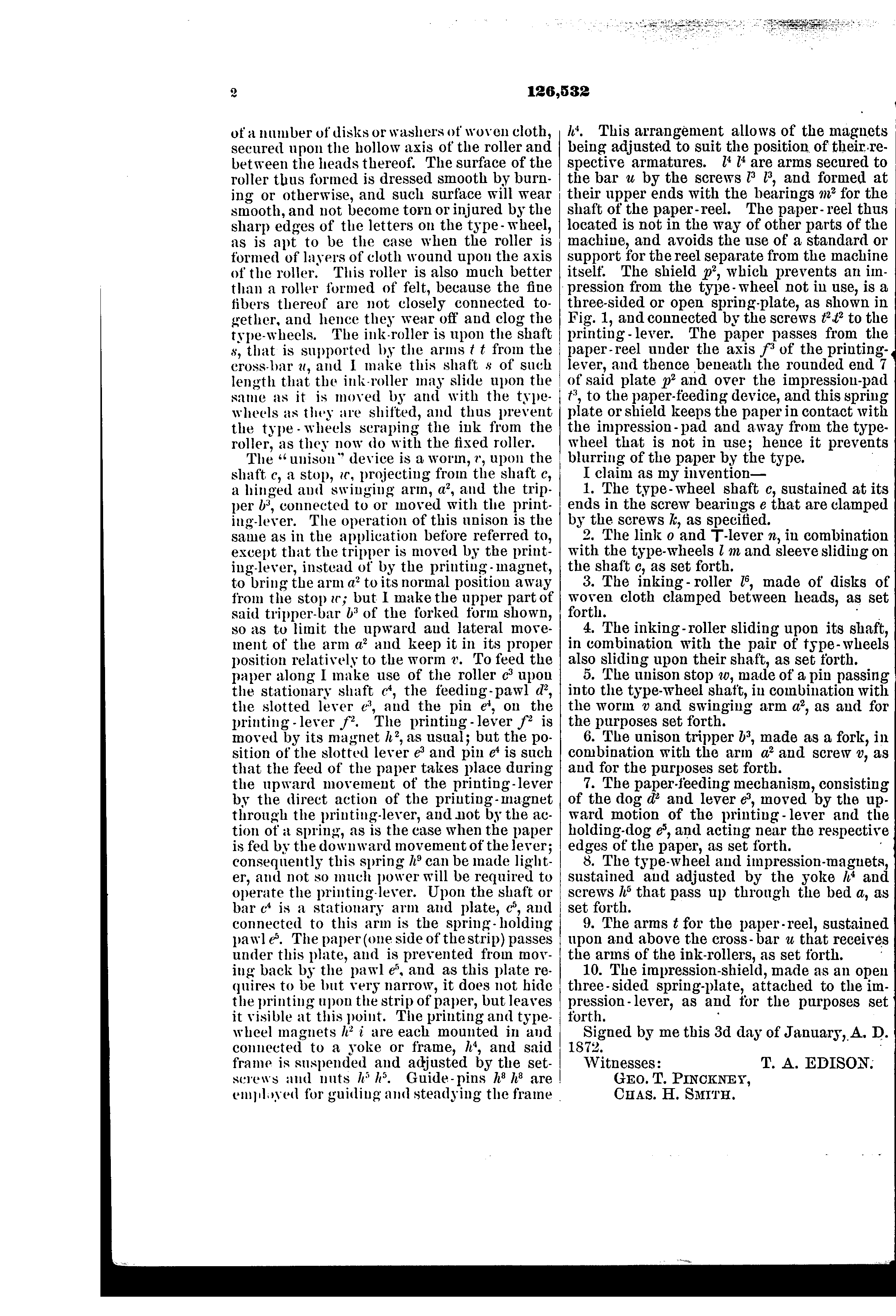
PDF · Google Patents · Signed 3 January 1872; assigned to the Gold and Stock Telegraph Company.
US 76,993, Calahan, granted 21 April 1868
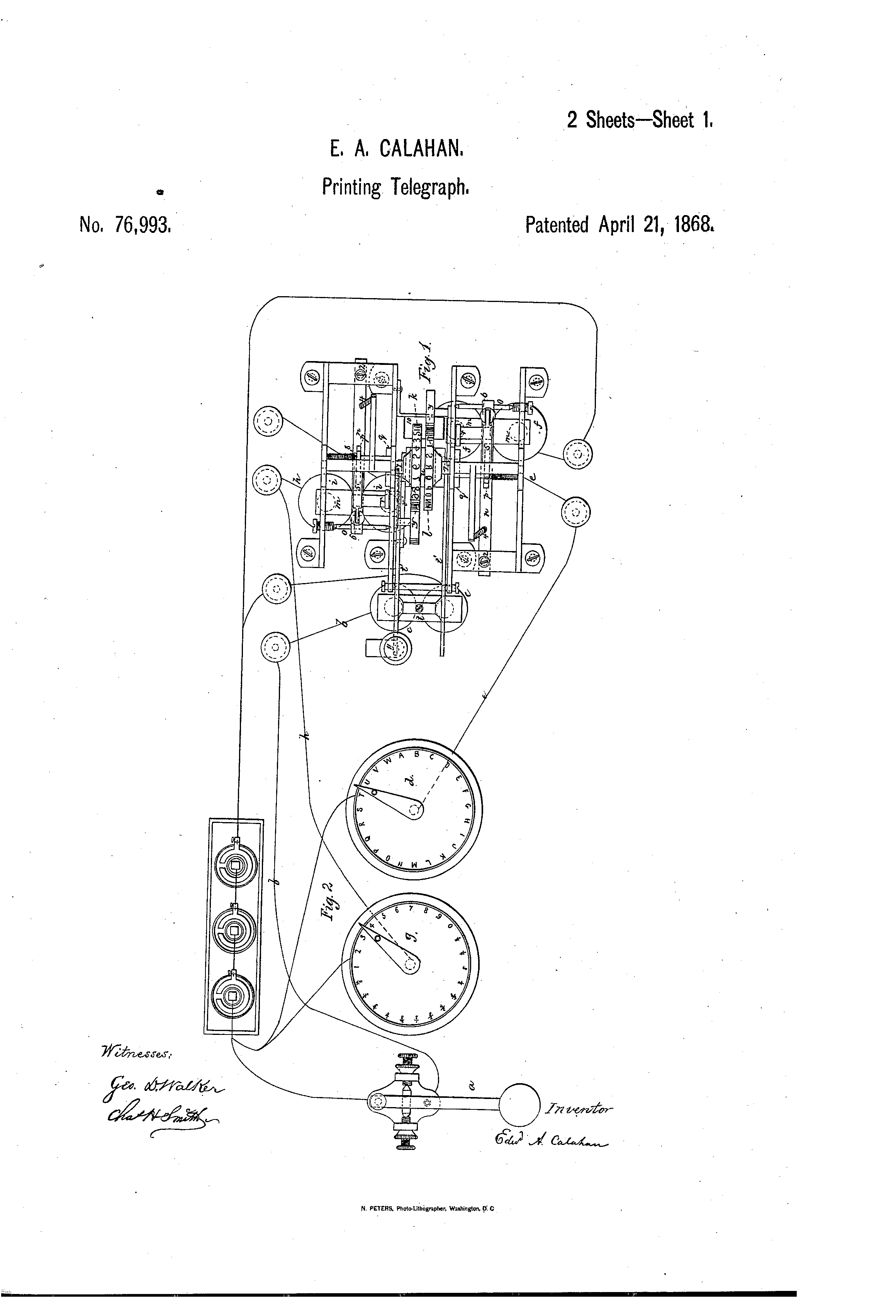
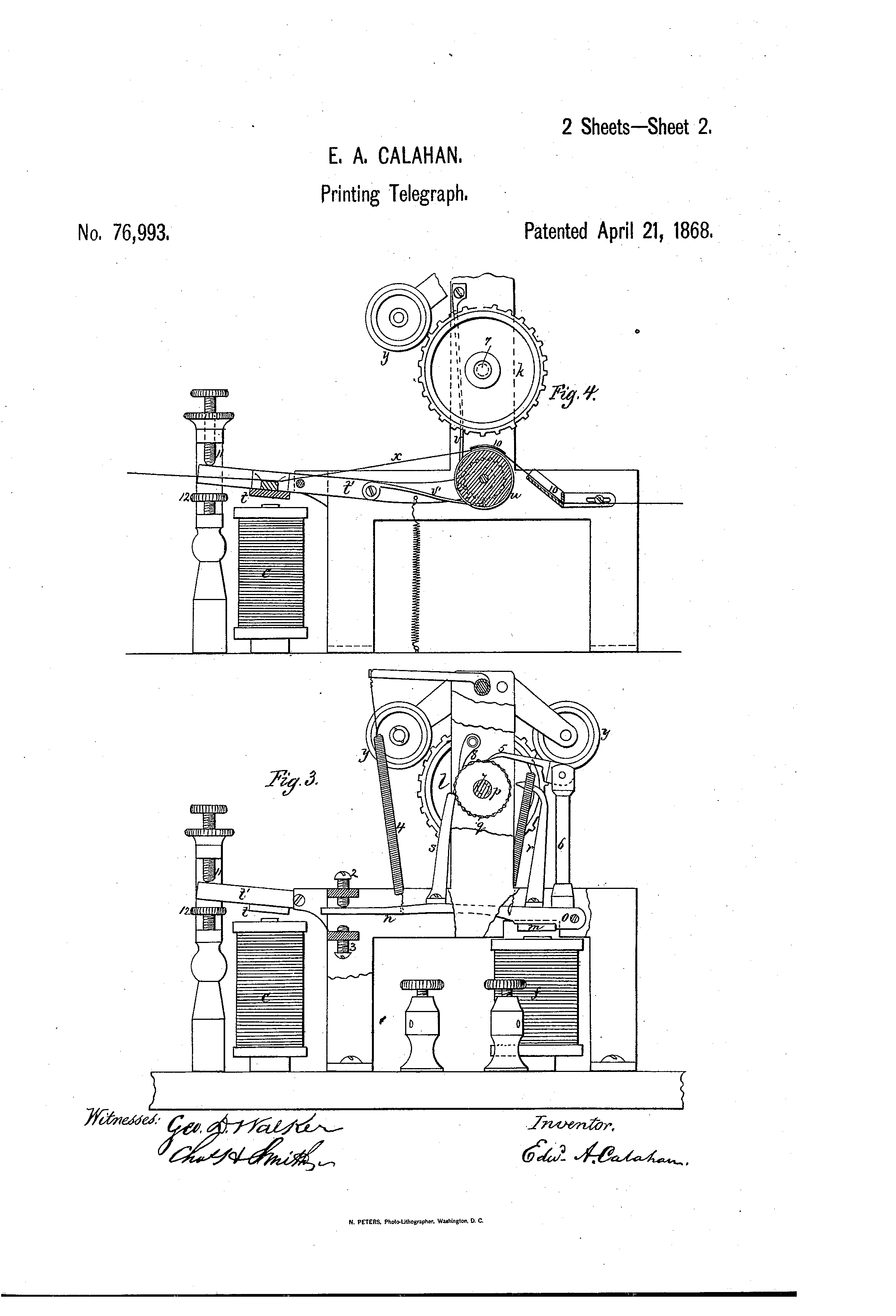
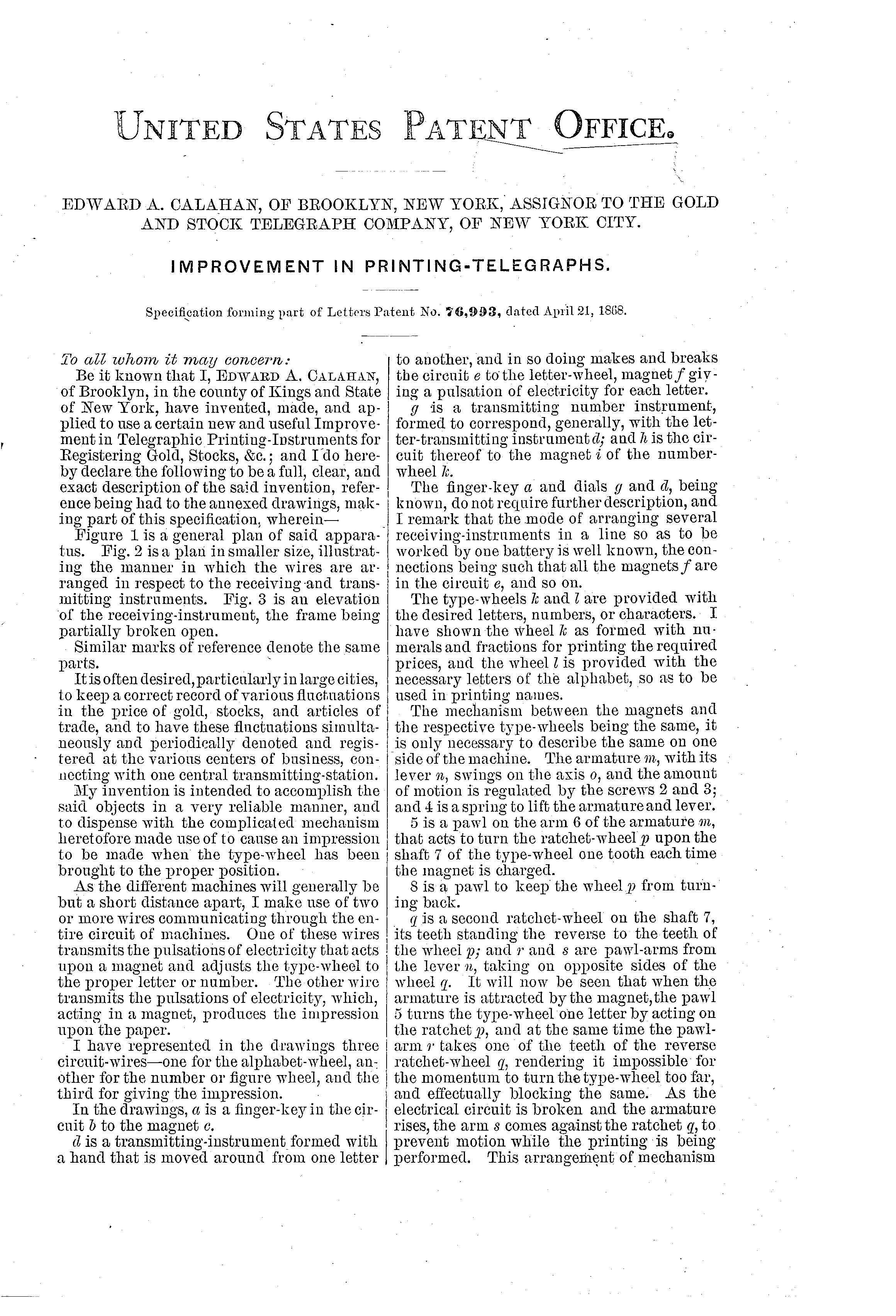
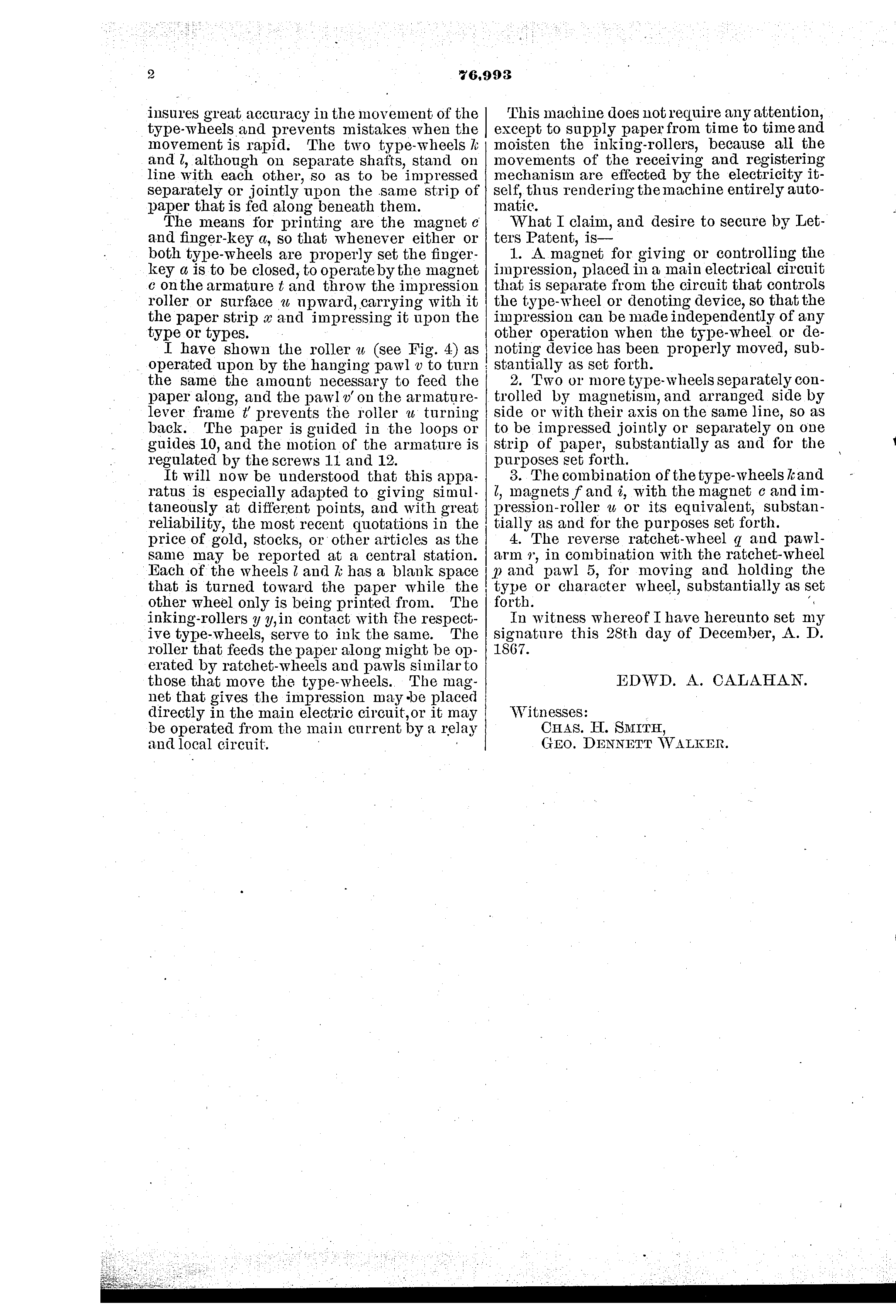
PDF · Google Patents · Assigned to the Gold and Stock Telegraph Company; the first patent to claim a stock printer.
US 72,742, Laws, granted 31 December 1867
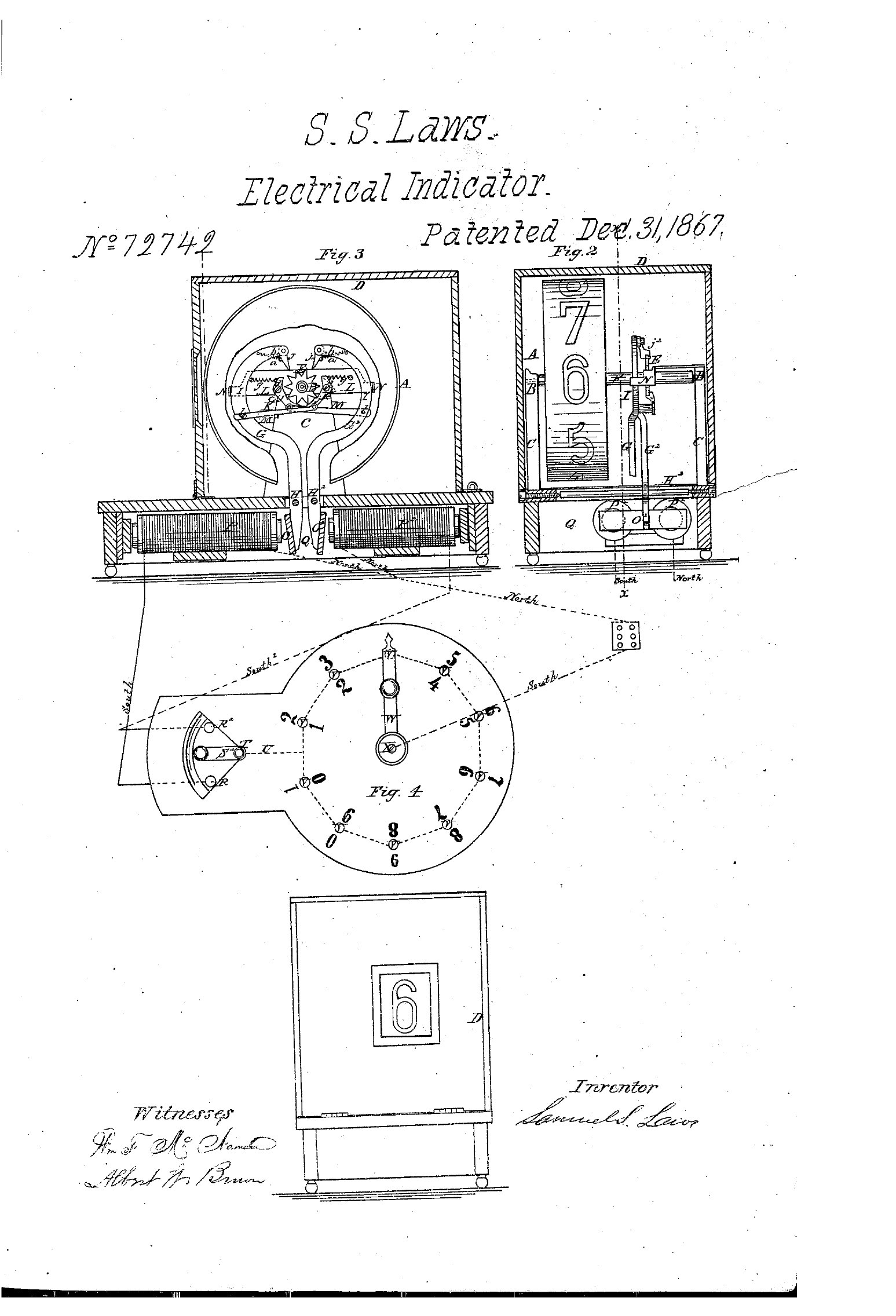
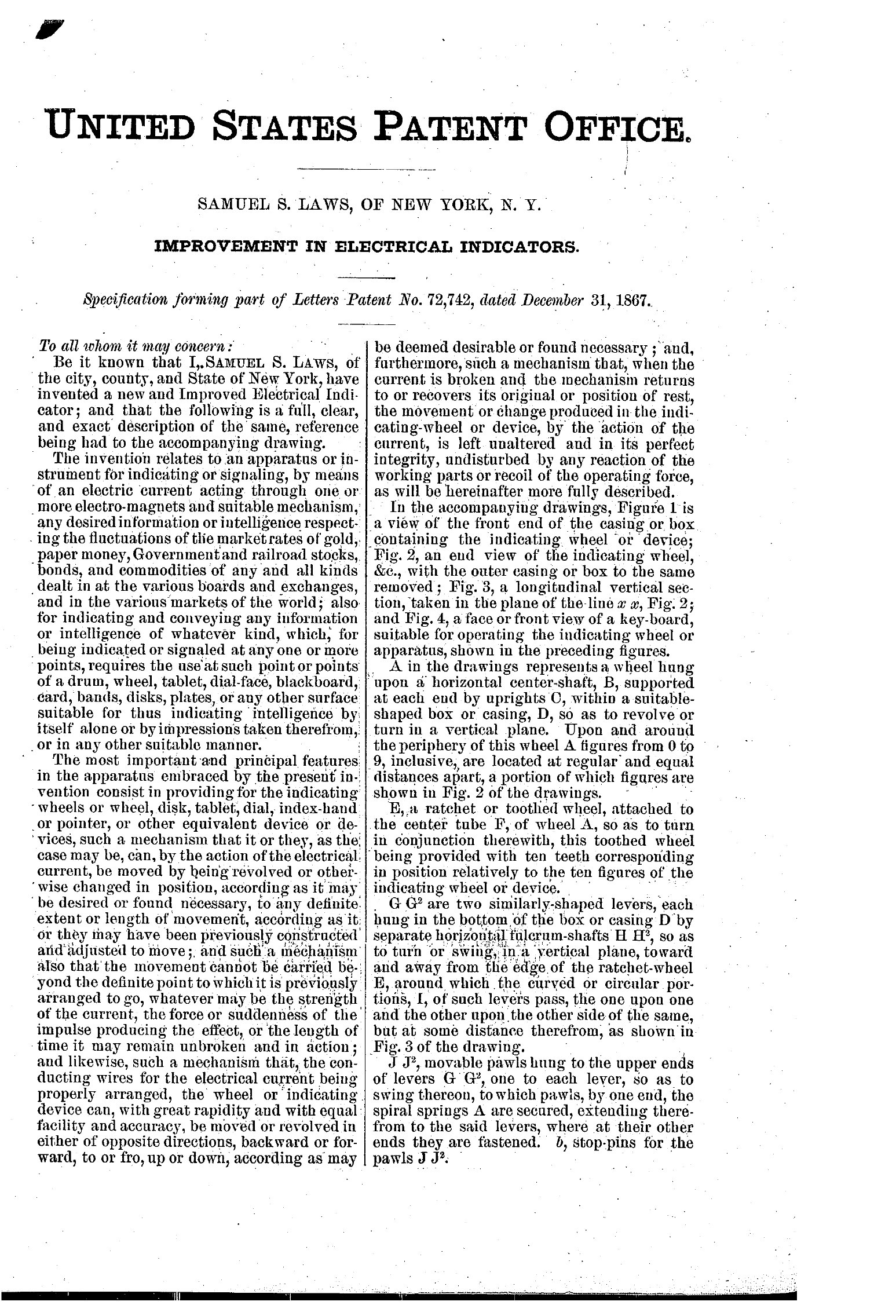
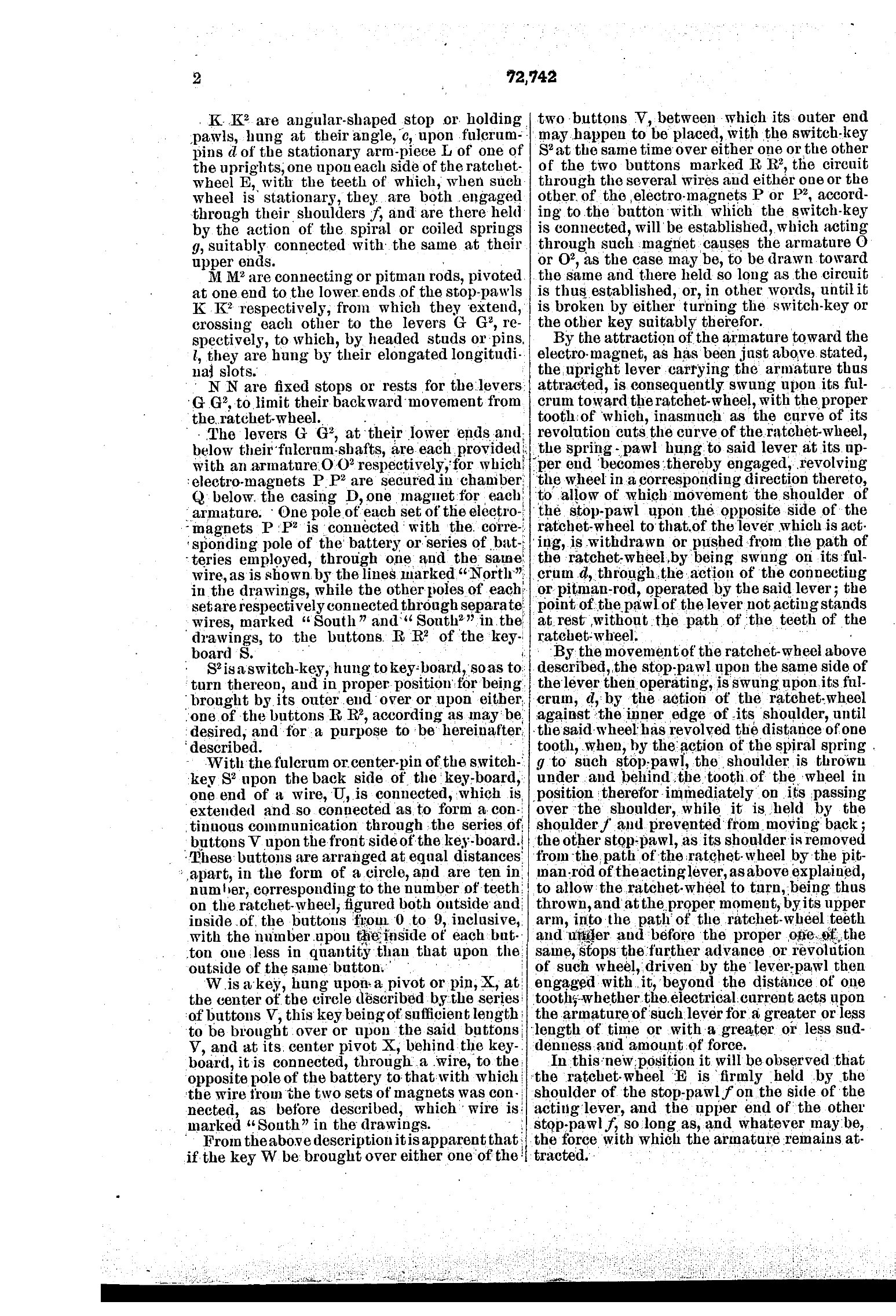
PDF · Google Patents · "Improvement in Electrical Indicators": a dial, not a printer.
Sources
Every fact on this page comes from these, as in the episode. Where the sources disagree, the page says so or leaves the point out.
Patents
- T. A. Edison, Improvement in Printing-Telegraphs, US Patent 126,532, 7 May 1872: the machine, its parts and the ink-roller; and its companions 123,006 (23 January 1872, the shift), 126,535 (7 May 1872, the screw unison) and 131,344 (17 September 1872, the half-step escapement, quoted above).
- T. A. Edison, US Patent 96,567, signed 17 August 1869, granted 9 November 1869, assigned to S. S. Laws: the redesigned Laws printer.
- E. A. Calahan, US Patent 76,993, 21 April 1868, assigned to the Gold and Stock Telegraph Company.
- S. S. Laws, Improvement in Electrical Indicators, US Patent 72,742, 31 December 1867.
History
- R. V. Jenkins et al. (eds.), The Papers of Thomas A. Edison, vol. 1, The Making of an Inventor (Johns Hopkins, 1989): the editors' notes, pp. 124–126 and 224 (Edison's hiring, the Laws sale, "lost his four-week-old job", Western Union's control of Gold and Stock), and Docs. 70 (his letter of July 1869), 97 (the April 1870 agreement), 126 (the October 1870 draft letter), 158 (the unison), 164 (the contract of 26 May 1871 and its notes), 165 and 195 (the private-line and stock printers; model no. 568; the specimen tape; numbers made); Doc. 169, pp. 296–297 (Stockton Griffin to Edison, 10 June 1871: "Inst had Thrown out once"); Edison's autobiographical notes of 1908–09, Appendix 1, pp. 639–642 (the breakdown story, the $1,500 and the $40,000).
- F. L. Dyer and T. C. Martin, Edison: His Life and Inventions (New York, 1910), vol. 1, pp. 131–133 (the offer, the teller, the small bills and the bank account, told from Edison's notes).
- Agreement of 26 May 1871, Edison and the Gold & Stock Telegraph Company, Rare Book and Manuscript Library, Columbia University (Edison Papers X090E).
- Gold and Stock Telegraph Company, board minutes of 25 August 1869, pp. 57–60, Western Union Telegraph Company Records, Archives Center, National Museum of American History (Edison Papers X099BA057): the Laws purchase and the hundred and forty indicators.
- E. A. Calahan, "The Evolution of the Stock Ticker", Electrical World and Engineer, 9 February 1901, pp. 236–238.
- R. W. Pope, "The Rise of the Stock Reporting Telegraph", The Electrical World, 4 March 1899, pp. 268–270.
- The Telegrapher, vol. 6: 2 October 1869 ("Newspaper Telegraphic Science"; the Pope, Edison & Co. card) and 16 April 1870 ("The Printing Telegraph. Its History and Applications. II": Calahan's printers and the fifty-six gold printers).
- G. B. Prescott, Electricity and the Electric Telegraph, vol. 2 (New York: Appleton, 1888), pp. 674–679.
- J. K. Medbery, Men and Mysteries of Wall Street (Boston, 1870), pp. 231–234 (the Gold Room).
- J. D. Reid, The Telegraph in America (New York, 1886), p. 822 (Calahan's start as a messenger).
- Annual Catalogue of the Missouri University, 1879–80, p. 5 and the faculty list (Laws as president; the telescope).
- The New York Times, 21 October 1884, p. 2, and 29 October 1886, p. 2 (the tape); 13 September 1912, p. 9 (Calahan's obituary).
- Thomas A. Edison Papers, Rutgers University: chronologies 1847–1870 and 1871–1880 (New York, the superintendent's job, the Newark shops, London, Menlo Park, the phonograph), and "Stock Ticker" ("until about 1960").
- CultureNow, "Canyon of Heroes", on the Alliance for Downtown New York's parade markers (a secondary source).
- Dollar amounts in today's money: the ratio of annual-average consumer prices, from the Federal Reserve Bank of Minneapolis, "Consumer Price Index, 1800-", with 2025 as today, rounded to two figures. Prices before 1913 are estimates, which is why every figure is marked ≈.
Images
- Patent drawings and specifications: USPTO, public domain.
- Prescott's engravings (1888), the Laws indicator from Electrical World and Engineer (1901) and Medbery's "The Gold Room" (1870): published in the United States before 1931, public domain; scans via the Internet Archive.
- "Automatic ticker apparatus, New York Stock Exchange. Central control station", 5 December 1922, Library of Congress Prints and Photographs Division, LC-DIG-ds-06719: "No known restrictions on publication."