 Curious Patents
The Electric Self-Starter
In 1903 the United States granted a patent for a motor that starts a car's engine, then turns into a dynamo and charges the battery. It was not Charles Kettering's: he filed his eight years later, and his is the one in the history books. Drive Kettering's starting device from its clutch pedal and run Coleman's 1903 gears beside it, both rebuilt from the patents' drawings; read the patents, and see every source.
Watch the episode
Two patents, eight years apart
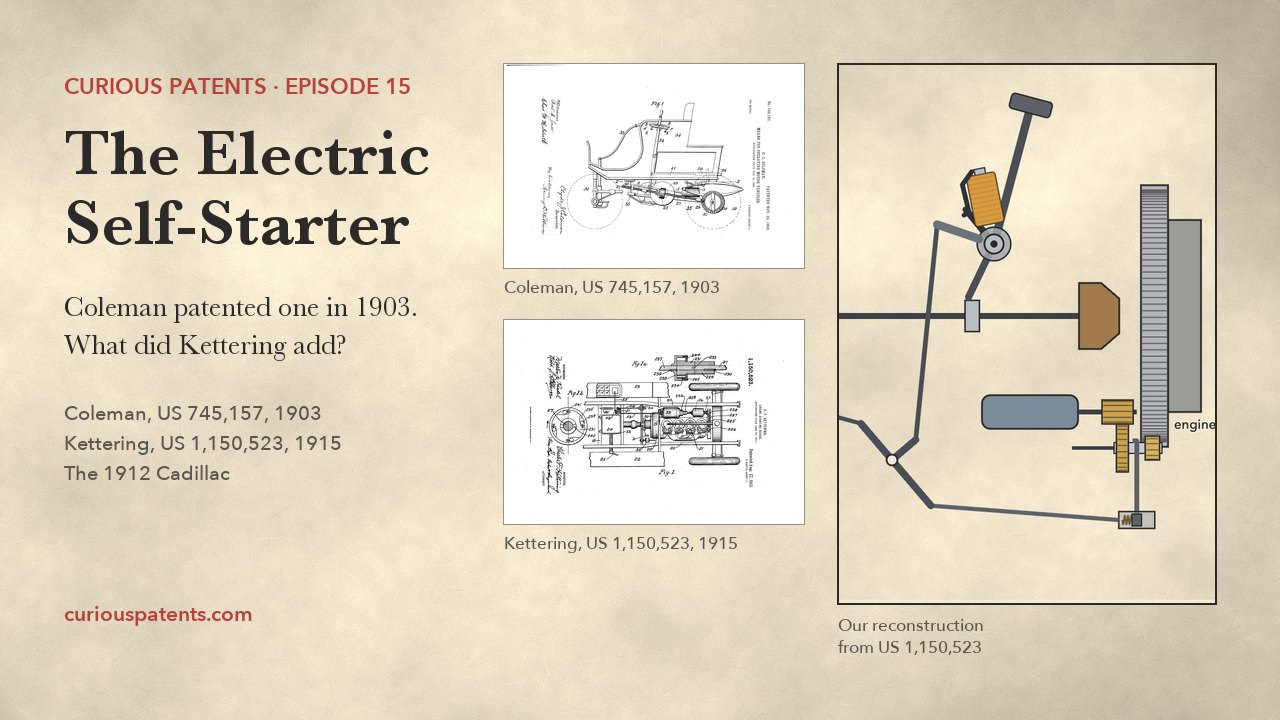
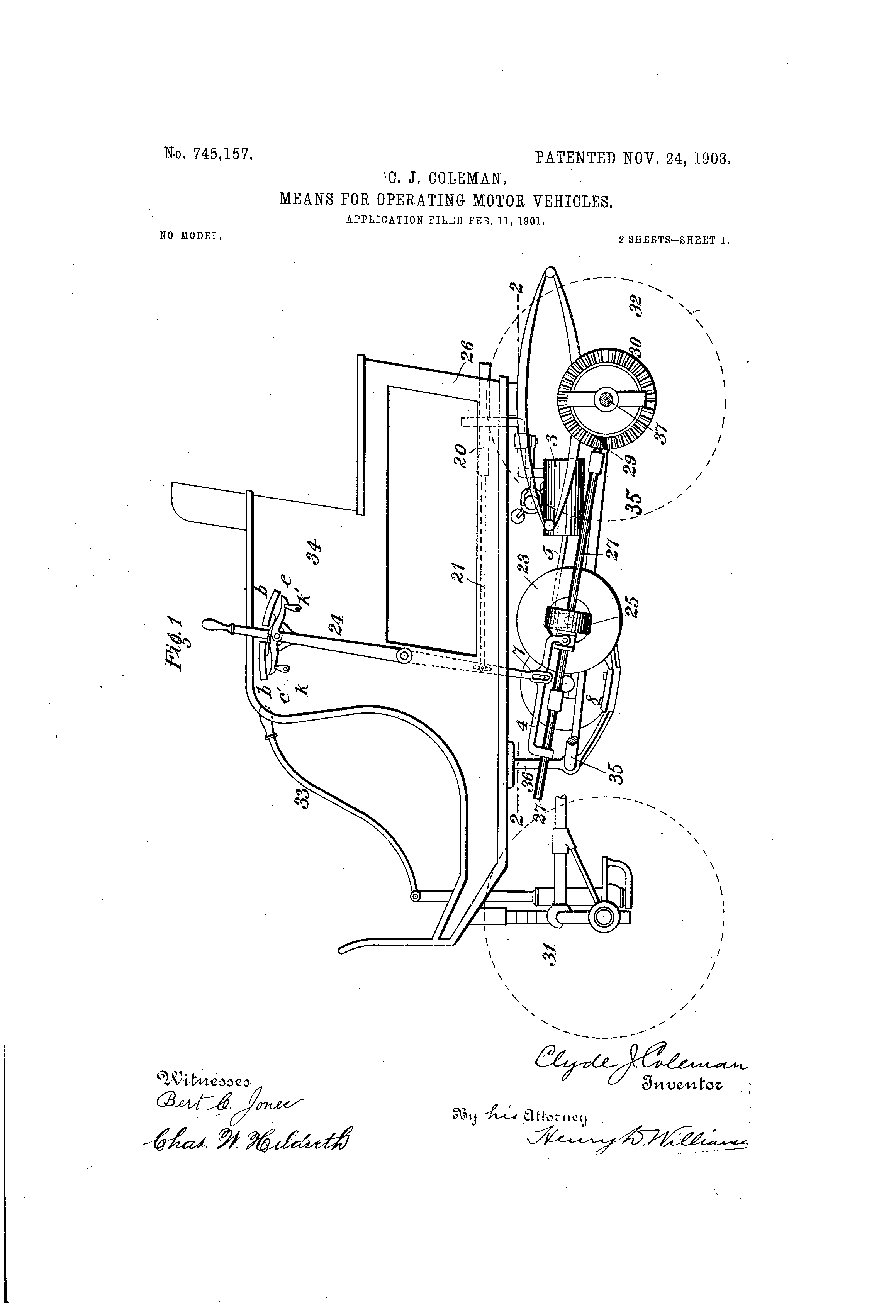
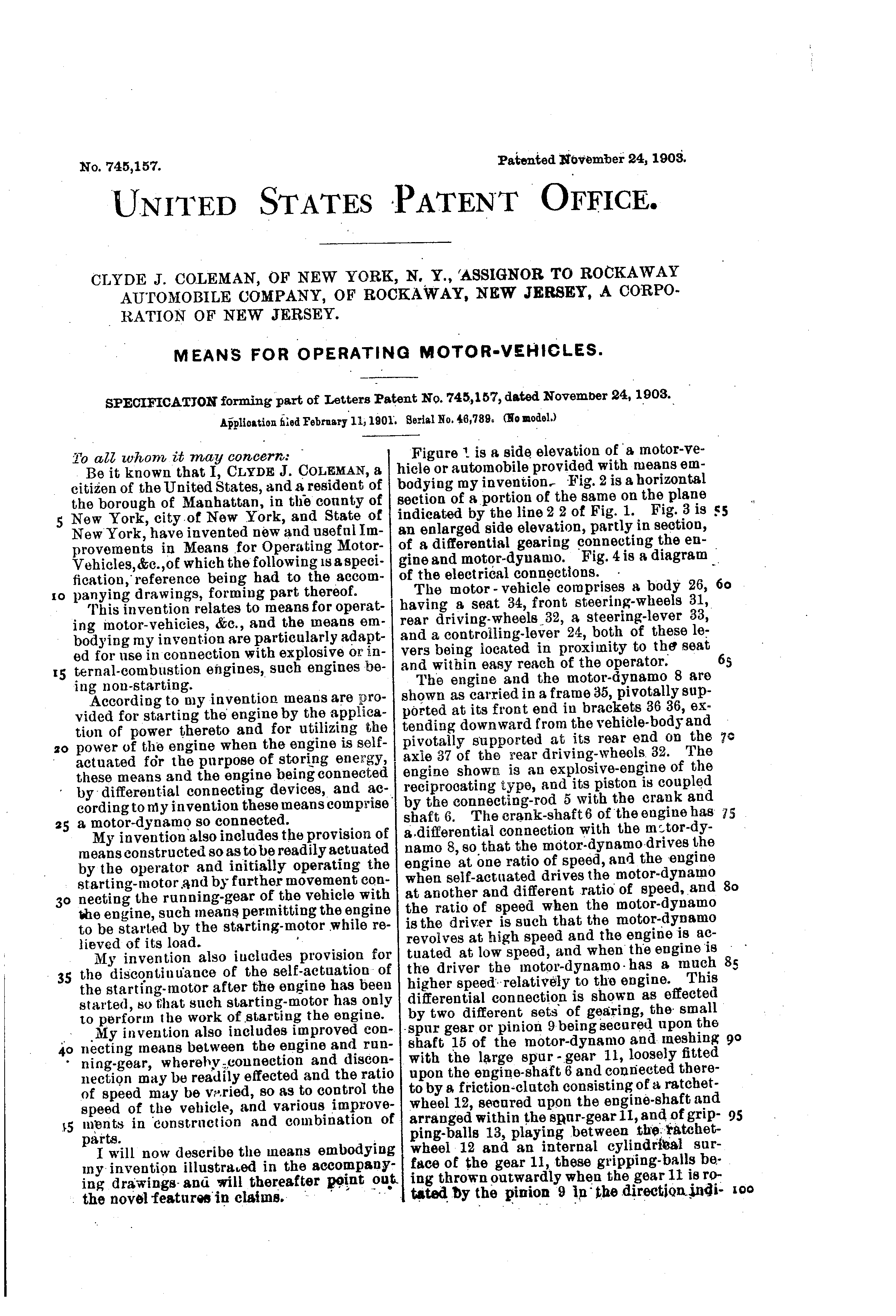
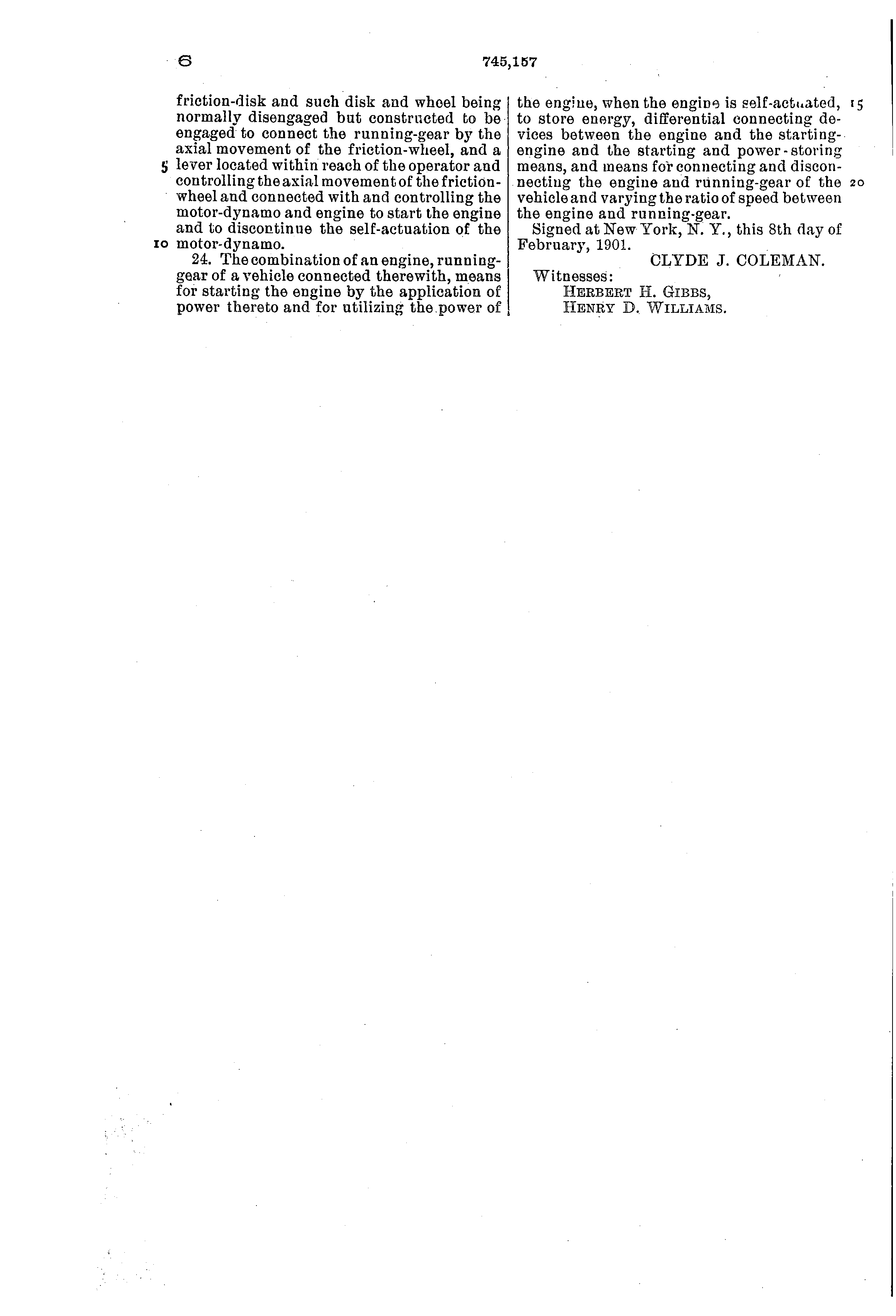
Clyde J. Coleman, of New York, filed his patent in February 1901, and it was granted on 24 November 1903 (US 745,157, assigned to the Rockaway Automobile Company, of New Jersey). It describes a motor that starts a car's engine, then is driven by the engine as a dynamo and charges the battery (pp. 1-2).
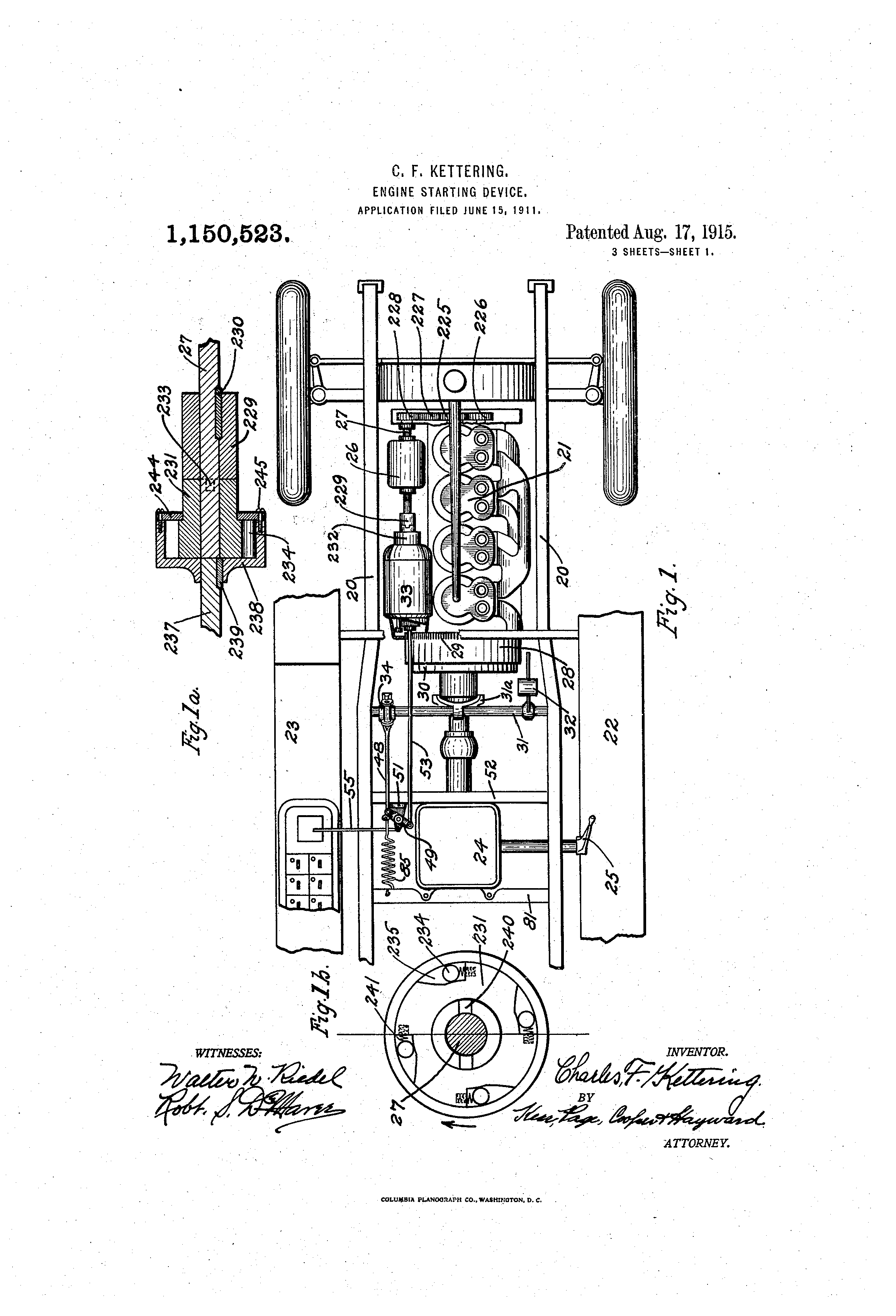
Charles F. Kettering, of Dayton, Ohio, filed his "Engine-starting device" on 15 June 1911. It was granted on 17 August 1915, to his company, the Dayton Engineering Laboratories Co. (US 1,150,523). So what did Kettering patent that was not already on the page? In short: a clutch pedal with two jobs, a magnet that decides when it has them, and a battery rewired in the middle of a start (claims 6, 8, 19-23). The model further down lets you work all three.
What the crank did
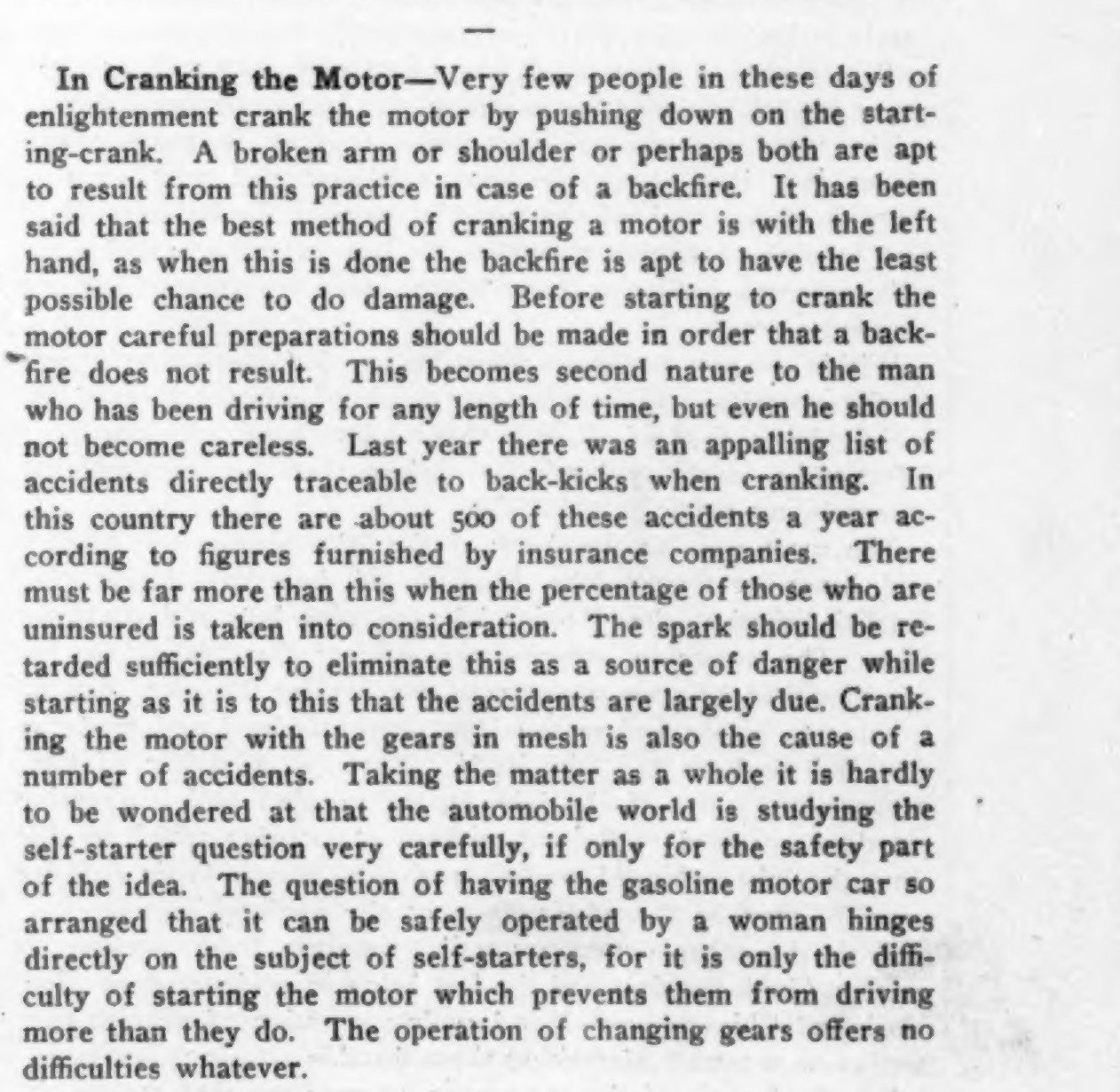
Before the self-starter, a gasoline engine was started by hand, with a crank at the front of the car. The danger was the backfire. If the spark came too early, the engine could kick back and throw the crank the wrong way, against the hand that held it (The Automobile, 14 March 1912, p. 721: "back-kicks when cranking"; "The spark should be retarded").
The trade weekly warned against pushing down on the crank: "A broken arm or shoulder or perhaps both are apt to result from this practice in case of a backfire." And it put a number on it: "In this country there are about 500 of these accidents a year according to figures furnished by insurance companies. There must be far more than this", it went on, counting the drivers who had no insurance (p. 721).
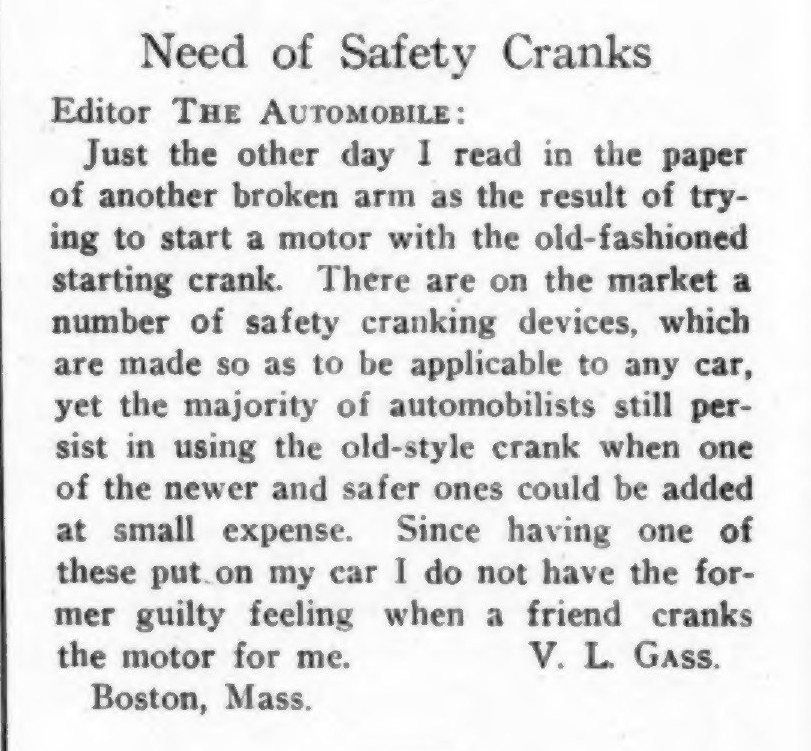
Readers had written in already. A letter printed in December 1911 began: "Just the other day I read in the paper of another broken arm as the result of trying to start a motor with the old-fashioned starting crank" (V. L. Gass, Boston, in The Automobile, 14 December 1911, p. 1056).
Those are reported accidents, not deaths. The advice was to retard the spark first, and to crank with the left hand, where a kick "is apt to have the least possible chance to do damage" (The Automobile, 1912, p. 721). An electric motor at the flywheel would take the hand off the crank altogether.
The story usually told
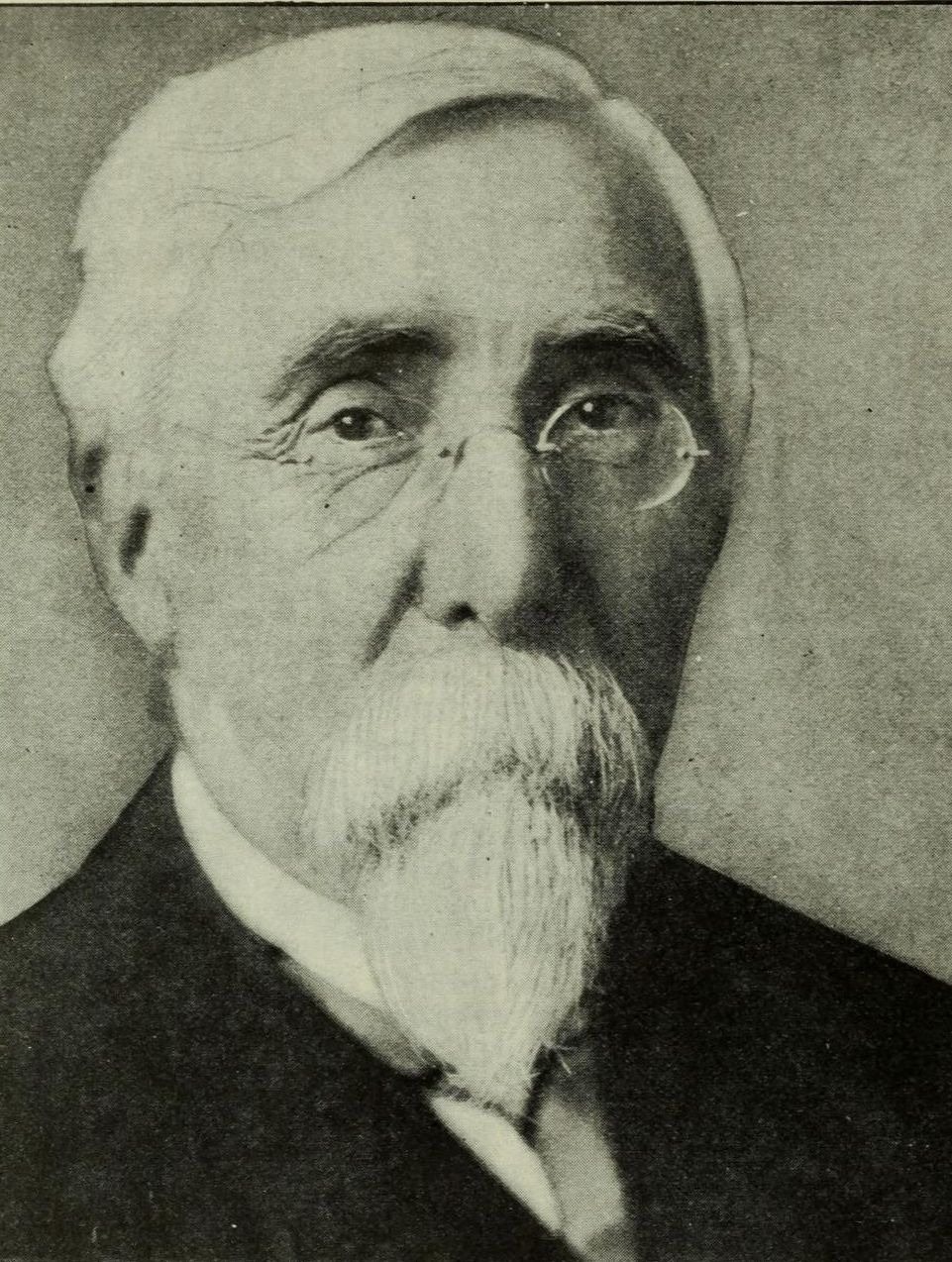
The story usually told is that a friend of Henry Leland, the head of Cadillac, was killed by a crank on a Detroit bridge, and that Leland then asked Kettering to get rid of the crank. It has several versions: in GM's The Turning Wheel (1934, which names no one), in T. A. Boyd's Kettering biography (1957) and in the Lelands' biography (1966), as the Cartercar history site, cartercar.org, lists them. The earliest account we know of that names the man, Byron Carter, is Boyd's of 1957 (as cartercar.org lists it; we have not seen the book).
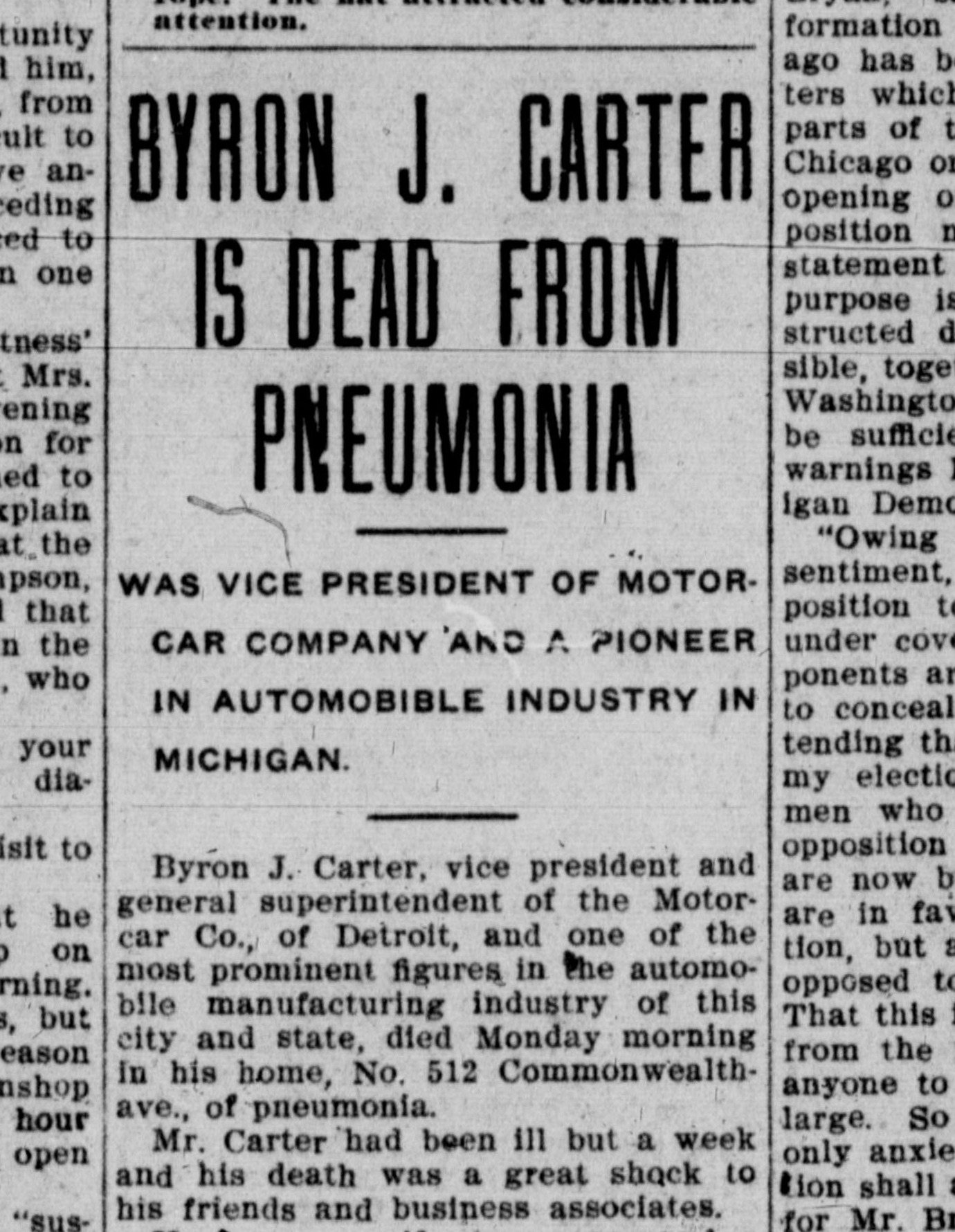
Carter's own death was reported in the Detroit Times on 6 April 1908: "BYRON J. CARTER IS DEAD FROM PNEUMONIA". "Mr. Carter had been ill but a week."
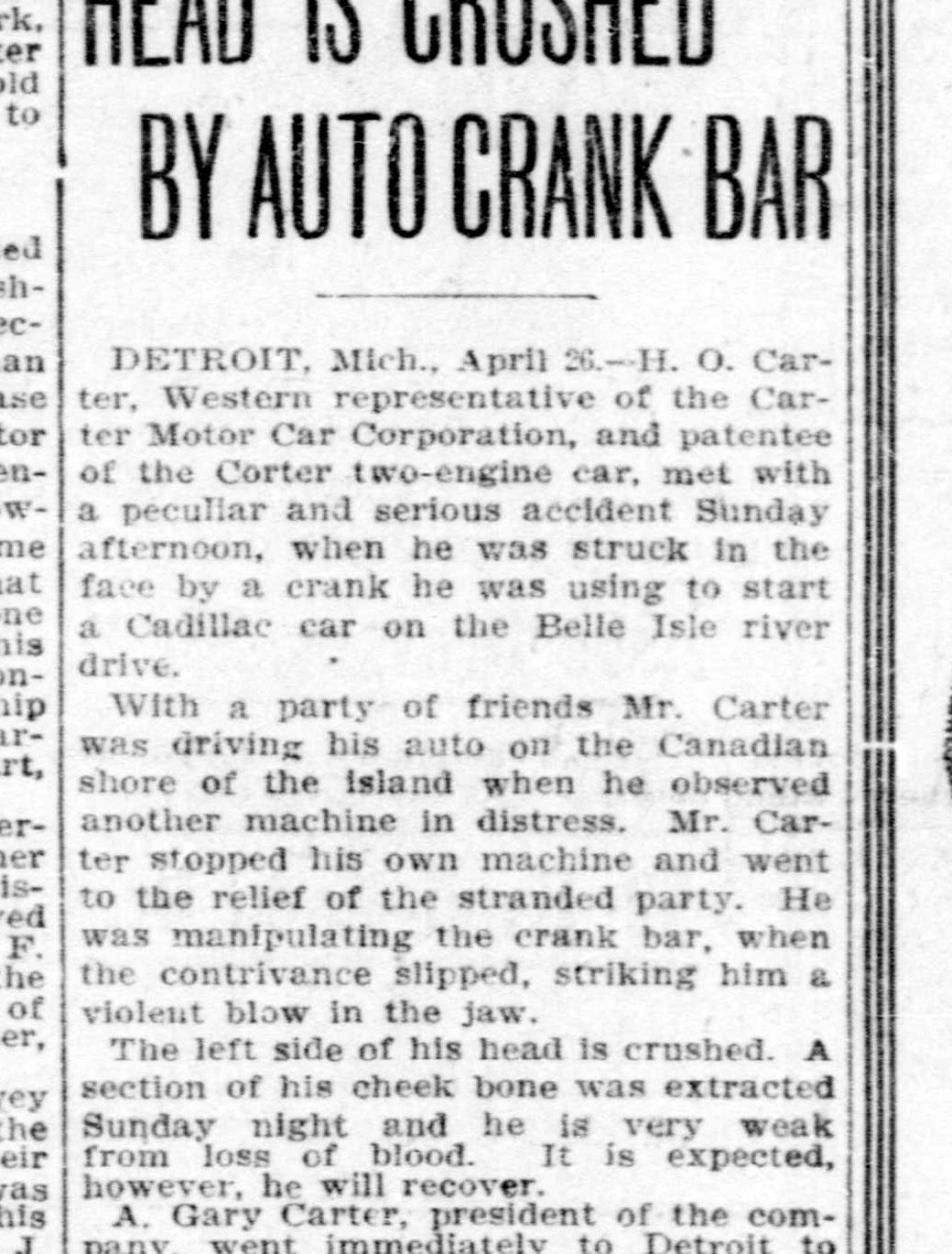
A year earlier, a report from Detroit told of a different Carter, H. O. Carter, of the Carter Motor Car Corporation, "struck in the face by a crank he was using to start a Cadillac car on the Belle Isle river drive". It ended: "It is expected, however, he will recover." (The Washington Times, 26 April 1907, p. 3.)
Neither report names Leland, Kettering or a starter. We found no account from the time that ties either man to the starter.
Coleman, 1903
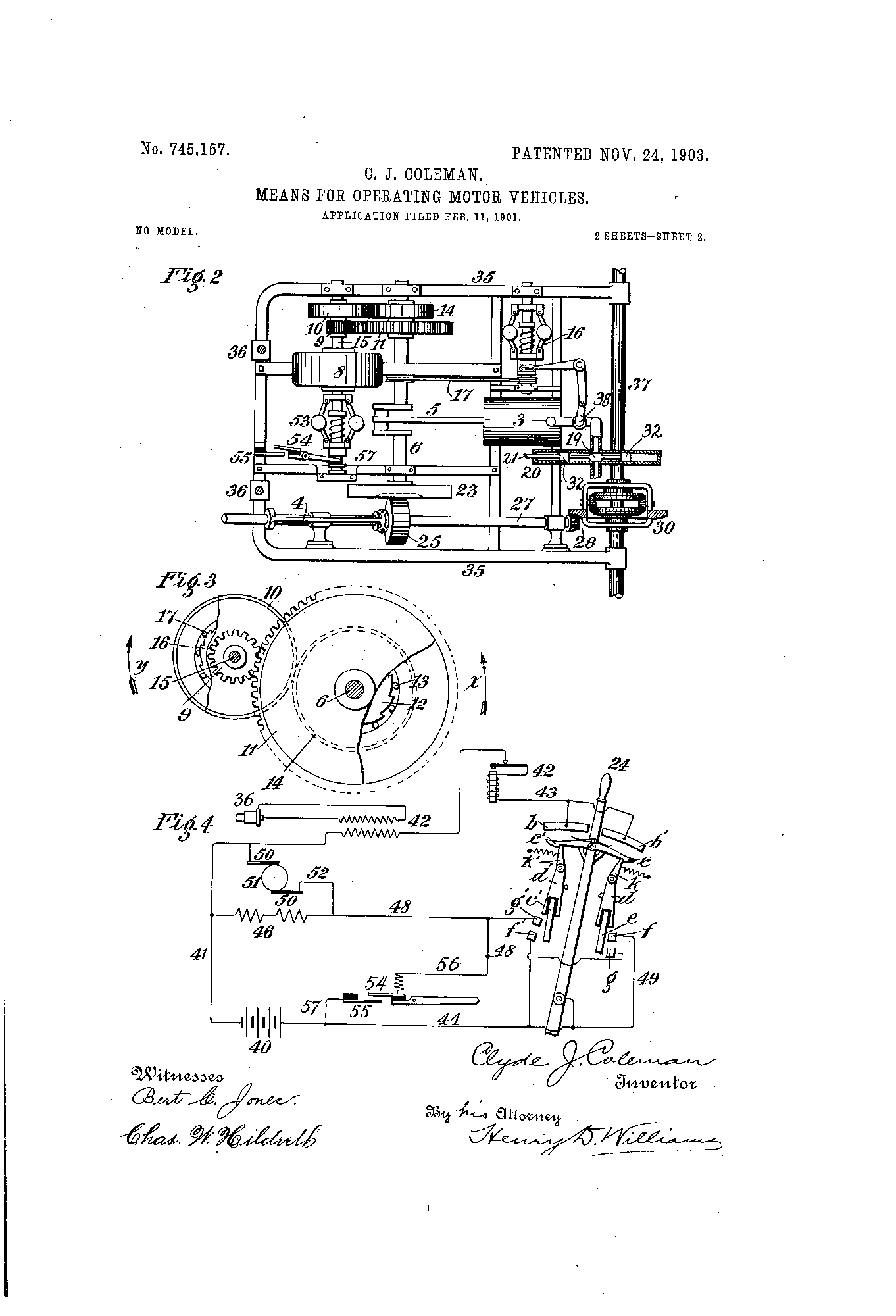
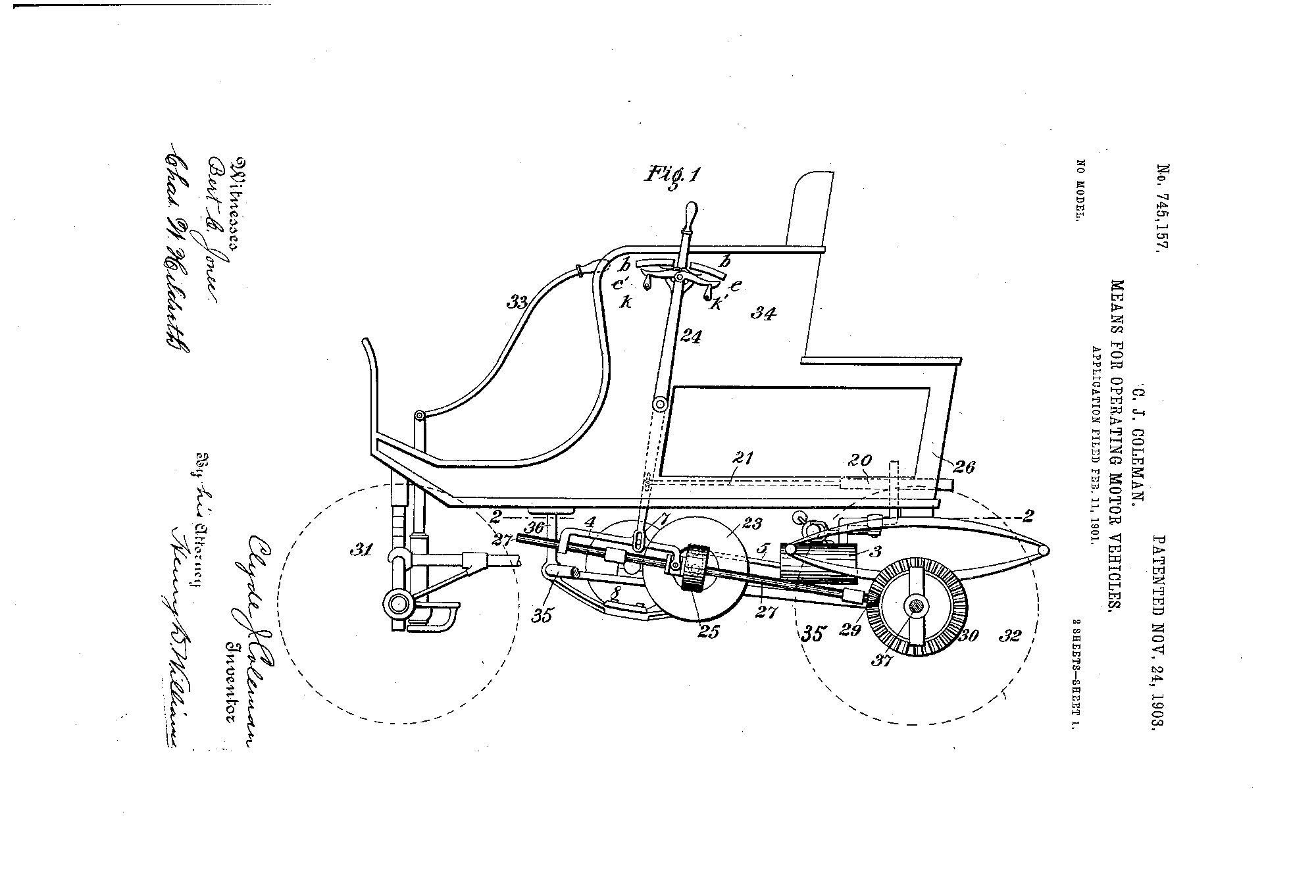
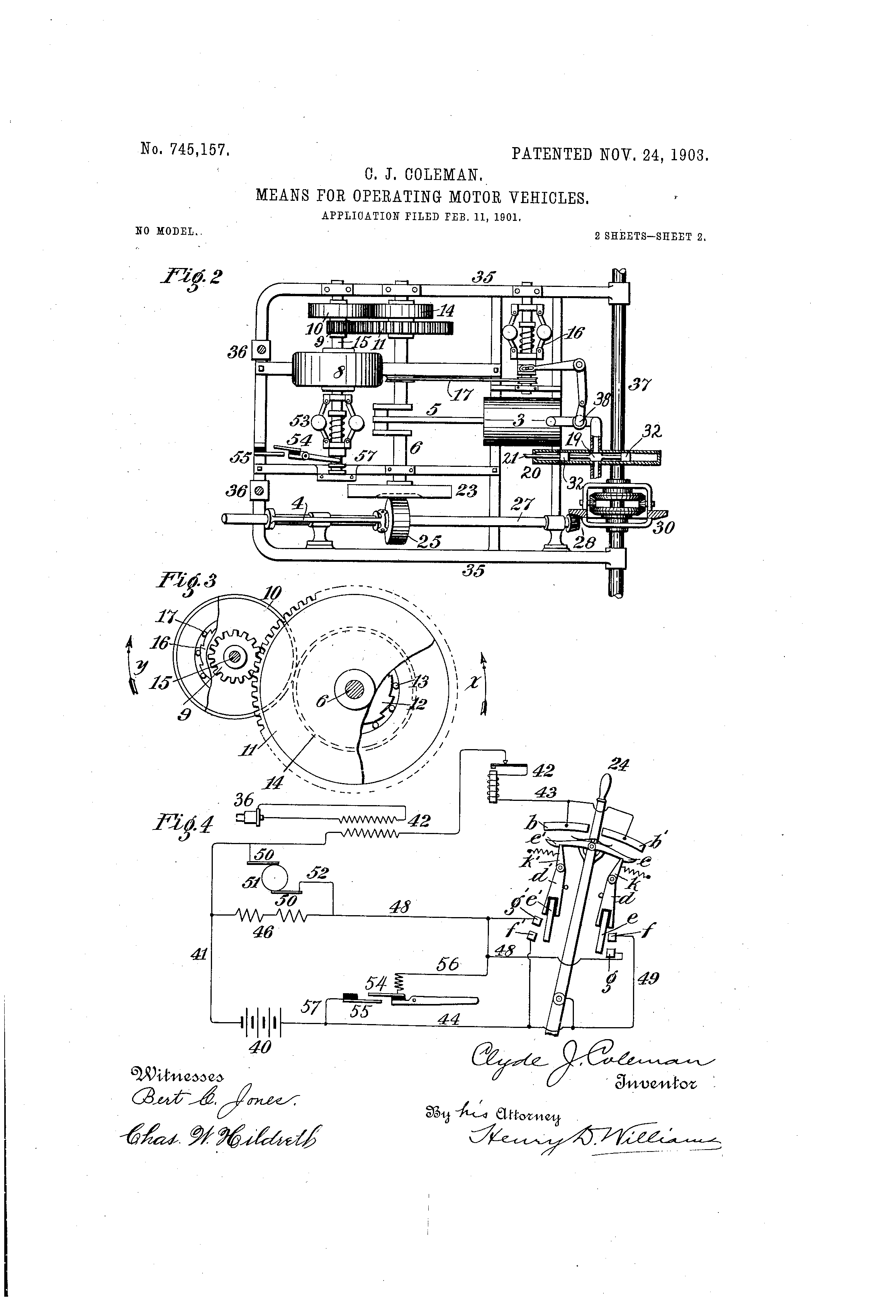
Coleman called his patent "Means for operating motor-vehicles", and its first idea is the one we call the self-starter. An electric "motor-dynamo" is geared to the engine. Run from a storage battery, it turns the engine over; once the engine runs, the engine drives it back, and it charges the battery (US 745,157, pp. 1-2).
The trick is two pairs of gears, each with its own one-way clutch: steel balls that wedge in one direction and roll free in the other (Fig. 3). As a motor, it drives the engine through a small gear on a large one, pinion 9 on gear 11, slowly, "with considerable advantage of leverage" (p. 2). When the engine fires and outruns it, that clutch lets go, and the second pair takes over: friction gears 14 and 10, "both of the same diameter", so now the engine turns the dynamo at its own speed.
From the patent (Fig. 3; pp. 1-2): pinion 9 on the motor-dynamo's shaft 15, always in mesh with gear 11, which is loose on engine shaft 6 and drives it through ratchet 12 and gripping balls 13; friction gear 14, keyed to shaft 6, always against friction gear 10, which is loose on shaft 15 and drives it through ratchet 16 and balls 17; 14 and 10 "both of the same diameter". Balls that are holding are drawn red. Ours: the 1 to 4 of pinion 9 and gear 11 (the drawing shows 11 about four times the size of 9), the number of balls, the speeds, the moment the engine fires (2.7 seconds after the motor starts), and the motor stopping as it fires, as the episode draws it. In the patent it is the lever's further movement that cuts the motor (below). Checked by the episode's test: as a motor it turns four times for each turn of the engine, as a dynamo once; the two ball clutches never hold at once, which would lock the gears.
One lever by the seat runs the start. Its first movement switches on the motor, opens the fuel and closes the spark circuit, while the wheels stay disconnected. Pushed further, it cuts off the motor and connects the engine to the wheels. So the engine is started, in Coleman's words, "while relieved of its load" (pp. 1, 3). A governor closes the charging circuit only when the engine reaches its normal speed, so the battery is not overcharged (pp. 2-3).
From the specification (p. 3) and claims 2 and 14-16: the first movement of lever 24 closes the motor circuit, opens supply valve 20 and closes the sparking circuit while friction wheel 25 sits in the recess of disk 23, so the wheels are not driven; further movement breaks the motor circuit and moves friction-gear 25 out across the disk's face, "farther away from the axis", so the engine drives the wheels, faster the further it goes; governor 53 closes the charging circuit at the engine's normal speed. Ours: the positions along the lever's travel at which each thing switches.
So a motor that starts the engine and then charges the battery, and a start with the wheels disconnected, were in a patent of 1903. One thing his design never needs: his gears are always in mesh, and the balls choose which pair does the driving. We found no record that Coleman's design was built or sold.
Kettering, Leland and Delco
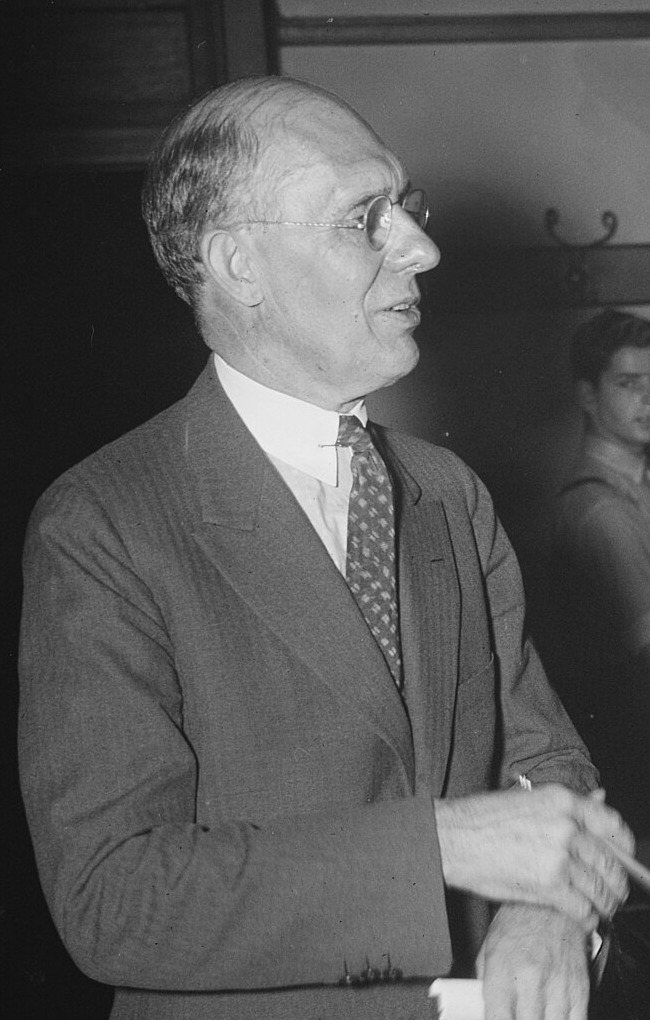
Charles Kettering was an engineer at the National Cash Register Company, in Dayton, Ohio. In 1909 he and Edward Deeds set up the Dayton Engineering Laboratories Company, which came to be called Delco (according to Mark Strecker's history of the starter and to Delco's own company history; the company's name is in the patent's heading).
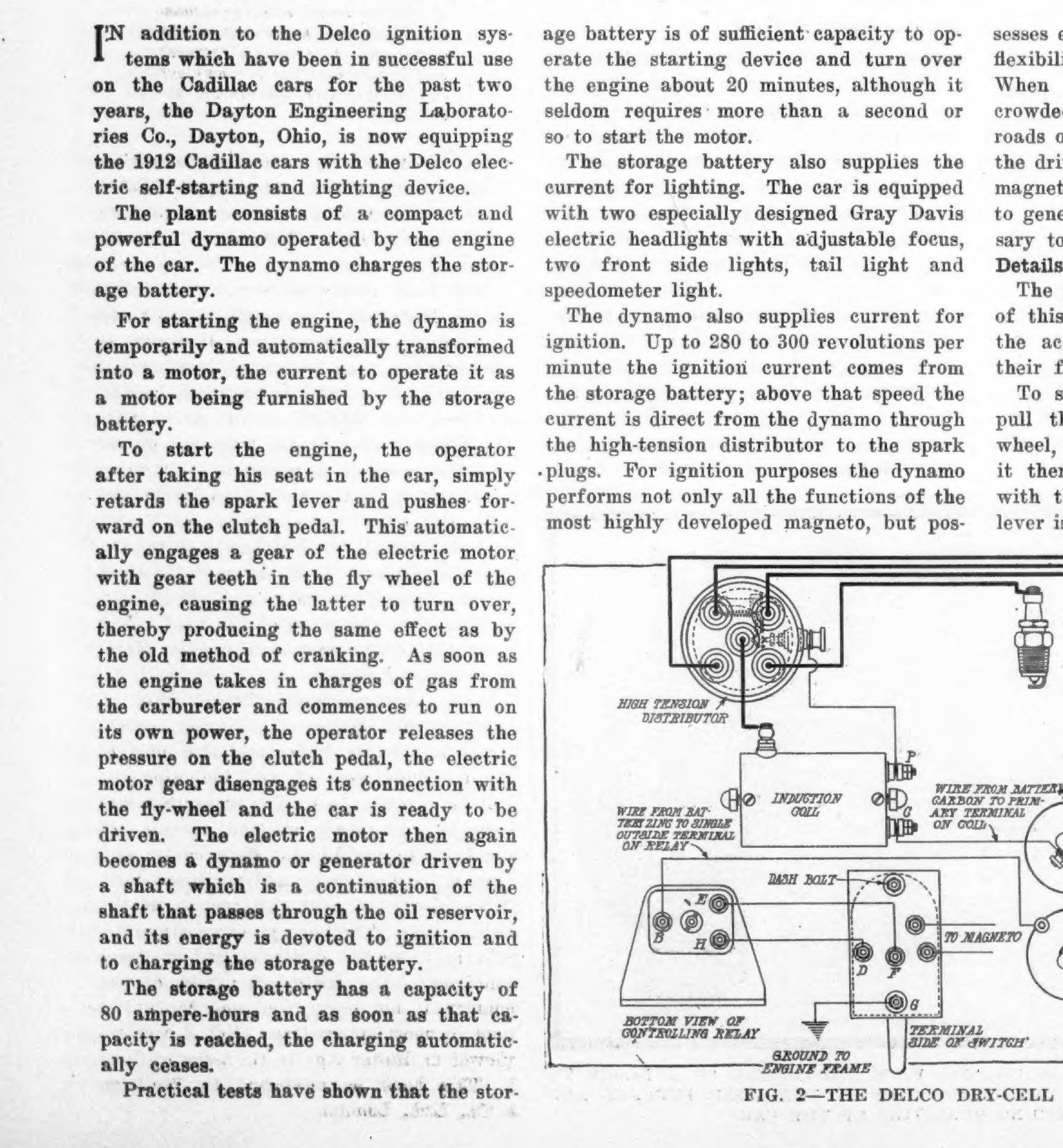
Its first big customer was Cadillac, for ignition. In October 1911, Motor Age wrote that Delco ignition had "been in successful use on the Cadillac cars for the past two years" (5 October 1911, p. 34). Cadillac was run by Henry Leland, a machinist known for precision (as Strecker's page puts it, quoting earlier histories).
Delco's own history, unsigned and undated, has Leland telling Kettering: "If you can provide an electric starter, I will put it on my 1912 car." Work on the starter began in 1910, according to that history, in the barn behind Deeds's house in Dayton, where Kettering had worked since 1908 ("Deeds Barn and the Self Starter").
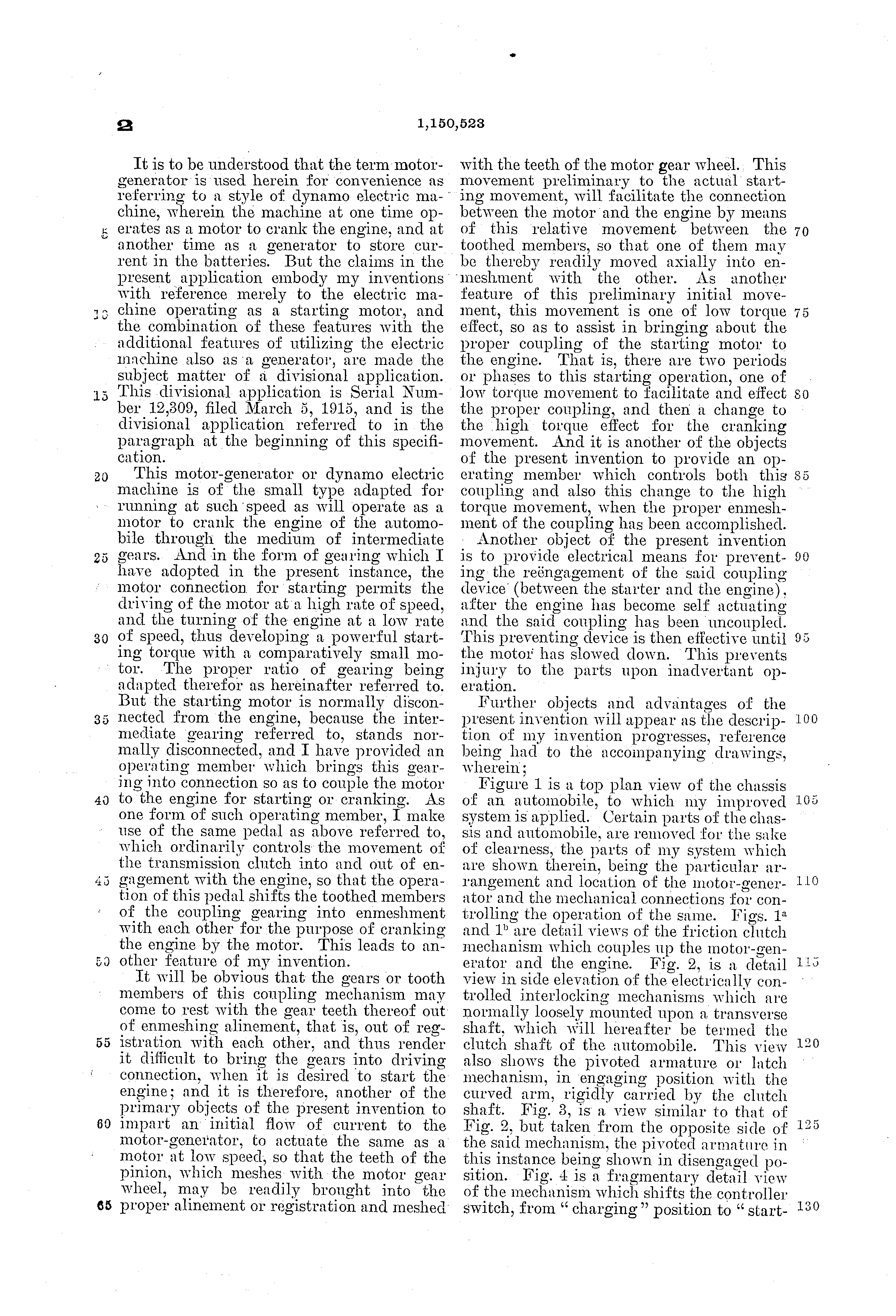
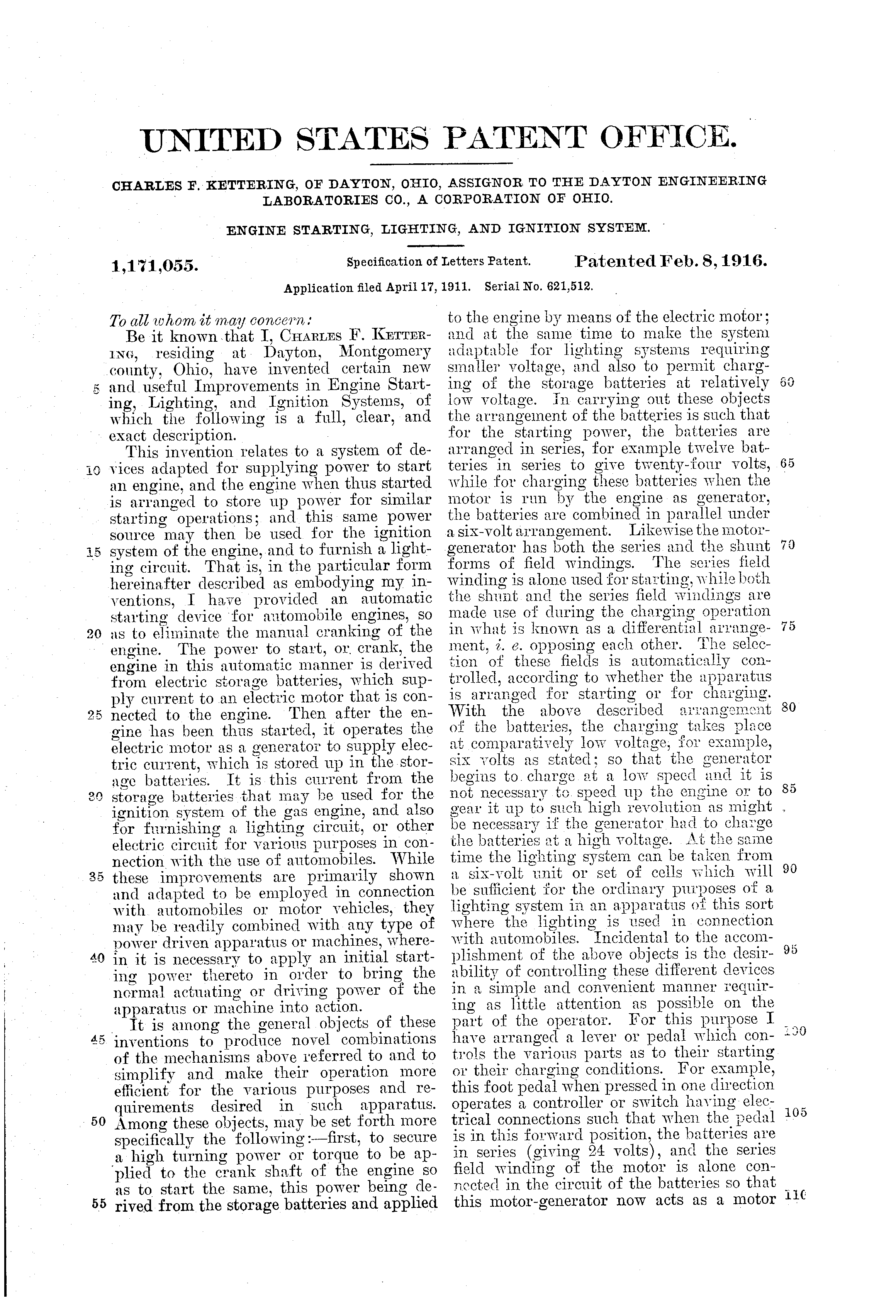
Kettering filed for a whole system, starting, lighting and ignition together, in April 1911 (US 1,171,055), and for the starting device itself in June (US 1,150,523).
Kettering's patent
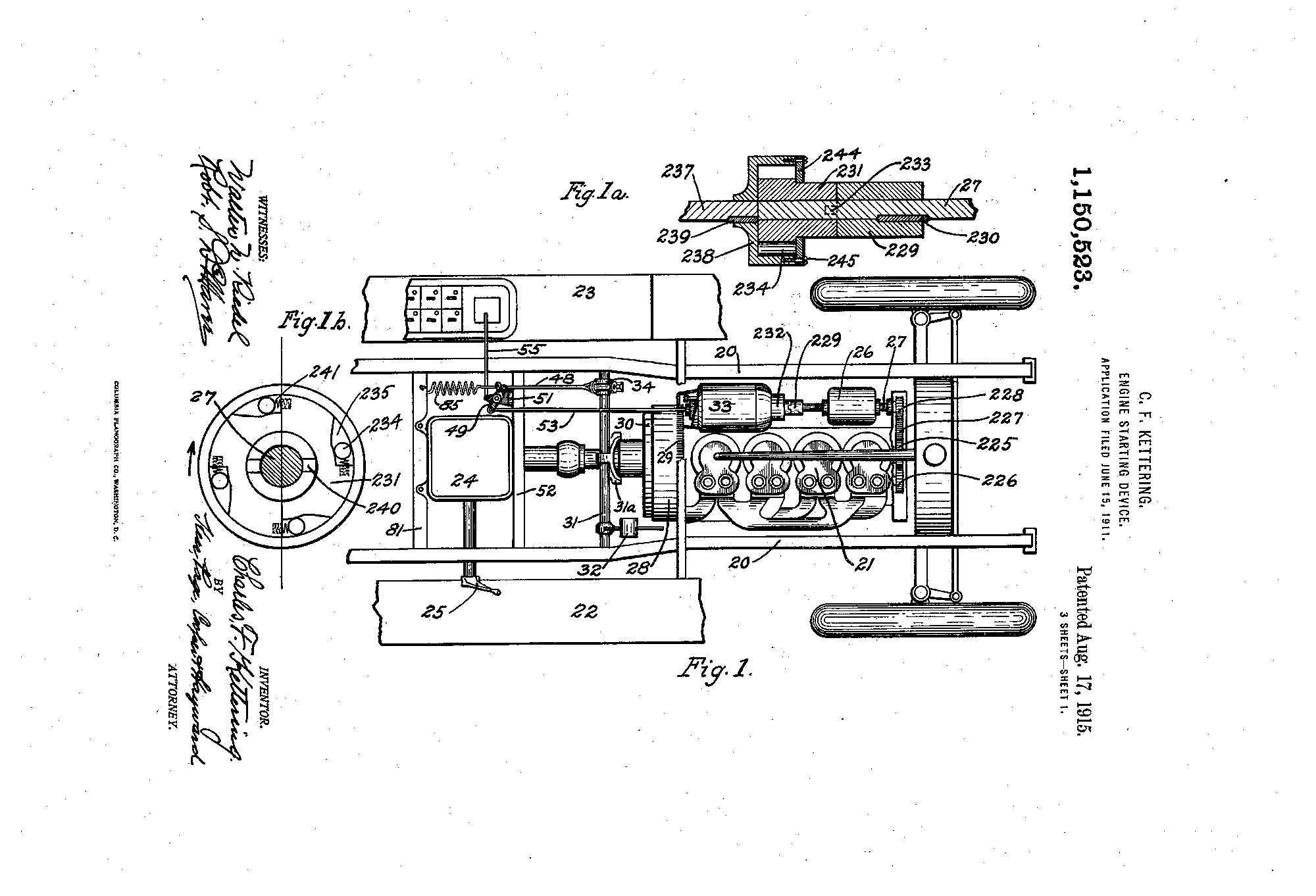
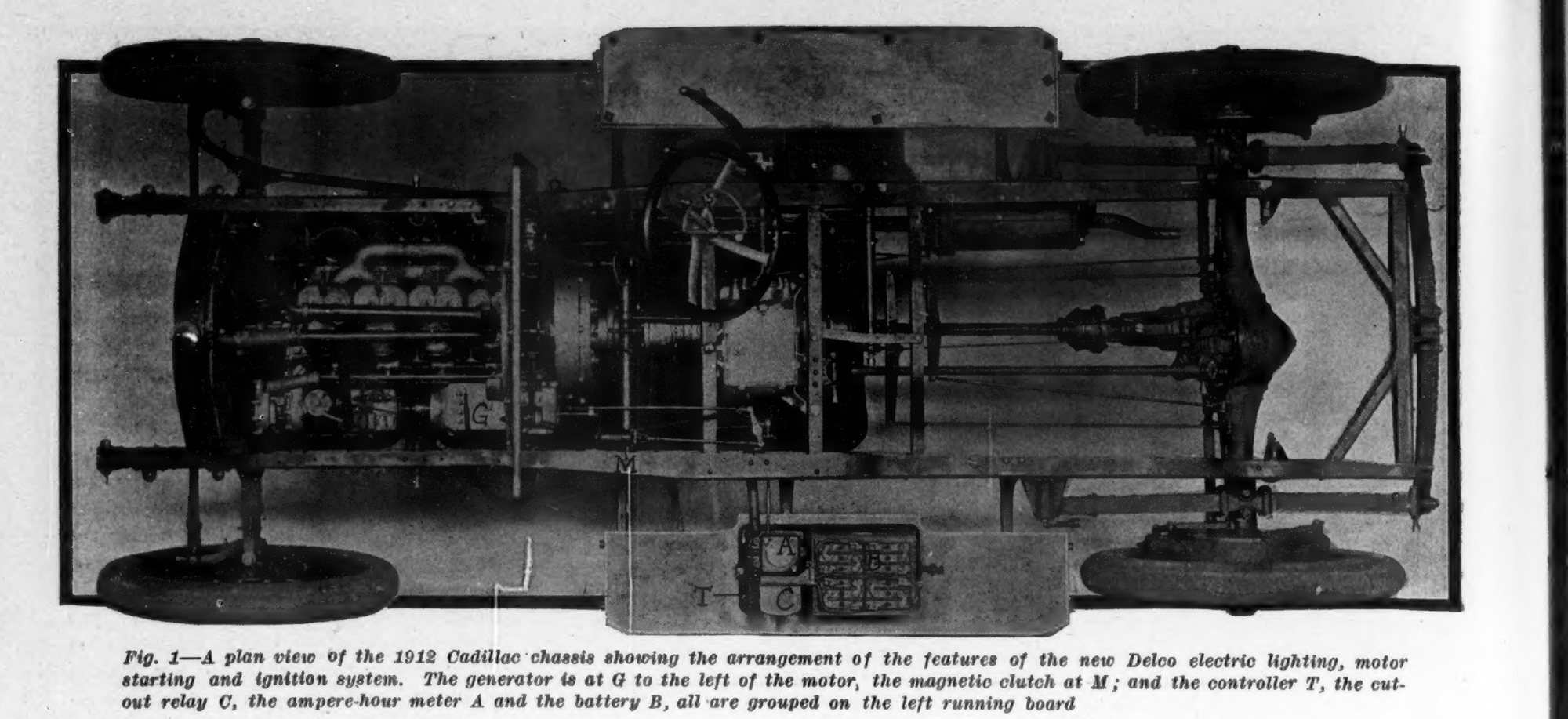
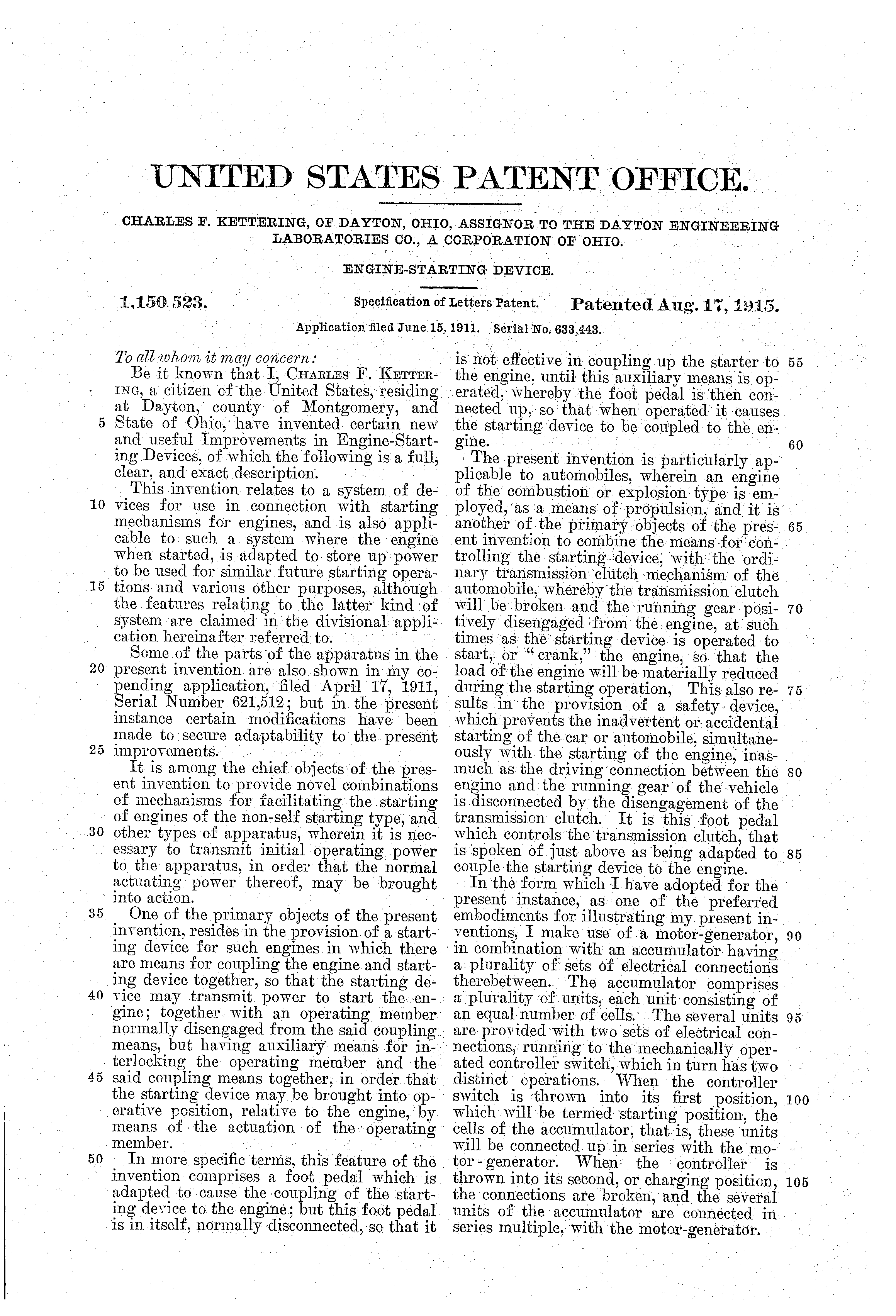
The starting patent was granted in August 1915, for an "Engine-starting device". Kettering is the inventor; his company in Dayton owns it. Its first drawing is a car's chassis from above, and the text names the car: "the 'Cadillac' which is a well known automobile, on the market at the present time" (US 1,150,523, p. 3).
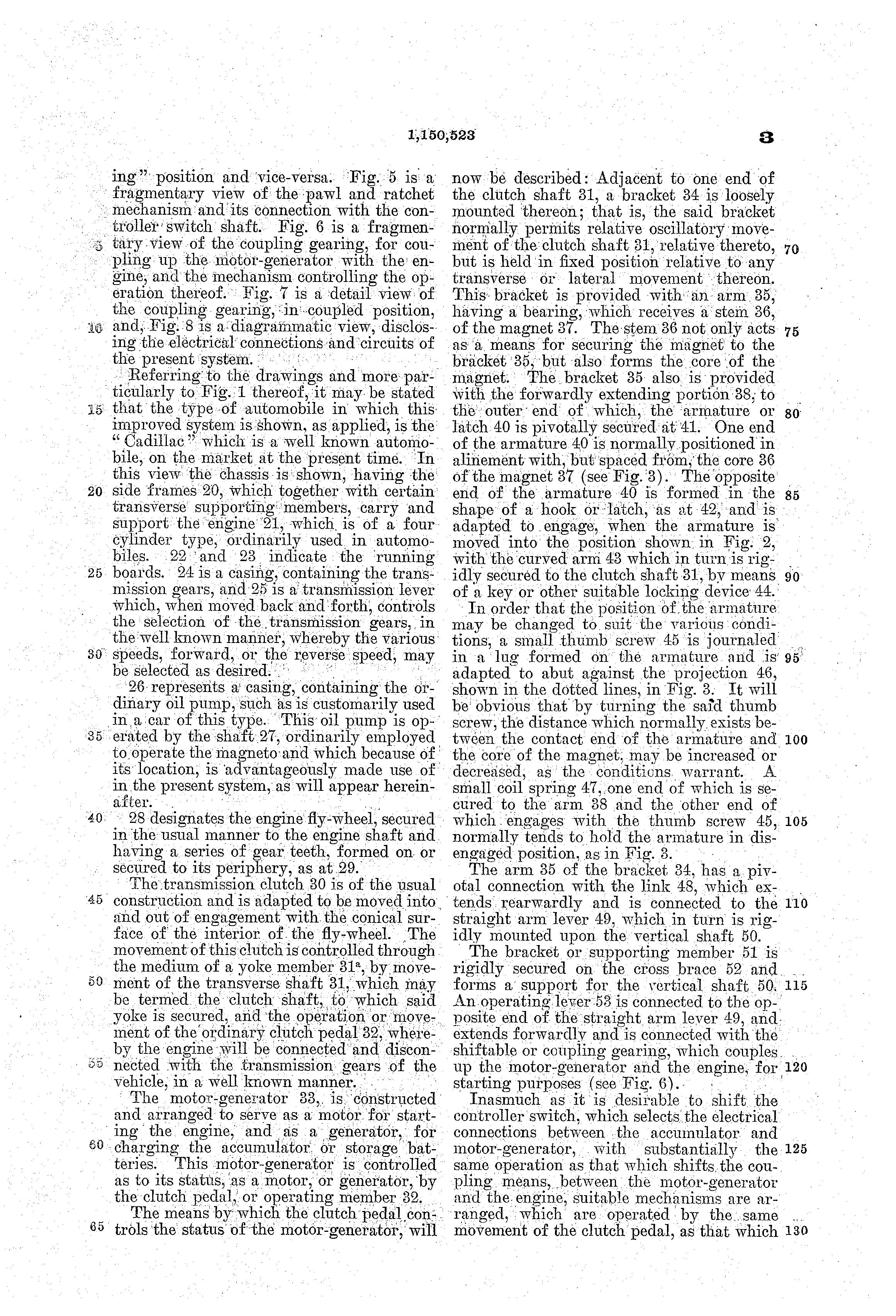
Two parts matter most. The flywheel, the heavy wheel at the back of the engine, has teeth round its rim; and beside the engine sits one electric machine, a "motor-generator", that both starts and charges (pp. 2-3, Fig. 1). The other sheets show a magnet on the clutch shaft, the gears that reach the flywheel, and the wiring.
On its first page, the patent says what it is about: a foot pedal that couples the starter to the engine, "but this foot pedal is in itself, normally disconnected". It is the ordinary clutch pedal. The same push that starts the engine frees it from the wheels, so its load "will be materially reduced", and the car cannot move off by itself: "a safety device, which prevents the inadvertent or accidental starting of the car" (p. 1).
"... so constructed that the forward movement of the clutch pedal will simultaneously disengage the clutch from the engine and couple up the engine and the starting device."
Claim 6 of US 1,150,523.
How it works: drive it yourself
Here is the starting device, rebuilt from the patent's drawings: the mechanism on the left, drawn unfolded into one plane, and the wiring on the right, simplified from Fig. 8. Both run on one clock. Start with the pedal alone; then hold the button and press the pedal, steadily. The line under the controls says what is happening, and the patent's own account follows below the model.
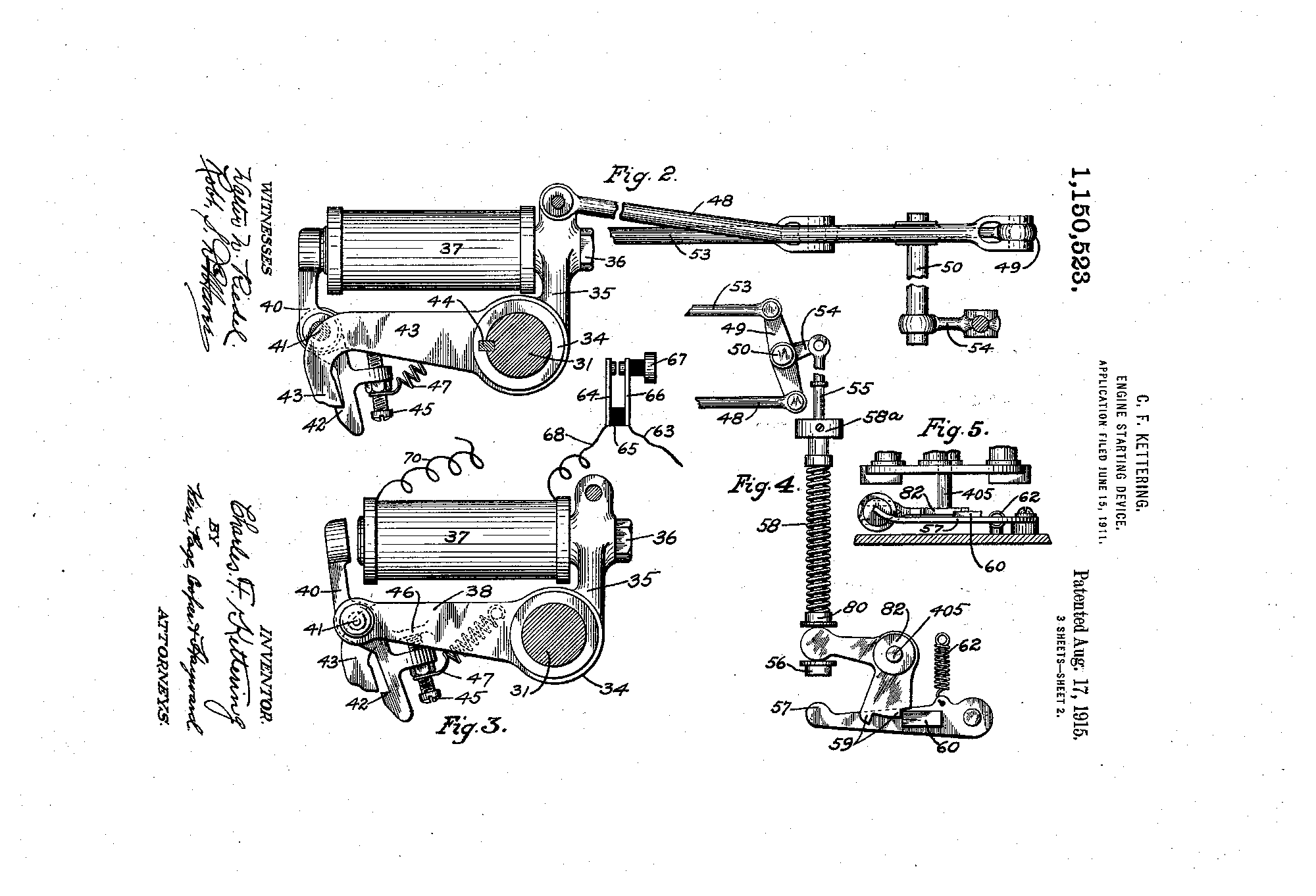
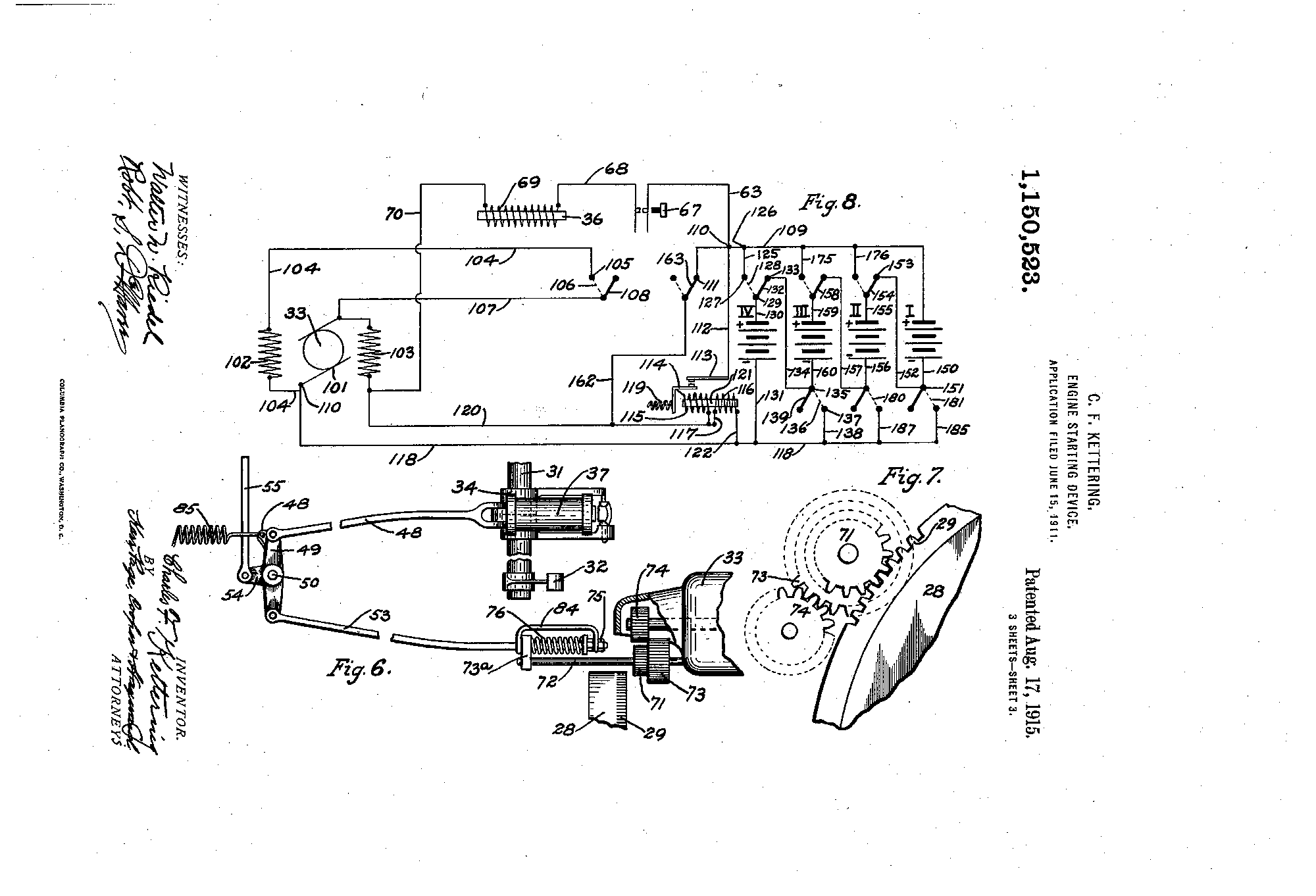
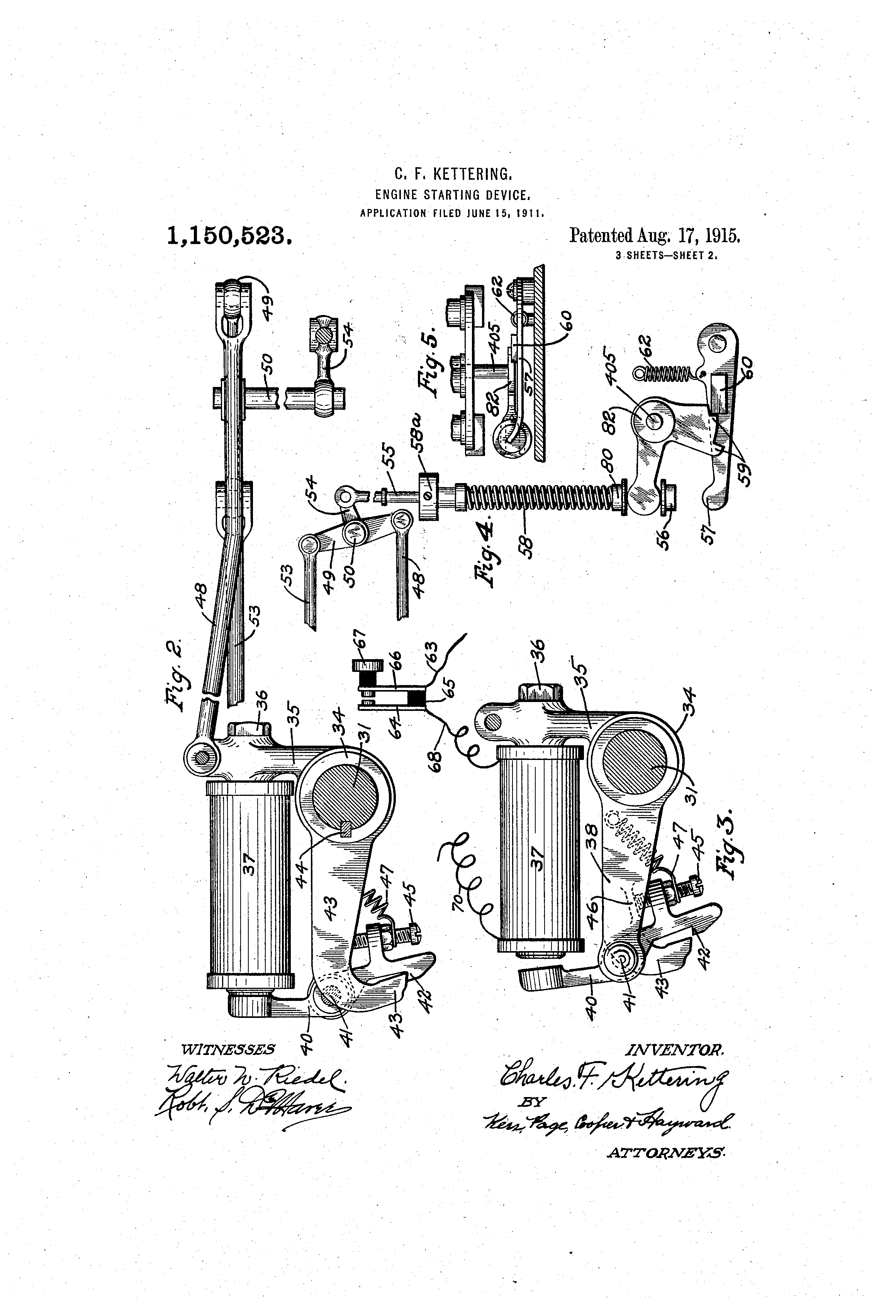
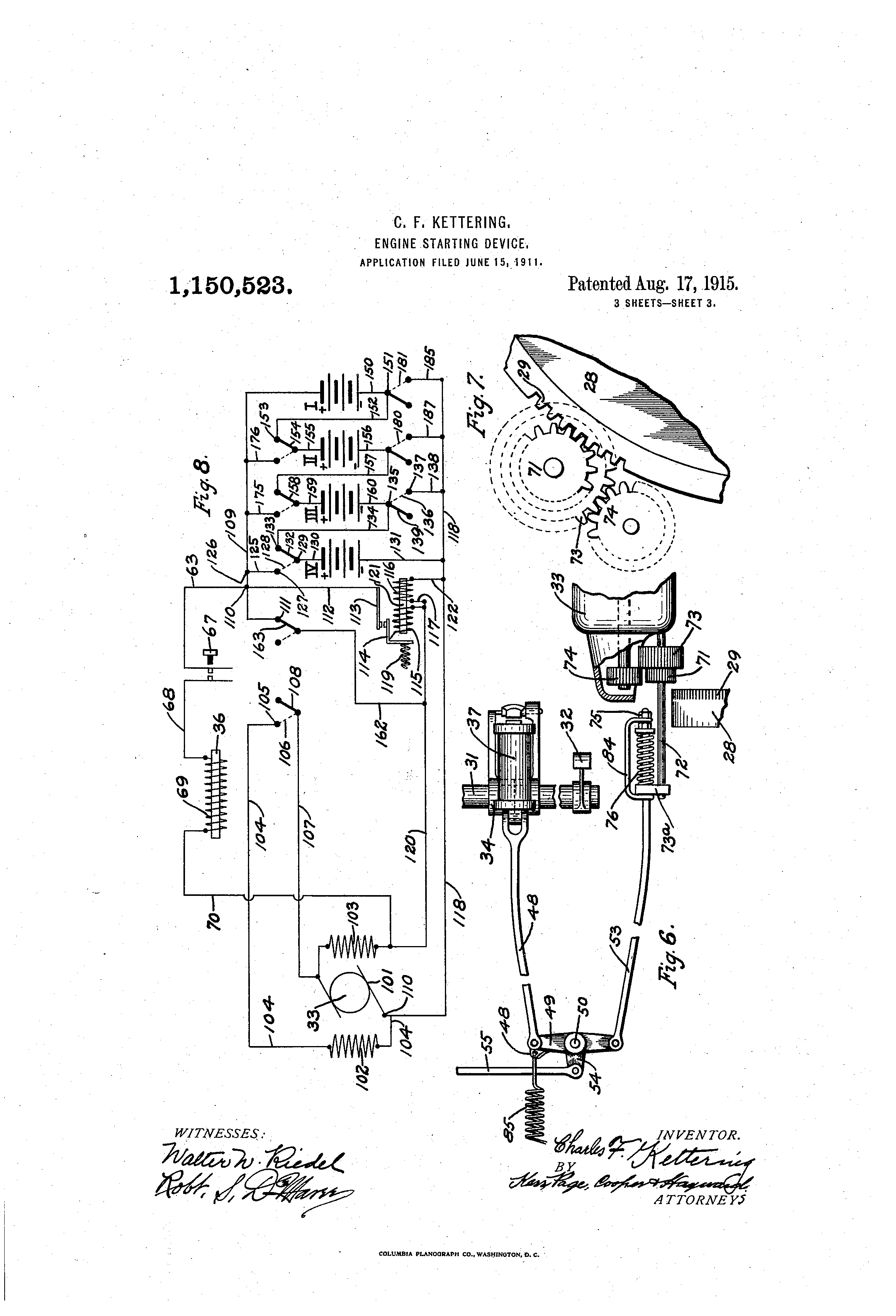
From the patent (Figs. 1-8; pp. 1-13): clutch pedal 32 on clutch shaft 31, transmission clutch 30 against flywheel 28 with its teeth 29; arm 43 keyed to the shaft; bracket 34 loose on it, with magnet 37 and latch 40 (hook 42), the magnet's coil 69 fed through push button 67; link 48, levers 49 and 53 on shaft 50, the flexible connection with spring 76, fork 72 and the sleeve with pinions 71 and 73; motor pinion 74 on motor-generator 33; link 54, plunger 55 with spring 58, pawl 57 and controller handle 82; the battery of four units of three cells, side by side to charge and end to end to start, "practically 24 volts" (p. 7); roller clutch 232 to shaft 27 (Figs. 1a, 1b); the cut-out (113-122). Ours: the drawing unfolded into one plane (the patent's parts sit at different depths), the layout, every size, the tooth counts (20 to 1 overall, the figure Motor Age gives for the 1912 Cadillac; the patent gives no ratio), the speeds and timing (slowed), the turns before the engine fires, the voltages at which the cut-out closes and opens, and the wiring as a block diagram. In our model a fast push on the pedal can switch to START before the pinion is in; the patent relies on the slow turn and the pedal's travel to keep the order. Not shown, as the patent leaves them to other applications: a device against throwing the gears in while the engine runs, and a limit on the motor's speed (claims 9-10), so here the pedal does nothing more once the engine has fired. Checked by the episode's test, run again on this page's copy: 54 checks, all pass: the parts fit; the order of events is the patent's; no tooth ever passes through a tooth; the battery is six volts side by side and twenty-four end to end and never shorted; planted faults (no slow turn, no flexible link, a switch that makes before it breaks, a pawl knocked clear too early) are caught.
What happens, in the patent's order
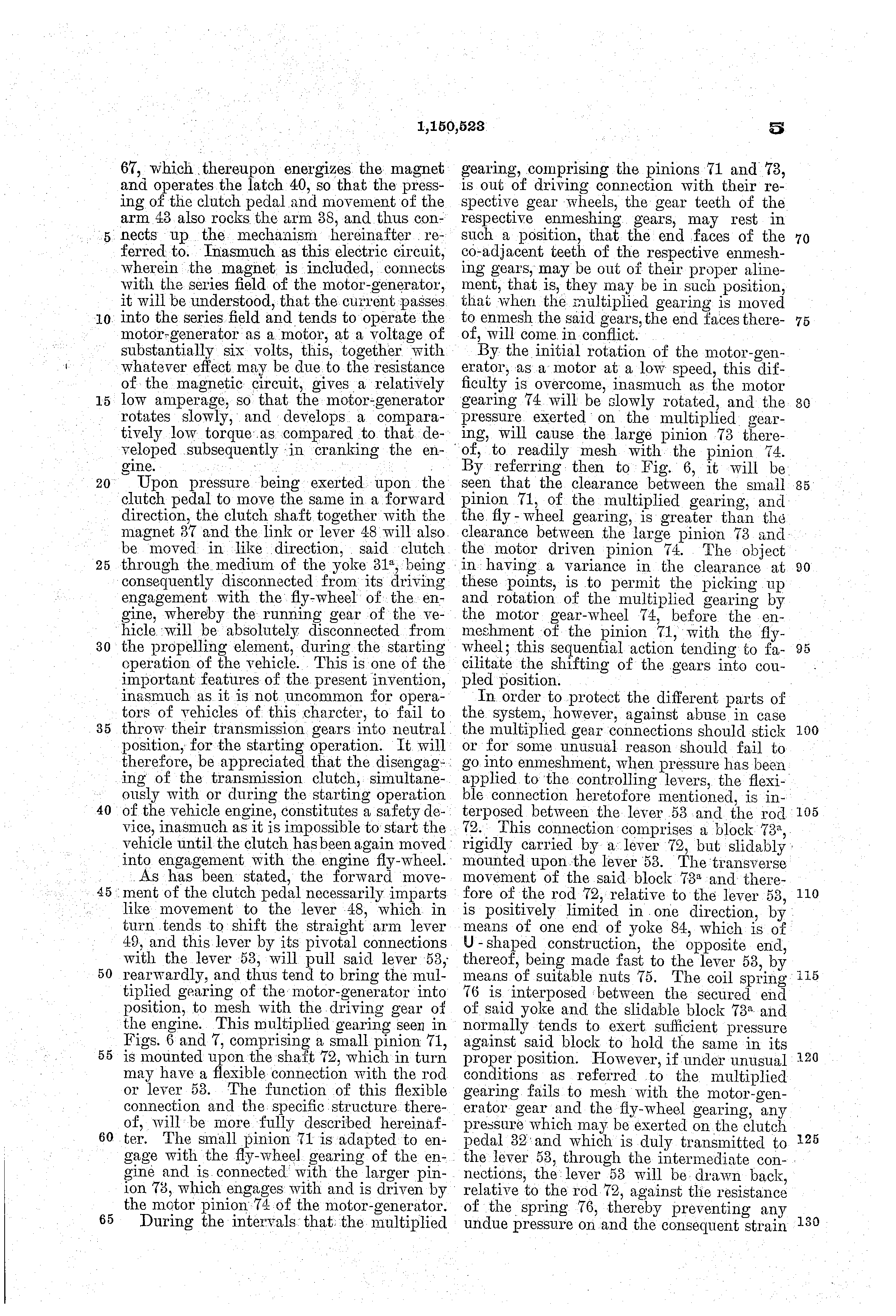
At rest, the pedal works the clutch, and nothing else. Press it, and the arm on the clutch shaft rocks past the magnet, which rides loose on the same shaft ("normally loosely mounted on the clutch shaft", p. 13). Nothing follows it.
To start, the driver holds down a push button. A small current, about six volts, flows through the magnet's coil and on through the motor. The magnet pulls its latch in, and the hook catches the arm: now the magnet and its bracket are locked to the pedal (Figs. 2-3, p. 5). The same current turns the motor slowly, with little force: it "rotates slowly, and develops a comparatively low torque" (p. 5). That slow turn has a job to do.
Now the pedal goes down. The clutch leaves the flywheel, so the wheels are free, and the latched bracket pulls a train of levers that slides a pinion toward the flywheel's teeth (pp. 5-6; claim 6). If a tooth meets a tooth, end to end, the pinion cannot go in. A spring in the linkage gives, so nothing breaks; the slow turn brings a gap round, and the pinion slides home (p. 5; claims 11, 16).
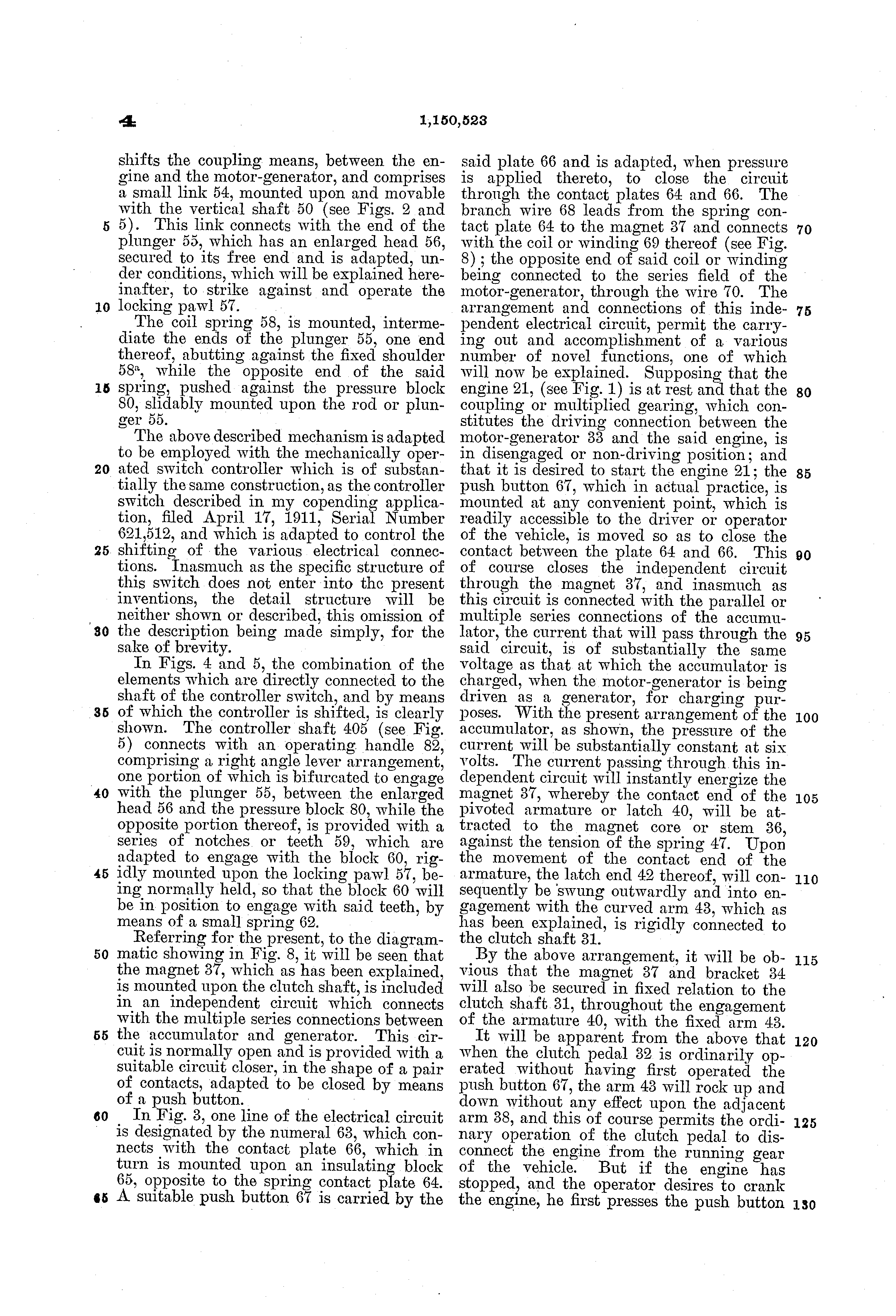
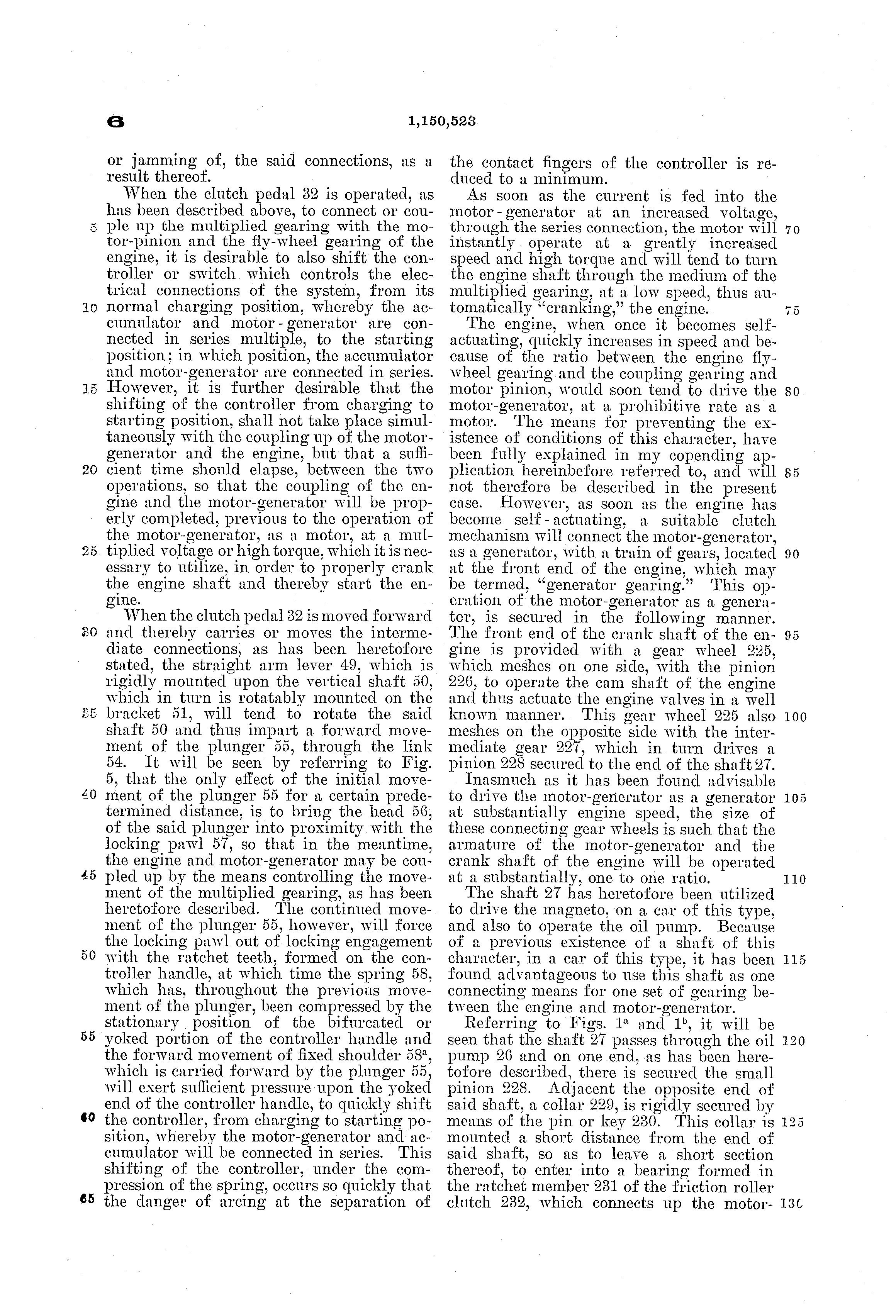
Only then does the switch move. A plunger, pushed by the same levers, has been squeezing a spring; now it knocks a pawl clear, and the spring snaps the switch over, fast. The shift "occurs so quickly that the danger of arcing ... is reduced to a minimum" (p. 6; claim 21). The four units of three cells, side by side, gave six volts; the switch puts them end to end, "practically 24 volts", into the motor (pp. 7, 10, 12). Four times the voltage, and the motor cranks the engine round (p. 6).
When the engine fires, the driver lets the pedal up. A spring pulls the pinion out, the plunger pushes the switch back, and the batteries return to six volts, side by side. Let go of the button, and the latch drops; the clutch meets the flywheel again, and the car is ready to drive (pp. 12-13).
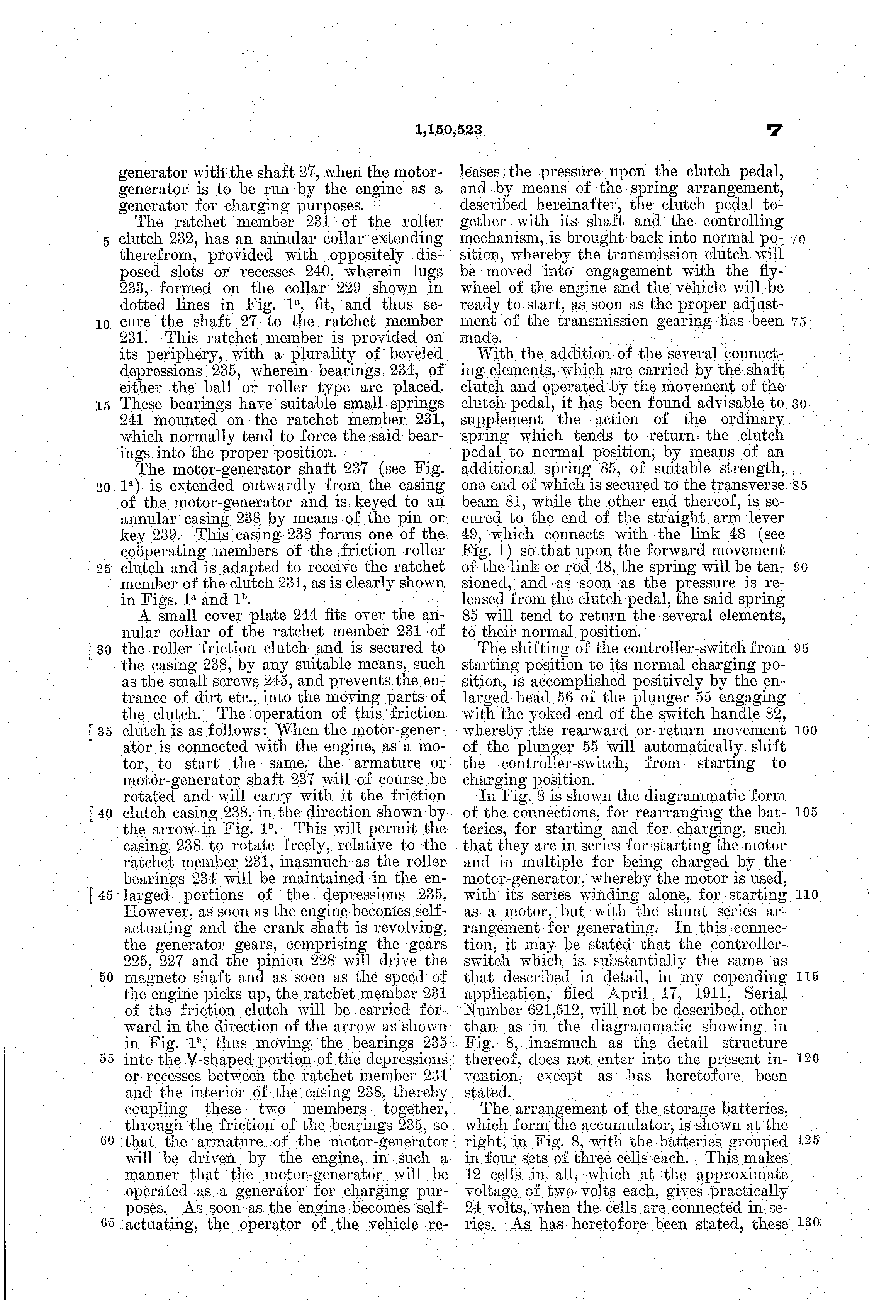
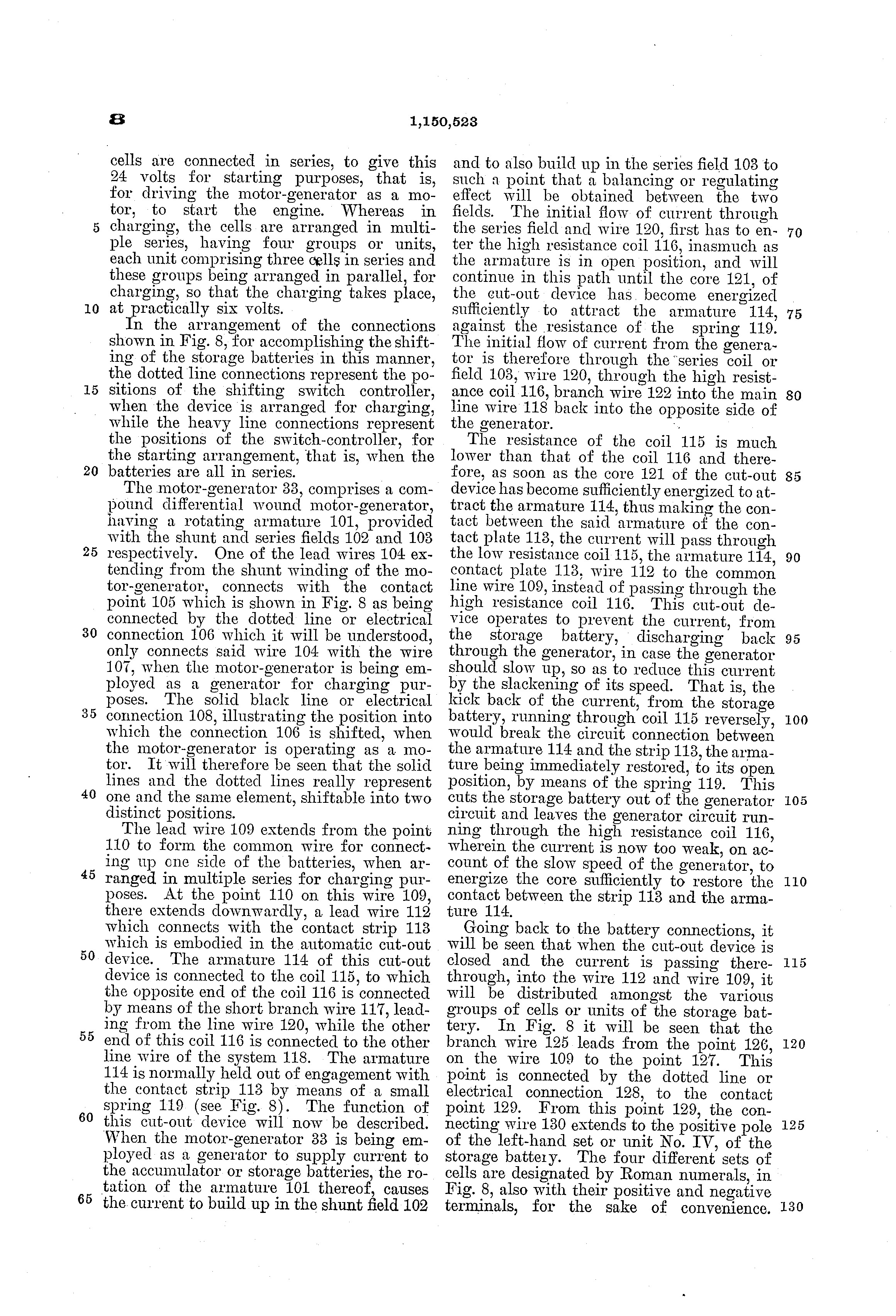
The motor now runs as a generator, driven by the engine through a roller clutch, which slipped while the motor was cranking and now locks (pp. 6-7, Figs. 1a, 1b). When its voltage passes the battery's, a relay closes, and the batteries charge, all four together, at about six volts; if the engine slows and the generator's voltage falls, the relay opens again, so the batteries never drive it backwards (pp. 8-9).
The patent gives no sizes, speeds or gear ratios. The ones in our model are ours.
The 1912 Cadillac
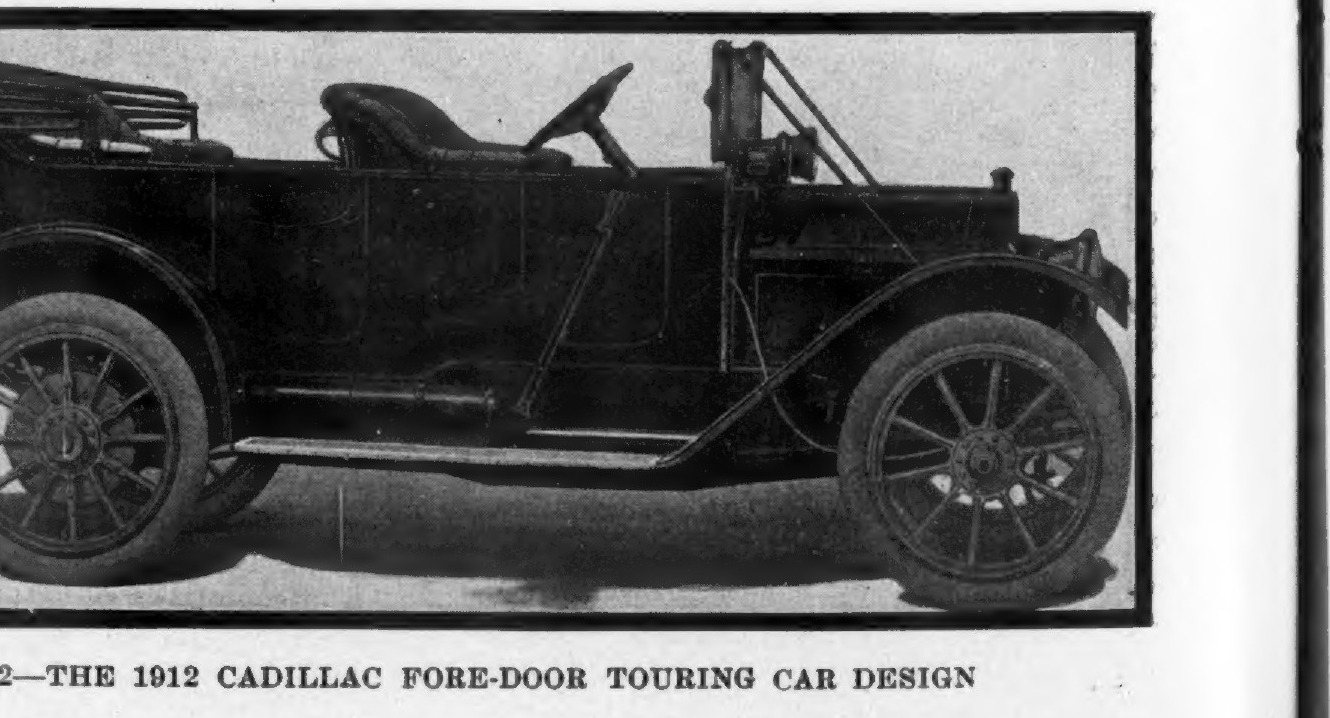
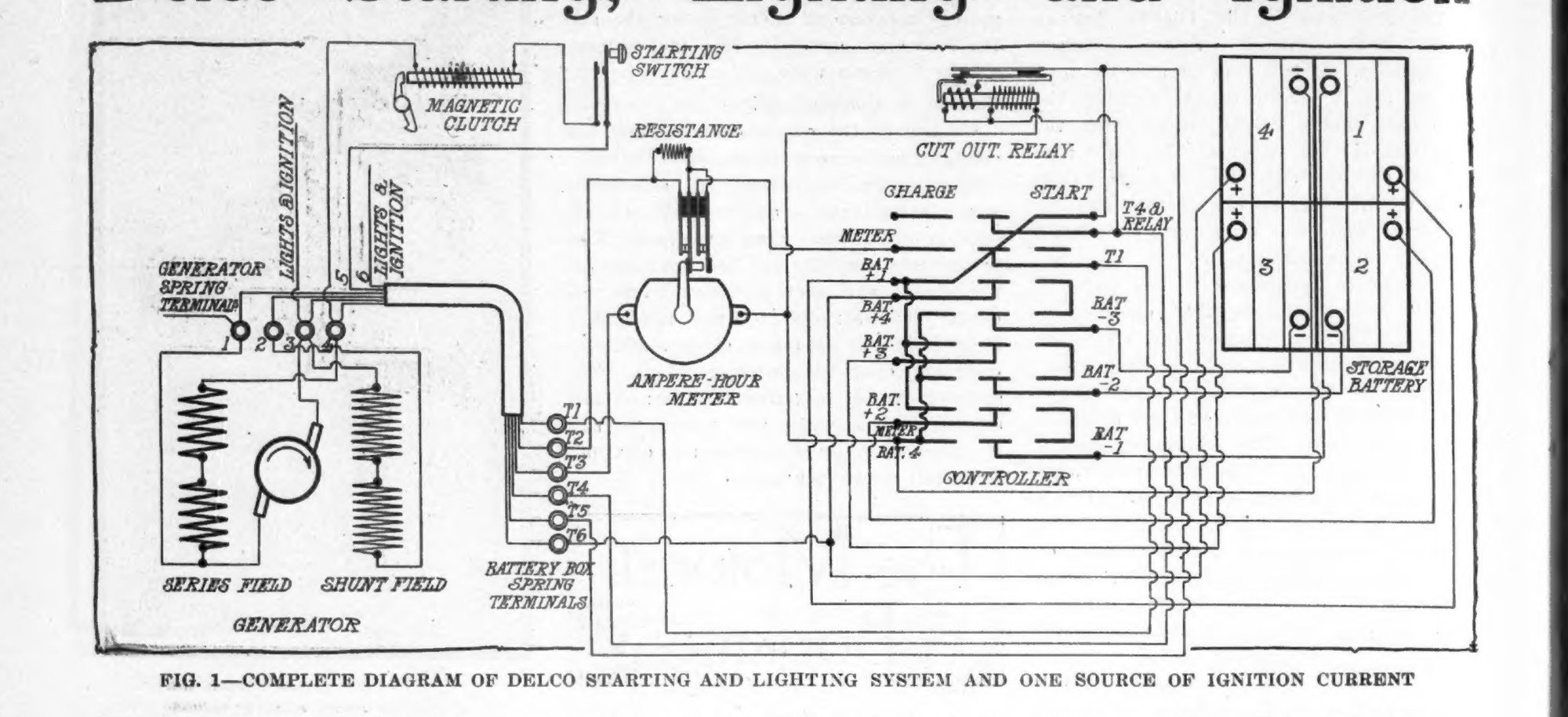
In October 1911, Motor Age described the Cadillac for 1912, with "an automatic electric starting device" and electric lights (5 October 1911, p. 30). To start it, the driver "simply retards the spark lever and pushes forward on the clutch pedal" (p. 34).
That is the patent's pedal, with two differences. There was no push button: the switch that turned the motor slowly closed when the spark lever was pulled all the way to retard (p. 34). And the gearing to the flywheel had "a double gear reduction of 20 to 1" (p. 35); the patent gives no ratio. The model above shows the Cadillac's version too: choose "The 1912 Cadillac" over the controls.
The battery was the patent's: twelve cells in four groups, in series to start at twenty-four volts, and in parallel for charging and the lights (p. 35). Retarding the spark was also the first rule of cranking by hand (The Automobile, 1912, p. 721). On the Cadillac, the same move began the start.
Motor Age said the battery could turn the engine over for "about 20 minutes", though it "seldom requires more than a second or so" to start (p. 34). That is the magazine's description, before the cars reached buyers, not a test we can check.
What Kettering added: the two patents side by side
Read from the claims and the specifications only.
| Coleman, 745,157 | Kettering, 1,150,523 | |
|---|---|---|
| A motor that starts the engine, then is driven as a dynamo to charge a battery | Yes, a "motor-dynamo" (claims 3-13, 17-24) | Yes, a "motor-generator"; the charging claims are left to the divisional application (p. 1) |
| Engine started with the wheels disconnected | Yes, by the first movement of a hand lever ("while relieved of its load", p. 1; claim 2) | Yes, by the clutch pedal ("the load of the engine will be materially reduced", p. 1; claims 6, 22, 23) |
| One-way (ball or roller) clutch | Yes, two: on the starting gear (12, 13) and the charging gear (16, 17) | Yes, one: on the generator drive (232, Figs. 1a, 1b); not claimed |
| Gears between motor and engine | Always in mesh; the clutches choose the path | Normally disconnected: a pinion moved into the flywheel's teeth to start and pulled out after (claims 14-17, 29-34) |
| Lining the teeth up | Not needed (always meshed) | A slow, low-torque turn before meshing, "a movement of registration" (claims 12-21, 26-28, 32-34) |
| A yielding link if the teeth meet end on | No | Yes, flexible means (claim 11) |
| Control | A hand lever, switching by its own latches c, d | The ordinary clutch pedal, made to work the starter only while a magnet latch is energised from a push button (claims 1-8, 23, 35-37) |
| Battery | One battery, 40 | Regrouped: units in parallel (about 6 volts) to charge, in series (24 volts) to start, switched by a spring-snapped controller only after the gears mesh (claims 19-24) |
| Charging switch | Centrifugal governor 53 on the motor shaft | Cut-out relay (Fig. 8, 113-122) |
So Coleman had the starter-dynamo, the start with the wheels disconnected, and one-way clutches. Kettering's claims are the coupling (a pinion meshed on demand, lined up by a slow turn, with a yielding link), the pedal with its magnet latch, and the battery switched from parallel to series after the mesh.
Two more patents
The starting patent sends some of its subject elsewhere. Parts of it, the text says, are also shown in Kettering's application of April 1911, and its charging features are claimed in a divisional application (US 1,150,523, p. 1).
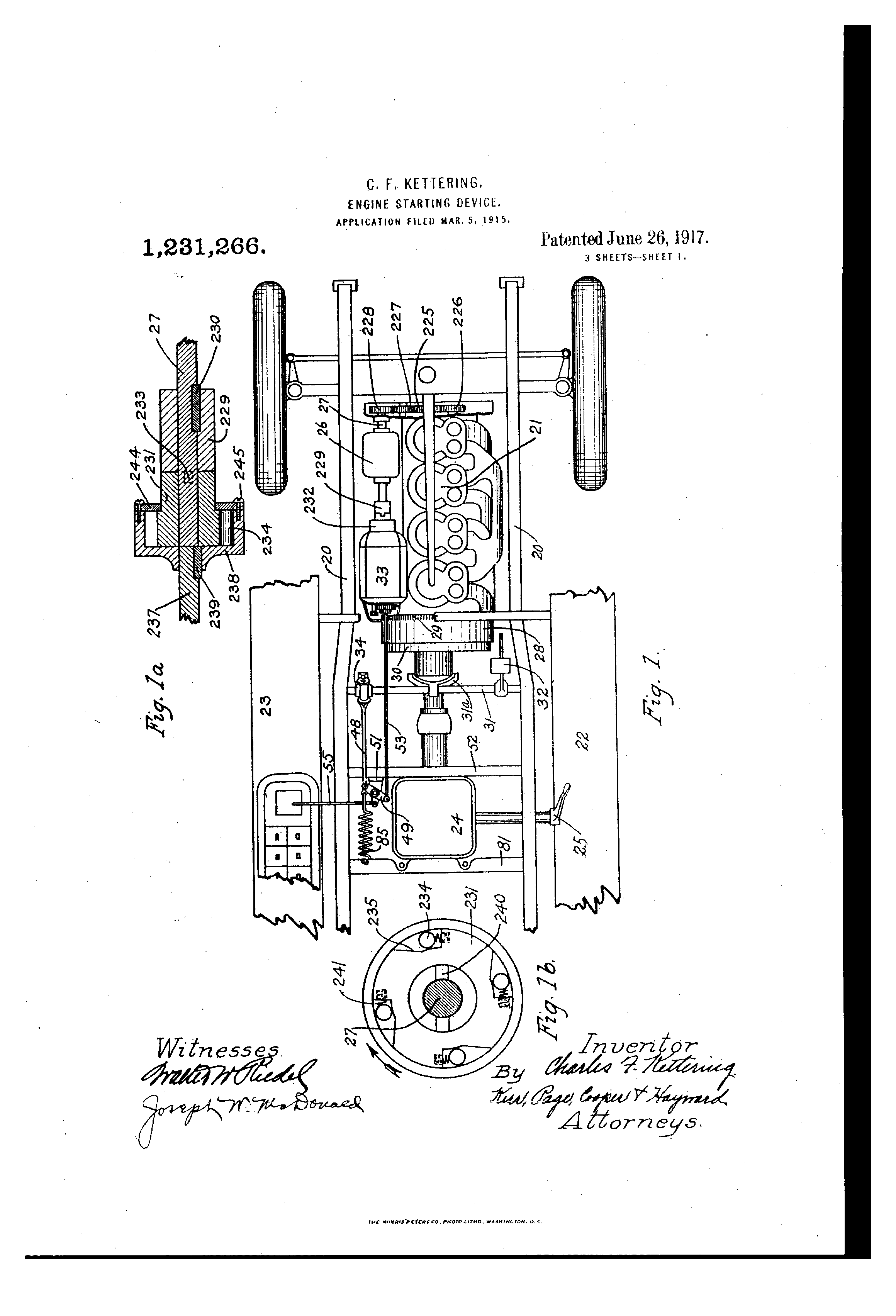
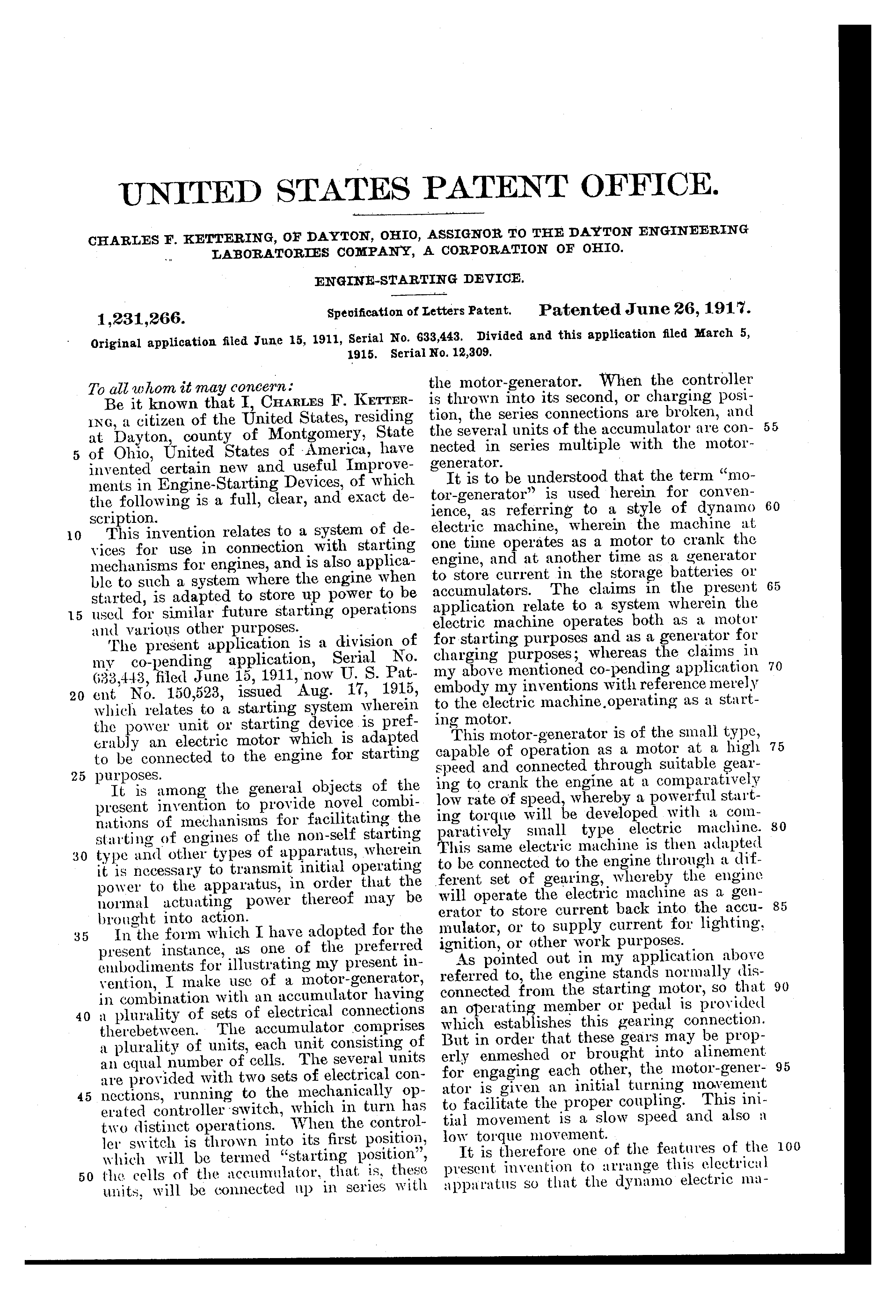
The April application was granted in February 1916, as an "Engine starting, lighting, and ignition system": one battery and one machine, for starting, the lights and the ignition (US 1,171,055, filed 17 April 1911, granted 8 February 1916). The divisional was filed in March 1915 and granted in June 1917 (US 1,231,266, filed 5 March 1915, granted 26 June 1917). So the patents came out years after the cars: the first in 1915, the last in 1917.
| Patent | Title | Filed | Granted |
|---|---|---|---|
| US 1,171,055 | Engine starting, lighting, and ignition system | 17 April 1911 | 8 February 1916 |
| US 1,150,523 | Engine-starting device | 15 June 1911 | 17 August 1915 |
| US 1,231,266 | Engine-starting device (divisional) | 5 March 1915 | 26 June 1917 |
Who could drive
According to a later account, other makers soon took up Delco starters, and Ford offered an electric starter on the Model T in 1919 (Mac's Motor City Garage, "Cadillac's Great Leap Forward", 2024; the page gives no sources for this).
The Automobile, on the same page that counted the accidents, saw another reason it mattered. "It is hardly to be wondered at", it wrote, "that the automobile world is studying the self-starter question very carefully, if only for the safety part of the idea."
"The question of having the gasoline motor car so arranged that it can be safely operated by a woman hinges directly on the subject of self-starters, for it is only the difficulty of starting the motor which prevents them from driving more than they do."
The Automobile, 14 March 1912, p. 721.
That is a trade paper's opinion, in 1912. We found no figures for who bought the starter, or for who drove because of it.
Then and now
A starter today does the same jobs with different parts. A solenoid, an electromagnet, pushes the pinion into the flywheel's teeth and closes the heavy contacts to the motor. A one-way clutch on the pinion lets the engine run free once it fires, and a spring pulls the pinion back when the key or button is let go (Wikipedia, "Starter (engine)").
In Kettering's design, the pedal and its latch did the solenoid's pushing, the spring-loaded switch did its switching, and a spring pulled the pinion back. His one roller clutch is on the generator (US 1,150,523). Most cars start on twelve volts today (Wikipedia); Kettering's motor cranked on twenty-four (p. 12).
| The job | Kettering, 1911 | A starter today |
|---|---|---|
| Push the pinion into the flywheel's teeth | Clutch pedal 32, through magnet latch 40 and the levers | The solenoid |
| Close the heavy contacts to the motor | Controller 82, snapped over by spring 58 | The solenoid |
| Let the engine run free once it fires | The pinion pulled out as the pedal comes up | A one-way clutch on the pinion |
| Pull the pinion back | A spring | A spring |
| Volts to crank | 24 | Most cars: 12 |
So who invented the electric starter? Not Kettering alone. Coleman's patent had a motor that started the engine and then charged the battery, eight years before Kettering filed. What Kettering patented was the coupling: a pinion that goes into the flywheel only when it is needed, lined up by a slow turn; a clutch pedal that frees the car and meshes the gears in one push, but only while the button is held; and a battery rewired from six volts to twenty-four for the start (claims 6, 11, 16-23). And Cadillac put a version of it on sale for 1912 (Motor Age, 1911).
What we cannot tell you is whether Coleman's machine ever ran, or what happened on that bridge in Detroit.
Read the original patents
All four are US patents of 1903 to 1917, in the public domain. Click a page for full resolution; drawing sheets come first, then the specification. The sheets are shown as printed: several are drawn across the page.
US 745,157, Clyde J. Coleman, Means for Operating Motor-Vehicles, filed 11 February 1901, granted 24 November 1903
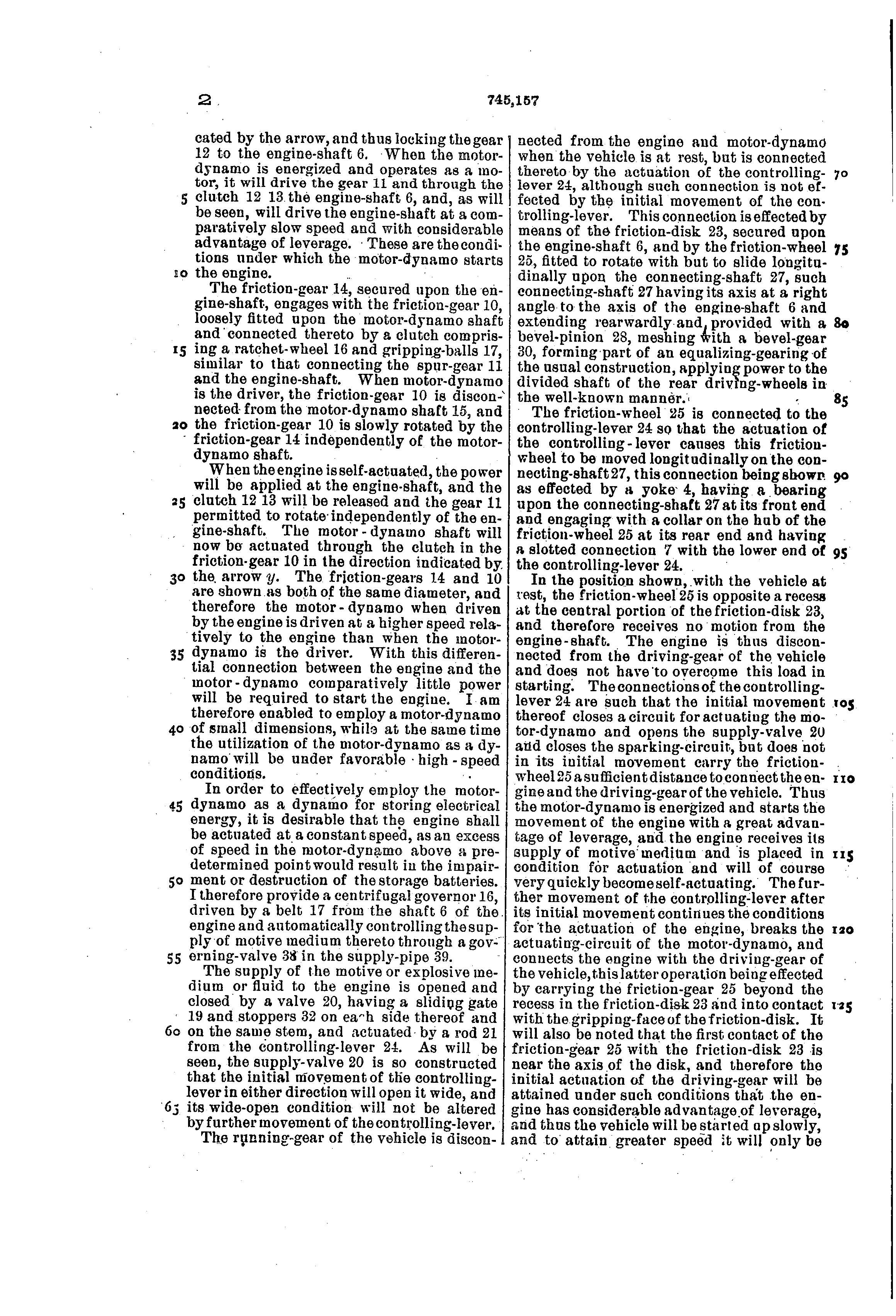
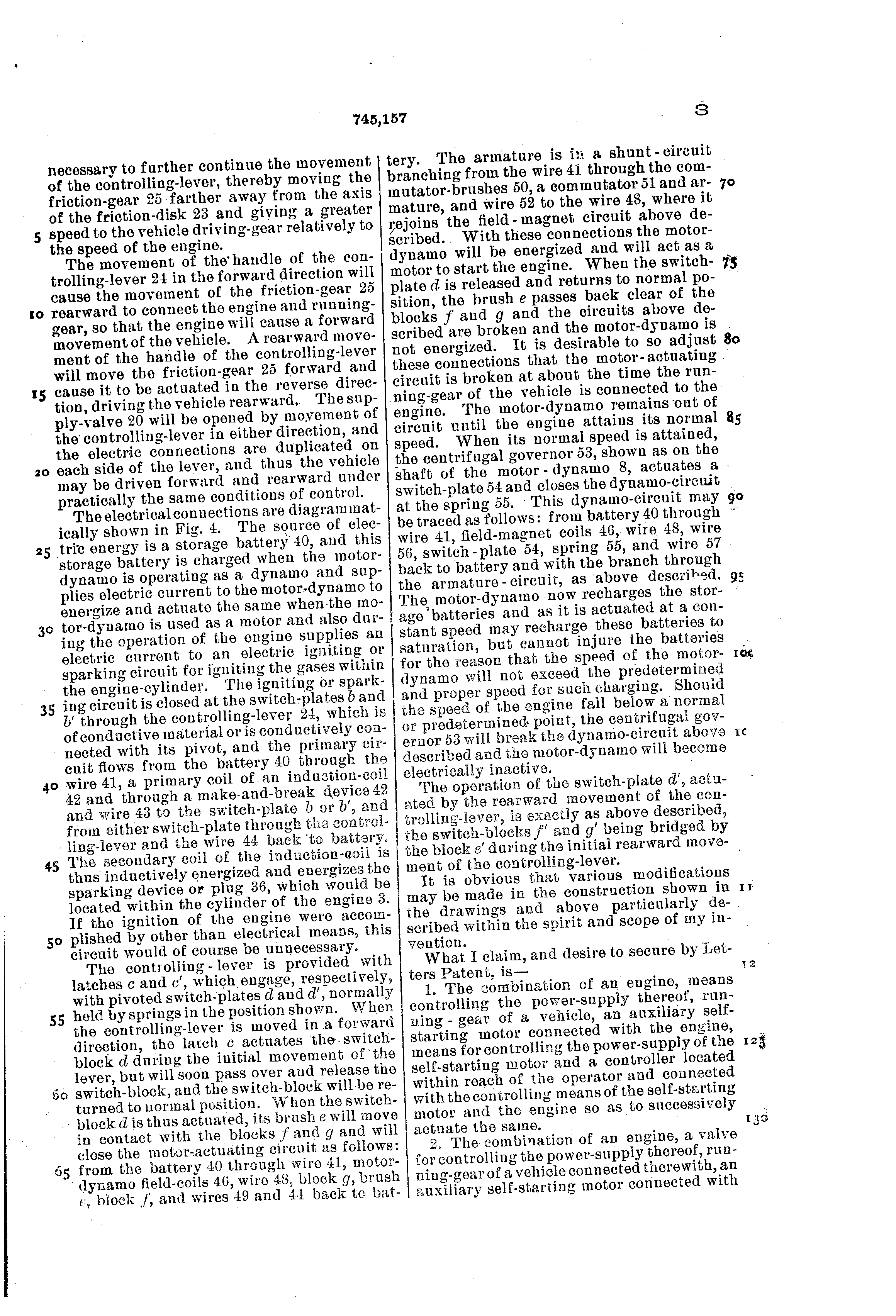
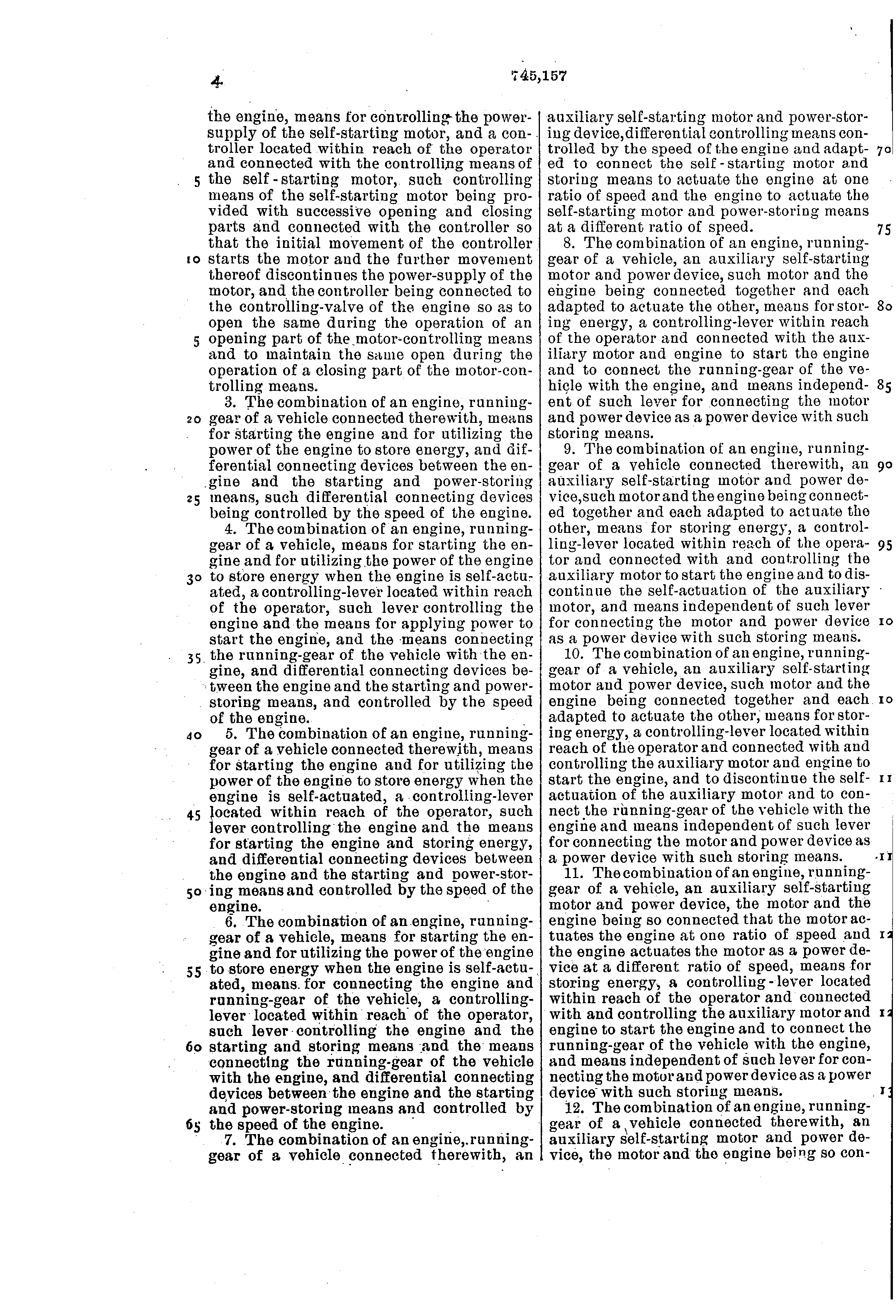
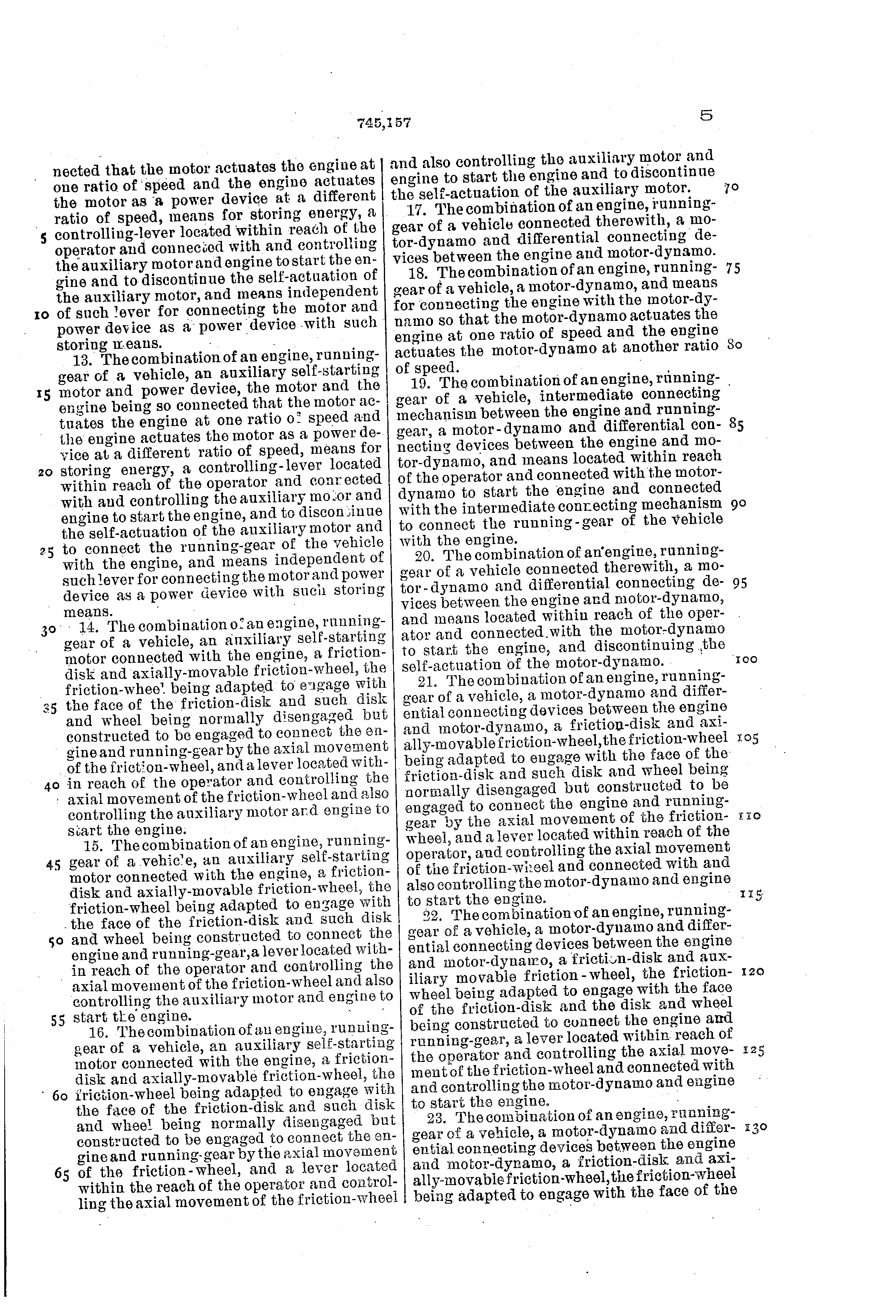
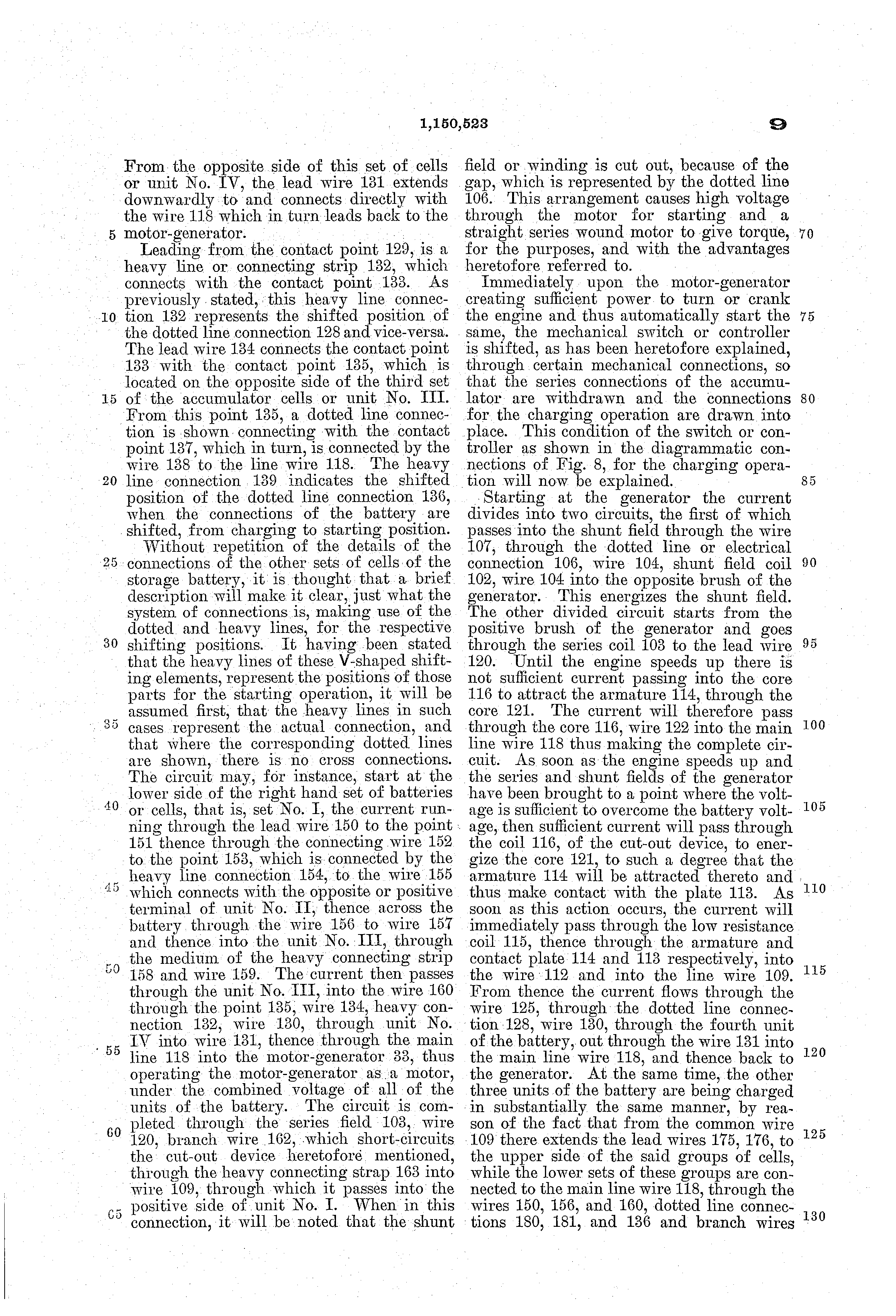
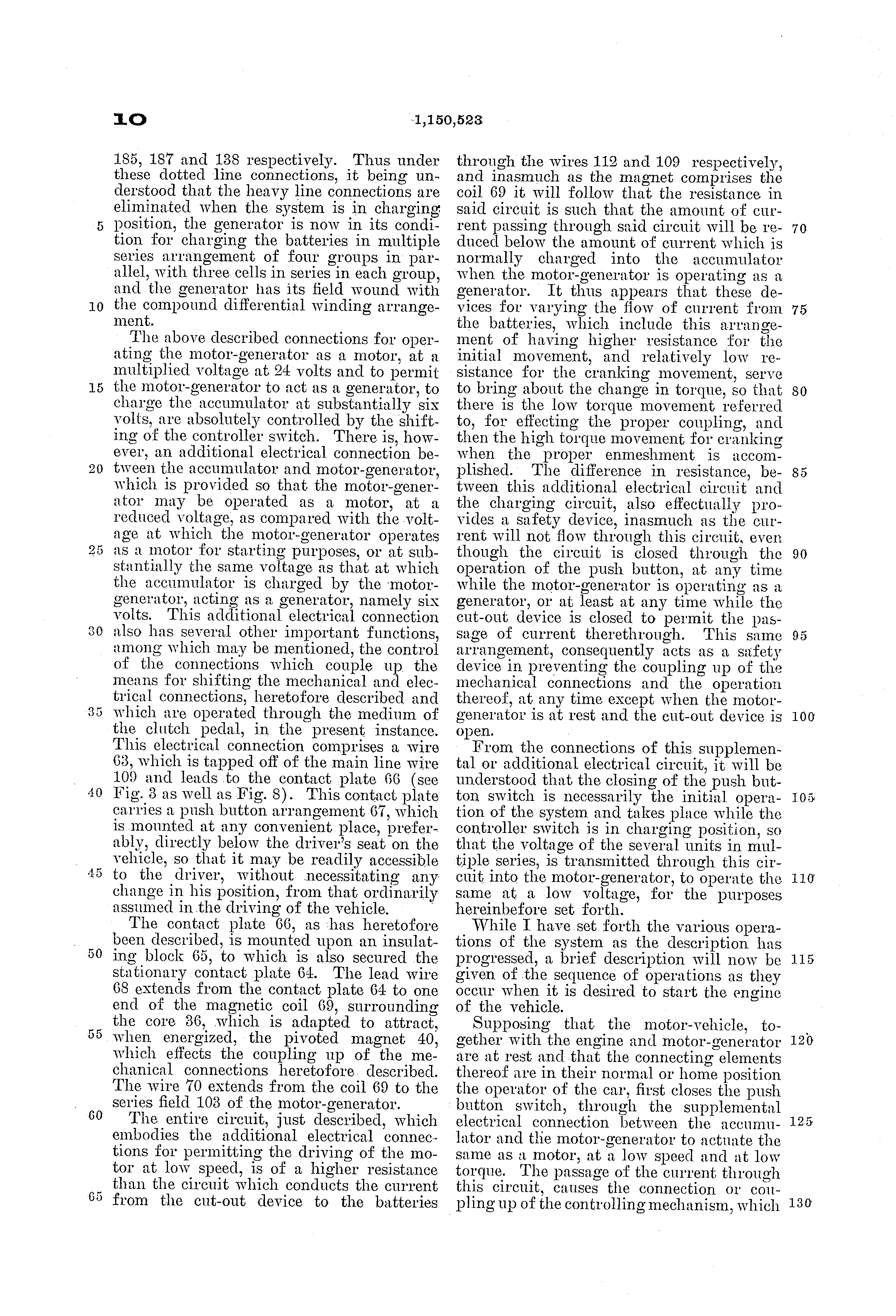
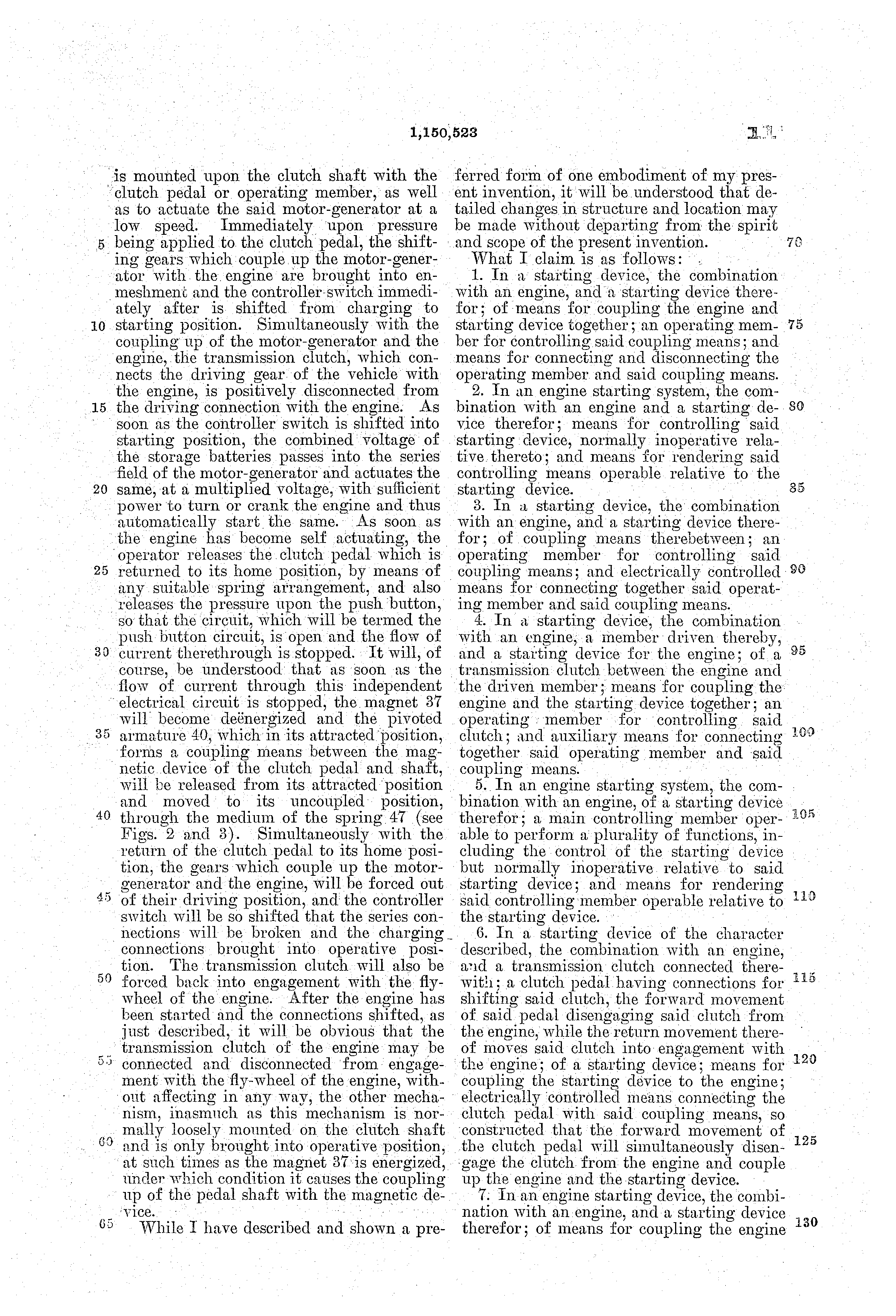
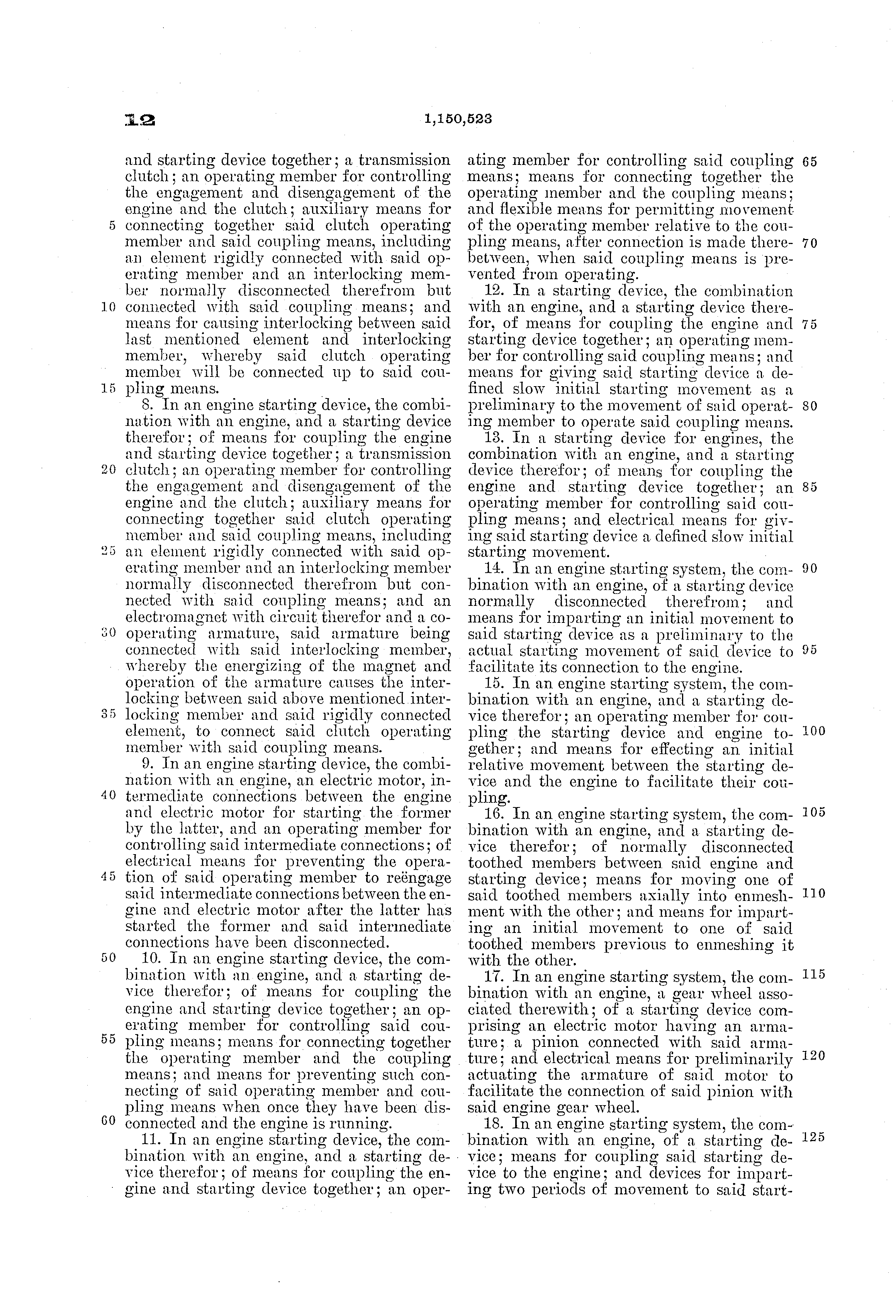
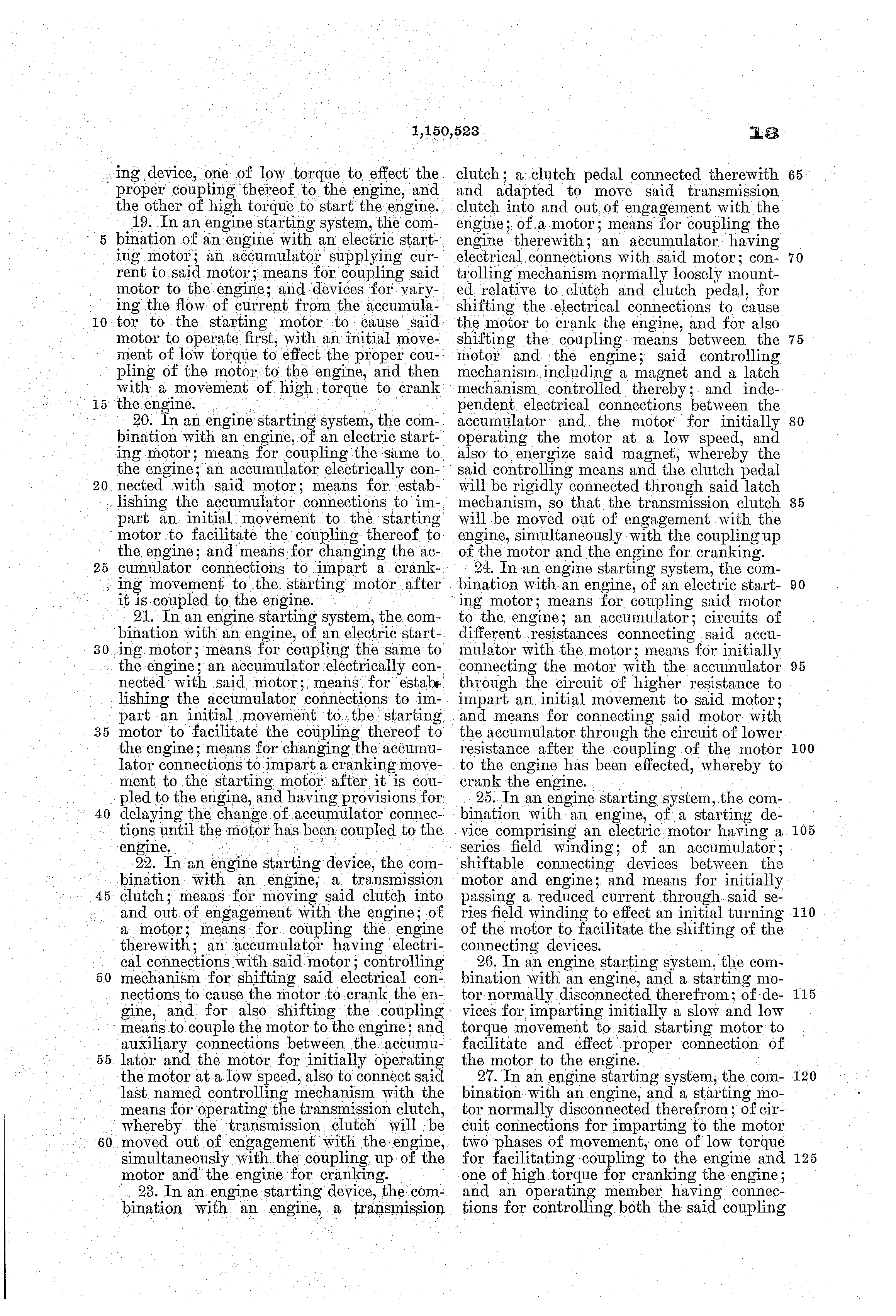
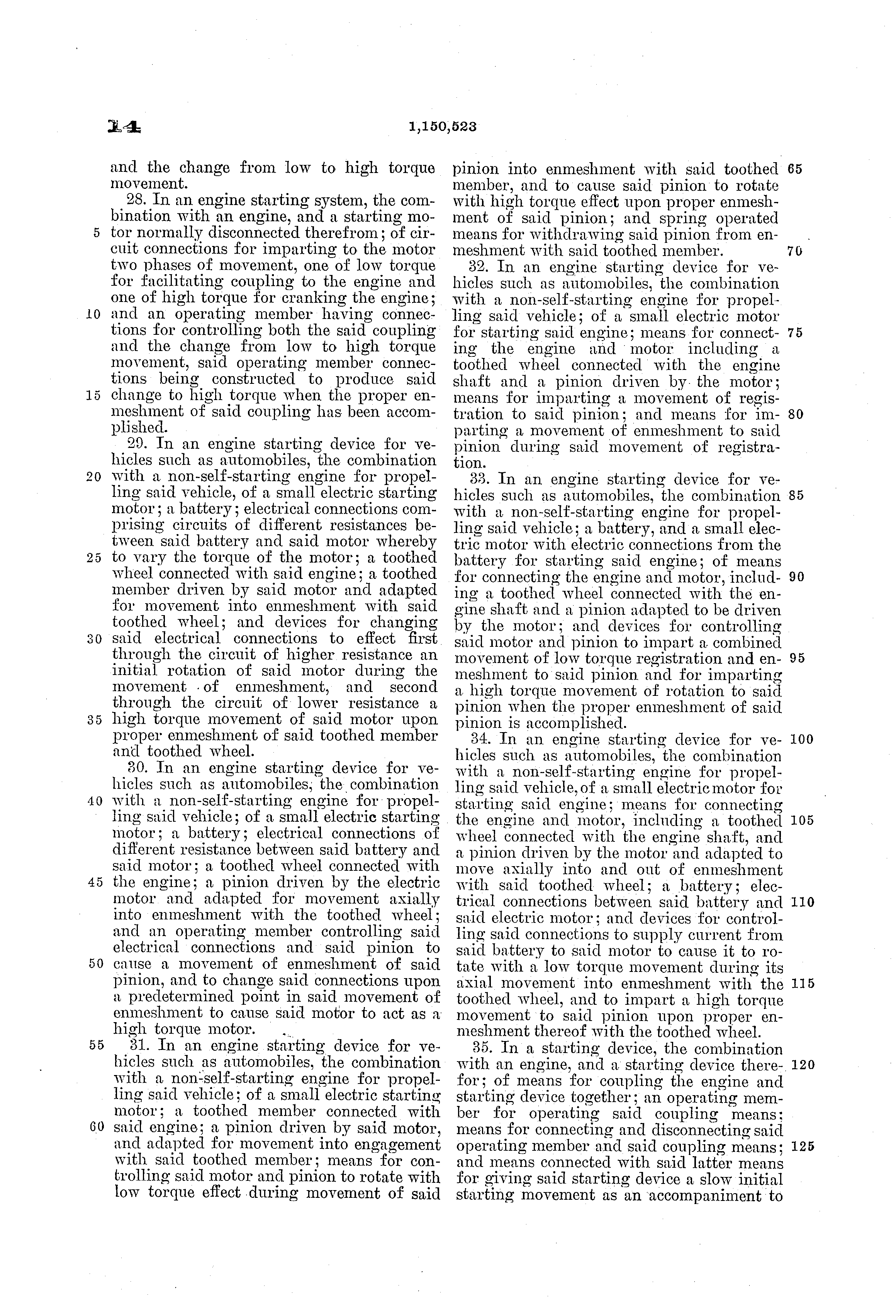
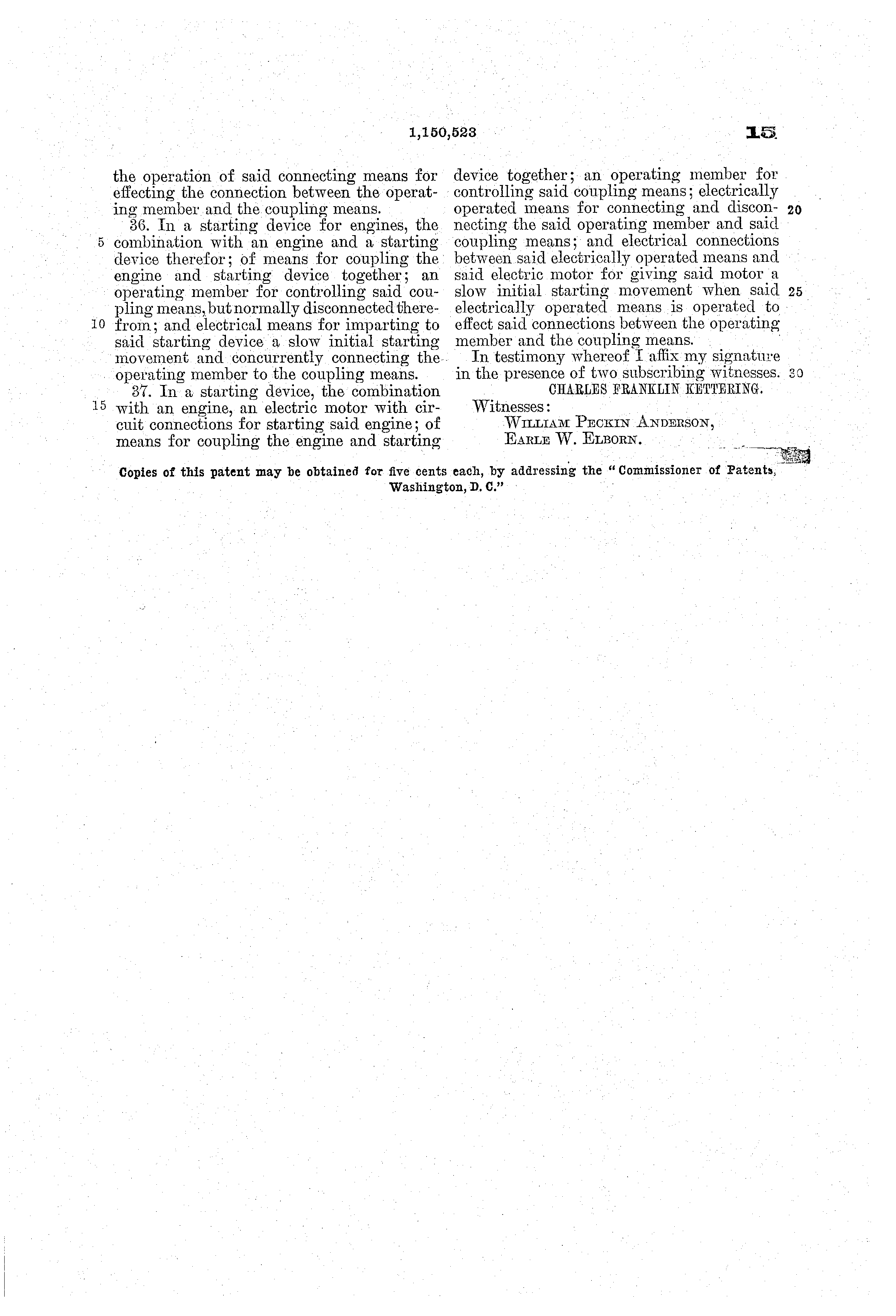
US 1,150,523, Charles F. Kettering, Engine-Starting Device, filed 15 June 1911, granted 17 August 1915
US 1,171,055, Charles F. Kettering, Engine Starting, Lighting, and Ignition System, filed 17 April 1911, granted 8 February 1916
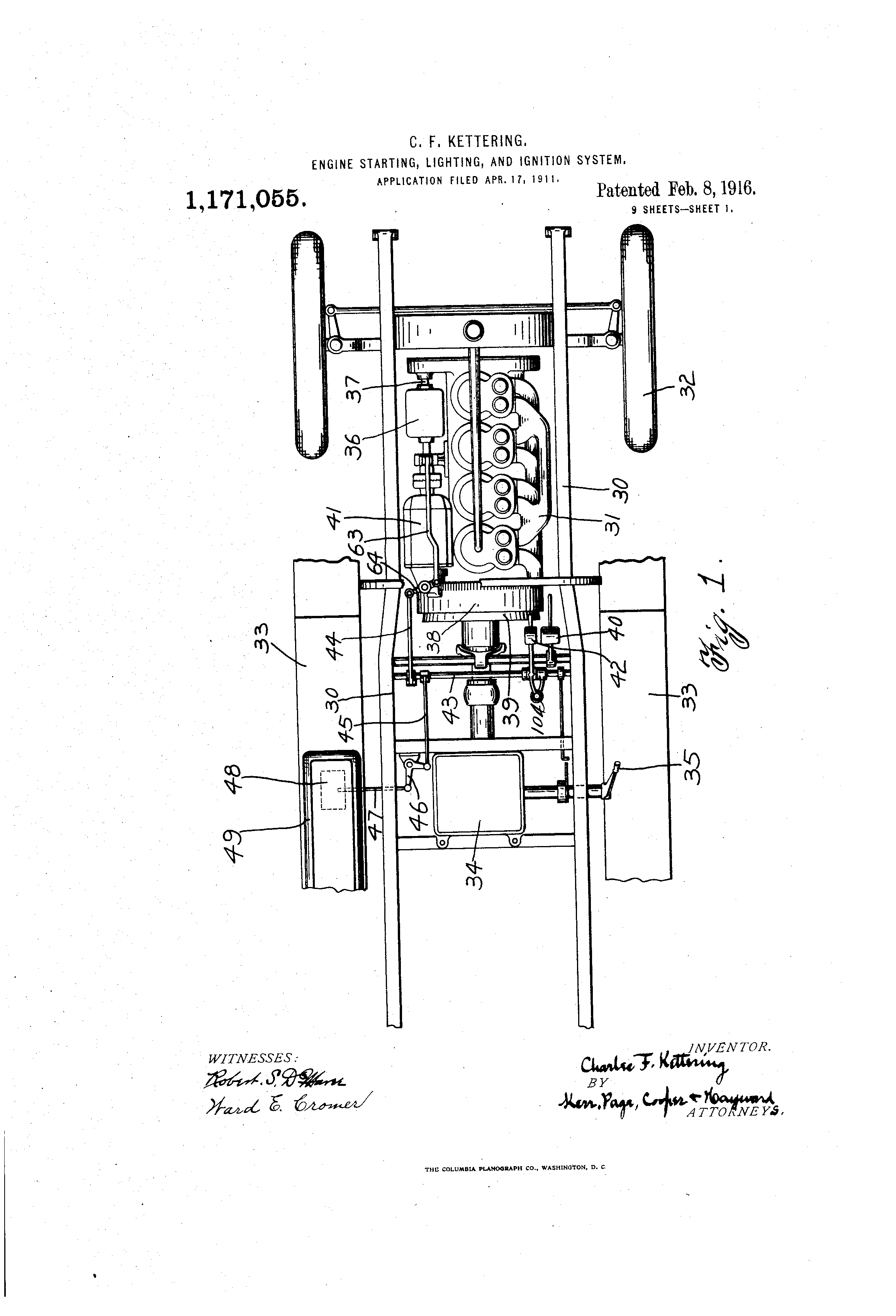
The first sheet and first page; every page is in the PDF · Google Patents
US 1,231,266, Charles F. Kettering, Engine-Starting Device, divisional, filed 5 March 1915, granted 26 June 1917
The first sheet and first page; every page is in the PDF · Google Patents
Sources
Every fact on this page comes from these, as in the episode. Where we have a source only second-hand, the text says so.
Patents (US, public domain; full-page scans from the USPTO)
- C. J. Coleman, Means for Operating Motor-Vehicles, US 745,157 (filed 11 February 1901, granted 24 November 1903; assigned to the Rockaway Automobile Company): the motor-dynamo, the two pairs of gears and ball clutches (pp. 1-2, Fig. 3; "with considerable advantage of leverage", "both of the same diameter", p. 2), "while relieved of its load" (p. 1), lever 24 and governor 53 (p. 3), the claims (pp. 3-6).
- C. F. Kettering, Engine-Starting Device, US 1,150,523 (filed 15 June 1911, granted 17 August 1915; assigned to the Dayton Engineering Laboratories Co.): the pedal "normally disconnected", "materially reduced", the safety device, the other two applications (p. 1); the Cadillac (p. 3); "rotates slowly" (p. 5); "so quickly" (p. 6); "practically 24 volts" (p. 7); the cut-out (pp. 8-9); the loose bracket (p. 13); claims 1-37, claim 6 quoted.
- C. F. Kettering, Engine Starting, Lighting, and Ignition System, US 1,171,055 (filed 17 April 1911, granted 8 February 1916), and Engine-Starting Device, US 1,231,266 (divisional, filed 5 March 1915, granted 26 June 1917): titles and dates from their first pages.
Period sources (public domain)
- Motor Age (Chicago), 5 October 1911, pp. 30-35: "Several New Ideas Are Incorporated" (the 1912 Cadillac: "an automatic electric starting device", p. 30; the 20 to 1 reduction and the battery, p. 35) and "Delco Starting, Lighting and Ignition" (Delco ignition on Cadillacs "for the past two years", the spark lever and the clutch pedal, "about 20 minutes", p. 34); the photographs and the Delco wiring diagram. Internet Archive.
- The Automobile (New York), 14 March 1912, p. 721, "In Cranking the Motor": the backfire, the 500 accidents, the left hand, the self-starter question, "safely operated by a woman". Internet Archive.
- The Automobile, 14 December 1911, p. 1056, "Need of Safety Cranks", a letter from V. L. Gass, Boston. Internet Archive.
- The Detroit Times, 6 April 1908, p. 1: "Byron J. Carter is dead from pneumonia". The Washington Times, 26 April 1907, p. 3: "Head is crushed by auto crank bar", a dispatch from Detroit. Both read on the page images (Library of Congress, Chronicling America).
Secondary
- "Byron Carter and the Self-Starter", cartercar.org (read 29 October 2026): the versions of the story and where they were printed (The Turning Wheel, 1934; T. A. Boyd, 1957; the Lelands' biography, 1966). We have not seen those books.
- "Deeds Barn and the Self Starter", an undated, unsigned Delco company history, Project Gutenberg no. 64831: Leland's line, the barn, Delco's founding.
- Mark Strecker, "Invention of the auto electric starter", markstrecker.com: Kettering at NCR, Delco's founding, the 1910 start of the work, Leland's reputation.
- Mac's Motor City Garage, "Cadillac's Great Leap Forward" (2024): other makers, and the Model T's starter in 1919 (no sources given on the page).
- Wikipedia, "Starter (engine)": the modern starter's parts, twelve volts.
- The reconstructions and diagrams are our own work, as described under each. Kettering's and Coleman's models are checked by the episode's test, run again on this page's copy.
Images
- Patent drawings and specifications: USPTO, public domain. Sheets printed sideways are turned upright where they illustrate the text.
- Motor Age (1911) and The Automobile (1911, 1912): scans via the Internet Archive; published in the US before 1931, public domain.
- The Detroit Times (1908) and The Washington Times (1907): Library of Congress, Chronicling America; public domain. The Washington Times clipping has its contrast raised for reading.
- Henry M. Leland: The World's Work, vol. 41 (1921), p. 565; published in the US in 1921, public domain.
- Charles F. Kettering, 12 August 1936: Harris & Ewing, Library of Congress (LCCN 2016878371), cropped to Kettering; "No known restrictions on publication".
- The video also uses an AI illustration, labelled on screen with what it is based on. None is used on this page.