 Curious Patents
Hollerith's Tabulating Machine
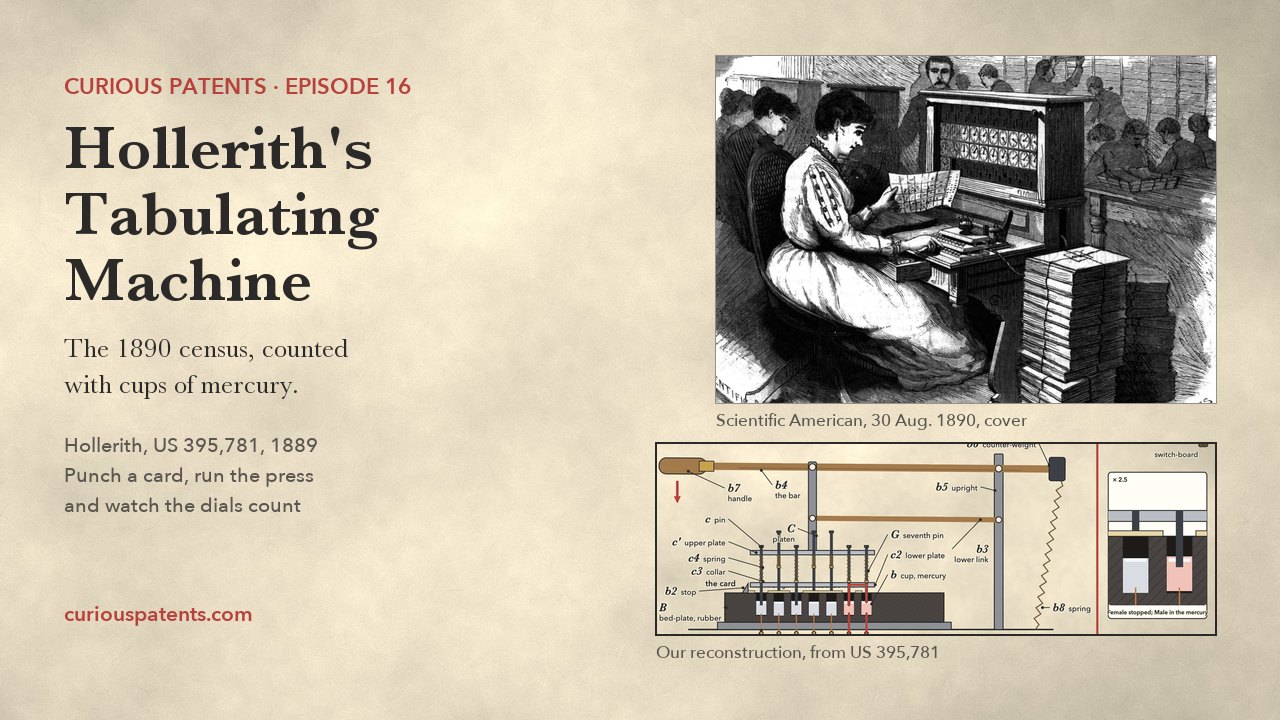
The 1890 United States census was tabulated with cups of mercury. A steel pin came down through a hole punched in a card, touched the liquid metal and closed a circuit, and a dial moved on by one. Punch a card yourself, put it in Hollerith's press, rebuilt from his patent, and watch the circuits close and the dials count; then run a deck through it, read the patent, and see every source.
Watch the episode
Counting by hand
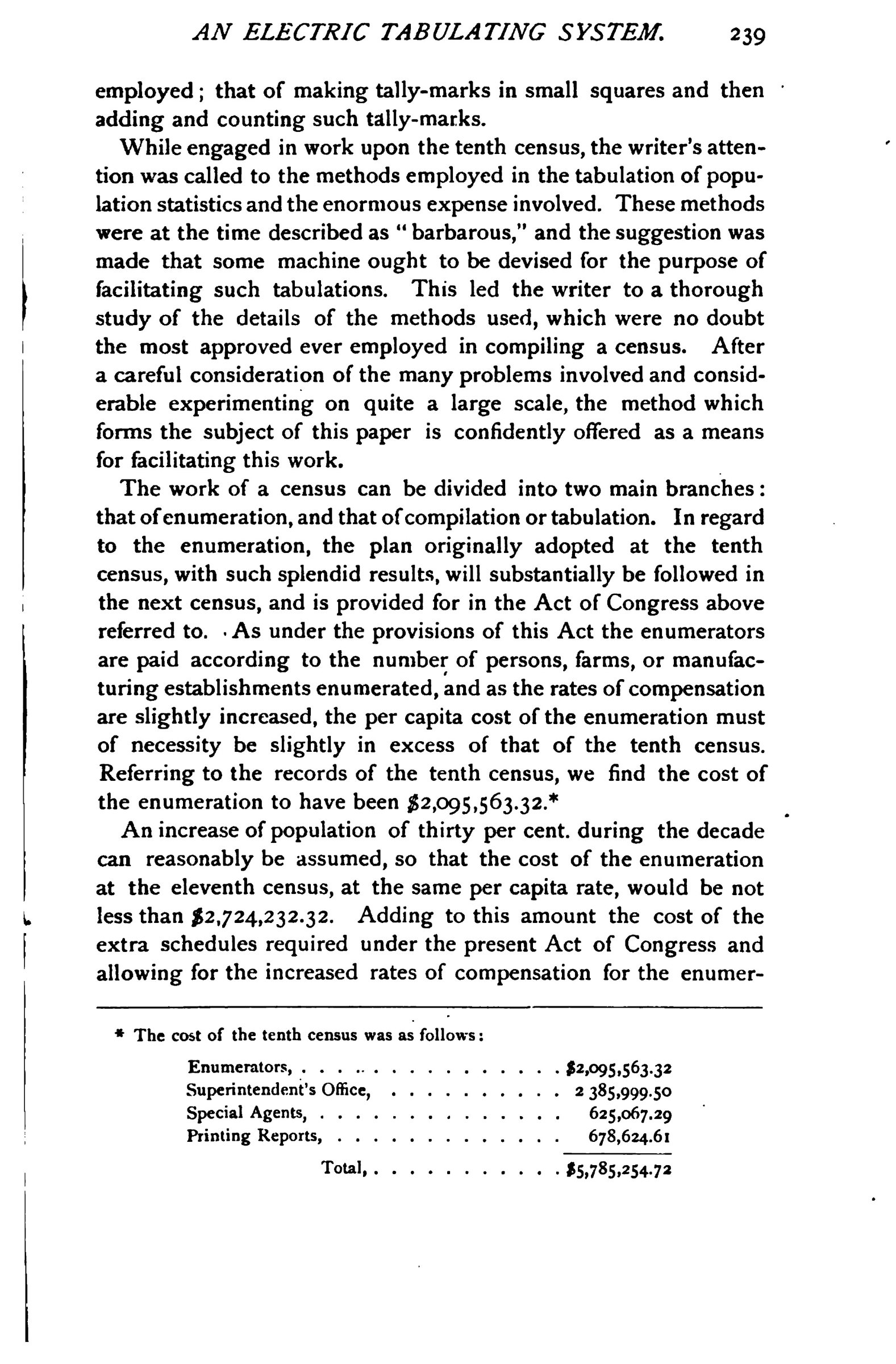
In 1880, a census was counted by hand. Clerks went through the schedules and made a pencil mark in a square for each person of each kind, then added up the marks (Hollerith, "An Electric Tabulating System", 1889, p. 239). Hollerith, who worked on that census, wrote that the methods were "described as 'barbarous'" (p. 239).
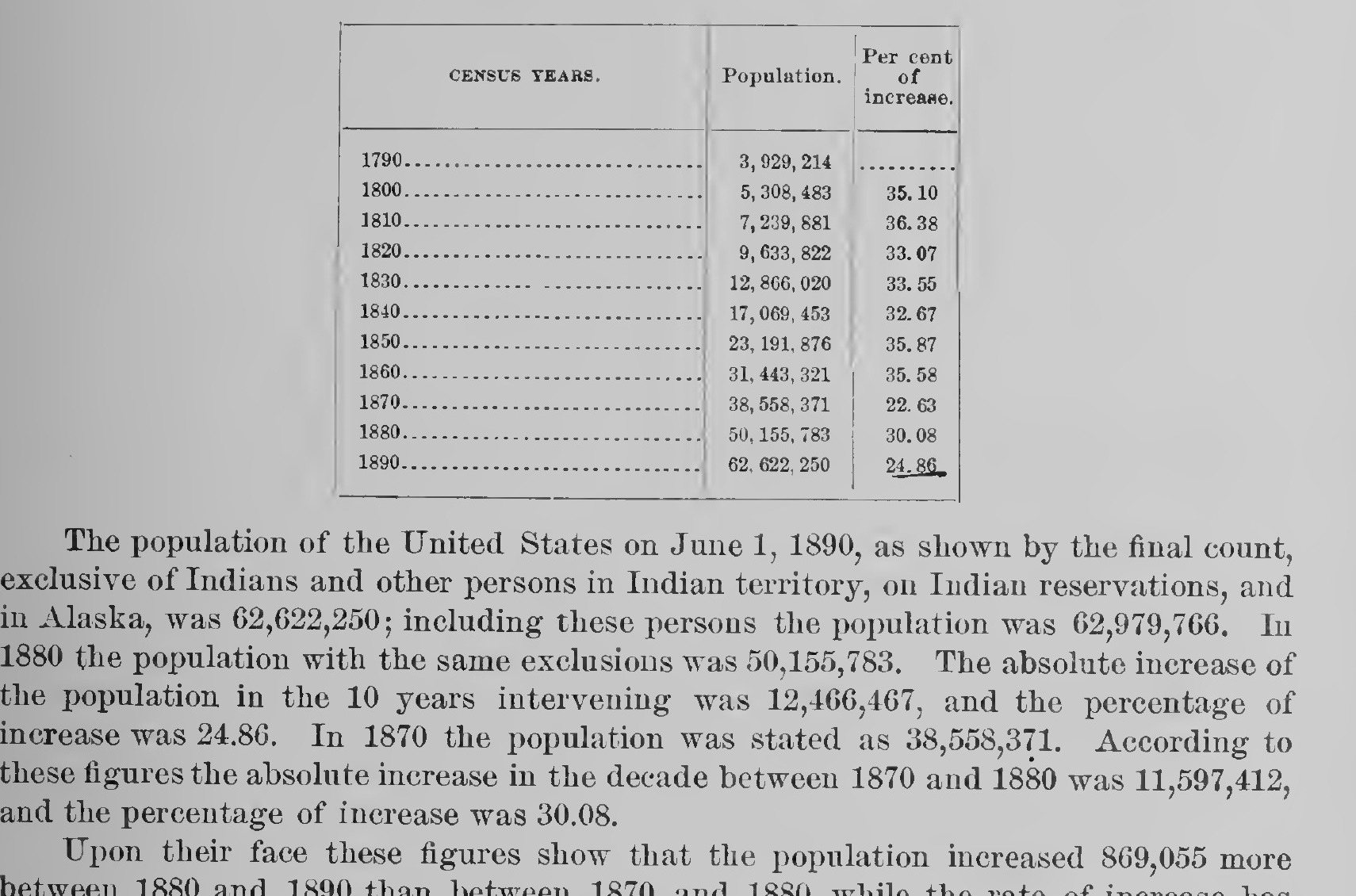
The country had about fifty million people in 1880, and more than sixty-two million were expected in 1890. The tenth census had cost $5,785,254.72 (about $193 million today), and Congress set the limit for the next at $6,400,000 (about $229 million today), printing not included (Hollerith 1889, pp. 238-240). By the Census Bureau's own account, the final tables of 1880 were not finished until 1887.
Hollerith had joined the Census Office in October 1879, aged nineteen, as a special agent on $600 a year (about $20,000 today; Truesdell, p. 27). In his paper of 1889 he put the job this way: "A census is often spoken of as a photograph of the social and economic conditions of a people" (p. 240). Counting by hand, much of that photograph was never developed: every new question meant going back through millions of marks.
Today's money: US consumer prices, Federal Reserve Bank of Minneapolis; rough, so "about".
Where did the idea come from?
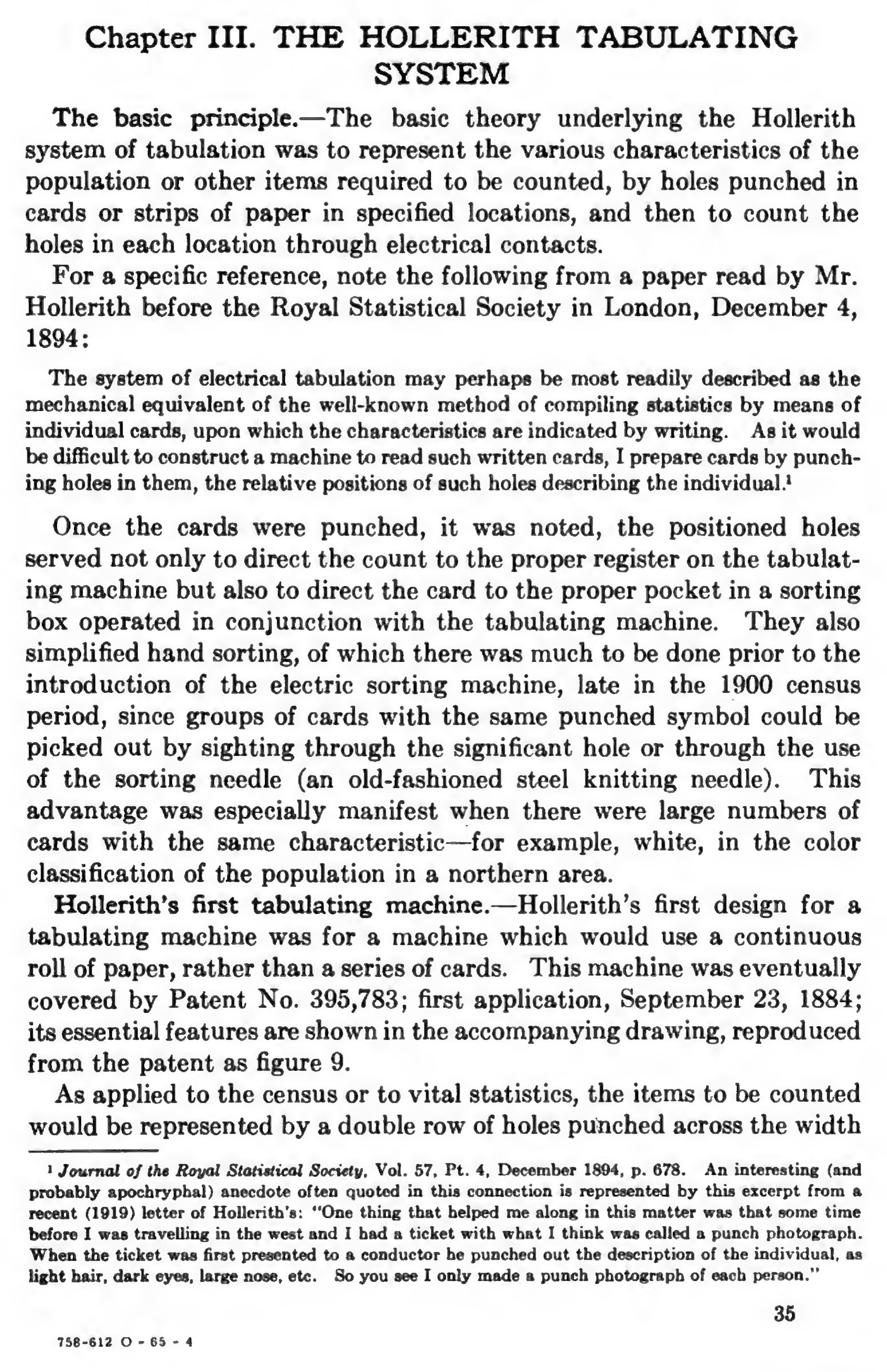
The story usually told is that a train conductor's ticket punch gave Hollerith the idea. The source is Hollerith himself, in a letter of 1919:
"I had a ticket with what I think was called a punch photograph. When the ticket was first presented to a conductor he punched out the description of the individual, as light hair, dark eyes, large nose, etc. So you see I only made a punch photograph of each person."
Hollerith to McPherson, 7 August 1919, quoted by Truesdell (1965), p. 35, note.
Such tickets were real. In August 1887 The Railway News described a new "punch photograph" on the overland roads to California: a column of printed words, male or female, slim, medium or stout, light or dark hair, with every word that did not fit the passenger punched out (27 August 1887, p. 360, as quoted by J. Strickland of the Computer History Museum; we have not seen the page).
But the letter says the ticket "helped me along". It was written more than thirty years after the first machine was built, and the Census Bureau's own historian called the story "probably apochryphal" (his spelling; Truesdell, p. 35).
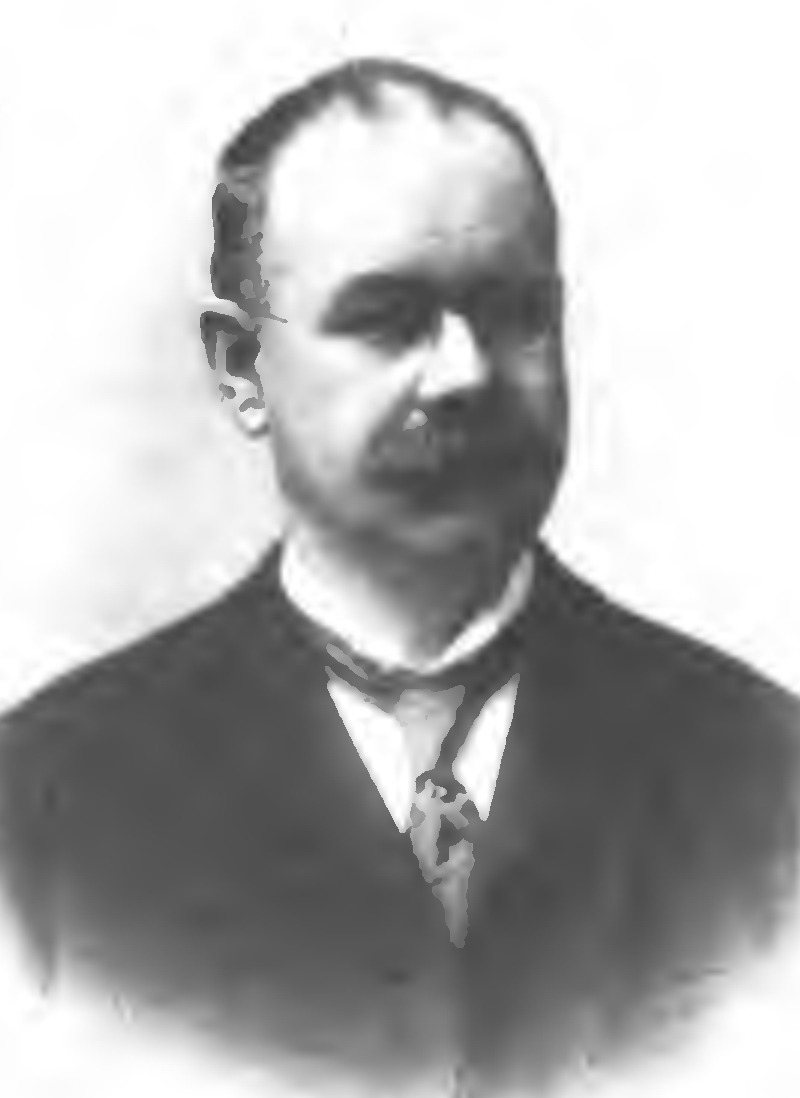
In the same year Hollerith wrote a second account, and it starts with someone else. John Shaw Billings, an army surgeon in charge of the census's vital statistics, had said to him at his tea table that "there ought to be a machine for doing the purely mechanical work of tabulating population and similar statistics" (Truesdell, p. 31).
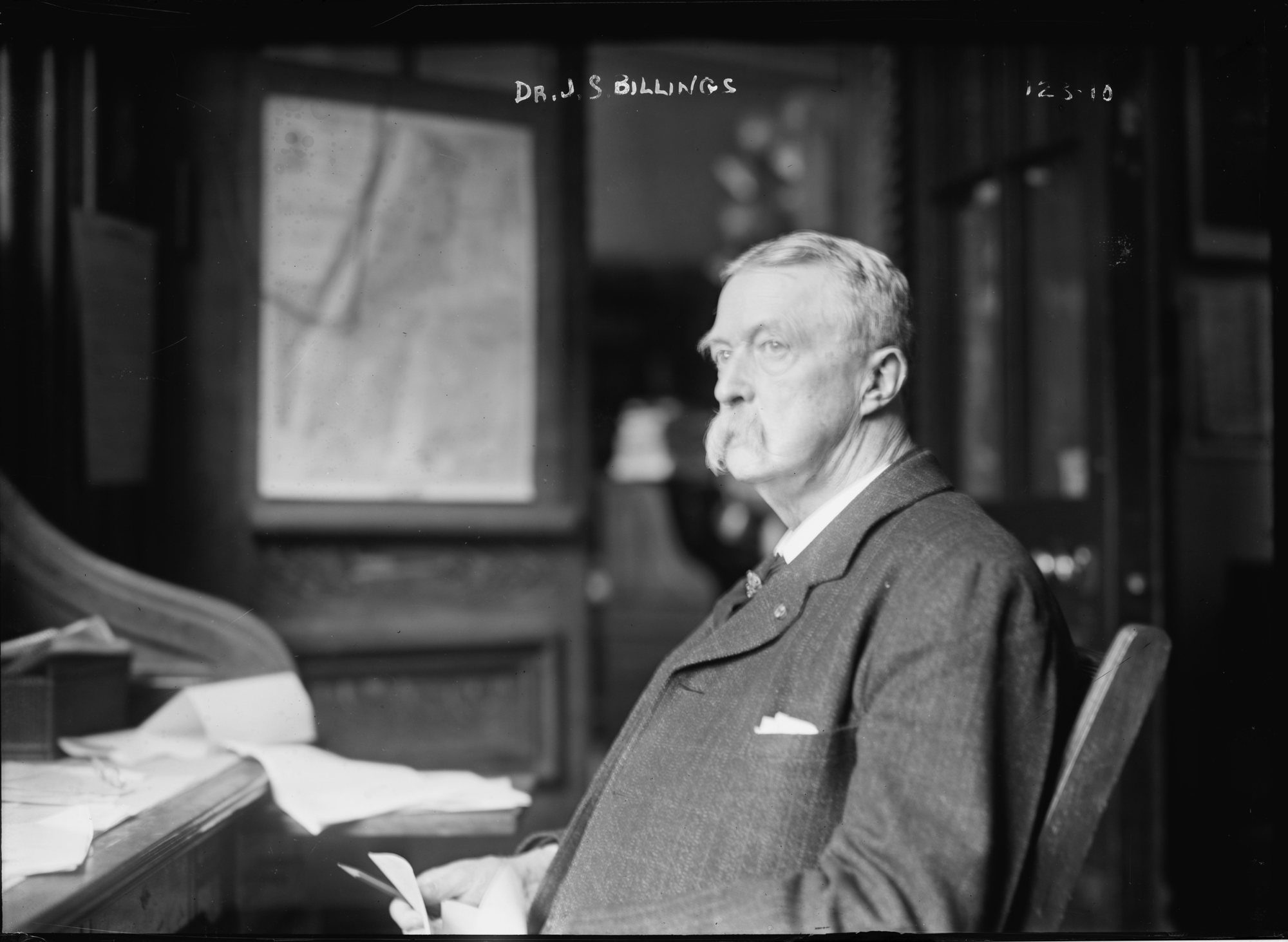
Billings said so himself, in print, long before. In 1887 he wrote that "seven years ago" he had advised Hollerith "to take the matter up and devise such a machine" (quoted by Truesdell, p. 32). In 1885 he had already proposed cards with holes, counted "by electrical counting or by distributing the cards by machinery" (Truesdell, p. 32, from the Tenth Census reports). His daughter remembered "the first little wooden model" Hollerith brought to their library, "many evenings while they were puzzling their brains over its adaptation" (Truesdell, pp. 30-31).
So the record gives Billings the suggestion: cards, holes, counted by machine. Hollerith worked out how. The conductor's ticket is real, but it first appears in this story in 1919.
The card
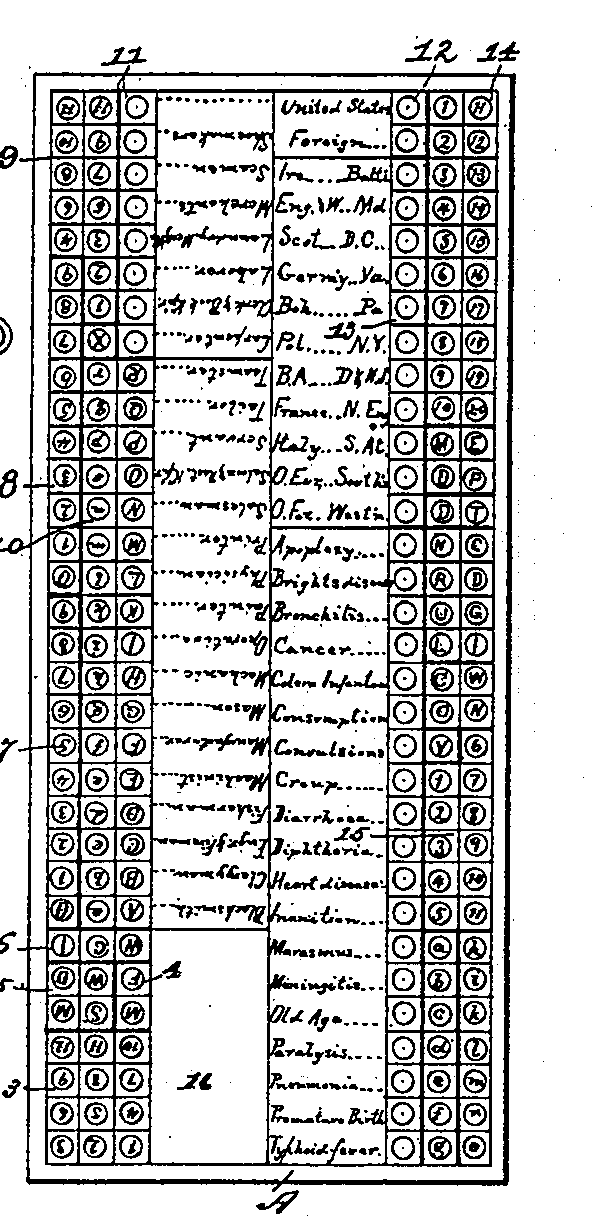
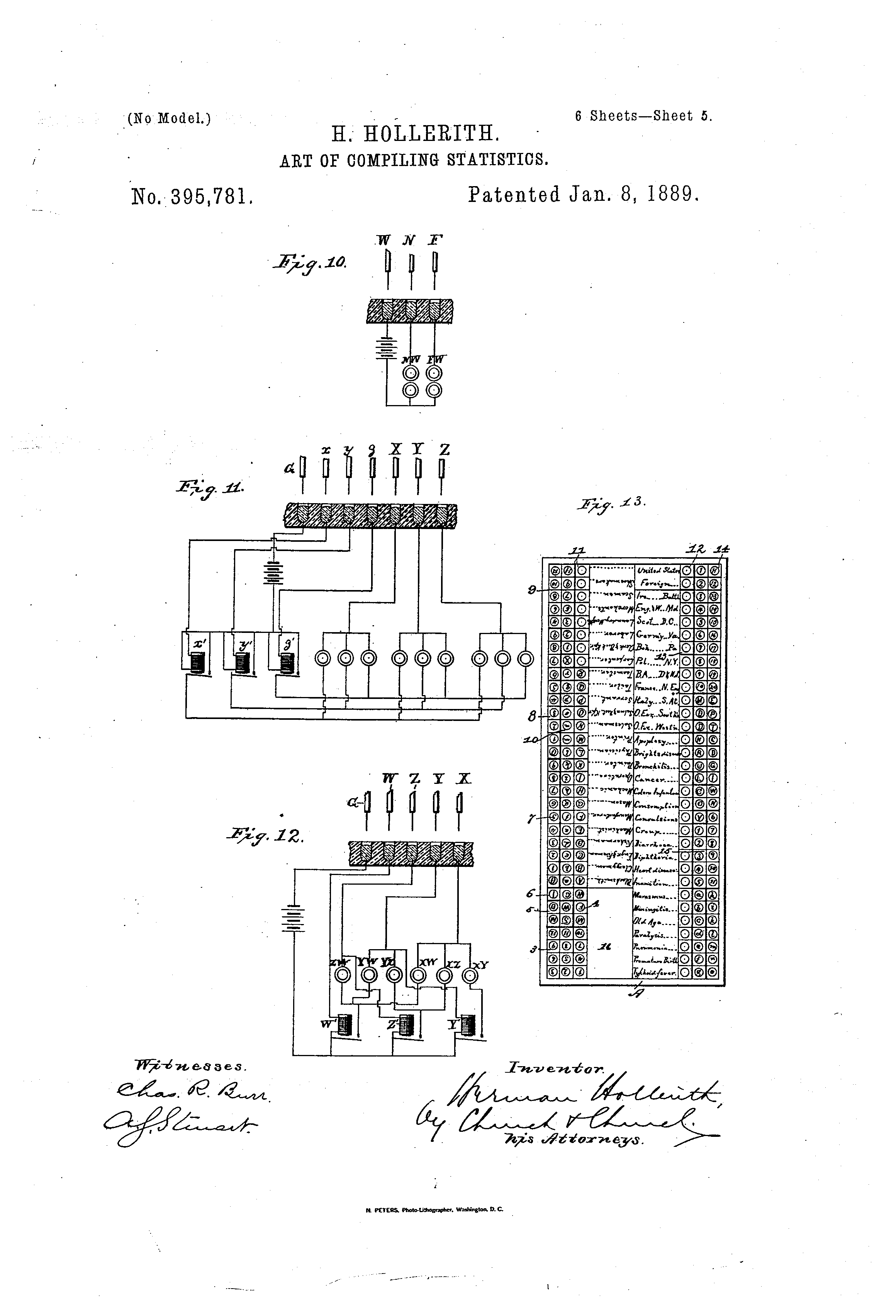
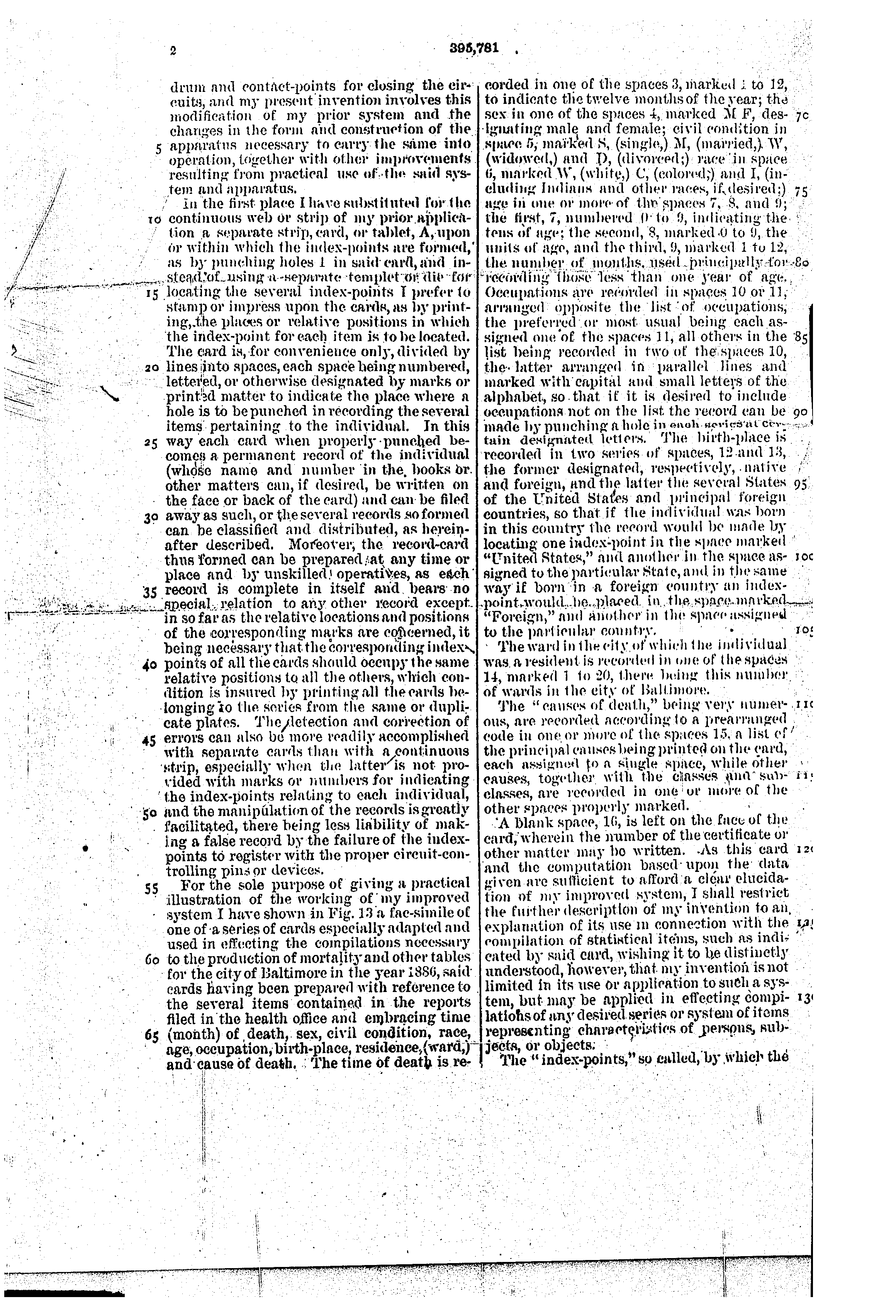
The first real test was in Baltimore: the city's health office put its deaths for 1886 on cards (US 395,781, p. 2; Truesdell, p. 30). The patent prints one of those cards. Each has places for the month, sex, whether single, married, widowed or divorced, race, age, occupation, birthplace, the city ward and the cause of death (spec p. 2, Fig. 13).
One hole in the right place records one fact, and the same places are printed on every card. The patent says each punched card "becomes a permanent record of the individual", and that the cards can be prepared "by unskilled operatives" (p. 2).
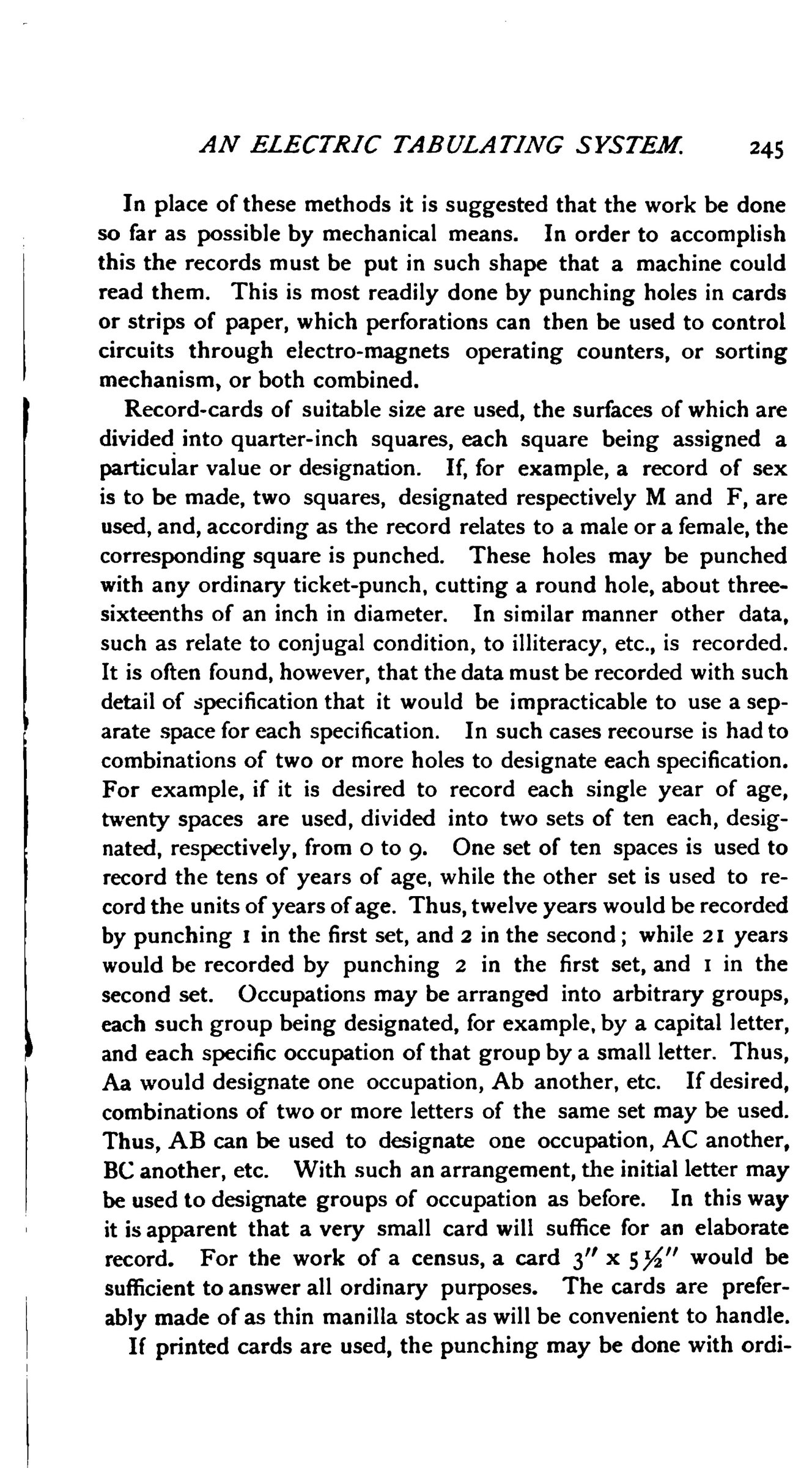
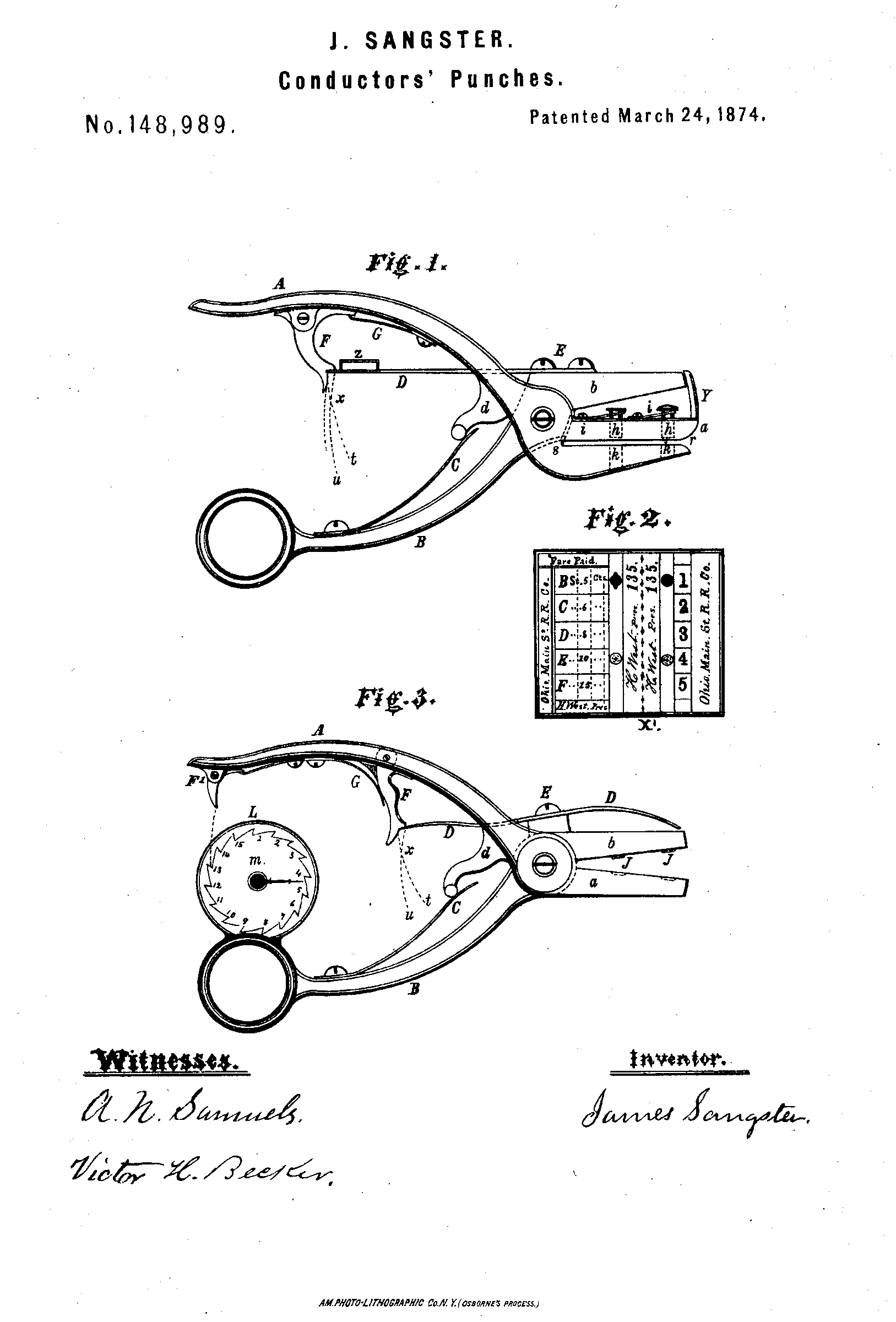
To punch them Hollerith used, in his words, "any ordinary ticket-punch, cutting a round hole about three-sixteenths of an inch in diameter" (Hollerith 1889, p. 245). So the conductor's punch is in the story after all, as a tool.
His first applications, in 1884, used a long strip of paper instead of cards (US 395,782 and 395,783). In June 1887 he filed this one, with a separate card for each person. All three were granted on the same day, 8 January 1889.
How the press counts
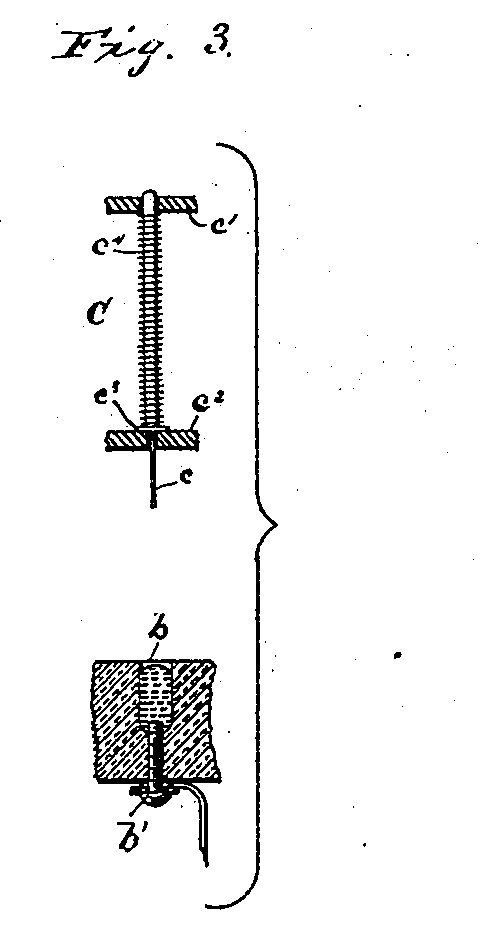
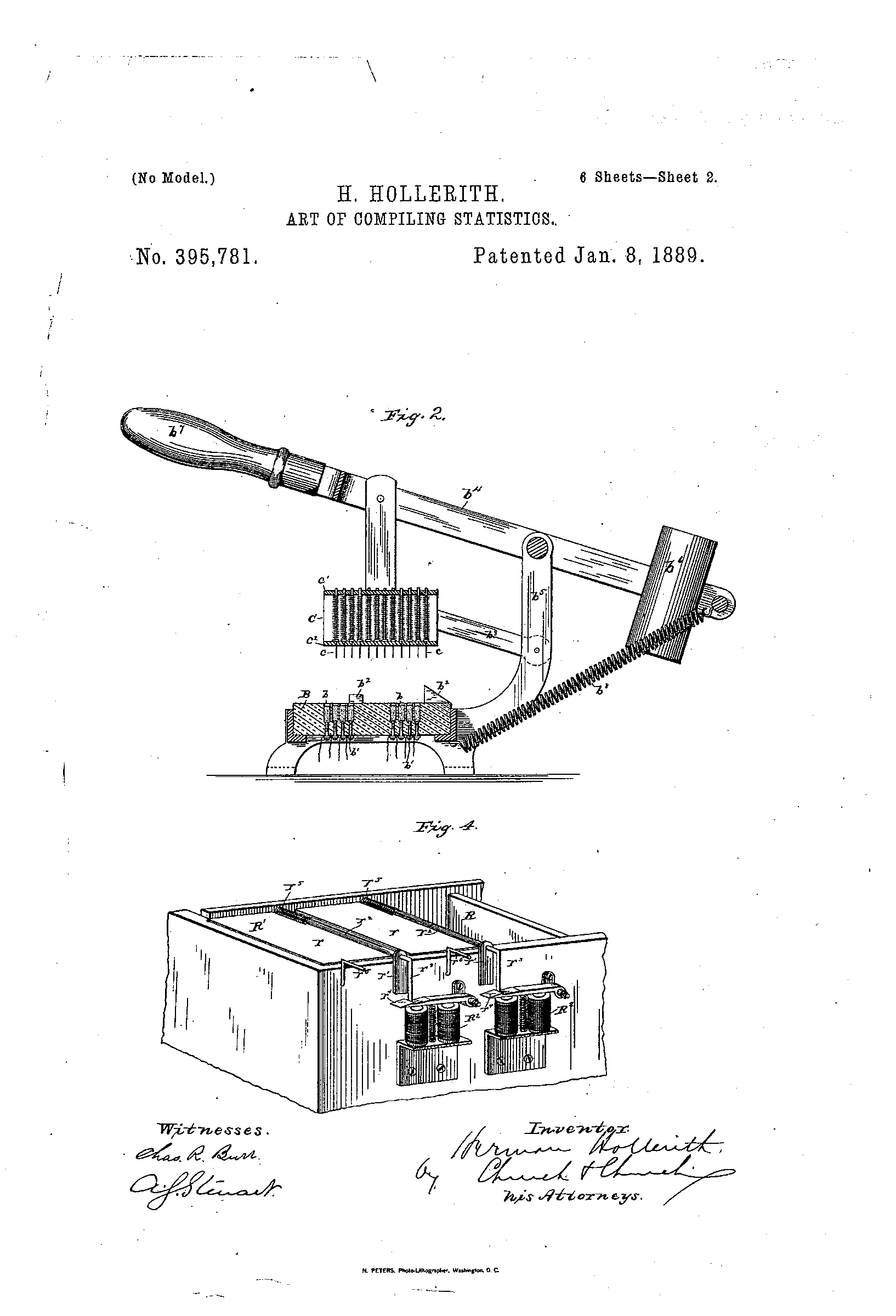
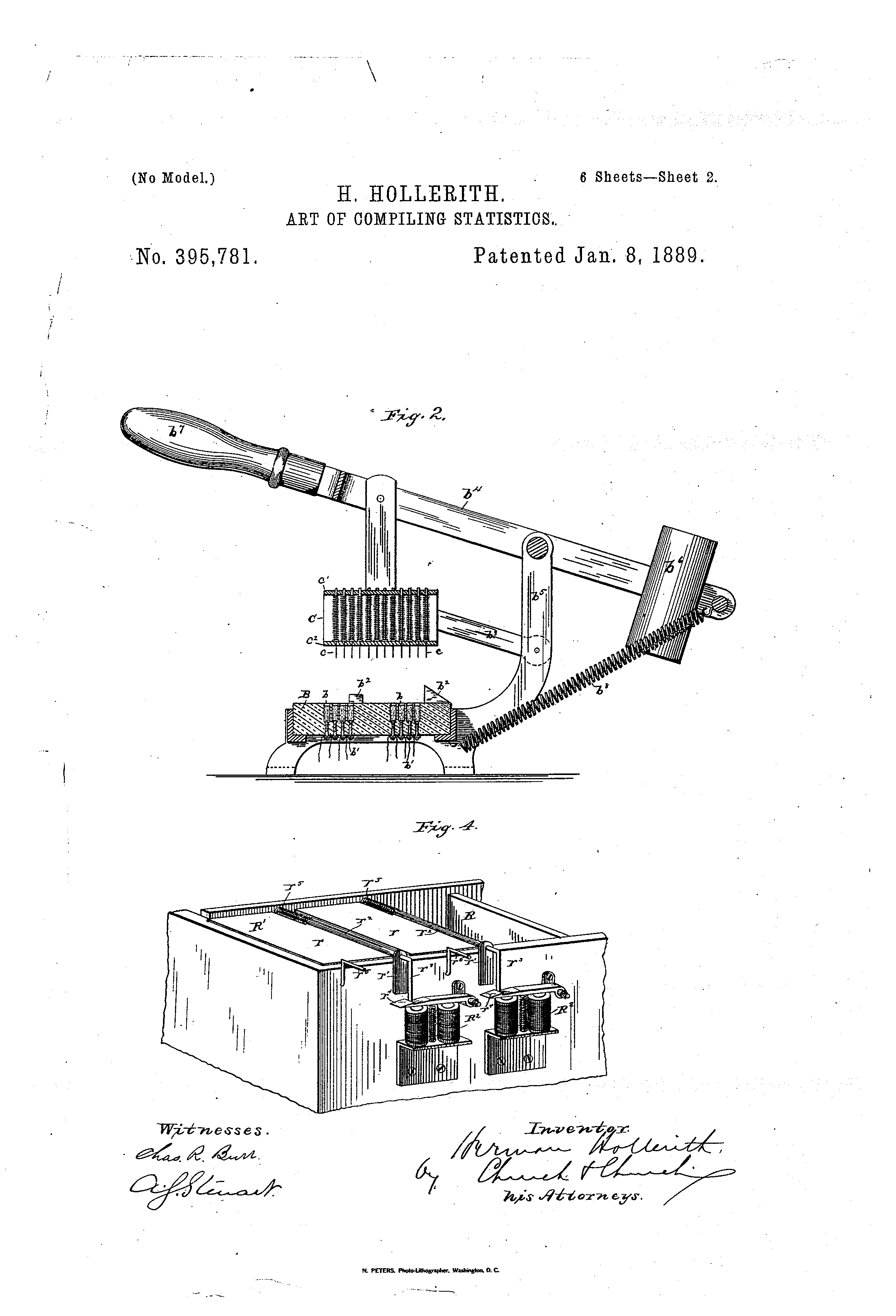
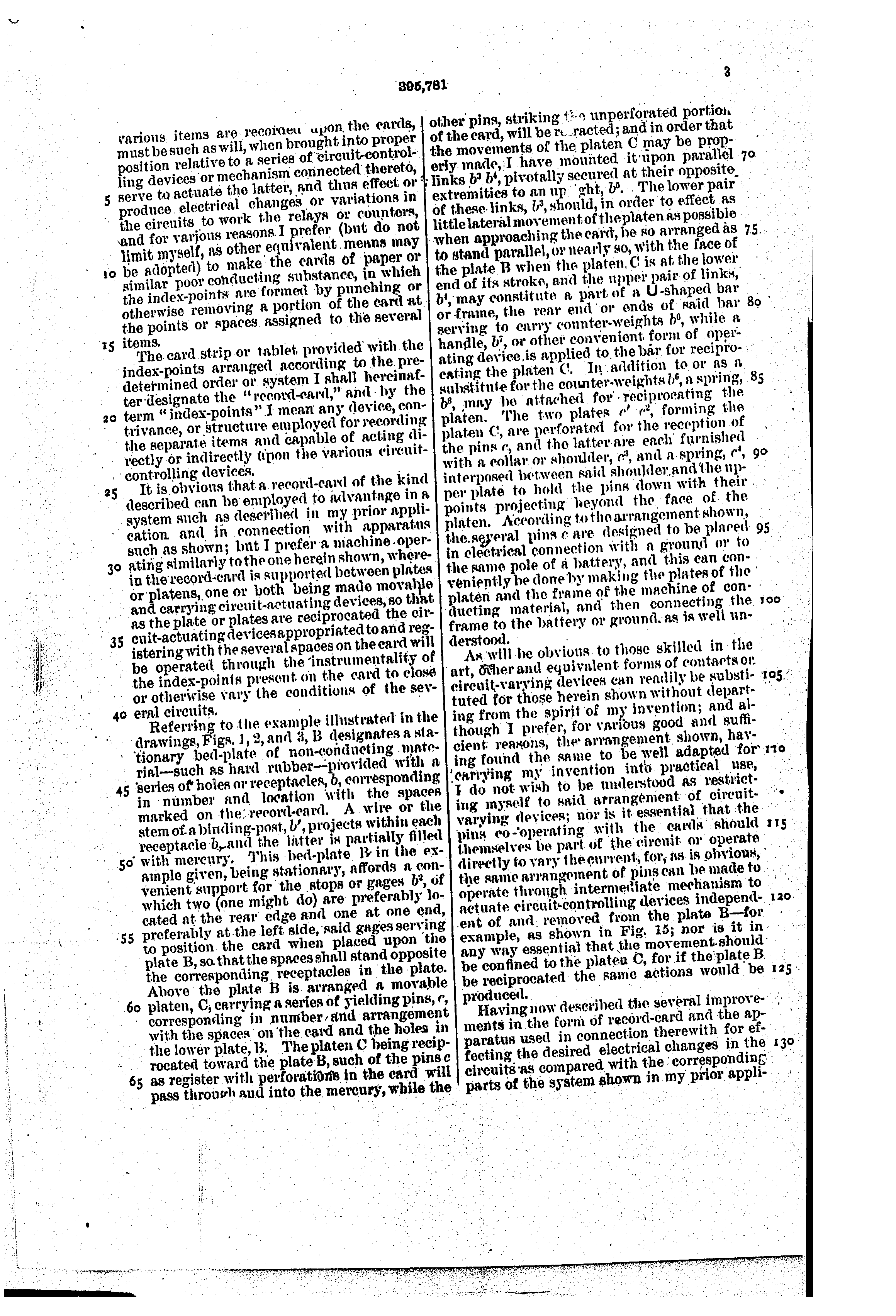
The card goes face up on a bed of hard rubber, pushed against stops so it sits in exactly the same place every time. Under every place a hole could be there is a small cup, partly filled with mercury. Above the card, a plate carries a steel pin for each of those places, each held down by a spring. Pull the handle, and the plate comes down (US 395,781, p. 3).
In the patent's words, the pins that meet a hole "pass through and into the mercury, while other pins, striking an unperforated portion of the card, will be retracted" (p. 3). The pins and the frame are wired to one side of a battery; a pin that reaches the mercury completes a circuit, through a wire from the bottom of that cup, to its own counter (p. 3; Hollerith 1889, p. 250).
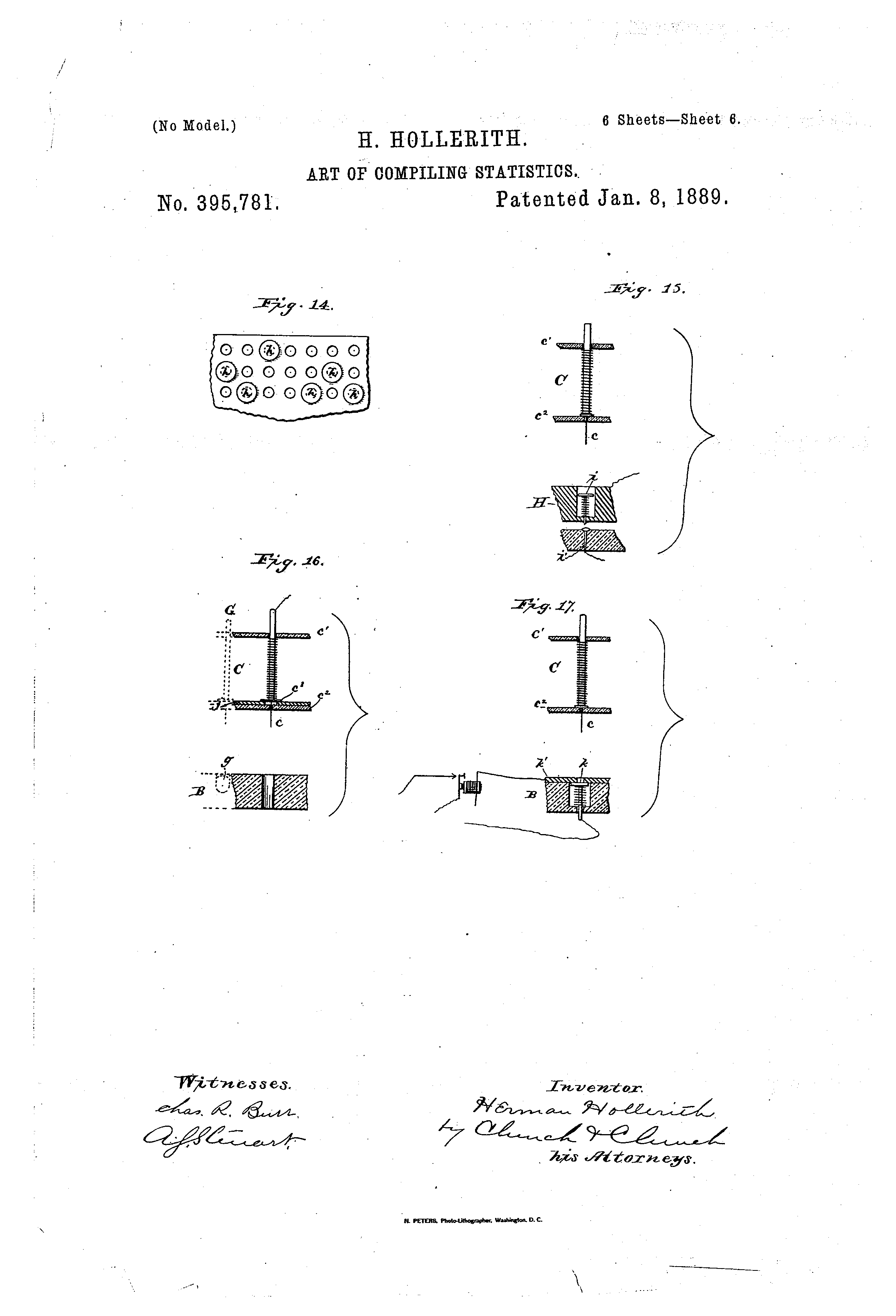
One more pin, G, closes the circuit for all the others, and it is set to touch a little later than they do (the patent: by shortening the pin or lowering the mercury in its cup), so it makes contact last and breaks it first. If the card is in crooked, the card holds G back, and nothing counts: "By this means I suspend the action of the circuit-controlling devices when a card is improperly inserted and prevent erroneous counts being made" (p. 6). In the census office of 1890, a bell rang with every card that counted; when it stayed silent, the clerk knew to look at that card again (Martin 1891, p. 524; Truesdell, p. 55).
Run the machine
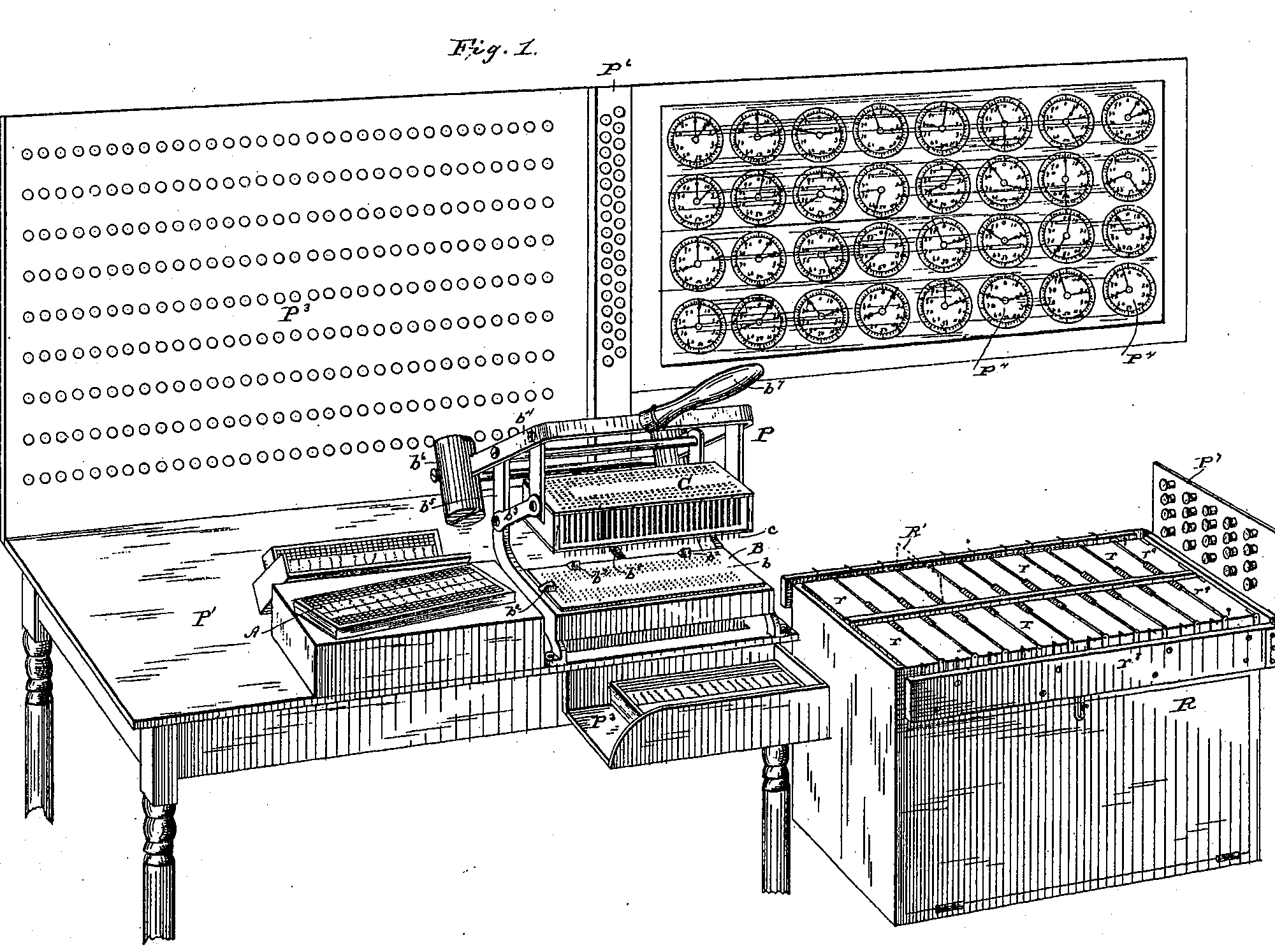
Here is the whole outfit, rebuilt from the patent: a card for you to punch, the press, the wiring with Fig. 6's relays, a counter for each fact, and the sorting box. Punch a person into the card, then press "Put it in the press". Every pin that finds a hole closes its circuit, and each closed circuit's counter moves on by one. Then run the deck of forty made-up people and watch the dials count.
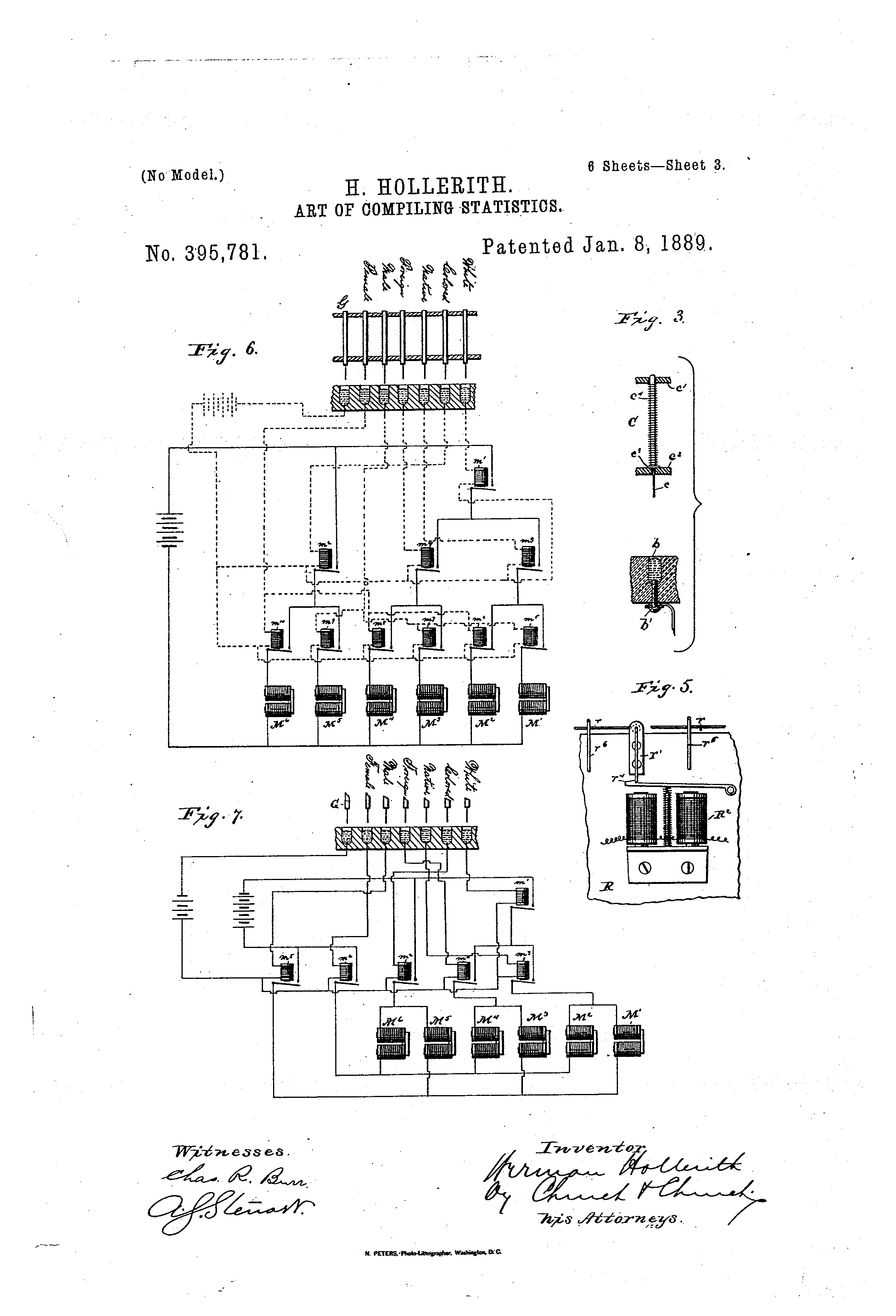
What the patent and Hollerith give. The press: the card against its stops on a hard-rubber bed, a cup of mercury under each place, a spring pin over each, pins over holes "into the mercury", pins over solid card "retracted", the pins and the frame one pole of a battery (US 395,781, p. 3). Pin G, shorter and in series with every pin, so a crooked card counts nothing (p. 6). Single facts by "direct circuits" from the pins to the counters' magnets (p. 6). Combinations by relays, as Fig. 6 (p. 6, right column, read on the page): relay m′ is worked by the pin "white", m² by "colored", m³ by "native", m⁴ by "foreign", m⁵ m⁷ m⁹ by "male" and m⁶ m⁸ m¹⁰ by "female"; counter M′, "native white males", is in circuit with the contacts of m⁵, m³ and m′; M², "native white females", m⁶ m³ m′; M³, "foreign white males", m⁷ m⁴ m′; M⁴, "foreign white females", m⁸ m⁴ m′; M⁵, "colored males", m⁹ m²; M⁶, "colored females", m¹⁰ m². The counters' magnets "belong to the counting mechanism or sorting-boxes, or to both" (p. 6), and the relays' coils are in circuit "with the six cups on one side and with the battery and cup of the pin G on the other" (p. 6). The sorting box: lid, rod, arm, catch, magnet, spring and stop (Figs. 4, 5; p. 5); a card that belongs to no compartment goes into receptacle P2 (p. 5). The counter: a face three inches square, "a dial divided into 100 parts and two hands, one counting units the other hundreds", one step each time its magnet is energised, up to 10,000 (Hollerith 1889, p. 251). The bell is the 1890 machine's (Martin 1891, p. 524). This page's relays are wired as Fig. 6 wires them, but on our card "Town or city" works m′, "Country" m², "Born in the US" m³ and "Born abroad" m⁴.
What is ours. The card: a modern one of our own, not a census form, with sex, where the person lives, where they were born, age, marital status and the month they were born, and one hole to a field. Which places our switch-board wires to a counter: 20 single facts and Fig. 6's six combinations, 26 dials (Fig. 1 draws 32; the 1890 machine had 40); month and units of age are on the card but have no pins on this run (in 1890 "pins were provided only for that part of the card to be used in a specific tabulation", Truesdell, p. 49). Each pin's wire running through its own counter and then through its relays' coils, in series (the patent allows the magnets "separately or in series", p. 6); where the batteries sit. Which compartment each combination opens: three compartments here, where the 1890 sorting box had 26 lids (Scientific American, 1890, p. 132). The press drawn as a section through one row of the card, the six places of Figs. 6-8, with every other pin doing what a pin over a hole or over solid card does there. Every size, speed and timing; the relays and counters drawn as closing the instant their circuits do. The hands' colours and the marks every ten on the dials; the number under each dial in the dial view (a real dial has only its hands). The counter's works and its carry (below). The forty people of the deck are made up, drawn the same for every visitor from a fixed seed; they are no one.
Checked. The episode's own test, run again on this page's copy of the press: 52 checks, all pass (pins over holes reach the mercury and pins over solid card never pass its face; G touches last and leaves first; a crooked card counts nothing; the counter reads to 10,000; the sorting lid opens only after its magnet and never passes its stop). This page's test: 21 checks, all pass, among them that after the made-up deck every dial, the six combination counters included, reads exactly the number of cards punched for it, and that one card moves exactly the dials its holes call for, each by one. We ran the same check on this page in a browser.
Counting combinations, and sorting
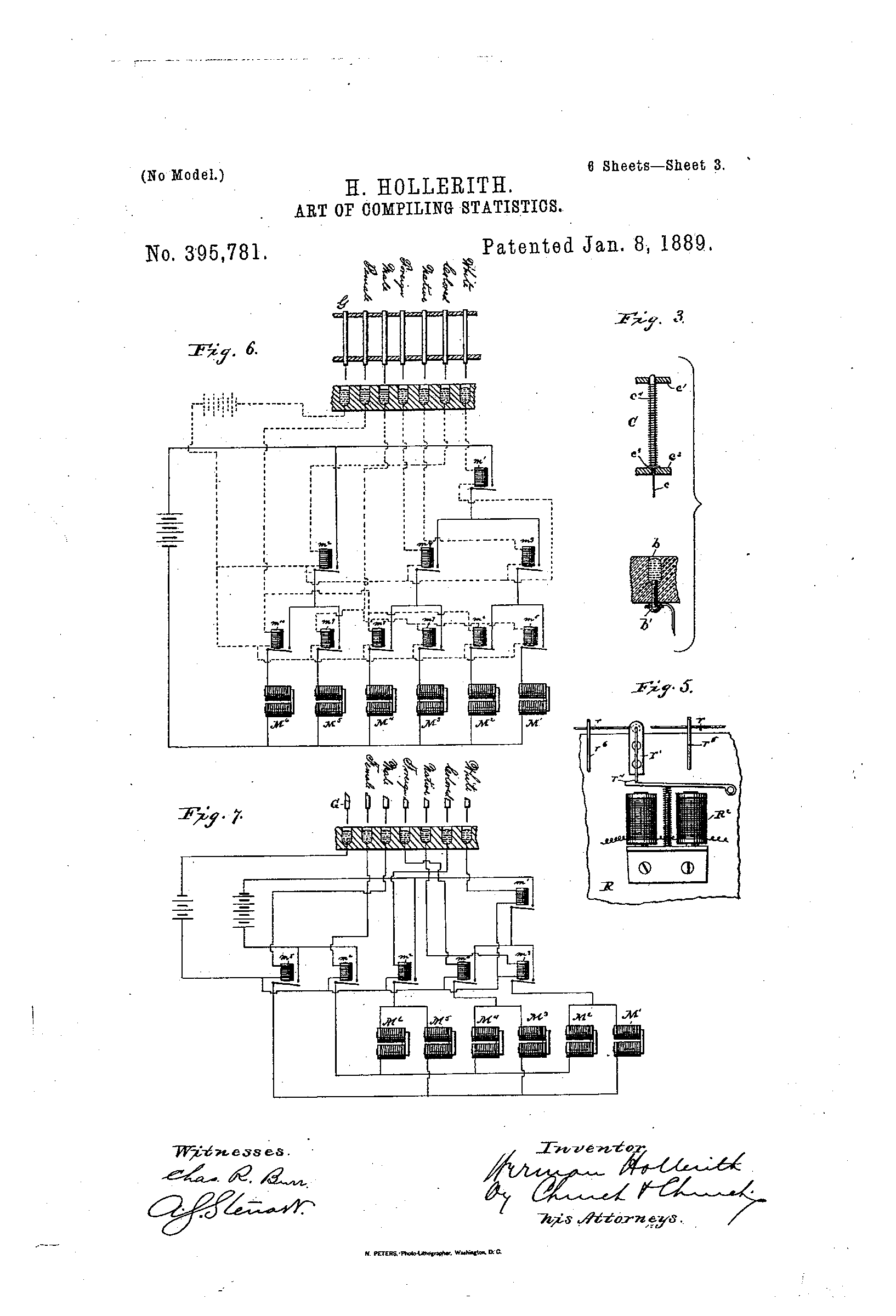
Counting one fact at a time is only a start. A census wants combinations: how many men born abroad, say. For that, the patent uses relays. Its Fig. 6 counts six combinations of sex, race and nativity: "first, native white males; second, native white females; third, foreign white males; fourth, foreign white females; fifth, colored males and, sixth, colored females" (US 395,781, p. 6). The machine above is wired the same way, but its card uses modern categories of our own: town or city, or the country, in place of the 1890 race field.
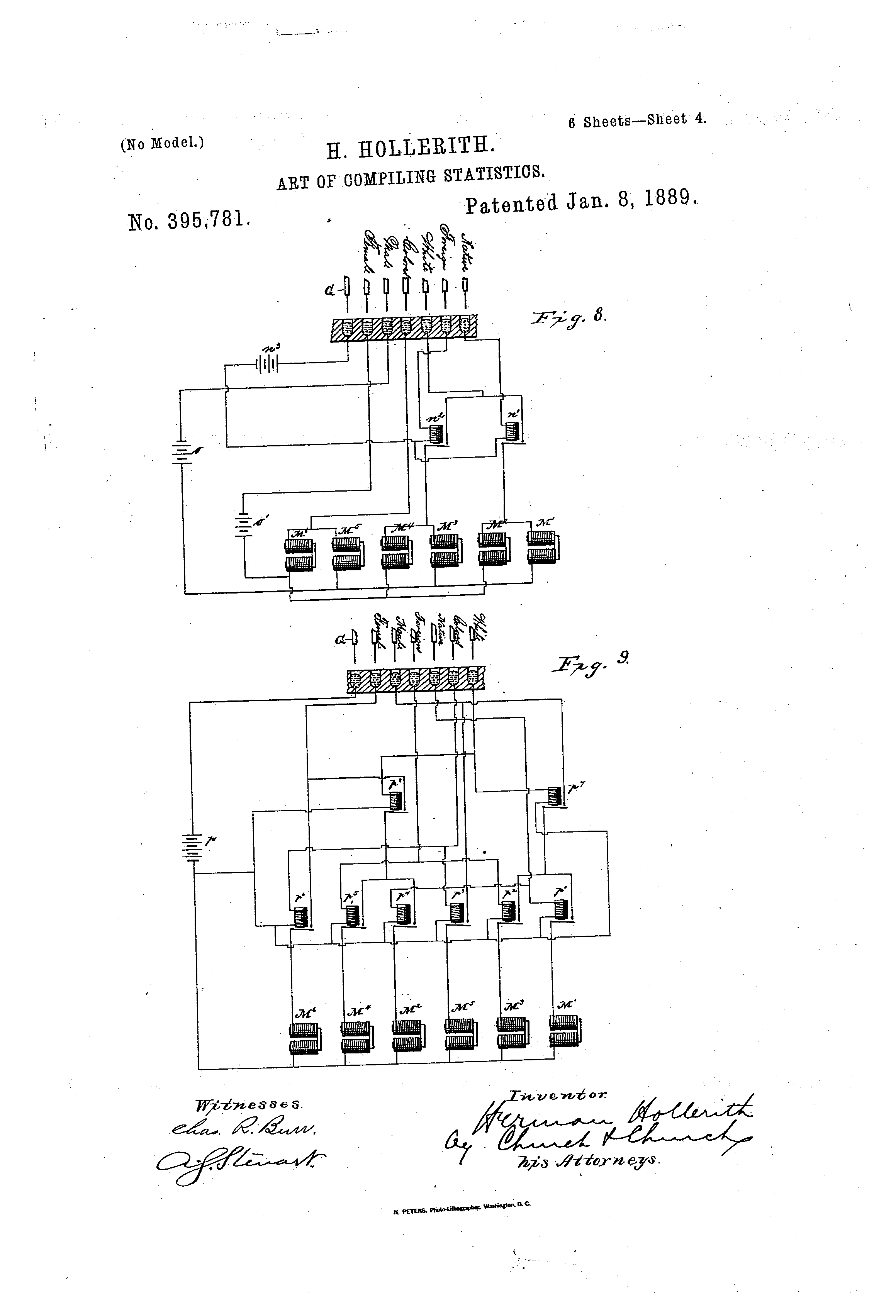
Each of the six pins works relays in a "primary" circuit; each counter sits in a "secondary" circuit through the contacts of two or three relays, so it moves only when all its holes are in the card: "by the concurrent action of the two or more index-points" (p. 7). That is the lower half of the wiring above. Hollerith says he chose relays to avoid "delicate adjustments of resistances" (p. 6).
The same circuits can sort the cards. Beside the press stands a box of compartments, each with a lid held shut by a catch. When a card closes the right circuit, a magnet pulls the catch, a spring throws up one lid, and the clerk drops the card in; only one compartment is open, so the card can't go into the wrong one (pp. 4-5). The clerk closes the lid "with the right hand, while at the same time the next card is placed in position in the press with the left hand" (Hollerith 1889, pp. 253-254).
Today we would call this a query: count the cards where all three are true, then sort them for the next question. And because the cards stay sorted, the next table doesn't need the schedules again, just the cards (Truesdell, p. 42; Hollerith 1889, p. 255). The comparison with a query is ours.
Inside a counter
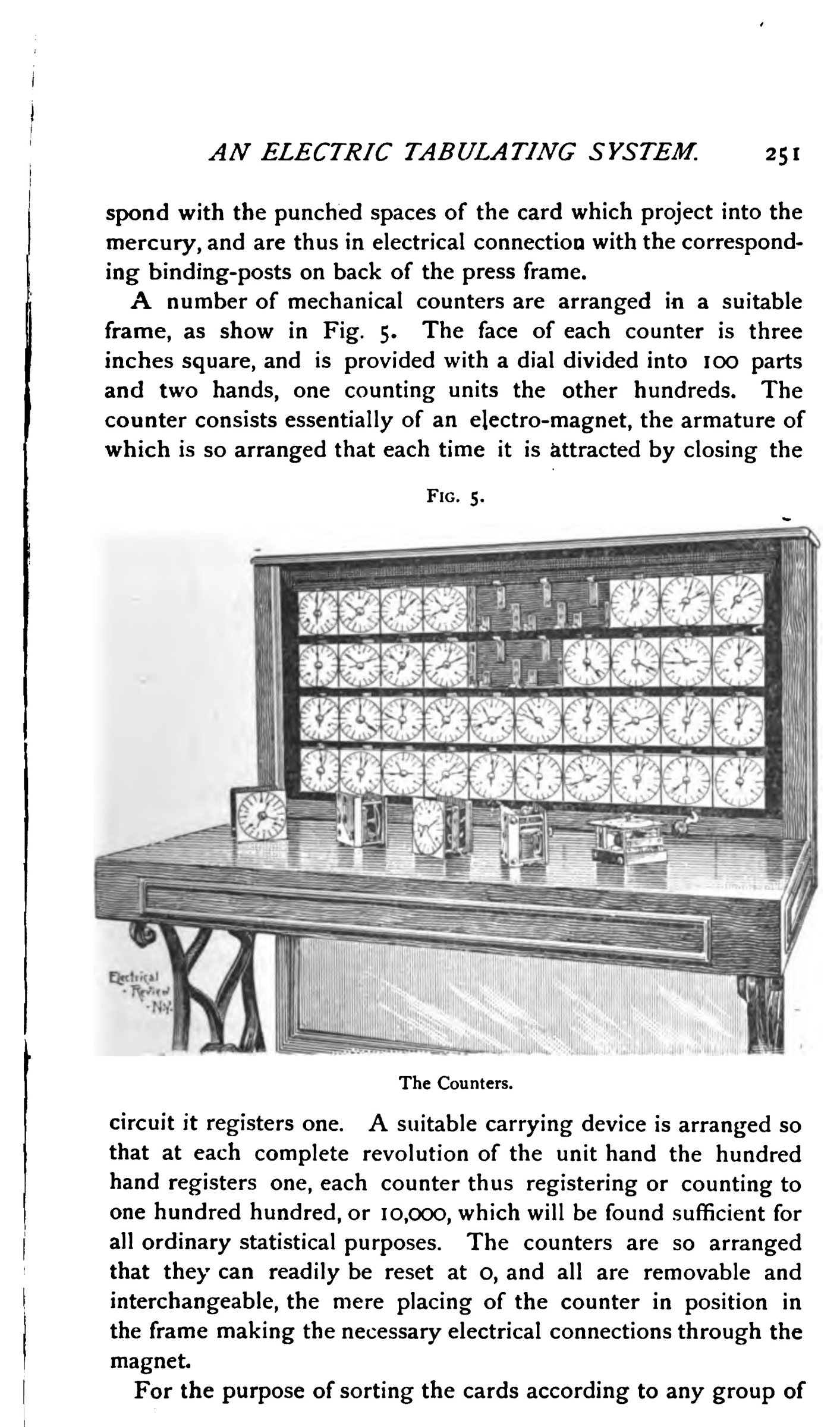
Each counter is a dial with an electromagnet behind it. In Hollerith's description, every time the circuit closes, the magnet pulls its armature and the dial "registers one". A dial had two hands, units and hundreds, so each could count to ten thousand: "A suitable carrying device is arranged so that at each complete revolution of the unit hand the hundred hand registers one" (Hollerith 1889, p. 251). How the hundreds hand was moved, neither the patent nor that paper says; the works below are the episode's own design. Pick any counter of the machine above and watch it: run the deck a few times and the hundreds hand moves when the units hand passes 99.
The contest of 1889
In 1889 the new Superintendent of the Census, Robert Porter, had a committee test three systems against each other; Billings was on it. Hollerith's punched cards; Charles Pidgin's coloured chips; and William Hunt's cards, written on by hand in colour and sorted by hand. The test used the 1880 returns for four districts of St. Louis, about ten and a half thousand people (Martin 1891, pp. 521-522; Truesdell, pp. 40-42; Truesdell's text gives 10,491 and a note 10,941).
| System | Copying the data onto cards or chips | Counting |
|---|---|---|
| Hollerith: punched cards, counted by machine | 72:27 | 5:28 |
| Pidgin: coloured chips | 110:56 | 44:41 |
| Hunt: written slips | 144:25 | 55:22 |
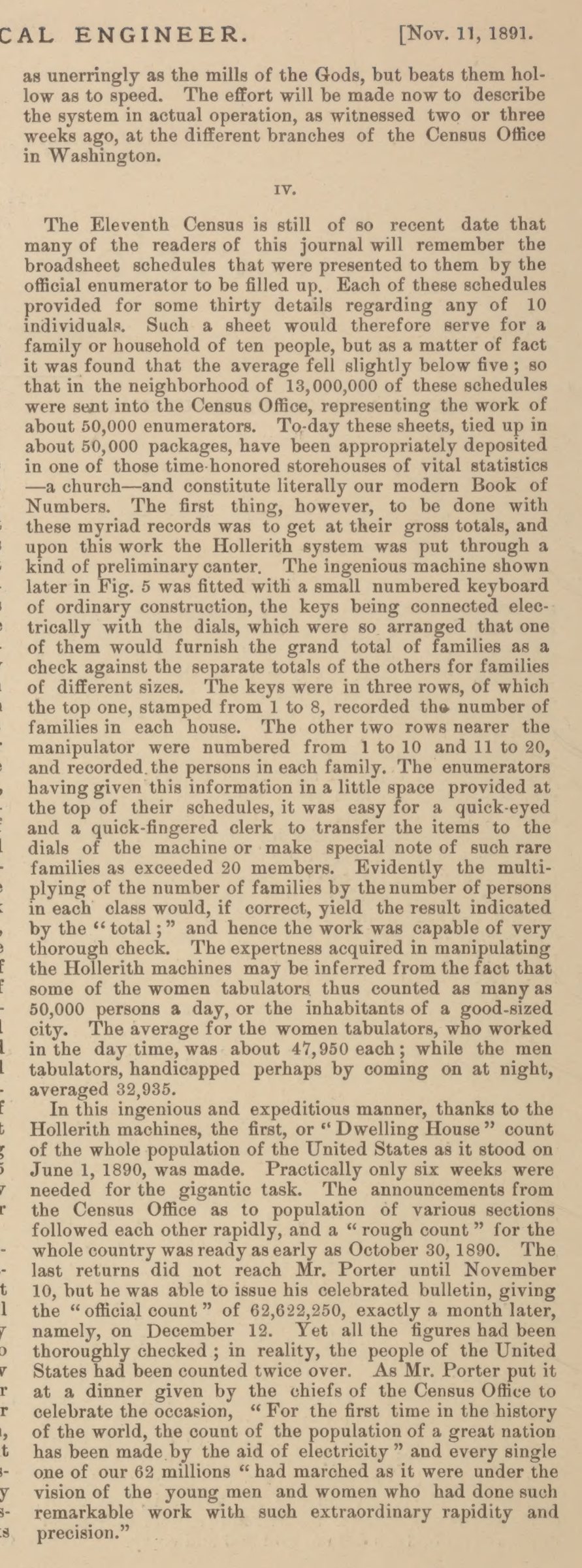
The committee chose the machine, and estimated it would save nearly $600,000 on the next census (Martin 1891, p. 522; about $21.5 million today). One fair note from the Census Bureau's own historian: for a single simple table, a good clerk with a pencil might have kept up (Truesdell, pp. 41-42, note). The machine won because the same cards could be counted again and again, in any combination, without going back to the schedules (Truesdell, p. 42).
Six weeks
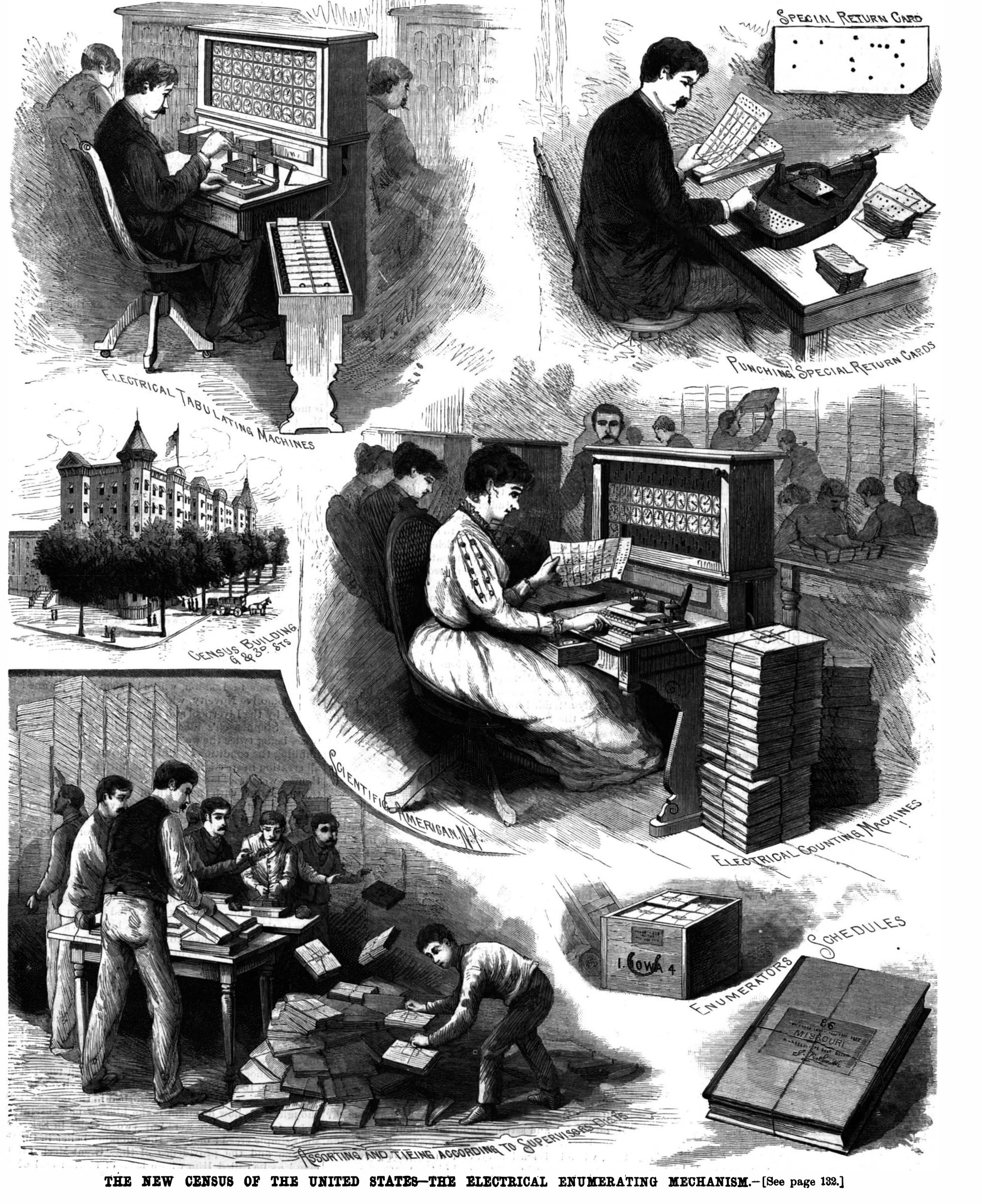
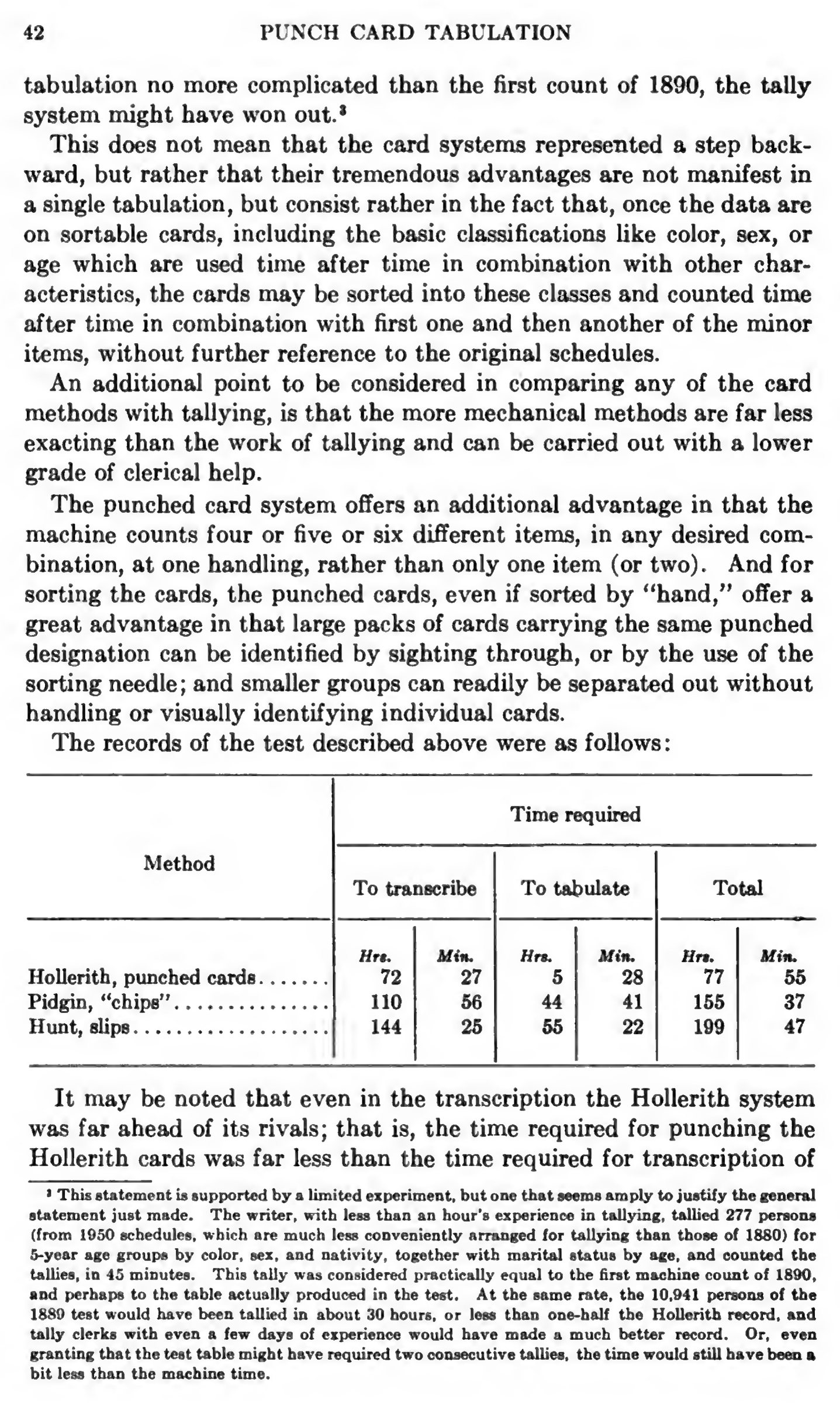
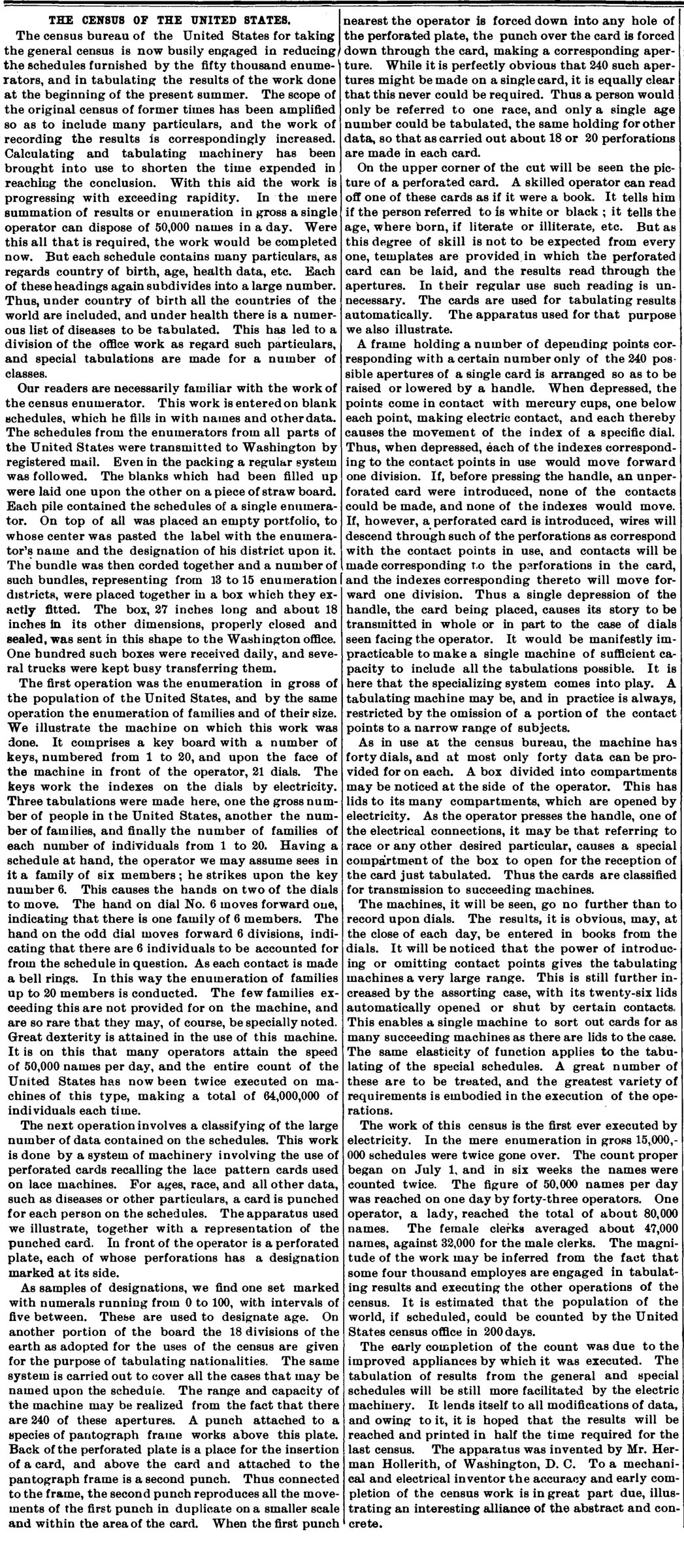
The count began on 1 July 1890, with about thirteen million schedule sheets from the enumerators (Martin 1891, p. 522). Scientific American reported it that August: "The work of this census is the first ever executed by electricity", and "in six weeks the names were counted twice" (30 August 1890, p. 132).
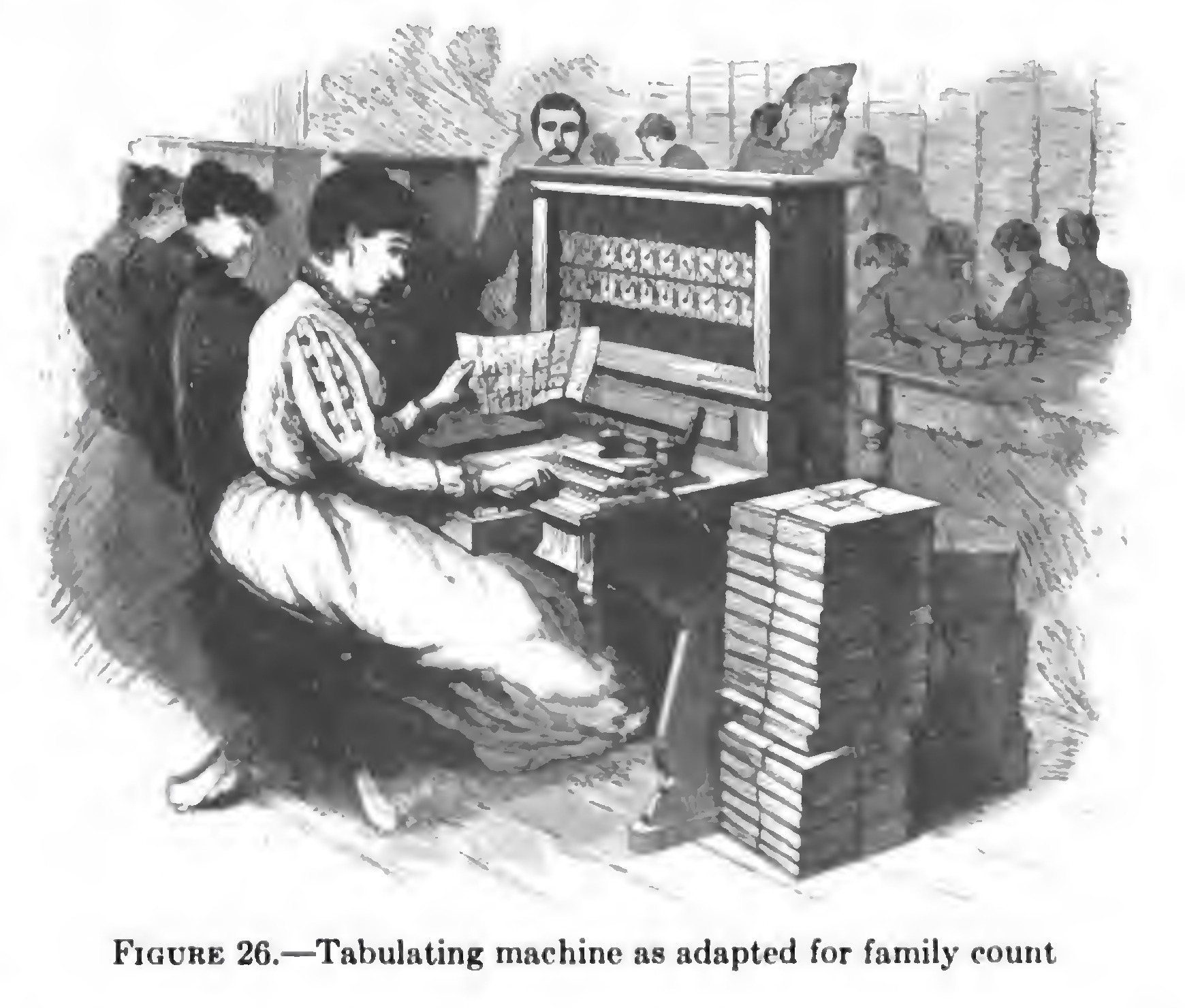
But that first count did not use punched cards. The press was swapped for a small keyboard, numbered one to twenty. A clerk read the number of people in the family at the head of each sheet and pressed that key, and the dial for families of that size moved on by one (Truesdell, pp. 61-62; Scientific American, p. 132; Martin, p. 522). Working that way, a clerk could count about fifty thousand people a day; one woman reached about eighty thousand (Scientific American, p. 132). So the famous six weeks belong to Hollerith's dials, worked from a keyboard.
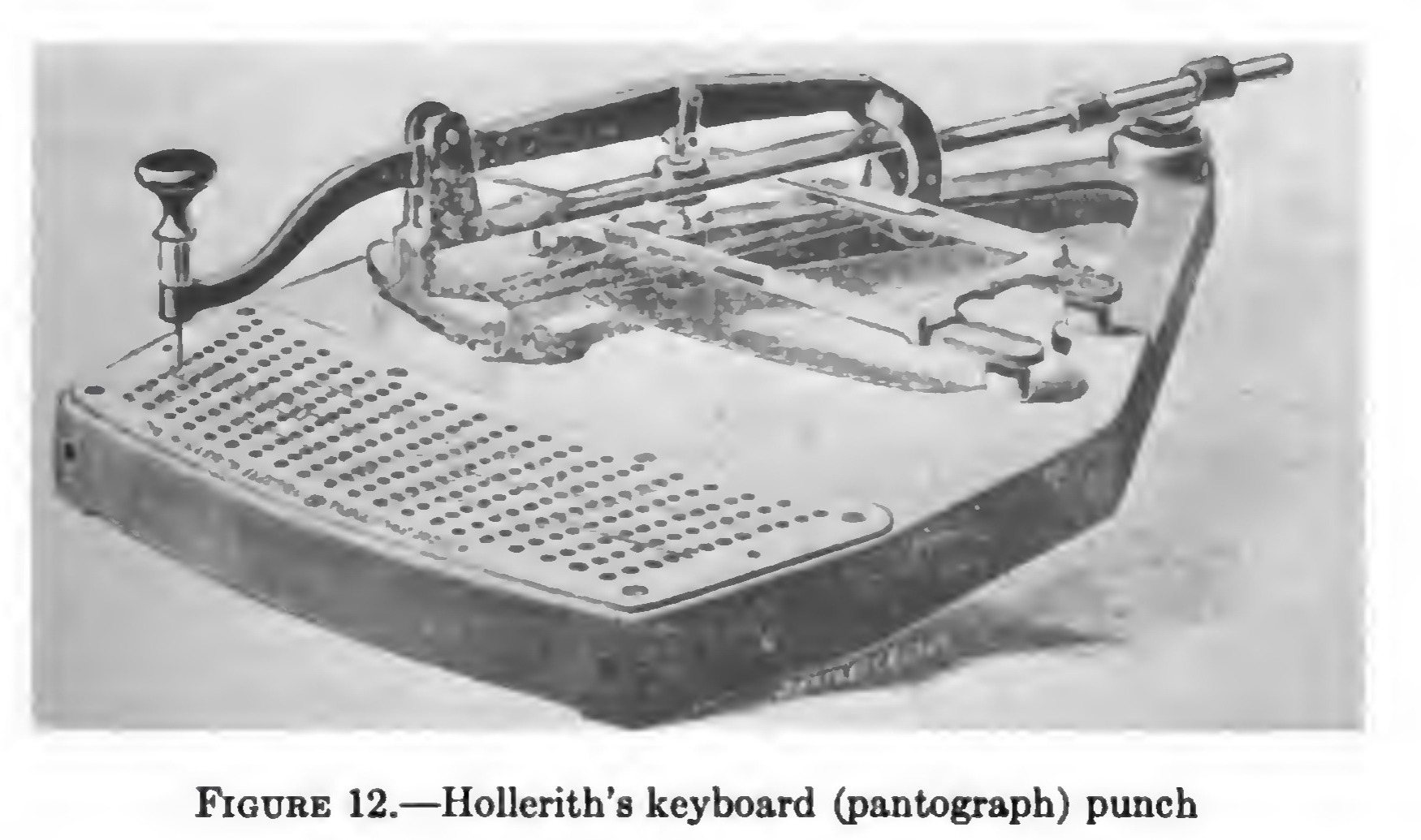
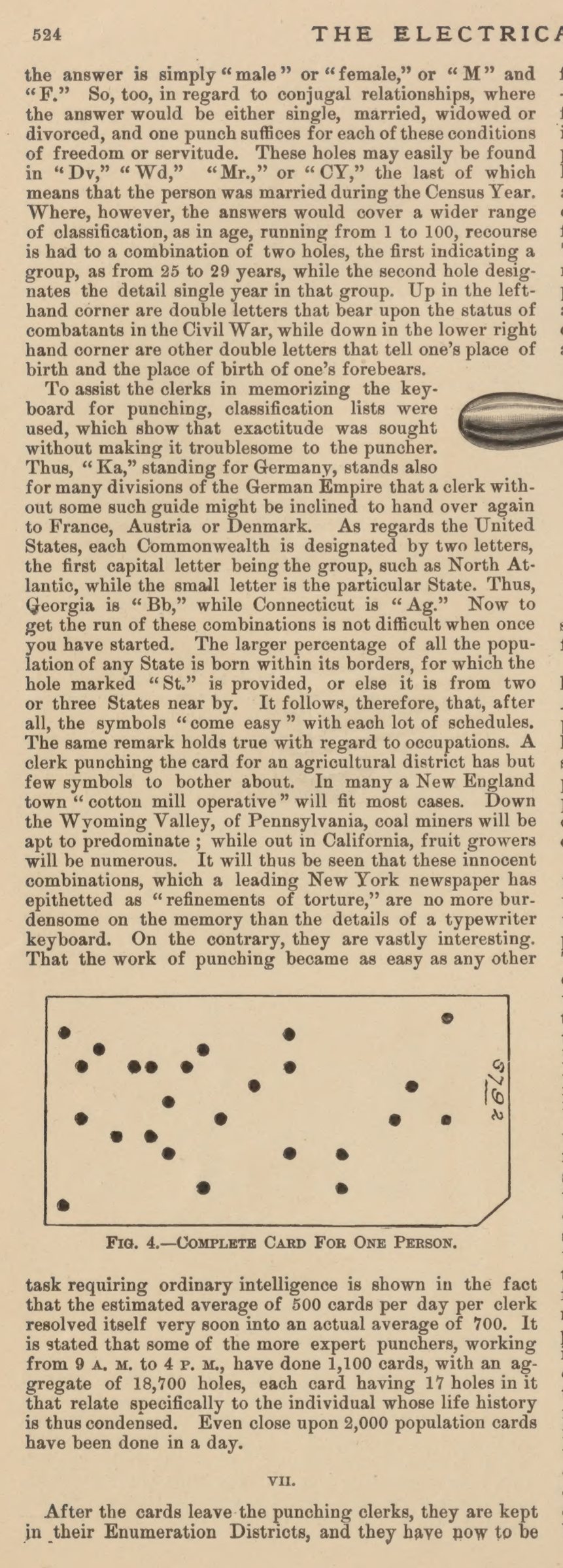
The cards came next, for the detailed tables: one card for every person, punched on a keyboard punch, about seventeen holes each. Clerks averaged about seven hundred cards a day, against the five hundred the committee had expected (Martin, pp. 522, 524). On one day eighty-one clerks at the machines counted 434,493 cards and sorted 121,853, 556,346 in all (Martin, pp. 524-525; Truesdell's 656,346 is a misprint).
The number nobody liked
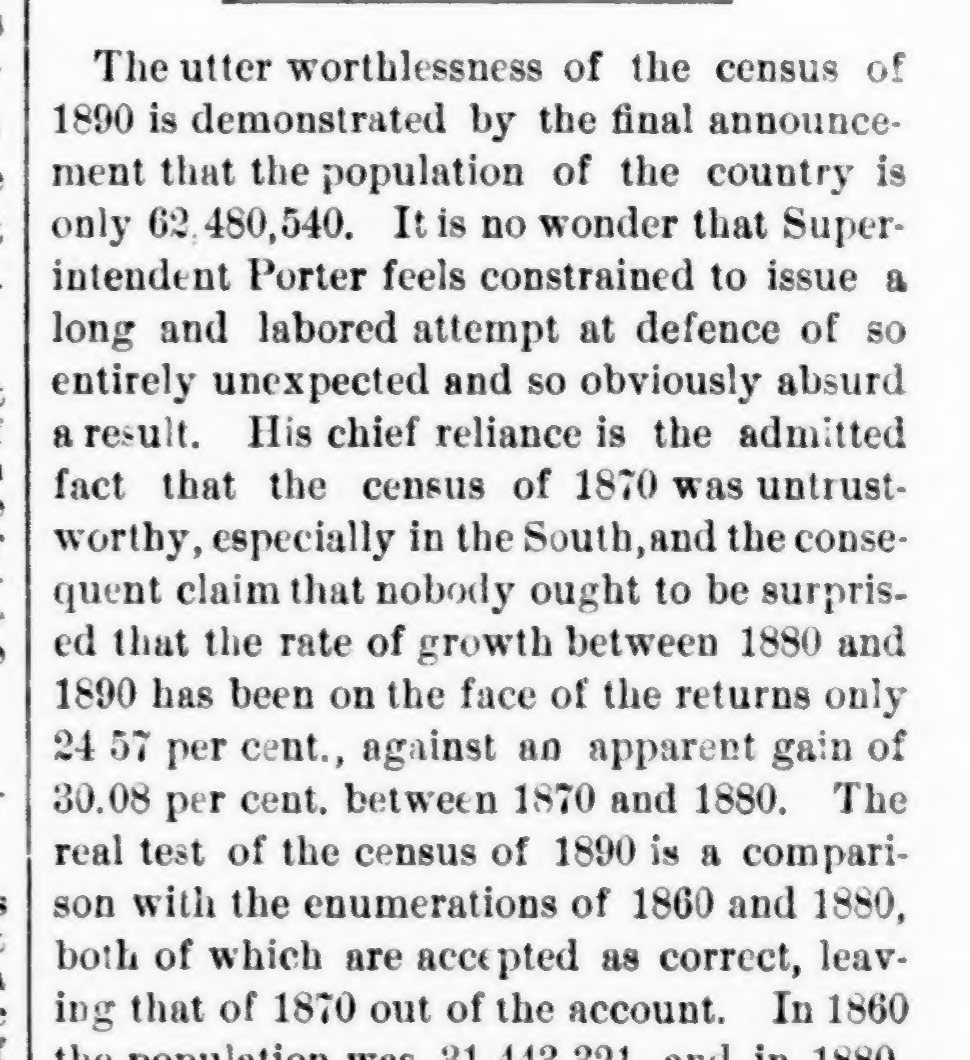
In late October 1890, the first total for the whole country came out: 62,480,540 people (The Nation, 6 November 1890, p. 352). Many people had expected more. The Nation printed the complaint that it showed "the utter worthlessness of the census of 1890", and called for a new one.
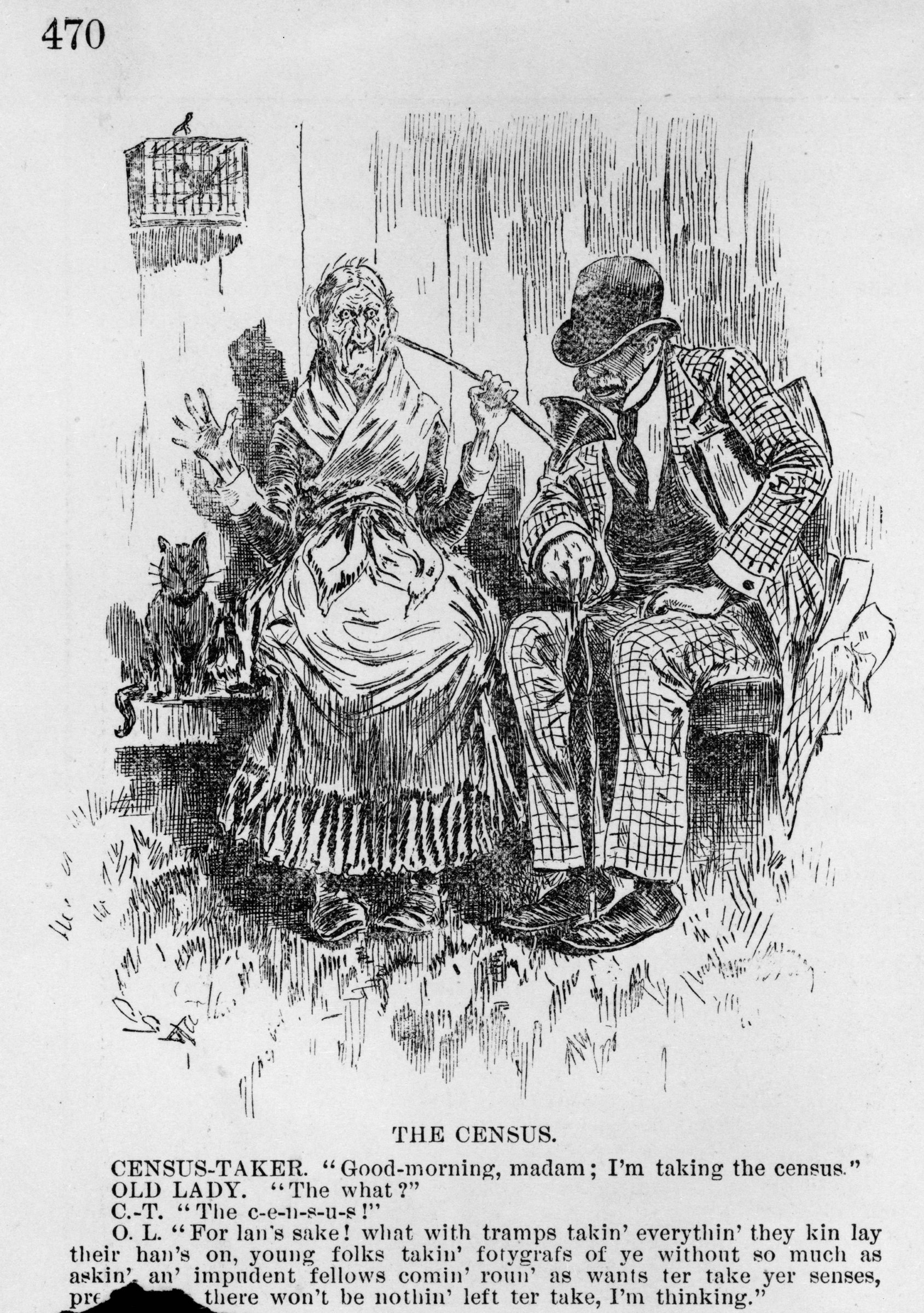
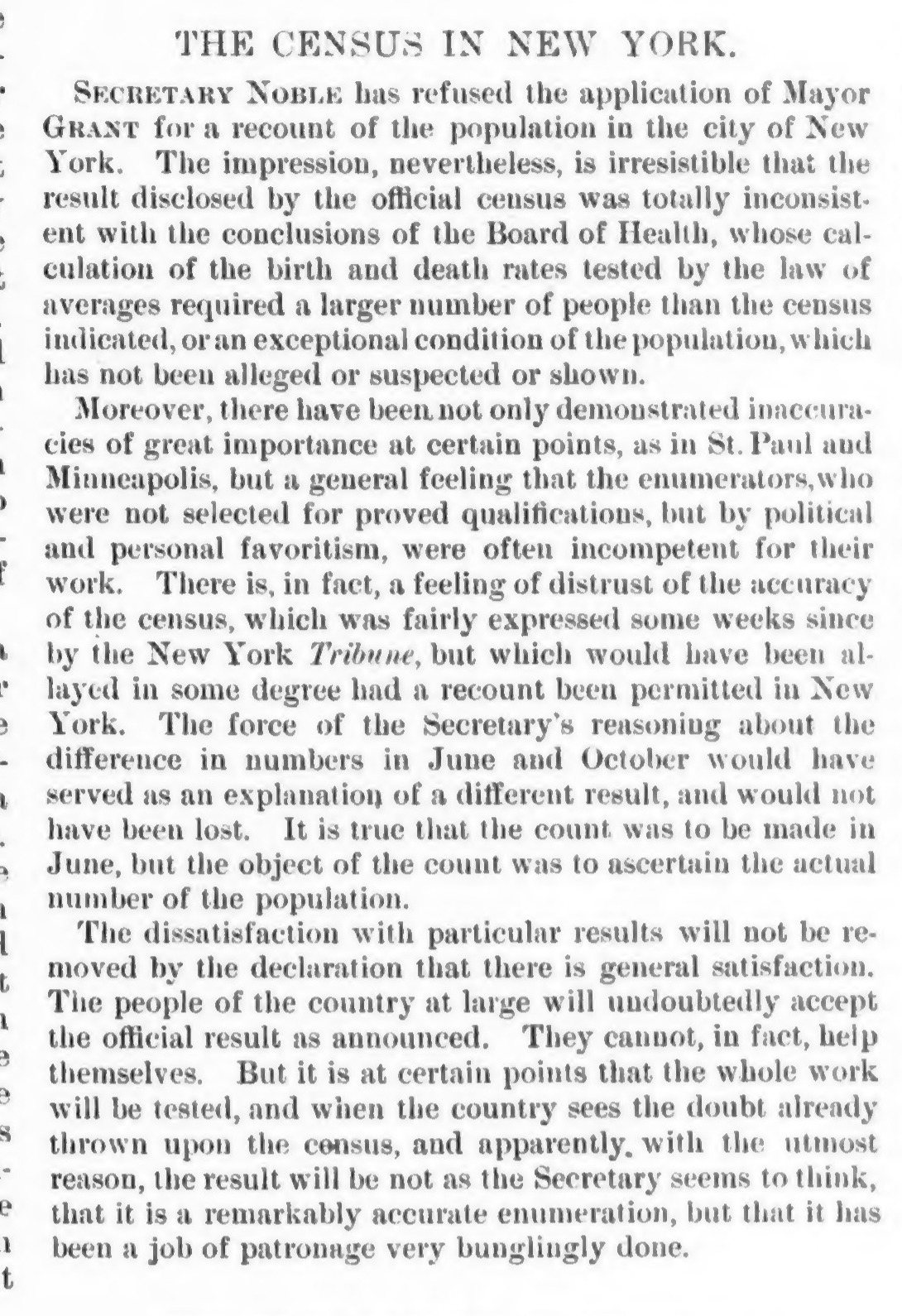
In New York, the mayor asked for a recount. Harper's Weekly blamed the enumerators, chosen by political favour, and called the census "a job of patronage very bunglingly done" (8 November 1890, p. 863). In the papers we searched, none of the complaints blamed the machine. They blamed Porter and the people he had hired to knock on doors.
The final count, published later, was a little higher: 62,622,250, not counting Indian reservations and Alaska (62,979,766 with them; Compendium of the Eleventh Census, Part I, 1892). Porter told a dinner of his office chiefs: "For the first time in the history of the world, the count of the population of a great nation has been made by the aid of electricity" (Martin, p. 522).
The machine shop, and IBM
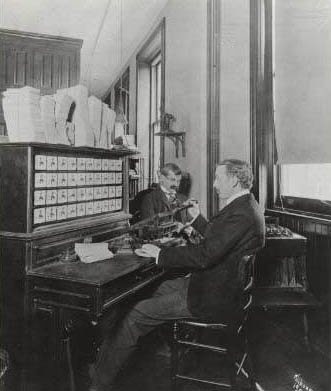
Hollerith rented his machines to the government. By the census of 1900 the office had 311 of them, and used about 215 million cards (Truesdell, p. 89). The rent was around $1,000 a machine a year (about $38,700 today; Truesdell, p. 120). By then his business was the Tabulating Machine Company, which he founded in 1896 (U.S. Census Bureau history; ETHW).
In 1905 a new Census Director, Simon North, thought the rates too high, and refused to renew the contract (Truesdell, p. 119). Congress gave the bureau $40,000 for its own machine shop (about $1.43 million today), and the original patents ran out in January 1906 (Truesdell, pp. 120-121). In 1909 Hollerith offered a licence for his newer machines for $100,000 (about $3.6 million today). The bureau said no, and counted 1910 on its own machines (Truesdell, p. 127). The farm census of 1910 was added up on Burroughs adding machines, the kind we rebuilt in episode 7 (Truesdell, p. 128).
Hollerith's company sued the bureau in 1910; the Census Bureau's history says the suit was "finally disposed of without significant action" (Truesdell, p. 129, note 14). In 1911 his company was merged with three others into the Computing-Tabulating-Recording Company, and in 1924 that company became International Business Machines. Hollerith died in 1929 (ETHW and IEEE biographies; Truesdell, p. 142, note).
Then and now
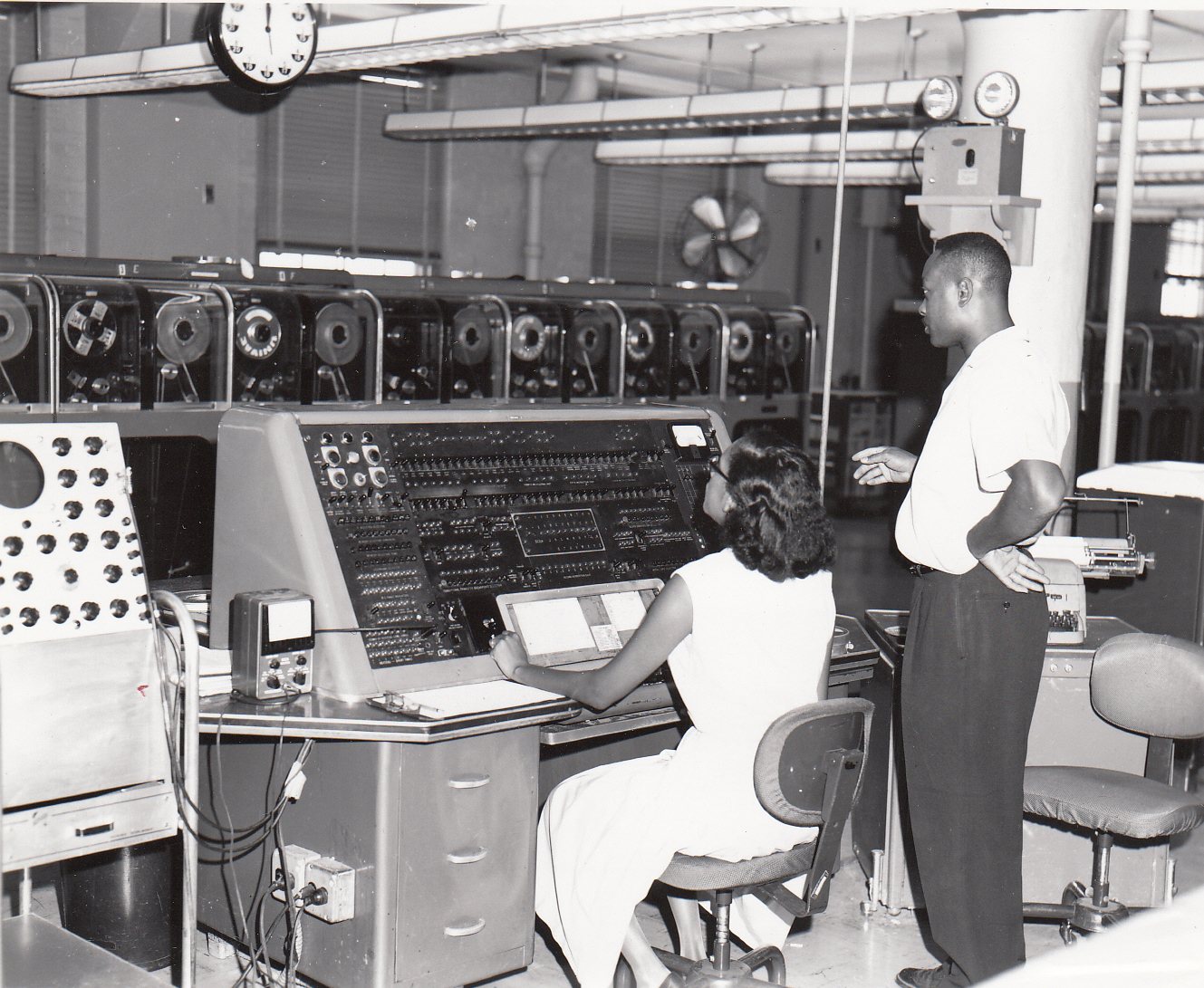
A card for each person, a hole for each fact, and a count of the cards that match. That is still how a database answers a question (our comparison). The Census Bureau kept using descendants of these machines until electronic computers began to replace them in the 1950s (U.S. Census Bureau history).
So, where did the idea come from? Billings suggested cards counted by machine, and said so in print years before. Hollerith turned the suggestion into pins, cups of mercury, relays and dials, and patented it. The conductor's ticket may well have helped, as Hollerith said; it just isn't where the story starts. And the six weeks that made the machine famous were counted on its dials, a key at a time.
Read the original patents
US patents of 1874 and 1889, in the public domain. Click a page for full resolution; drawing sheets come first, then the specification. The sheets are shown as printed: Fig. 1 is drawn across its sheet.
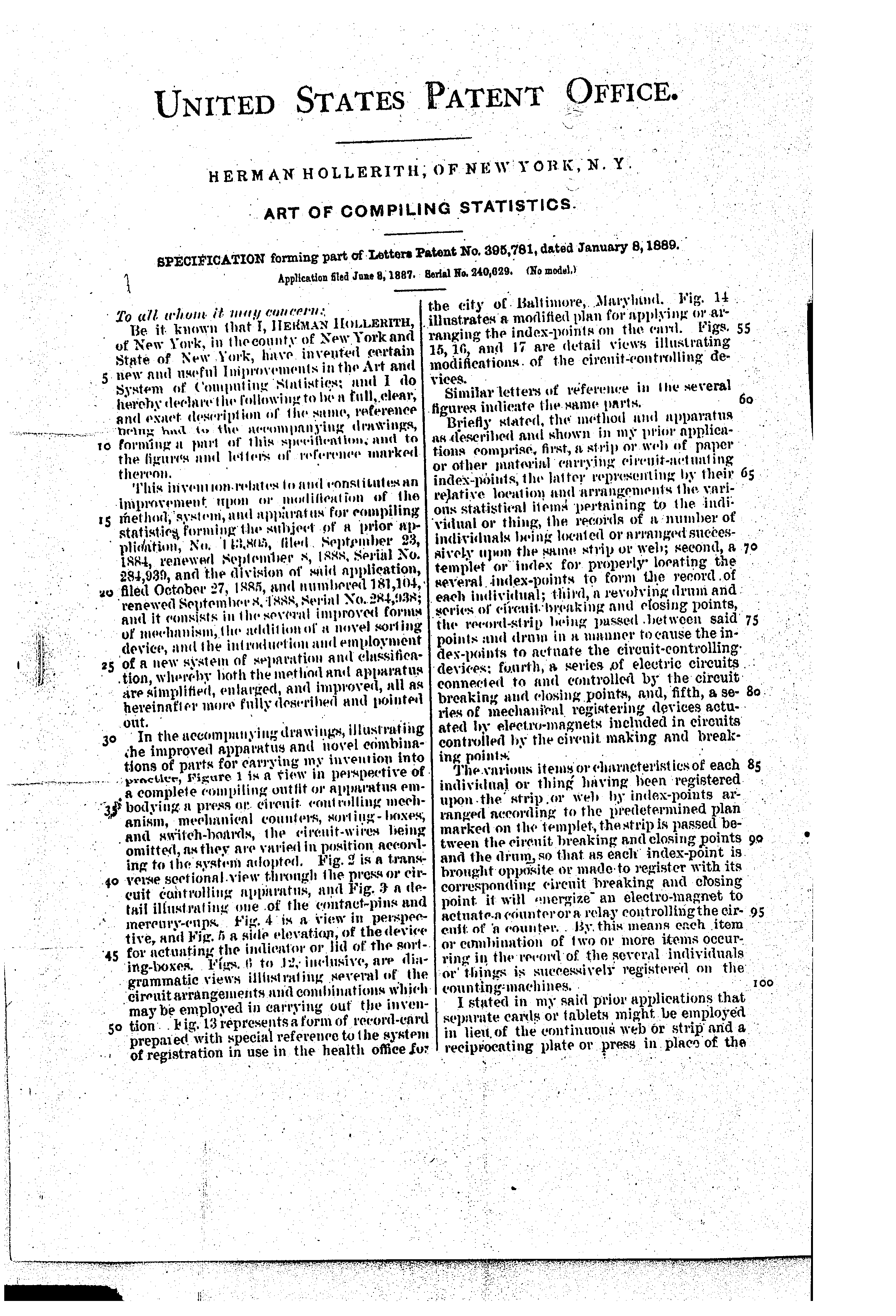
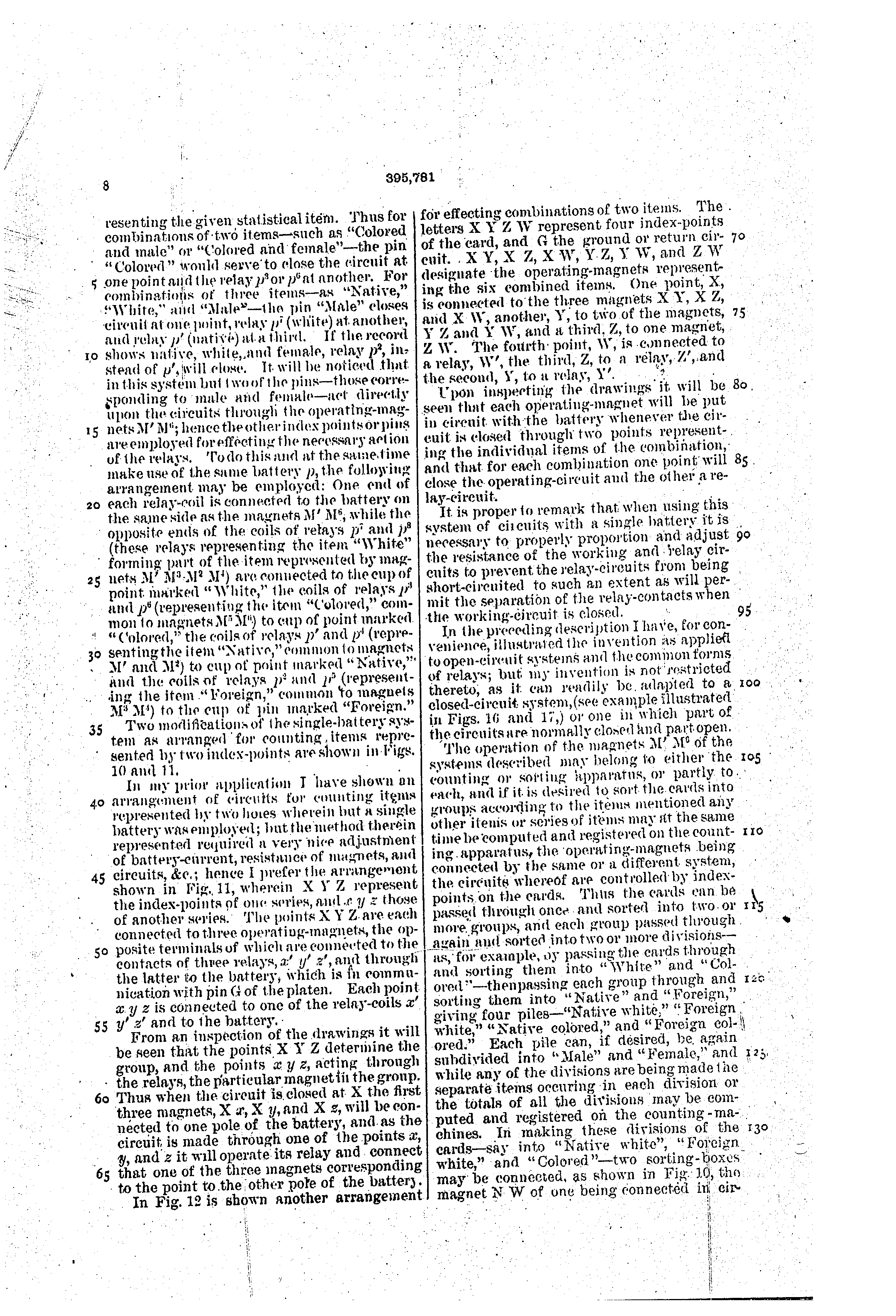
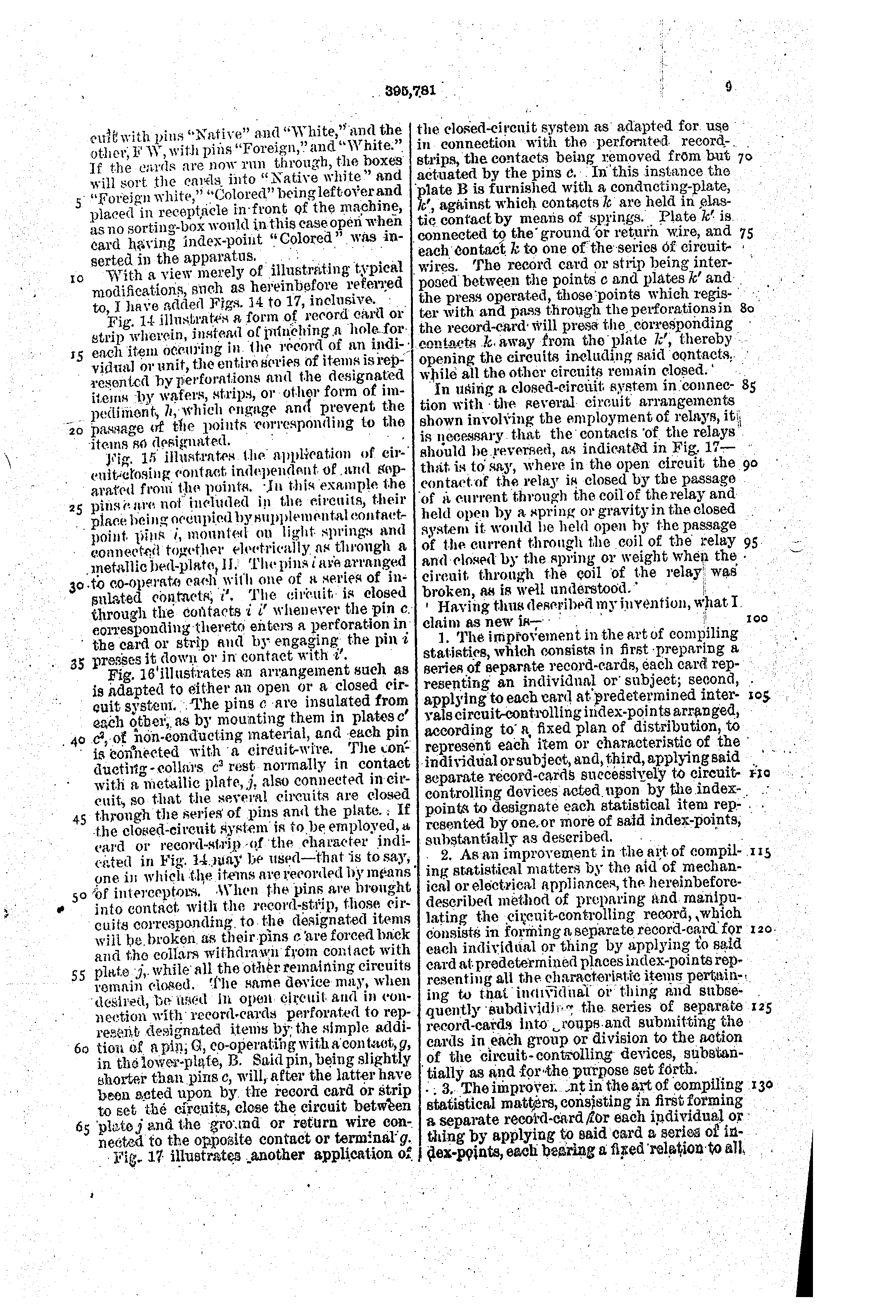
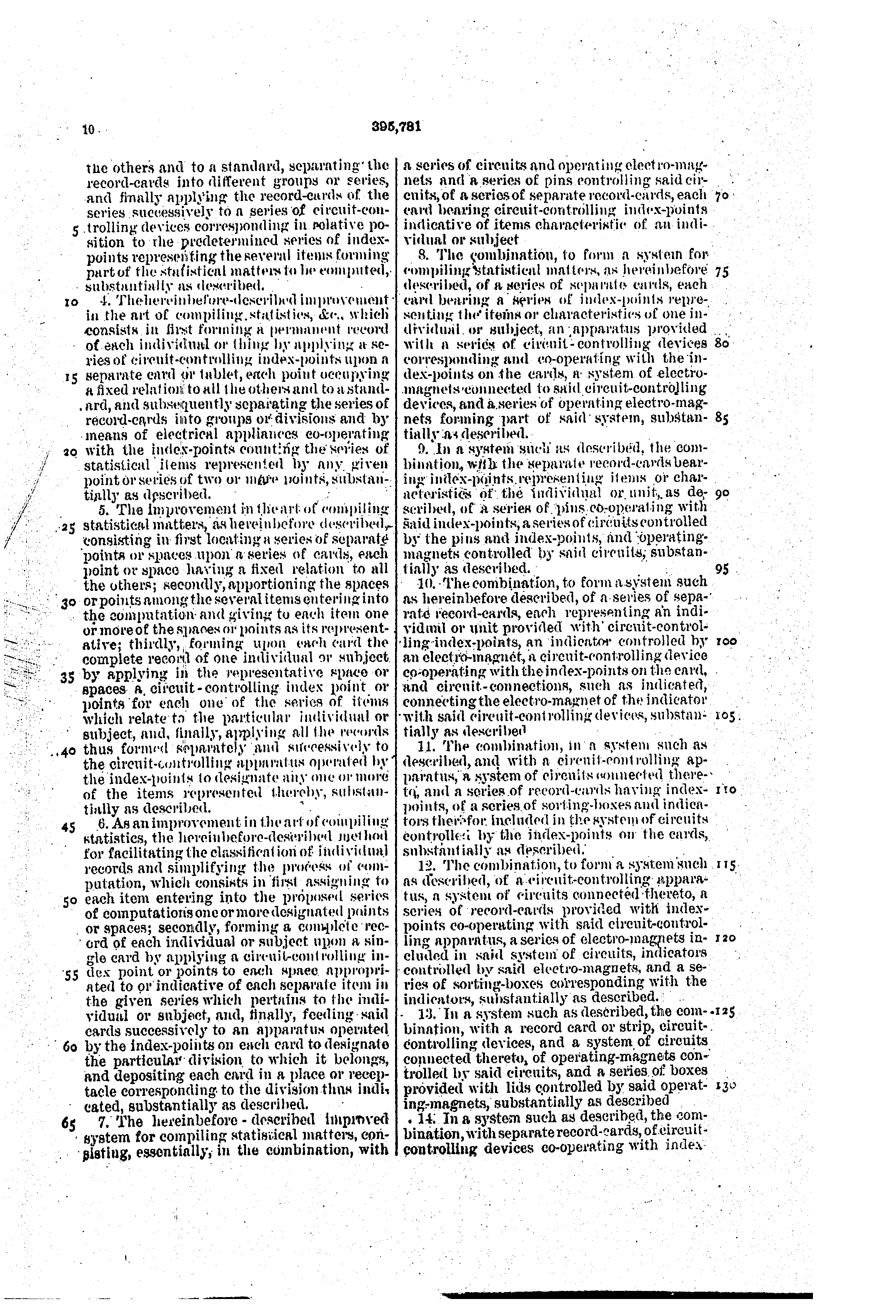
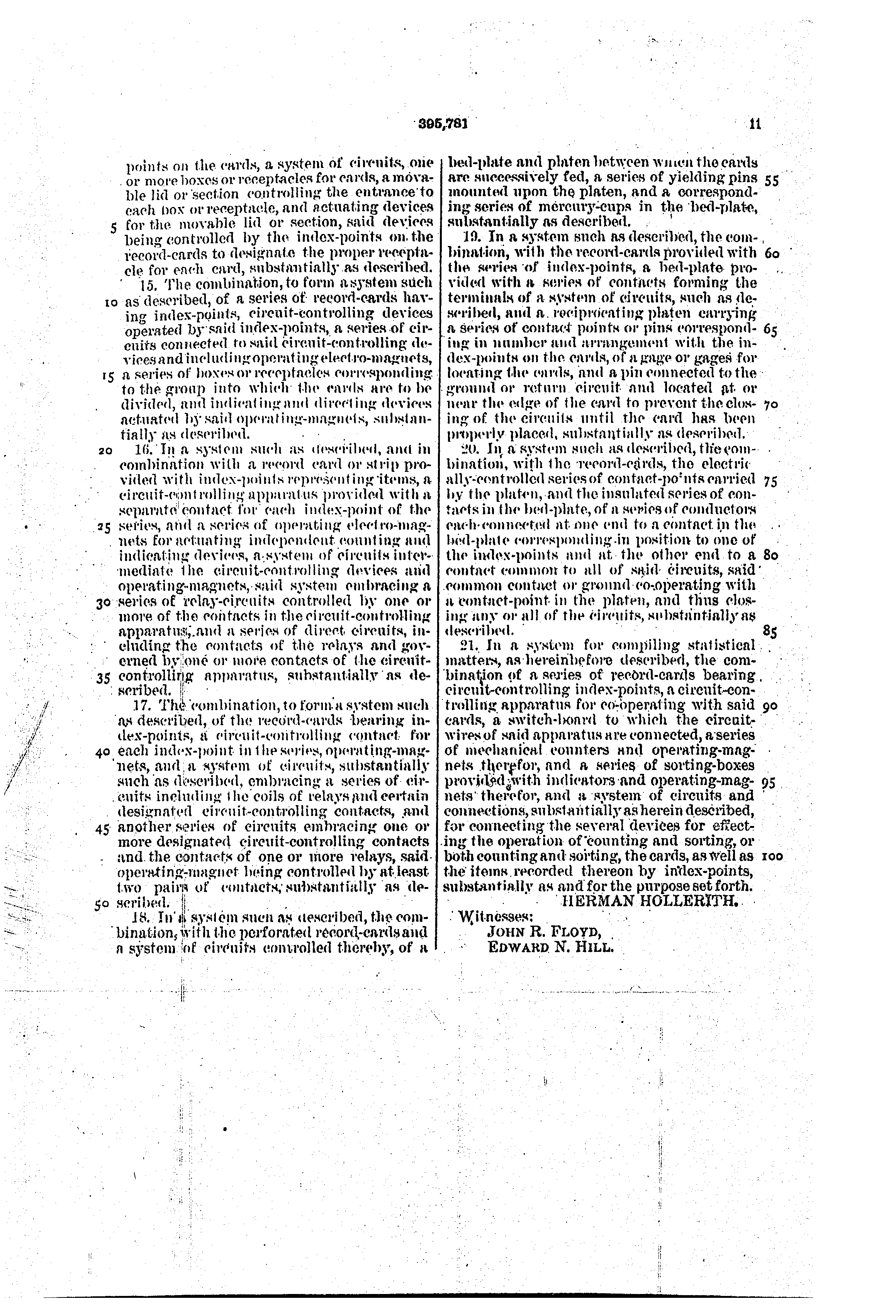
US 395,781, Herman Hollerith, Art of Compiling Statistics, filed 8 June 1887, granted 8 January 1889
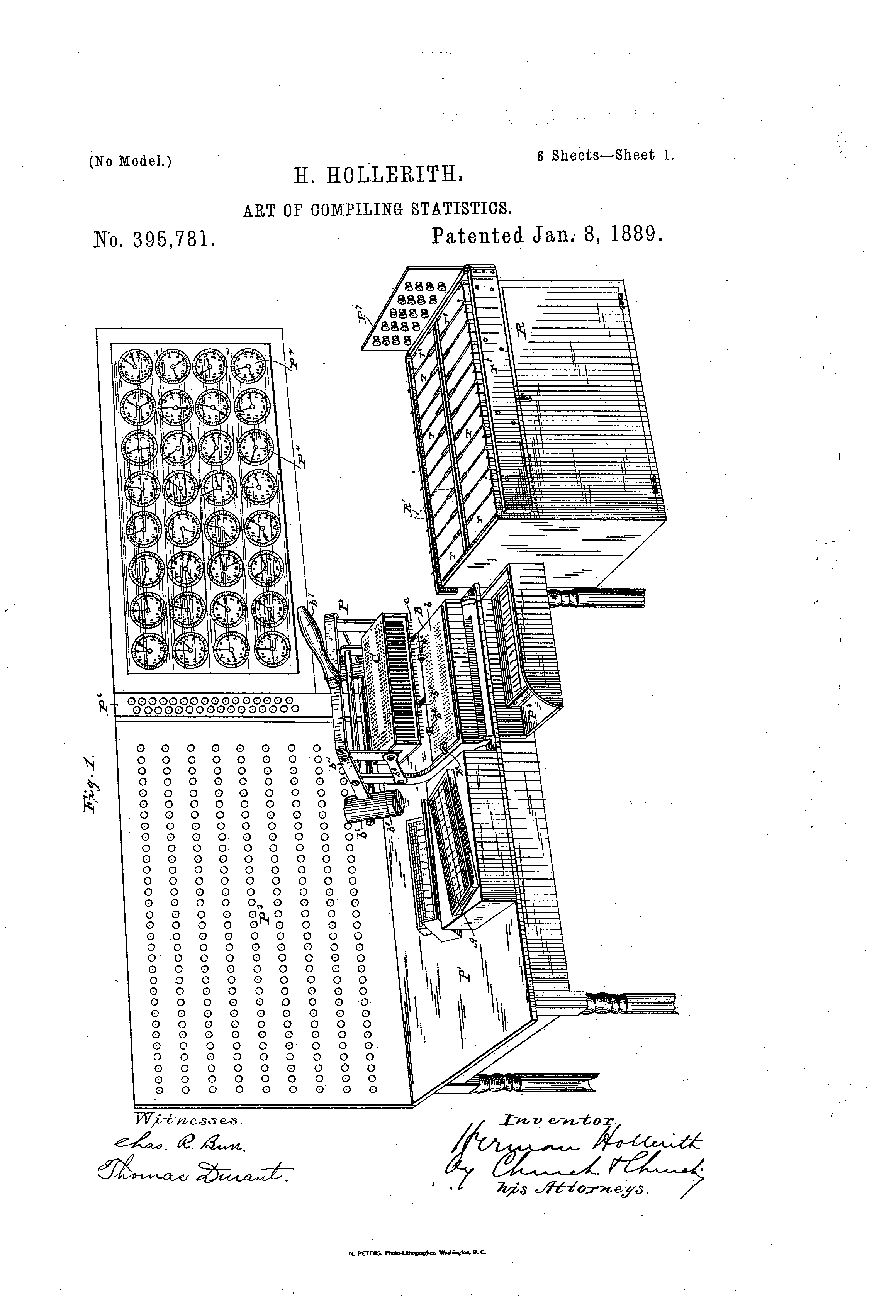
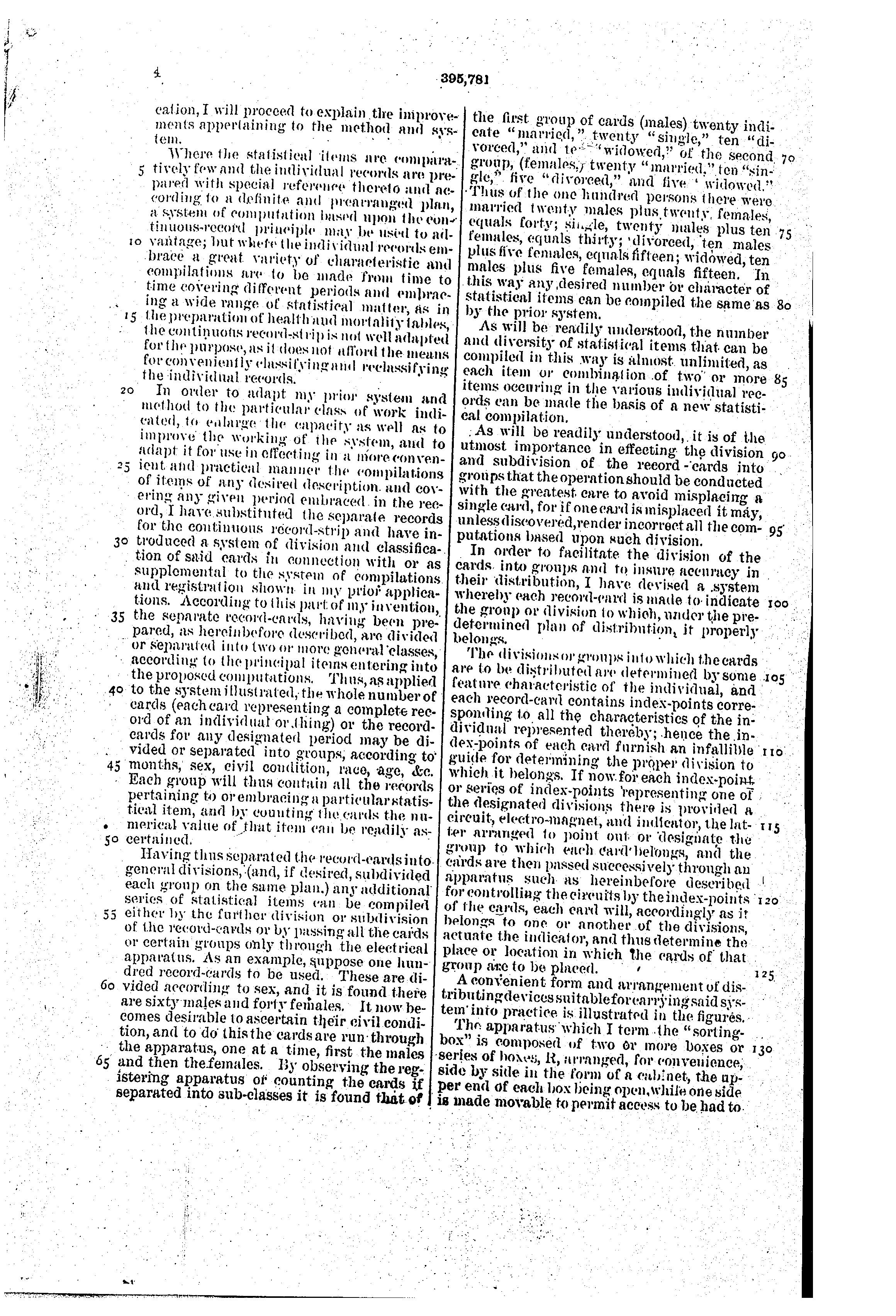
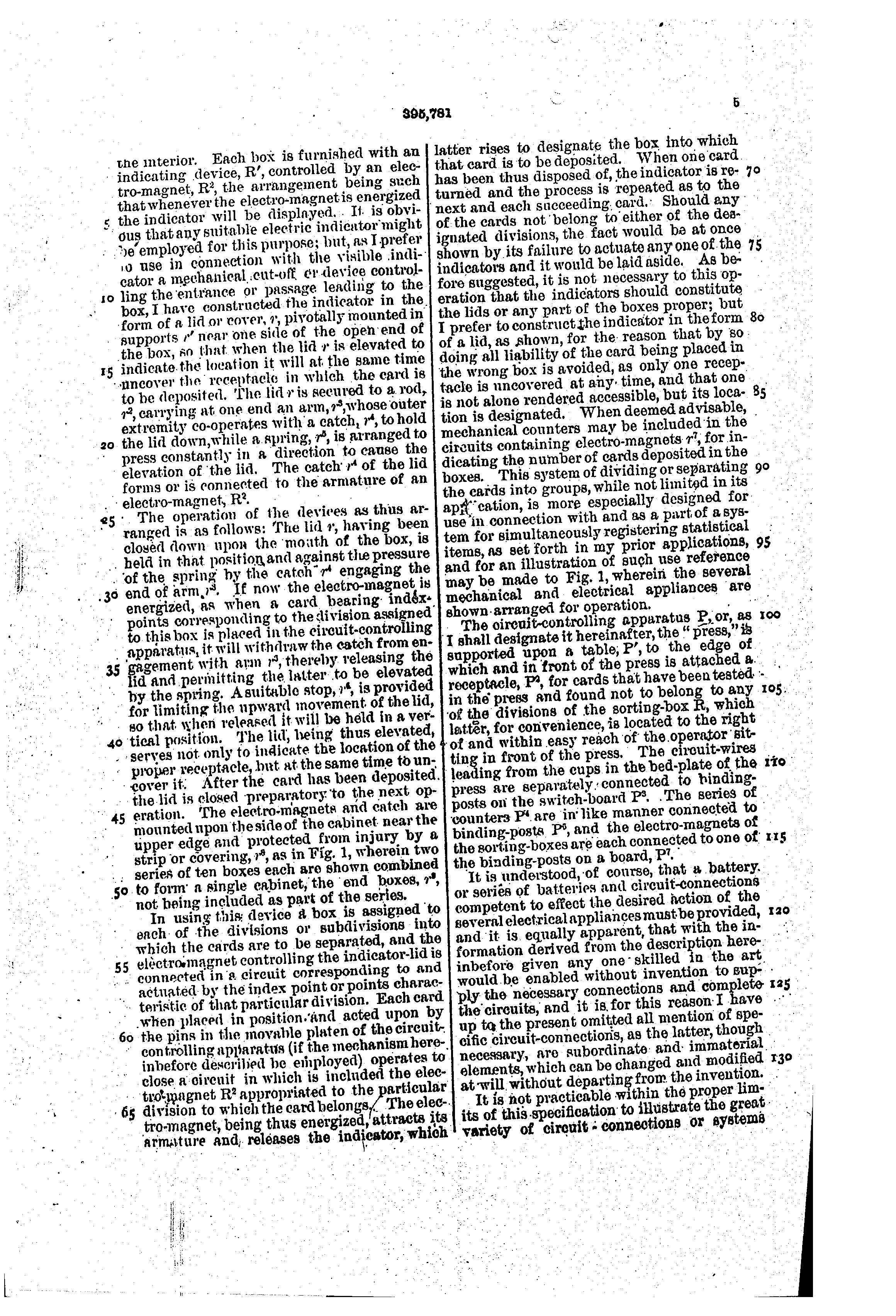
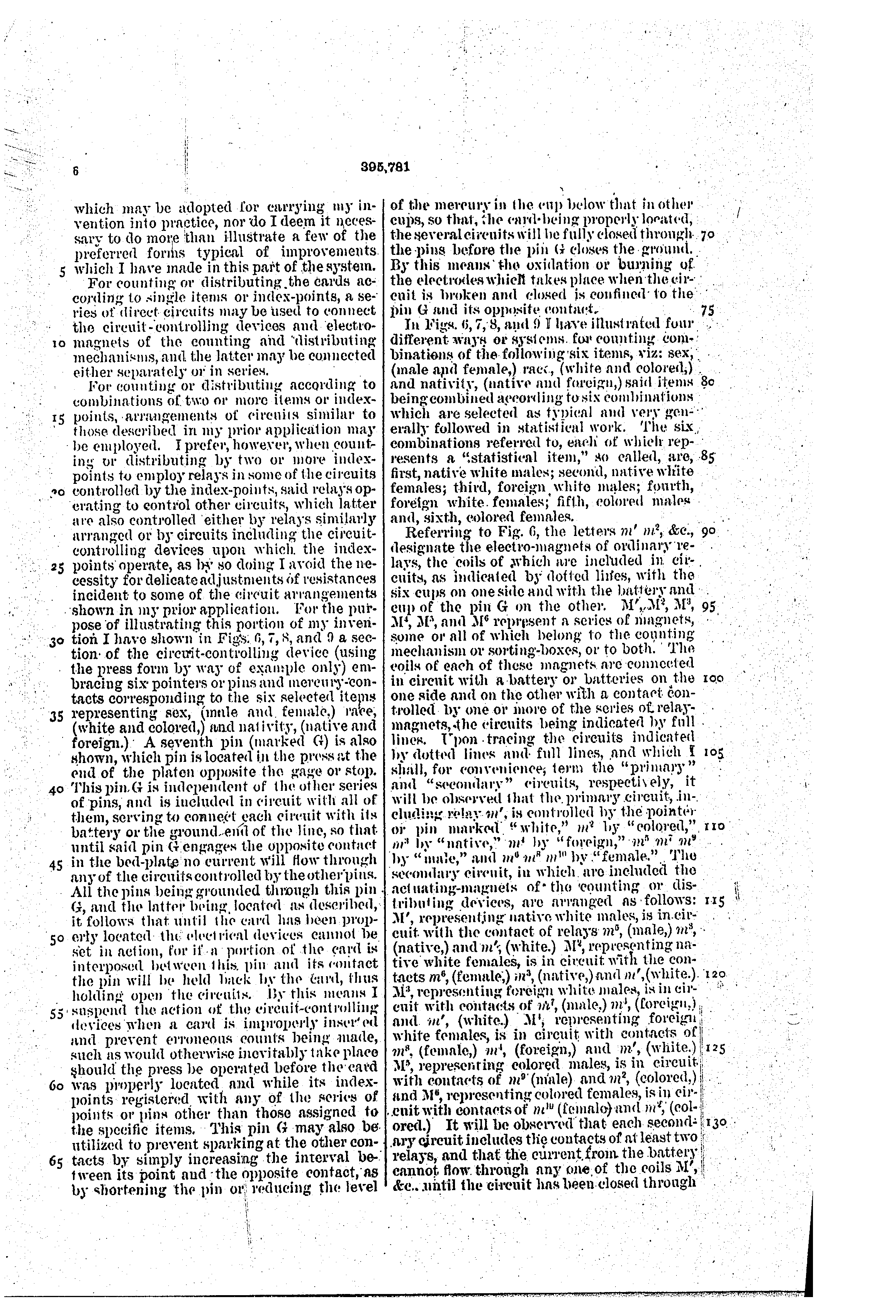
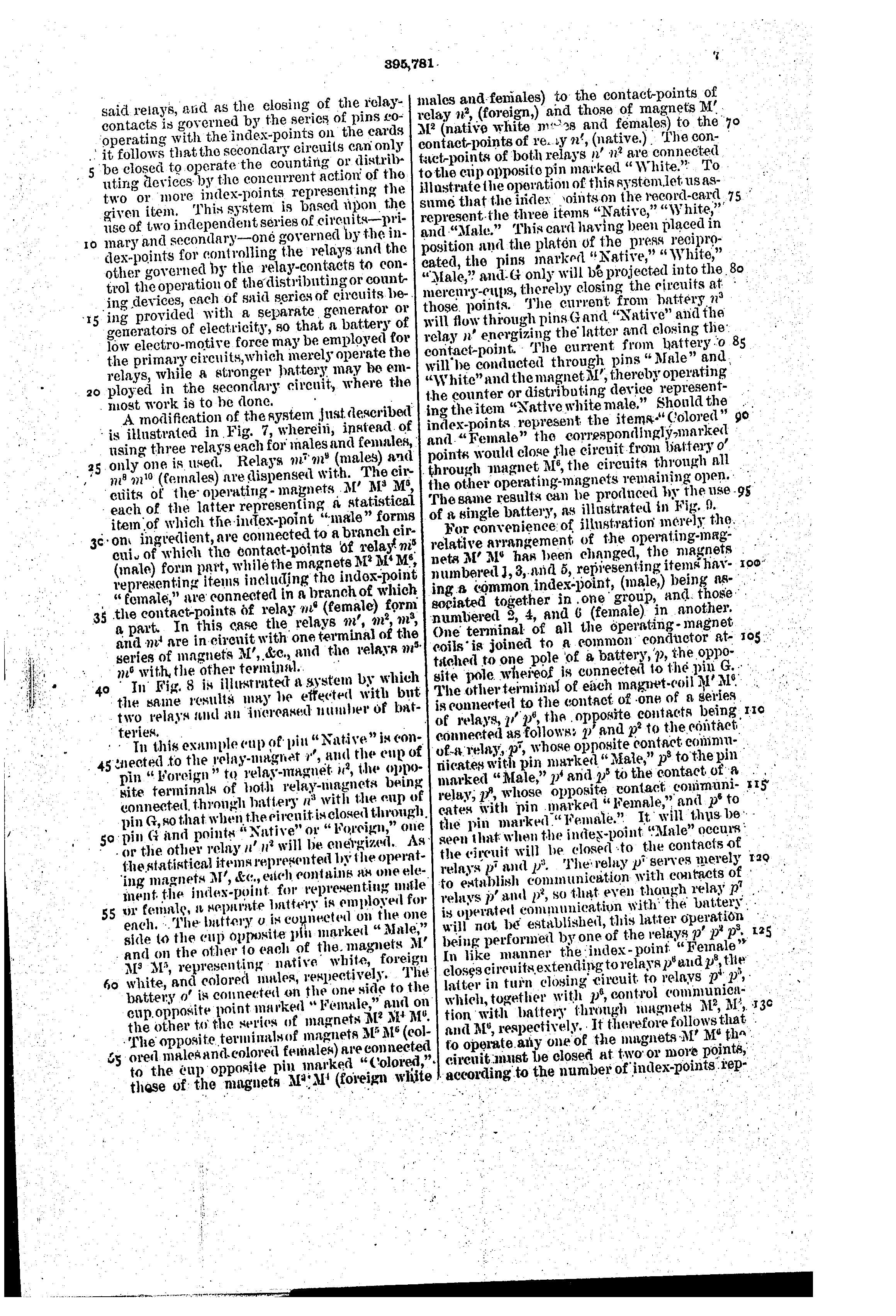
US 395,782 and 395,783, Herman Hollerith, the 1884 paper-strip applications, filed 23 September 1884, granted 8 January 1889
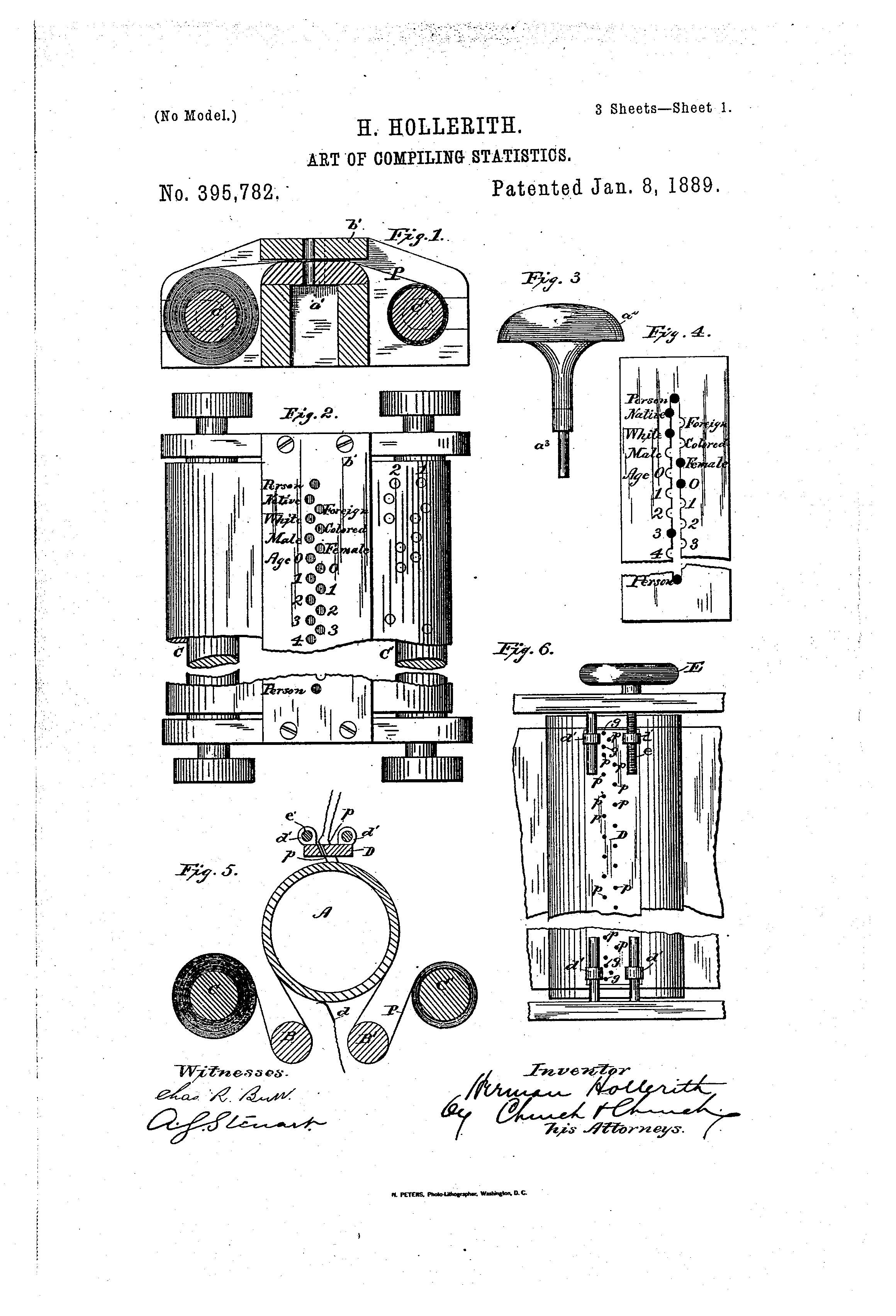
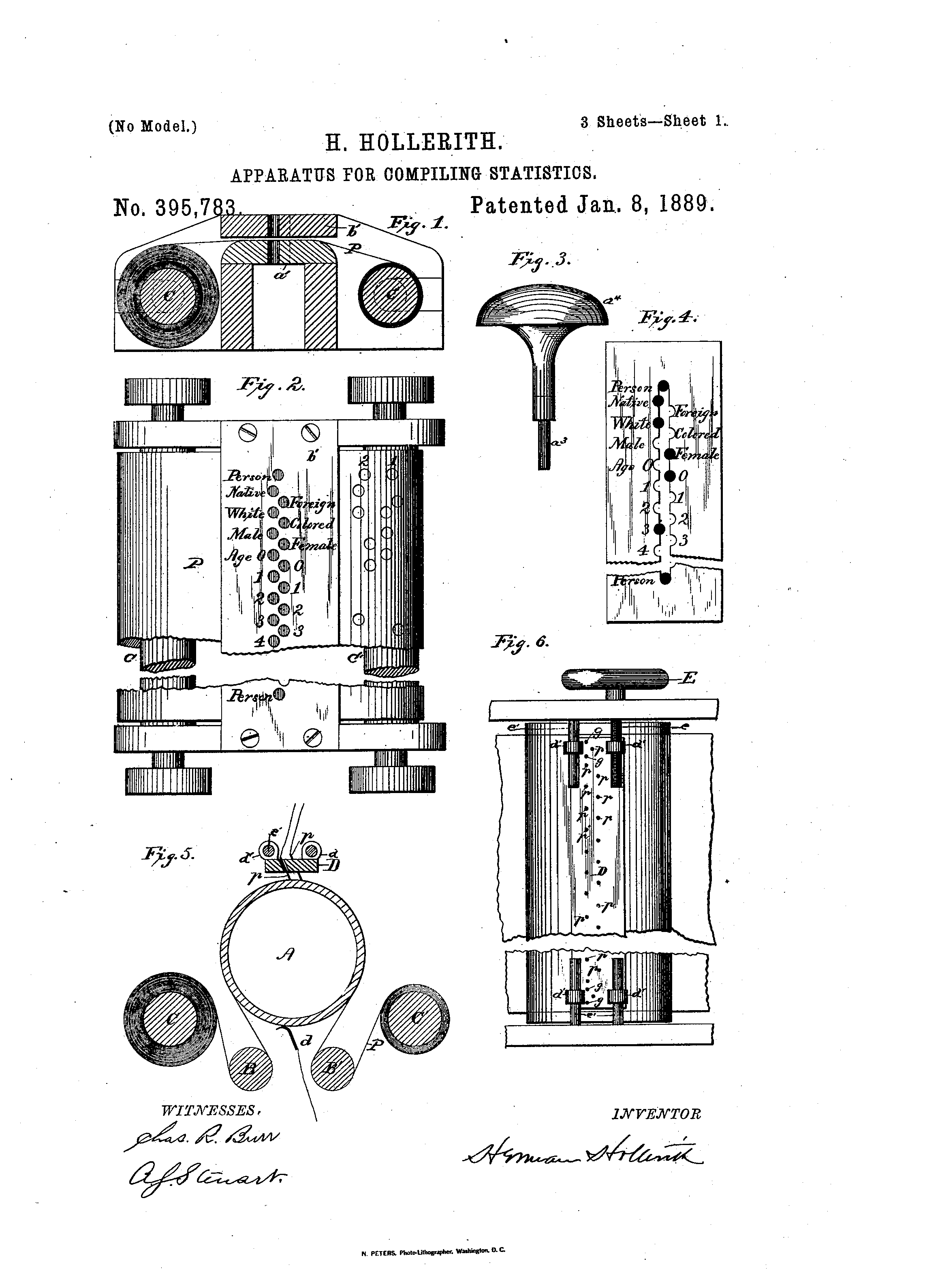
The first sheet of each; every page is in the PDFs: US 395,782 · US 395,783
US 148,989, J. Sangster, Conductors' Punches, granted 24 March 1874
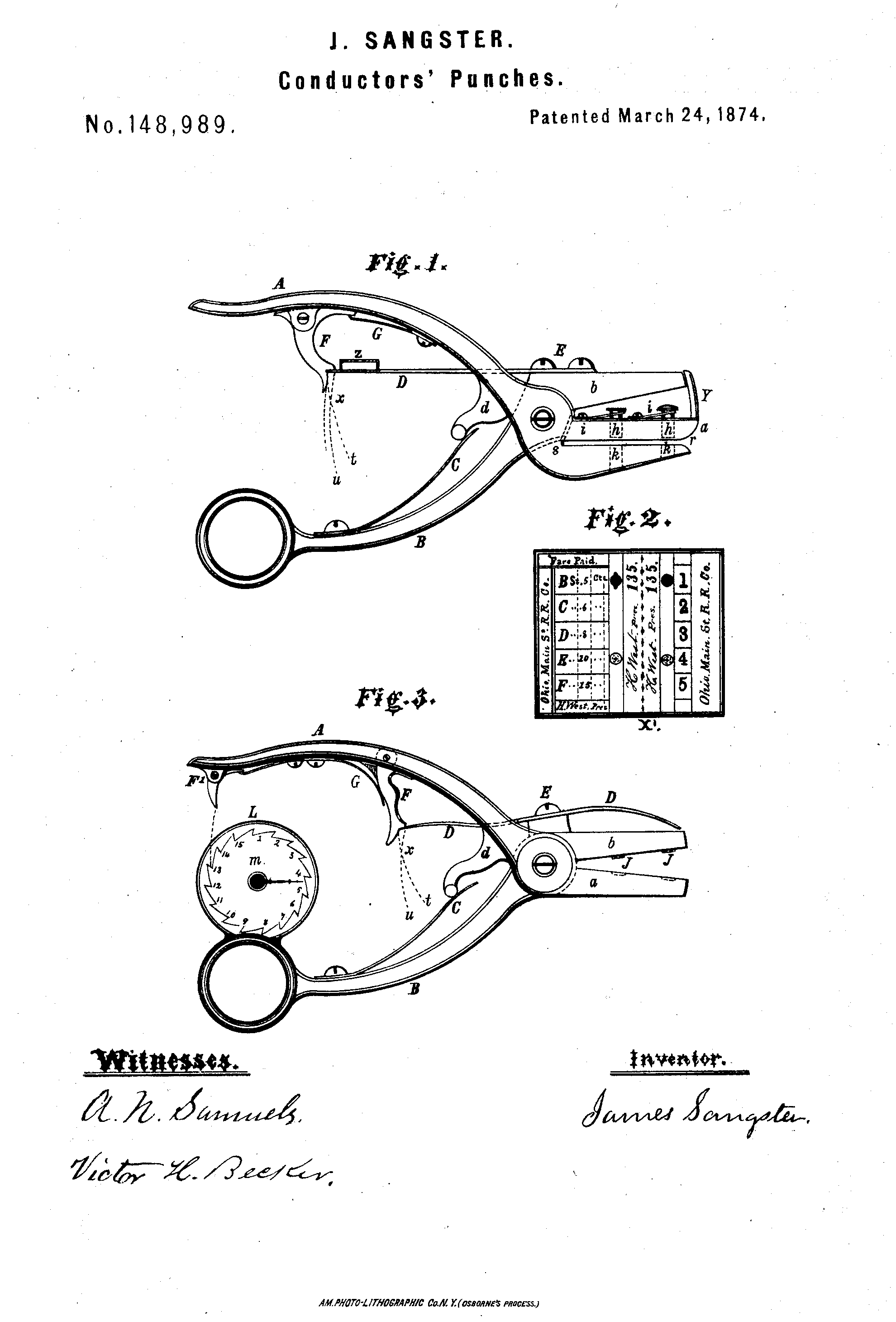
Sources
Every fact on this page comes from these, as in the episode. Where we have a source only second-hand, the text says so.
Patents (US, public domain; full-page scans from the USPTO)
- H. Hollerith, Art of Compiling Statistics, US 395,781 (filed 8 June 1887, granted 8 January 1889): the card and the Baltimore card's spaces (p. 2, Fig. 13), "a permanent record of the individual", "by unskilled operatives" (p. 2); the press, "pass through and into the mercury", the pins and frame wired to the battery (p. 3); the sorting box and receptacle P2 (p. 5); direct circuits, relays and "delicate adjustments of resistances", pin G, Fig. 6's six combinations and its relays and counters (p. 6); "the concurrent action of the two or more index-points", Fig. 8 (p. 7); the claims (pp. 9-11); Fig. 1's 32 dials.
- H. Hollerith, US 395,782 and US 395,783 (filed 23 September 1884, granted 8 January 1889): the paper-strip system.
- J. Sangster, Conductors' Punches, US 148,989 (1874): the ticket punch shown.
Period sources (public domain)
- H. Hollerith, "An Electric Tabulating System", The Quarterly (Columbia School of Mines), vol. 10, April 1889, pp. 238-255: the 1880 methods, "barbarous" (p. 239), the costs (pp. 238-240), "a photograph" (p. 240), the ticket-punch and the card (p. 245), the counters (p. 251), the lid closed with the right hand (pp. 253-254). Internet Archive.
- Scientific American, 30 August 1890: the cover engraving and "The Census of the United States", p. 132 ("the first ever executed by electricity", "in six weeks the names were counted twice", the keyboard, fifty and eighty thousand a day, the 40 dials and the 26-lid sorting box). Internet Archive.
- T. C. Martin, "Counting a Nation by Electricity", The Electrical Engineer, 11 November 1891, pp. 521-525: the contest and its times, the saving, the schedules, Porter's dinner (p. 522), the cards, the bell and a day's work (pp. 524-525). Internet Archive.
- The Nation, 6 November 1890, p. 352; Harper's Weekly, 8 November 1890, p. 863, "The Census in New York"; Harper's Weekly, 14 June 1890, p. 470, "The Census" (Library of Congress).
- Compendium of the Eleventh Census: 1890, Part I (1892): the final count. Internet Archive.
Other sources
- L. E. Truesdell, The Development of Punch Card Tabulation in the Bureau of the Census, 1890-1940 (U.S. Census Bureau, 1965): Hollerith's letter of 1919 and Billings's statements of 1885 and 1887 as quoted there, the daughter's recollection (pp. 30-35), Hollerith's appointment (p. 27), the 1889 test's table (pp. 40-42), the bell (p. 55), the keyboard count (pp. 61-62), 1900's machines and cards (p. 89), the contract, the machine shop and the licence (pp. 119-128), the suit (p. 129); figures 7, 12 and 26. Internet Archive.
- The Railway News, 27 August 1887, p. 360, "The Punch Photograph", as quoted by J. Strickland, "Hollerith and the 'Punched Photograph'" (Computer History Museum volunteer newsletter).
- U.S. Census Bureau history pages (census.gov): the 1880 tables finished in 1887; machines used until the 1950s; the Tabulating Machine Company, 1896.
- ETHW and IEEE biographies of Hollerith: the 1911 merger and IBM, 1924.
- Today's money: US consumer prices, Federal Reserve Bank of Minneapolis.
- The reconstructions are our own work, as described under the machine. The press, counter and sorting box are the episode's models, checked by its test, run again on this page's copy.
Images
- Patent drawings and specifications: USPTO, public domain. Fig. 1, printed sideways, is turned upright where it illustrates the text.
- The Quarterly (1889), Scientific American (1890), The Electrical Engineer (1891), The Nation and Harper's Weekly (1890), the Compendium (1892): scans via the Internet Archive; published in the US before 1931, public domain.
- Truesdell (1965), figs. 7, 12 and 26, and pp. 35 and 42: a US federal publication, with no copyright notice and no credit line for the figures.
- Dr. J. S. Billings: Bain News Service, Library of Congress (LCCN 2014680718); "No known restrictions on publication". "The Census", Harper's Weekly, 1890: Library of Congress; "No known restrictions on publication".
- A Hollerith tabulating machine, 1902, and Census Bureau employees at a UNIVAC I, about 1960: U.S. Census Bureau (Wikimedia Commons), public domain as the work of federal employees, on Commons' statement.
- The video also uses AI illustrations, labelled on screen with what they are based on. None is used on this page.