 Curious Patents
Whitney's Cotton Gin
In 1812 Eli Whitney asked Congress to renew his patent. From no state, he wrote, had he received half a cent a pound for the cotton his machine had cleaned. Turn the crank of the machine rebuilt from his description and drawings, and cut it open to watch the seed stop at the slot while the fibre goes through. Then follow the patent through the courts, and see what the gin changed and what it did not, with every source.
Watch the episode
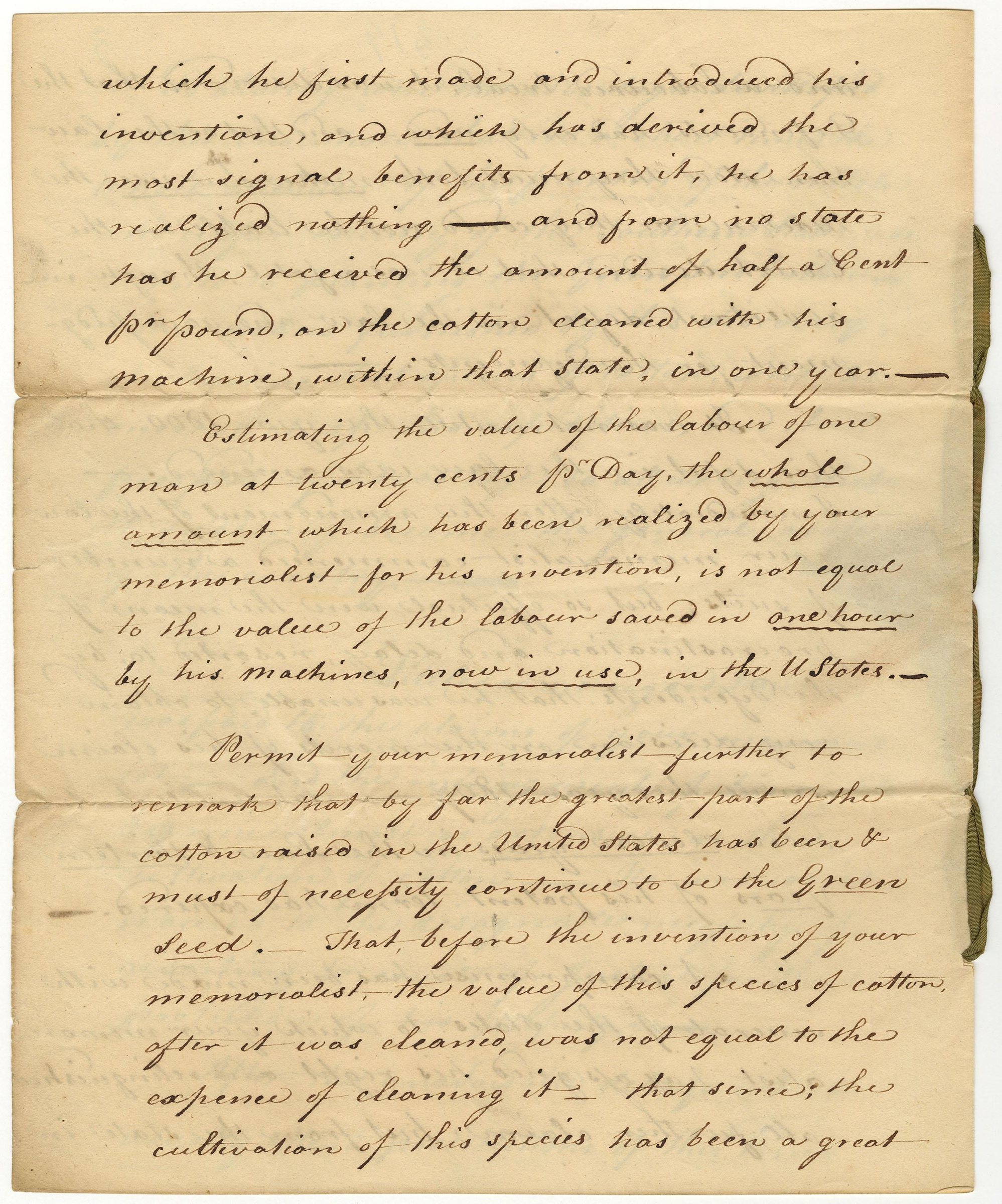
In 1812, Eli Whitney asked Congress to renew his patent. He told them that "from no state has he received the amount of half a Cent per pound, on the cotton cleaned with his machine, within that state in one year" (petition, 16 April 1812).
To his father, in 1793, he had written that his machine "makes the labor fifty times less, without throwing any class of People out of business". In the seventy years that followed, the number of enslaved people in the United States grew from 697,681 in 1790 to 3,953,760 in 1860 (Census Bureau, Working Paper 56, Table 1).
This page is the patent, how the machine worked, and what it did.
Two kinds of cotton
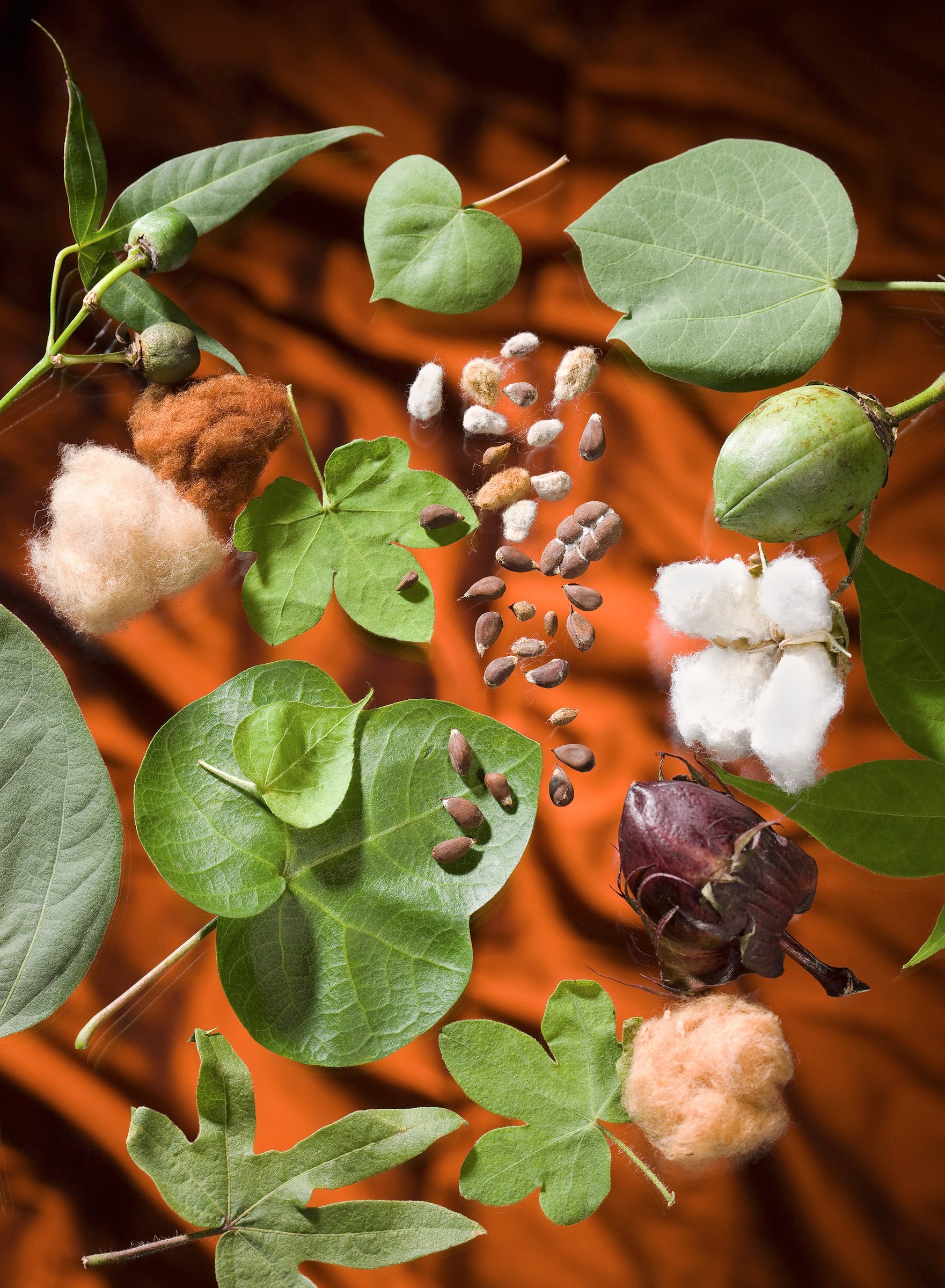
Sea-island cotton has long fibres and smooth black seeds, and in the 1790s it grew only near the coast. Upland cotton grew almost anywhere inland, but its seed is green and fuzzy, "covered with a kind of green coat, resembling velvet", as Whitney's patent puts it, and the fibres cling to it (US X72, p. 11). Whitney's petition says it was "so extremely difficult to clean, as to discourage all further attempts to raise it".
By hand, a pound of clean cotton was a day's work. According to his first biographer, Olmsted, writing in 1832, it was done in the evening, after the field work, by enslaved men, women and children sitting in circles (Olmsted, p. 14).
Machines for cleaning cotton were old. Roller gins, two rollers turning together, had been used in India for centuries, and planters on the coast used them. They pinched long fibres off smooth seeds, but they could not get green seed clean. The National Archives puts it simply: "Whitney's was the first to clean short-staple cotton." The name, gin, is short for engine.
Ten days at Mulberry Grove
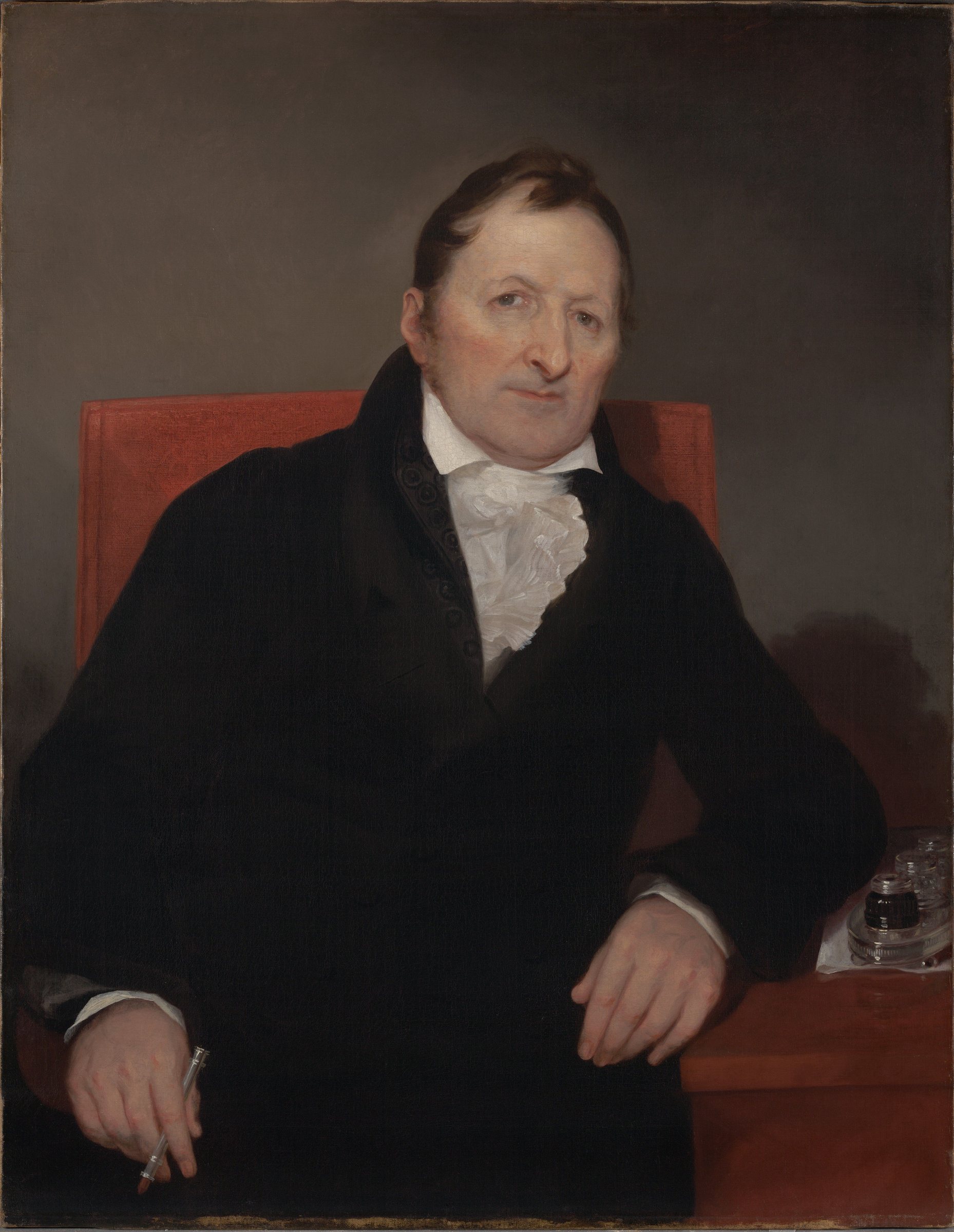

Whitney had just graduated from Yale. In late 1792 he sailed south with the widow of the war hero Nathanael Greene, to her plantation near Savannah, called Mulberry Grove, on his way to a teaching job. The job paid half what he had been promised: "instead of a hundred, I found I could get only fifty Guineas a year". And at Mrs. Greene's, he wrote, he heard planters say that a machine to clean cotton quickly would be "a great thing both to the Country and to the inventor" (Whitney to his father, 11 September 1793).
"In about ten Days I made a little model, for which I was offered, if I would give up all right and title to it, a Hundred Guineas."Whitney to his father, 11 September 1793 (American Historical Review, 1897, p. 100)
Ten days was the model. The full-size machine took until April: he wrote to Thomas Jefferson that he had been "prevented" from "completing the larger one until sometime in April last" (24 November 1793). The plantation's manager, Phineas Miller, offered to pay for the work and share the profits.
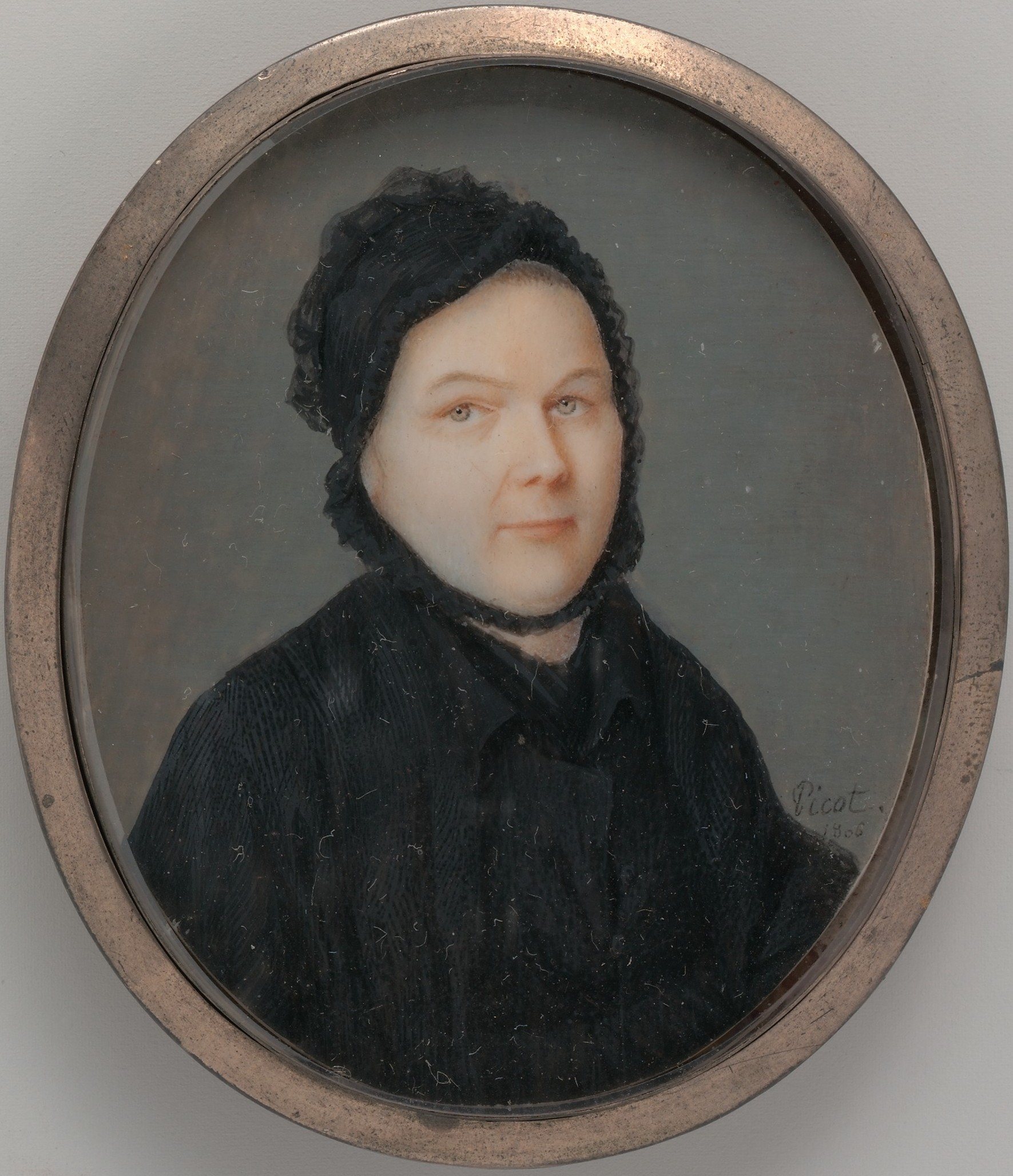
Years later, Whitney remembered where the first teeth came from: "one of the Miss Greens had brought out a coile of iron wire to make a bird cage" (Whitney to Stebbins, 7 March 1803).
There is a story that Catharine Greene thought of the brush that clears the teeth. It appears in print long after, as a claim made on her behalf. The editor of Whitney's letters, in 1897, wrote that "No evidence of any kind, so far as I know, has ever been brought forward in support of this claim"; he was firmly on Whitney's side. The patent says what the brush is made of: "The brush is made of hog's bristles" (p. 8). It does not say whose idea it was.
The paper we read

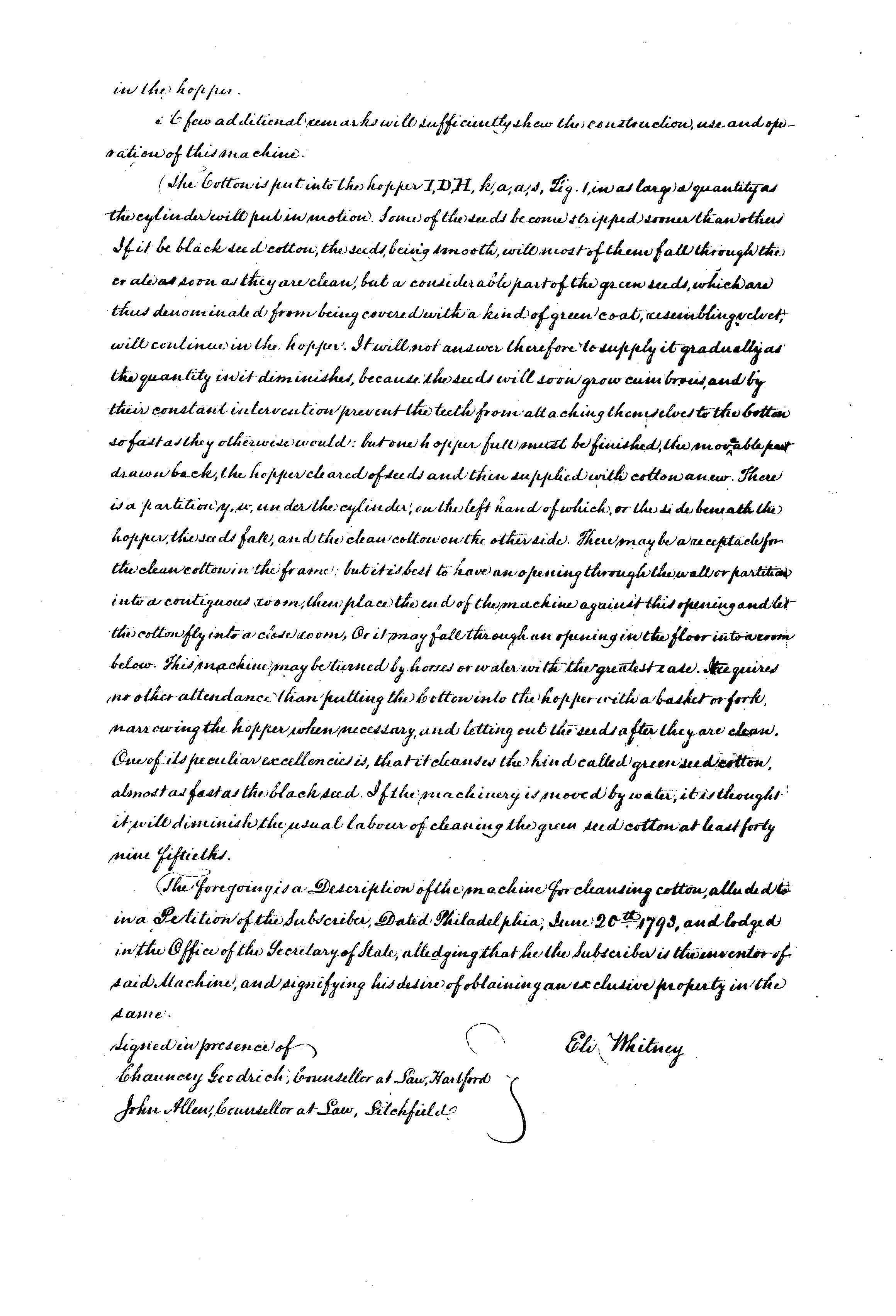
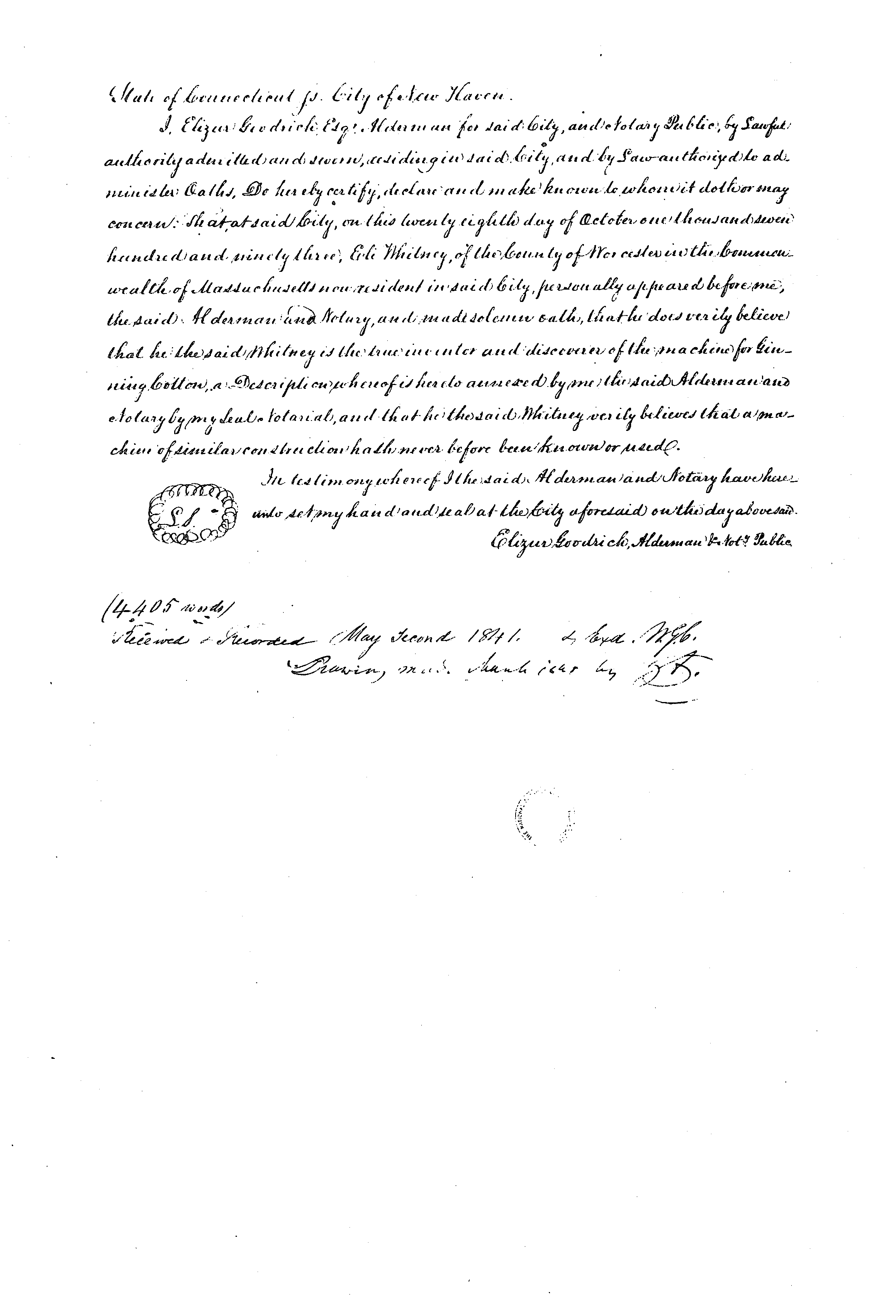
Whitney asked for his patent in June 1793 ("Dated Philadelphia, June 20th 1793", p. 11), and swore to his description before a notary in New Haven on "this twenty eighth day of October" (p. 12).
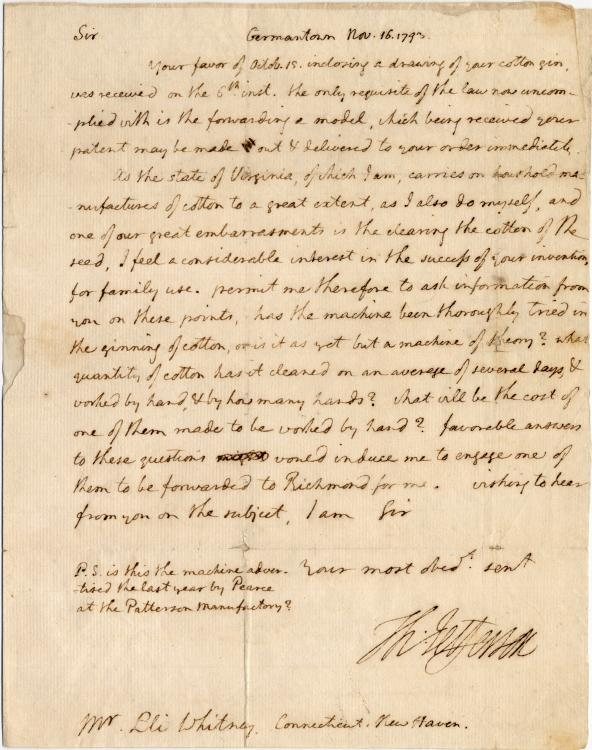
The Secretary of State, Thomas Jefferson, wrote back that "The only requisite of the law now uncomplied with is the forwarding of a model". He also asked: "Has the machine been thoroughly tried in the ginning of cotton, or is it yet but a machine of theory?" (16 November 1793, as printed by Lewton, 1937).
The patent was granted on 14 March 1794, for fourteen years ("Patented Mar. 14, 1794" on the drawing; the Patent Act of 1793, "a term not exceeding fourteen years").
What we can read today is a copy. In 1803, James Madison, then Secretary of State, certified "That the annexed Writings and Drawings are true Copies of Original papers deposited in this Office" by Whitney (p. 4). In 1836 the Patent Office burned. Whitney's papers were among those restored afterwards ("Received & Recorded May Second 1841", p. 12), and the early patents were numbered then, with an X. His is 72-X, written by hand on the drawing (USPTO).
The machine on the page
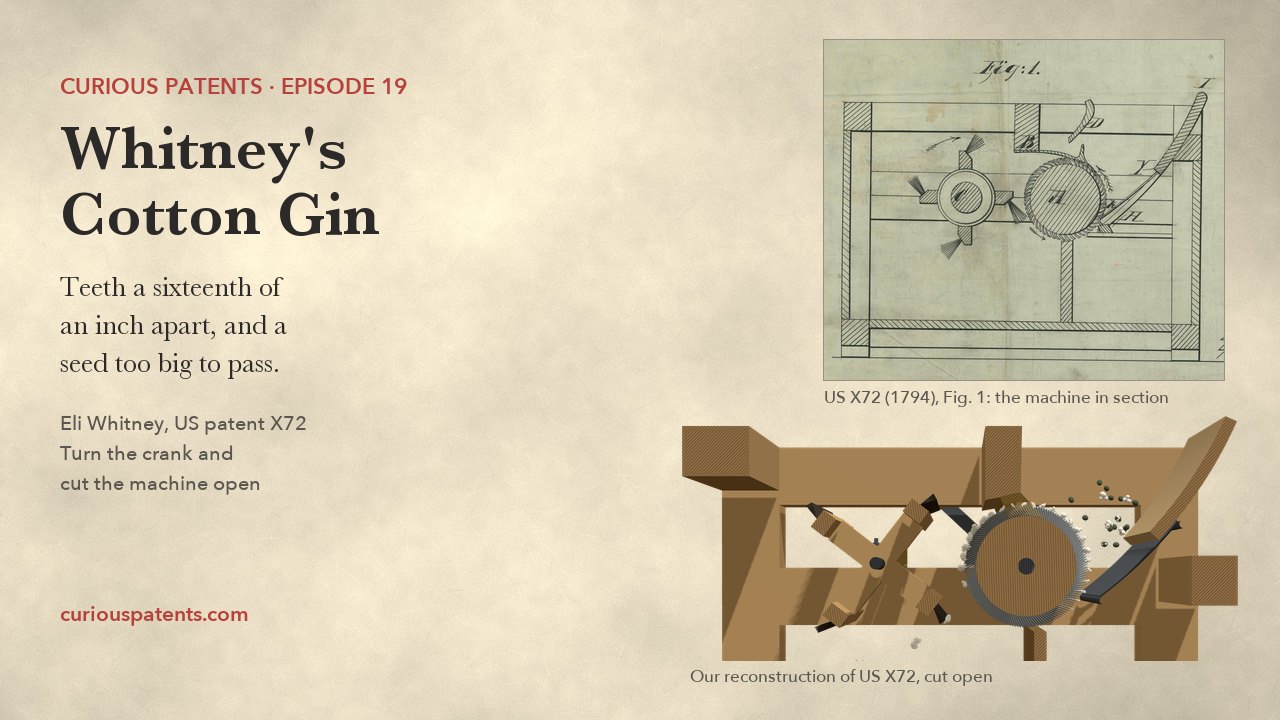
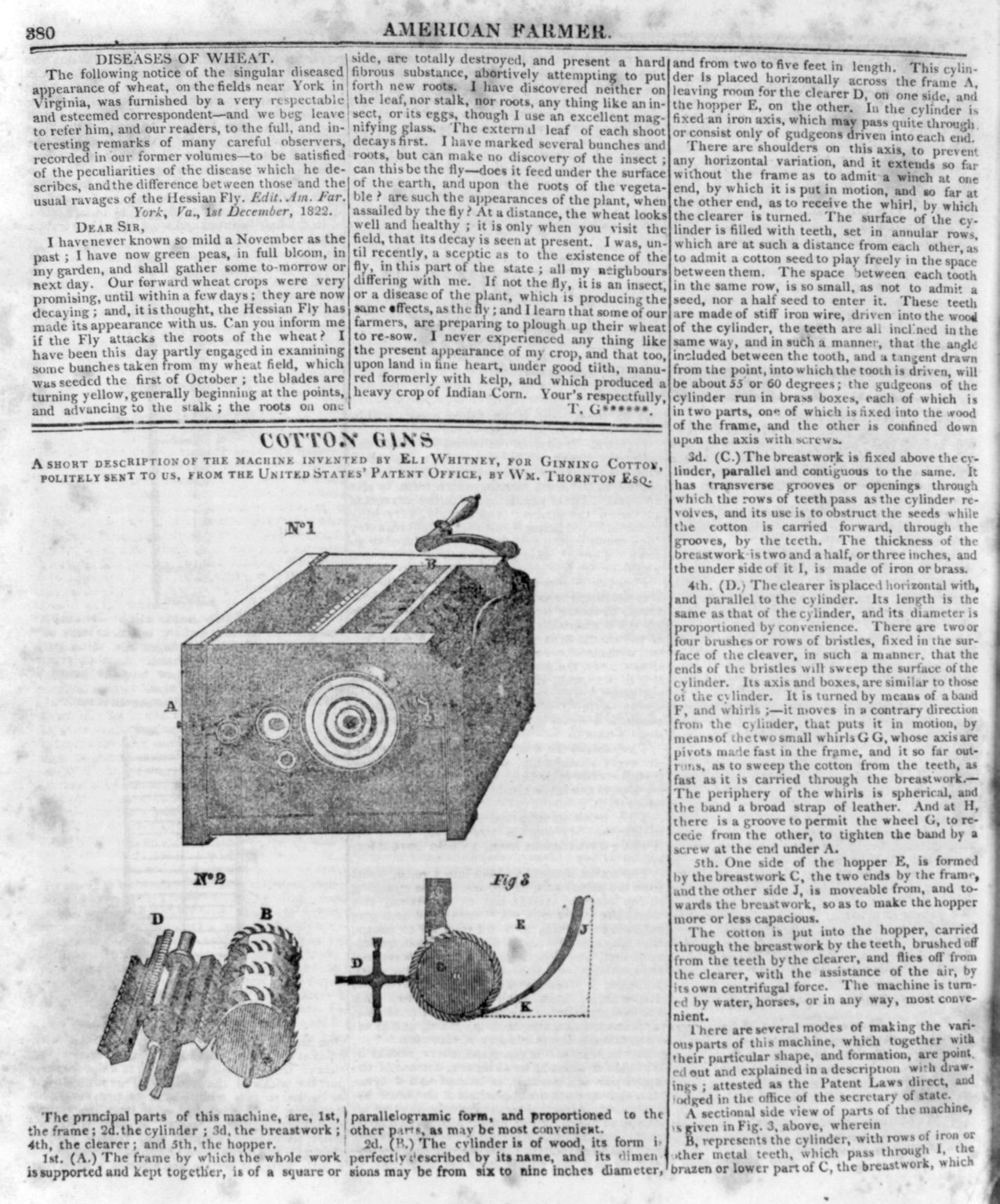
The description names five parts: "1st The frame; 2, the cylinder; 3, the breastwork; 4, the clearer; and 5, the hopper" (p. 4).
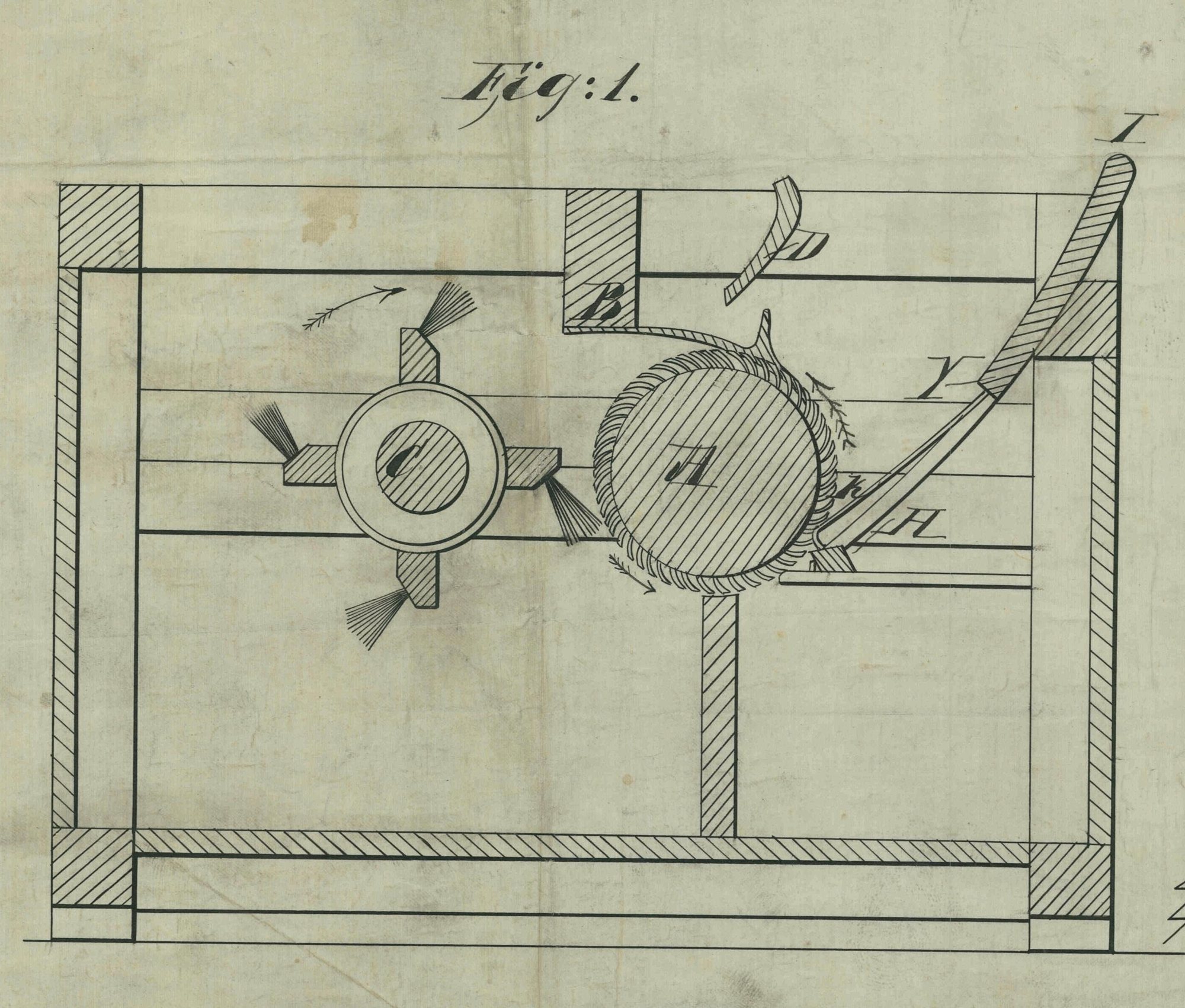
The cylinder is wood, "from six to nine inches diameter, and from two to five feet in length", on an iron axle with a crank. Its surface is set with rows of teeth, cut from "common iron wire about No. 12, 13, or 14", about an inch long and leaning forward (pp. 4-6).
Then the two numbers that matter. Between the rows, the space "must be so large as to admit a cotton seed to turn round freely in them every way: and ought not to be less than seven sixteenths of an inch" (about 11 mm). Between the teeth in a row, "they ought not to exceed one twelfth of an inch; and I think about one sixteenth of an inch the best" (about 1.6 mm) (p. 5).
Over the cylinder sits the breastwork, a plate of brass or iron with a slot for every row of teeth; the teeth pass through the slots (p. 7). Behind it is the clearer, four arms with brushes of hog's bristles, which "turns in a direction contrary from that of the cylinder", its surface "moving much faster" (p. 9). Whitney drove it with a leather band over wooden pulleys he calls whirls. It works like a cogwheel and pinion, he says, "with much less friction and expence, and without the rattling noise" (p. 10). The cotton goes into a hopper on the other side, and the cleaned seeds fall through a crate of wire (pp. 10-11).
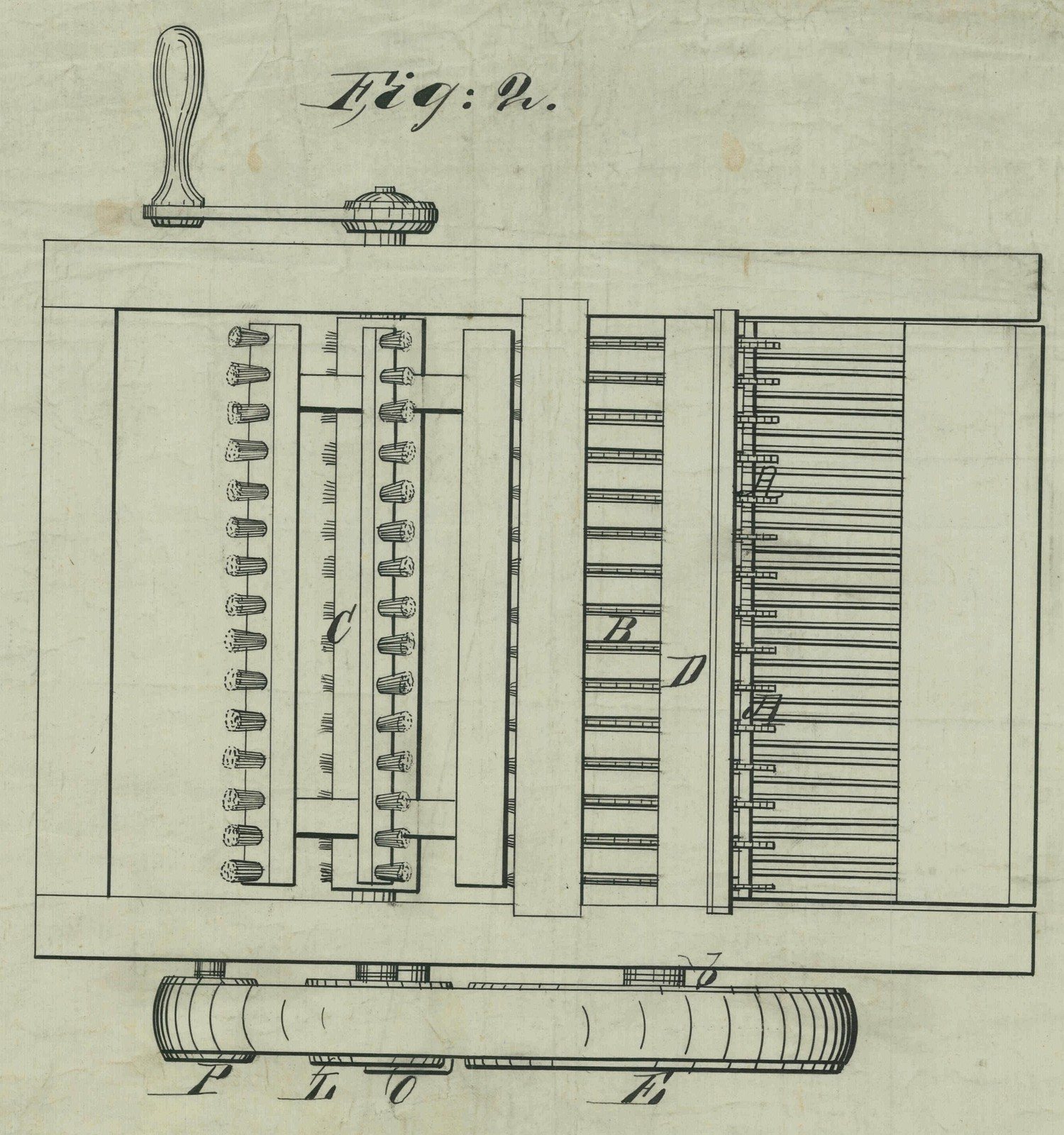
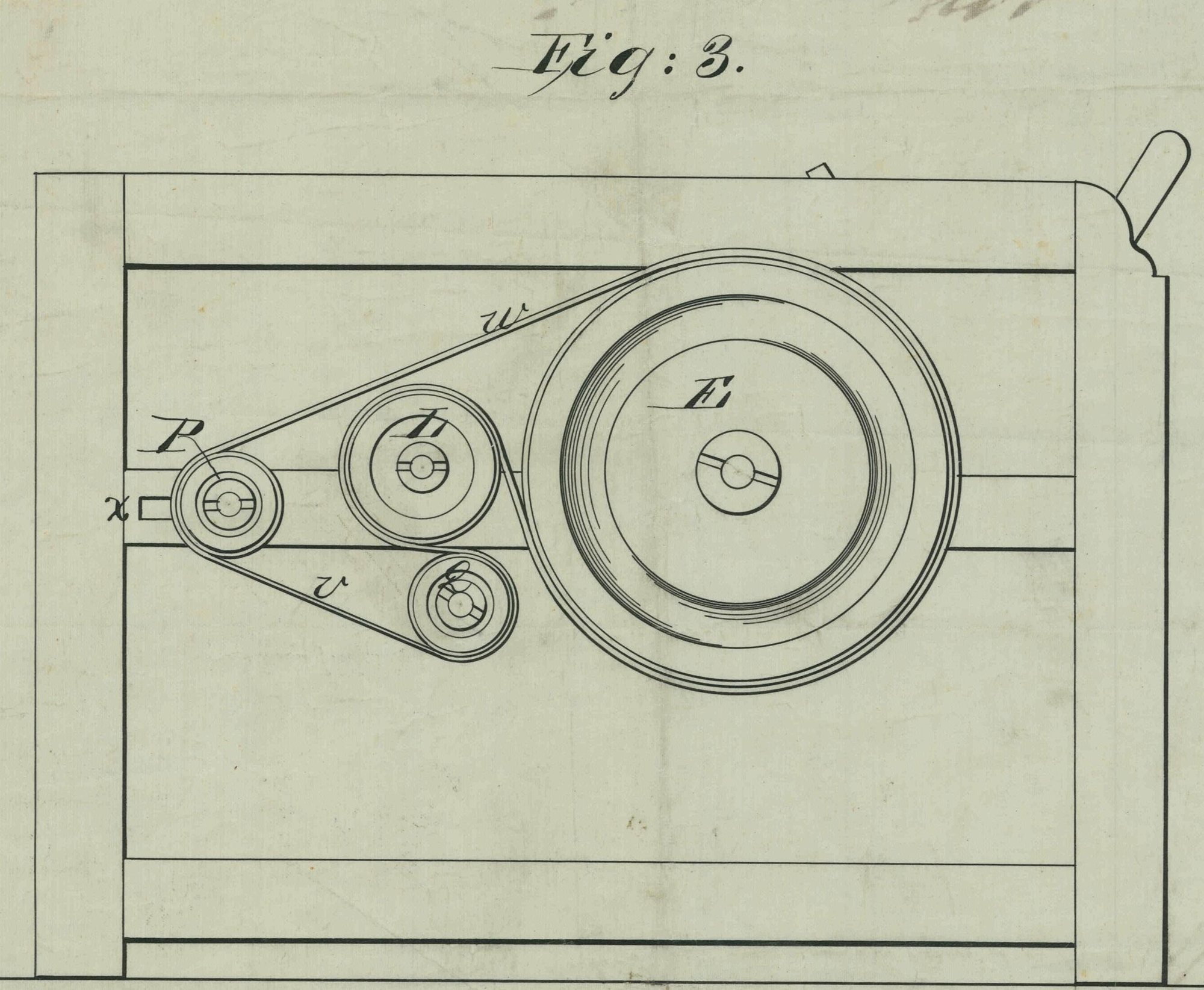
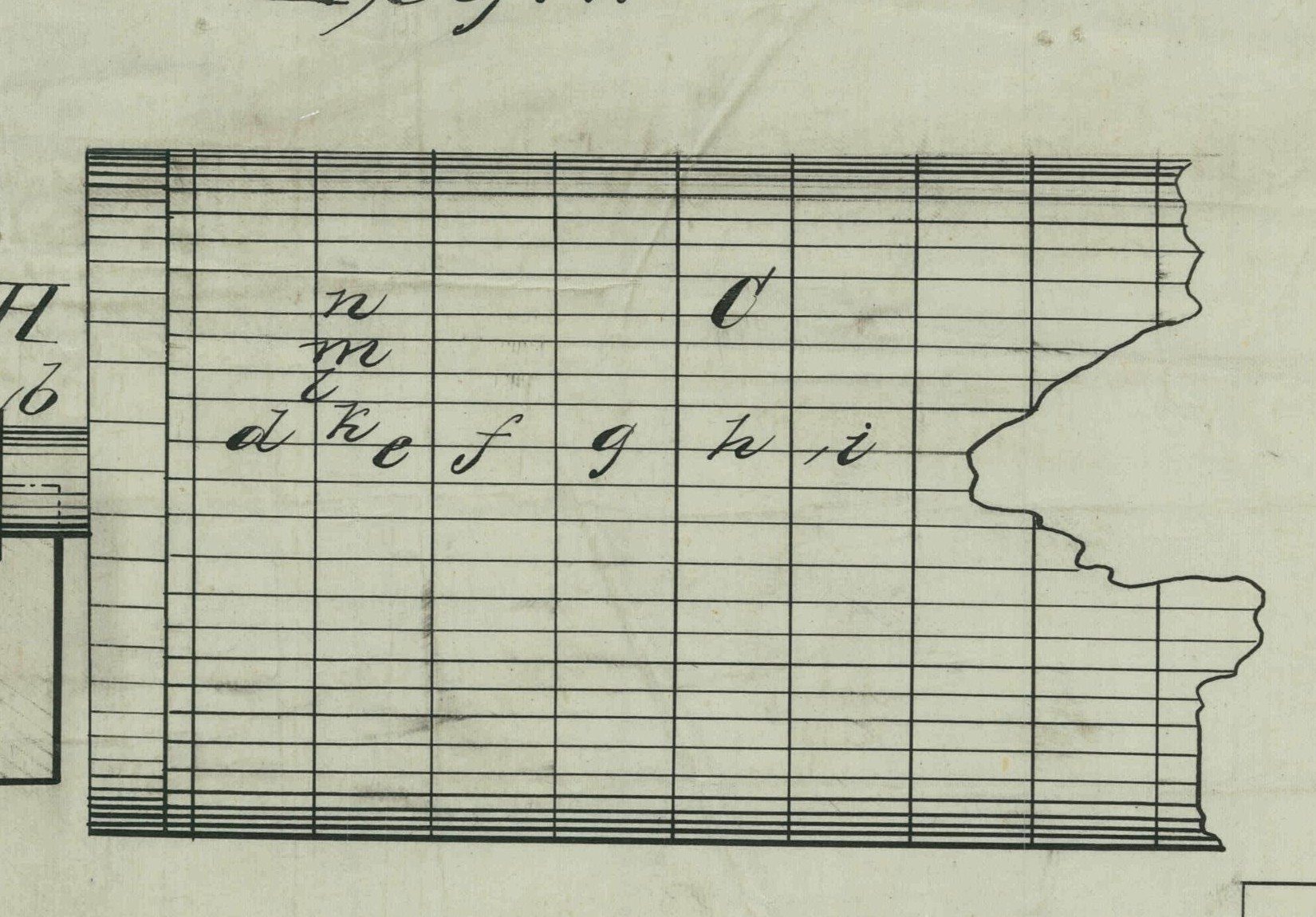
The drawings and the text do not always agree on proportions. Where they differ, our model follows the text; where only the drawing gives a position, as for the clearer, it follows the drawing. The note under the model lists every size that is ours.
Turn the crank, and cut the machine open
Here is the machine, rebuilt from the patent. Turn the crank, then choose Cut open or The seed at the slot to see it as Fig. 1 draws it: the teeth carry the fibre through the breastwork, and the seed stays behind.
What the patent gives. The five parts and their letters (p. 4, Figs. 1-3); the cylinder "from six to nine inches diameter, and from two to five feet in length"; the teeth of "common iron wire about No. 12, 13, or 14", teeth and tangent at "about 55 or 60 Degrees"; the spaces between rows "not ... less than seven sixteenths of an inch", in a row "about one sixteenth of an inch the best" (pp. 5-6); the breastwork "fixed above the cylinder; parallel and contiguous to the same", with "transverse grooves or openings ... through which the rows of teeth pass", its face "less than 30 Degrees" to the tangent, "about 2½ or 3 inches" thick (p. 7); the clearer's "four pieces", brushes of hog's bristles about an inch long at "20 or 25°", turning "contrary" to the cylinder and "much faster" (pp. 8-9); whirls E and L, the false whirls P and Q and the band (p. 10, Fig. 3); the hopper's movable side, "a portion of a hollow cylinder", that "may slide up nearer the cylinder", and the crate of wire between H and Y (pp. 10-11); the frame of "scantling four inches by three" (US X72). Which way the cylinder and the clearer turn is read from the arrows in Fig. 1, and the band's path from Fig. 3.
What is ours (the episode's list, from the model itself):
Crank turns are counted from Reset. The seeds and the cotton are a picture of the cycle drawn from the patent's words, not a simulation: each seed is stripped over a few turns and then drops through the crate. A modern fuzzy upland seed is about 9 by 11 mm (Herritt et al., 2020); the gap between teeth in a row is about 1.6 mm.
Checked. The episode's own test, run again on this page's copy of the model: 56 checks, all pass. Among them: the teeth pass through the slots without touching the breastwork, at every angle of a full turn; the gap between teeth in a row is a sixteenth of an inch at the body, too narrow for a seed or half a seed; the gap between rows lets a fuzzy seed turn; the clearer turns the other way, 2.7 times as fast, and its bristles reach the teeth; and cleaned seeds always land on the hopper's side of the partition.
Why the seed stays behind
Turn the crank, and the teeth rise through the cotton and hook the fibres. They carry them up to the breastwork and into the slots. The fibres go through. The seed cannot: it is several times wider than the gap. So the fibres are pulled off the seed, and the seed is left behind.
"A tooth in passing from k, up to the breastwork B, fastens itself upon a certain quantity of cotton, which is still connected with its seeds. The seeds being too large to pass thro' the breastwork are thus stopped, while the cotton is forced thro' the groove and disengaged from the seeds."US X72, p. 7
A seed in the hopper turns and tumbles, meeting tooth after tooth, until it is bare. Then it falls through the crate (p. 11). On the far side, the brush sweeps the teeth clean, and the cotton flies off: "Its use is to brush the cotton from the teeth after it is forced thro' the grooves and separated from its seeds" (p. 9).
Whitney claimed that, driven by water, "it will diminish the usual labour of cleaning the green seed cotton at least forty nine fiftieths" (p. 11). To Jefferson he gave a number. It took one man to keep a hand-turned machine going, he wrote, and the daily task for one worker was fifty pounds of clean cotton:
"It is turned by hand, and requires the strength of one man to keep it in constant motion. It is the stated task of one negro to clean 50 weight (I mean 50 pounds after it is separated from the seed), of the green seed cotton per day."Whitney to Jefferson, 24 November 1793, quoted as written (as printed by Lewton, 1937)
Fifty pounds a day (about 23 kg), where by hand it had been one.
A third of the crop, and four words in the law
Whitney and Miller did not plan to sell the machines. They planned to clean cotton for planters, and keep a share of it. According to Whitney's first biographer, the share was "every third pound" (Olmsted, p. 18). By the summer of 1794 Whitney wrote: "We have now Eight Hundred Thousand weight of Cotton on hand" (17 August 1794). In March 1795 his workshop in New Haven burned, with "work equal to twenty finished cotton machines" (22 March 1795).
And the machine was easy to copy. Miller wrote in 1797 that planters "continue to clean great quantities of cotton with Lyon's Gin", while "the Patent ginned cotton is run down as good for nothing" (American Historical Review, 1897, p. 105).
So they sued. They lost the first trial, on the wording of the law. The Patent Act of 1793 punished anyone who would "make, devise and use, or sell" a patented machine (1 Stat. 318, s. 5). The planters had not made the gins they used. In the words of Whitney's petition, "the Defendents had only used", and "as the law then stood they must both make and use the machine, or they could not be liable". He called it "a fatal, though inadvertent defect in the law". Congress fixed it in 1800: "make, devise, use, or sell" (2 Stat. 37, s. 3). Even then, he was "unable to obtain any decision on the merits of his claim until the year 1807" (petition).
The saw gin, the courts, and half a cent
In 1796, a Georgia man named Holmes patented a gin of his own (X115, as indexed). In place of wire, his teeth were cut into iron plates, like circular saws. Saws were easier to make than thousands of wire teeth, and the seeds could fall out between ribs while the machine kept running. Whitney's gin had to stop when its hopper filled with seeds: "one hopper full must be finished, the movable part drawn back, the hopper cleared of seeds and then supplied with cotton anew" (p. 11). Tick Saw teeth under the model to see our reconstruction of a saw gin; Holmes's own drawings are lost.
In December 1807, a federal judge in Georgia, William Johnson, finally ruled for Whitney, in Whitney v. Fort. Of Holmes's saws he said: "A Mr. Holmes has cut teeth in plates of iron ... But at last, what does it amount to, except a more convenient mode of making the same thing?" "Every characteristic of Mr. Whitney's machine is preserved", he went on. But "Mr. Whitney may not be at liberty to use Mr. Holmes' iron plate" (the decree as printed by Olmsted, 1832).
By then Whitney's own gins used saws. In another case, Whitney v. Carter, the court record says "Mr. Whitney now uses, and that the defendant also uses, teeth formed of circular plates, instead of teeth made of wire", and the jury gave him $1,500 ≈ $30,000. According to his biographer, in one trial Whitney brought two cylinders to court, one with saw teeth made to look like wire and one with wire made to look like saws, and the witnesses got them the wrong way round: "They accordingly swore the saw teeth upon Whitney, and the wire teeth upon Holmes" (Olmsted, p. 58, note).
His patent ran fourteen years, so by the time a court upheld it, it had almost run out. In his petition's words, he could get no decision "untill he had been eleven years in the Law & thirteen Years of his patent term had expired".
Some states paid instead. In 1801 South Carolina voted $50,000 ≈ $970,000 for the right to use it. Whitney called it "selling the right at a great sacrifice" (20 December 1801). Then the state stopped paying, and later started again. North Carolina and Tennessee taxed each gin saw for a few years (Olmsted). Georgia, where it began, paid nothing: from Georgia, his petition says, "he has realized nothing".
In 1812 he asked Congress to renew the patent. The whole amount he had made from it, he wrote, was "not equal to the value of the labour saved in one hour by his machines, now in use". The petition "was not approved" (House of Representatives, History, Art & Archives).
What the gin changed, and what it did not
Upland cotton would grow far inland, on land the coastal planters had never used for it. Cleaned by hand, it was not worth growing. With the gin, it was. In the historian Damian Pargas's words, "the piedmont regions of South Carolina and Georgia were the first to be cleared and converted to cotton at the turn of the nineteenth century, but the westward expansion quickly spilled into the new territories of the Deep South": into Alabama, Mississippi, Louisiana and, later, Texas (Pargas, 2015, p. 21).
In 1807 Judge Johnson described what the gin had done: "The whole interior of the Southern States was languishing", until this machine "set the whole country in active motion". "Our lands trebled themselves in value." (Whitney v. Fort, as printed by Olmsted.)
But the gin did one job. It took the seed out. Every pound still had to be planted and picked by hand. The National Archives puts it this way: "Cotton growing became so profitable for plantation owners that it greatly increased their demand for both land and enslaved labor."
| What was counted | Then | Later | Source |
|---|---|---|---|
| Cotton exported, pounds | 487,600 (1793) | 17,789,803 (1800) | Pitkin, 1816 |
| Cotton crop, bales | 73,000 (1800) | 3,841,000 (1860) | NBER Macrohistory, via FRED |
| Enslaved people in Georgia, South Carolina, Alabama, Mississippi and Louisiana (in 1860 with Texas), of all in the US | 551,886 of 1,538,022 (1820) | 2,250,607 of 3,953,760 (1860) | Census of 1860, Recapitulation; Census Bureau WP 56 |
| Enslaved people in Mississippi | 3,489 (1800) | 436,631 (1860) | the same |
The people who grew it were moved with it. From 1808 it was against federal law to bring enslaved people in from abroad (2 Stat. 426), so they were moved within the country. Historians estimate that between 1790 and 1860 somewhere from about 835,000 to more than a million people were forced from the Upper South to the cotton states, many of them sold by traders (Fogel and Engerman, and Gutman and Sutch, as given by Pritchett, 2001; Pargas counts at least 875,000 for 1820 to 1860). One historian of that migration, Damian Pargas, calls the cotton boom "by far the most important pull factor in the reallocation of American slave labor from the eastern seaboard to the southern interior" (p. 23).
By 1850 the census office estimated that, of about two and a half million enslaved people working on farms, 1,815,000 worked in cotton: about three in four. That is De Bow's estimate in the Census Office's compendium; the census never recorded the occupations of enslaved people (De Bow, 1854, p. 94). By 1860 cotton was about three-fifths of the value of everything the United States exported (Historical Statistics of the United States, series U 191 and U 276).
The gin was not the only cause. Demand came from the spinning mills, and the picking got faster too, from about 28 pounds a day per picker in 1801 to about 114 in 1862 (about 13 and 52 kg), mostly from new varieties of cotton (Olmstead and Rhode, NBER Working Paper 14142, fitted trend values). And slavery was large before the gin: 697,681 people in 1790. The economic historian Gavin Wright calls the gin "merely a blip in a more extended transition" (Economic History Review, 2020).
The National Archives' own conclusion is this: "the most significant impact of the cotton gin was on the growth of slavery".
What stayed


Saw gins won. But the idea under them was the one in Whitney's description. The Department of Agriculture's cotton researchers put it this way: "The basic operating principle of separating fiber and seed by pulling the cotton fiber through narrow slots that blocked the passage of the cottonseed in these early saw gins has not changed" (Hughs, Holt and Rutherford, 2017). And a modern gin stand still has a brush behind the saws, turning faster than they do: in their figure, "Saw speed, 850 rpm; brush speed, 1,579 rpm".
Whitney went on to make muskets for the government in New Haven. That is another story, and a contested one.
The patent itself is a wooden drum, some wire, and a slot narrower than a seed.
Read the original patent
A US patent of 1794, in the public domain. What survives is the copy certified in 1803 and restored after the fire of 1836. Click a page for full resolution. First the two drawing sheets as the National Archives holds them, then the twelve pages of the USPTO's copy: a photograph of sheet 1, the two sheets redrawn, the eight pages of the description with Madison's certificate at the top of the first, and the New Haven oath.
US X72, Eli Whitney, Cotton Gin, patented 14 March 1794
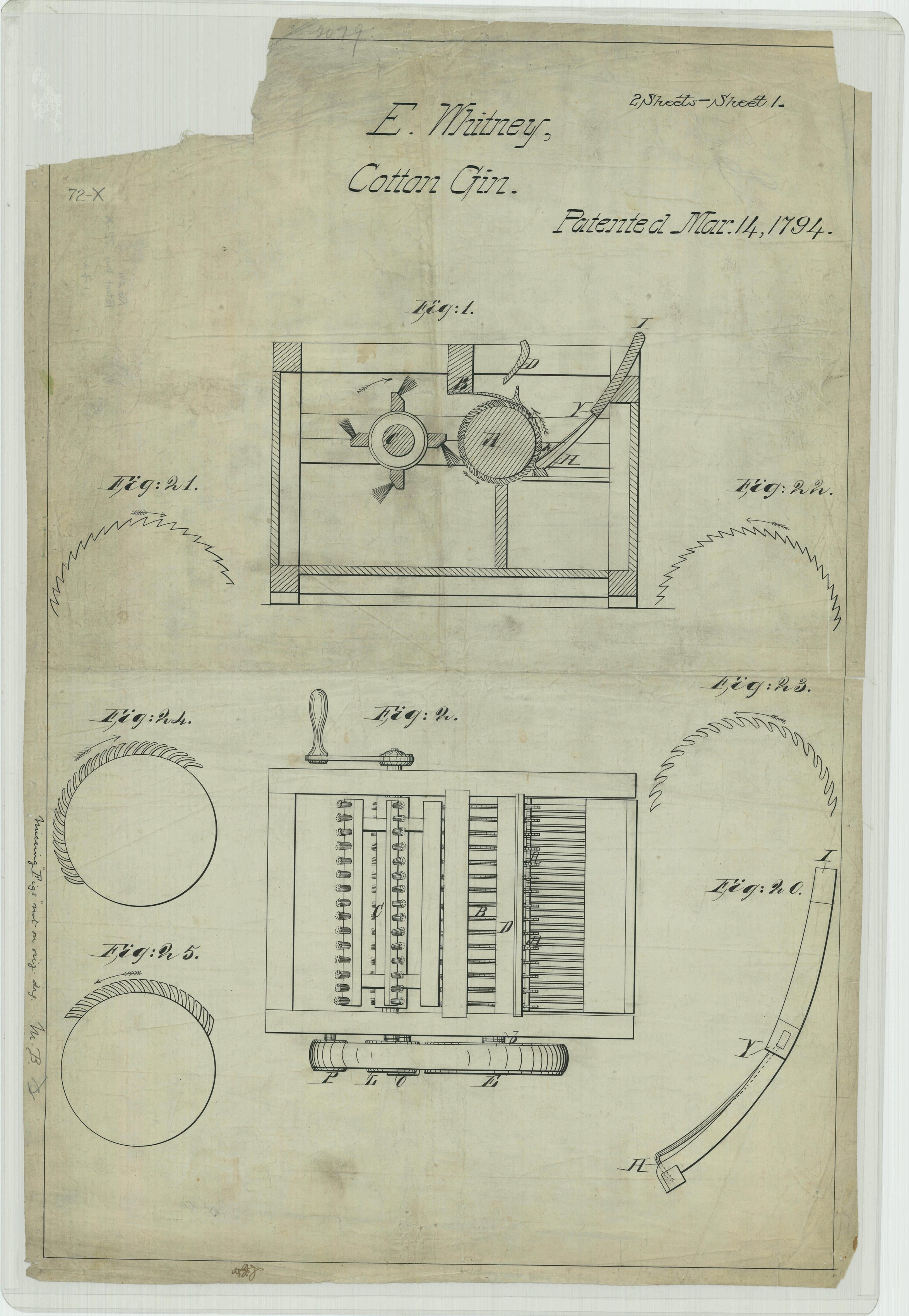
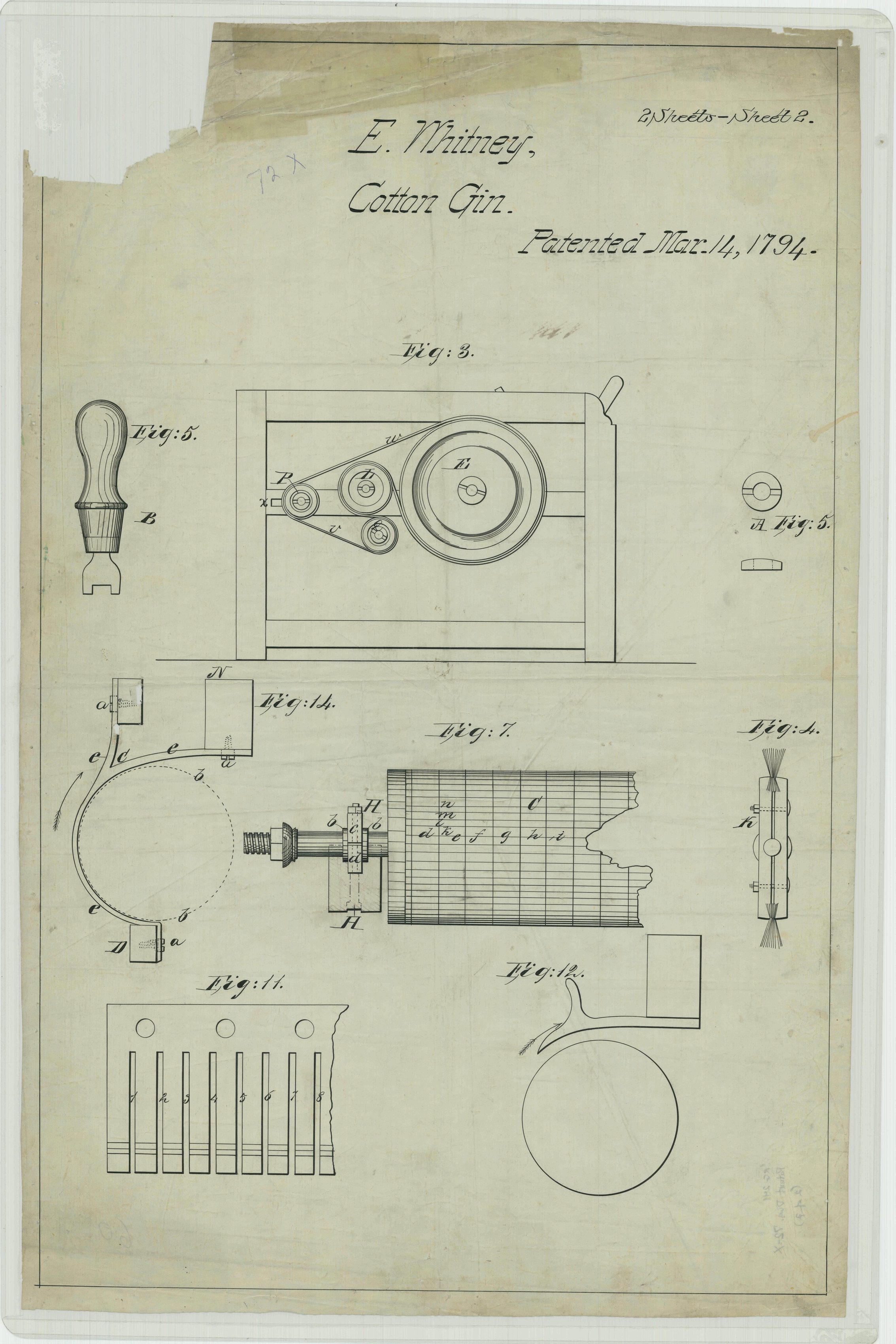
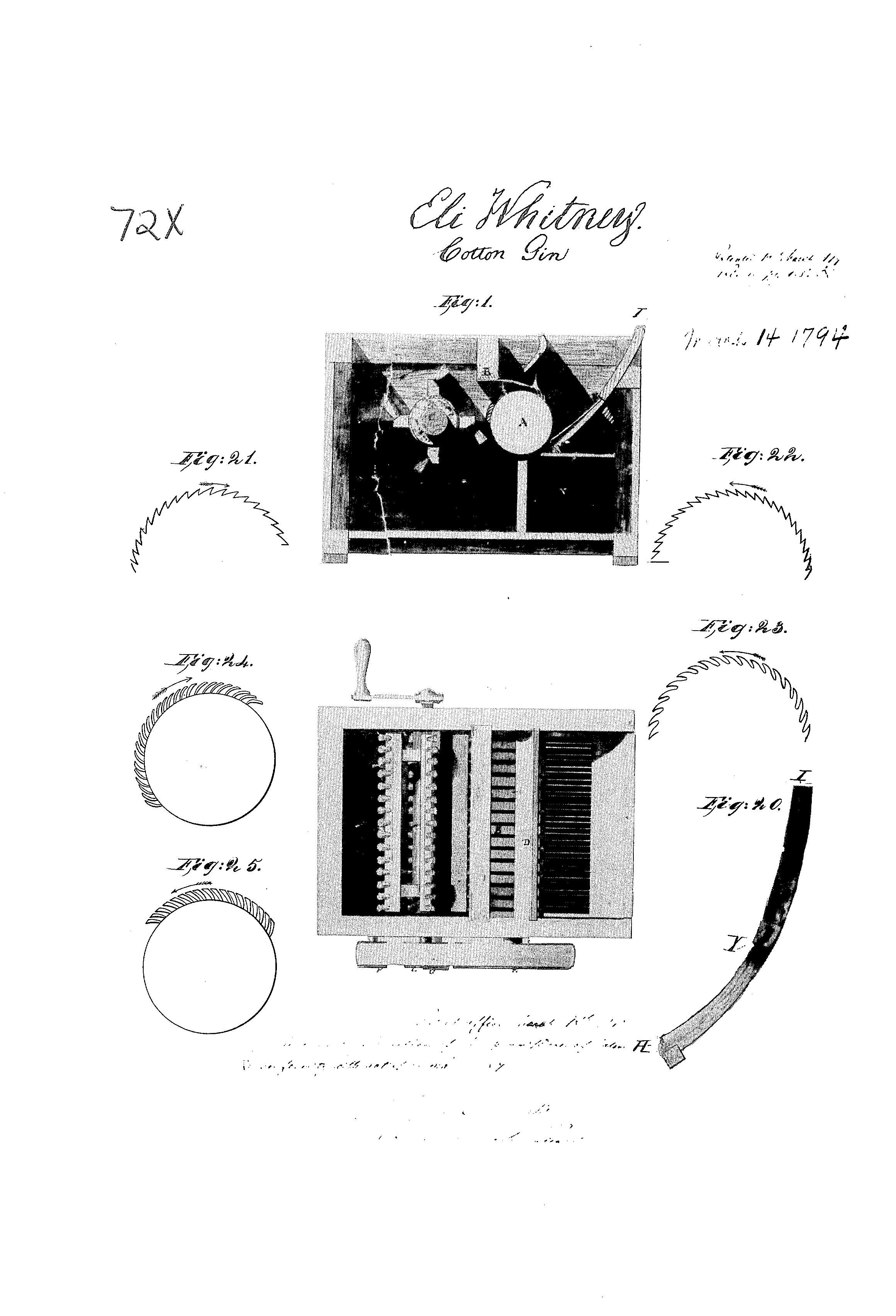
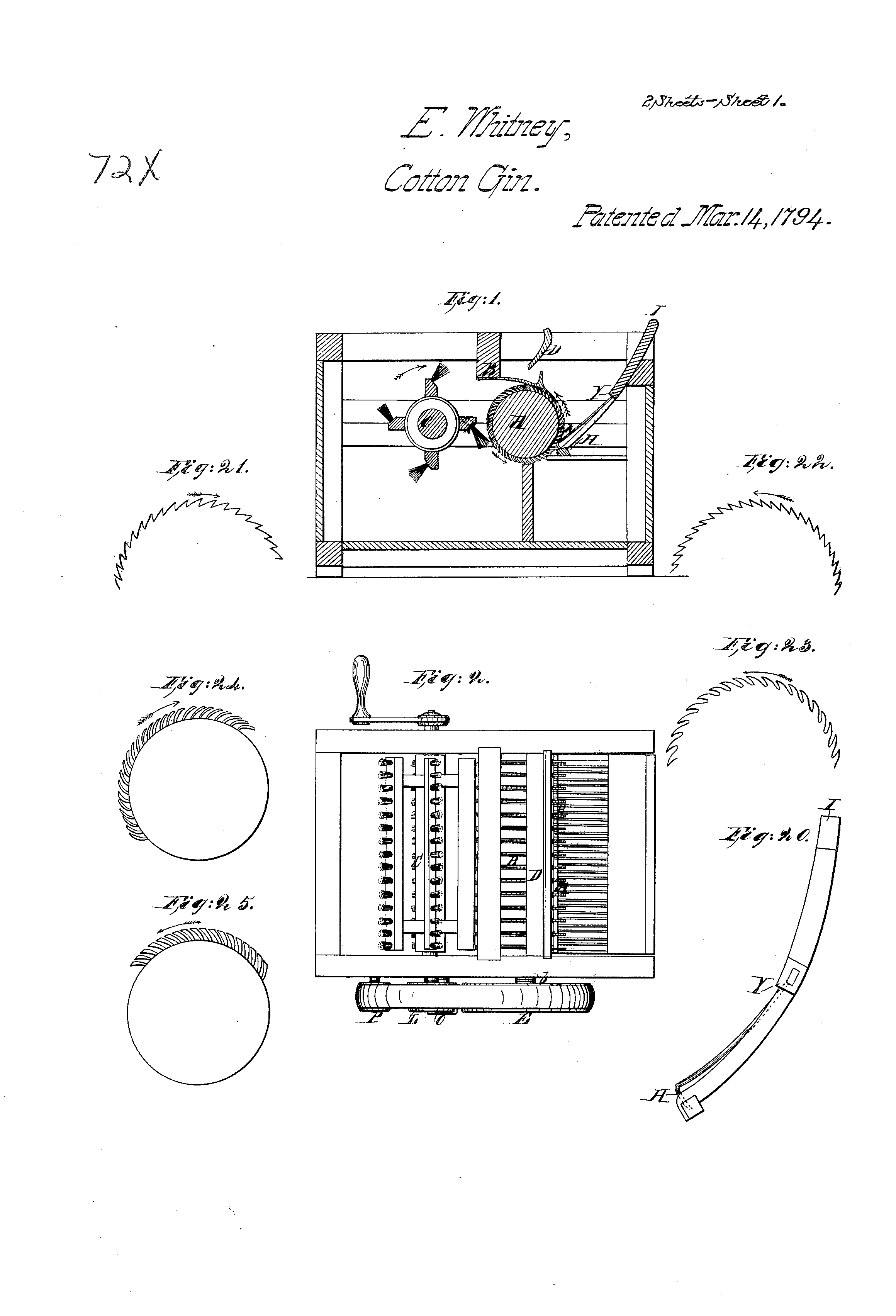
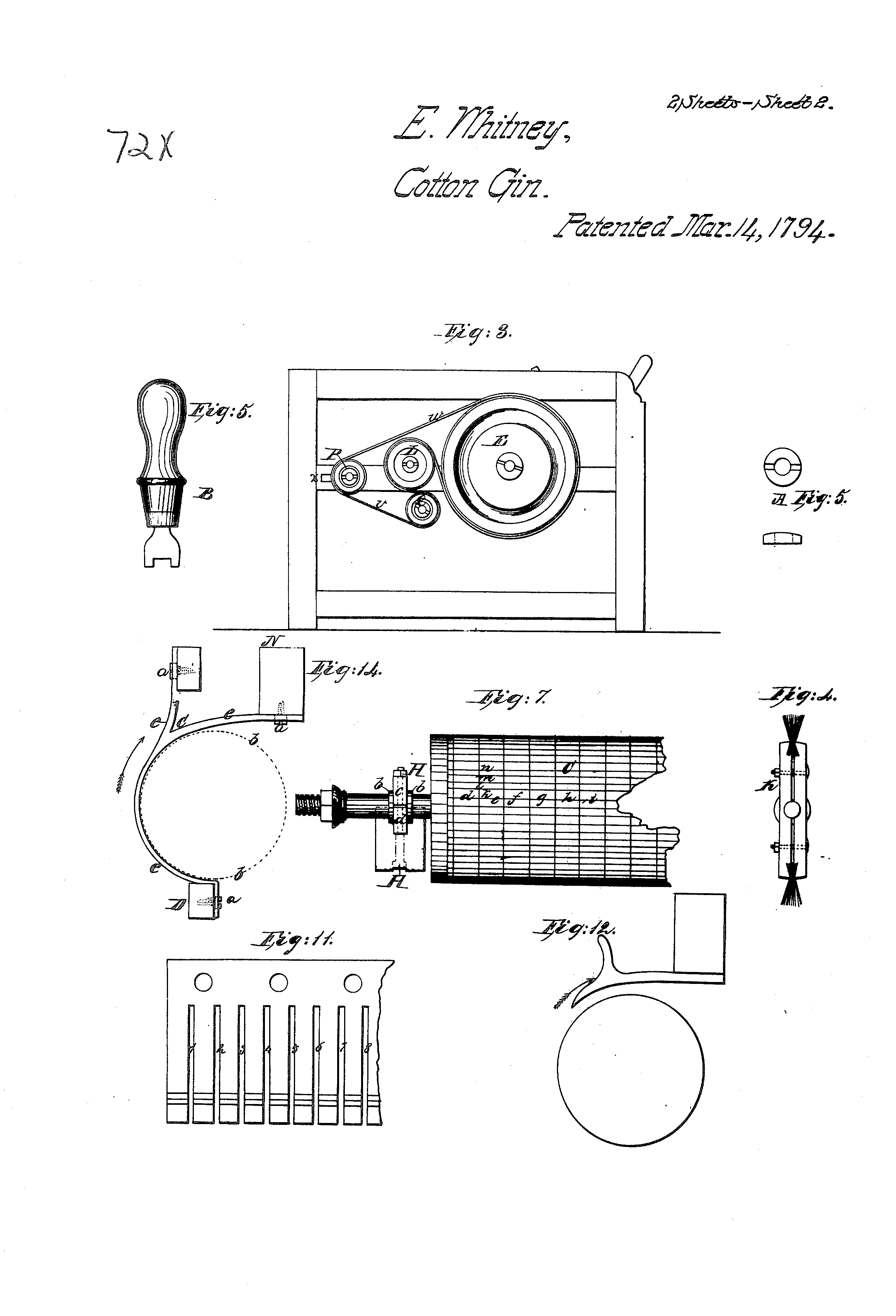
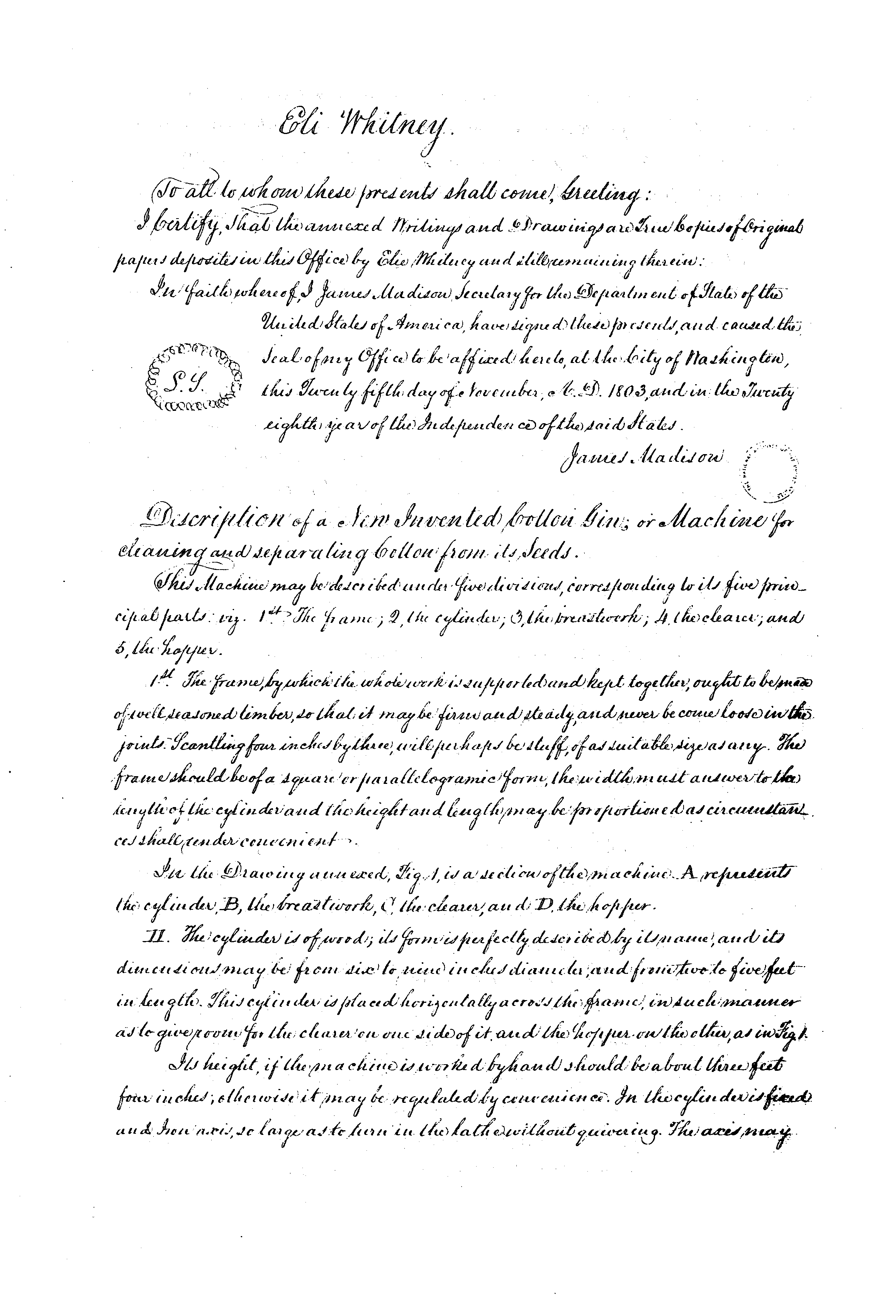
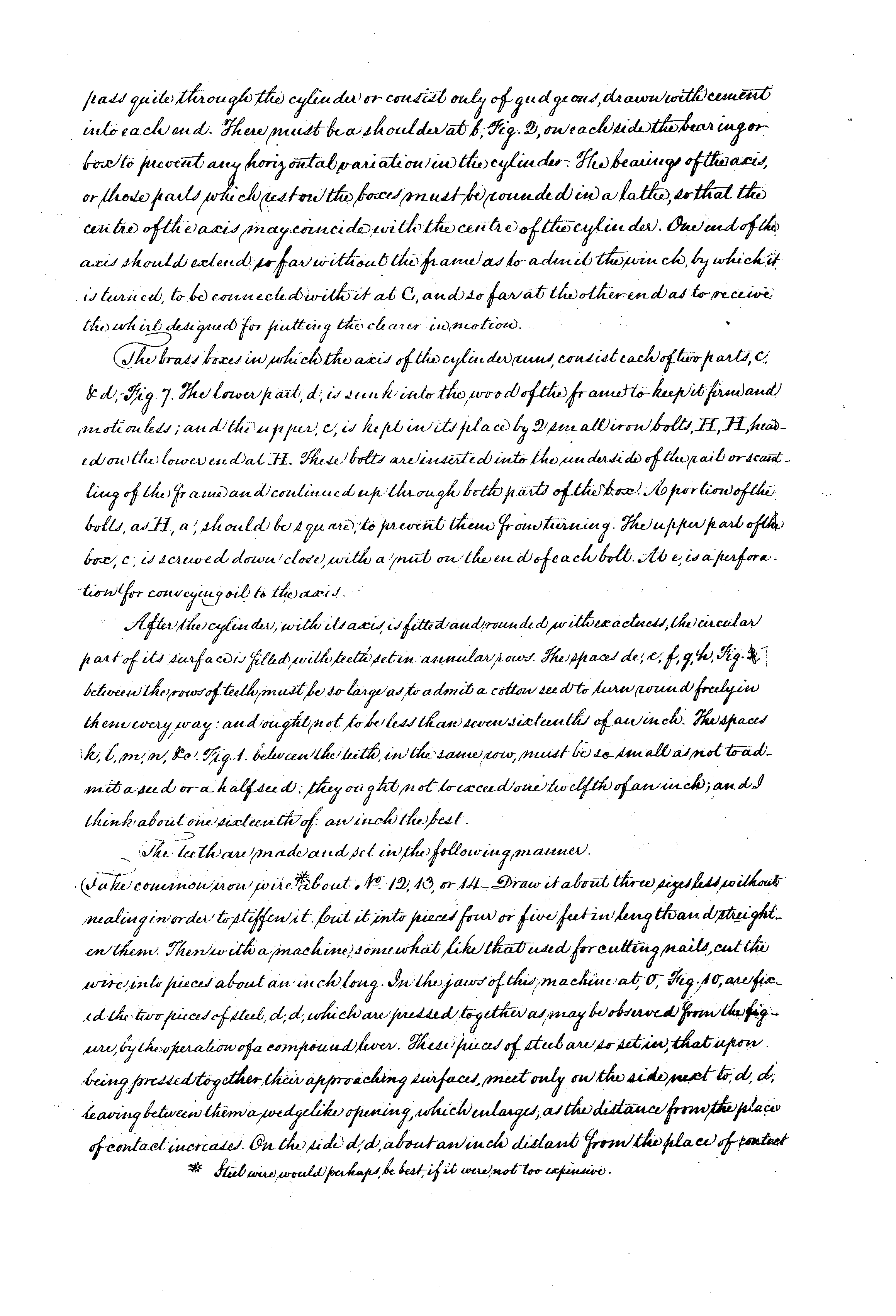
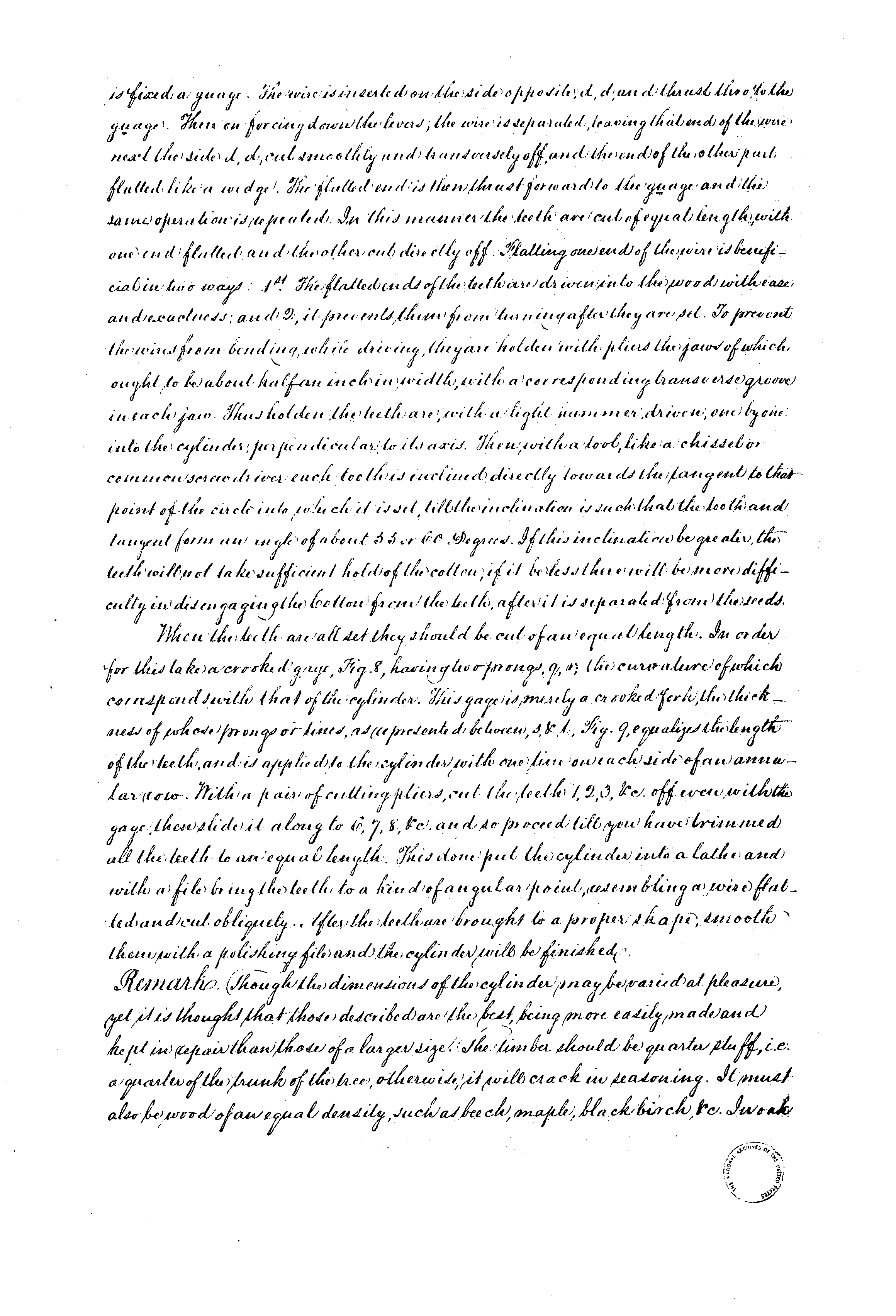
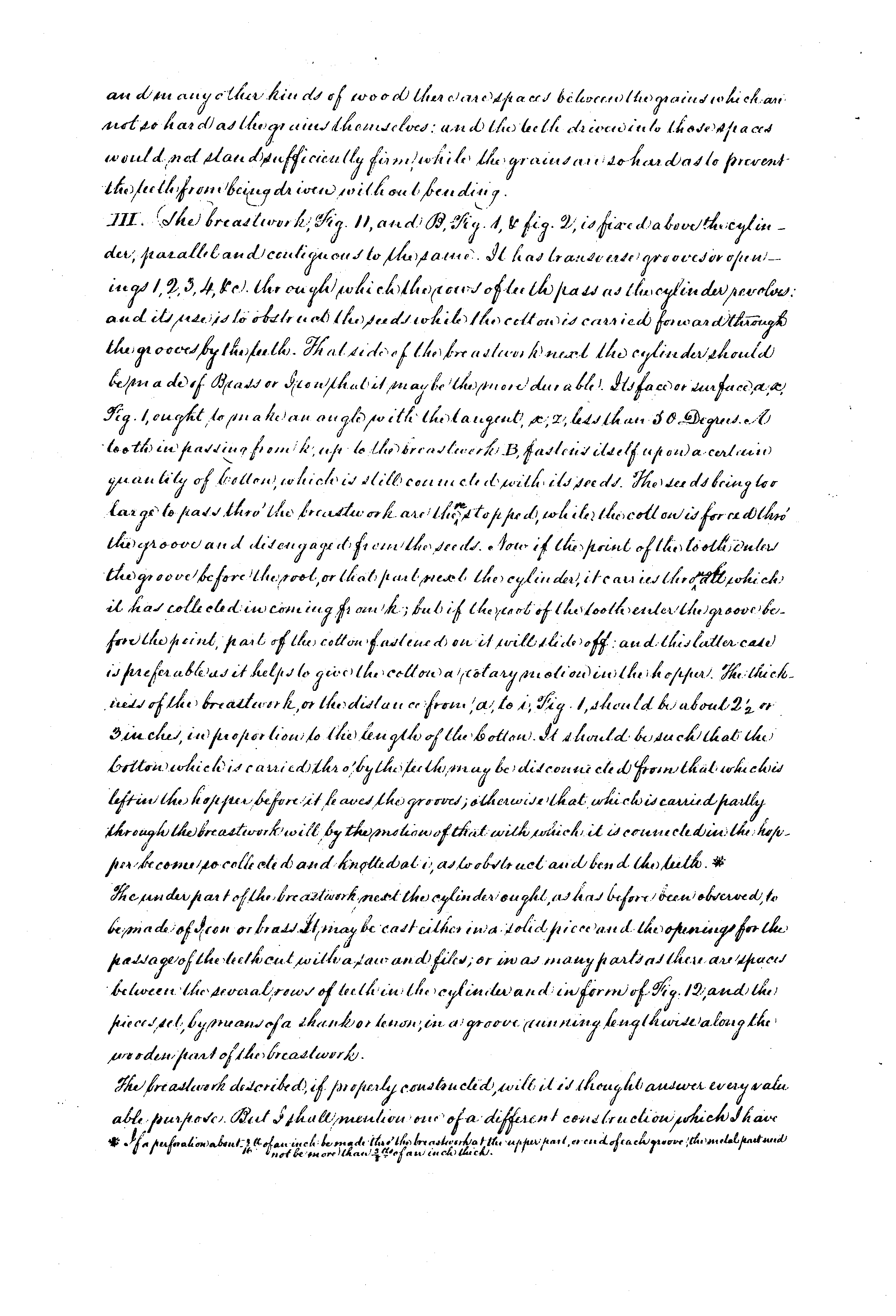
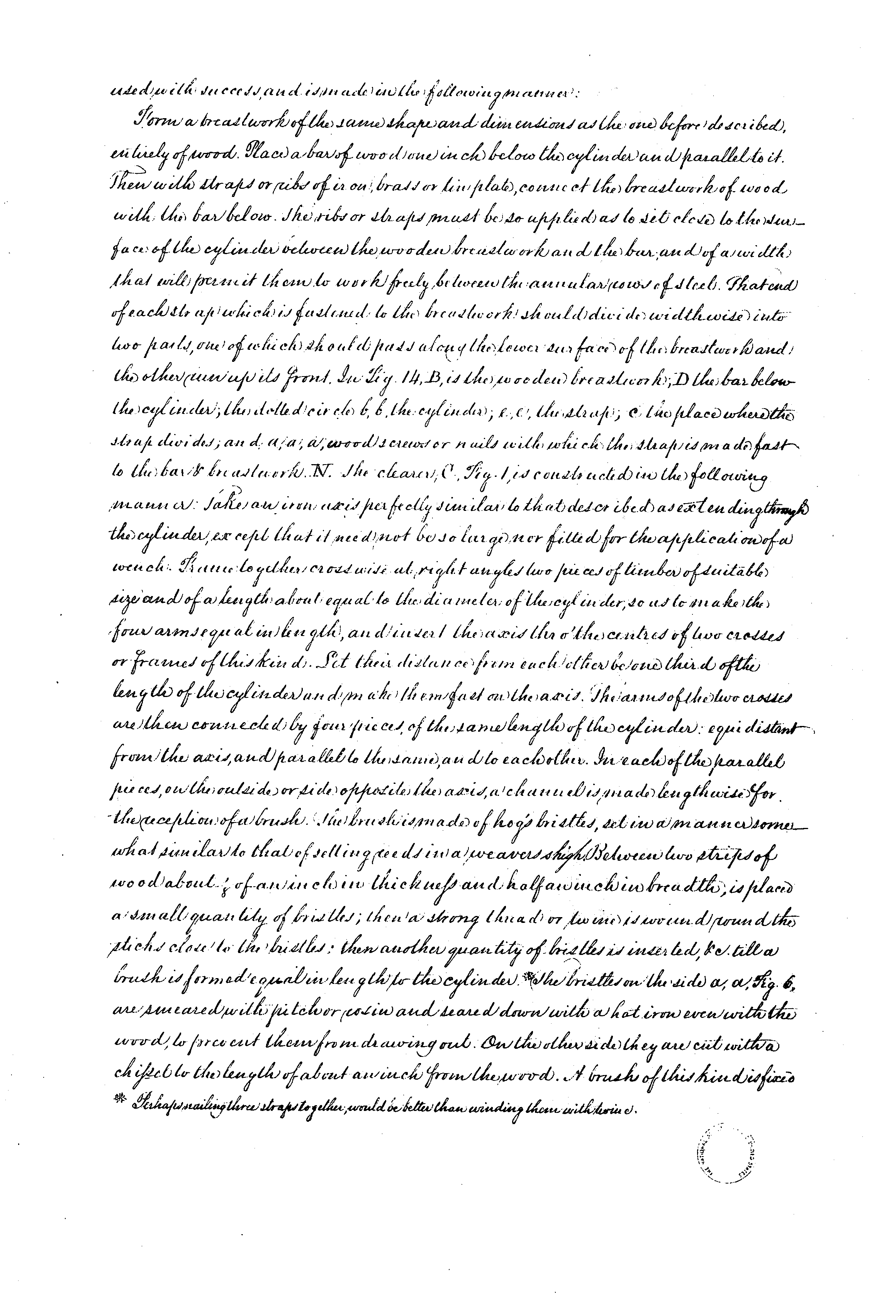
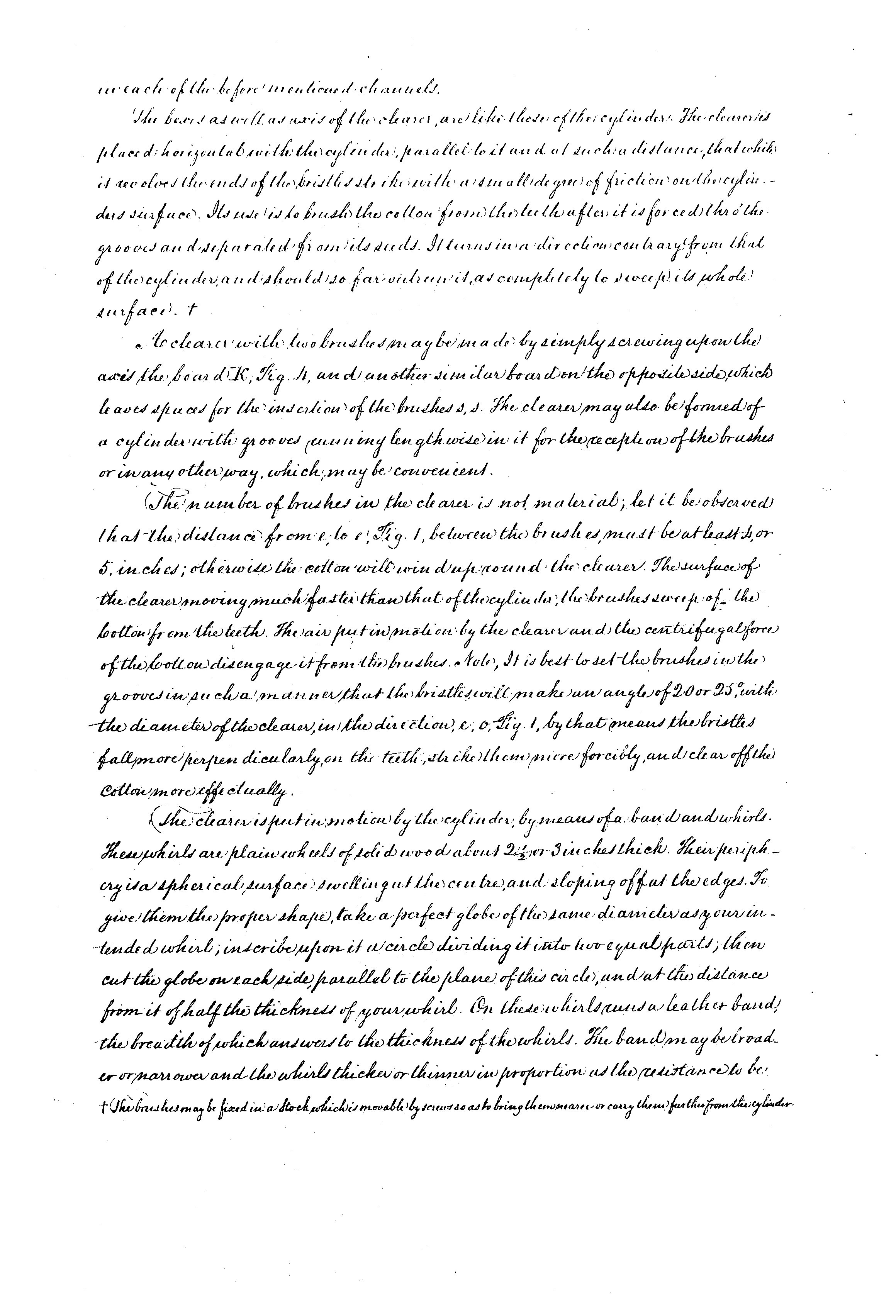
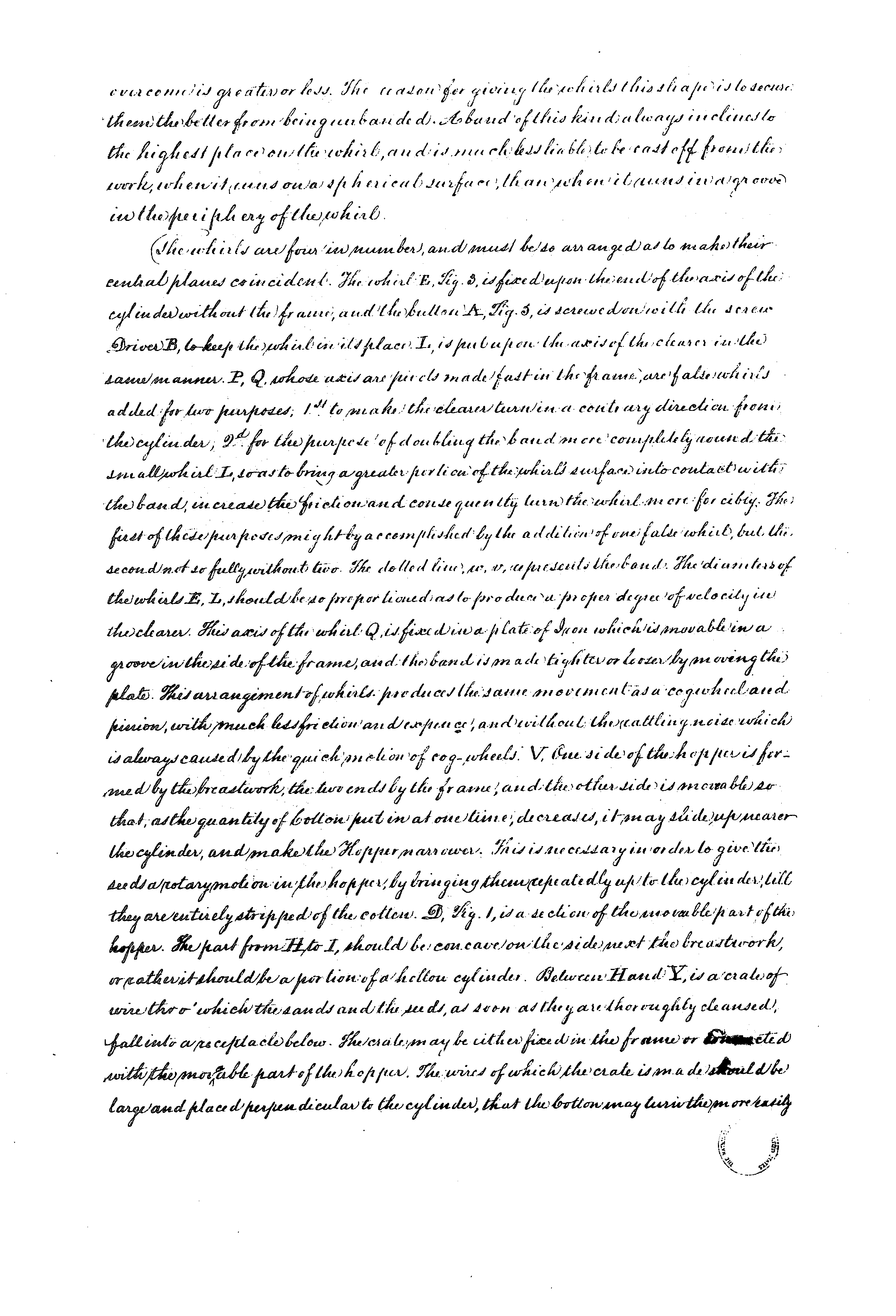
PDF · Google Patents · the drawing at the National Archives
Sources
Every fact on this page comes from these, as in the episode. Where we have a source only second-hand, the text says whose words they are.
The patent (US, public domain)
- E. Whitney, Cotton Gin, US X72 ("72-X"), patented 14 Mar. 1794: the description of 1793 as certified by James Madison, 25 Nov. 1803 (USPTO page images; page numbers are the PDF's): Madison's certificate and the five parts (p. 4); the cylinder, the two numbers, the teeth (pp. 4-6); the breastwork and "thus stopped" (p. 7); the brush (p. 8); the clearer (p. 9); the whirls and the hopper (p. 10); green seed, the crate, "one hopper full", "forty nine fiftieths", the date (p. 11); the oath and "Received & Recorded May Second 1841" (p. 12). Read on the page images by the episode's research.
- The drawing: National Archives, Records of the Patent and Trademark Office (RG 241): "Patented Mar. 14, 1794", the hand number 72-X, Figs. 1-11. The rotation of the cylinder and the clearer is read from the arrows on Fig. 1.
Documents
- Eli Whitney, petition to Congress, 16 Apr. 1812: National Archives, Center for Legislative Archives (RG 233), NAID 306631 (text also at DocsTeach); House of Representatives, History, Art & Archives, record of the petition: "was not approved".
- "Correspondence of Eli Whitney relative to the Invention of the Cotton Gin", ed. M. B. Hammond, American Historical Review 3 (1897), pp. 90-127 (Internet Archive): the letters of 11 Sept. 1793, 17 Aug. 1794, 22 Mar. 1795, Miller's of 1797, 20 Dec. 1801 and 7 Mar. 1803; Hammond's note on the claim for Mrs. Greene (p. 97).
- F. L. Lewton, "Historical Notes on the Cotton Gin", Smithsonian Report for 1937 (LacusCurtius): Jefferson to Whitney, 16 Nov. 1793, and Whitney to Jefferson, 24 Nov. 1793, as printed there.
- D. Olmsted, Memoir of Eli Whitney (1832; Internet Archive): the evenings of hand cleaning (p. 14), "every third pound" (p. 18), the state payments (pp. 31-34), the Whitney v. Fort decree of Dec. 1807 as printed (pp. 38-41), the two cylinders (p. 58, note).
- Whitney v. Carter, Federal Cases No. 17,583: "teeth formed of circular plates"; damages $1,500 ≈ $30,000.
- Patent Act of 21 Feb. 1793, 1 Stat. 318, ss. 1 and 5; Act of 17 Apr. 1800, 2 Stat. 37, s. 3 (1793, 1800); Act of 2 Mar. 1807, 2 Stat. 426.
- USPTO, "The search for lost X-patents": the 1836 fire and the X numbers.
- National Archives, "Patent for Cotton Gin (1794)", Milestone Documents: "the first to clean short-staple cotton", "so profitable for plantation owners", "the most significant impact of the cotton gin".
- Georgia Southern University's index of X-patents, as cited by the episode's research: "Cotton gin, Hodgen Holmes, 1796-05-12, X115".
Numbers and historians
- US Census Bureau, Working Paper 56 (Gibson and Jung, 2002), Table 1; Census of 1860, Population, Recapitulation, pp. 599-603.
- T. Pitkin, A Statistical View of the Commerce of the United States (1816): exports of 1793 and 1800. NBER Macrohistory database via FRED: the crop in bales.
- J. D. B. De Bow, Statistical View of the United States ... Compendium of the Seventh Census (1854), p. 94, footnote table (Internet Archive): an estimate, "as near as can be judged".
- Historical Statistics of the United States, Colonial Times to 1970, chapter U, series U 191 and U 276 (1860).
- D. Pargas, Slavery and Forced Migration in the Antebellum South (Cambridge, 2015), pp. 19, 21, 23 (publisher's excerpt).
- J. Pritchett, Journal of Economic History 61 (2001), abstract; M. Tadman, Journal of American Studies 13 (1979), abstract.
- A. Olmstead and P. Rhode, NBER Working Paper 14142, pp. 1, 22: picking rates, fitted trend values.
- G. Wright, "Slavery and Anglo-American capitalism revisited", Economic History Review 73(2), 2020, s. IV.
- Hughs, Holt and Rutherford (USDA-ARS), "Saw Gin Stands", Journal of Cotton Science 21:60 (2017): the abstract and a figure legend.
- Seed size: Herritt, Jones and Thompson, Journal of Cotton Science 24:112 (2020), modern upland seed.
- Today's money: US consumer prices, Federal Reserve Bank of Minneapolis, "Consumer Price Index, 1800-", with 2025 as today, rounded to two figures. Rough, so "≈". The Carter damages are converted at 1808 prices, as in the episode.
- The reconstruction is our own work, as described under the model: the episode's model, checked by its test, run again on this page's copy.
Images
- Patent drawing (Figs. 1, 2, 3, 7 and both sheets) and Whitney's petition: National Archives, unrestricted. The USPTO's page images of the patent: public domain.
- Eli Whitney by Samuel F. B. Morse, 1822, and Munson's painting of 1827: Yale University Art Gallery, via Wikimedia Commons, public domain. Jefferson's letter: Yale University Manuscripts & Archives, via Wikimedia Commons, public domain.
- Catharine Greene (Mrs. Phineas Miller), 1806: The Metropolitan Museum of Art, The Moses Lazarus Collection, 95.14.101, public domain.
- The American Farmer, 1823: Library of Congress, Prints and Photographs Division ("No known restrictions on publication").
- Cotton seeds and lint: Peggy Greb, USDA Agricultural Research Service, public domain.
- The video also uses three AI illustrations (a parlour, a gin house and a courtroom), labelled on screen. None is used on this page.